Call or Text 727-513-9780
  • Shopping Cart Shopping Cart
    0Shopping Cart
Pure Tested Peptides | America's most trusted Peptides for sale online
  • Peptides for sale
    • Oral Peptides for sale
      • Peptide Capsules for sale
      • BPC 157 Capsules 1000mcg
      • SLU-PP-332 Capsules | 1000 mcg
      • 5-Amino-1MQ 50mg Capsules
      • Tesofensine 500mcg
    • All Peptides for sale
    • Peptide Sprays
      • BPC 157 Nasal Spray Kit
      • BPC-157 TB500 Nasal Spray Kit
      • Semax Nasal Spray 10mg
      • Selank – Nasal Spray Kit – 10mg
      • Epithalon 50MG Nasal Spray Kit
      • Ipamorelin 10mg Nasal Spray
      • Klow Nasal Spray (BPC-157 + TB-500 + GHK-Cu + KPV) | 80mg
      • Hulk Nasal Spray Tesa / Ipa Blend 6/3 MG
      • Klow Nasal Spray
      • NAD + 500 mg Nasal Spray
      • PT-141 Nasal Spray Kit
    • GHRH Peptides
      • Ipa Peptides
      • CJC-1295 Peptides
        • CJC-1295 with DAC 5 mg
        • CJC-1295 without DAC 5 mg
        • CJC-1295 Ipa 10mg
      • Tesa Peptides
        • Tesa Peptide
        • Tesa 20 mg
    • GHK-Cu Peptides
      • All GHK-Cu Peptides
      • GHK-Cu 100mg
      • KLOW Peptide Blend – Buy KLOW blend online
    • BPC Peptides
      • All BPC Peptides
      • BPC-157
      • BPC-157 TB-500
      • BPC 157 capsules 1000mcg
    • SLU-PP-332 Peptides
      • All SLU-PP-332 Peptides
      • SLU-PP-332 5mg
    • GLP3 Peptides
    • PT-141 Peptides
      • PT-141 Peptides for sale
      • PT-141 10mg
      • PT-141 Nasal Spray
    • CAG Peptides
      • Lipo-C Peptide Blend
      • CAG 5mg
      • CAG 10mg
    • MOTS-C Peptides
      • MOTS-C Peptides for sale
      • MOTS-c peptide
      • MOTS-c 10mg *6 pack*
    • 5 Amino 1MQ Peptides
      • 5 Amino 1MQ Peptides for sale
      • 5-Amino-1MQ 50mg Capsules
      • 5-Amino-1MQ 5mg
    • Epithalon Peptides
      • Epithalon Peptides for sale
      • Epithalon 10mg
      • Epithalon 50mg
  • Shop
    • GLPs
      • 5-Amino-1MQ 50mg Capsules
      • 5-Amino-1MQ 5mg
      • L-Carnitine 500mg/ml
      • Tesofensine 500mcg
      • SLU-PP-332 5mg
      • MOTS-c 10mg *6 pack*
    • Epithalon & BPC Peptides
      • Epithalon 10mg
      • Epithalon 50mg
      • BPC-157
      • BPC 157 capsules 1000mcg
      • BPC-157 TB-500
      • BPC-157 TB500 Nasal Spray Kit
      • BPC 157 Nasal Spray Kit
    • BPC TB-500 & NAD+ Peptides
      • NAD+ 500 mg
      • KLOW Peptide Blend – Buy KLOW blend online
      • GLOW Peptide Blend
      • TB 500 5mg
      • BPC 157 capsules 1000mcg – Supplement
      • BPC 157 Nasal Spray Kit
      • BPC-157
      • BPC-157 TB500 Nasal Spray Kit
      • BPC-157 TB-500
      • BPC 157 capsules 1000mcg
    • LL-37 Peptide
      • LL-37 10 mg
    • MOTS-C & Selank
      • MOTS-c peptide
      • Selank 10mg
    • GHK Peptides
      • GHK-Cu 100mg
      • GLOW Peptide Blend
      • KLOW Peptide Blend – Buy KLOW blend online
  • COAs
  • Wholesale
    • Wholesale Peptides for sale
  • PTP FAQ
  • Affiliates
    • Selank Peptide: Advanced Pharmacological Mechanisms Underlying Its Anxiolytic and Nootropic Effects in Research
      • 5-Amino-1MQ Peptide: Detailed Mechanisms of NNMT Inhibition and Its Impact on Cellular Metabolism Research
        • MOTS-C Peptide: Unraveling Its Role in Mitochondrial Dynamics and Energy Metabolism Research
          • Epithalon Peptide and Telomerase Regulation: Investigating Its Impact on Cellular Senescence and Lifespan Research Models
            • GLP2-T vs GLP2 Tirz Peptide: Understanding the Naming, Mechanistic Nuances, and Research Implications for Gut Health
      • Peptides and Polypeptides in Modern Pharmacology: What Research on Metoprolol, Prednisone, and Amlodipine Reveals
        • Polypeptide Peptides vs NSAIDs: What Naproxen and Diclofenac Teach Tissue-Repair Researchers About BPC‑157 and TB‑500
          • Peptides and Polypeptides in Endocrine Pharmacology: How GLP-1, GLP-2, and GLP-3 Retatrutide Differ From Classic Drugs Like Prednisone and Amlodipine
          • 5‑Amino‑1MQ Peptide and NNMT Inhibition: How It Compares With Statins Like Atorvastatin in Adipose and Lipid Metabolism Research
      • Enclomiphene, Estrogen Receptor Signaling, and Luteinizing Phase Biology: What Hormone Researchers Should Measure
        • Mesenchymal Stem Cells, BPC‑157, and GHK‑Cu: How Tissue Repair Peptides Compare With Classic NSAIDs Like Naproxen in Injury Models
          • Peptide Calculator Use Cases Beyond Growth Hormone: Working Through GLP‑3 Retatrutide, MOTS‑c, and BPC‑157 Research Dosing
        • Polypeptide Peptides in Endocrine and Metabolic Pharmacology: Lessons From Amlodipine, Prednisone, and Metoprolol
        • Peptides Calculator for Advanced Blends: Worked Examples for Tesamorelin, CJC‑1295, and Ipamorelin Stacks
          • Peptides and Polypeptides in Human Physiology: How Molecular Size Shapes Research Applications
            • Selank Peptide: Advanced Pharmacological Mechanisms Underlying Its Anxiolytic and Nootropic Effects in Research
          • 5-Amino-1MQ Peptide: Detailed Mechanisms of NNMT Inhibition and Its Impact on Cellular Metabolism Research
            • MOTS-C Peptide: Unraveling Its Role in Mitochondrial Dynamics and Energy Metabolism Research
              • Epithalon Peptide and Telomerase Regulation: Investigating Its Impact on Cellular Senescence and Lifespan Research Models
                • GLP2-T vs GLP2 Tirz Peptide: Understanding the Naming, Mechanistic Nuances, and Research Implications for Gut Health
                  • Peptides and Polypeptides in Endocrine Pharmacology: How GLP-1, GLP-2, and GLP-3 Retatrutide Differ From Classic Drugs Like Prednisone and Amlodipine
                    • Polypeptide Peptides vs NSAIDs: What Naproxen and Diclofenac Teach Tissue-Repair Researchers About BPC‑157 and TB‑500
                      • Peptides and Polypeptides in Modern Pharmacology: What Research on Metoprolol, Prednisone, and Amlodipine Reveals
                        • 5‑Amino‑1MQ Peptide and NNMT Inhibition: How It Compares With Statins Like Atorvastatin in Adipose and Lipid Metabolism Research
                        • Enclomiphene, Estrogen Receptor Signaling, and Luteinizing Phase Biology: What Hormone Researchers Should Measure
                        • Mesenchymal Stem Cells, BPC‑157, and GHK‑Cu: How Tissue Repair Peptides Compare With Classic NSAIDs Like Naproxen in Injury Models
                        • Peptide Calculator Use Cases Beyond Growth Hormone: Working Through GLP‑3 Retatrutide, MOTS‑c, and BPC‑157 Research Dosing
                        • Polypeptide Peptides in Endocrine and Metabolic Pharmacology: Lessons From Amlodipine, Prednisone, and Metoprolol
                        • Peptides Calculator for Advanced Blends: Worked Examples for Tesamorelin, CJC‑1295, and Ipamorelin Stacks
                        • Peptides and Polypeptides in Human Physiology: How Molecular Size Shapes Research Applications
                        • Selank Peptide: Advanced Pharmacological Mechanisms Underlying Its Anxiolytic and Nootropic Effects in Research
                        • MOTS-C Peptide: Unraveling Its Role in Mitochondrial Dynamics and Energy Metabolism Research
                        • Peptides and Polypeptides in Modern Pharmacology: What Research on Metoprolol, Prednisone, and Amlodipine Reveals
                        • Peptides and Polypeptides in Endocrine Pharmacology: How GLP-1, GLP-2, and GLP-3 Retatrutide Differ From Classic Drugs Like Prednisone and Amlodipine
                        • 5-Amino-1MQ Peptide: Detailed Mechanisms of NNMT Inhibition and Its Impact on Cellular Metabolism Research
                        • Mesenchymal Stem Cells, BPC‑157, and GHK‑Cu: How Tissue Repair Peptides Compare With Classic NSAIDs Like Naproxen in Injury Models
                        • Peptide Calculator Use Cases Beyond Growth Hormone: Working Through GLP‑3 Retatrutide, MOTS‑c, and BPC‑157 Research Dosing
                        • GLP2-T vs GLP2 Tirz Peptide: Understanding the Naming, Mechanistic Nuances, and Research Implications for Gut Health
                        • Polypeptide Peptides in Endocrine and Metabolic Pharmacology: Lessons From Amlodipine, Prednisone, and Metoprolol
                        • Polypeptide Peptides vs NSAIDs: What Naproxen and Diclofenac Teach Tissue-Repair Researchers About BPC‑157 and TB‑500
                        • Peptides and Polypeptides in Human Physiology: How Molecular Size Shapes Research Applications
                        • Peptides Calculator for Advanced Blends: Worked Examples for Tesamorelin, CJC‑1295, and Ipamorelin Stacks
                        • 5‑Amino‑1MQ Peptide and NNMT Inhibition: How It Compares With Statins Like Atorvastatin in Adipose and Lipid Metabolism Research
                        • Enclomiphene, Estrogen Receptor Signaling, and Luteinizing Phase Biology: What Hormone Researchers Should Measure
                        • Epithalon Peptide and Telomerase Regulation: Investigating Its Impact on Cellular Senescence and Lifespan Research Models
                        • Best research protocol Klow blend
                        • best time to take BPC-157
                        • best time to take DSIP (Delta Sleep Inducing Peptide)
                        • best time to take CJC-1295
                        • best time to take AOD-9604
                        • best time to take Follistatin 344
                        • best time to take Ipamorelin
                        • best time to take MK-677 (Ibutamoren)
                        • best time to take Ligandrol (LGD-4033) — research compound
                        • best time to take Ostarine (MK-2866) — research compound
                        • best time to take GHK-CU
                        • best time to take TB-500
                        • best time to take MOTS-c
                        • best time to take Semax
                        • best time to take RAD-140 (Testolone) — research compound
                        • best time to take Thymosin Alpha-1
                        • best time to take PEG-MGF
                        • Biolife Plasma, Octapharma Plasma, and Research Peptides: How Plasma Donation Labs Differ From Peptide Suppliers
                        • best time to take YK-11 — research compound
                        • best time to take PT-141 (Bremelanotide)
                        • Best research protocol Klow blend
                        • 5-Amino-1MQ and MOTS-C Synergy: Metabolic Signaling, Mitochondria, and Research Design
                        • BPC-157 and TB-500: Investigating Their Combined Effects on Angiogenesis and Cellular Migration in Tissue Repair Models
                        • BPC-157 Peptide: Gut Barrier Function, Inflammation, and Tissue-Recovery Research
                        • 5‑Amino‑1MQ and MOTS‑c Synergy in Metabolic Research: Designing NNMT and Mitochondrial Biogenesis Stacks
                        • CJC-1295 with DAC vs. Without DAC: Half-Life, Release Kinetics, and Research Implications
                        • CJC‑1295 with DAC vs. Without DAC: Expanding on Half‑Life Differences Using Tesamorelin and Ipamorelin Blend Case Studies
                        • Collagen Biology and Copper‑Binding Peptides: How GHK‑Cu, Glow Blend, and Klow Blend Interact with Skin and Connective Tissue
                        • Collagen Biology and Regenerative Peptides: How GHK‑Cu, Glow Blend, and Klow Blend Affect Extracellular Matrix Research
                    • DNA, Telomeres, and Longevity Peptides: Positioning Epithalon and MOTS‑c in Genetic Aging Research
                      • Enclomiphene Citrate: serm Mechanism, Testosterone Research, and Stack Compatibility
                        • Enclomiphene vs Enclomiphene Citrate: Formulation, Bioavailability, and Research Distinctions
                        • Epithalon Peptide Research: Telomerase Activation, Aging, and Pineal Gland Function
                        • Estrogen Receptor Signaling and Enclomiphene: How Selective Modulators Compare with Classic Polypeptide Hormones
                        • GHK-Cu Peptide: Advanced Mechanisms in Extracellular Matrix Remodeling and Wound Healing Research
                        • GHK-Cu Peptide: Collagen Synthesis, Wound Repair, and Skin-Barrier Research Models
                        • GLP-1 vs GLP-3 vs GLP-2: Peptide Classification and Research Applications
                        • GLP-2 Peptide Research Guide: Gut Barrier Function, Nutrient Absorption, and Intestinal Recovery Models
                        • GLP-3 Retatrutide vs. GLP-1 Drugs: What Triple-Agonist Biology Changes in Research Models
                        • Ipamorelin and Tesamorelin Combination: Synergistic GH Secretagogue Research and Dosing Protocols
                        • GLP2 Tirz Peptide: What It Is, Why the Name Exists, and How Researchers Should Interpret It
                        • Klow Blend Peptide Nasal Spray: What the Formulation Is Trying to Do in Cognitive Research
                        • Mitochondria, NNMT Inhibition, and Peptide Modulators: Where MOTS‑c and 5‑Amino‑1MQ Fit in Cellular Energy Research
                        • MOTS-c Peptide: Mitochondrial Function, Energy Metabolism, and What Researchers Measure
                        • MOTS-c vs. 5-Amino-1MQ: Which Metabolic Research Questions Each Compound Actually Answers
                        • Nasal Spray Peptides: Bioavailability, Administration, and Semax/Selank Research Applications
                        • PT-141 Peptide Research: Mechanism of Action and Melanocortin Receptor Signaling
                        • Retatrutide for Research: Mechanism, Structure, and GLP-1/GLP-3 Dual Action
                        • Retatrutide for Obesity and Type 2 Diabetes: What the Latest Trial Data Suggest
                        • Tesofensine Peptide Research: Mechanism, Appetite Suppression, and Neuropeptide Y Pathways
  • Contact
    • Contact Customer Service
    • Text Customer Support
  • About US
  • Shop all peptides
  • Affiliate Program
    • Affiliate Signup
  • Login / Register Login / Register Page Link Login / Register Page Link
  • Click to open the search input field Click to open the search input field Search
  • Menu Menu
GLP-2-T and GLP2 Tirz Peptide Research: How to Design Intestinal Barrier, Organoid, and Epithelial-Repair Assays

GLP-2-T and GLP2 Tirz Peptide Research: How to Design Intestinal Barrier, Organoid, and Epithelial-Repair Assays

October 1, 2026/0 Comments/in Uncategorized/by

Roughly 70% of the body's immune activity is concentrated in the gut lining, yet most peptide research programs treat intestinal barrier function as an afterthought. GLP-2-T and GLP2 Tirz Peptide Research: How to Design Intestinal Barrier, Organoid, and Epithelial-Repair Assays has emerged as a rigorous discipline precisely because the gut epithelium is both a therapeutic target and a sensitive readout system. Designing assays that capture permeability shifts, tight-junction remodeling, and organoid growth requires a structured approach and a clear understanding of what these peptide names actually represent.

Key Takeaways

  • GLP-2 drives intestinal growth indirectly through enteric neurons, not directly through epithelial receptors, assay design must account for this.
  • "GLP-2-T" and "GLP2 Tirz" are working nomenclature terms, not validated compound names; confirm identity through mass spectrometry and receptor-binding assays before interpreting data.
  • Core barrier readouts include transepithelial electrical resistance (TEER), FITC-dextran permeability, and tight-junction protein immunostaining.
  • Organoid models using intestinal stem cells (ISCs) and Paneth cells provide the most physiologically relevant epithelial-repair endpoints.
  • Purity and sequence verification of research peptides are non-negotiable prerequisites for reproducible results.

Understanding GLP-2 Biology Before Building Assays
Understanding GLP-2 Biology Before Building Assays

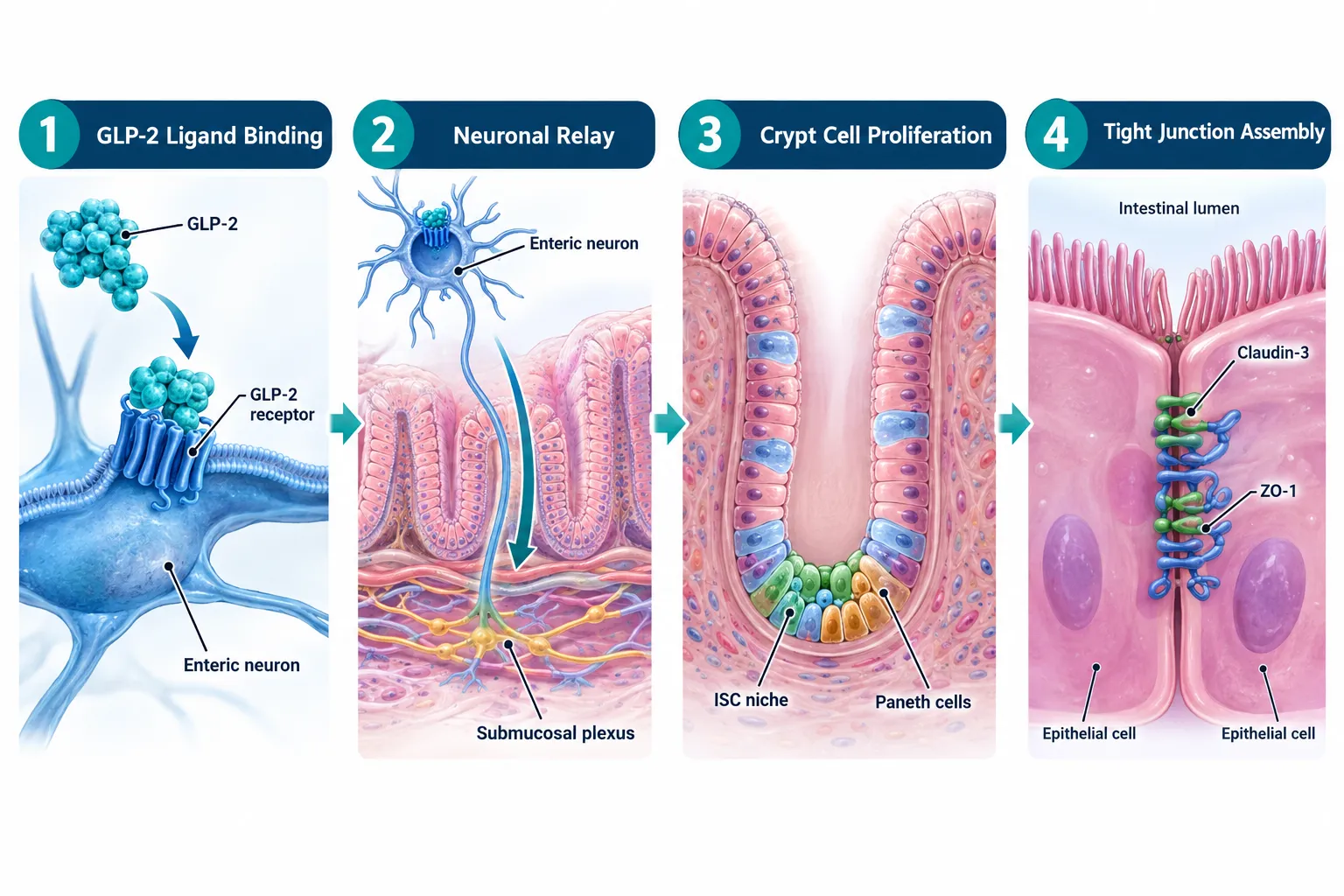
GLP-2 (glucagon-like peptide-2) is a 33-amino-acid hormone secreted by enteroendocrine L-cells in response to luminal nutrients. Its primary role is to stimulate intestinal growth, increase mucosal surface area, and reinforce epithelial barrier integrity. A critical detail that shapes every assay design: the GLP-2 receptor is expressed on enteric neurons and subepithelial myofibroblasts, not on enterocytes themselves. This means GLP-2 acts indirectly, triggering a neuronal relay that ultimately drives crypt cell proliferation and tight-junction assembly.

This neuroepithelial circuit has direct implications for assay selection. Simple monolayer cell cultures lacking a neuronal component will not fully recapitulate GLP-2 signaling. Researchers working on GLP-2-T and GLP2 Tirz concepts must either use co-culture systems or organoid platforms that preserve the cellular architecture of the crypt-villus axis.

Nomenclature clarity matters. The terms "GLP-2-T" and "GLP2 Tirz" circulate in research communities as shorthand for modified GLP-2 analogs or multi-agonist concepts that may incorporate tirzepatide-like dual-receptor targeting. Neither term corresponds to a single, fully characterized compound as of 2026. Before any assay begins, researchers should confirm peptide identity via mass spectrometry, HPLC purity analysis, and receptor-binding confirmation. Explore available GLP peptide research options to understand the range of characterized analogs on the market.


Designing Intestinal Barrier Assays for GLP-2-T and GLP2 Tirz Peptide Research
Designing Intestinal Barrier Assays for GLP-2-T and GLP2 Tirz Peptide Research

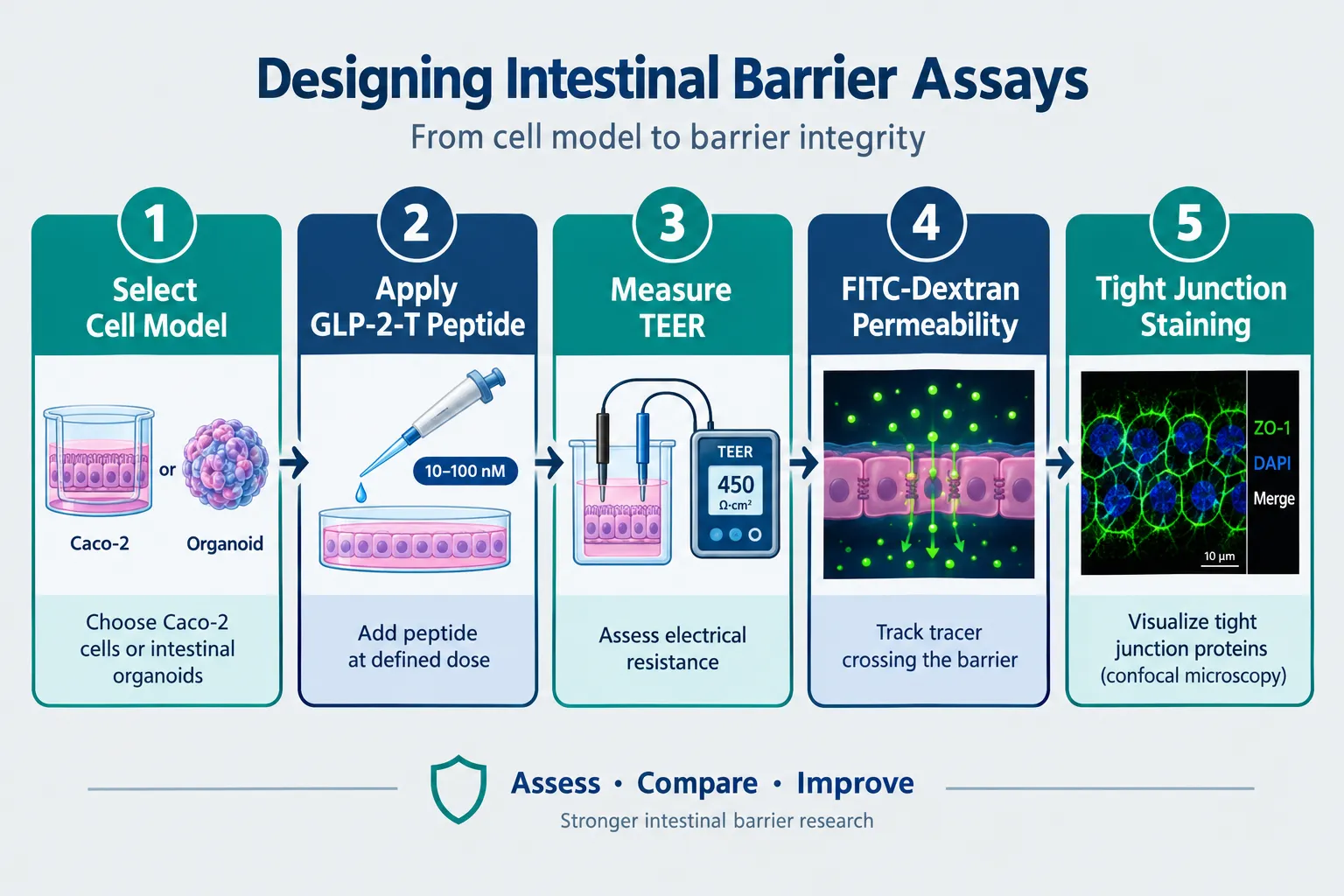
Barrier function assays form the quantitative backbone of GLP-2-T and GLP2 Tirz Peptide Research: How to Design Intestinal Barrier, Organoid, and Epithelial-Repair Assays programs. Two readouts dominate the literature:

Transepithelial Electrical Resistance (TEER)

TEER measures the ionic resistance across a cell monolayer grown on a permeable Transwell insert. Higher resistance values indicate a tighter, more intact barrier. For GLP-2 analog research:

  • Seed Caco-2 or T84 cells on 0.4-micron Transwell membranes
  • Allow 21 days for full differentiation and tight-junction maturation
  • Apply peptide at physiologically relevant concentrations (typically 1-100 nM)
  • Record TEER at 24, 48, and 72 hours post-treatment

Key point: A meaningful TEER increase after GLP-2-T treatment suggests tight-junction reinforcement, but must be paired with protein-level confirmation.

FITC-Dextran Permeability

This assay quantifies paracellular leakage by measuring how much fluorescently labeled dextran crosses the monolayer from apical to basolateral compartments. A reduction in FITC-dextran flux after peptide treatment confirms barrier-sealing activity.

Tight-Junction Protein Immunostaining

Immunofluorescence staining for ZO-1, claudin-3, and occludin provides mechanistic evidence. Disrupted tight junctions appear as fragmented or discontinuous staining patterns. Successful GLP-2 analog treatment should restore linear, continuous junction morphology.

Endpoint summary table:

Assay Readout Positive Result
TEER Ohms x cm2 Increased resistance
FITC-Dextran Fluorescence (ng/mL) Decreased flux
ZO-1 Immunostaining Confocal imaging Continuous junctions
NLRP3 Inflammasome Western blot / ELISA Reduced activation
LPS Translocation ELISA (basolateral) Reduced LPS signal

For researchers exploring related multi-agonist frameworks, reviewing GLP-3 peptide research compounds can help contextualize receptor-specificity differences when designing controls.


Organoid and Epithelial-Repair Assays in GLP-2-T and GLP2 Tirz Peptide Research
Organoid and Epithelial-Repair Assays in GLP-2-T and GLP2 Tirz Peptide Research

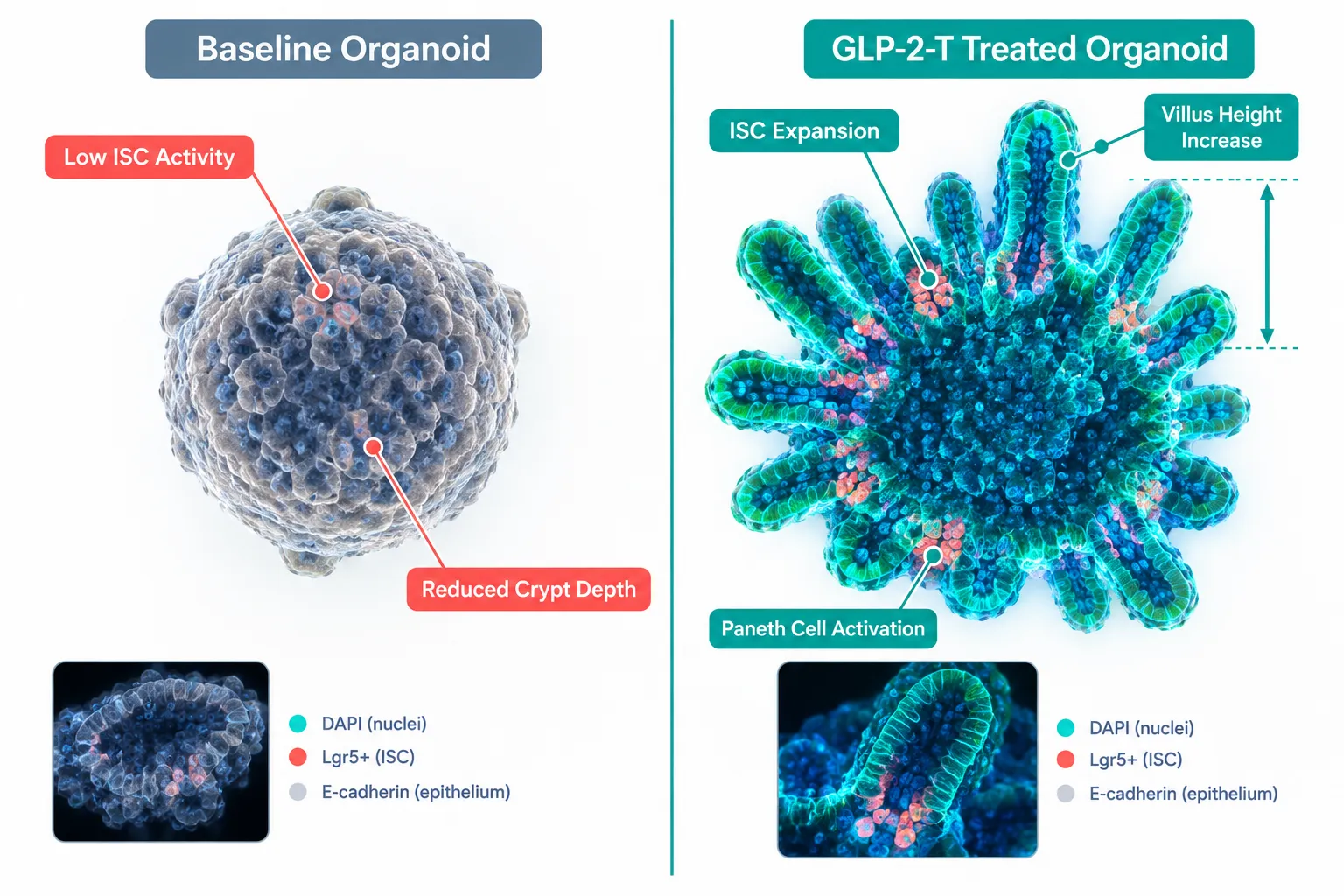
Organoid models represent the most physiologically faithful platform for GLP-2-T and GLP2 Tirz Peptide Research: How to Design Intestinal Barrier, Organoid, and Epithelial-Repair Assays. Intestinal organoids derived from crypts maintain ISC populations, Paneth cells, goblet cells, and enterocytes in a self-organizing three-dimensional structure.

Setting Up the Organoid Assay

  1. Isolate crypts from murine small intestine or human biopsy tissue using EDTA chelation
  2. Embed in Matrigel at 37°C and overlay with ENR medium (EGF, Noggin, R-spondin)
  3. Introduce peptide at day 3 post-seeding, once basal organoids are established
  4. Quantify growth by measuring organoid surface area, budding frequency, and villus-like domain length at 24-hour intervals

Key Epithelial-Repair Endpoints

  • ISC marker expression: Lgr5+ cell frequency by immunofluorescence or flow cytometry
  • Paneth cell density: Lysozyme staining as a proxy for niche-support capacity
  • Villus height and crypt depth: Morphometric analysis from confocal z-stacks
  • Proliferation index: Ki-67 staining in crypt-base columnar cells

GLP-2 analogs consistently increase organoid budding efficiency and villus domain length in preclinical models. Modified analogs with extended half-lives, relevant to the GLP-2-T concept, show amplified effects on crypt proliferation compared to native GLP-2, making organoid size and budding frequency sensitive discriminators between compound variants.

Researchers interested in complementary barrier-repair peptide tools may find value in reviewing SS-31 peptide research for mitochondrial-protection endpoints that can run alongside epithelial-repair assays. Similarly, cagrilinitide peptide research offers a relevant comparator for multi-agonist gut-axis studies.

Disease Model Applications

  • IBD models: LPS-challenged organoids or DSS-treated murine intestine provide a relevant inflammatory context for testing GLP-2-T barrier-rescue activity
  • Short bowel syndrome (SBS) surrogates: Remnant intestine organoids from partial resection models show blunted adaptation that GLP-2 analogs can rescue, a validated translational endpoint
  • GVHD models: Graft-versus-host disease involves severe epithelial damage; GLP-2 receptor agonism has shown protective effects in these systems, making crypt survival the primary endpoint

For those sourcing characterized analogs for these models, GLP-3R peptide options and Reta peptide research compounds represent structurally related tools worth including as comparators.


Conclusion

Rigorous GLP-2-T and GLP2 Tirz Peptide Research: How to Design Intestinal Barrier, Organoid, and Epithelial-Repair Assays programs rest on three pillars: verified peptide identity, mechanistically appropriate cell models, and multi-endpoint readout strategies. The following steps will strengthen any research program:

  1. Verify compound identity with mass spectrometry and HPLC before any biological assay
  2. Pair TEER with FITC-dextran and tight-junction immunostaining for a complete barrier profile
  3. Use organoid models when ISC proliferation and villus morphology are primary endpoints
  4. Include inflammatory challenge conditions (LPS, DSS) to stress-test barrier-repair claims
  5. Source research-grade peptides from suppliers with documented purity data, see guidance on evaluating purity for research-grade peptides for a practical framework

As multi-agonist concepts combining GLP-2 activity with tirzepatide-like GIP/GLP-1 receptor engagement continue to develop, the assay toolkit described here will serve as the foundation for evaluating any new analog claiming intestinal barrier or epithelial-repair activity.

Tags: epithelial repair, fitc-dextran permeability, glp-2-t peptide research, glp2 tirz, intestinal barrier assays, organoid research, teer assay, tight junction proteins
https://www.puretestedpeptides.com/wp-content/uploads/2026/10/glp-2-t-and-glp2-tirz-peptide-research-how-to-design-intestinal-barrier-organoid.webp 1024 1536 https://www.puretestedpeptides.com/wp-content/uploads/2026/01/buy-peptides-online.jpg 2026-10-01 13:03:562026-10-01 13:03:56GLP-2-T and GLP2 Tirz Peptide Research: How to Design Intestinal Barrier, Organoid, and Epithelial-Repair Assays
You might also like
Where to Buy Research-Grade GLP2-T and GLP2 Tirz Peptides: Navigating Naming Confusion, Certificates of Analysis, and Storage Where to Buy Research-Grade GLP2-T and GLP2 Tirz Peptides: Navigating Naming Confusion, Certificates of Analysis, and Storage
GLP-2 and GLP-2 Tirz Peptides: Intestinal Barrier Function and Research Applications GLP-2 and GLP-2 Tirz Peptides: Intestinal Barrier Function and Research Applications
GLP-2-T and GLP2 Tirz Peptide Research: Distinguishing Epithelial Repair From Changes in Motility and Intake GLP-2-T and GLP2 Tirz Peptide Research: Distinguishing Epithelial Repair From Changes in Motility and Intake
0 replies

Leave a Reply

Want to join the discussion?
Feel free to contribute!

Leave a Reply Cancel reply

Your email address will not be published. Required fields are marked *

×

Helpful Links

  • My account
  • Cart
  • Checkout
  • Refund and Returns Policy
  • Privacy Policy
  • SMS Privacy Policy
  • Login
  • My Account
  • Logout

USA Made Lab Tested Peptides

All products are sold for research, laboratory, or analytical purposes only, and are not for human consumption


Pure Tested Peptides is a chemical supplier. Pure Tested Peptides is not a compounding / chemical compounding facility as defined under 503A of the Federal Food, Drug, and Cosmetic act. Pure Tested Peptides is not an outsourcing facility as defined under 503B of the Federal Food, Drug, and Cosmetic act.

The statements made within this website have not been evaluated by the US Food and Drug Administration. The products we offer are not intended to diagnose, treat, cure or prevent any disease.

Human/Animal Consumption Prohibited. Laboratory/In-Vitro Experimental Use Only

Link to: Hemoglobin, LDL Cholesterol, and Blood Pressure in Peptide Studies: Building a Cardiometabolic Monitoring Panel Link to: Hemoglobin, LDL Cholesterol, and Blood Pressure in Peptide Studies: Building a Cardiometabolic Monitoring Panel Hemoglobin, LDL Cholesterol, and Blood Pressure in Peptide Studies: Building...Hemoglobin, LDL Cholesterol, and Blood Pressure in Peptide Studies: Building a Cardiometabolic Monitoring Panel Link to: BPC-157 and TB-500 in Tendon and Muscle Models: Separating Angiogenesis, Matrix Remodeling, and Inflammation Readouts Link to: BPC-157 and TB-500 in Tendon and Muscle Models: Separating Angiogenesis, Matrix Remodeling, and Inflammation Readouts BPC-157 and TB-500 in Tendon and Muscle Models: Separating Angiogenesis, Matrix Remodeling, and Inflammation ReadoutsBPC-157 and TB-500 in Tendon and Muscle Models: Separating Angiogenesis, Matrix...
Scroll to top Scroll to top Scroll to top