Call or Text 727-513-9780
  • Shopping Cart Shopping Cart
    0Shopping Cart
Pure Tested Peptides | America's most trusted Peptides for sale online
  • Peptides for sale
    • Oral Peptides for sale
      • Peptide Capsules for sale
      • BPC 157 Capsules 1000mcg
      • SLU-PP-332 Capsules | 1000 mcg
      • 5-Amino-1MQ 50mg Capsules
      • Tesofensine 500mcg
    • All Peptides for sale
    • Peptide Sprays
      • BPC 157 Nasal Spray Kit
      • BPC-157 TB500 Nasal Spray Kit
      • Semax Nasal Spray 10mg
      • Selank – Nasal Spray Kit – 10mg
      • Epithalon 50MG Nasal Spray Kit
      • Ipamorelin 10mg Nasal Spray
      • Klow Nasal Spray (BPC-157 + TB-500 + GHK-Cu + KPV) | 80mg
      • Hulk Nasal Spray Tesa / Ipa Blend 6/3 MG
      • Klow Nasal Spray
      • NAD + 500 mg Nasal Spray
      • PT-141 Nasal Spray Kit
    • GHRH Peptides
      • Ipa Peptides
      • CJC-1295 Peptides
        • CJC-1295 with DAC 5 mg
        • CJC-1295 without DAC 5 mg
        • CJC-1295 Ipa 10mg
      • Tesa Peptides
        • Tesa Peptide
        • Tesa 20 mg
    • GHK-Cu Peptides
      • All GHK-Cu Peptides
      • GHK-Cu 100mg
      • KLOW Peptide Blend – Buy KLOW blend online
    • BPC Peptides
      • All BPC Peptides
      • BPC-157
      • BPC-157 TB-500
      • BPC 157 capsules 1000mcg
    • SLU-PP-332 Peptides
      • All SLU-PP-332 Peptides
      • SLU-PP-332 5mg
    • GLP3 Peptides
    • PT-141 Peptides
      • PT-141 Peptides for sale
      • PT-141 10mg
      • PT-141 Nasal Spray
    • CAG Peptides
      • Lipo-C Peptide Blend
      • CAG 5mg
      • CAG 10mg
    • MOTS-C Peptides
      • MOTS-C Peptides for sale
      • MOTS-c peptide
      • MOTS-c 10mg *6 pack*
    • 5 Amino 1MQ Peptides
      • 5 Amino 1MQ Peptides for sale
      • 5-Amino-1MQ 50mg Capsules
      • 5-Amino-1MQ 5mg
    • Epithalon Peptides
      • Epithalon Peptides for sale
      • Epithalon 10mg
      • Epithalon 50mg
  • Shop
    • GLPs
      • 5-Amino-1MQ 50mg Capsules
      • 5-Amino-1MQ 5mg
      • L-Carnitine 500mg/ml
      • Tesofensine 500mcg
      • SLU-PP-332 5mg
      • MOTS-c 10mg *6 pack*
    • Epithalon & BPC Peptides
      • Epithalon 10mg
      • Epithalon 50mg
      • BPC-157
      • BPC 157 capsules 1000mcg
      • BPC-157 TB-500
      • BPC-157 TB500 Nasal Spray Kit
      • BPC 157 Nasal Spray Kit
    • BPC TB-500 & NAD+ Peptides
      • NAD+ 500 mg
      • KLOW Peptide Blend – Buy KLOW blend online
      • GLOW Peptide Blend
      • TB 500 5mg
      • BPC 157 capsules 1000mcg – Supplement
      • BPC 157 Nasal Spray Kit
      • BPC-157
      • BPC-157 TB500 Nasal Spray Kit
      • BPC-157 TB-500
      • BPC 157 capsules 1000mcg
    • LL-37 Peptide
      • LL-37 10 mg
    • MOTS-C & Selank
      • MOTS-c peptide
      • Selank 10mg
    • GHK Peptides
      • GHK-Cu 100mg
      • GLOW Peptide Blend
      • KLOW Peptide Blend – Buy KLOW blend online
  • COAs
  • Wholesale
    • Wholesale Peptides for sale
  • PTP FAQ
  • Affiliates
    • Selank Peptide: Advanced Pharmacological Mechanisms Underlying Its Anxiolytic and Nootropic Effects in Research
      • 5-Amino-1MQ Peptide: Detailed Mechanisms of NNMT Inhibition and Its Impact on Cellular Metabolism Research
        • MOTS-C Peptide: Unraveling Its Role in Mitochondrial Dynamics and Energy Metabolism Research
          • Epithalon Peptide and Telomerase Regulation: Investigating Its Impact on Cellular Senescence and Lifespan Research Models
            • GLP2-T vs GLP2 Tirz Peptide: Understanding the Naming, Mechanistic Nuances, and Research Implications for Gut Health
      • Peptides and Polypeptides in Modern Pharmacology: What Research on Metoprolol, Prednisone, and Amlodipine Reveals
        • Polypeptide Peptides vs NSAIDs: What Naproxen and Diclofenac Teach Tissue-Repair Researchers About BPC‑157 and TB‑500
          • Peptides and Polypeptides in Endocrine Pharmacology: How GLP-1, GLP-2, and GLP-3 Retatrutide Differ From Classic Drugs Like Prednisone and Amlodipine
          • 5‑Amino‑1MQ Peptide and NNMT Inhibition: How It Compares With Statins Like Atorvastatin in Adipose and Lipid Metabolism Research
      • Enclomiphene, Estrogen Receptor Signaling, and Luteinizing Phase Biology: What Hormone Researchers Should Measure
        • Mesenchymal Stem Cells, BPC‑157, and GHK‑Cu: How Tissue Repair Peptides Compare With Classic NSAIDs Like Naproxen in Injury Models
          • Peptide Calculator Use Cases Beyond Growth Hormone: Working Through GLP‑3 Retatrutide, MOTS‑c, and BPC‑157 Research Dosing
        • Polypeptide Peptides in Endocrine and Metabolic Pharmacology: Lessons From Amlodipine, Prednisone, and Metoprolol
        • Peptides Calculator for Advanced Blends: Worked Examples for Tesamorelin, CJC‑1295, and Ipamorelin Stacks
          • Peptides and Polypeptides in Human Physiology: How Molecular Size Shapes Research Applications
            • Selank Peptide: Advanced Pharmacological Mechanisms Underlying Its Anxiolytic and Nootropic Effects in Research
          • 5-Amino-1MQ Peptide: Detailed Mechanisms of NNMT Inhibition and Its Impact on Cellular Metabolism Research
            • MOTS-C Peptide: Unraveling Its Role in Mitochondrial Dynamics and Energy Metabolism Research
              • Epithalon Peptide and Telomerase Regulation: Investigating Its Impact on Cellular Senescence and Lifespan Research Models
                • GLP2-T vs GLP2 Tirz Peptide: Understanding the Naming, Mechanistic Nuances, and Research Implications for Gut Health
                  • Peptides and Polypeptides in Endocrine Pharmacology: How GLP-1, GLP-2, and GLP-3 Retatrutide Differ From Classic Drugs Like Prednisone and Amlodipine
                    • Polypeptide Peptides vs NSAIDs: What Naproxen and Diclofenac Teach Tissue-Repair Researchers About BPC‑157 and TB‑500
                      • Peptides and Polypeptides in Modern Pharmacology: What Research on Metoprolol, Prednisone, and Amlodipine Reveals
                        • 5‑Amino‑1MQ Peptide and NNMT Inhibition: How It Compares With Statins Like Atorvastatin in Adipose and Lipid Metabolism Research
                        • Enclomiphene, Estrogen Receptor Signaling, and Luteinizing Phase Biology: What Hormone Researchers Should Measure
                        • Mesenchymal Stem Cells, BPC‑157, and GHK‑Cu: How Tissue Repair Peptides Compare With Classic NSAIDs Like Naproxen in Injury Models
                        • Peptide Calculator Use Cases Beyond Growth Hormone: Working Through GLP‑3 Retatrutide, MOTS‑c, and BPC‑157 Research Dosing
                        • Polypeptide Peptides in Endocrine and Metabolic Pharmacology: Lessons From Amlodipine, Prednisone, and Metoprolol
                        • Peptides Calculator for Advanced Blends: Worked Examples for Tesamorelin, CJC‑1295, and Ipamorelin Stacks
                        • Peptides and Polypeptides in Human Physiology: How Molecular Size Shapes Research Applications
                        • Selank Peptide: Advanced Pharmacological Mechanisms Underlying Its Anxiolytic and Nootropic Effects in Research
                        • MOTS-C Peptide: Unraveling Its Role in Mitochondrial Dynamics and Energy Metabolism Research
                        • Peptides and Polypeptides in Modern Pharmacology: What Research on Metoprolol, Prednisone, and Amlodipine Reveals
                        • Peptides and Polypeptides in Endocrine Pharmacology: How GLP-1, GLP-2, and GLP-3 Retatrutide Differ From Classic Drugs Like Prednisone and Amlodipine
                        • 5-Amino-1MQ Peptide: Detailed Mechanisms of NNMT Inhibition and Its Impact on Cellular Metabolism Research
                        • Mesenchymal Stem Cells, BPC‑157, and GHK‑Cu: How Tissue Repair Peptides Compare With Classic NSAIDs Like Naproxen in Injury Models
                        • Peptide Calculator Use Cases Beyond Growth Hormone: Working Through GLP‑3 Retatrutide, MOTS‑c, and BPC‑157 Research Dosing
                        • GLP2-T vs GLP2 Tirz Peptide: Understanding the Naming, Mechanistic Nuances, and Research Implications for Gut Health
                        • Polypeptide Peptides in Endocrine and Metabolic Pharmacology: Lessons From Amlodipine, Prednisone, and Metoprolol
                        • Polypeptide Peptides vs NSAIDs: What Naproxen and Diclofenac Teach Tissue-Repair Researchers About BPC‑157 and TB‑500
                        • Peptides and Polypeptides in Human Physiology: How Molecular Size Shapes Research Applications
                        • Peptides Calculator for Advanced Blends: Worked Examples for Tesamorelin, CJC‑1295, and Ipamorelin Stacks
                        • 5‑Amino‑1MQ Peptide and NNMT Inhibition: How It Compares With Statins Like Atorvastatin in Adipose and Lipid Metabolism Research
                        • Enclomiphene, Estrogen Receptor Signaling, and Luteinizing Phase Biology: What Hormone Researchers Should Measure
                        • Epithalon Peptide and Telomerase Regulation: Investigating Its Impact on Cellular Senescence and Lifespan Research Models
                        • Best research protocol Klow blend
                        • best time to take BPC-157
                        • best time to take DSIP (Delta Sleep Inducing Peptide)
                        • best time to take CJC-1295
                        • best time to take AOD-9604
                        • best time to take Follistatin 344
                        • best time to take Ipamorelin
                        • best time to take MK-677 (Ibutamoren)
                        • best time to take Ligandrol (LGD-4033) — research compound
                        • best time to take Ostarine (MK-2866) — research compound
                        • best time to take GHK-CU
                        • best time to take TB-500
                        • best time to take MOTS-c
                        • best time to take Semax
                        • best time to take RAD-140 (Testolone) — research compound
                        • best time to take Thymosin Alpha-1
                        • best time to take PEG-MGF
                        • Biolife Plasma, Octapharma Plasma, and Research Peptides: How Plasma Donation Labs Differ From Peptide Suppliers
                        • best time to take YK-11 — research compound
                        • best time to take PT-141 (Bremelanotide)
                        • Best research protocol Klow blend
                        • 5-Amino-1MQ and MOTS-C Synergy: Metabolic Signaling, Mitochondria, and Research Design
                        • BPC-157 and TB-500: Investigating Their Combined Effects on Angiogenesis and Cellular Migration in Tissue Repair Models
                        • BPC-157 Peptide: Gut Barrier Function, Inflammation, and Tissue-Recovery Research
                        • 5‑Amino‑1MQ and MOTS‑c Synergy in Metabolic Research: Designing NNMT and Mitochondrial Biogenesis Stacks
                        • CJC-1295 with DAC vs. Without DAC: Half-Life, Release Kinetics, and Research Implications
                        • CJC‑1295 with DAC vs. Without DAC: Expanding on Half‑Life Differences Using Tesamorelin and Ipamorelin Blend Case Studies
                        • Collagen Biology and Copper‑Binding Peptides: How GHK‑Cu, Glow Blend, and Klow Blend Interact with Skin and Connective Tissue
                        • Collagen Biology and Regenerative Peptides: How GHK‑Cu, Glow Blend, and Klow Blend Affect Extracellular Matrix Research
                    • DNA, Telomeres, and Longevity Peptides: Positioning Epithalon and MOTS‑c in Genetic Aging Research
                      • Enclomiphene Citrate: serm Mechanism, Testosterone Research, and Stack Compatibility
                        • Enclomiphene vs Enclomiphene Citrate: Formulation, Bioavailability, and Research Distinctions
                        • Epithalon Peptide Research: Telomerase Activation, Aging, and Pineal Gland Function
                        • Estrogen Receptor Signaling and Enclomiphene: How Selective Modulators Compare with Classic Polypeptide Hormones
                        • GHK-Cu Peptide: Advanced Mechanisms in Extracellular Matrix Remodeling and Wound Healing Research
                        • GHK-Cu Peptide: Collagen Synthesis, Wound Repair, and Skin-Barrier Research Models
                        • GLP-1 vs GLP-3 vs GLP-2: Peptide Classification and Research Applications
                        • GLP-2 Peptide Research Guide: Gut Barrier Function, Nutrient Absorption, and Intestinal Recovery Models
                        • GLP-3 Retatrutide vs. GLP-1 Drugs: What Triple-Agonist Biology Changes in Research Models
                        • Ipamorelin and Tesamorelin Combination: Synergistic GH Secretagogue Research and Dosing Protocols
                        • GLP2 Tirz Peptide: What It Is, Why the Name Exists, and How Researchers Should Interpret It
                        • Klow Blend Peptide Nasal Spray: What the Formulation Is Trying to Do in Cognitive Research
                        • Mitochondria, NNMT Inhibition, and Peptide Modulators: Where MOTS‑c and 5‑Amino‑1MQ Fit in Cellular Energy Research
                        • MOTS-c Peptide: Mitochondrial Function, Energy Metabolism, and What Researchers Measure
                        • MOTS-c vs. 5-Amino-1MQ: Which Metabolic Research Questions Each Compound Actually Answers
                        • Nasal Spray Peptides: Bioavailability, Administration, and Semax/Selank Research Applications
                        • PT-141 Peptide Research: Mechanism of Action and Melanocortin Receptor Signaling
                        • Retatrutide for Research: Mechanism, Structure, and GLP-1/GLP-3 Dual Action
                        • Retatrutide for Obesity and Type 2 Diabetes: What the Latest Trial Data Suggest
                        • Tesofensine Peptide Research: Mechanism, Appetite Suppression, and Neuropeptide Y Pathways
  • Contact
    • Contact Customer Service
    • Text Customer Support
  • About US
  • Shop all peptides
  • Affiliate Program
    • Affiliate Signup
  • Login / Register Login / Register Page Link Login / Register Page Link
  • Click to open the search input field Click to open the search input field Search
  • Menu Menu
PT-141 Peptide vs Sildenafil: Choosing Receptor, Vascular, and Behavioral Readouts

PT-141 Peptide vs Sildenafil: Choosing Receptor, Vascular, and Behavioral Readouts

October 18, 2026/0 Comments/in Uncategorized/by

Roughly 30% of men who use PDE5 inhibitors report inadequate responses, a figure that has quietly driven researchers toward a fundamentally different class of compounds. The comparison of PT-141 Peptide vs Sildenafil: Choosing Receptor, Vascular, and Behavioral Readouts is not simply a question of which drug works better. It is a question of which assay, which endpoint, and which biological pathway a given study is actually designed to measure.

Key Takeaways

  • PT-141 (bremelanotide) acts centrally on melanocortin receptors (MC3R/MC4R); sildenafil acts peripherally on the PDE5 enzyme in vascular smooth muscle.
  • Sildenafil depends heavily on intact endothelial nitric oxide signaling; PT-141 is relatively independent of this pathway, making it useful in vascular-compromised models.
  • Behavioral readouts, desire, distress, and satisfying sexual events, are primary endpoints for PT-141 research, especially in female models.
  • RigiScan studies provide objective erectile rigidity data that can isolate the vascular contribution of each compound or their combination.
  • Emerging research positions PT-141 as an adjunct for PDE5 non-responders, with combination studies showing additive effects and specific blood-pressure monitoring requirements.

Receptor-Level Contrast: Melanocortin Agonism vs PDE5 Inhibition
Receptor-Level Contrast: Melanocortin Agonism vs PDE5 Inhibition

Understanding the PT-141 Peptide vs Sildenafil: Choosing Receptor, Vascular, and Behavioral Readouts debate starts at the receptor. These two compounds do not compete on the same biological terrain.

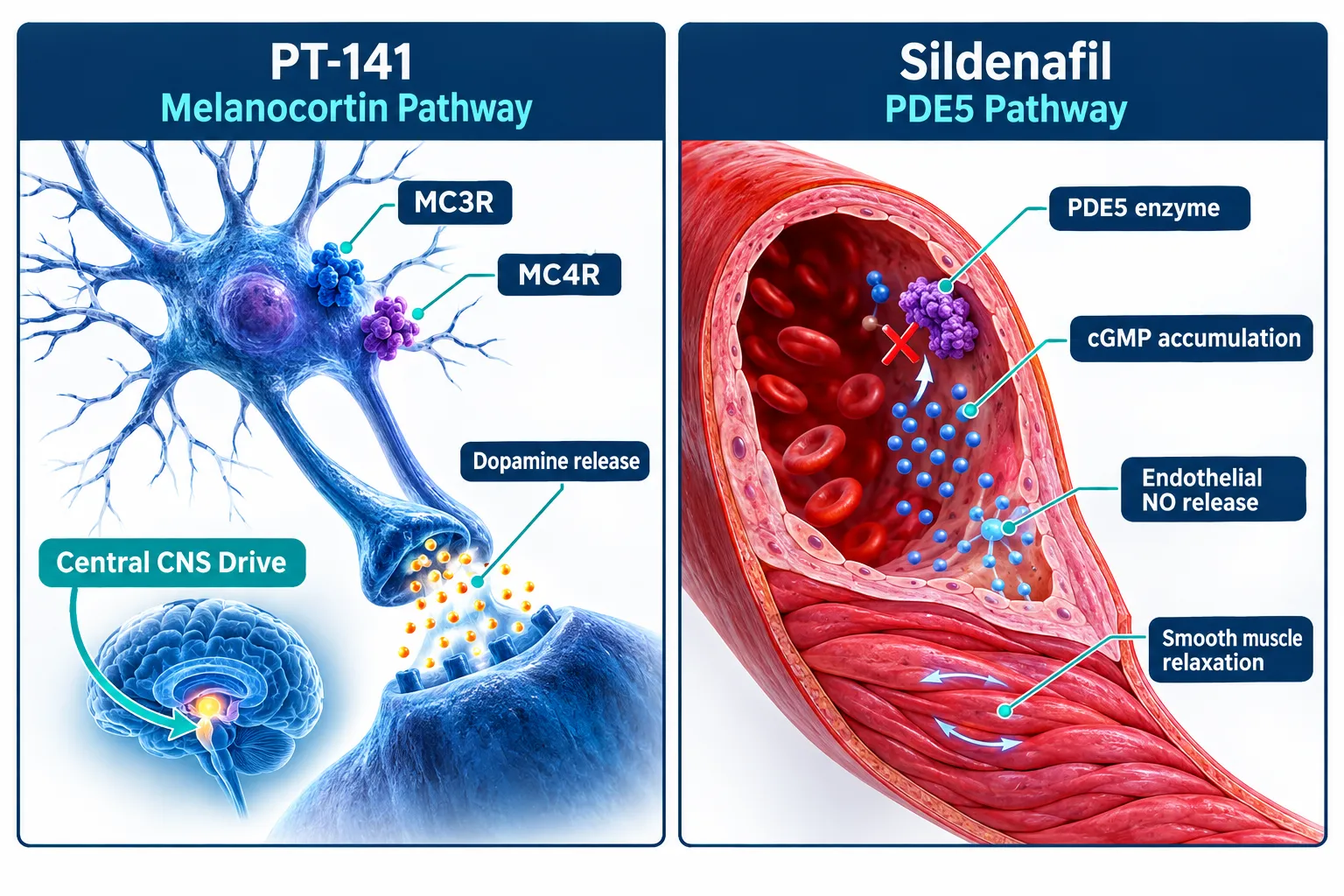
PT-141 is a cyclic heptapeptide analog of alpha-melanocyte-stimulating hormone. It binds melanocortin receptors, primarily MC3R and MC4R, located in the central nervous system. Activation of these receptors triggers dopaminergic and oxytocinergic signaling in the hypothalamus, generating a neurally mediated drive toward sexual behavior. This is a top-down mechanism: the brain initiates the signal.

Sildenafil, by contrast, is a phosphodiesterase type 5 (PDE5) inhibitor. It works peripherally by blocking the enzyme that degrades cyclic guanosine monophosphate (cGMP) in vascular smooth muscle. The result is prolonged smooth muscle relaxation and increased blood flow to erectile tissue. This is a bottom-up mechanism: the vasculature responds to an existing neural signal.

Feature PT-141 (Bremelanotide) Sildenafil
Primary target MC3R / MC4R (CNS) PDE5 (vascular)
Mechanism direction Central to peripheral Peripheral only
NO-pathway dependency Low High
Onset (research models) 45-60 minutes 30-60 minutes
Primary readout type Behavioral / desire Vascular / rigidity

For researchers selecting assays, this distinction is critical. A study using only penile blood flow as its endpoint will undervalue PT-141's contribution. A study using only desire questionnaires will undervalue sildenafil's.

Researchers exploring other centrally and peripherally acting peptides, such as those reviewing MT-2 research peptide data, will recognize that melanocortin agonism produces a distinct pharmacological fingerprint worth isolating in study design.


Vascular Readouts and Nitric Oxide Controls

Vascular Readouts and Nitric Oxide Controls

The most important confounding variable when comparing these two compounds in vascular assays is endothelial nitric oxide (NO) availability. Sildenafil amplifies the cGMP signal that NO produces. If endothelial NO synthesis is impaired, as it is in diabetes, hypertension, or aging models, sildenafil's efficacy drops substantially. PT-141 bypasses this bottleneck entirely.

This makes NO-pathway integrity a required control variable in any head-to-head vascular study. Researchers should document:

  • Baseline endothelial function (flow-mediated dilation or equivalent)
  • Nitric oxide synthase (NOS) activity in the model
  • Presence of vascular comorbidities that would suppress cGMP signaling

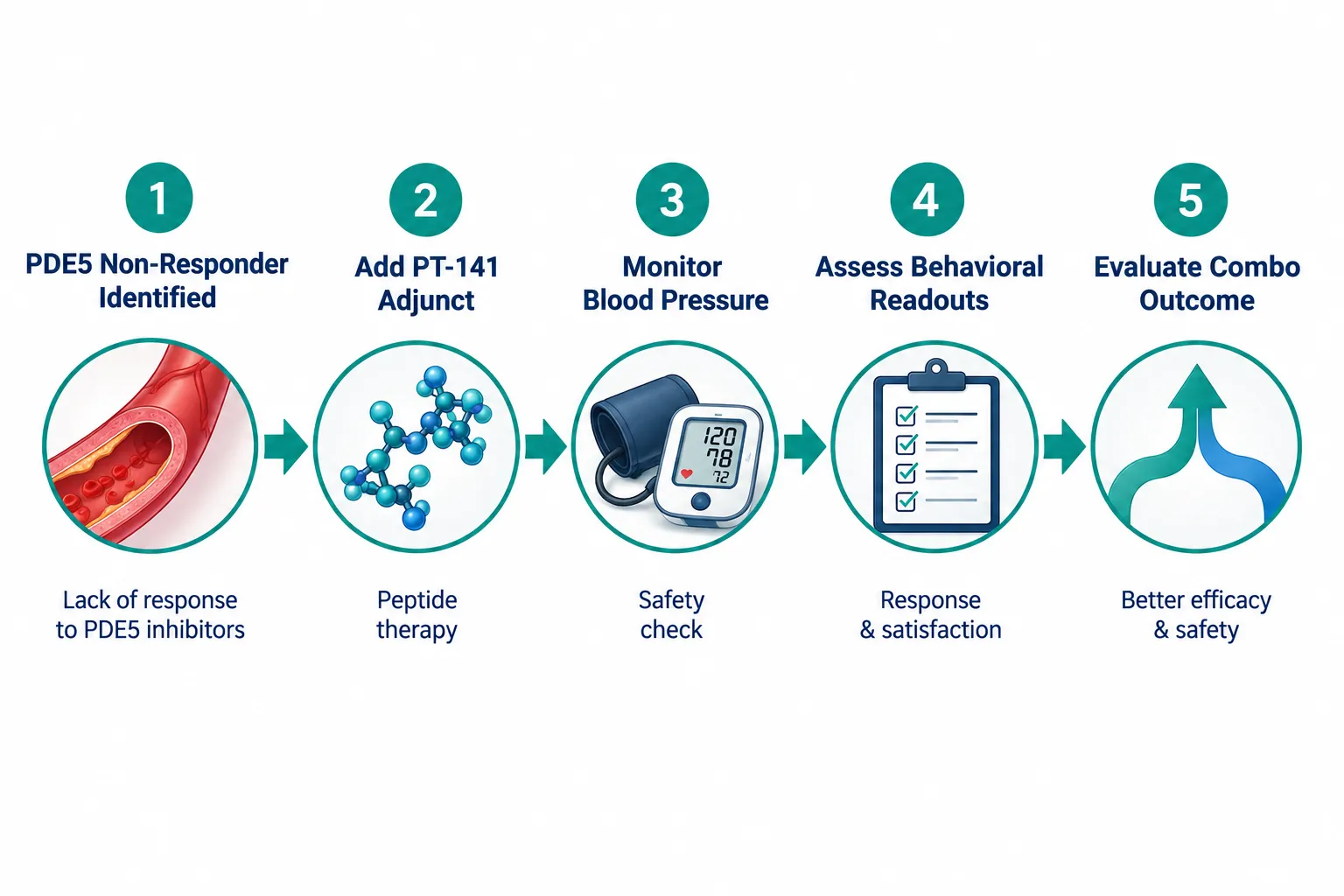
RigiScan studies, which measure tip and base rigidity continuously during sleep or stimulation, have been used to generate objective erectile rigidity data for both compounds. These studies show that PT-141 alone produces measurable rigidity increases, and that combining it with a PDE5 inhibitor in non-responder models produces additive effects beyond either agent alone. The combination appears to engage both the central drive and the peripheral vascular amplification simultaneously.

"The additive effect observed in combination models suggests that central melanocortin activation and peripheral PDE5 inhibition operate on non-overlapping rate-limiting steps."

For researchers already working with mitochondria-targeted peptides such as SS31 peptide, which addresses oxidative stress in endothelial cells, the intersection of vascular health and peptide pharmacology is a relevant parallel. Endothelial protection may restore the NO-pathway sensitivity that sildenafil requires, while PT-141 remains active regardless.

Safety note on combination use: Blood pressure monitoring is non-negotiable in combination protocols. PT-141 produces transient blood pressure increases (primarily through melanocortin-mediated vasoconstriction), while sildenafil produces decreases. The net hemodynamic effect is partially offsetting but unpredictable across individuals, requiring careful titration and monitoring in any research protocol.


Behavioral Readouts: Desire, Distress, and Satisfying Sexual Events
Behavioral Readouts: Desire, Distress, and Satisfying Sexual Events

The PT-141 Peptide vs Sildenafil: Choosing Receptor, Vascular, and Behavioral Readouts comparison becomes most distinct when female models are included. Sildenafil has shown limited efficacy in female sexual dysfunction research, largely because genital blood flow is a less reliable proxy for subjective desire in women than in men.

PT-141's FDA approval for hypoactive sexual desire disorder (HSDD) in premenopausal women was built on three validated behavioral endpoints:

  1. Desire score, measured via the Female Sexual Function Index (FSFI) desire subscale
  2. Distress score, measured via the Female Sexual Distress Scale-Revised (FSDS-R)
  3. Satisfying sexual events (SSEs), a diary-based count of encounters rated as satisfying by the participant

These endpoints capture the neurally mediated, motivational dimension of sexual function that vascular assays miss entirely. For researchers designing studies that include female subjects or that target desire rather than performance, these behavioral readouts are primary, not secondary, outcomes.

In male models, SSEs and desire scores remain useful adjunct readouts alongside RigiScan data. A 2026 subcutaneous bremelanotide safety study in men confirmed cardiovascular tolerability at standard doses while reinforcing that behavioral self-report metrics add meaningful signal beyond objective rigidity measurements alone.

Researchers building comprehensive protocols may also find value in reviewing how other peptide classes are evaluated for behavioral and metabolic endpoints, such as those covered in resources on GLP-1 peptide research concepts and sourcing, where endpoint selection similarly determines what a study can and cannot conclude.

For researchers sourcing compounds for these protocols, documentation standards matter as much as purity. The principles outlined in the BPC-157 core peptides documentation first research guide apply broadly to any peptide research program requiring traceable, reproducible results.


Conclusion

Selecting between PT-141 and sildenafil, or designing a study that uses both, requires clarity about what is actually being measured. Vascular assays with NO-pathway controls favor sildenafil as the primary variable. Behavioral assays using desire, distress, and SSE endpoints favor PT-141. Combination protocols targeting PDE5 non-responders need both objective rigidity data and behavioral self-report, with mandatory hemodynamic monitoring.

Actionable next steps for researchers:

  • Define the primary endpoint before selecting the compound, receptor-level, vascular, or behavioral.
  • Include endothelial NO-pathway status as a baseline covariate in any vascular study.
  • Use validated scales (FSFI, FSDS-R, SSE diary) alongside RigiScan data in combination studies.
  • Monitor blood pressure at all timepoints in PT-141 plus PDE5 inhibitor protocols.
  • Review the emerging 2026 male safety data before finalizing dosing parameters for subcutaneous bremelanotide protocols.

The field is moving toward recognizing PT-141 not as a replacement for sildenafil but as a mechanistically distinct adjunct, one that fills the gap where vascular amplification alone is insufficient.

Tags: behavioral readouts, bremelanotide, melanocortin receptor, pde5 inhibitor, pt-141 peptide, sexual dysfunction research, sildenafil, vascular assays
https://www.puretestedpeptides.com/wp-content/uploads/2026/10/pt-141-peptide-vs-sildenafil-choosing-receptor-vascular-and-behavioral-readouts.webp 1024 1536 https://www.puretestedpeptides.com/wp-content/uploads/2026/01/buy-peptides-online.jpg 2026-10-18 13:03:372026-10-18 13:03:37PT-141 Peptide vs Sildenafil: Choosing Receptor, Vascular, and Behavioral Readouts
You might also like
Best Research-Use Peptides for Sexual Function Studies: Comparing PT-141, Sildenafil, and GLP-Class Metabolic Adjuncts Best Research-Use Peptides for Sexual Function Studies: Comparing PT-141, Sildenafil, and GLP-Class Metabolic Adjuncts
PT-141 Peptide Research: Mechanism, Applications, and Comparison to Traditional Approaches PT-141 Peptide Research: Mechanism, Applications, and Comparison to Traditional Approaches
PT-141 Research Applications Beyond Mechanism: What Studies Measure in Sexual Function Models PT-141 Research Applications Beyond Mechanism: What Studies Measure in Sexual Function Models
PT-141 Peptide Research Safety Guide: Dosing, Timing, and Tolerability Questions Labs Ask PT-141 Peptide Research Safety Guide: Dosing, Timing, and Tolerability Questions Labs Ask
PT-141 Peptide: Mechanism of Action, Research Applications, and Protocol Questions PT-141 Peptide: Mechanism of Action, Research Applications, and Protocol Questions
Tadalafil vs. PT-141 (Bremelanotide): Central Melanocortin Receptor Signaling vs. Peripheral Nitric Oxide Pathways Tadalafil vs. PT-141 (Bremelanotide): Central Melanocortin Receptor Signaling vs. Peripheral Nitric Oxide Pathways
PT-141 Peptide: Investigating Its Melanocortin Receptor Agonism and Applications in Sexual Function Research PT-141 Peptide: Investigating Its Melanocortin Receptor Agonism and Applications in Sexual Function Research
Best Research Applications for PT-141: What Makes It Different From Other Melanocortin Peptides? Best Research Applications for PT-141: What Makes It Different From Other Melanocortin Peptides?
0 replies

Leave a Reply

Want to join the discussion?
Feel free to contribute!

Leave a Reply Cancel reply

Your email address will not be published. Required fields are marked *

×

Helpful Links

  • My account
  • Cart
  • Checkout
  • Refund and Returns Policy
  • Privacy Policy
  • SMS Privacy Policy
  • Login
  • My Account
  • Logout

USA Made Lab Tested Peptides

All products are sold for research, laboratory, or analytical purposes only, and are not for human consumption


Pure Tested Peptides is a chemical supplier. Pure Tested Peptides is not a compounding / chemical compounding facility as defined under 503A of the Federal Food, Drug, and Cosmetic act. Pure Tested Peptides is not an outsourcing facility as defined under 503B of the Federal Food, Drug, and Cosmetic act.

The statements made within this website have not been evaluated by the US Food and Drug Administration. The products we offer are not intended to diagnose, treat, cure or prevent any disease.

Human/Animal Consumption Prohibited. Laboratory/In-Vitro Experimental Use Only

Link to: GHK-Cu, Glow Blend, and Klow Blend: Choosing Skin-Model Endpoints for Matrix Remodeling Research Link to: GHK-Cu, Glow Blend, and Klow Blend: Choosing Skin-Model Endpoints for Matrix Remodeling Research GHK-Cu, Glow Blend, and Klow Blend: Choosing Skin-Model Endpoints for Matrix...GHK-Cu, Glow Blend, and Klow Blend: Choosing Skin-Model Endpoints for Matrix Remodeling Research Link to: BPC-157 and TB-500 Combination Research: How to Test Additivity Without Assuming Synergy Link to: BPC-157 and TB-500 Combination Research: How to Test Additivity Without Assuming Synergy BPC-157 and TB-500 Combination Research: How to Test Additivity Without Assuming SynergyBPC-157 and TB-500 Combination Research: How to Test Additivity Without Assuming...
Scroll to top Scroll to top Scroll to top