

PT-141 Peptide Research: Melanocortin Receptor Mapping for Separating Sexual Motivation, Vascular Function, and Behavior
Only one FDA-approved drug targets the brain directly to treat low sexual desire in women, and its mechanism of action is still officially listed as "unknown." That compound is bremelanotide (PT-141), and the gap between its clinical approval and incomplete mechanistic understanding makes it one of the most scientifically interesting peptides in active research today. PT-141 peptide research: melanocortin receptor mapping for separating sexual motivation, vascular function, and behavior sits at the intersection of neuroscience, endocrinology, and behavioral pharmacology, and the 2026 literature is beginning to draw clearer lines between what this peptide does and how it does it.
Key Takeaways
- PT-141 (bremelanotide) acts primarily on MC4R receptors in the hypothalamus and limbic system to drive dopamine release and increase sexual desire, not through direct vascular mechanisms.
- Animal studies show PT-141 increases sexual motivation and proceptive behaviors but does not enhance sexual reward or hedonic pleasure via the classic VTA-nucleus accumbens circuit.
- The conceptual separation between desire (central), behavior (central and peripheral), and vascular response (peripheral) is critical for interpreting PT-141 research versus PDE5 inhibitor research.
- Phase 3 RECONNECT trial data in women with HSDD support improvements in desire and distress, but effect sizes are modest and the mechanism remains partially understood.
- Male indications and combination regimens with PDE5 inhibitors are speculative as of 2026, with no completed Phase 3 trial in men available.
Melanocortin Receptor Biology: The Foundation of PT-141 Peptide Research
Understanding PT-141 requires a working map of the melanocortin system. Five receptor subtypes (MC1R through MC5R) are distributed across multiple tissues, but the two most relevant to sexual function research are MC3R and MC4R.
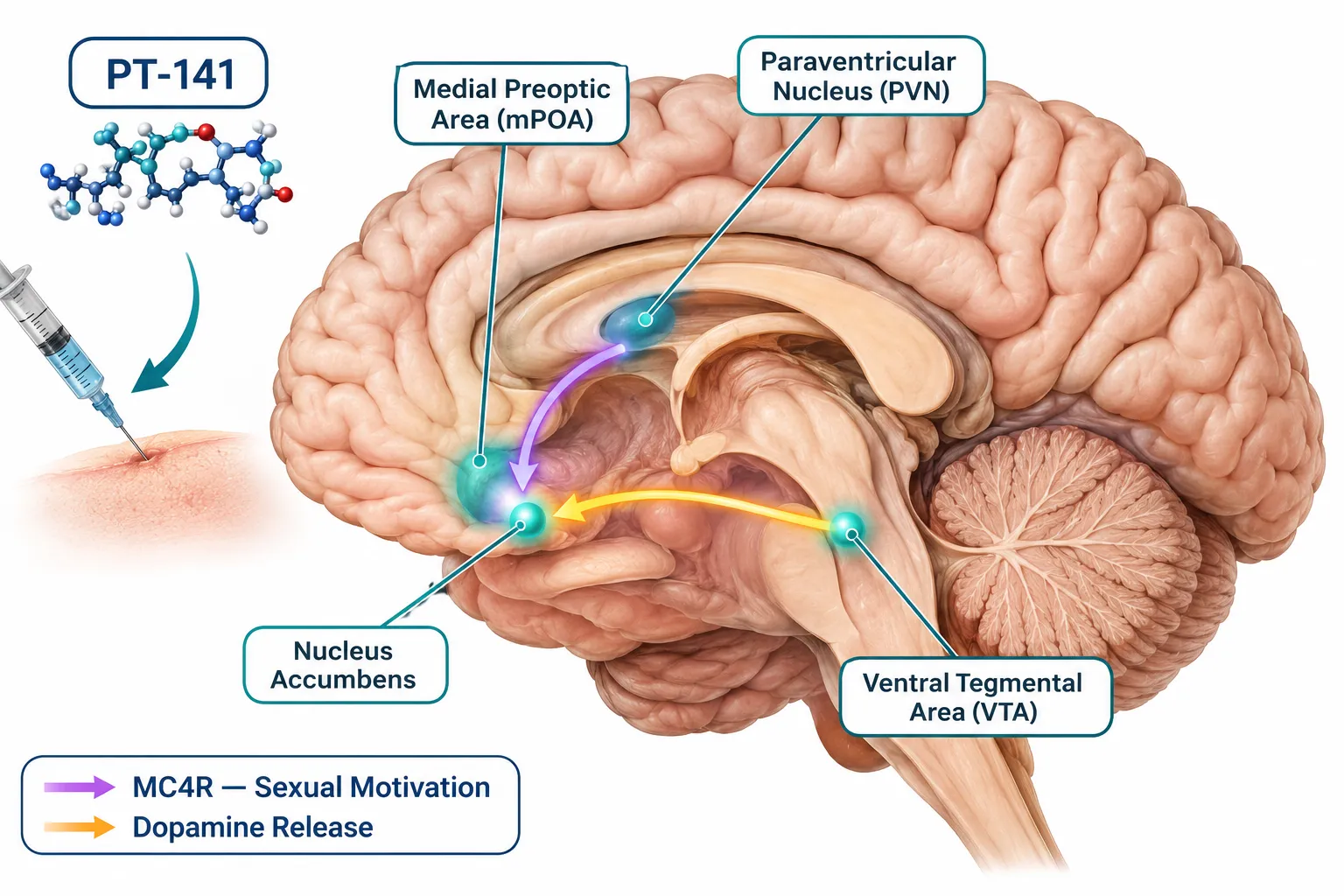
MC4R is expressed densely in the medial preoptic area (mPOA) and paraventricular nucleus (PVN) of the hypothalamus. Presynaptic MC4Rs in the mPOA appear to be key drivers of dopamine release and, in animal models, are directly linked to increased sexual motivation. MC3R, meanwhile, is highly expressed in dopamine neurons of the ventral tegmental area (VTA), as confirmed in 2025 mapping work using female Syrian hamsters.
This receptor geography matters enormously. It places PT-141's activity squarely in the brain's motivational and arousal circuits, not in peripheral vascular tissue. That distinction is the cornerstone of ongoing PT-141 peptide research: melanocortin receptor mapping for separating sexual motivation, vascular function, and behavior.
Key receptor locations:
| Receptor | Primary Brain Region | Linked Function |
|---|---|---|
| MC4R | mPOA, PVN | Sexual motivation, erection, lordosis |
| MC3R | VTA | Dopaminergic arousal pathways |
| MC1R | Peripheral/CNS | Pigmentation, secondary CNS roles |
Because MC4R populations in hypothalamic nuclei act as integrators of motivational state, their activation does not simply flip a behavioral switch. They coordinate a network of downstream signals, dopamine, oxytocin, and autonomic tone, that together produce the experience of sexual desire and the behavioral outputs that follow.
Separating Sexual Motivation, Vascular Function, and Behavioral Endpoints
One of the most important distinctions in PT-141 peptide research: melanocortin receptor mapping for separating sexual motivation, vascular function, and behavior is the difference between three concepts that clinical literature often conflates.
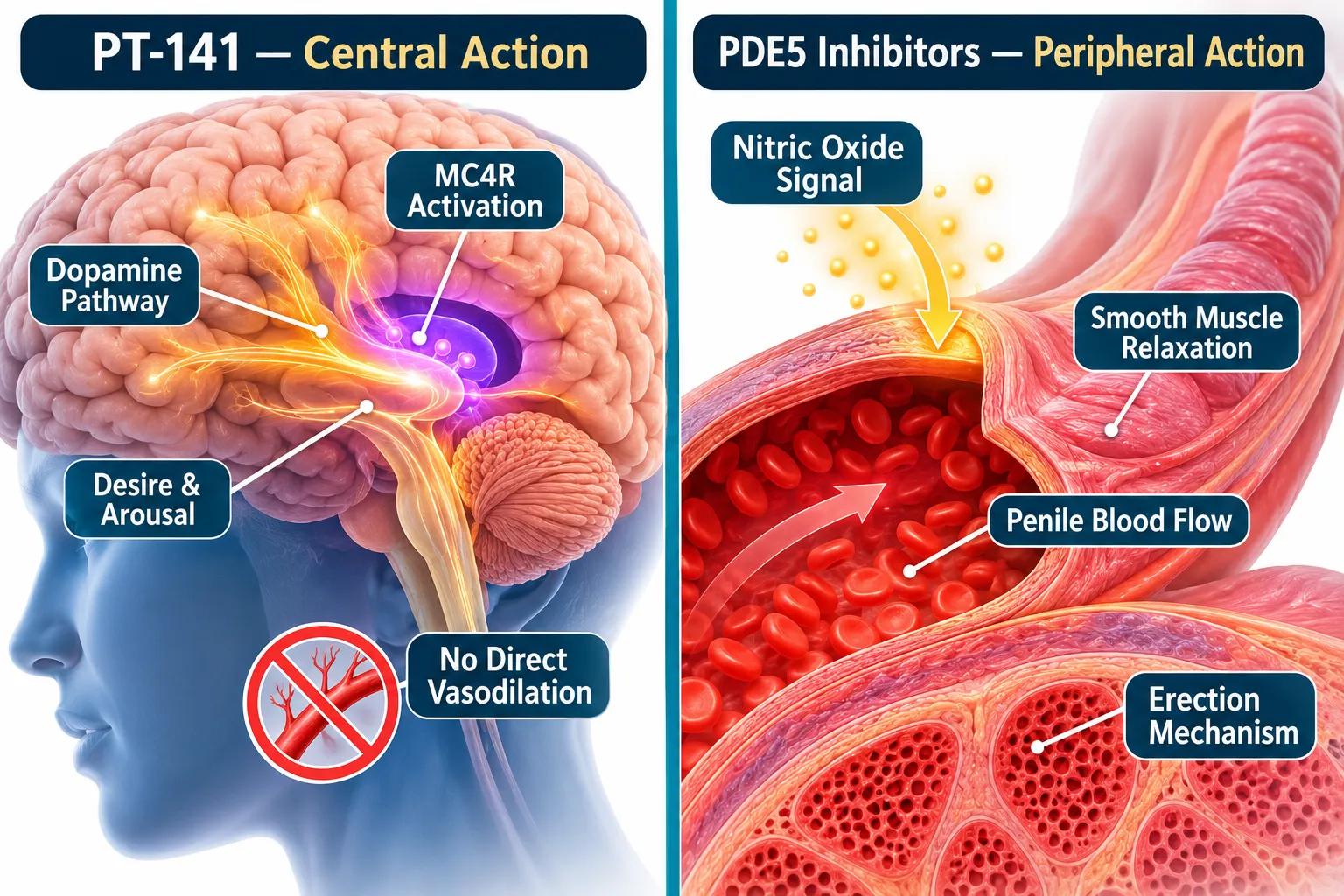
Sexual motivation refers to the internal drive to seek sexual activity. It is centrally mediated, generated in hypothalamic and limbic circuits, and measurable through proceptive behaviors in animal models and subjective desire scales in humans.
Vascular function refers to genital blood flow: penile engorgement in males, vaginal lubrication and clitoral swelling in females. This is primarily governed by nitric oxide signaling and smooth muscle relaxation, the exact pathway that PDE5 inhibitors (sildenafil, tadalafil) exploit.
Behavior occupies a middle ground: it depends on both motivation and physical capacity, but also on learned patterns, partner dynamics, and mood.
PT-141 acts on the first category, not the second. It does not dilate blood vessels the way a PDE5 inhibitor does. This is why researchers in 2026 consistently describe bremelanotide as an "on-demand" CNS agent that improves desire and arousal, while framing PDE5 drugs as peripheral vascular agents. The two drug classes are not interchangeable, they target opposite ends of the sexual response chain.
"PT-141 targets dopaminergic motivational circuits rather than peripheral vascular tissue, a distinction with direct implications for how researchers design endpoints and interpret outcomes."
Critically, even within the central domain, motivation and reward are separable. The 2025 Syrian hamster study found that while bremelanotide increased measures of proceptive behavior, it did not enhance conditioned place preference for sexual activity. In plain terms: the animals were more motivated to seek sex, but they did not find the experience more pleasurable or rewarding. This dissociation between motivation and hedonic reward has major implications for study design and for understanding which patient populations are most likely to benefit.
Clinical Evidence, Sex Differences, and the Confound of PDE5 Inhibitors
The most rigorous clinical dataset in PT-141 peptide research comes from the paired Phase 3 RECONNECT trials, which enrolled 1,267 premenopausal women with hypoactive sexual desire disorder (HSDD). Using 1.75 mg subcutaneous injections at least 45 minutes before sexual activity, bremelanotide produced statistically significant improvements in desire scores and personal distress compared to placebo. Effect sizes were modest, roughly a 1 to 2-point improvement on standard desire scales for many participants, but consistent across the two trials.
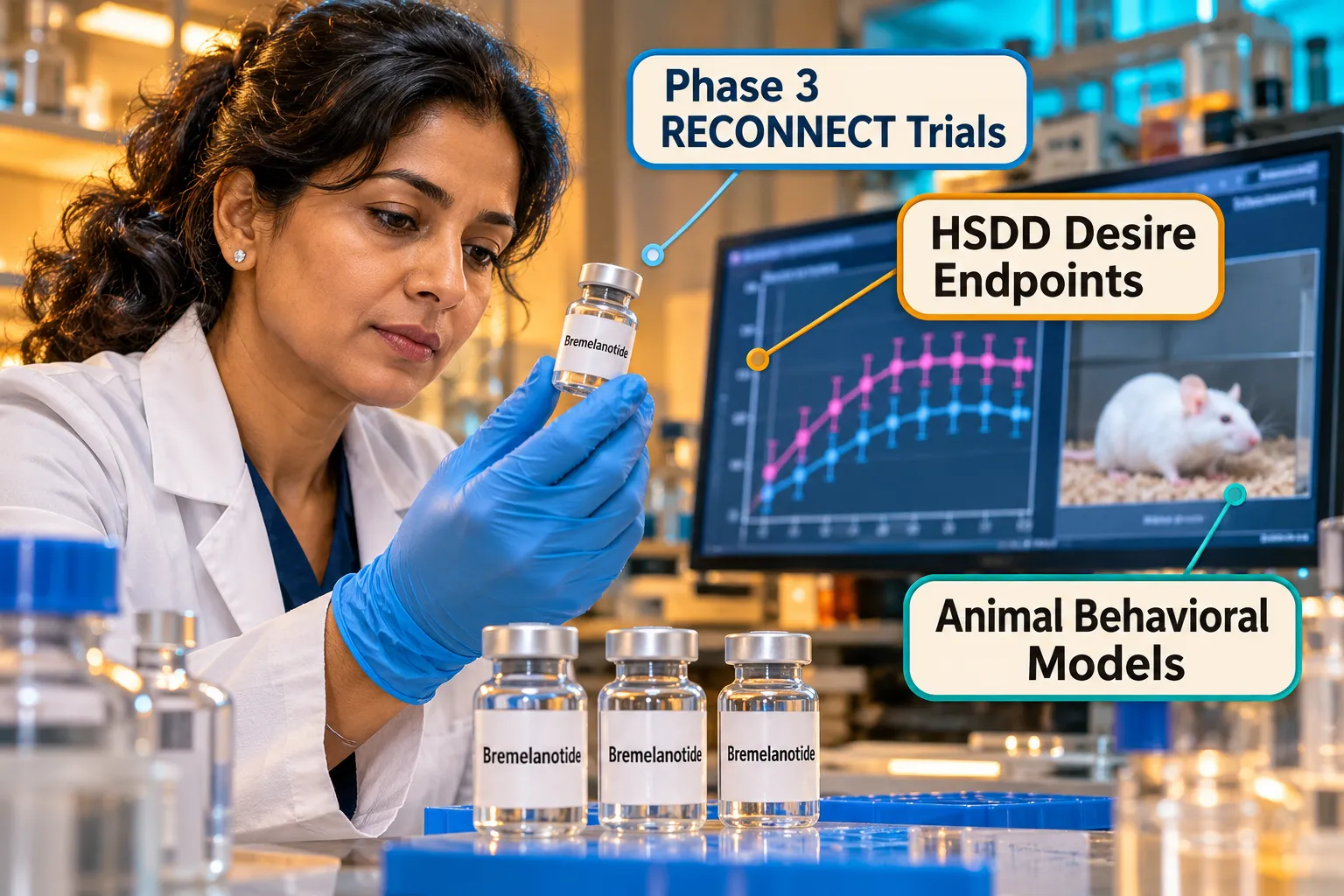
The RECONNECT results are framed as evidence of improved central motivation rather than vascular or purely behavioral change, reinforcing the conceptual framework built from the receptor mapping data.
Tolerability is generally favorable. The most common adverse events include:
- Nausea (most frequent)
- Flushing
- Headache
- Transient blood pressure changes
No major cardiovascular events emerged in trial populations, and the absence of a direct vasodilatory mechanism aligns with the observed safety profile. Researchers exploring resources on mitochondrial and vascular peptide compounds, such as SS-31 mitochondrial research themes, will recognize that separating central from peripheral mechanisms is a recurring methodological challenge across peptide research programs.
In men, the data picture is far less complete. Small exploratory studies suggest bremelanotide modulates dopaminergic pathways involved in desire and arousal in male participants, positioning it as a potential option for men with low desire rather than primary erectile dysfunction. Palatin Technologies announced an open-label study combining bremelanotide with a PDE5 inhibitor in June 2024 and has discussed plans for a Phase 2/3 male trial, but no results are available as of late 2026.
This combination design is scientifically logical: PT-141 addresses central desire while a PDE5 inhibitor addresses peripheral vascular capacity. However, it introduces a significant confound for researchers trying to isolate PT-141's specific contributions to behavioral outcomes. Researchers sourcing lab tested peptides for preclinical work should account for this interaction when designing behavioral battery protocols.
Sex differences in receptor expression and dopaminergic signaling further complicate cross-sex extrapolation. The Syrian hamster receptor mapping work focused on females, and the majority of human clinical data comes from women. Male-specific receptor localization studies remain a gap in the 2026 literature, and the MT2 research chemical literature, covering the closely related melanocortin agonist melanotan II, provides some complementary data on male arousal responses but cannot substitute for bremelanotide-specific trials.
Researchers consulting resources on peptide acquisition can explore options through where to buy peptides for verified sourcing guidance relevant to preclinical study setups.
Conclusion
PT-141 peptide research: melanocortin receptor mapping for separating sexual motivation, vascular function, and behavior has made meaningful progress in 2026, but critical gaps remain. The current consensus identifies MC4R in the hypothalamic mPOA and PVN as the primary therapeutic target, with MC3R in the VTA contributing to arousal pathways. Activation of these receptors drives dopamine release and increases sexual motivation without directly altering vascular function, a mechanistic profile that is fundamentally different from PDE5 inhibitors.
Actionable next steps for researchers and clinicians:
- Design studies with behavioral endpoints that distinguish motivation, hedonic reward, and vascular response as separate dependent variables.
- Account for PDE5 inhibitor co-administration as a potential confound in any male-cohort or combination-therapy trial design.
- Prioritize receptor-selective ligands (MC3R vs. MC4R) in preclinical work to sharpen mechanistic attribution.
- Integrate functional neuroimaging where feasible to link receptor activation to human motivational states rather than relying solely on self-report desire scales.
- Treat male indication data as preliminary until completed Phase 3 evidence is available.
The field's most important near-term task is closing the gap between approved clinical use and mechanistic understanding, a goal that requires tighter receptor mapping, better-controlled behavioral protocols, and rigorous separation of central from peripheral endpoints.


Leave a Reply
Want to join the discussion?Feel free to contribute!