

{"cover":"Professional landscape format (1536×1024) hero image with bold text overlay: 'PT-141 Peptide Research: Melanocortin Receptor Targeting vs. Sildenafil & Tadalafil' in extra large 72pt white bold sans-serif font with deep shadow effect, centered upper-third placement. Background features a split-composition scientific illustration: left side shows a stylized human brain with glowing neural pathways in electric blue and violet representing melanocortin receptor activation, right side shows molecular pill structures in soft amber representing PDE5 inhibitors. Dark navy-to-black gradient overlay ensures text legibility. Color palette: deep navy, electric blue, white, gold accents. Magazine cover aesthetic, editorial quality, high contrast.","content":["Landscape format (1536×1024) detailed scientific illustration showing a cross-section of the human hypothalamus with highlighted MC3R and MC4R receptor sites glowing in violet-blue, with dopamine release pathways rendered as luminous yellow-orange streams flowing outward. A labeled molecular diagram of the PT-141 cyclic heptapeptide structure floats to the right. Background is deep charcoal with subtle grid lines. Style: medical textbook meets modern editorial infographic, clean white labels, high contrast, no people.","Landscape format (1536×1024) side-by-side comparison infographic showing two distinct biological pathways: left panel labeled 'PT-141 Central Pathway' with a brain icon and neural activation arrows in blue-purple; right panel labeled 'PDE5 Inhibitors Peripheral Pathway' with vascular anatomy and blood flow arrows in warm red-orange. Center dividing column shows overlapping use-case icons. Clean white background with bold section headers, data callout boxes, and a subtle gradient border. Scientific editorial style, no people, high contrast color coding.","Landscape format (1536×1024) clinical research aesthetic showing a sterile laboratory bench with a subcutaneous injection syringe, a vial labeled 'Bremelanotide', and printed Phase III clinical trial data charts in the background showing upward-trending efficacy scores. Soft cool-white lighting with blue-teal accent tones. A translucent overlay panel displays a simplified pharmacokinetics curve graph with a 2.7-hour half-life annotation. Style: pharmaceutical research photography meets editorial infographic, professional and clean, no identifiable faces."]
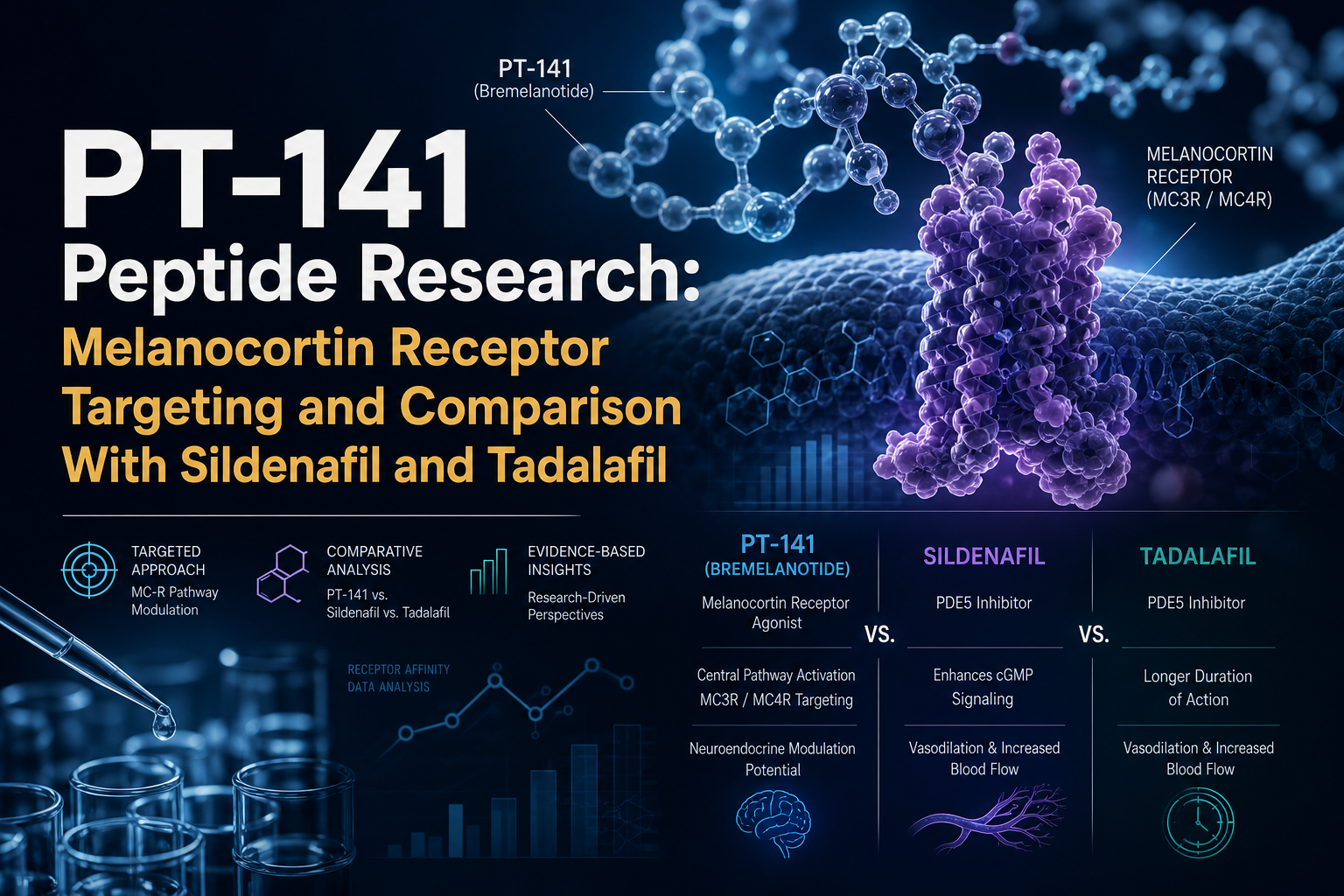
Most sexual dysfunction treatments work from the body upward. PT-141 works from the brain down — and that single difference changes nearly everything about how it performs in preclinical and clinical research models.
PT-141 Peptide Research: Melanocortin Receptor Targeting and Comparison With Sildenafil and Tadalafil sits at the center of a growing conversation in pharmacology about whether central nervous system pathways can outperform peripheral vascular mechanisms in specific patient populations. As 2026 research continues to expand, understanding this distinction is essential for anyone studying peptide-based interventions.
Key Takeaways
- PT-141 (bremelanotide) targets melanocortin receptors MC3R and MC4R in the brain, not vascular tissue
- Sildenafil and tadalafil act peripherally by inhibiting PDE5 enzymes to increase genital blood flow
- PT-141 received FDA approval in 2019 for hypoactive sexual desire disorder (HSDD) in premenopausal women
- Preclinical and clinical data show PT-141 can produce responses in subjects who do not respond to PDE5 inhibitors
- The two drug classes are mechanistically complementary, not simply interchangeable
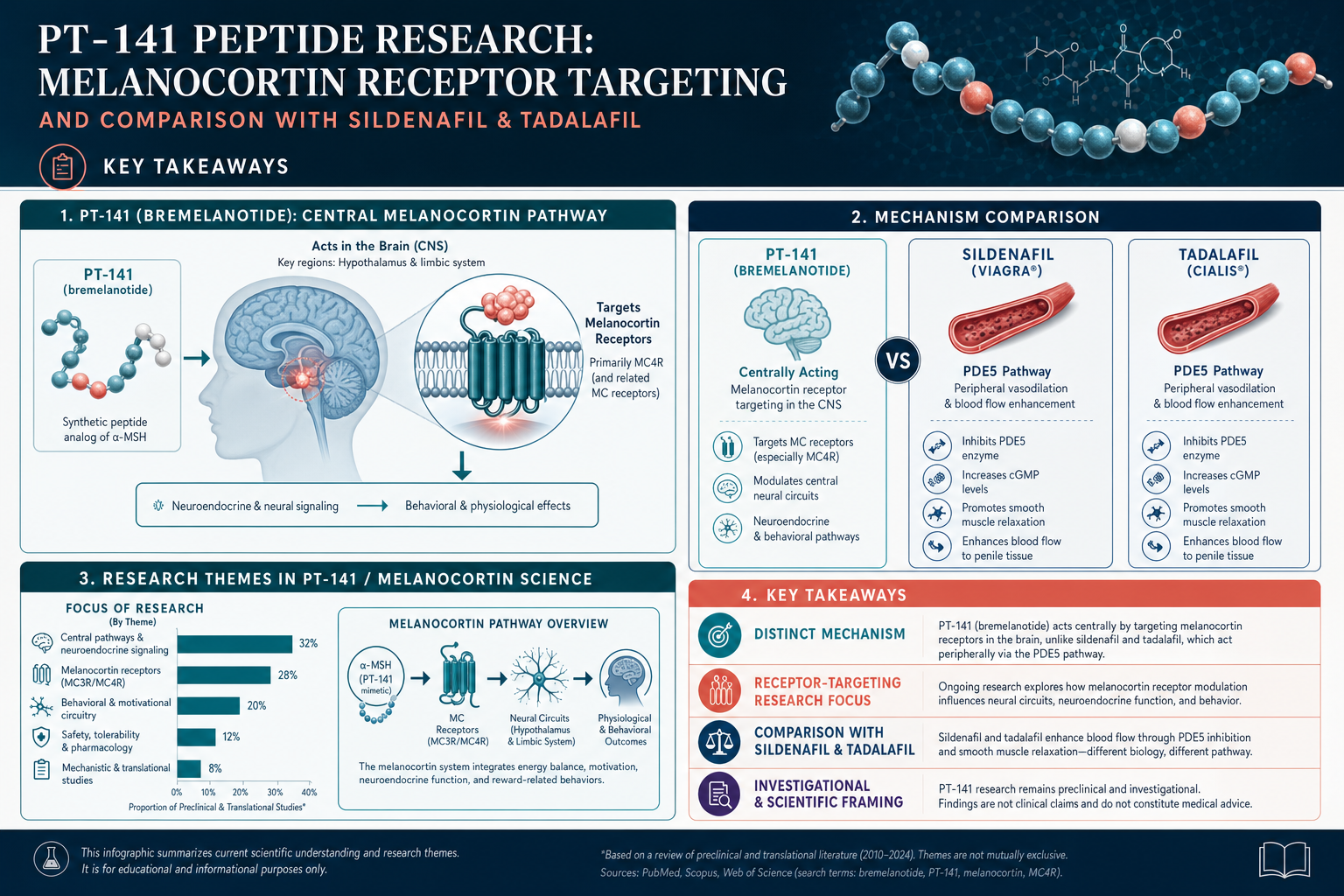
How PT-141 Targets Melanocortin Receptors
PT-141 is a synthetic cyclic heptapeptide derived from Melanotan II, which was originally studied for skin-tanning properties. During early Melanotan II trials, researchers observed spontaneous erections in male subjects — an unexpected finding that redirected research toward sexual function.
The compound acts as a melanocortin receptor agonist, binding primarily to MC3R and MC4R within the hypothalamus. Activation of MC4R in particular triggers the release of dopamine and related neurochemicals tied to sexual motivation and reward. This is a fundamentally different entry point than any approved PDE5 inhibitor.
"PT-141 does not enhance blood flow directly. It activates the neural circuitry that initiates desire and arousal at the source."
Because the mechanism is central rather than peripheral, PT-141 does not depend on sexual stimulation to produce a measurable response in research models. This makes it especially relevant for studying desire disorders rather than purely mechanical erectile function.
For researchers exploring other peptides with CNS-adjacent or systemic signaling roles, the simple peptides research overview provides useful foundational context.
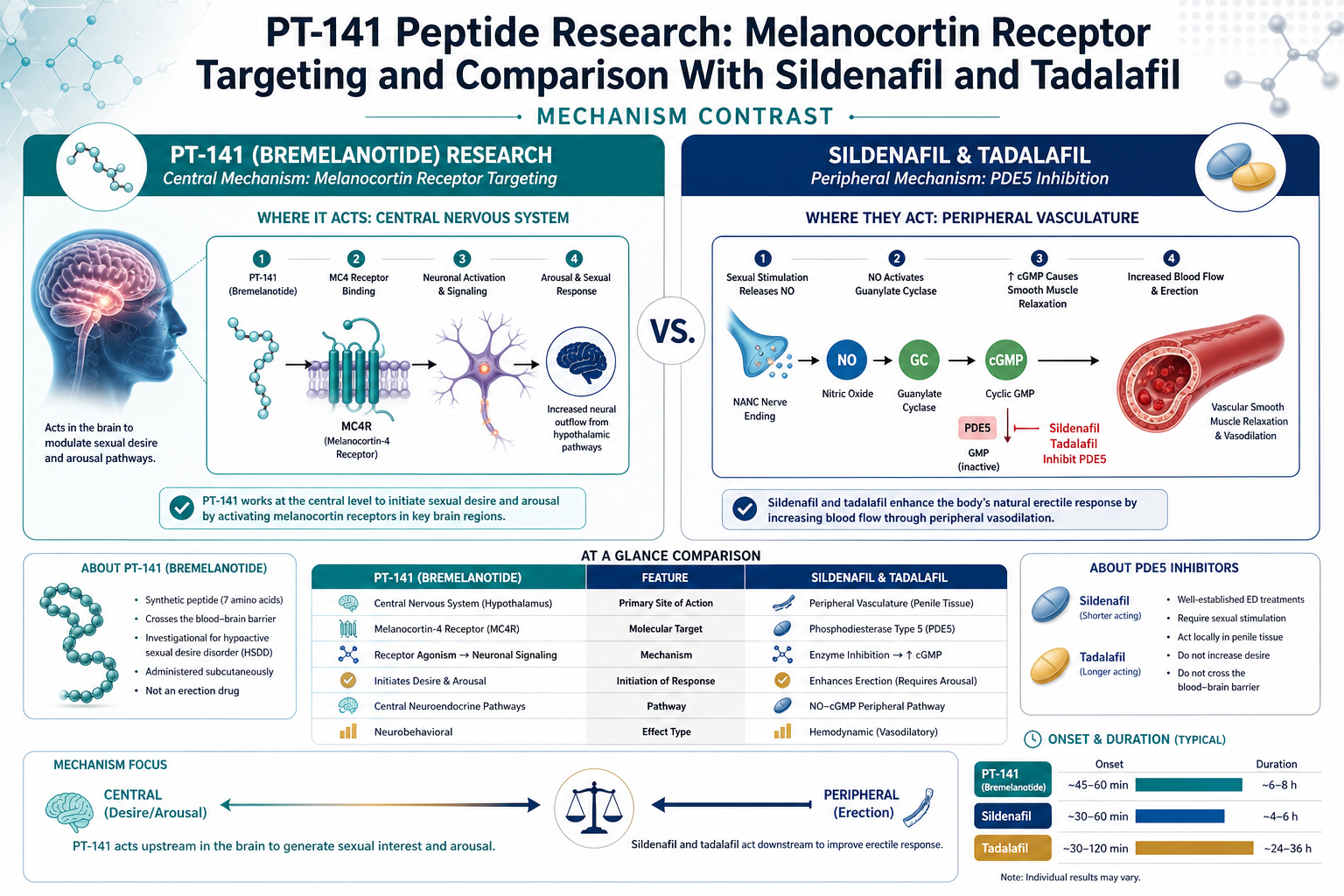
PT-141 Peptide Research: Melanocortin Receptor Targeting and Comparison With Sildenafil and Tadalafil — Mechanism Contrast
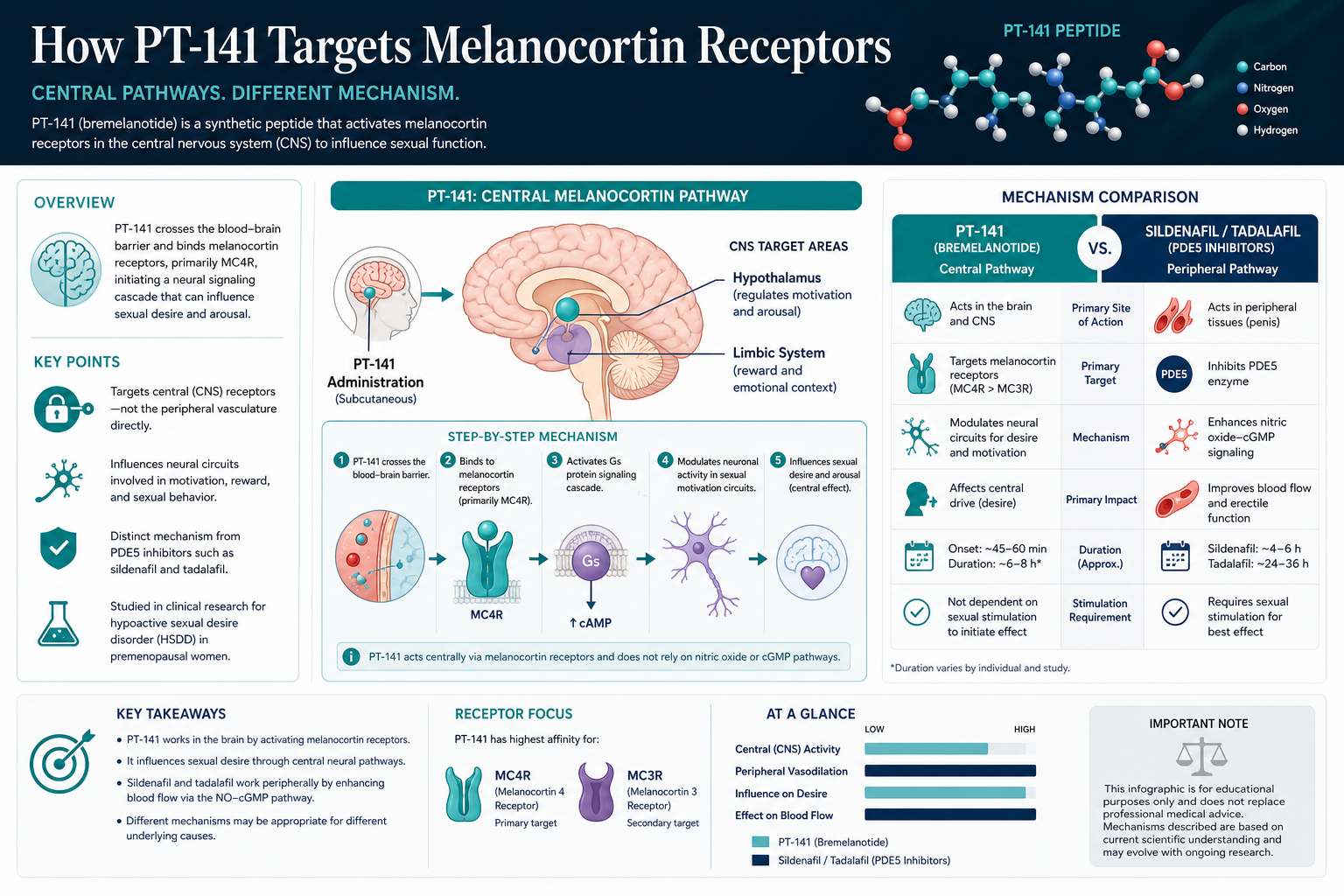
The table below clarifies the core mechanistic differences between PT-141 and the two dominant PDE5 inhibitors used in sexual dysfunction research.
| Feature | PT-141 (Bremelanotide) | Sildenafil / Tadalafil |
|---|---|---|
| Primary target | MC3R, MC4R (CNS) | PDE5 enzyme (peripheral) |
| Site of action | Hypothalamus / brain | Penile and vascular tissue |
| Requires stimulation | No | Yes |
| Approved indication | HSDD in women (FDA 2019) | Erectile dysfunction |
| Route of administration | Subcutaneous injection | Oral tablet |
| Half-life | ~2.7 hours | 3–5 hrs (sildenafil); ~17.5 hrs (tadalafil) |
Sildenafil and tadalafil block the PDE5 enzyme, which prevents the breakdown of cyclic GMP and sustains smooth muscle relaxation in genital vasculature. The result is increased blood flow — but only when arousal signals are already present. Without that upstream neural signal, PDE5 inhibitors have limited effect.
PT-141 bypasses this dependency entirely. By activating dopaminergic reward pathways, it generates the arousal signal itself. This is why studies have documented erectile responses in men with erectile dysfunction who showed inadequate responses to sildenafil — the two compounds are addressing different steps in the same process.
Researchers interested in how other peptides modulate systemic pathways may also find value in reviewing BPC-157 core documentation and the TB-500 and BPC-157 regeneration research.
Clinical Evidence and Safety Profile
The Phase III RECONNECT trials provided the most rigorous clinical data for PT-141 Peptide Research: Melanocortin Receptor Targeting and Comparison With Sildenafil and Tadalafil in female populations. Results showed statistically significant improvements in sexual desire scores and meaningful reductions in distress associated with low desire among premenopausal women with HSDD. This led to FDA approval of bremelanotide (Vyleesi) in June 2019.
In male-focused research, a double-blind, placebo-controlled study published in 2004 evaluated intranasal PT-141 in healthy males and those with mild-to-moderate erectile dysfunction. The study demonstrated significant erectile responses, supporting further investigation into its use for male sexual dysfunction — even though no male-specific FDA approval has followed.
Key safety findings across trials:
- No significant hemodynamic changes observed
- Generally well-tolerated across study populations
- Most common adverse effects: nausea, flushing, and injection-site reactions
- No severe cardiovascular events reported
PT-141 is administered via subcutaneous injection approximately 45 minutes before anticipated sexual activity. Its effects persist beyond the plasma half-life of 2.7 hours, suggesting receptor-level activity that outlasts circulating peptide concentration.
For those researching peptides with hormonal or metabolic signaling relevance, tesa peptide benefits and GLP-1 peptide research concepts offer comparative mechanistic reading. Researchers sourcing verified compounds can also explore PT-141 peptide for sale through quality-tested suppliers.
Conclusion
PT-141 Peptide Research: Melanocortin Receptor Targeting and Comparison With Sildenafil and Tadalafil reveals a clear and actionable insight: these drug classes do not compete — they address different nodes in the sexual response cascade. PDE5 inhibitors optimize the vascular response once arousal exists. PT-141 generates the arousal signal at the hypothalamic level through MC4R activation and dopamine release.
Actionable next steps for researchers in 2026:
- Review the RECONNECT Phase III trial data to understand female HSDD endpoints and how they differ from male erectile dysfunction models
- Examine studies where PT-141 produced responses in PDE5 inhibitor non-responders to map the mechanistic gap
- Consider the broader implications of central melanocortin pathway modulation for conditions beyond sexual dysfunction
- Source research-grade PT-141 from verified, tested suppliers to ensure compound integrity in experimental models
The central-versus-peripheral distinction is not a minor pharmacological footnote. It is the defining variable that explains why outcomes diverge — and why both classes remain relevant in the evolving landscape of sexual health research.
Leave a Reply
Want to join the discussion?Feel free to contribute!