Call or Text 727-513-9780
  • Shopping Cart Shopping Cart
    0Shopping Cart
Pure Tested Peptides | America's most trusted Peptides for sale online
  • Peptides for sale
    • Oral Peptides for sale
      • Peptide Capsules for sale
      • BPC 157 Capsules 1000mcg
      • SLU-PP-332 Capsules | 1000 mcg
      • 5-Amino-1MQ 50mg Capsules
      • Tesofensine 500mcg
    • All Peptides for sale
    • Peptide Sprays
      • BPC 157 Nasal Spray Kit
      • BPC-157 TB500 Nasal Spray Kit
      • Semax Nasal Spray 10mg
      • Selank – Nasal Spray Kit – 10mg
      • Epithalon 50MG Nasal Spray Kit
      • Ipamorelin 10mg Nasal Spray
      • Klow Nasal Spray (BPC-157 + TB-500 + GHK-Cu + KPV) | 80mg
      • Hulk Nasal Spray Tesa / Ipa Blend 6/3 MG
      • Klow Nasal Spray
      • NAD + 500 mg Nasal Spray
      • PT-141 Nasal Spray Kit
    • GHRH Peptides
      • Ipa Peptides
      • CJC-1295 Peptides
        • CJC-1295 with DAC 5 mg
        • CJC-1295 without DAC 5 mg
        • CJC-1295 Ipa 10mg
      • Tesa Peptides
        • Tesa Peptide
        • Tesa 20 mg
    • GHK-Cu Peptides
      • All GHK-Cu Peptides
      • GHK-Cu 100mg
      • KLOW Peptide Blend – Buy KLOW blend online
    • BPC Peptides
      • All BPC Peptides
      • BPC-157
      • BPC-157 TB-500
      • BPC 157 capsules 1000mcg
    • SLU-PP-332 Peptides
      • All SLU-PP-332 Peptides
      • SLU-PP-332 5mg
    • GLP3 Peptides
      • GLP3-R
      • GLP3-R CAG 10mg
      • GLP3-R 20mg
    • PT-141 Peptides
      • PT-141 Peptides for sale
      • PT-141 10mg
      • PT-141 Nasal Spray
    • CAG Peptides
      • Lipo-C Peptide Blend
      • CAG 5mg
      • CAG 10mg
    • MOTS-C Peptides
      • MOTS-C Peptides for sale
      • MOTS-c peptide
      • MOTS-c 10mg *6 pack*
    • 5 Amino 1MQ Peptides
      • 5 Amino 1MQ Peptides for sale
      • 5-Amino-1MQ 50mg Capsules
      • 5-Amino-1MQ 5mg
    • Epithalon Peptides
      • Epithalon Peptides for sale
      • Epithalon 10mg
      • Epithalon 50mg
  • Shop
    • GLPs
      • 5-Amino-1MQ 50mg Capsules
      • 5-Amino-1MQ 5mg
      • GLP3-Reta
      • L-Carnitine 500mg/ml
      • Tesofensine 500mcg
      • SLU-PP-332 5mg
      • MOTS-c 10mg *6 pack*
    • Epithalon & BPC Peptides
      • Epithalon 10mg
      • Epithalon 50mg
      • BPC-157
      • BPC 157 capsules 1000mcg
      • BPC-157 TB-500
      • BPC-157 TB500 Nasal Spray Kit
      • BPC 157 Nasal Spray Kit
    • BPC TB-500 & NAD+ Peptides
      • NAD+ 500 mg
      • KLOW Peptide Blend – Buy KLOW blend online
      • GLOW Peptide Blend
      • TB 500 5mg
      • BPC 157 capsules 1000mcg – Supplement
      • BPC 157 Nasal Spray Kit
      • BPC-157
      • BPC-157 TB500 Nasal Spray Kit
      • BPC-157 TB-500
      • BPC 157 capsules 1000mcg
    • LL-37 Peptide
      • LL-37 10 mg
    • MOTS-C & Selank
      • MOTS-c peptide
      • Selank 10mg
    • GHK Peptides
      • GHK-Cu 100mg
      • GLOW Peptide Blend
      • KLOW Peptide Blend – Buy KLOW blend online
  • COAs
  • Wholesale
    • Wholesale Peptides for sale
  • PTP FAQ
  • Affiliates
    • Selank Peptide: Advanced Pharmacological Mechanisms Underlying Its Anxiolytic and Nootropic Effects in Research
      • 5-Amino-1MQ Peptide: Detailed Mechanisms of NNMT Inhibition and Its Impact on Cellular Metabolism Research
        • MOTS-C Peptide: Unraveling Its Role in Mitochondrial Dynamics and Energy Metabolism Research
          • Epithalon Peptide and Telomerase Regulation: Investigating Its Impact on Cellular Senescence and Lifespan Research Models
            • GLP2-T vs GLP2 Tirz Peptide: Understanding the Naming, Mechanistic Nuances, and Research Implications for Gut Health
      • Peptides and Polypeptides in Modern Pharmacology: What Research on Metoprolol, Prednisone, and Amlodipine Reveals
        • Polypeptide Peptides vs NSAIDs: What Naproxen and Diclofenac Teach Tissue-Repair Researchers About BPC‑157 and TB‑500
          • Peptides and Polypeptides in Endocrine Pharmacology: How GLP-1, GLP-2, and GLP-3 Retatrutide Differ From Classic Drugs Like Prednisone and Amlodipine
          • 5‑Amino‑1MQ Peptide and NNMT Inhibition: How It Compares With Statins Like Atorvastatin in Adipose and Lipid Metabolism Research
      • Enclomiphene, Estrogen Receptor Signaling, and Luteinizing Phase Biology: What Hormone Researchers Should Measure
        • Mesenchymal Stem Cells, BPC‑157, and GHK‑Cu: How Tissue Repair Peptides Compare With Classic NSAIDs Like Naproxen in Injury Models
          • Peptide Calculator Use Cases Beyond Growth Hormone: Working Through GLP‑3 Retatrutide, MOTS‑c, and BPC‑157 Research Dosing
        • Polypeptide Peptides in Endocrine and Metabolic Pharmacology: Lessons From Amlodipine, Prednisone, and Metoprolol
        • Peptides Calculator for Advanced Blends: Worked Examples for Tesamorelin, CJC‑1295, and Ipamorelin Stacks
          • Peptides and Polypeptides in Human Physiology: How Molecular Size Shapes Research Applications
            • Selank Peptide: Advanced Pharmacological Mechanisms Underlying Its Anxiolytic and Nootropic Effects in Research
          • 5-Amino-1MQ Peptide: Detailed Mechanisms of NNMT Inhibition and Its Impact on Cellular Metabolism Research
            • MOTS-C Peptide: Unraveling Its Role in Mitochondrial Dynamics and Energy Metabolism Research
              • Epithalon Peptide and Telomerase Regulation: Investigating Its Impact on Cellular Senescence and Lifespan Research Models
                • GLP2-T vs GLP2 Tirz Peptide: Understanding the Naming, Mechanistic Nuances, and Research Implications for Gut Health
                  • Peptides and Polypeptides in Endocrine Pharmacology: How GLP-1, GLP-2, and GLP-3 Retatrutide Differ From Classic Drugs Like Prednisone and Amlodipine
                    • Polypeptide Peptides vs NSAIDs: What Naproxen and Diclofenac Teach Tissue-Repair Researchers About BPC‑157 and TB‑500
                      • Peptides and Polypeptides in Modern Pharmacology: What Research on Metoprolol, Prednisone, and Amlodipine Reveals
                        • 5‑Amino‑1MQ Peptide and NNMT Inhibition: How It Compares With Statins Like Atorvastatin in Adipose and Lipid Metabolism Research
                        • Enclomiphene, Estrogen Receptor Signaling, and Luteinizing Phase Biology: What Hormone Researchers Should Measure
                        • Mesenchymal Stem Cells, BPC‑157, and GHK‑Cu: How Tissue Repair Peptides Compare With Classic NSAIDs Like Naproxen in Injury Models
                        • Peptide Calculator Use Cases Beyond Growth Hormone: Working Through GLP‑3 Retatrutide, MOTS‑c, and BPC‑157 Research Dosing
                        • Polypeptide Peptides in Endocrine and Metabolic Pharmacology: Lessons From Amlodipine, Prednisone, and Metoprolol
                        • Peptides Calculator for Advanced Blends: Worked Examples for Tesamorelin, CJC‑1295, and Ipamorelin Stacks
                        • Peptides and Polypeptides in Human Physiology: How Molecular Size Shapes Research Applications
                        • Selank Peptide: Advanced Pharmacological Mechanisms Underlying Its Anxiolytic and Nootropic Effects in Research
                        • MOTS-C Peptide: Unraveling Its Role in Mitochondrial Dynamics and Energy Metabolism Research
                        • Peptides and Polypeptides in Modern Pharmacology: What Research on Metoprolol, Prednisone, and Amlodipine Reveals
                        • Peptides and Polypeptides in Endocrine Pharmacology: How GLP-1, GLP-2, and GLP-3 Retatrutide Differ From Classic Drugs Like Prednisone and Amlodipine
                        • 5-Amino-1MQ Peptide: Detailed Mechanisms of NNMT Inhibition and Its Impact on Cellular Metabolism Research
                        • Mesenchymal Stem Cells, BPC‑157, and GHK‑Cu: How Tissue Repair Peptides Compare With Classic NSAIDs Like Naproxen in Injury Models
                        • Peptide Calculator Use Cases Beyond Growth Hormone: Working Through GLP‑3 Retatrutide, MOTS‑c, and BPC‑157 Research Dosing
                        • GLP2-T vs GLP2 Tirz Peptide: Understanding the Naming, Mechanistic Nuances, and Research Implications for Gut Health
                        • Polypeptide Peptides in Endocrine and Metabolic Pharmacology: Lessons From Amlodipine, Prednisone, and Metoprolol
                        • Polypeptide Peptides vs NSAIDs: What Naproxen and Diclofenac Teach Tissue-Repair Researchers About BPC‑157 and TB‑500
                        • Peptides and Polypeptides in Human Physiology: How Molecular Size Shapes Research Applications
                        • Peptides Calculator for Advanced Blends: Worked Examples for Tesamorelin, CJC‑1295, and Ipamorelin Stacks
                        • 5‑Amino‑1MQ Peptide and NNMT Inhibition: How It Compares With Statins Like Atorvastatin in Adipose and Lipid Metabolism Research
                        • Enclomiphene, Estrogen Receptor Signaling, and Luteinizing Phase Biology: What Hormone Researchers Should Measure
                        • Epithalon Peptide and Telomerase Regulation: Investigating Its Impact on Cellular Senescence and Lifespan Research Models
                        • Best research protocol Klow blend
                        • best time to take BPC-157
                        • best time to take DSIP (Delta Sleep Inducing Peptide)
                        • best time to take CJC-1295
                        • best time to take AOD-9604
                        • best time to take Follistatin 344
                        • best time to take Ipamorelin
                        • best time to take MK-677 (Ibutamoren)
                        • best time to take Ligandrol (LGD-4033) — research compound
                        • best time to take Ostarine (MK-2866) — research compound
                        • best time to take GHK-CU
                        • best time to take TB-500
                        • best time to take MOTS-c
                        • best time to take Semax
                        • best time to take RAD-140 (Testolone) — research compound
                        • best time to take Thymosin Alpha-1
                        • best time to take PEG-MGF
                        • Biolife Plasma, Octapharma Plasma, and Research Peptides: How Plasma Donation Labs Differ From Peptide Suppliers
                        • best time to take YK-11 — research compound
                        • best time to take PT-141 (Bremelanotide)
                        • Best research protocol Klow blend
                        • 5-Amino-1MQ and MOTS-C Synergy: Metabolic Signaling, Mitochondria, and Research Design
                        • BPC-157 and TB-500: Investigating Their Combined Effects on Angiogenesis and Cellular Migration in Tissue Repair Models
                        • BPC-157 Peptide: Gut Barrier Function, Inflammation, and Tissue-Recovery Research
                        • 5‑Amino‑1MQ and MOTS‑c Synergy in Metabolic Research: Designing NNMT and Mitochondrial Biogenesis Stacks
                        • CJC-1295 with DAC vs. Without DAC: Half-Life, Release Kinetics, and Research Implications
                        • CJC‑1295 with DAC vs. Without DAC: Expanding on Half‑Life Differences Using Tesamorelin and Ipamorelin Blend Case Studies
                        • Collagen Biology and Copper‑Binding Peptides: How GHK‑Cu, Glow Blend, and Klow Blend Interact with Skin and Connective Tissue
                        • Collagen Biology and Regenerative Peptides: How GHK‑Cu, Glow Blend, and Klow Blend Affect Extracellular Matrix Research
                    • DNA, Telomeres, and Longevity Peptides: Positioning Epithalon and MOTS‑c in Genetic Aging Research
                      • Enclomiphene Citrate: serm Mechanism, Testosterone Research, and Stack Compatibility
                        • Enclomiphene vs Enclomiphene Citrate: Formulation, Bioavailability, and Research Distinctions
                        • Epithalon Peptide Research: Telomerase Activation, Aging, and Pineal Gland Function
                        • Estrogen Receptor Signaling and Enclomiphene: How Selective Modulators Compare with Classic Polypeptide Hormones
                        • GHK-Cu Peptide: Advanced Mechanisms in Extracellular Matrix Remodeling and Wound Healing Research
                        • GHK-Cu Peptide: Collagen Synthesis, Wound Repair, and Skin-Barrier Research Models
                        • GLP-1 vs GLP-3 vs GLP-2: Peptide Classification and Research Applications
                        • GLP-2 Peptide Research Guide: Gut Barrier Function, Nutrient Absorption, and Intestinal Recovery Models
                        • GLP-3 Retatrutide vs. GLP-1 Drugs: What Triple-Agonist Biology Changes in Research Models
                        • Ipamorelin and Tesamorelin Combination: Synergistic GH Secretagogue Research and Dosing Protocols
                        • GLP2 Tirz Peptide: What It Is, Why the Name Exists, and How Researchers Should Interpret It
                        • Klow Blend Peptide Nasal Spray: What the Formulation Is Trying to Do in Cognitive Research
                        • Mitochondria, NNMT Inhibition, and Peptide Modulators: Where MOTS‑c and 5‑Amino‑1MQ Fit in Cellular Energy Research
                        • MOTS-c Peptide: Mitochondrial Function, Energy Metabolism, and What Researchers Measure
                        • MOTS-c vs. 5-Amino-1MQ: Which Metabolic Research Questions Each Compound Actually Answers
                        • Nasal Spray Peptides: Bioavailability, Administration, and Semax/Selank Research Applications
                        • PT-141 Peptide Research: Mechanism of Action and Melanocortin Receptor Signaling
                        • Retatrutide for Research: Mechanism, Structure, and GLP-1/GLP-3 Dual Action
                        • Retatrutide for Obesity and Type 2 Diabetes: What the Latest Trial Data Suggest
                        • Tesofensine Peptide Research: Mechanism, Appetite Suppression, and Neuropeptide Y Pathways
  • Contact
    • Contact Customer Service
    • Text Customer Support
  • About US
  • Shop all peptides
  • Affiliate Program
    • Affiliate Signup
  • Login / Register Login / Register Page Link Login / Register Page Link
  • Click to open the search input field Click to open the search input field Search
  • Menu Menu

Tag Archive for: aging biomarkers

MOTS‑c and 5‑Amino‑1MQ Beyond Adiposity: How Labs Are Starting to Explore Cognitive, Cardiometabolic, and Longevity Endpoints

MOTS‑c and 5‑Amino‑1MQ Beyond Adiposity: How Labs Are Starting to Explore Cognitive, Cardiometabolic, and Longevity Endpoints

August 29, 2026/0 Comments/in Uncategorized/by

Mitochondria do more than generate ATP, they secrete signaling molecules that influence the brain, heart, and aging clock simultaneously. That biological reality is driving a new wave of research interest in two compounds: MOTS‑c, a mitochondria-derived peptide, and 5‑Amino‑1MQ (5A1MQ), a small-molecule NNMT inhibitor. Most public discussion has centered on their anti-obesity effects, but the frontier of MOTS‑c and 5‑Amino‑1MQ beyond adiposity, how labs are starting to explore cognitive, cardiometabolic, and longevity endpoints, is where the most scientifically interesting questions now live.

Key Takeaways

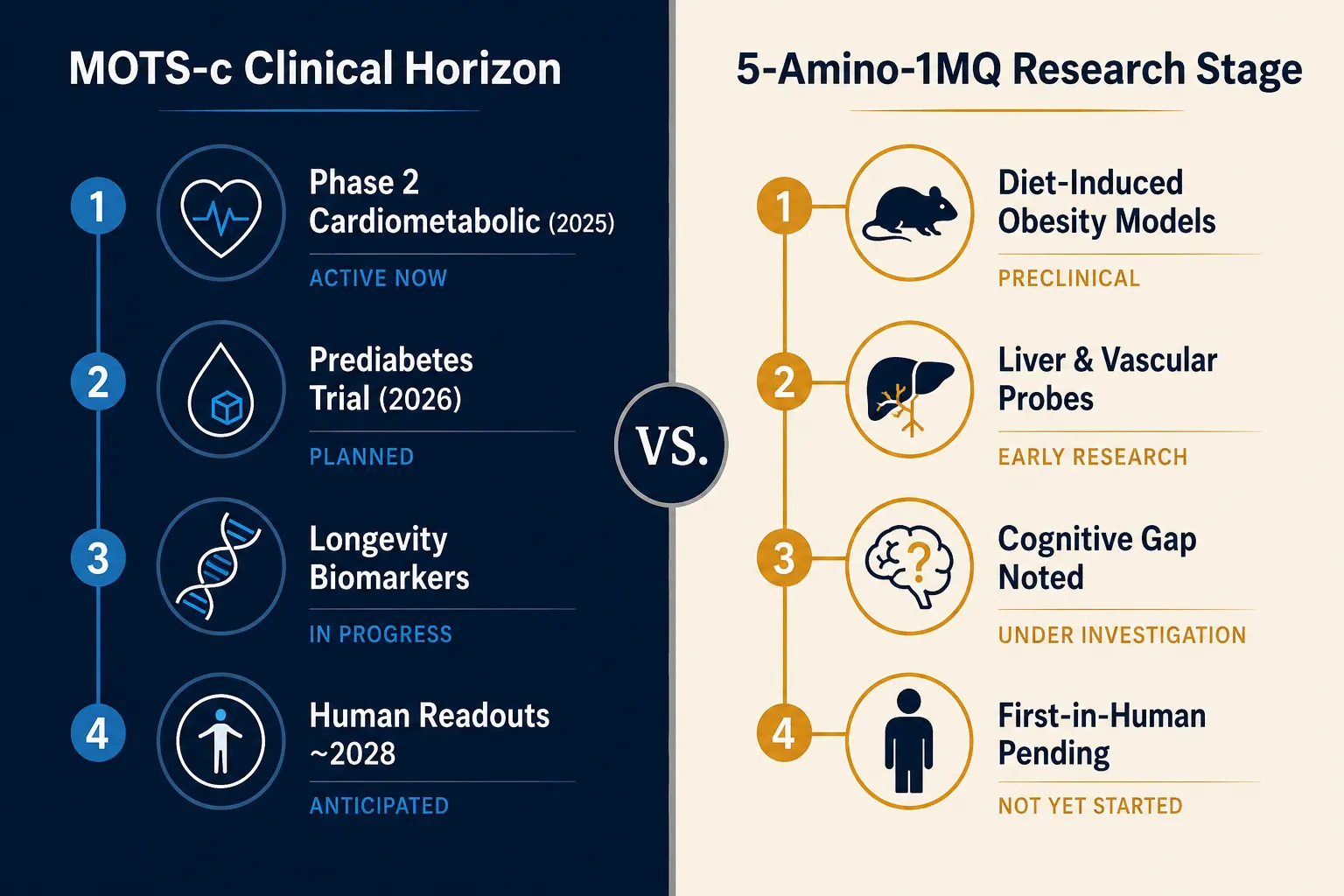
  • MOTS‑c completed its first Phase 2 cardiometabolic trial in 2025, showing modest but significant benefits; a 2026 prediabetes trial is ongoing.
  • Cognitive endpoints for MOTS‑c remain preclinical and contested, with blood-brain barrier penetration still unresolved.
  • 5‑Amino‑1MQ has robust preclinical metabolic data but has not yet entered human trials for any indication.
  • Both compounds are framed as potential longevity agents, but human evidence for aging biomarkers is largely observational.
  • Evidence lags significantly behind marketing narratives at longevity clinics, researchers urge caution.

What MOTS‑c and 5‑Amino‑1MQ Actually Do
What MOTS‑c and 5‑Amino‑1MQ Actually Do

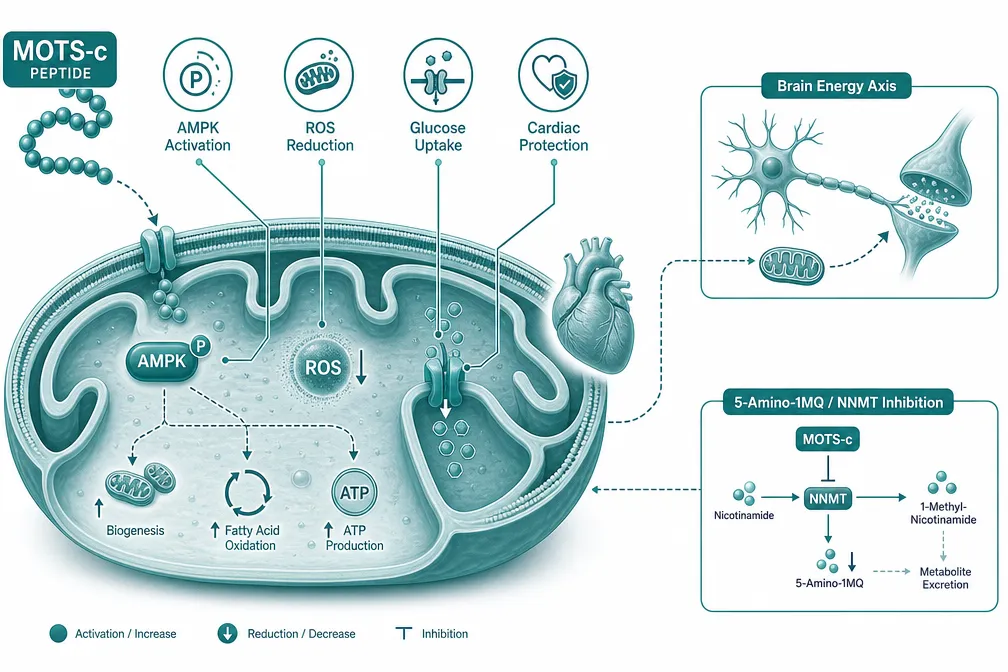
MOTS‑c is a 16-amino-acid peptide encoded in mitochondrial DNA. It activates AMPK, reduces reactive oxygen species, and improves glucose uptake in skeletal muscle. Researchers increasingly describe it as a "mitochondrial hormone", a circulating signal that coordinates whole-body energy sensing rather than acting locally. Levels decline with age and rise with exercise, which has made it a subject of longevity biology interest.

5‑Amino‑1MQ works through a different mechanism. It inhibits nicotinamide N-methyltransferase (NNMT), an enzyme overexpressed in adipose tissue during obesity. By blocking NNMT, 5A1MQ raises NAD+ precursor availability and shifts cellular metabolism toward fat oxidation. In diet-induced obese mouse models, the compound produced robust reductions in body weight and fat mass without significant toxicity signals.

Both compounds intersect at a common node: mitochondrial efficiency and metabolic reprogramming. That shared biology is why researchers studying one often look at the other, and why SS-31 and MOTS-c are frequently paired in mitochondria-focused research stacks. For researchers sourcing verified material, buying MOTS-c peptide from a lab-tested supplier is a standard first step before designing any preclinical protocol.

Cardiometabolic and Cognitive Frontiers: Where the Data Actually Stands
Cardiometabolic and Cognitive Frontiers: Where the Data Actually Stands

Cardiometabolic Evidence

The most concrete human data belongs to MOTS‑c. A Phase 2 trial completed in 2025 reported modest but statistically significant cardiometabolic improvements, including insulin sensitivity and lipid markers, in its target population. The word "modest" matters here; expert commentary has been careful not to overstate the signal. A follow-on Phase 2a trial launched in 2026 specifically targets prediabetes with broader mechanistic endpoints, including vascular biomarkers and inflammatory markers alongside glycemic outcomes. Definitive cardiometabolic readouts are not expected before approximately 2028.

Preclinical cardiac data are more striking. MOTS‑c appears to protect the diabetic heart by preserving mitochondrial membrane integrity and reducing oxidative stress in cardiomyocytes. This is consistent with the broader research theme explored in SS-31 mitochondrial research, where mitochondria-targeted peptides show cardioprotective properties across multiple model systems.

For 5‑Amino‑1MQ, cardiometabolic work is earlier-stage. Animal studies probing liver fat accumulation and vascular inflammation are underway, but no human data exist. The compound's NNMT inhibition mechanism theoretically reduces metabolic inflammation, a driver of cardiovascular risk, but that pathway has not been validated in clinical populations. Researchers interested in the metabolic axis may also want to review GLP-3 retatrutide and the future of metabolic research for context on how the broader field is evolving.

Cognitive Endpoints

This is where the gap between marketing and science is widest. MOTS‑c's cognitive potential is entirely preclinical, and the evidence is mixed. Some rodent studies suggest it may reduce neuroinflammation and support brain energy metabolism, plausible given that neurons are among the most mitochondria-dense cells in the body. However, blood-brain barrier (BBB) penetration remains unresolved. Peripheral injection does not guarantee central nervous system exposure, and conflicting claims about MOTS‑c's BBB permeability circulate widely in longevity clinic marketing without adequate support.

For 5‑Amino‑1MQ, cognitive endpoints are essentially absent from the published literature. No preclinical models have systematically tested its effects on memory, neuroinflammation, or synaptic function. Researchers exploring peptide cognitive endpoints will find far more developed data in neuropeptide categories like Semax and Selank, covered in depth in the comparative research on neurogenesis and synaptic plasticity.

Key distinction: MOTS‑c has a plausible cognitive mechanism but unconfirmed CNS access. 5‑Amino‑1MQ has no meaningful cognitive dataset at all.

Longevity Endpoints and What Researchers Should Watch

Longevity Endpoints and What Researchers Should Watch

The longevity framing around MOTS‑c is scientifically grounded in one important respect: circulating MOTS‑c levels in humans correlate inversely with age and positively with physical fitness. Centenarian studies have found elevated MOTS‑c relative to age-matched controls. These are observational associations, not intervention evidence, but they anchor the hypothesis that restoring youthful MOTS‑c levels could slow aging-related decline.

Aging biomarker endpoints being considered for future trials include:

  • Telomere length and telomerase activity, connected to mitochondrial health signals
  • Inflammatory cytokines (IL-6, TNF-alpha), modulated by AMPK activation
  • Epigenetic clocks, increasingly used as surrogate aging endpoints in peptide trials
  • Vascular stiffness measures, relevant to both cardiometabolic and longevity outcomes

For 5‑Amino‑1MQ, longevity research is speculative. NAD+ pathway involvement is the primary theoretical link, since NNMT inhibition increases NAD+ precursor flux, a mechanism shared with well-studied longevity compounds. But without first-in-human data, longevity claims remain hypothesis-generating rather than evidence-based.

Researchers building aging-focused protocols may find relevant context in aging support research categories and in the hTERT-related work tagged under hTERT longevity research.

Research Caution: Authoritative reviews consistently note that both MOTS‑c and 5‑Amino‑1MQ carry no approved human indications as of 2026. Off-label use through longevity clinics outpaces the available evidence by a significant margin.

Conclusion

The research trajectory for MOTS‑c and 5‑Amino‑1MQ beyond adiposity, spanning cognitive, cardiometabolic, and longevity endpoints, is genuinely promising but unevenly developed. MOTS‑c has crossed into human trials with modest early signals and a plausible mechanistic story for vascular and brain energy benefits. 5‑Amino‑1MQ remains a preclinical compound with strong metabolic data and an untested cognitive profile.

Actionable next steps for researchers and clinicians:

  1. Track the 2026 MOTS‑c prediabetes Phase 2a trial for mechanistic endpoint data, these results will clarify whether cardiometabolic benefits extend beyond glycemic control.
  2. Treat cognitive claims for both compounds as hypothesis-generating until BBB penetration and CNS efficacy are confirmed in controlled studies.
  3. Use longevity biomarker panels (epigenetic clocks, vascular stiffness, inflammatory markers) as outcome measures in any preclinical stack design, not just body composition.
  4. Apply strict sourcing standards; lab-tested peptides with documented purity are non-negotiable for reproducible research.
  5. Revisit the evidence base in 2028 when more definitive cardiometabolic readouts from MOTS‑c trials are expected to be available.

The science is moving, but it is moving at the pace of rigorous trials, not marketing timelines.

https://www.puretestedpeptides.com/wp-content/uploads/2026/08/mots-c-and-5-amino-1mq-beyond-adiposity-how-labs-are-starting-to-explore-cogniti.webp 672 1008 https://www.puretestedpeptides.com/wp-content/uploads/2026/01/buy-peptides-online.jpg 2026-08-29 13:10:582026-08-29 13:10:58MOTS‑c and 5‑Amino‑1MQ Beyond Adiposity: How Labs Are Starting to Explore Cognitive, Cardiometabolic, and Longevity Endpoints
×

Helpful Links

  • My account
  • Cart
  • Checkout
  • Refund and Returns Policy
  • Privacy Policy
  • SMS Privacy Policy
  • Login
  • My Account
  • Logout

USA Made Lab Tested Peptides

All products are sold for research, laboratory, or analytical purposes only, and are not for human consumption


Pure Tested Peptides is a chemical supplier. Pure Tested Peptides is not a compounding / chemical compounding facility as defined under 503A of the Federal Food, Drug, and Cosmetic act. Pure Tested Peptides is not an outsourcing facility as defined under 503B of the Federal Food, Drug, and Cosmetic act.

The statements made within this website have not been evaluated by the US Food and Drug Administration. The products we offer are not intended to diagnose, treat, cure or prevent any disease.

Human/Animal Consumption Prohibited. Laboratory/In-Vitro Experimental Use Only

Scroll to top Scroll to top Scroll to top