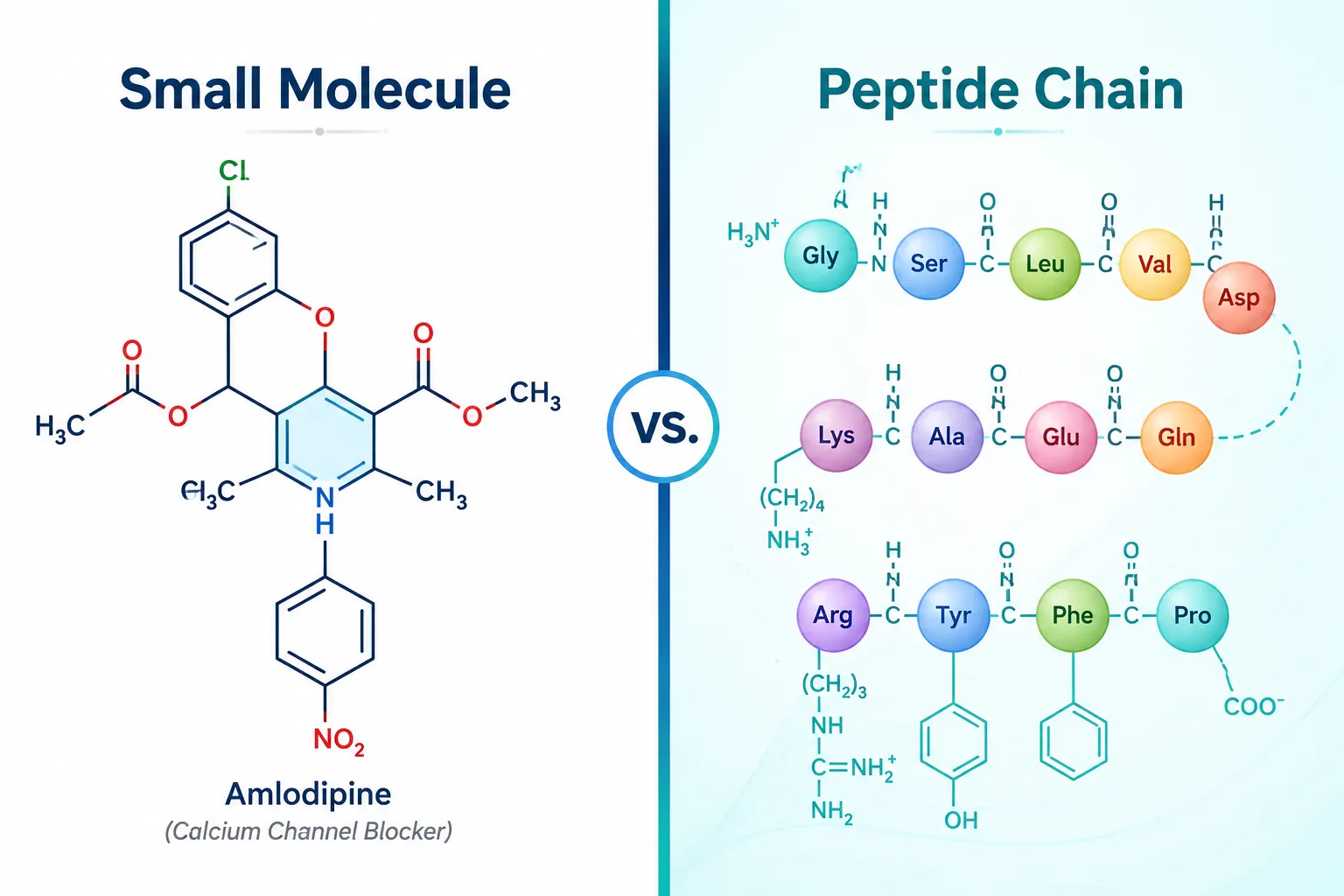
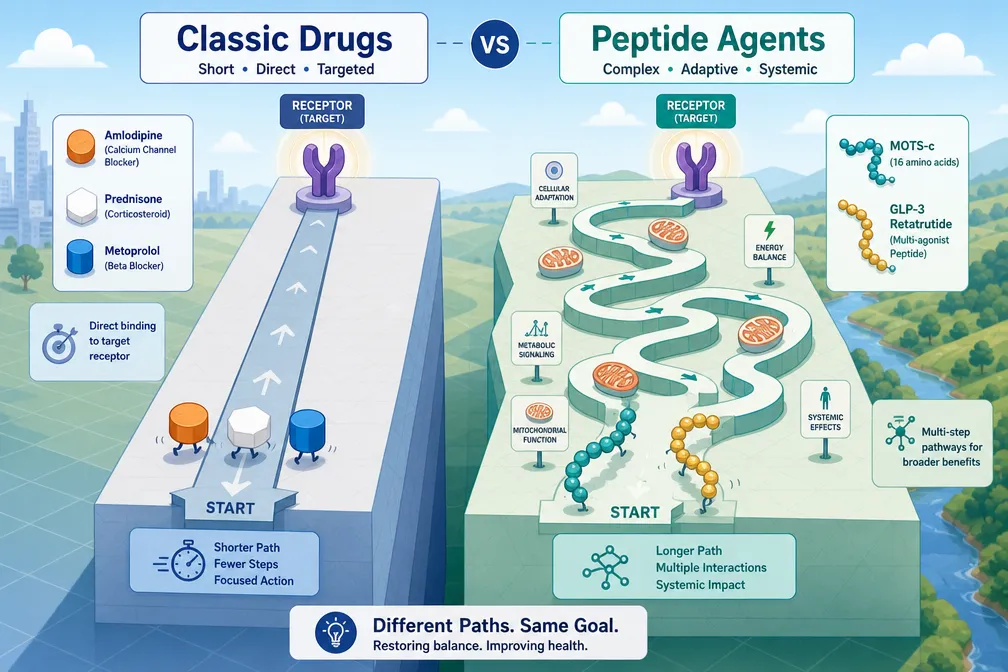
Amlodipine and Research Peptides: How Calcium-Channel Blockade Can Confound Blood-Pressure Experiments
Fewer than 10% of preclinical cardiovascular studies explicitly report whether test subjects were receiving background antihypertensive therapy, yet a single oral dose of amlodipine can drop systolic blood pressure by 18 to 45 mmHg for six hours or longer. That gap between standard practice and methodological rigor sits at the heart of the problem explored here. Understanding Amlodipine and Research Peptides: How Calcium-Channel Blockade Can Confound Blood-Pressure Experiments is not a niche concern; it is a prerequisite for any researcher using GLP-class peptides, growth-hormone secretagogues, or tissue-repair compounds in models where blood pressure, vascular tone, or intracellular calcium is a primary endpoint.
Key Takeaways
- Amlodipine produces dose-dependent, long-lasting blood-pressure reductions that can dominate hemodynamic readouts across typical experimental windows.
- Calcium-channel blockade can physically interfere with fura-based fluorescent calcium imaging, producing false signals that mimic peptide activity.
- Circadian blood-pressure patterns, critical for ambulatory monitoring studies, can be altered by amlodipine independently of any peptide intervention.
- Confounding by indication and dose is a recognized methodological hazard in pharmacoepidemiology that applies directly to peptide trials.
- Researchers can control for these effects through explicit CCB documentation, adequate washout periods, group stratification, and adjusted statistical models.
How Amlodipine Changes Vascular Tone and Blood-Pressure Baselines
Amlodipine is a dihydropyridine calcium-channel blocker (CCB) that selectively inhibits voltage-gated L-type calcium channels in vascular smooth muscle. By preventing calcium influx, it reduces the contractile force of arterial walls, lowers peripheral vascular resistance, and decreases blood pressure without producing large chronic changes in resting heart rate. This peripheral vasodilatory action is highly relevant when studying any peptide that targets the cardiovascular system.
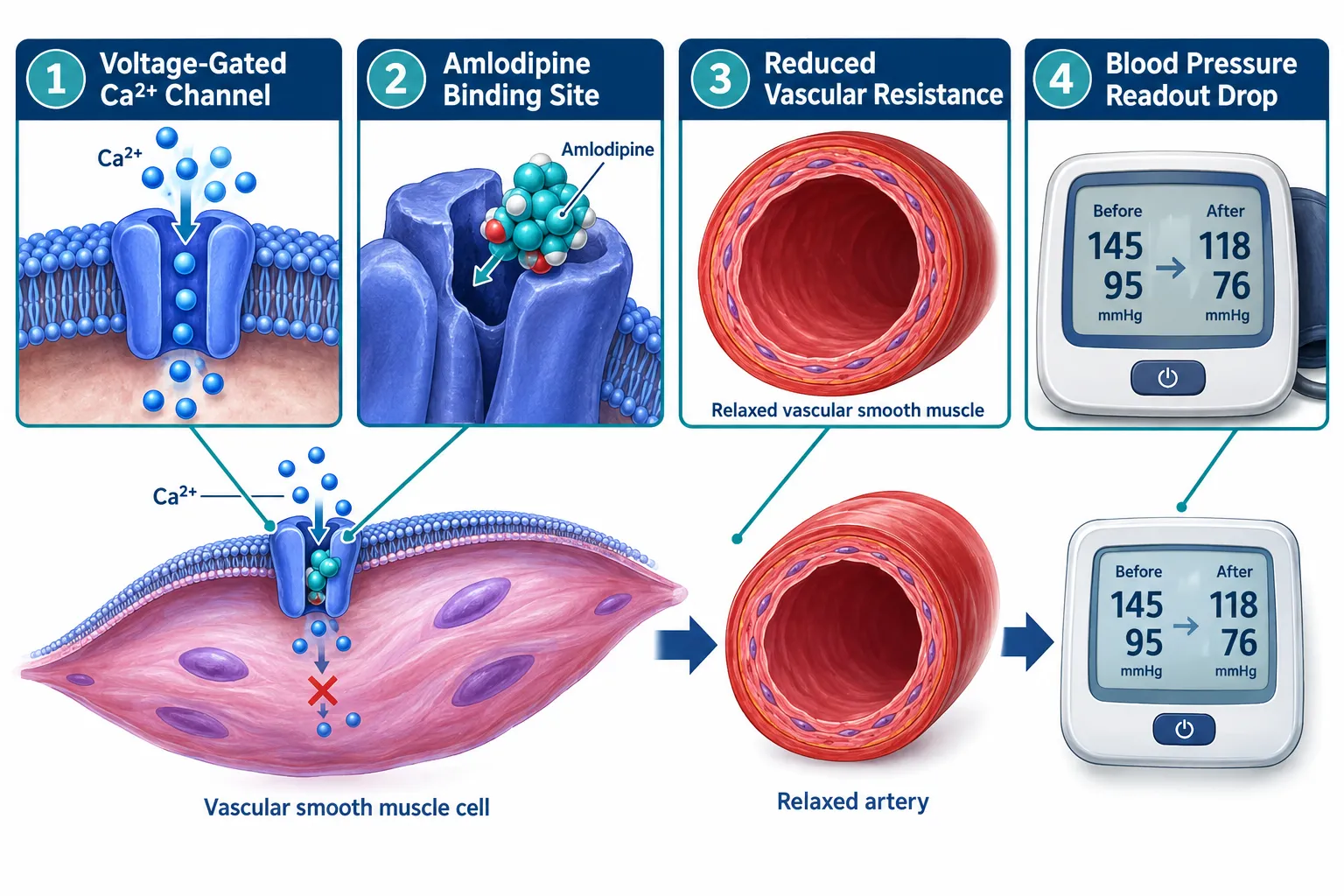
In spontaneously hypertensive rat (SHR) models, the most widely used preclinical platform for antihypertensive research, oral doses between 1 and 10 mg/kg reduce blood pressure for at least six hours after administration. At higher maintenance doses of around 8 mg/kg per day, marked systolic blood-pressure reductions persist for 16 to 20 hours, effectively spanning an entire experimental window. This matters enormously for researchers studying peptides such as SS-31, which targets mitochondrial cardiolipin and influences cardiac energetics in pressure-overload models. If amlodipine is present in the background, observed improvements in afterload and wall stress may reflect CCB-induced resistance changes rather than peptide activity.
Key hemodynamic facts about amlodipine:
| Parameter | Typical Effect |
|---|---|
| Systolic BP reduction (SHR, acute) | 18 to 45 mmHg |
| Duration per oral dose | 6 to 20+ hours |
| Heart rate change (stable angina) | Minimal chronic change |
| Peripheral vascular resistance | Significantly reduced |
The drug's long half-life, roughly 35 to 50 hours in humans, means that "overnight discontinuation" is wholly inadequate as a washout strategy. Researchers designing experiments around lab-tested peptides must plan washout periods of several days, not hours, to eliminate residual CCB influence on hemodynamic baselines.
Why Calcium-Channel Blockade Specifically Confounds Peptide Research
The confounding problem in Amlodipine and Research Peptides: How Calcium-Channel Blockade Can Confound Blood-Pressure Experiments operates through at least three distinct mechanisms, each capable of invalidating a study on its own.
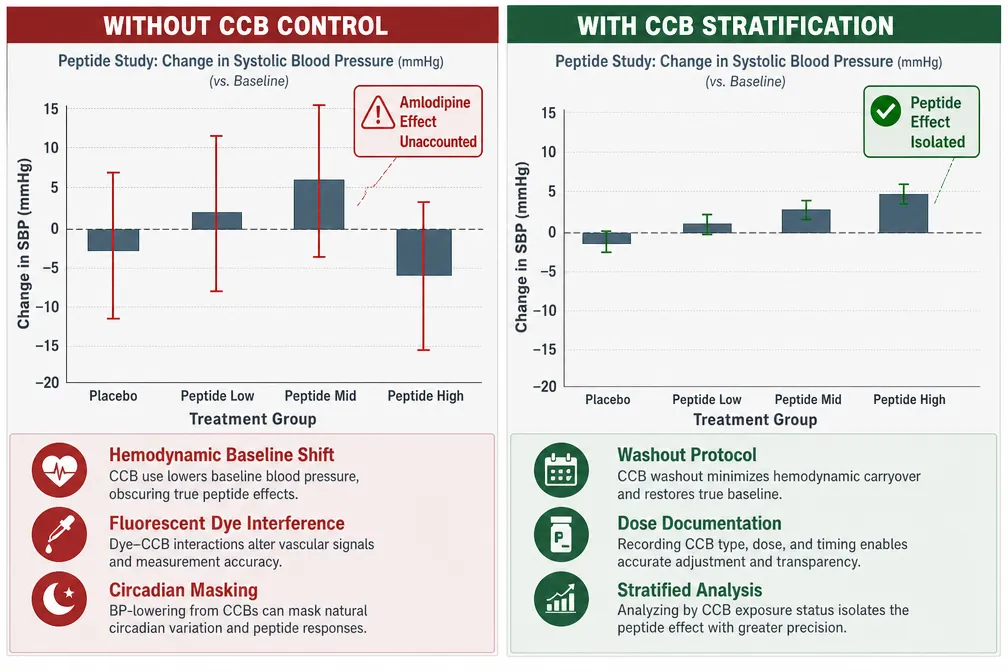
Hemodynamic Baseline Masking
Cardioprotective peptides are typically evaluated against endpoints such as infarct size, contractility, fibrosis, and cardiomyocyte apoptosis. All of these endpoints are highly sensitive to baseline hemodynamics. A 2023 clinical analysis found that 10 mg/day of amlodipine lowered systolic blood pressure by 14.2 mmHg and diastolic blood pressure by 13.6 mmHg over eight weeks, while converting approximately 40% of patients from a "non-dipper" to a "dipper" nocturnal profile. Any concurrent peptide therapy evaluated via 24-hour ambulatory monitoring could have its chronobiologic effects masked or mimicked by these CCB-driven shifts.
For researchers studying SS-31 kidney health or cardiac remodeling, this means a peptide that genuinely reduces nocturnal blood pressure might appear no better than placebo if amlodipine has already normalized the dipper profile.
Fluorescent Calcium Imaging Interference
This is perhaps the most underappreciated confound. Amlodipine besylate accumulates in the cytoplasm and overlaps spectrally with fura-2, the most widely used fluorescent dye for measuring intracellular calcium. The drug dominates the fluorescence signal, mimicking calcium transients that do not exist. Any peptide claimed to modulate excitation-contraction coupling, including growth-hormone secretagogues or vasoactive intestinal peptides, could appear falsely effective or ineffective in fura-loaded cells exposed to amlodipine.
"Amlodipine's spectral overlap with fura-2 means that calcium imaging data collected in its presence cannot be reliably attributed to any co-administered peptide."
Confounding by Indication and Dose
Pharmacoepidemiologic research has established that both the clinical reason for prescribing a CCB and the dose level act as independent confounders. In observational peptide trials, unequal distribution of background CCB therapy across study arms, even with randomization, can systematically bias blood-pressure and remodeling outcomes. This problem is compounded by precision-dosing approaches: one trial demonstrated that app-guided amlodipine titration in 205 adults reduced mean blood pressure from 142/87 to 131/81 mmHg over 14 weeks, a moving target that would be nearly impossible to control for without explicit documentation.
Practical Design Strategies for CCB-Aware Peptide Experiments
Addressing Amlodipine and Research Peptides: How Calcium-Channel Blockade Can Confound Blood-Pressure Experiments requires deliberate protocol choices at the design stage, not post-hoc corrections.
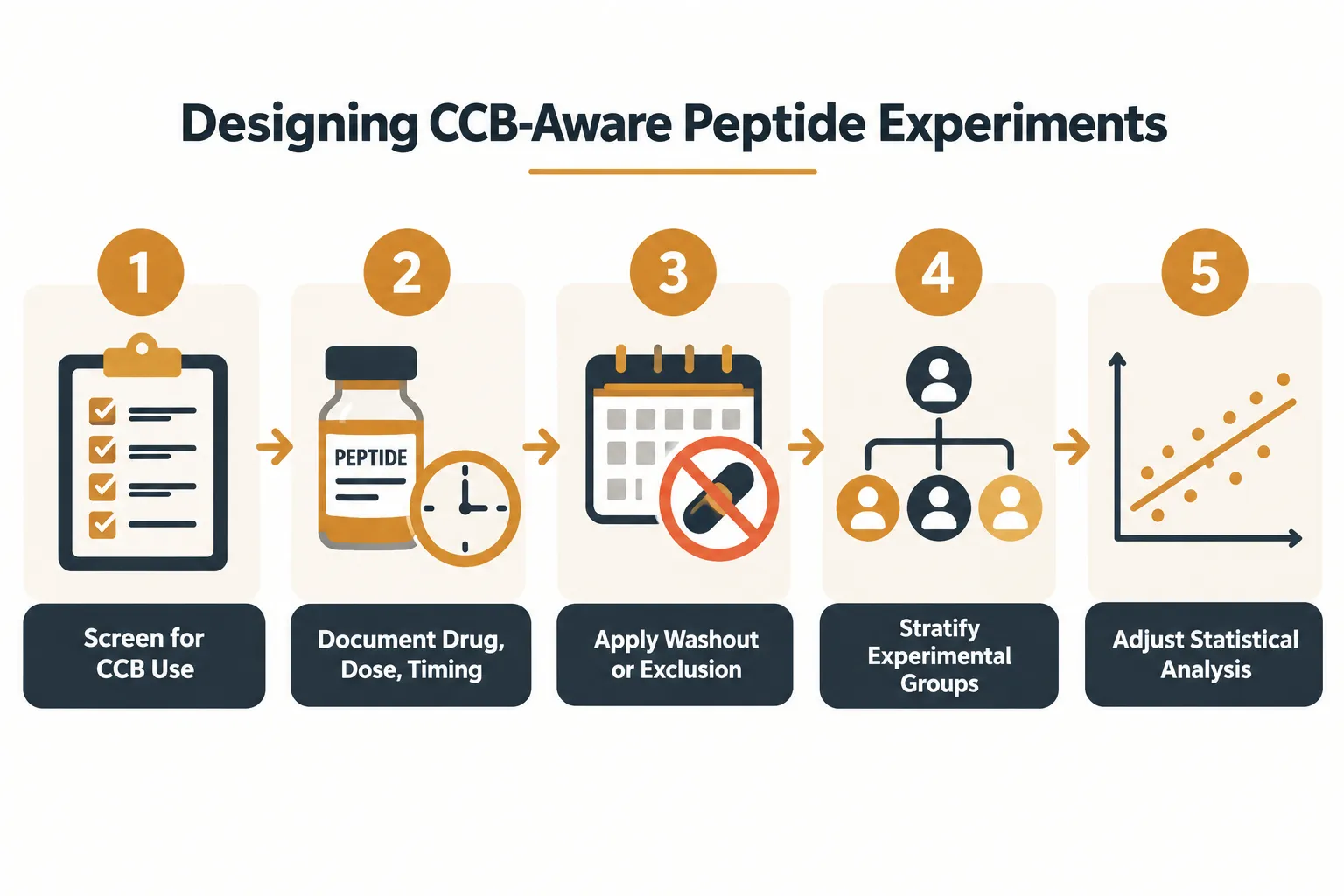
Five actionable steps for researchers:
- Screen and document all CCB exposure, Record drug name, dose, formulation, and timing for every subject or animal before enrollment.
- Apply adequate washout periods, Given amlodipine's half-life, washout of at least five half-lives (seven or more days in humans) is the minimum acceptable standard.
- Exclude or stratify CCB-treated subjects, In studies using SS-31 mitochondrial research endpoints or similar oxidative-stress markers, exclusion is preferable; if exclusion is not feasible, stratify and adjust quantitatively.
- Avoid fura-based calcium imaging in amlodipine-exposed tissue, Switch to alternative calcium indicators without spectral overlap, or use CCB-naive preparations.
- Adjust statistical models for CCB covariates, Include CCB type, dose, and duration as covariates in regression models for blood-pressure and remodeling outcomes.
These principles apply equally to researchers working with MOTS-C peptide in metabolic-cardiovascular models, Thymosin Alpha-4 in cardiac repair studies, or VIP peptide in vascular tone experiments. Each of these compounds interacts with pathways that are directly altered by sustained calcium-channel blockade.
Checklist summary:
- Document CCB use at baseline
- Plan washout of at least 5 half-lives
- Stratify groups by CCB status
- Avoid fura-2 imaging in CCB-exposed cells
- Report CCB covariates in all statistical models
- Pre-register exclusion criteria related to antihypertensive therapy
Conclusion
The intersection of Amlodipine and Research Peptides: How Calcium-Channel Blockade Can Confound Blood-Pressure Experiments is a methodological blind spot with real consequences for data validity. Amlodipine's long half-life, potent hemodynamic effects, and spectral interference with calcium-imaging tools create three separate pathways through which it can distort peptide study results, masking genuine effects, generating false signals, or introducing systematic bias across study arms.
Actionable next steps for research teams in 2026:
- Audit existing protocols for undocumented CCB exposure before data collection begins.
- Add CCB screening as a mandatory enrollment step in any blood-pressure or calcium-signaling study.
- Consult pharmacoepidemiology guidance on confounding by indication when designing observational peptide trials.
- Source lab-tested peptides with verified purity certificates to eliminate compound-quality confounds alongside pharmacological ones.
Rigorous control of background antihypertensive therapy is not optional, it is the foundation on which credible peptide cardiovascular research is built.