Call or Text 727-513-9780
  • Shopping Cart Shopping Cart
    0Shopping Cart
Pure Tested Peptides | America's most trusted Peptides for sale online
  • Peptides for sale
    • Oral Peptides for sale
      • Peptide Capsules for sale
      • BPC 157 Capsules 1000mcg
      • SLU-PP-332 Capsules | 1000 mcg
      • 5-Amino-1MQ 50mg Capsules
      • Tesofensine 500mcg
    • All Peptides for sale
    • Peptide Sprays
      • BPC 157 Nasal Spray Kit
      • BPC-157 TB500 Nasal Spray Kit
      • Semax Nasal Spray 10mg
      • Selank – Nasal Spray Kit – 10mg
      • Epithalon 50MG Nasal Spray Kit
      • Ipamorelin 10mg Nasal Spray
      • Klow Nasal Spray (BPC-157 + TB-500 + GHK-Cu + KPV) | 80mg
      • Hulk Nasal Spray Tesa / Ipa Blend 6/3 MG
      • Klow Nasal Spray
      • NAD + 500 mg Nasal Spray
      • PT-141 Nasal Spray Kit
    • GHRH Peptides
      • Ipa Peptides
      • CJC-1295 Peptides
        • CJC-1295 with DAC 5 mg
        • CJC-1295 without DAC 5 mg
        • CJC-1295 Ipa 10mg
      • Tesa Peptides
        • Tesa Peptide
        • Tesa 20 mg
    • GHK-Cu Peptides
      • All GHK-Cu Peptides
      • GHK-Cu 100mg
      • KLOW Peptide Blend – Buy KLOW blend online
    • BPC Peptides
      • All BPC Peptides
      • BPC-157
      • BPC-157 TB-500
      • BPC 157 capsules 1000mcg
    • SLU-PP-332 Peptides
      • All SLU-PP-332 Peptides
      • SLU-PP-332 5mg
    • GLP3 Peptides
    • PT-141 Peptides
      • PT-141 Peptides for sale
      • PT-141 10mg
      • PT-141 Nasal Spray
    • CAG Peptides
      • Lipo-C Peptide Blend
      • CAG 5mg
      • CAG 10mg
    • MOTS-C Peptides
      • MOTS-C Peptides for sale
      • MOTS-c peptide
      • MOTS-c 10mg *6 pack*
    • 5 Amino 1MQ Peptides
      • 5 Amino 1MQ Peptides for sale
      • 5-Amino-1MQ 50mg Capsules
      • 5-Amino-1MQ 5mg
    • Epithalon Peptides
      • Epithalon Peptides for sale
      • Epithalon 10mg
      • Epithalon 50mg
  • Shop
    • GLPs
      • 5-Amino-1MQ 50mg Capsules
      • 5-Amino-1MQ 5mg
      • L-Carnitine 500mg/ml
      • Tesofensine 500mcg
      • SLU-PP-332 5mg
      • MOTS-c 10mg *6 pack*
    • Epithalon & BPC Peptides
      • Epithalon 10mg
      • Epithalon 50mg
      • BPC-157
      • BPC 157 capsules 1000mcg
      • BPC-157 TB-500
      • BPC-157 TB500 Nasal Spray Kit
      • BPC 157 Nasal Spray Kit
    • BPC TB-500 & NAD+ Peptides
      • NAD+ 500 mg
      • KLOW Peptide Blend – Buy KLOW blend online
      • GLOW Peptide Blend
      • TB 500 5mg
      • BPC 157 capsules 1000mcg – Supplement
      • BPC 157 Nasal Spray Kit
      • BPC-157
      • BPC-157 TB500 Nasal Spray Kit
      • BPC-157 TB-500
      • BPC 157 capsules 1000mcg
    • LL-37 Peptide
      • LL-37 10 mg
    • MOTS-C & Selank
      • MOTS-c peptide
      • Selank 10mg
    • GHK Peptides
      • GHK-Cu 100mg
      • GLOW Peptide Blend
      • KLOW Peptide Blend – Buy KLOW blend online
  • COAs
  • Wholesale
    • Wholesale Peptides for sale
  • PTP FAQ
  • Affiliates
    • Selank Peptide: Advanced Pharmacological Mechanisms Underlying Its Anxiolytic and Nootropic Effects in Research
      • 5-Amino-1MQ Peptide: Detailed Mechanisms of NNMT Inhibition and Its Impact on Cellular Metabolism Research
        • MOTS-C Peptide: Unraveling Its Role in Mitochondrial Dynamics and Energy Metabolism Research
          • Epithalon Peptide and Telomerase Regulation: Investigating Its Impact on Cellular Senescence and Lifespan Research Models
            • GLP2-T vs GLP2 Tirz Peptide: Understanding the Naming, Mechanistic Nuances, and Research Implications for Gut Health
      • Peptides and Polypeptides in Modern Pharmacology: What Research on Metoprolol, Prednisone, and Amlodipine Reveals
        • Polypeptide Peptides vs NSAIDs: What Naproxen and Diclofenac Teach Tissue-Repair Researchers About BPC‑157 and TB‑500
          • Peptides and Polypeptides in Endocrine Pharmacology: How GLP-1, GLP-2, and GLP-3 Retatrutide Differ From Classic Drugs Like Prednisone and Amlodipine
          • 5‑Amino‑1MQ Peptide and NNMT Inhibition: How It Compares With Statins Like Atorvastatin in Adipose and Lipid Metabolism Research
      • Enclomiphene, Estrogen Receptor Signaling, and Luteinizing Phase Biology: What Hormone Researchers Should Measure
        • Mesenchymal Stem Cells, BPC‑157, and GHK‑Cu: How Tissue Repair Peptides Compare With Classic NSAIDs Like Naproxen in Injury Models
          • Peptide Calculator Use Cases Beyond Growth Hormone: Working Through GLP‑3 Retatrutide, MOTS‑c, and BPC‑157 Research Dosing
        • Polypeptide Peptides in Endocrine and Metabolic Pharmacology: Lessons From Amlodipine, Prednisone, and Metoprolol
        • Peptides Calculator for Advanced Blends: Worked Examples for Tesamorelin, CJC‑1295, and Ipamorelin Stacks
          • Peptides and Polypeptides in Human Physiology: How Molecular Size Shapes Research Applications
            • Selank Peptide: Advanced Pharmacological Mechanisms Underlying Its Anxiolytic and Nootropic Effects in Research
          • 5-Amino-1MQ Peptide: Detailed Mechanisms of NNMT Inhibition and Its Impact on Cellular Metabolism Research
            • MOTS-C Peptide: Unraveling Its Role in Mitochondrial Dynamics and Energy Metabolism Research
              • Epithalon Peptide and Telomerase Regulation: Investigating Its Impact on Cellular Senescence and Lifespan Research Models
                • GLP2-T vs GLP2 Tirz Peptide: Understanding the Naming, Mechanistic Nuances, and Research Implications for Gut Health
                  • Peptides and Polypeptides in Endocrine Pharmacology: How GLP-1, GLP-2, and GLP-3 Retatrutide Differ From Classic Drugs Like Prednisone and Amlodipine
                    • Polypeptide Peptides vs NSAIDs: What Naproxen and Diclofenac Teach Tissue-Repair Researchers About BPC‑157 and TB‑500
                      • Peptides and Polypeptides in Modern Pharmacology: What Research on Metoprolol, Prednisone, and Amlodipine Reveals
                        • 5‑Amino‑1MQ Peptide and NNMT Inhibition: How It Compares With Statins Like Atorvastatin in Adipose and Lipid Metabolism Research
                        • Enclomiphene, Estrogen Receptor Signaling, and Luteinizing Phase Biology: What Hormone Researchers Should Measure
                        • Mesenchymal Stem Cells, BPC‑157, and GHK‑Cu: How Tissue Repair Peptides Compare With Classic NSAIDs Like Naproxen in Injury Models
                        • Peptide Calculator Use Cases Beyond Growth Hormone: Working Through GLP‑3 Retatrutide, MOTS‑c, and BPC‑157 Research Dosing
                        • Polypeptide Peptides in Endocrine and Metabolic Pharmacology: Lessons From Amlodipine, Prednisone, and Metoprolol
                        • Peptides Calculator for Advanced Blends: Worked Examples for Tesamorelin, CJC‑1295, and Ipamorelin Stacks
                        • Peptides and Polypeptides in Human Physiology: How Molecular Size Shapes Research Applications
                        • Selank Peptide: Advanced Pharmacological Mechanisms Underlying Its Anxiolytic and Nootropic Effects in Research
                        • MOTS-C Peptide: Unraveling Its Role in Mitochondrial Dynamics and Energy Metabolism Research
                        • Peptides and Polypeptides in Modern Pharmacology: What Research on Metoprolol, Prednisone, and Amlodipine Reveals
                        • Peptides and Polypeptides in Endocrine Pharmacology: How GLP-1, GLP-2, and GLP-3 Retatrutide Differ From Classic Drugs Like Prednisone and Amlodipine
                        • 5-Amino-1MQ Peptide: Detailed Mechanisms of NNMT Inhibition and Its Impact on Cellular Metabolism Research
                        • Mesenchymal Stem Cells, BPC‑157, and GHK‑Cu: How Tissue Repair Peptides Compare With Classic NSAIDs Like Naproxen in Injury Models
                        • Peptide Calculator Use Cases Beyond Growth Hormone: Working Through GLP‑3 Retatrutide, MOTS‑c, and BPC‑157 Research Dosing
                        • GLP2-T vs GLP2 Tirz Peptide: Understanding the Naming, Mechanistic Nuances, and Research Implications for Gut Health
                        • Polypeptide Peptides in Endocrine and Metabolic Pharmacology: Lessons From Amlodipine, Prednisone, and Metoprolol
                        • Polypeptide Peptides vs NSAIDs: What Naproxen and Diclofenac Teach Tissue-Repair Researchers About BPC‑157 and TB‑500
                        • Peptides and Polypeptides in Human Physiology: How Molecular Size Shapes Research Applications
                        • Peptides Calculator for Advanced Blends: Worked Examples for Tesamorelin, CJC‑1295, and Ipamorelin Stacks
                        • 5‑Amino‑1MQ Peptide and NNMT Inhibition: How It Compares With Statins Like Atorvastatin in Adipose and Lipid Metabolism Research
                        • Enclomiphene, Estrogen Receptor Signaling, and Luteinizing Phase Biology: What Hormone Researchers Should Measure
                        • Epithalon Peptide and Telomerase Regulation: Investigating Its Impact on Cellular Senescence and Lifespan Research Models
                        • Best research protocol Klow blend
                        • best time to take BPC-157
                        • best time to take DSIP (Delta Sleep Inducing Peptide)
                        • best time to take CJC-1295
                        • best time to take AOD-9604
                        • best time to take Follistatin 344
                        • best time to take Ipamorelin
                        • best time to take MK-677 (Ibutamoren)
                        • best time to take Ligandrol (LGD-4033) — research compound
                        • best time to take Ostarine (MK-2866) — research compound
                        • best time to take GHK-CU
                        • best time to take TB-500
                        • best time to take MOTS-c
                        • best time to take Semax
                        • best time to take RAD-140 (Testolone) — research compound
                        • best time to take Thymosin Alpha-1
                        • best time to take PEG-MGF
                        • Biolife Plasma, Octapharma Plasma, and Research Peptides: How Plasma Donation Labs Differ From Peptide Suppliers
                        • best time to take YK-11 — research compound
                        • best time to take PT-141 (Bremelanotide)
                        • Best research protocol Klow blend
                        • 5-Amino-1MQ and MOTS-C Synergy: Metabolic Signaling, Mitochondria, and Research Design
                        • BPC-157 and TB-500: Investigating Their Combined Effects on Angiogenesis and Cellular Migration in Tissue Repair Models
                        • BPC-157 Peptide: Gut Barrier Function, Inflammation, and Tissue-Recovery Research
                        • 5‑Amino‑1MQ and MOTS‑c Synergy in Metabolic Research: Designing NNMT and Mitochondrial Biogenesis Stacks
                        • CJC-1295 with DAC vs. Without DAC: Half-Life, Release Kinetics, and Research Implications
                        • CJC‑1295 with DAC vs. Without DAC: Expanding on Half‑Life Differences Using Tesamorelin and Ipamorelin Blend Case Studies
                        • Collagen Biology and Copper‑Binding Peptides: How GHK‑Cu, Glow Blend, and Klow Blend Interact with Skin and Connective Tissue
                        • Collagen Biology and Regenerative Peptides: How GHK‑Cu, Glow Blend, and Klow Blend Affect Extracellular Matrix Research
                    • DNA, Telomeres, and Longevity Peptides: Positioning Epithalon and MOTS‑c in Genetic Aging Research
                      • Enclomiphene Citrate: serm Mechanism, Testosterone Research, and Stack Compatibility
                        • Enclomiphene vs Enclomiphene Citrate: Formulation, Bioavailability, and Research Distinctions
                        • Epithalon Peptide Research: Telomerase Activation, Aging, and Pineal Gland Function
                        • Estrogen Receptor Signaling and Enclomiphene: How Selective Modulators Compare with Classic Polypeptide Hormones
                        • GHK-Cu Peptide: Advanced Mechanisms in Extracellular Matrix Remodeling and Wound Healing Research
                        • GHK-Cu Peptide: Collagen Synthesis, Wound Repair, and Skin-Barrier Research Models
                        • GLP-1 vs GLP-3 vs GLP-2: Peptide Classification and Research Applications
                        • GLP-2 Peptide Research Guide: Gut Barrier Function, Nutrient Absorption, and Intestinal Recovery Models
                        • GLP-3 Retatrutide vs. GLP-1 Drugs: What Triple-Agonist Biology Changes in Research Models
                        • Ipamorelin and Tesamorelin Combination: Synergistic GH Secretagogue Research and Dosing Protocols
                        • GLP2 Tirz Peptide: What It Is, Why the Name Exists, and How Researchers Should Interpret It
                        • Klow Blend Peptide Nasal Spray: What the Formulation Is Trying to Do in Cognitive Research
                        • Mitochondria, NNMT Inhibition, and Peptide Modulators: Where MOTS‑c and 5‑Amino‑1MQ Fit in Cellular Energy Research
                        • MOTS-c Peptide: Mitochondrial Function, Energy Metabolism, and What Researchers Measure
                        • MOTS-c vs. 5-Amino-1MQ: Which Metabolic Research Questions Each Compound Actually Answers
                        • Nasal Spray Peptides: Bioavailability, Administration, and Semax/Selank Research Applications
                        • PT-141 Peptide Research: Mechanism of Action and Melanocortin Receptor Signaling
                        • Retatrutide for Research: Mechanism, Structure, and GLP-1/GLP-3 Dual Action
                        • Retatrutide for Obesity and Type 2 Diabetes: What the Latest Trial Data Suggest
                        • Tesofensine Peptide Research: Mechanism, Appetite Suppression, and Neuropeptide Y Pathways
  • Contact
    • Contact Customer Service
    • Text Customer Support
  • About US
  • Shop all peptides
  • Affiliate Program
    • Affiliate Signup
  • Login / Register Login / Register Page Link Login / Register Page Link
  • Click to open the search input field Click to open the search input field Search
  • Menu Menu

Tag Archive for: beta-blockers

Metoprolol, Beta-Blockers, and Incretin Peptide Research: What Labs Track When Combining GLP-3 Retatrutide With Cardioactive Drugs

Metoprolol, Beta-Blockers, and Incretin Peptide Research: What Labs Track When Combining GLP-3 Retatrutide With Cardioactive Drugs

September 20, 2026/0 Comments/in Uncategorized/by

Roughly 40% of adults with obesity also carry a diagnosis of cardiovascular disease, making the overlap between metabolic therapies and heart-active medications not a niche concern but a near-universal research challenge. As retatrutide advances through Phase 3 TRIUMPH trials with striking cardiometabolic data, the question of how this triple-incretin agonist interacts with beta-blockers like metoprolol has become one of the most pressing topics in preclinical and translational lab design for 2026.

This guide addresses the core of that challenge: what measurements, markers, and safety checkpoints researchers track when studying metoprolol, beta-blockers, and incretin peptide research, specifically what labs track when combining GLP-3 retatrutide with cardioactive drugs in structured experimental frameworks.

Key Takeaways

  • Retatrutide activates GLP-1, GIP, and glucagon receptors simultaneously, creating a multi-axis effect on heart rate, blood pressure, and glucose that overlaps directly with beta-blocker pharmacology.
  • Metoprolol and other beta-blockers can mask hypoglycemia symptoms, a risk that becomes more complex when combined with incretin agents that lower glucose through multiple pathways.
  • Researchers tracking this combination should monitor cardiac rhythm, hemodynamics, glucose metabolism, and renal function as a minimum panel.
  • Emerging arrhythmia signals from triple-incretin agonist data make QTc interval and Holter monitoring critical additions to any lab protocol.
  • Purity and consistency of research-grade peptides are foundational to reproducible results in this interaction space.

Understanding the Pharmacological Overlap
Understanding the Pharmacological Overlap

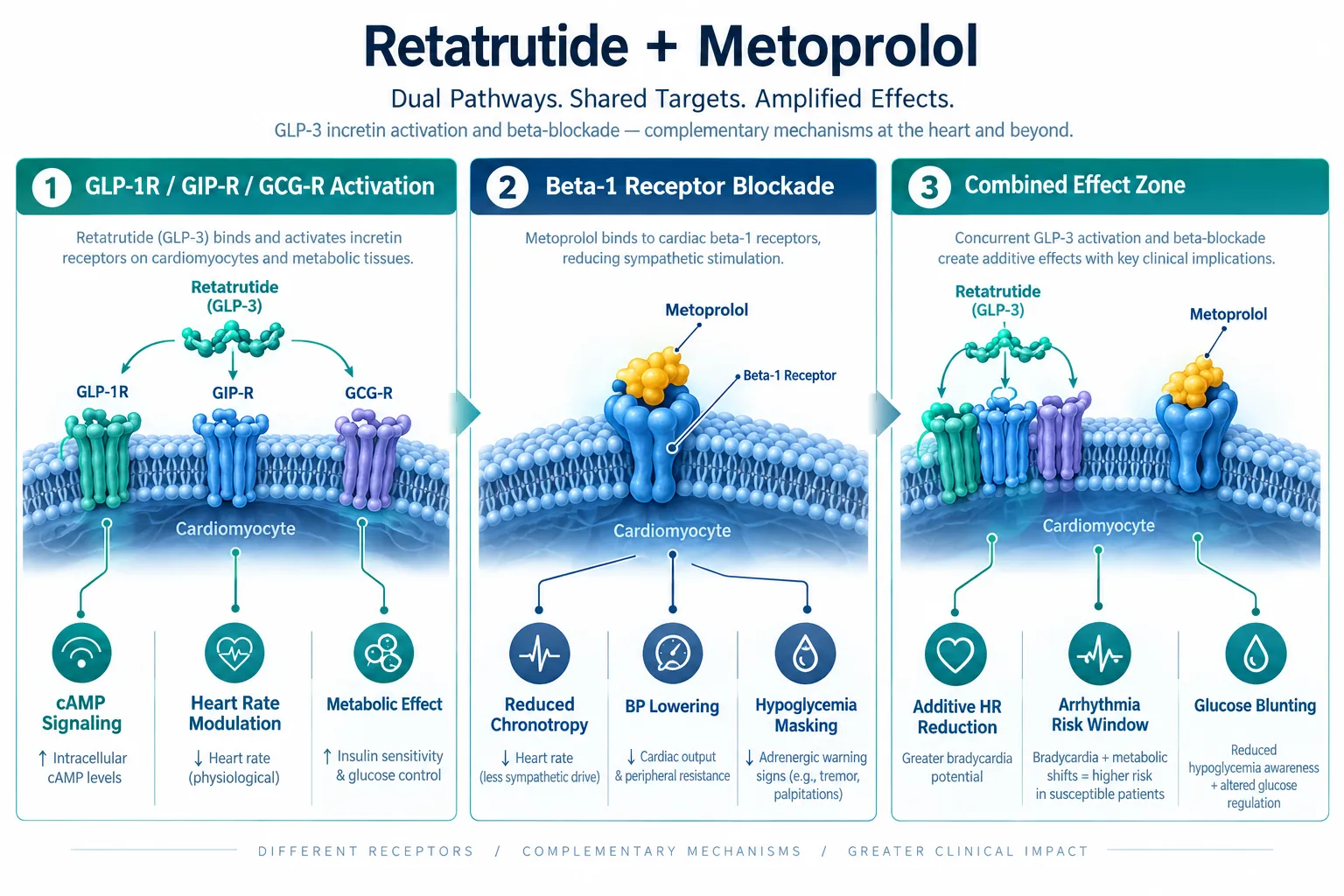
Retatrutide is a triple-receptor agonist targeting GLP-1R, GIPR, and glucagon receptors. Each of these pathways carries cardiovascular relevance. GLP-1 receptor activation raises cyclic AMP in cardiac tissue, which increases heart rate and cardiac output. Glucagon receptor activation has similar chronotropic effects. In isolation, these actions are manageable. When layered onto a beta-blocker framework, the dynamics shift.

Metoprolol is a selective beta-1 adrenergic antagonist. Its primary cardiac effects include reduced heart rate, lower blood pressure, and decreased myocardial oxygen demand. When a researcher or clinician introduces a GLP-class incretin peptide alongside metoprolol, the two agents are working on overlapping but mechanistically distinct pathways, one suppressing adrenergic drive, the other stimulating cAMP-mediated chronotropy.

The result is not simply additive or subtractive. The net heart rate effect depends on receptor density, dose, and individual variability. In vitro models studying GLP-3 peptide interactions need to account for this bidirectional tension explicitly in their experimental design.

A second layer of complexity involves glucose regulation. Beta-blockers are known to blunt the sympathoadrenal response to hypoglycemia, the very response that triggers awareness of low blood sugar. Incretin peptides lower glucose through multiple mechanisms. When combined, the hypoglycemia masking effect of metoprolol can obscure a glucose drop that the incretin agent has contributed to, creating a safety blind spot that labs must monitor actively.

Core Lab Panels for Metoprolol, Beta-Blockers, and Incretin Peptide Research
Core Lab Panels for Metoprolol, Beta-Blockers, and Incretin Peptide Research

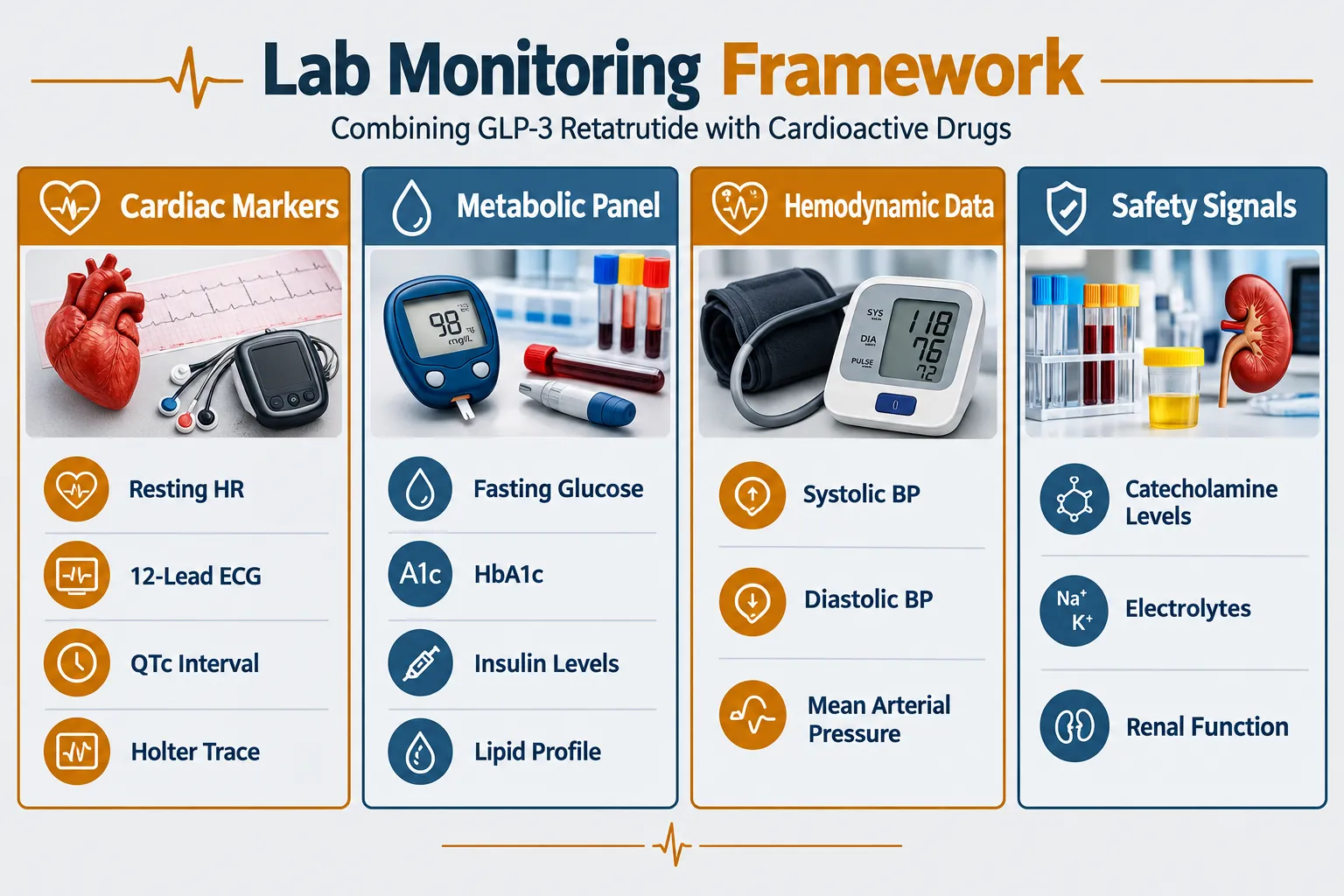
Designing a rigorous monitoring protocol for this combination requires tracking across four domains: cardiac rhythm, hemodynamics, metabolic markers, and safety biomarkers.

Cardiac Rhythm and Electrophysiology

The most immediate concern when combining GLP-3 retatrutide with cardioactive drugs is arrhythmia risk. Emerging data from triple-incretin agonist research has flagged QTc prolongation as a signal requiring active surveillance. Labs should include:

  • 12-lead ECG at baseline and at defined intervals
  • QTc interval measurement using Fridericia or Bazett correction
  • Holter monitoring for continuous rhythm capture over 24-48 hours
  • Resting heart rate tracked across all time points

When peptide dosing protocols are adjusted, rhythm data should be recaptured to identify dose-dependent changes.

Hemodynamic Monitoring

Blood pressure response is a critical variable. Retatrutide has shown meaningful reductions in systolic blood pressure in TRIUMPH trial data. Metoprolol compounds this effect. Labs should record:

Measurement Frequency
Systolic blood pressure Every experimental session
Diastolic blood pressure Every experimental session
Mean arterial pressure Calculated at each time point
Orthostatic BP change Standing vs. supine, at peak drug effect

Orthostatic hypotension is a real concern in this combination and should not be treated as a secondary endpoint.

Metabolic and Glucose Panel

Given the hypoglycemia masking risk described above, glucose monitoring must be granular:

  • Fasting glucose at baseline and post-dose
  • Insulin and C-peptide levels
  • HbA1c for longer study windows
  • Glucagon levels, given retatrutide's direct glucagon receptor activity

Researchers sourcing GLP-3 retatrutide for lab use should confirm purity documentation, as impurities in the peptide can introduce confounding metabolic signals.

Safety Biomarkers

A complete panel also includes:

  • Serum electrolytes (potassium and magnesium, given arrhythmia risk)
  • Catecholamine levels (epinephrine, norepinephrine) to detect suppressed stress response
  • Renal function markers (creatinine, eGFR) given the renal clearance pathways of both drug classes
  • Liver enzymes for hepatic safety tracking

Designing the Monitoring Protocol: What Labs Track When Combining GLP-3 Retatrutide With Cardioactive Drugs
Designing the Monitoring Protocol: What Labs Track When Combining GLP-3 Retatrutide With Cardioactive Drugs

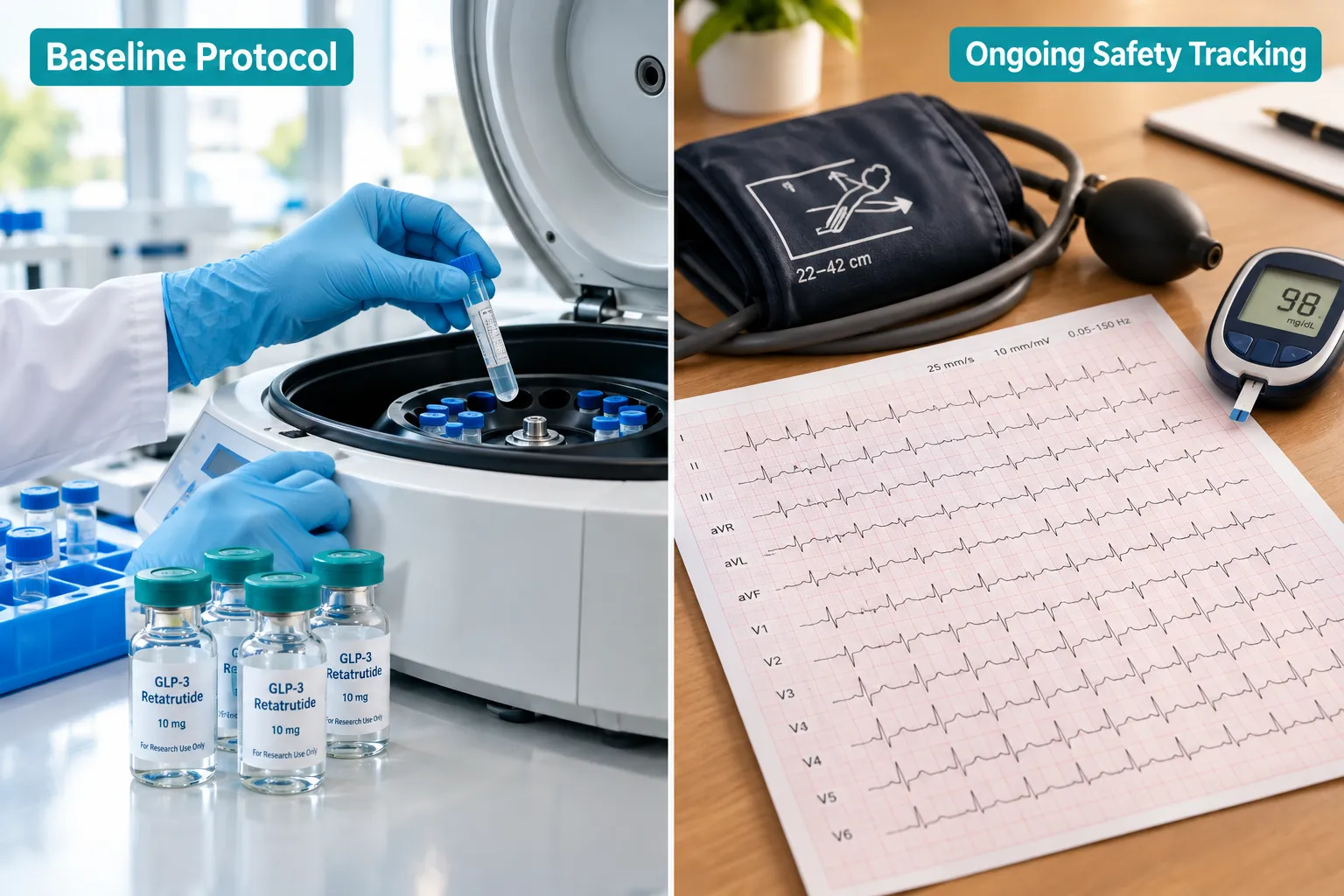
A well-structured protocol for studying metoprolol, beta-blockers, and incretin peptide research does not treat these measurements as isolated checkboxes. It builds them into a timeline that reflects the pharmacokinetics of both agents.

Retatrutide has a long half-life, approximately 6 days in clinical data, which means steady-state effects accumulate across a study window. Metoprolol, by contrast, has a much shorter half-life of 3-7 hours for standard formulations. This mismatch means:

  1. Baseline measurements must be captured before either agent is introduced.
  2. Acute monitoring should align with metoprolol's peak effect window (1-2 hours post-dose).
  3. Trough monitoring should capture the period when metoprolol is at its lowest plasma level but retatrutide remains pharmacologically active.
  4. Washout tracking should extend beyond retatrutide's half-life to confirm return to baseline cardiac and metabolic parameters.

Researchers working with GLP-3 nasal spray formulations or alternative delivery formats should adjust absorption timing windows accordingly, as pharmacokinetic profiles differ from injectable preparations.

For labs using complementary cardioprotective peptides alongside this combination, resources on SS-31 peptide research considerations may provide useful parallel monitoring frameworks, given SS-31's mitochondrial cardioprotective mechanism.

Sensory and Neurological Safety Signals

Phase 3 retatrutide data has introduced a newer sensory safety signal, peripheral sensory changes in a subset of subjects. While the mechanism is not fully characterized, labs studying this combination should include basic neurological assessments and track any reported sensory changes systematically. This is particularly relevant when beta-blockers are co-administered, as they can independently affect peripheral circulation.

Conclusion

The intersection of GLP-3 retatrutide and beta-blocker pharmacology is not a simple additive equation. For researchers designing protocols around metoprolol, beta-blockers, and incretin peptide research, what labs track when combining GLP-3 retatrutide with cardioactive drugs must span cardiac rhythm, hemodynamics, glucose metabolism, electrolytes, and emerging sensory signals, all mapped against the distinct pharmacokinetic timelines of each agent.

Actionable next steps for research teams in 2026:

  • Establish a pre-study baseline panel covering all four monitoring domains before any agent is introduced.
  • Build time-matched monitoring windows that reflect both the short half-life of metoprolol and the extended half-life of retatrutide.
  • Treat hypoglycemia masking as a primary, not secondary, safety concern in any protocol combining beta-blockers with incretin peptides.
  • Confirm third-party purity testing on all research-grade peptides used; explore GLP-3 peptide options with documented quality assurance.
  • Document sensory safety signals as a standard endpoint given the emerging data from triple-incretin agonist trials.

Rigorous lab design in this space is not just a procedural formality, it is the foundation for generating data that can meaningfully inform the next generation of cardiometabolic research.

https://www.puretestedpeptides.com/wp-content/uploads/2026/09/metoprolol-beta-blockers-and-incretin-peptide-research-what-labs-track-when-comb.webp 1024 1536 https://www.puretestedpeptides.com/wp-content/uploads/2026/01/buy-peptides-online.jpg 2026-09-20 13:06:342026-09-20 13:06:34Metoprolol, Beta-Blockers, and Incretin Peptide Research: What Labs Track When Combining GLP-3 Retatrutide With Cardioactive Drugs
×

Helpful Links

  • My account
  • Cart
  • Checkout
  • Refund and Returns Policy
  • Privacy Policy
  • SMS Privacy Policy
  • Login
  • My Account
  • Logout

USA Made Lab Tested Peptides

All products are sold for research, laboratory, or analytical purposes only, and are not for human consumption


Pure Tested Peptides is a chemical supplier. Pure Tested Peptides is not a compounding / chemical compounding facility as defined under 503A of the Federal Food, Drug, and Cosmetic act. Pure Tested Peptides is not an outsourcing facility as defined under 503B of the Federal Food, Drug, and Cosmetic act.

The statements made within this website have not been evaluated by the US Food and Drug Administration. The products we offer are not intended to diagnose, treat, cure or prevent any disease.

Human/Animal Consumption Prohibited. Laboratory/In-Vitro Experimental Use Only

Scroll to top Scroll to top Scroll to top