Call or Text 727-513-9780
  • Shopping Cart Shopping Cart
    0Shopping Cart
Pure Tested Peptides | America's most trusted Peptides for sale online
  • Peptides for sale
    • Oral Peptides for sale
      • Peptide Capsules for sale
      • BPC 157 Capsules 1000mcg
      • SLU-PP-332 Capsules | 1000 mcg
      • 5-Amino-1MQ 50mg Capsules
      • Tesofensine 500mcg
    • All Peptides for sale
    • Peptide Sprays
      • BPC 157 Nasal Spray Kit
      • BPC-157 TB500 Nasal Spray Kit
      • Semax Nasal Spray 10mg
      • Selank – Nasal Spray Kit – 10mg
      • Epithalon 50MG Nasal Spray Kit
      • Ipamorelin 10mg Nasal Spray
      • Klow Nasal Spray (BPC-157 + TB-500 + GHK-Cu + KPV) | 80mg
      • Hulk Nasal Spray Tesa / Ipa Blend 6/3 MG
      • Klow Nasal Spray
      • NAD + 500 mg Nasal Spray
      • PT-141 Nasal Spray Kit
    • GHRH Peptides
      • Ipa Peptides
      • CJC-1295 Peptides
        • CJC-1295 with DAC 5 mg
        • CJC-1295 without DAC 5 mg
        • CJC-1295 Ipa 10mg
      • Tesa Peptides
        • Tesa Peptide
        • Tesa 20 mg
    • GHK-Cu Peptides
      • All GHK-Cu Peptides
      • GHK-Cu 100mg
      • KLOW Peptide Blend – Buy KLOW blend online
    • BPC Peptides
      • All BPC Peptides
      • BPC-157
      • BPC-157 TB-500
      • BPC 157 capsules 1000mcg
    • SLU-PP-332 Peptides
      • All SLU-PP-332 Peptides
      • SLU-PP-332 5mg
    • GLP3 Peptides
    • PT-141 Peptides
      • PT-141 Peptides for sale
      • PT-141 10mg
      • PT-141 Nasal Spray
    • CAG Peptides
      • Lipo-C Peptide Blend
      • CAG 5mg
      • CAG 10mg
    • MOTS-C Peptides
      • MOTS-C Peptides for sale
      • MOTS-c peptide
      • MOTS-c 10mg *6 pack*
    • 5 Amino 1MQ Peptides
      • 5 Amino 1MQ Peptides for sale
      • 5-Amino-1MQ 50mg Capsules
      • 5-Amino-1MQ 5mg
    • Epithalon Peptides
      • Epithalon Peptides for sale
      • Epithalon 10mg
      • Epithalon 50mg
  • Shop
    • GLPs
      • 5-Amino-1MQ 50mg Capsules
      • 5-Amino-1MQ 5mg
      • L-Carnitine 500mg/ml
      • Tesofensine 500mcg
      • SLU-PP-332 5mg
      • MOTS-c 10mg *6 pack*
    • Epithalon & BPC Peptides
      • Epithalon 10mg
      • Epithalon 50mg
      • BPC-157
      • BPC 157 capsules 1000mcg
      • BPC-157 TB-500
      • BPC-157 TB500 Nasal Spray Kit
      • BPC 157 Nasal Spray Kit
    • BPC TB-500 & NAD+ Peptides
      • NAD+ 500 mg
      • KLOW Peptide Blend – Buy KLOW blend online
      • GLOW Peptide Blend
      • TB 500 5mg
      • BPC 157 capsules 1000mcg – Supplement
      • BPC 157 Nasal Spray Kit
      • BPC-157
      • BPC-157 TB500 Nasal Spray Kit
      • BPC-157 TB-500
      • BPC 157 capsules 1000mcg
    • LL-37 Peptide
      • LL-37 10 mg
    • MOTS-C & Selank
      • MOTS-c peptide
      • Selank 10mg
    • GHK Peptides
      • GHK-Cu 100mg
      • GLOW Peptide Blend
      • KLOW Peptide Blend – Buy KLOW blend online
  • COAs
  • Wholesale
    • Wholesale Peptides for sale
  • PTP FAQ
  • Affiliates
    • Selank Peptide: Advanced Pharmacological Mechanisms Underlying Its Anxiolytic and Nootropic Effects in Research
      • 5-Amino-1MQ Peptide: Detailed Mechanisms of NNMT Inhibition and Its Impact on Cellular Metabolism Research
        • MOTS-C Peptide: Unraveling Its Role in Mitochondrial Dynamics and Energy Metabolism Research
          • Epithalon Peptide and Telomerase Regulation: Investigating Its Impact on Cellular Senescence and Lifespan Research Models
            • GLP2-T vs GLP2 Tirz Peptide: Understanding the Naming, Mechanistic Nuances, and Research Implications for Gut Health
      • Peptides and Polypeptides in Modern Pharmacology: What Research on Metoprolol, Prednisone, and Amlodipine Reveals
        • Polypeptide Peptides vs NSAIDs: What Naproxen and Diclofenac Teach Tissue-Repair Researchers About BPC‑157 and TB‑500
          • Peptides and Polypeptides in Endocrine Pharmacology: How GLP-1, GLP-2, and GLP-3 Retatrutide Differ From Classic Drugs Like Prednisone and Amlodipine
          • 5‑Amino‑1MQ Peptide and NNMT Inhibition: How It Compares With Statins Like Atorvastatin in Adipose and Lipid Metabolism Research
      • Enclomiphene, Estrogen Receptor Signaling, and Luteinizing Phase Biology: What Hormone Researchers Should Measure
        • Mesenchymal Stem Cells, BPC‑157, and GHK‑Cu: How Tissue Repair Peptides Compare With Classic NSAIDs Like Naproxen in Injury Models
          • Peptide Calculator Use Cases Beyond Growth Hormone: Working Through GLP‑3 Retatrutide, MOTS‑c, and BPC‑157 Research Dosing
        • Polypeptide Peptides in Endocrine and Metabolic Pharmacology: Lessons From Amlodipine, Prednisone, and Metoprolol
        • Peptides Calculator for Advanced Blends: Worked Examples for Tesamorelin, CJC‑1295, and Ipamorelin Stacks
          • Peptides and Polypeptides in Human Physiology: How Molecular Size Shapes Research Applications
            • Selank Peptide: Advanced Pharmacological Mechanisms Underlying Its Anxiolytic and Nootropic Effects in Research
          • 5-Amino-1MQ Peptide: Detailed Mechanisms of NNMT Inhibition and Its Impact on Cellular Metabolism Research
            • MOTS-C Peptide: Unraveling Its Role in Mitochondrial Dynamics and Energy Metabolism Research
              • Epithalon Peptide and Telomerase Regulation: Investigating Its Impact on Cellular Senescence and Lifespan Research Models
                • GLP2-T vs GLP2 Tirz Peptide: Understanding the Naming, Mechanistic Nuances, and Research Implications for Gut Health
                  • Peptides and Polypeptides in Endocrine Pharmacology: How GLP-1, GLP-2, and GLP-3 Retatrutide Differ From Classic Drugs Like Prednisone and Amlodipine
                    • Polypeptide Peptides vs NSAIDs: What Naproxen and Diclofenac Teach Tissue-Repair Researchers About BPC‑157 and TB‑500
                      • Peptides and Polypeptides in Modern Pharmacology: What Research on Metoprolol, Prednisone, and Amlodipine Reveals
                        • 5‑Amino‑1MQ Peptide and NNMT Inhibition: How It Compares With Statins Like Atorvastatin in Adipose and Lipid Metabolism Research
                        • Enclomiphene, Estrogen Receptor Signaling, and Luteinizing Phase Biology: What Hormone Researchers Should Measure
                        • Mesenchymal Stem Cells, BPC‑157, and GHK‑Cu: How Tissue Repair Peptides Compare With Classic NSAIDs Like Naproxen in Injury Models
                        • Peptide Calculator Use Cases Beyond Growth Hormone: Working Through GLP‑3 Retatrutide, MOTS‑c, and BPC‑157 Research Dosing
                        • Polypeptide Peptides in Endocrine and Metabolic Pharmacology: Lessons From Amlodipine, Prednisone, and Metoprolol
                        • Peptides Calculator for Advanced Blends: Worked Examples for Tesamorelin, CJC‑1295, and Ipamorelin Stacks
                        • Peptides and Polypeptides in Human Physiology: How Molecular Size Shapes Research Applications
                        • Selank Peptide: Advanced Pharmacological Mechanisms Underlying Its Anxiolytic and Nootropic Effects in Research
                        • MOTS-C Peptide: Unraveling Its Role in Mitochondrial Dynamics and Energy Metabolism Research
                        • Peptides and Polypeptides in Modern Pharmacology: What Research on Metoprolol, Prednisone, and Amlodipine Reveals
                        • Peptides and Polypeptides in Endocrine Pharmacology: How GLP-1, GLP-2, and GLP-3 Retatrutide Differ From Classic Drugs Like Prednisone and Amlodipine
                        • 5-Amino-1MQ Peptide: Detailed Mechanisms of NNMT Inhibition and Its Impact on Cellular Metabolism Research
                        • Mesenchymal Stem Cells, BPC‑157, and GHK‑Cu: How Tissue Repair Peptides Compare With Classic NSAIDs Like Naproxen in Injury Models
                        • Peptide Calculator Use Cases Beyond Growth Hormone: Working Through GLP‑3 Retatrutide, MOTS‑c, and BPC‑157 Research Dosing
                        • GLP2-T vs GLP2 Tirz Peptide: Understanding the Naming, Mechanistic Nuances, and Research Implications for Gut Health
                        • Polypeptide Peptides in Endocrine and Metabolic Pharmacology: Lessons From Amlodipine, Prednisone, and Metoprolol
                        • Polypeptide Peptides vs NSAIDs: What Naproxen and Diclofenac Teach Tissue-Repair Researchers About BPC‑157 and TB‑500
                        • Peptides and Polypeptides in Human Physiology: How Molecular Size Shapes Research Applications
                        • Peptides Calculator for Advanced Blends: Worked Examples for Tesamorelin, CJC‑1295, and Ipamorelin Stacks
                        • 5‑Amino‑1MQ Peptide and NNMT Inhibition: How It Compares With Statins Like Atorvastatin in Adipose and Lipid Metabolism Research
                        • Enclomiphene, Estrogen Receptor Signaling, and Luteinizing Phase Biology: What Hormone Researchers Should Measure
                        • Epithalon Peptide and Telomerase Regulation: Investigating Its Impact on Cellular Senescence and Lifespan Research Models
                        • Best research protocol Klow blend
                        • best time to take BPC-157
                        • best time to take DSIP (Delta Sleep Inducing Peptide)
                        • best time to take CJC-1295
                        • best time to take AOD-9604
                        • best time to take Follistatin 344
                        • best time to take Ipamorelin
                        • best time to take MK-677 (Ibutamoren)
                        • best time to take Ligandrol (LGD-4033) — research compound
                        • best time to take Ostarine (MK-2866) — research compound
                        • best time to take GHK-CU
                        • best time to take TB-500
                        • best time to take MOTS-c
                        • best time to take Semax
                        • best time to take RAD-140 (Testolone) — research compound
                        • best time to take Thymosin Alpha-1
                        • best time to take PEG-MGF
                        • Biolife Plasma, Octapharma Plasma, and Research Peptides: How Plasma Donation Labs Differ From Peptide Suppliers
                        • best time to take YK-11 — research compound
                        • best time to take PT-141 (Bremelanotide)
                        • Best research protocol Klow blend
                        • 5-Amino-1MQ and MOTS-C Synergy: Metabolic Signaling, Mitochondria, and Research Design
                        • BPC-157 and TB-500: Investigating Their Combined Effects on Angiogenesis and Cellular Migration in Tissue Repair Models
                        • BPC-157 Peptide: Gut Barrier Function, Inflammation, and Tissue-Recovery Research
                        • 5‑Amino‑1MQ and MOTS‑c Synergy in Metabolic Research: Designing NNMT and Mitochondrial Biogenesis Stacks
                        • CJC-1295 with DAC vs. Without DAC: Half-Life, Release Kinetics, and Research Implications
                        • CJC‑1295 with DAC vs. Without DAC: Expanding on Half‑Life Differences Using Tesamorelin and Ipamorelin Blend Case Studies
                        • Collagen Biology and Copper‑Binding Peptides: How GHK‑Cu, Glow Blend, and Klow Blend Interact with Skin and Connective Tissue
                        • Collagen Biology and Regenerative Peptides: How GHK‑Cu, Glow Blend, and Klow Blend Affect Extracellular Matrix Research
                    • DNA, Telomeres, and Longevity Peptides: Positioning Epithalon and MOTS‑c in Genetic Aging Research
                      • Enclomiphene Citrate: serm Mechanism, Testosterone Research, and Stack Compatibility
                        • Enclomiphene vs Enclomiphene Citrate: Formulation, Bioavailability, and Research Distinctions
                        • Epithalon Peptide Research: Telomerase Activation, Aging, and Pineal Gland Function
                        • Estrogen Receptor Signaling and Enclomiphene: How Selective Modulators Compare with Classic Polypeptide Hormones
                        • GHK-Cu Peptide: Advanced Mechanisms in Extracellular Matrix Remodeling and Wound Healing Research
                        • GHK-Cu Peptide: Collagen Synthesis, Wound Repair, and Skin-Barrier Research Models
                        • GLP-1 vs GLP-3 vs GLP-2: Peptide Classification and Research Applications
                        • GLP-2 Peptide Research Guide: Gut Barrier Function, Nutrient Absorption, and Intestinal Recovery Models
                        • GLP-3 Retatrutide vs. GLP-1 Drugs: What Triple-Agonist Biology Changes in Research Models
                        • Ipamorelin and Tesamorelin Combination: Synergistic GH Secretagogue Research and Dosing Protocols
                        • GLP2 Tirz Peptide: What It Is, Why the Name Exists, and How Researchers Should Interpret It
                        • Klow Blend Peptide Nasal Spray: What the Formulation Is Trying to Do in Cognitive Research
                        • Mitochondria, NNMT Inhibition, and Peptide Modulators: Where MOTS‑c and 5‑Amino‑1MQ Fit in Cellular Energy Research
                        • MOTS-c Peptide: Mitochondrial Function, Energy Metabolism, and What Researchers Measure
                        • MOTS-c vs. 5-Amino-1MQ: Which Metabolic Research Questions Each Compound Actually Answers
                        • Nasal Spray Peptides: Bioavailability, Administration, and Semax/Selank Research Applications
                        • PT-141 Peptide Research: Mechanism of Action and Melanocortin Receptor Signaling
                        • Retatrutide for Research: Mechanism, Structure, and GLP-1/GLP-3 Dual Action
                        • Retatrutide for Obesity and Type 2 Diabetes: What the Latest Trial Data Suggest
                        • Tesofensine Peptide Research: Mechanism, Appetite Suppression, and Neuropeptide Y Pathways
  • Contact
    • Contact Customer Service
    • Text Customer Support
  • About US
  • Shop all peptides
  • Affiliate Program
    • Affiliate Signup
  • Login / Register Login / Register Page Link Login / Register Page Link
  • Click to open the search input field Click to open the search input field Search
  • Menu Menu

Tag Archive for: bia accuracy

Electrolytes, Diuretics, and Growth-Hormone Peptides: Interpreting Fluid Retention Without Misreading Body Composition

Electrolytes, Diuretics, and Growth-Hormone Peptides: Interpreting Fluid Retention Without Misreading Body Composition

November 5, 2026/0 Comments/in Uncategorized/by

A single dose of furosemide can drop the scale by two to four pounds overnight, none of it fat. Yet that number routinely gets recorded as "progress." Understanding electrolytes, diuretics, and growth-hormone peptides: interpreting fluid retention without misreading body composition is one of the most clinically important skills anyone tracking physique or health metrics needs to develop in 2026.

Sodium, potassium, hydration status, thiazide diuretics like hydrochlorothiazide (HCTZ), loop diuretics like furosemide, and growth-hormone-releasing peptides all move water in and out of tissues. When those shifts go unaccounted for, lean-mass and weight endpoints become meaningless noise.

Key Takeaways

  • Fluid retained or lost because of electrolytes, diuretics, or GH peptides is not fat gained or lost.
  • Bioelectrical impedance analysis (BIA) is highly sensitive to hydration status and electrolyte balance, often producing wildly inaccurate lean-mass readings.
  • Growth-hormone peptides cause dose-dependent, reversible water retention by altering sodium handling rather than increasing fat mass.
  • Diuretics deplete electrolytes alongside water, compounding measurement error and adding real cardiovascular risk.
  • Body composition should only be assessed after fluid status, medications, and measurement timing are standardized.

How Growth-Hormone Peptides Drive Fluid Retention
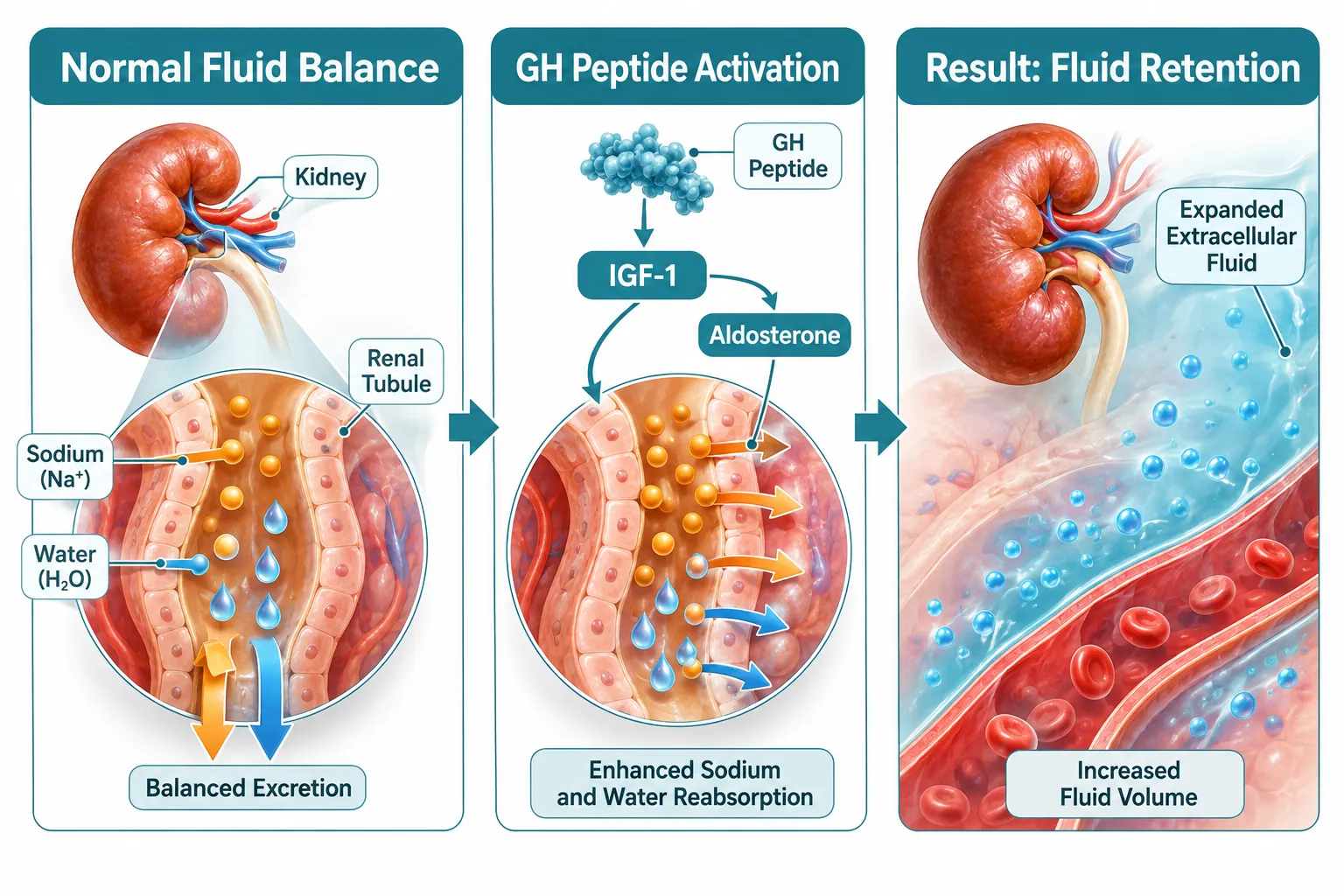
How Growth-Hormone Peptides Drive Fluid Retention

Growth-hormone secretagogues and GHRH analogs, the class of compounds that includes tesa-based protocols, stimulate endogenous GH release. That GH pulse triggers an IGF-1 response that, in turn, promotes sodium and water reabsorption in the renal tubules. The result is an expansion of extracellular fluid volume that shows up almost immediately on the scale.

This mechanism is well-established. GH and GH-related peptides shift sodium-water handling rather than directly increasing adipose tissue. The water retention is dose-dependent: larger or more frequent administrations produce more pronounced fluid accumulation. Critically, the effect is reversible, fluid redistributes back toward baseline when dosing is reduced or discontinued.

"The scale going up during a GH peptide protocol almost always reflects water, not fat. Treating it as fat gain is a measurement error, not a physiology lesson."

For anyone following a tesa dosage for bodybuilding protocol, understanding this distinction prevents unnecessary caloric restriction that undermines the goal of the compound entirely.

Regulatory labeling updated in 2025-2026 now consistently highlights fluid retention as a primary monitoring parameter for GH-class products, reinforcing that practitioners must track it separately from true composition changes.


Why Diuretics Distort the Picture Further
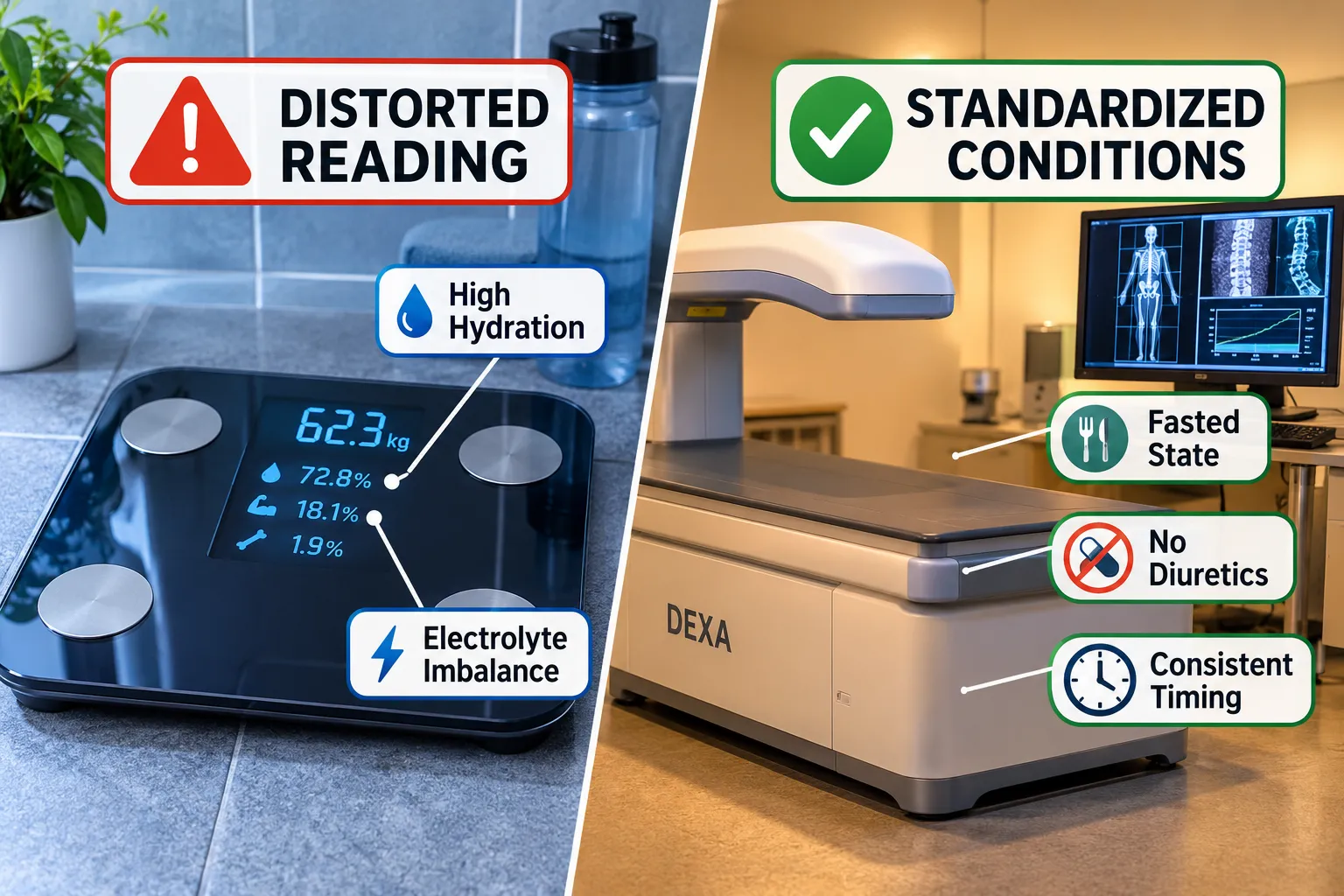
Why Diuretics Distort the Picture Further

Diuretics operate through completely different mechanisms, yet they produce a mirror-image problem. HCTZ works on the distal tubule to block sodium-chloride co-transport, pulling water out through the kidneys. Furosemide, a loop diuretic, blocks a broader sodium-potassium-chloride transporter in the loop of Henle, producing faster and more dramatic fluid loss, along with significant potassium and magnesium depletion.

The clinical danger here is twofold:

  1. Measurement distortion: Rapid water loss makes the scale drop and BIA devices report falsely elevated lean-mass percentages, since the device interprets lower total body water as proportionally more muscle.
  2. Electrolyte depletion + exercise risk: Diuretic-driven hypokalemia combined with intense physical activity magnifies cardiac arrhythmia risk. This is not theoretical, it is a documented interaction that has ended athletic careers.

Combining diuretics with GH peptide protocols creates competing fluid signals. The peptide retains water; the diuretic flushes it. The body composition reading at any single point reflects whichever force is currently dominant, not actual tissue changes.

Compound Primary Fluid Action Electrolyte Effect BIA Impact
GH Peptides Increases extracellular water Mild sodium retention Falsely lower lean-mass %
HCTZ Reduces total body water Potassium/magnesium loss Falsely higher lean-mass %
Furosemide Rapid total body water loss Significant K+/Mg2+ depletion Severely distorted readings

Standardizing Assessment to Get Accurate Body Composition Data
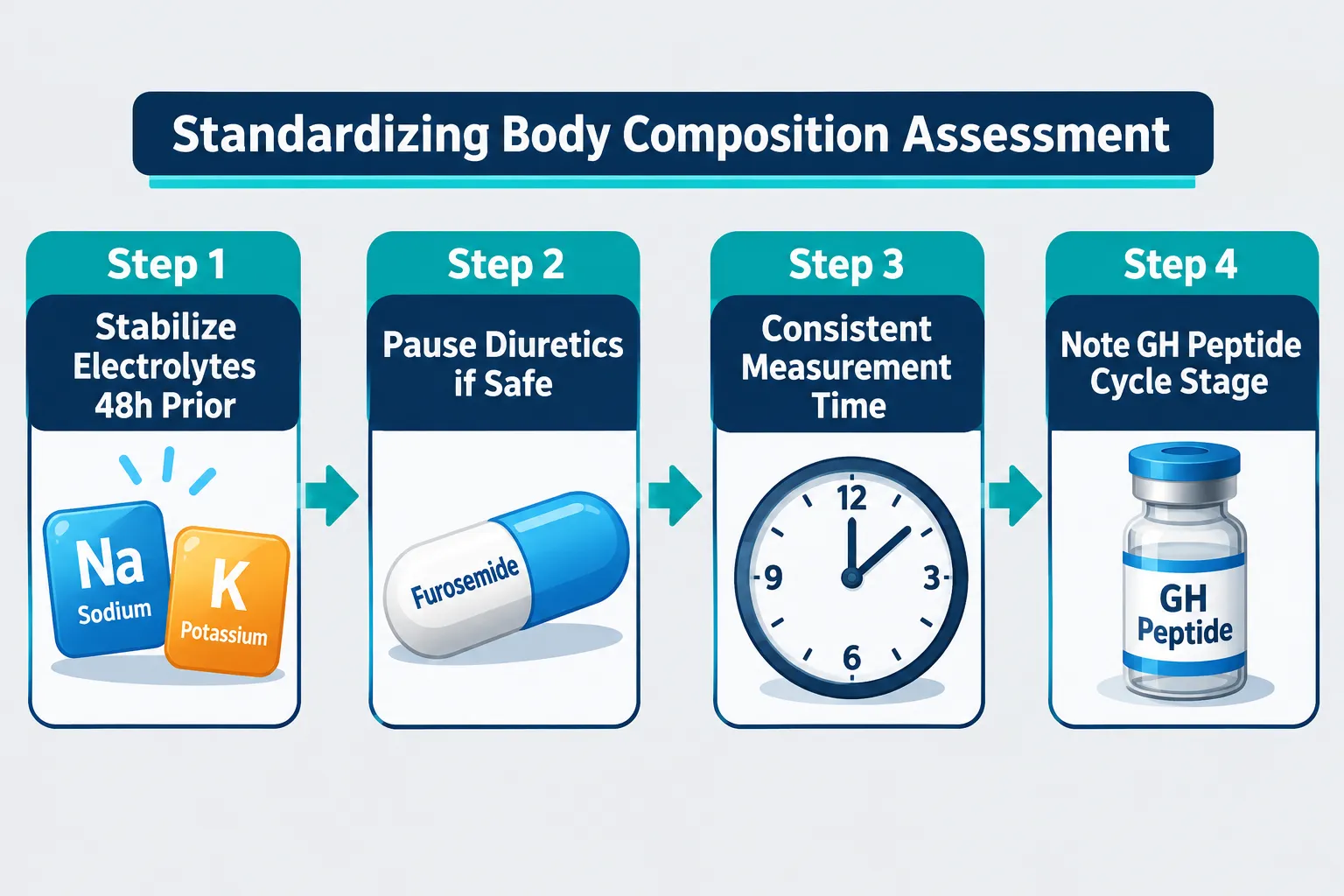
Standardizing Assessment to Get Accurate Body Composition Data

The expert consensus in 2026 is clear: body composition should only be interpreted when fluid status, medications, and timing have been standardized. Without that foundation, even imaging-based methods like DEXA are affected, though less so than BIA.

BIA scales are the worst performers under variable hydration conditions. A person who drank an extra liter of water or took a diuretic the previous evening can see lean-mass readings shift by three to five pounds from one morning to the next with zero actual tissue change. For anyone researching peptide compounds and their effect on weight endpoints, this point cannot be overstated. Resources like what is the strongest peptide for weight loss often focus on fat oxidation mechanisms, but those mechanisms are invisible if the measurement tool is compromised by fluid noise.

A practical standardization protocol:

  • 48 hours before assessment: stabilize sodium and potassium intake; avoid high-sodium processed foods.
  • Morning of assessment: fasted state, consistent time (within 30 minutes of prior tests), post first void.
  • Medication pause: if clinically safe, pause diuretics for 48 hours before measurement; document GH peptide cycle stage.
  • Hydration: maintain consistent water intake; avoid heavy exercise the prior day.
  • Record confounders: note menstrual cycle phase, recent illness, travel, or unusual stress.

This protocol applies whether using BIA, DEXA, or hydrostatic weighing. The goal is to hold the fluid variable constant so that any change in the number genuinely reflects tissue change.

For those researching peptide mechanisms more broadly, the GLP-3 peptide signaling pathway article provides useful context on how peptide classes interact with metabolic endpoints differently, and how GLP-1 peptides affect body composition through appetite and metabolic routes rather than direct fluid retention pathways.

Looking ahead, body-composition tool manufacturers are expected to integrate hydration and medication flags directly into consumer and clinical devices, a development that would automatically alert users when a reading is likely compromised by fluid status.


Conclusion

Fluid retention from electrolyte shifts, diuretic use, or growth-hormone peptide protocols is one of the most common and least-corrected sources of body-composition measurement error. Recognizing that a rising scale during a GH peptide cycle reflects reversible water retention, not fat gain, and that furosemide or HCTZ "weight loss" reflects electrolyte depletion rather than fat reduction, is foundational to any honest tracking practice.

Actionable next steps:

  1. Standardize measurement conditions before drawing any conclusion from a body composition reading.
  2. Document current medications, including diuretics and peptide cycle stage, alongside every assessment.
  3. Use BIA readings only as directional trend data, not absolute values, whenever hydration or electrolyte status is in flux.
  4. If managing both diuretic and GH peptide protocols, consider imaging-based assessments at standardized intervals rather than relying on daily scale data.
  5. Consult a qualified clinician before pausing any prescribed diuretic for measurement purposes.

Accurate composition data is only possible when the fluid variable is controlled. Everything else is measuring water.

https://www.puretestedpeptides.com/wp-content/uploads/2026/11/electrolytes-diuretics-and-growth-hormone-peptides-interpreting-fluid-retention.webp 1024 1536 https://www.puretestedpeptides.com/wp-content/uploads/2026/01/buy-peptides-online.jpg 2026-11-05 14:03:452026-11-05 14:03:45Electrolytes, Diuretics, and Growth-Hormone Peptides: Interpreting Fluid Retention Without Misreading Body Composition
×

Helpful Links

  • My account
  • Cart
  • Checkout
  • Refund and Returns Policy
  • Privacy Policy
  • SMS Privacy Policy
  • Login
  • My Account
  • Logout

USA Made Lab Tested Peptides

All products are sold for research, laboratory, or analytical purposes only, and are not for human consumption


Pure Tested Peptides is a chemical supplier. Pure Tested Peptides is not a compounding / chemical compounding facility as defined under 503A of the Federal Food, Drug, and Cosmetic act. Pure Tested Peptides is not an outsourcing facility as defined under 503B of the Federal Food, Drug, and Cosmetic act.

The statements made within this website have not been evaluated by the US Food and Drug Administration. The products we offer are not intended to diagnose, treat, cure or prevent any disease.

Human/Animal Consumption Prohibited. Laboratory/In-Vitro Experimental Use Only

Scroll to top Scroll to top Scroll to top