Call or Text 727-513-9780
  • Shopping Cart Shopping Cart
    0Shopping Cart
Pure Tested Peptides | America's most trusted Peptides for sale online
  • Peptides for sale
    • Oral Peptides for sale
      • Peptide Capsules for sale
      • BPC 157 Capsules 1000mcg
      • SLU-PP-332 Capsules | 1000 mcg
      • 5-Amino-1MQ 50mg Capsules
      • Tesofensine 500mcg
    • All Peptides for sale
    • Peptide Sprays
      • BPC 157 Nasal Spray Kit
      • BPC-157 TB500 Nasal Spray Kit
      • Semax Nasal Spray 10mg
      • Selank – Nasal Spray Kit – 10mg
      • Epithalon 50MG Nasal Spray Kit
      • Ipamorelin 10mg Nasal Spray
      • Klow Nasal Spray (BPC-157 + TB-500 + GHK-Cu + KPV) | 80mg
      • Hulk Nasal Spray Tesa / Ipa Blend 6/3 MG
      • Klow Nasal Spray
      • NAD + 500 mg Nasal Spray
      • PT-141 Nasal Spray Kit
    • GHRH Peptides
      • Ipa Peptides
      • CJC-1295 Peptides
        • CJC-1295 with DAC 5 mg
        • CJC-1295 without DAC 5 mg
        • CJC-1295 Ipa 10mg
      • Tesa Peptides
        • Tesa Peptide
        • Tesa 20 mg
    • GHK-Cu Peptides
      • All GHK-Cu Peptides
      • GHK-Cu 100mg
      • KLOW Peptide Blend – Buy KLOW blend online
    • BPC Peptides
      • All BPC Peptides
      • BPC-157
      • BPC-157 TB-500
      • BPC 157 capsules 1000mcg
    • SLU-PP-332 Peptides
      • All SLU-PP-332 Peptides
      • SLU-PP-332 5mg
    • GLP3 Peptides
    • PT-141 Peptides
      • PT-141 Peptides for sale
      • PT-141 10mg
      • PT-141 Nasal Spray
    • CAG Peptides
      • Lipo-C Peptide Blend
      • CAG 5mg
      • CAG 10mg
    • MOTS-C Peptides
      • MOTS-C Peptides for sale
      • MOTS-c peptide
      • MOTS-c 10mg *6 pack*
    • 5 Amino 1MQ Peptides
      • 5 Amino 1MQ Peptides for sale
      • 5-Amino-1MQ 50mg Capsules
      • 5-Amino-1MQ 5mg
    • Epithalon Peptides
      • Epithalon Peptides for sale
      • Epithalon 10mg
      • Epithalon 50mg
  • Shop
    • GLPs
      • 5-Amino-1MQ 50mg Capsules
      • 5-Amino-1MQ 5mg
      • L-Carnitine 500mg/ml
      • Tesofensine 500mcg
      • SLU-PP-332 5mg
      • MOTS-c 10mg *6 pack*
    • Epithalon & BPC Peptides
      • Epithalon 10mg
      • Epithalon 50mg
      • BPC-157
      • BPC 157 capsules 1000mcg
      • BPC-157 TB-500
      • BPC-157 TB500 Nasal Spray Kit
      • BPC 157 Nasal Spray Kit
    • BPC TB-500 & NAD+ Peptides
      • NAD+ 500 mg
      • KLOW Peptide Blend – Buy KLOW blend online
      • GLOW Peptide Blend
      • TB 500 5mg
      • BPC 157 capsules 1000mcg – Supplement
      • BPC 157 Nasal Spray Kit
      • BPC-157
      • BPC-157 TB500 Nasal Spray Kit
      • BPC-157 TB-500
      • BPC 157 capsules 1000mcg
    • LL-37 Peptide
      • LL-37 10 mg
    • MOTS-C & Selank
      • MOTS-c peptide
      • Selank 10mg
    • GHK Peptides
      • GHK-Cu 100mg
      • GLOW Peptide Blend
      • KLOW Peptide Blend – Buy KLOW blend online
  • COAs
  • Wholesale
    • Wholesale Peptides for sale
  • PTP FAQ
  • Affiliates
    • Selank Peptide: Advanced Pharmacological Mechanisms Underlying Its Anxiolytic and Nootropic Effects in Research
      • 5-Amino-1MQ Peptide: Detailed Mechanisms of NNMT Inhibition and Its Impact on Cellular Metabolism Research
        • MOTS-C Peptide: Unraveling Its Role in Mitochondrial Dynamics and Energy Metabolism Research
          • Epithalon Peptide and Telomerase Regulation: Investigating Its Impact on Cellular Senescence and Lifespan Research Models
            • GLP2-T vs GLP2 Tirz Peptide: Understanding the Naming, Mechanistic Nuances, and Research Implications for Gut Health
      • Peptides and Polypeptides in Modern Pharmacology: What Research on Metoprolol, Prednisone, and Amlodipine Reveals
        • Polypeptide Peptides vs NSAIDs: What Naproxen and Diclofenac Teach Tissue-Repair Researchers About BPC‑157 and TB‑500
          • Peptides and Polypeptides in Endocrine Pharmacology: How GLP-1, GLP-2, and GLP-3 Retatrutide Differ From Classic Drugs Like Prednisone and Amlodipine
          • 5‑Amino‑1MQ Peptide and NNMT Inhibition: How It Compares With Statins Like Atorvastatin in Adipose and Lipid Metabolism Research
      • Enclomiphene, Estrogen Receptor Signaling, and Luteinizing Phase Biology: What Hormone Researchers Should Measure
        • Mesenchymal Stem Cells, BPC‑157, and GHK‑Cu: How Tissue Repair Peptides Compare With Classic NSAIDs Like Naproxen in Injury Models
          • Peptide Calculator Use Cases Beyond Growth Hormone: Working Through GLP‑3 Retatrutide, MOTS‑c, and BPC‑157 Research Dosing
        • Polypeptide Peptides in Endocrine and Metabolic Pharmacology: Lessons From Amlodipine, Prednisone, and Metoprolol
        • Peptides Calculator for Advanced Blends: Worked Examples for Tesamorelin, CJC‑1295, and Ipamorelin Stacks
          • Peptides and Polypeptides in Human Physiology: How Molecular Size Shapes Research Applications
            • Selank Peptide: Advanced Pharmacological Mechanisms Underlying Its Anxiolytic and Nootropic Effects in Research
          • 5-Amino-1MQ Peptide: Detailed Mechanisms of NNMT Inhibition and Its Impact on Cellular Metabolism Research
            • MOTS-C Peptide: Unraveling Its Role in Mitochondrial Dynamics and Energy Metabolism Research
              • Epithalon Peptide and Telomerase Regulation: Investigating Its Impact on Cellular Senescence and Lifespan Research Models
                • GLP2-T vs GLP2 Tirz Peptide: Understanding the Naming, Mechanistic Nuances, and Research Implications for Gut Health
                  • Peptides and Polypeptides in Endocrine Pharmacology: How GLP-1, GLP-2, and GLP-3 Retatrutide Differ From Classic Drugs Like Prednisone and Amlodipine
                    • Polypeptide Peptides vs NSAIDs: What Naproxen and Diclofenac Teach Tissue-Repair Researchers About BPC‑157 and TB‑500
                      • Peptides and Polypeptides in Modern Pharmacology: What Research on Metoprolol, Prednisone, and Amlodipine Reveals
                        • 5‑Amino‑1MQ Peptide and NNMT Inhibition: How It Compares With Statins Like Atorvastatin in Adipose and Lipid Metabolism Research
                        • Enclomiphene, Estrogen Receptor Signaling, and Luteinizing Phase Biology: What Hormone Researchers Should Measure
                        • Mesenchymal Stem Cells, BPC‑157, and GHK‑Cu: How Tissue Repair Peptides Compare With Classic NSAIDs Like Naproxen in Injury Models
                        • Peptide Calculator Use Cases Beyond Growth Hormone: Working Through GLP‑3 Retatrutide, MOTS‑c, and BPC‑157 Research Dosing
                        • Polypeptide Peptides in Endocrine and Metabolic Pharmacology: Lessons From Amlodipine, Prednisone, and Metoprolol
                        • Peptides Calculator for Advanced Blends: Worked Examples for Tesamorelin, CJC‑1295, and Ipamorelin Stacks
                        • Peptides and Polypeptides in Human Physiology: How Molecular Size Shapes Research Applications
                        • Selank Peptide: Advanced Pharmacological Mechanisms Underlying Its Anxiolytic and Nootropic Effects in Research
                        • MOTS-C Peptide: Unraveling Its Role in Mitochondrial Dynamics and Energy Metabolism Research
                        • Peptides and Polypeptides in Modern Pharmacology: What Research on Metoprolol, Prednisone, and Amlodipine Reveals
                        • Peptides and Polypeptides in Endocrine Pharmacology: How GLP-1, GLP-2, and GLP-3 Retatrutide Differ From Classic Drugs Like Prednisone and Amlodipine
                        • 5-Amino-1MQ Peptide: Detailed Mechanisms of NNMT Inhibition and Its Impact on Cellular Metabolism Research
                        • Mesenchymal Stem Cells, BPC‑157, and GHK‑Cu: How Tissue Repair Peptides Compare With Classic NSAIDs Like Naproxen in Injury Models
                        • Peptide Calculator Use Cases Beyond Growth Hormone: Working Through GLP‑3 Retatrutide, MOTS‑c, and BPC‑157 Research Dosing
                        • GLP2-T vs GLP2 Tirz Peptide: Understanding the Naming, Mechanistic Nuances, and Research Implications for Gut Health
                        • Polypeptide Peptides in Endocrine and Metabolic Pharmacology: Lessons From Amlodipine, Prednisone, and Metoprolol
                        • Polypeptide Peptides vs NSAIDs: What Naproxen and Diclofenac Teach Tissue-Repair Researchers About BPC‑157 and TB‑500
                        • Peptides and Polypeptides in Human Physiology: How Molecular Size Shapes Research Applications
                        • Peptides Calculator for Advanced Blends: Worked Examples for Tesamorelin, CJC‑1295, and Ipamorelin Stacks
                        • 5‑Amino‑1MQ Peptide and NNMT Inhibition: How It Compares With Statins Like Atorvastatin in Adipose and Lipid Metabolism Research
                        • Enclomiphene, Estrogen Receptor Signaling, and Luteinizing Phase Biology: What Hormone Researchers Should Measure
                        • Epithalon Peptide and Telomerase Regulation: Investigating Its Impact on Cellular Senescence and Lifespan Research Models
                        • Best research protocol Klow blend
                        • best time to take BPC-157
                        • best time to take DSIP (Delta Sleep Inducing Peptide)
                        • best time to take CJC-1295
                        • best time to take AOD-9604
                        • best time to take Follistatin 344
                        • best time to take Ipamorelin
                        • best time to take MK-677 (Ibutamoren)
                        • best time to take Ligandrol (LGD-4033) — research compound
                        • best time to take Ostarine (MK-2866) — research compound
                        • best time to take GHK-CU
                        • best time to take TB-500
                        • best time to take MOTS-c
                        • best time to take Semax
                        • best time to take RAD-140 (Testolone) — research compound
                        • best time to take Thymosin Alpha-1
                        • best time to take PEG-MGF
                        • Biolife Plasma, Octapharma Plasma, and Research Peptides: How Plasma Donation Labs Differ From Peptide Suppliers
                        • best time to take YK-11 — research compound
                        • best time to take PT-141 (Bremelanotide)
                        • Best research protocol Klow blend
                        • 5-Amino-1MQ and MOTS-C Synergy: Metabolic Signaling, Mitochondria, and Research Design
                        • BPC-157 and TB-500: Investigating Their Combined Effects on Angiogenesis and Cellular Migration in Tissue Repair Models
                        • BPC-157 Peptide: Gut Barrier Function, Inflammation, and Tissue-Recovery Research
                        • 5‑Amino‑1MQ and MOTS‑c Synergy in Metabolic Research: Designing NNMT and Mitochondrial Biogenesis Stacks
                        • CJC-1295 with DAC vs. Without DAC: Half-Life, Release Kinetics, and Research Implications
                        • CJC‑1295 with DAC vs. Without DAC: Expanding on Half‑Life Differences Using Tesamorelin and Ipamorelin Blend Case Studies
                        • Collagen Biology and Copper‑Binding Peptides: How GHK‑Cu, Glow Blend, and Klow Blend Interact with Skin and Connective Tissue
                        • Collagen Biology and Regenerative Peptides: How GHK‑Cu, Glow Blend, and Klow Blend Affect Extracellular Matrix Research
                    • DNA, Telomeres, and Longevity Peptides: Positioning Epithalon and MOTS‑c in Genetic Aging Research
                      • Enclomiphene Citrate: serm Mechanism, Testosterone Research, and Stack Compatibility
                        • Enclomiphene vs Enclomiphene Citrate: Formulation, Bioavailability, and Research Distinctions
                        • Epithalon Peptide Research: Telomerase Activation, Aging, and Pineal Gland Function
                        • Estrogen Receptor Signaling and Enclomiphene: How Selective Modulators Compare with Classic Polypeptide Hormones
                        • GHK-Cu Peptide: Advanced Mechanisms in Extracellular Matrix Remodeling and Wound Healing Research
                        • GHK-Cu Peptide: Collagen Synthesis, Wound Repair, and Skin-Barrier Research Models
                        • GLP-1 vs GLP-3 vs GLP-2: Peptide Classification and Research Applications
                        • GLP-2 Peptide Research Guide: Gut Barrier Function, Nutrient Absorption, and Intestinal Recovery Models
                        • GLP-3 Retatrutide vs. GLP-1 Drugs: What Triple-Agonist Biology Changes in Research Models
                        • Ipamorelin and Tesamorelin Combination: Synergistic GH Secretagogue Research and Dosing Protocols
                        • GLP2 Tirz Peptide: What It Is, Why the Name Exists, and How Researchers Should Interpret It
                        • Klow Blend Peptide Nasal Spray: What the Formulation Is Trying to Do in Cognitive Research
                        • Mitochondria, NNMT Inhibition, and Peptide Modulators: Where MOTS‑c and 5‑Amino‑1MQ Fit in Cellular Energy Research
                        • MOTS-c Peptide: Mitochondrial Function, Energy Metabolism, and What Researchers Measure
                        • MOTS-c vs. 5-Amino-1MQ: Which Metabolic Research Questions Each Compound Actually Answers
                        • Nasal Spray Peptides: Bioavailability, Administration, and Semax/Selank Research Applications
                        • PT-141 Peptide Research: Mechanism of Action and Melanocortin Receptor Signaling
                        • Retatrutide for Research: Mechanism, Structure, and GLP-1/GLP-3 Dual Action
                        • Retatrutide for Obesity and Type 2 Diabetes: What the Latest Trial Data Suggest
                        • Tesofensine Peptide Research: Mechanism, Appetite Suppression, and Neuropeptide Y Pathways
  • Contact
    • Contact Customer Service
    • Text Customer Support
  • About US
  • Shop all peptides
  • Affiliate Program
    • Affiliate Signup
  • Login / Register Login / Register Page Link Login / Register Page Link
  • Click to open the search input field Click to open the search input field Search
  • Menu Menu

Tag Archive for: buspirone anxiolytic

Buspirone and Selank Anxiolytic Protocols: Separating 5-HT1A Receptor Agonism From Peptide Neurotrophic Activity

Buspirone and Selank Anxiolytic Protocols: Separating 5-HT1A Receptor Agonism From Peptide Neurotrophic Activity

October 28, 2026/0 Comments/in Uncategorized/by

Anxiety disorders affect roughly one in three adults at some point during their lifetime, yet fewer than half receive mechanistically targeted treatment. The gap between broad-spectrum sedation and precise neurochemical intervention has never been wider, or more important to close. Buspirone and Selank anxiolytic protocols: separating 5-HT1A receptor agonism from peptide neurotrophic activity represents one of the most methodologically significant distinctions in contemporary anxiety pharmacology. These two agents operate through fundamentally different biological pathways, and conflating them risks both under-treatment and missed synergistic opportunity.

Key Takeaways

  • Buspirone works as a partial 5-HT1A receptor agonist with delayed onset, modulating serotonin and dopamine signaling in limbic circuits.
  • Selank is a synthetic heptapeptide that potentiates GABAergic tone, regulates enkephalins, and upregulates neurotrophic factors such as BDNF.
  • The two agents do not share a mechanism of action, making their pharmacological profiles complementary rather than redundant.
  • No large-scale clinical trials combining buspirone and Selank existed as of 2026, meaning protocol design must draw from independent evidence bases.
  • Purity and sourcing quality critically affect peptide research reproducibility; supplier verification is essential.

How Buspirone Acts on the 5-HT1A Receptor System

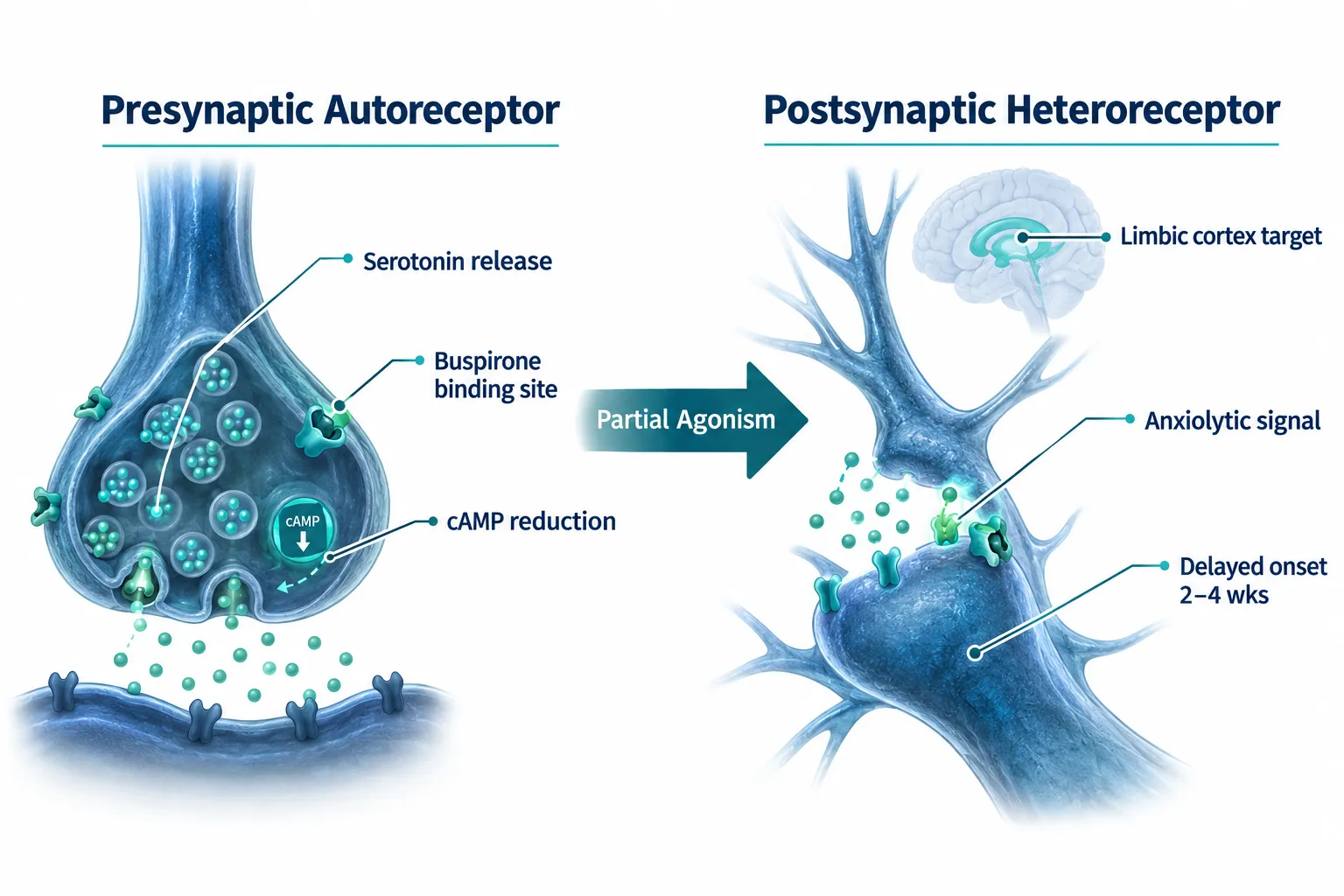
Buspirone is classified as an azapirone anxiolytic. Its primary mechanism involves partial agonism at 5-HT1A receptors, which are found as both presynaptic autoreceptors on raphe serotonergic neurons and postsynaptic heteroreceptors in limbic regions including the hippocampus and prefrontal cortex.
How Buspirone Acts on the 5-HT1A Receptor System

At presynaptic autoreceptors, buspirone binding reduces serotonin synthesis and release, a counterintuitive initial effect that explains its well-documented two-to-four-week latency before anxiolytic benefit emerges. Postsynaptic heteroreceptor activity in the amygdala and cingulate cortex eventually produces the net anxiolytic outcome. Buspirone also shows partial agonism at dopamine D2 receptors, which contributes to its mild antidepressant properties and differentiates it from benzodiazepines entirely.

Key pharmacokinetic facts:

Parameter Detail
Onset of anxiolytic effect 2-4 weeks
Half-life Approximately 2-3 hours
Primary metabolism Hepatic (CYP3A4)
Abuse potential Minimal, no GABA-A activity
Common dose range 5-30 mg/day in divided doses

Because buspirone does not engage GABA-A receptors, it carries no dependence liability, no sedation risk, and no cognitive blunting, a significant advantage over benzodiazepines in long-term anxiety management. Studies evaluating buspirone's effect on emotional processing confirm improvements in threat-signal recognition without impairment of working memory, underscoring its prefrontal-limbic specificity.

Research into newer 5-HT1A agonists such as DSP-1181 reveals that partial agonism at this receptor class remains a productive pharmacological target, validating buspirone's mechanism even while newer analogs are explored. For researchers interested in broader peptide modalities, exploring resources like the Semax peptide literature, another nootropic-anxiolytic agent, provides useful comparative context on serotonergic versus peptide-mediated approaches.


Selank's Neurotrophic and GABAergic Mechanism: A Distinct Protocol Framework

Selank (Thr-Lys-Pro-Arg-Pro-Gly-Pro) is a synthetic analog of the endogenous immunomodulatory peptide tuftsin. It does not bind 5-HT1A receptors. Its anxiolytic behavioral readouts emerge through a separate set of mechanisms, making Buspirone and Selank anxiolytic protocols: separating 5-HT1A receptor agonism from peptide neurotrophic activity a genuine methodological necessity rather than an academic distinction.
Selank's Neurotrophic and GABAergic Mechanism: A Distinct Protocol Framework

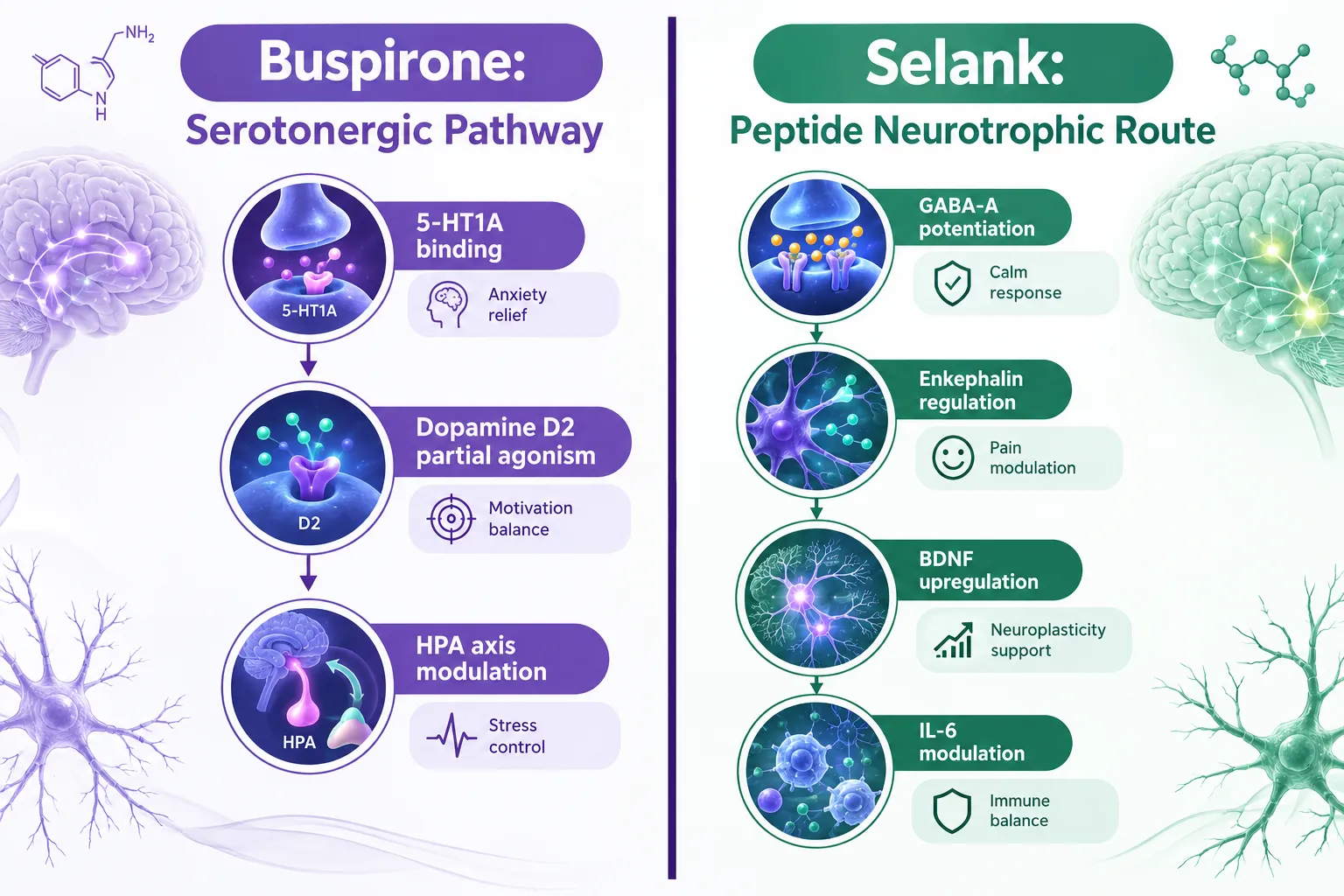
Selank's documented mechanisms include:

  • GABA-A potentiation: Selank enhances the sensitivity of GABA-A receptors without directly binding benzodiazepine sites, producing anxiolysis without sedation or tolerance development.
  • Enkephalin regulation: The peptide slows enzymatic degradation of met-enkephalin, extending endogenous opioid peptide activity in emotional processing circuits.
  • Neurotrophic upregulation: Selank increases expression of brain-derived neurotrophic factor (BDNF), suggesting neuroprotective and neuroplastic consequences beyond acute anxiolysis.
  • Immune-neuromodulation: Interleukin-6 and related cytokines are modulated by Selank, linking anxiety management to inflammatory signaling in ways buspirone does not address.

Clinical trials conducted in Russian research institutions compared Selank against medazepam (a benzodiazepine) in generalized anxiety disorder. Selank produced equivalent anxiolytic efficacy with markedly superior tolerability, no sedation, no withdrawal effects, and preserved psychomotor function. Unlike benzodiazepines, Selank appears to support cognitive clarity, consistent with its BDNF-upregulating properties.

Selank is typically administered intranasally at doses ranging from 250 to 500 micrograms, reflecting its peptide structure and degradation vulnerability via oral routes. Researchers evaluating peptide quality standards may find the guidance on peptide supplier comparisons interpreting Peptidetech Co and Peptidesc relevant to ensuring research-grade purity. Similarly, those assessing broader peptide sourcing standards can consult resources on where to buy research-grade Glow Blend Peptide evaluating purity as a model for verification criteria.


Designing Combined Anxiolytic Protocols in 2026

No peer-reviewed randomized controlled trial has yet evaluated the combination of buspirone and Selank directly. Protocol development in 2026 therefore requires triangulating independent evidence streams while respecting the mechanistic independence of each agent.
Designing Combined Anxiolytic Protocols in 2026

The mechanistic separation that defines Buspirone and Selank anxiolytic protocols: separating 5-HT1A receptor agonism from peptide neurotrophic activity is precisely what makes combination approaches theoretically attractive. Buspirone addresses serotonergic dysregulation and dopamine D2 tone; Selank addresses GABAergic sensitivity, enkephalin kinetics, and neurotrophic deficits. These are non-overlapping targets.

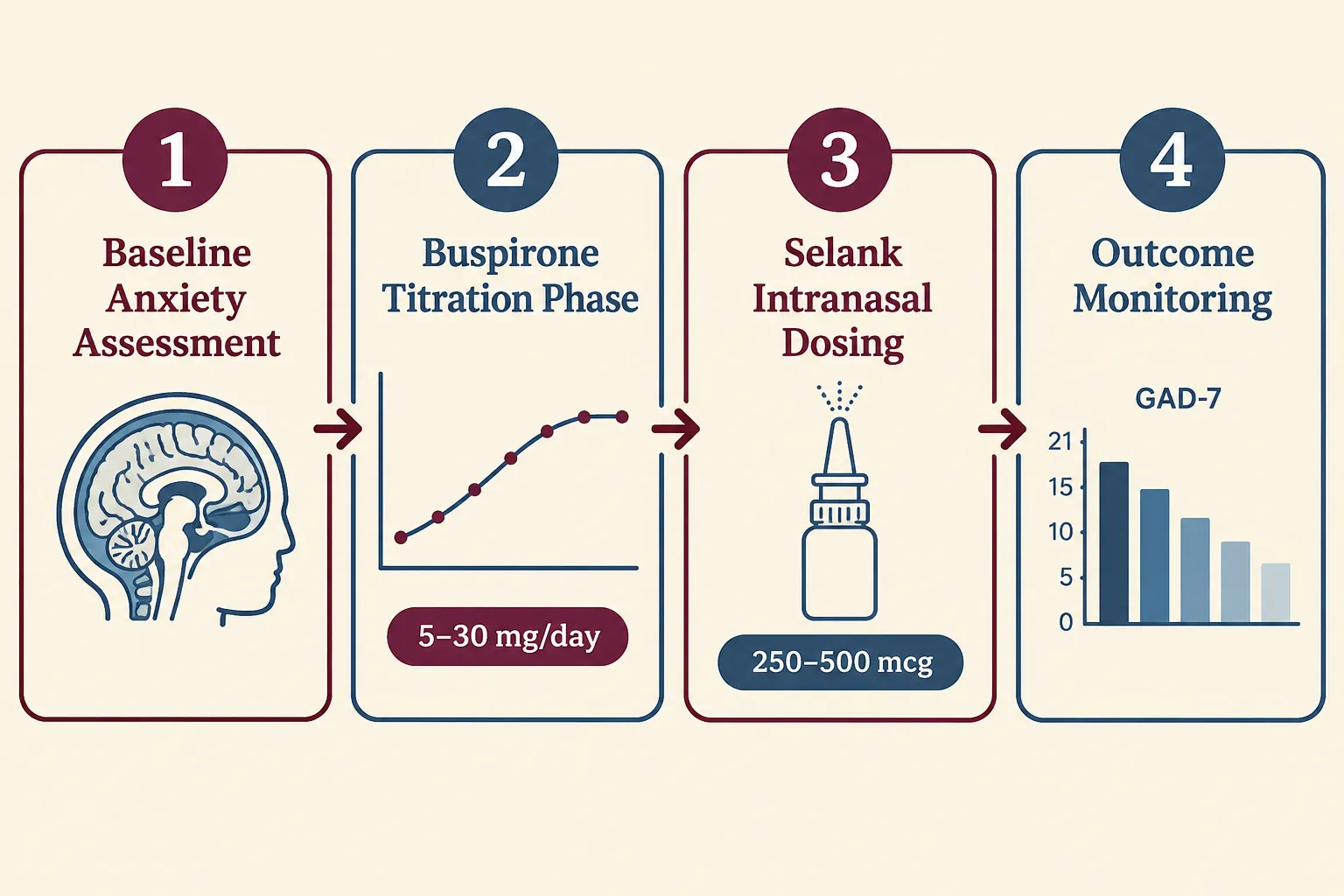
A rational stepwise protocol framework might include:

  1. Baseline assessment using validated tools (GAD-7, HAM-A) to characterize anxiety subtype and severity.
  2. Buspirone titration beginning at 5 mg twice daily, increasing over two to four weeks to therapeutic dose (15-30 mg/day), allowing 5-HT1A autoreceptor desensitization to complete.
  3. Selank adjunct introduction via intranasal administration at 250 mcg once or twice daily after buspirone steady-state is established.
  4. Outcome monitoring at four-week intervals, tracking both symptom scores and cognitive function to differentiate neurotrophic contributions from acute anxiolytic effects.

"The value of separating these two agents mechanistically is not academic, it is the foundation of rational dosing, accurate attribution of benefit, and safe protocol design."

Researchers examining mitochondria-targeted peptides for neuroprotection may also note relevant parallels in the MOTS-C peptide literature, where cellular energy regulation intersects with stress resilience pathways. Separately, those working with growth-related hormonal peptides such as Tesamorelin peptide benefits may find neuroendocrine interaction points worth tracking when co-administering multiple agents.

Considerations for protocol safety:

  • Buspirone interacts with CYP3A4 inhibitors; grapefruit juice and certain antifungals elevate plasma levels.
  • Selank's short plasma half-life requires consistent dosing schedules to maintain GABAergic effects.
  • Neither agent produces the respiratory depression associated with benzodiazepines or barbiturates.
  • Abuse liability data confirm that buspirone carries minimal misuse potential, consistent with its lack of GABA-A activity.

Conclusion

The mechanistic divergence between buspirone's 5-HT1A partial agonism and Selank's GABAergic and neurotrophic activity is not merely a pharmacology footnote, it is the conceptual backbone of effective anxiolytic protocol design. Treating these agents as interchangeable or redundant wastes their complementary potential. Researchers and clinicians in 2026 should approach buspirone and Selank anxiolytic protocols: separating 5-HT1A receptor agonism from peptide neurotrophic activity as a framework for precision, not a semantic exercise.

Actionable next steps:

  • Map individual anxiety profiles to the specific receptor systems most likely disrupted before selecting agents.
  • Source research-grade Selank from verified suppliers with documented purity testing.
  • Establish buspirone steady-state before layering in peptide adjuncts to isolate each agent's contribution.
  • Monitor cognitive and neurotrophic outcomes, not just anxiety scores, to capture Selank's full biological footprint.
  • Track emerging trials comparing novel 5-HT1A agonists against established anxiolytics to calibrate protocol evolution.

The cleaner the mechanistic separation, the more precise the therapeutic outcome.

https://www.puretestedpeptides.com/wp-content/uploads/2026/10/buspirone-and-selank-anxiolytic-protocols-separating-5-ht1a-receptor-agonism-fro.webp 1024 1536 https://www.puretestedpeptides.com/wp-content/uploads/2026/01/buy-peptides-online.jpg 2026-10-28 13:04:372026-10-28 13:04:37Buspirone and Selank Anxiolytic Protocols: Separating 5-HT1A Receptor Agonism From Peptide Neurotrophic Activity
×

Helpful Links

  • My account
  • Cart
  • Checkout
  • Refund and Returns Policy
  • Privacy Policy
  • SMS Privacy Policy
  • Login
  • My Account
  • Logout

USA Made Lab Tested Peptides

All products are sold for research, laboratory, or analytical purposes only, and are not for human consumption


Pure Tested Peptides is a chemical supplier. Pure Tested Peptides is not a compounding / chemical compounding facility as defined under 503A of the Federal Food, Drug, and Cosmetic act. Pure Tested Peptides is not an outsourcing facility as defined under 503B of the Federal Food, Drug, and Cosmetic act.

The statements made within this website have not been evaluated by the US Food and Drug Administration. The products we offer are not intended to diagnose, treat, cure or prevent any disease.

Human/Animal Consumption Prohibited. Laboratory/In-Vitro Experimental Use Only

Scroll to top Scroll to top Scroll to top