Call or Text 727-513-9780
  • Shopping Cart Shopping Cart
    0Shopping Cart
Pure Tested Peptides | America's most trusted Peptides for sale online
  • Peptides for sale
    • Oral Peptides for sale
      • Peptide Capsules for sale
      • BPC 157 Capsules 1000mcg
      • SLU-PP-332 Capsules | 1000 mcg
      • 5-Amino-1MQ 50mg Capsules
      • Tesofensine 500mcg
    • All Peptides for sale
    • Peptide Sprays
      • BPC 157 Nasal Spray Kit
      • BPC-157 TB500 Nasal Spray Kit
      • Semax Nasal Spray 10mg
      • Selank – Nasal Spray Kit – 10mg
      • Epithalon 50MG Nasal Spray Kit
      • Ipamorelin 10mg Nasal Spray
      • Klow Nasal Spray (BPC-157 + TB-500 + GHK-Cu + KPV) | 80mg
      • Hulk Nasal Spray Tesa / Ipa Blend 6/3 MG
      • Klow Nasal Spray
      • NAD + 500 mg Nasal Spray
      • PT-141 Nasal Spray Kit
    • GHRH Peptides
      • Ipa Peptides
      • CJC-1295 Peptides
        • CJC-1295 with DAC 5 mg
        • CJC-1295 without DAC 5 mg
        • CJC-1295 Ipa 10mg
      • Tesa Peptides
        • Tesa Peptide
        • Tesa 20 mg
    • GHK-Cu Peptides
      • All GHK-Cu Peptides
      • GHK-Cu 100mg
      • KLOW Peptide Blend – Buy KLOW blend online
    • BPC Peptides
      • All BPC Peptides
      • BPC-157
      • BPC-157 TB-500
      • BPC 157 capsules 1000mcg
    • SLU-PP-332 Peptides
      • All SLU-PP-332 Peptides
      • SLU-PP-332 5mg
    • GLP3 Peptides
    • PT-141 Peptides
      • PT-141 Peptides for sale
      • PT-141 10mg
      • PT-141 Nasal Spray
    • CAG Peptides
      • Lipo-C Peptide Blend
      • CAG 5mg
      • CAG 10mg
    • MOTS-C Peptides
      • MOTS-C Peptides for sale
      • MOTS-c peptide
      • MOTS-c 10mg *6 pack*
    • 5 Amino 1MQ Peptides
      • 5 Amino 1MQ Peptides for sale
      • 5-Amino-1MQ 50mg Capsules
      • 5-Amino-1MQ 5mg
    • Epithalon Peptides
      • Epithalon Peptides for sale
      • Epithalon 10mg
      • Epithalon 50mg
  • Shop
    • GLPs
      • 5-Amino-1MQ 50mg Capsules
      • 5-Amino-1MQ 5mg
      • L-Carnitine 500mg/ml
      • Tesofensine 500mcg
      • SLU-PP-332 5mg
      • MOTS-c 10mg *6 pack*
    • Epithalon & BPC Peptides
      • Epithalon 10mg
      • Epithalon 50mg
      • BPC-157
      • BPC 157 capsules 1000mcg
      • BPC-157 TB-500
      • BPC-157 TB500 Nasal Spray Kit
      • BPC 157 Nasal Spray Kit
    • BPC TB-500 & NAD+ Peptides
      • NAD+ 500 mg
      • KLOW Peptide Blend – Buy KLOW blend online
      • GLOW Peptide Blend
      • TB 500 5mg
      • BPC 157 capsules 1000mcg – Supplement
      • BPC 157 Nasal Spray Kit
      • BPC-157
      • BPC-157 TB500 Nasal Spray Kit
      • BPC-157 TB-500
      • BPC 157 capsules 1000mcg
    • LL-37 Peptide
      • LL-37 10 mg
    • MOTS-C & Selank
      • MOTS-c peptide
      • Selank 10mg
    • GHK Peptides
      • GHK-Cu 100mg
      • GLOW Peptide Blend
      • KLOW Peptide Blend – Buy KLOW blend online
  • COAs
  • Wholesale
    • Wholesale Peptides for sale
  • PTP FAQ
  • Affiliates
    • Selank Peptide: Advanced Pharmacological Mechanisms Underlying Its Anxiolytic and Nootropic Effects in Research
      • 5-Amino-1MQ Peptide: Detailed Mechanisms of NNMT Inhibition and Its Impact on Cellular Metabolism Research
        • MOTS-C Peptide: Unraveling Its Role in Mitochondrial Dynamics and Energy Metabolism Research
          • Epithalon Peptide and Telomerase Regulation: Investigating Its Impact on Cellular Senescence and Lifespan Research Models
            • GLP2-T vs GLP2 Tirz Peptide: Understanding the Naming, Mechanistic Nuances, and Research Implications for Gut Health
      • Peptides and Polypeptides in Modern Pharmacology: What Research on Metoprolol, Prednisone, and Amlodipine Reveals
        • Polypeptide Peptides vs NSAIDs: What Naproxen and Diclofenac Teach Tissue-Repair Researchers About BPC‑157 and TB‑500
          • Peptides and Polypeptides in Endocrine Pharmacology: How GLP-1, GLP-2, and GLP-3 Retatrutide Differ From Classic Drugs Like Prednisone and Amlodipine
          • 5‑Amino‑1MQ Peptide and NNMT Inhibition: How It Compares With Statins Like Atorvastatin in Adipose and Lipid Metabolism Research
      • Enclomiphene, Estrogen Receptor Signaling, and Luteinizing Phase Biology: What Hormone Researchers Should Measure
        • Mesenchymal Stem Cells, BPC‑157, and GHK‑Cu: How Tissue Repair Peptides Compare With Classic NSAIDs Like Naproxen in Injury Models
          • Peptide Calculator Use Cases Beyond Growth Hormone: Working Through GLP‑3 Retatrutide, MOTS‑c, and BPC‑157 Research Dosing
        • Polypeptide Peptides in Endocrine and Metabolic Pharmacology: Lessons From Amlodipine, Prednisone, and Metoprolol
        • Peptides Calculator for Advanced Blends: Worked Examples for Tesamorelin, CJC‑1295, and Ipamorelin Stacks
          • Peptides and Polypeptides in Human Physiology: How Molecular Size Shapes Research Applications
            • Selank Peptide: Advanced Pharmacological Mechanisms Underlying Its Anxiolytic and Nootropic Effects in Research
          • 5-Amino-1MQ Peptide: Detailed Mechanisms of NNMT Inhibition and Its Impact on Cellular Metabolism Research
            • MOTS-C Peptide: Unraveling Its Role in Mitochondrial Dynamics and Energy Metabolism Research
              • Epithalon Peptide and Telomerase Regulation: Investigating Its Impact on Cellular Senescence and Lifespan Research Models
                • GLP2-T vs GLP2 Tirz Peptide: Understanding the Naming, Mechanistic Nuances, and Research Implications for Gut Health
                  • Peptides and Polypeptides in Endocrine Pharmacology: How GLP-1, GLP-2, and GLP-3 Retatrutide Differ From Classic Drugs Like Prednisone and Amlodipine
                    • Polypeptide Peptides vs NSAIDs: What Naproxen and Diclofenac Teach Tissue-Repair Researchers About BPC‑157 and TB‑500
                      • Peptides and Polypeptides in Modern Pharmacology: What Research on Metoprolol, Prednisone, and Amlodipine Reveals
                        • 5‑Amino‑1MQ Peptide and NNMT Inhibition: How It Compares With Statins Like Atorvastatin in Adipose and Lipid Metabolism Research
                        • Enclomiphene, Estrogen Receptor Signaling, and Luteinizing Phase Biology: What Hormone Researchers Should Measure
                        • Mesenchymal Stem Cells, BPC‑157, and GHK‑Cu: How Tissue Repair Peptides Compare With Classic NSAIDs Like Naproxen in Injury Models
                        • Peptide Calculator Use Cases Beyond Growth Hormone: Working Through GLP‑3 Retatrutide, MOTS‑c, and BPC‑157 Research Dosing
                        • Polypeptide Peptides in Endocrine and Metabolic Pharmacology: Lessons From Amlodipine, Prednisone, and Metoprolol
                        • Peptides Calculator for Advanced Blends: Worked Examples for Tesamorelin, CJC‑1295, and Ipamorelin Stacks
                        • Peptides and Polypeptides in Human Physiology: How Molecular Size Shapes Research Applications
                        • Selank Peptide: Advanced Pharmacological Mechanisms Underlying Its Anxiolytic and Nootropic Effects in Research
                        • MOTS-C Peptide: Unraveling Its Role in Mitochondrial Dynamics and Energy Metabolism Research
                        • Peptides and Polypeptides in Modern Pharmacology: What Research on Metoprolol, Prednisone, and Amlodipine Reveals
                        • Peptides and Polypeptides in Endocrine Pharmacology: How GLP-1, GLP-2, and GLP-3 Retatrutide Differ From Classic Drugs Like Prednisone and Amlodipine
                        • 5-Amino-1MQ Peptide: Detailed Mechanisms of NNMT Inhibition and Its Impact on Cellular Metabolism Research
                        • Mesenchymal Stem Cells, BPC‑157, and GHK‑Cu: How Tissue Repair Peptides Compare With Classic NSAIDs Like Naproxen in Injury Models
                        • Peptide Calculator Use Cases Beyond Growth Hormone: Working Through GLP‑3 Retatrutide, MOTS‑c, and BPC‑157 Research Dosing
                        • GLP2-T vs GLP2 Tirz Peptide: Understanding the Naming, Mechanistic Nuances, and Research Implications for Gut Health
                        • Polypeptide Peptides in Endocrine and Metabolic Pharmacology: Lessons From Amlodipine, Prednisone, and Metoprolol
                        • Polypeptide Peptides vs NSAIDs: What Naproxen and Diclofenac Teach Tissue-Repair Researchers About BPC‑157 and TB‑500
                        • Peptides and Polypeptides in Human Physiology: How Molecular Size Shapes Research Applications
                        • Peptides Calculator for Advanced Blends: Worked Examples for Tesamorelin, CJC‑1295, and Ipamorelin Stacks
                        • 5‑Amino‑1MQ Peptide and NNMT Inhibition: How It Compares With Statins Like Atorvastatin in Adipose and Lipid Metabolism Research
                        • Enclomiphene, Estrogen Receptor Signaling, and Luteinizing Phase Biology: What Hormone Researchers Should Measure
                        • Epithalon Peptide and Telomerase Regulation: Investigating Its Impact on Cellular Senescence and Lifespan Research Models
                        • Best research protocol Klow blend
                        • best time to take BPC-157
                        • best time to take DSIP (Delta Sleep Inducing Peptide)
                        • best time to take CJC-1295
                        • best time to take AOD-9604
                        • best time to take Follistatin 344
                        • best time to take Ipamorelin
                        • best time to take MK-677 (Ibutamoren)
                        • best time to take Ligandrol (LGD-4033) — research compound
                        • best time to take Ostarine (MK-2866) — research compound
                        • best time to take GHK-CU
                        • best time to take TB-500
                        • best time to take MOTS-c
                        • best time to take Semax
                        • best time to take RAD-140 (Testolone) — research compound
                        • best time to take Thymosin Alpha-1
                        • best time to take PEG-MGF
                        • Biolife Plasma, Octapharma Plasma, and Research Peptides: How Plasma Donation Labs Differ From Peptide Suppliers
                        • best time to take YK-11 — research compound
                        • best time to take PT-141 (Bremelanotide)
                        • Best research protocol Klow blend
                        • 5-Amino-1MQ and MOTS-C Synergy: Metabolic Signaling, Mitochondria, and Research Design
                        • BPC-157 and TB-500: Investigating Their Combined Effects on Angiogenesis and Cellular Migration in Tissue Repair Models
                        • BPC-157 Peptide: Gut Barrier Function, Inflammation, and Tissue-Recovery Research
                        • 5‑Amino‑1MQ and MOTS‑c Synergy in Metabolic Research: Designing NNMT and Mitochondrial Biogenesis Stacks
                        • CJC-1295 with DAC vs. Without DAC: Half-Life, Release Kinetics, and Research Implications
                        • CJC‑1295 with DAC vs. Without DAC: Expanding on Half‑Life Differences Using Tesamorelin and Ipamorelin Blend Case Studies
                        • Collagen Biology and Copper‑Binding Peptides: How GHK‑Cu, Glow Blend, and Klow Blend Interact with Skin and Connective Tissue
                        • Collagen Biology and Regenerative Peptides: How GHK‑Cu, Glow Blend, and Klow Blend Affect Extracellular Matrix Research
                    • DNA, Telomeres, and Longevity Peptides: Positioning Epithalon and MOTS‑c in Genetic Aging Research
                      • Enclomiphene Citrate: serm Mechanism, Testosterone Research, and Stack Compatibility
                        • Enclomiphene vs Enclomiphene Citrate: Formulation, Bioavailability, and Research Distinctions
                        • Epithalon Peptide Research: Telomerase Activation, Aging, and Pineal Gland Function
                        • Estrogen Receptor Signaling and Enclomiphene: How Selective Modulators Compare with Classic Polypeptide Hormones
                        • GHK-Cu Peptide: Advanced Mechanisms in Extracellular Matrix Remodeling and Wound Healing Research
                        • GHK-Cu Peptide: Collagen Synthesis, Wound Repair, and Skin-Barrier Research Models
                        • GLP-1 vs GLP-3 vs GLP-2: Peptide Classification and Research Applications
                        • GLP-2 Peptide Research Guide: Gut Barrier Function, Nutrient Absorption, and Intestinal Recovery Models
                        • GLP-3 Retatrutide vs. GLP-1 Drugs: What Triple-Agonist Biology Changes in Research Models
                        • Ipamorelin and Tesamorelin Combination: Synergistic GH Secretagogue Research and Dosing Protocols
                        • GLP2 Tirz Peptide: What It Is, Why the Name Exists, and How Researchers Should Interpret It
                        • Klow Blend Peptide Nasal Spray: What the Formulation Is Trying to Do in Cognitive Research
                        • Mitochondria, NNMT Inhibition, and Peptide Modulators: Where MOTS‑c and 5‑Amino‑1MQ Fit in Cellular Energy Research
                        • MOTS-c Peptide: Mitochondrial Function, Energy Metabolism, and What Researchers Measure
                        • MOTS-c vs. 5-Amino-1MQ: Which Metabolic Research Questions Each Compound Actually Answers
                        • Nasal Spray Peptides: Bioavailability, Administration, and Semax/Selank Research Applications
                        • PT-141 Peptide Research: Mechanism of Action and Melanocortin Receptor Signaling
                        • Retatrutide for Research: Mechanism, Structure, and GLP-1/GLP-3 Dual Action
                        • Retatrutide for Obesity and Type 2 Diabetes: What the Latest Trial Data Suggest
                        • Tesofensine Peptide Research: Mechanism, Appetite Suppression, and Neuropeptide Y Pathways
  • Contact
    • Contact Customer Service
    • Text Customer Support
  • About US
  • Shop all peptides
  • Affiliate Program
    • Affiliate Signup
  • Login / Register Login / Register Page Link Login / Register Page Link
  • Click to open the search input field Click to open the search input field Search
  • Menu Menu

Tag Archive for: discontinuation rates

How to Interpret Weight Loss, A1C, and Discontinuation Rates in Retatrutide Research

How to Interpret Weight Loss, A1C, and Discontinuation Rates in Retatrutide Research

October 17, 2026/0 Comments/in Uncategorized/by

"

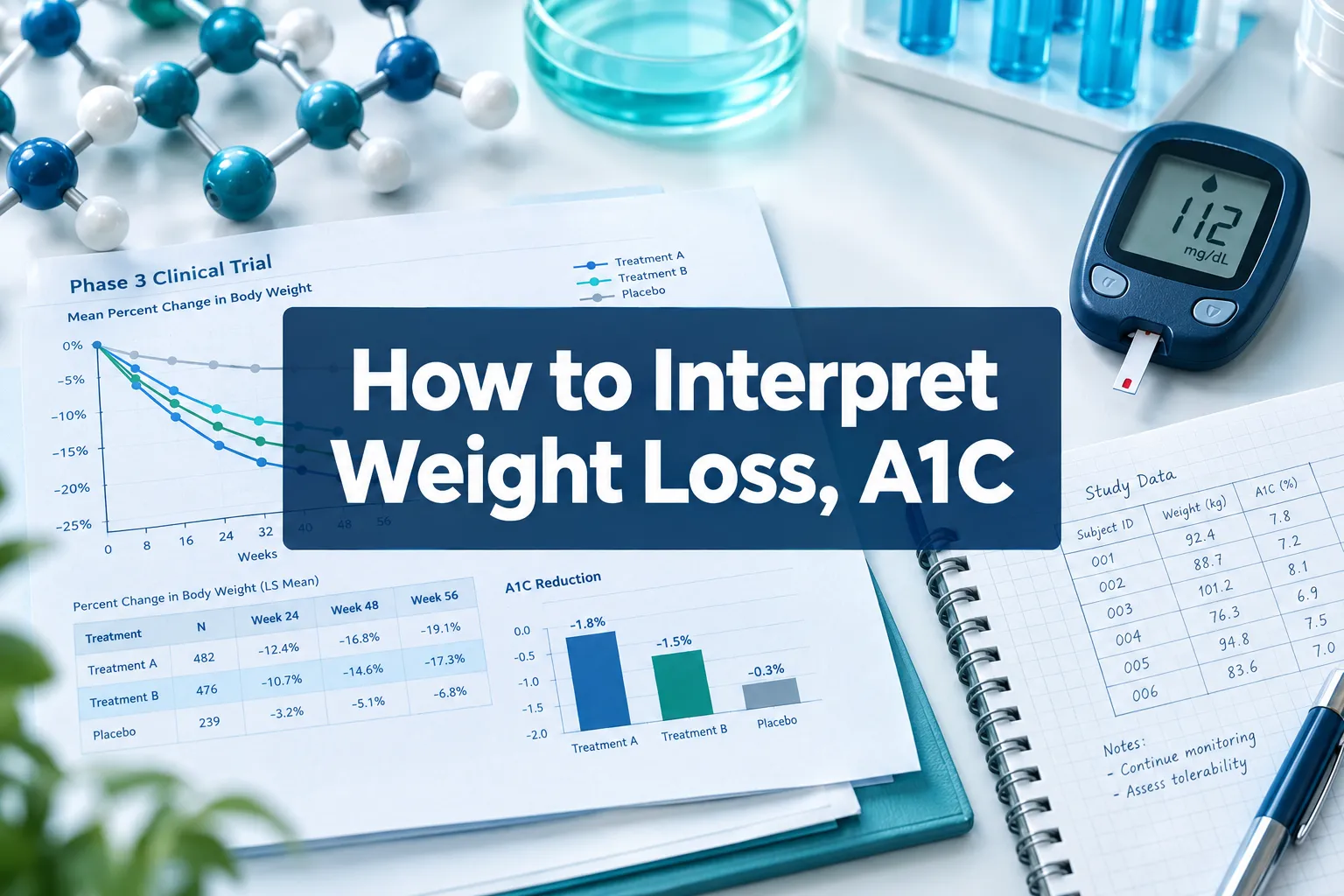
Professional () hero image with 'How to Interpret Weight Loss, A1C' in crisp white modern centered on a deep navy

A single phase-2 trial published in the New England Journal of Medicine reported mean body-weight reductions exceeding 17% at 24 weeks, a number that reshaped expectations for the entire incretin drug class. Yet that headline figure conceals at least six methodological layers that any serious researcher must unpack before drawing conclusions. Understanding how to interpret weight loss, A1C, and discontinuation rates in retatrutide research is not optional; it is the difference between actionable data and misleading benchmarks.

Key Takeaways

  • Percent weight loss and absolute weight loss tell different stories; always identify which metric a study reports.
  • A1C reductions must be read alongside baseline glycemic status, exposure duration, and dose level.
  • Discontinuation rates introduce survivorship bias; completer-only analyses inflate efficacy estimates.
  • Dose-escalation schedules vary across trials and directly affect both tolerability and endpoint timing.
  • Missing-data handling methods, such as last observation carried forward versus modified intent-to-treat, materially change how results should be interpreted.

Understanding the Metrics: A Research Checklist for Retatrutide Trials
Understanding the Metrics: A Research Checklist for Retatrutide Trials

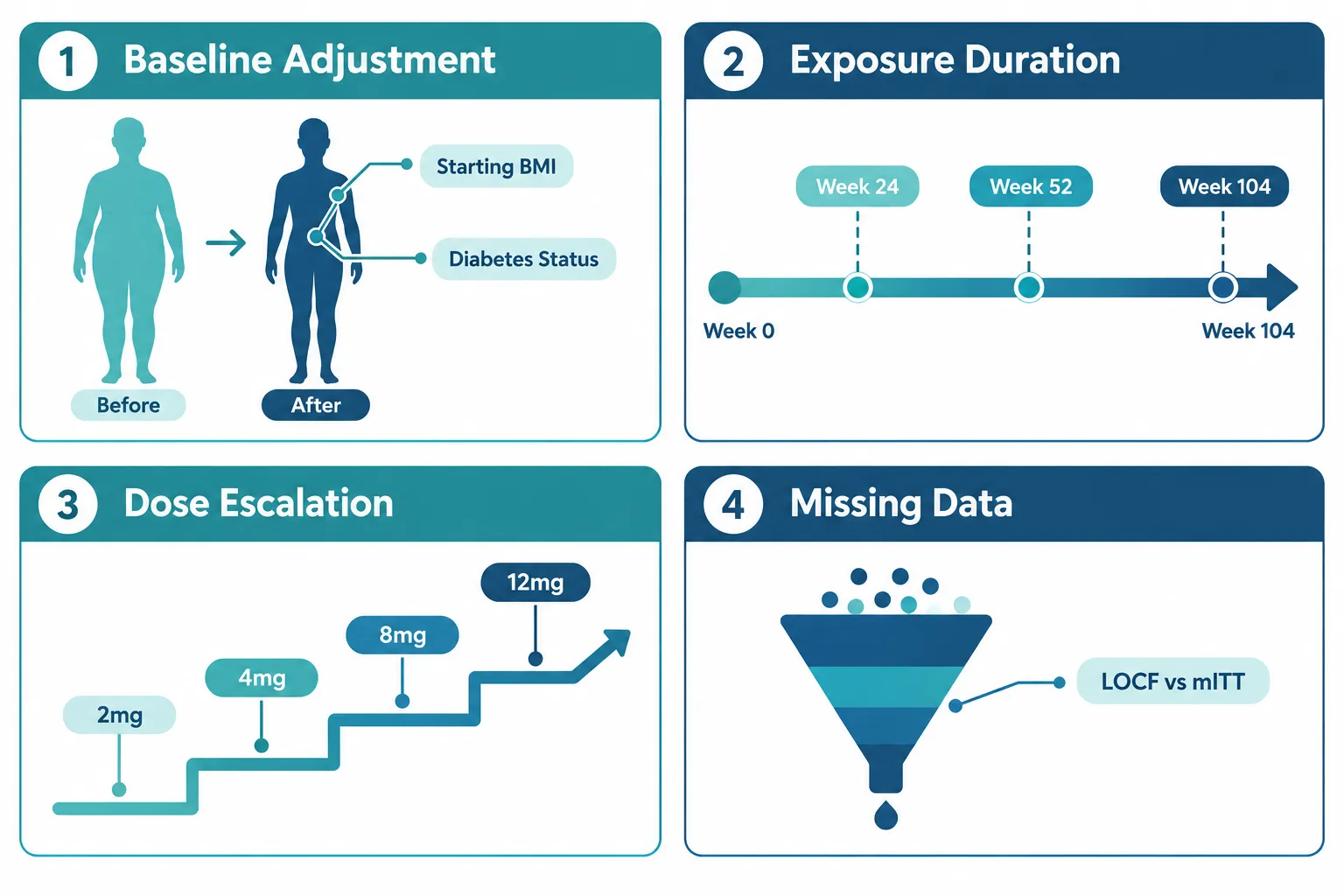
Before examining any specific endpoint, researchers reviewing retatrutide clinical trial data should build a structured checklist. Six variables consistently determine whether a reported number is comparable across studies.

1. Baseline adjustment. Weight-loss figures are meaningful only when the starting population is defined. TRIUMPH-3, the phase-3 obesity trial, enrolled adults with BMI of 30 or above without type 2 diabetes. TRIUMPH-2 enrolled adults with established type 2 diabetes, a population that typically shows attenuated weight loss due to disease-related metabolic differences. Comparing raw percentage figures between these two cohorts without baseline adjustment produces misleading conclusions.

2. Exposure duration. Long-term extension data from 2026 show approximately 30% mean weight loss at 104 weeks, roughly double the 24-week phase-2 figure. Researchers must anchor every efficacy claim to the exact week of assessment. A "24-week result" and a "2-year result" are not interchangeable data points.

3. Dose-escalation protocol. Retatrutide is titrated upward through multiple dose levels (commonly 2 mg, 4 mg, 8 mg, and 12 mg). Studies that terminate at lower doses or that allow slower escalation will report lower efficacy and potentially different tolerability profiles. Always confirm which dose was active at the time of the reported endpoint.

4. Missing-data handling. The modified intent-to-treat (mITT) population includes all randomized participants who received at least one dose. Last observation carried forward (LOCF) substitutes the final recorded value for participants who dropped out. These two approaches can shift reported weight loss by several percentage points. TRIUMPH-3 used mITT analysis; researchers comparing it to earlier phase-2 data should verify that the same convention was applied.

5. Responder rates versus mean change. A mean weight loss of 24% can mask a bimodal distribution where a subset of participants lost 40% and another subset lost less than 10%. Responder analyses, reporting the proportion achieving at least 5%, 10%, or 15% body-weight reduction, provide a more complete picture for visceral fat research contexts.

6. Tolerability and its interaction with efficacy. Gastrointestinal adverse events are the primary driver of early discontinuation. Participants who tolerate the drug long enough to reach maximum dose will inevitably show better outcomes than the full randomized group. This creates a systematic upward bias in completer analyses.


How to Interpret A1C Data in Retatrutide Research
How to Interpret A1C Data in Retatrutide Research

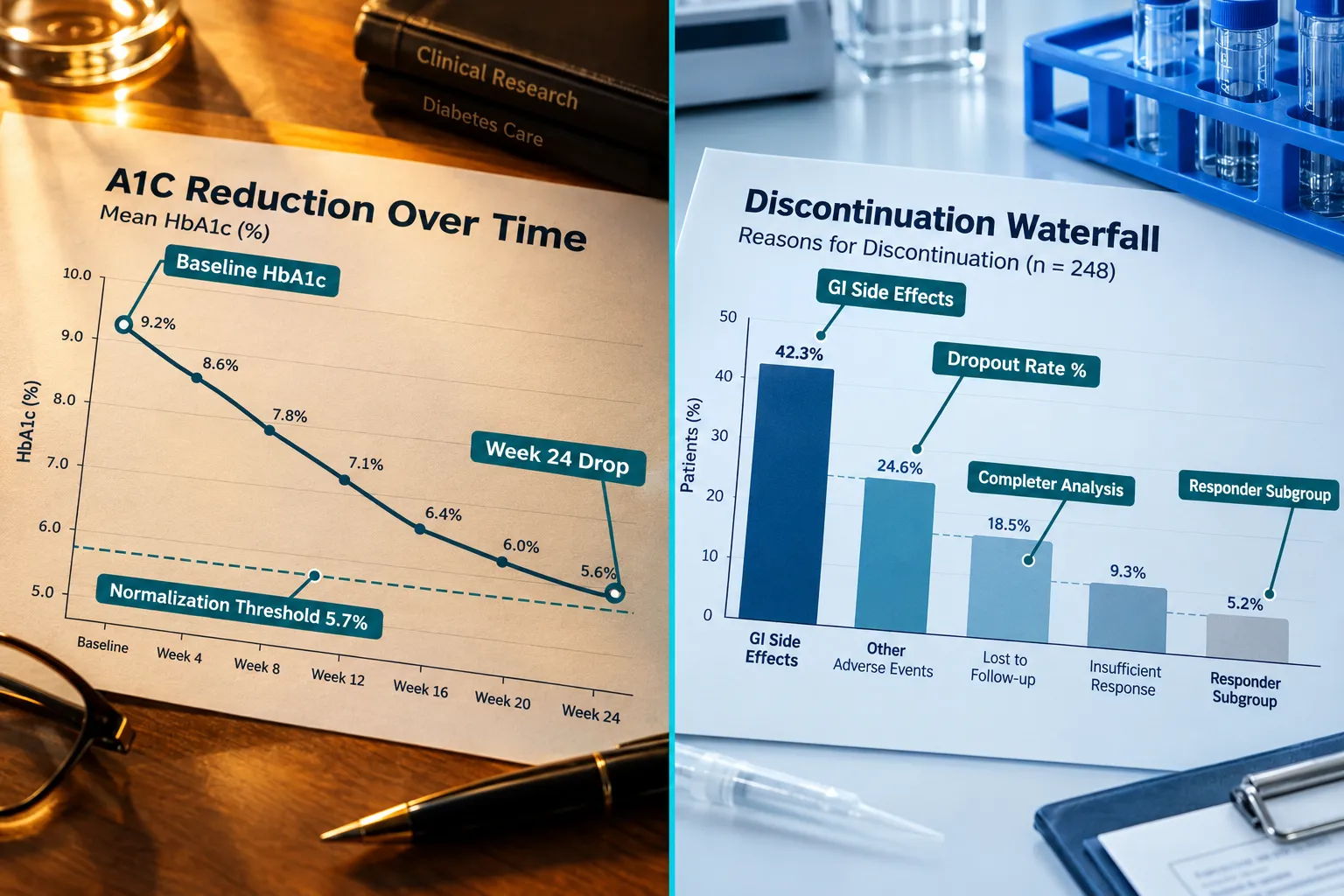
TRIUMPH-2 and the TRANSCEND-T2D-1 trial provide the most detailed glycemic data available as of 2026. TRANSCEND-T2D-1 reported A1C normalization, defined as reaching below 5.7%, in a substantial proportion of participants with type 2 diabetes, a result that positions retatrutide well above standard-of-care benchmarks. However, interpreting these numbers requires the same checklist discipline applied to weight-loss data.

"An A1C reduction from 8.5% to 6.2% and a reduction from 7.1% to 5.6% both represent meaningful clinical change, but they are not equivalent achievements and should never be averaged without stratification."

Baseline glycemic status matters most. A participant entering a trial with an A1C of 9% has more room to show a dramatic reduction than one starting at 7.2%. Meta-analytic reviews from 2025 and 2026 consistently flag this as the largest source of heterogeneity across retatrutide glycemic studies.

Concurrent weight loss confounds attribution. Because retatrutide acts on GLP-1, GIP, and glucagon receptors simultaneously, A1C improvements reflect both direct receptor-mediated effects and indirect benefits from weight reduction. Researchers should look for subgroup analyses that isolate glycemic response in participants with minimal weight loss to disentangle these mechanisms.

Dose level and A1C. Higher doses correlate with greater A1C reductions, but the dose-response curve flattens above 8 mg in most reported analyses. Citing an A1C result without specifying the active dose renders the figure nearly uninterpretable.

For researchers exploring related GLP-1 Reta receptor agonist mechanisms, understanding how triple-agonist activity differs from dual-agonist comparators is essential context for any glycemic endpoint.


Discontinuation Rates and What They Mean for Research Validity
Discontinuation Rates and What They Mean for Research Validity

TRIUMPH-3 reported discontinuation rates that, while lower than some earlier incretin trials, still warrant careful analysis. Approximately 10 to 16% of participants discontinued due to adverse events, primarily nausea, vomiting, and diarrhea, rates consistent with the class but not trivial.

Why discontinuation bias matters. When a trial reports efficacy only in completers, the remaining sample is systematically healthier and more tolerant. This is survivorship bias in its most direct form. A rigorous reading of how to interpret weight loss, A1C, and discontinuation rates in retatrutide research demands that readers identify whether the primary endpoint was calculated on the full mITT population or on completers only.

Sensitivity analyses are the gold standard. Well-designed trials include sensitivity analyses that model what outcomes would have looked like if all dropouts had remained on treatment. When sensitivity analyses produce results close to the primary analysis, confidence in the headline number increases substantially.

Safety signals from uncontrolled sources. Independent reporting in late 2026 highlighted safety concerns associated with counterfeit or improperly dosed buy Reta products circulating outside regulated research channels. These cases introduce noise into any real-world interpretation of tolerability data and underscore why sourcing integrity matters for laboratory use. Researchers seeking verified material should consult resources on where to buy Reta from tested, documented suppliers.

Regulatory implications. The FDA and other agencies evaluating retatrutide's approval pathway in 2026 have emphasized that labeling will reflect the full randomized population's outcomes, not completer subgroups. This distinction will directly affect how prescribing information frames expected weight loss and glycemic benefit in clinical practice.


Conclusion

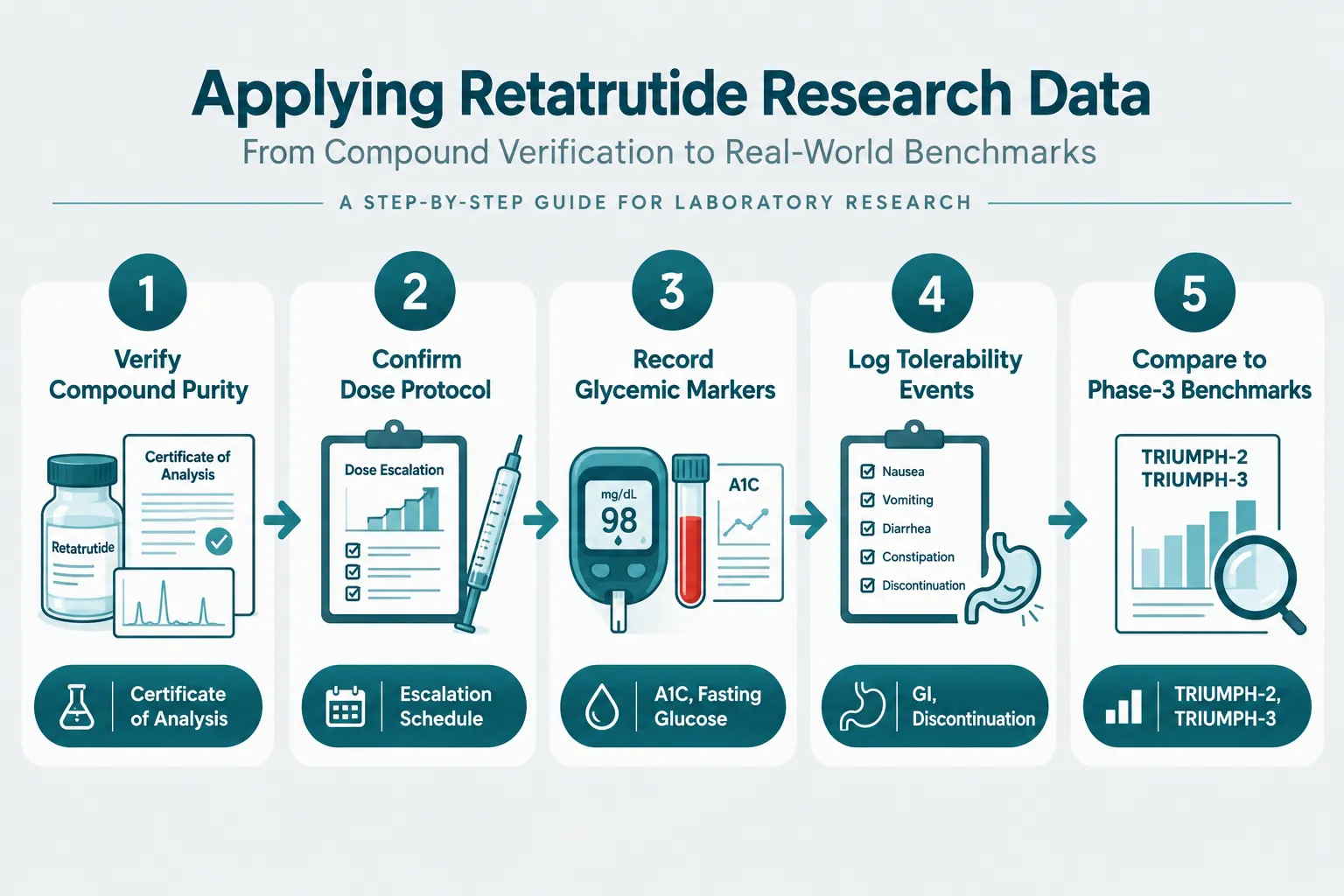
Interpreting retatrutide research accurately requires more than reading the abstract. Researchers should apply a six-point checklist, baseline adjustment, exposure duration, dose escalation, missing-data method, responder rates, and discontinuation analysis, to every efficacy claim before drawing comparisons or designing follow-on studies.

Actionable next steps for researchers in 2026:

  • Obtain the full statistical analysis plan for any trial before interpreting its primary endpoint.
  • Cross-reference weight-loss figures against the specific week, dose level, and analysis population reported.
  • Treat completer-only A1C data as hypothesis-generating rather than confirmatory.
  • Verify that any retatrutide compound used in laboratory settings comes from a documented, purity-tested source to prevent contaminated data.
  • Review long-term extension data alongside short-term phase-2 benchmarks to contextualize trajectory, not just magnitude.

The science behind this triple-receptor agonist is advancing rapidly. Applying rigorous interpretive standards now ensures that research contributions to this field remain credible and reproducible.

https://www.puretestedpeptides.com/wp-content/uploads/2026/10/how-to-interpret-weight-loss-a1c-and-discontinuation-rates-in-retatrutide-resear.webp 1024 1536 https://www.puretestedpeptides.com/wp-content/uploads/2026/01/buy-peptides-online.jpg 2026-10-17 13:05:092026-10-17 13:05:09How to Interpret Weight Loss, A1C, and Discontinuation Rates in Retatrutide Research
×

Helpful Links

  • My account
  • Cart
  • Checkout
  • Refund and Returns Policy
  • Privacy Policy
  • SMS Privacy Policy
  • Login
  • My Account
  • Logout

USA Made Lab Tested Peptides

All products are sold for research, laboratory, or analytical purposes only, and are not for human consumption


Pure Tested Peptides is a chemical supplier. Pure Tested Peptides is not a compounding / chemical compounding facility as defined under 503A of the Federal Food, Drug, and Cosmetic act. Pure Tested Peptides is not an outsourcing facility as defined under 503B of the Federal Food, Drug, and Cosmetic act.

The statements made within this website have not been evaluated by the US Food and Drug Administration. The products we offer are not intended to diagnose, treat, cure or prevent any disease.

Human/Animal Consumption Prohibited. Laboratory/In-Vitro Experimental Use Only

Scroll to top Scroll to top Scroll to top