
Retatrutide Phase 3 Data: How Researchers Should Separate Appetite, Energy Expenditure, and Glycemic Effects
Weight loss of nearly 21% of body weight in adults with type 2 diabetes is not a single-mechanism story. Yet that is precisely what Lilly's TRIUMPH-2 trial reported for the highest dose of retatrutide at 80 weeks. When a drug simultaneously activates GLP-1, GIP, and glucagon receptors, late-stage outcomes collapse three distinct physiological pathways into one number. Understanding Retatrutide Phase 3 Data: How Researchers Should Separate Appetite, Energy Expenditure, and Glycemic Effects is therefore less a statistical exercise and more a fundamental design imperative for anyone working with this compound.
Key Takeaways
- Retatrutide's TRIUMPH program spans four long-duration Phase 3 trials targeting obesity, type 2 diabetes, cardiovascular disease, and osteoarthritis.
- Composite endpoints, weight and A1c, integrate appetite, energy expenditure, and glucose effects rather than measuring each independently.
- Separating the three pathways requires dose-response modeling, indirect calorimetry substudies, and careful covariate design.
- TRIUMPH-2 reported up to 20.8% weight loss and A1c reductions of 1.6 percentage points, underscoring the magnitude of intertwined effects.
- Researchers sourcing this peptide for mechanistic study should prioritize verified purity and documented traceability.
The TRIUMPH Program: What the Phase 3 Architecture Looks Like
Lilly built the TRIUMPH umbrella around four registrational trials: TRIUMPH-1 for obesity and overweight, TRIUMPH-2 for obesity plus type 2 diabetes, TRIUMPH-3 for severe obesity with established cardiovascular disease, and TRIUMPH-4 for obesity with knee osteoarthritis.
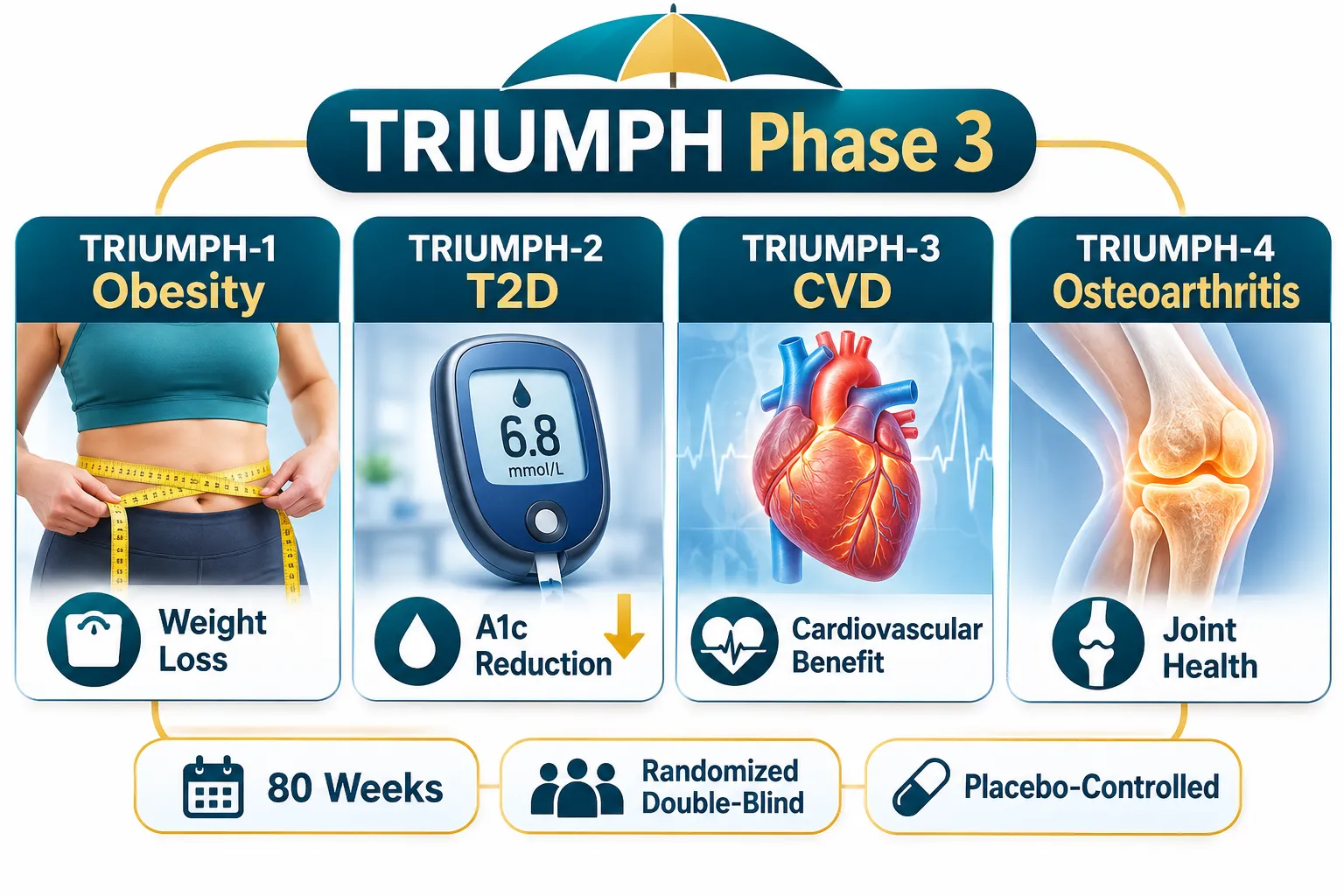
Every trial uses an 80-week (TRIUMPH-1) or similarly long randomized, double-blind, placebo-controlled design. All three weekly doses, 4 mg, 9 mg, and 12 mg, met primary and key secondary endpoints in TRIUMPH-1, delivering clinically meaningful reductions across the board. In TRIUMPH-2, those doses produced average weight reductions of 12.7%, 19.1%, and 20.8%, respectively, paired with A1c drops reaching 1.6 percentage points at 80 weeks.
This breadth positions retatrutide as a system-level metabolic intervention rather than a narrowly targeted weight drug. That ambition is also the core measurement challenge. For researchers exploring visceral fat research endpoints, a single composite outcome obscures which receptor arm is driving depot-specific fat loss.
Why Composite Endpoints Obscure Mechanism in Retatrutide Phase 3 Data
Registrational trials are optimized for regulatory approval, not mechanistic precision. TRIUMPH-2 uses weight and A1c as primary readouts across fixed doses over 80 weeks. This design is efficient but it integrates appetite suppression, altered energy expenditure, and improved glucose metabolism into a single output stream.
Consider what each receptor arm contributes:
| Receptor | Primary Metabolic Role | Expected Measurable Output |
|---|---|---|
| GLP-1 | Satiety signaling, gastric emptying, insulin secretion | Reduced caloric intake, A1c improvement |
| GIP | Adipose energy storage, insulin potentiation | Enhanced fat oxidation, energy expenditure |
| Glucagon | Hepatic glucose output, lipolysis, thermogenesis | Fasting glucose reduction, resting metabolic rate |
When a 12 mg dose produces 49.6 lbs of weight loss, researchers cannot determine from that number alone how much came from eating less versus burning more versus normalizing glucose flux. This is the central problem when interpreting Retatrutide Phase 3 Data: How Researchers Should Separate Appetite, Energy Expenditure, and Glycemic Effects.
"A triple agonist produces a triple blind spot in composite outcomes, each mechanism borrows statistical credit from the others."
Researchers working with GLP-3 Reta in pre-clinical or mechanistic contexts face this same layering problem at a smaller scale.
A Measurement Framework for Disaggregating the Three Pathways
Properly interpreting Retatrutide Phase 3 Data: How Researchers Should Separate Appetite, Energy Expenditure, and Glycemic Effects demands a layered analytical strategy built around three pillars.
Pillar 1: Appetite, Caloric Intake Substudies
Appetite effects are best captured through:
- Validated food diaries or doubly-labeled water intake estimates nested within the main trial
- Appetite visual-analogue scales at standardized time points
- Gastric emptying scintigraphy to separate mechanical slowing from central satiety
GLP-1 receptor activity is the dominant driver here. Isolating intake data from weight change requires holding physical activity constant as a covariate.
Pillar 2: Energy Expenditure, Metabolic Rate Substudies
Glucagon receptor agonism raises resting metabolic rate through hepatic and brown adipose thermogenesis. Measuring this requires:
- Indirect calorimetry at fasting baseline and post-dose intervals
- Respiratory quotient tracking to detect substrate oxidation shifts
- Lean mass preservation data (DEXA) to separate fat loss from muscle catabolism
Researchers interested in parallel mitochondrial mechanisms may find context in SS-31 mitochondrial research frameworks, which use similar calorimetric substudies.
Pillar 3: Glycemic Control, Glucose Kinetics
A1c is a lagging average. More granular separation requires:
- Fasting plasma glucose and 2-hour post-load glucose at each visit
- Homeostatic model assessment of insulin resistance (HOMA-IR)
- Continuous glucose monitoring substudies to capture time-in-range independently of weight-driven improvement
Because TRIUMPH-2 already embeds A1c as a primary endpoint, researchers can build co-primary models that partial out glycemic improvement from the weight-loss coefficient using mediation analysis.
Practical Design Additions
- Dose-response modeling across the 4/9/12 mg arms provides natural variation to test pathway dominance at different receptor occupancy levels.
- Covariate-adjusted mixed-effects models that include baseline insulin sensitivity, lean mass, and physical activity can attribute variance to each pathway.
For investigators sourcing research-grade material, verified purity matters enormously. Options such as GLP3 Reta 10mg and suppliers with buy Reta peptide documentation provide a starting point, though independent assay confirmation remains essential. Researchers seeking sourcing context can also review GLP-1 peptide buy: generational research concepts and sourcing notes for broader traceability considerations.
Applying the Framework Across TRIUMPH Subpopulations
TRIUMPH-3 targets adults with severe obesity (BMI 35 kg/m² or higher) and established cardiovascular disease. In this population, the glucagon-driven thermogenic arm becomes especially relevant because baseline resting metabolic rate is often suppressed. Separating energy expenditure gains from appetite-driven intake reductions is clinically critical when cardiovascular safety depends on muscle-preserving fat loss rather than lean mass wasting.
TRIUMPH-4's osteoarthritis cohort adds a functional dimension: weight loss improves joint load, but glycemic normalization also reduces inflammatory cytokines. Attributing pain score improvements requires knowing how much of the weight loss is adipose-driven (energy balance) versus inflammation-driven (glycemic control).
The master protocol structure of TRIUMPH-1, which nests sleep apnea and osteoarthritis subsets within the core obesity design, actually offers a methodological advantage. Researchers can exploit these nested groups as natural experiments, comparing pathway-level effects across populations with different baseline metabolic phenotypes.
Conclusion
Retatrutide's Phase 3 data represent a landmark in multi-receptor metabolic pharmacology. However, the same breadth that makes TRIUMPH's outcomes impressive makes mechanistic interpretation difficult without deliberate disaggregation.
Actionable next steps for researchers:
- Design or lobby for substudies that capture indirect calorimetry and caloric intake within the existing TRIUMPH framework.
- Apply mediation analysis to published TRIUMPH-2 data to partial out A1c improvement from weight-loss-mediated glycemic change.
- Use dose-response variation across the 4/9/12 mg arms as a natural instrument for identifying receptor-dominant pathway effects.
- Prioritize sourcing from suppliers with documented assay data when conducting independent mechanistic studies. Resources on AOD 9604 research method notes, storage and traceability offer a useful model for traceability standards to apply to retatrutide as well.
Separating appetite, energy expenditure, and glycemic effects in Retatrutide Phase 3 Data is not optional for researchers who want to understand what this molecule actually does, it is the scientific obligation that late-stage composite endpoints leave unfinished.