

Prostate Specific Antigen and Hormone-Modulating Compounds: How PSA Monitoring Interfaces With Enclomiphene and GLP-Class Peptide Research
Nearly one in eight men will receive a prostate cancer diagnosis during their lifetime, making prostate-specific antigen one of the most scrutinized biomarkers in all of medicine. As research into hormone-modulating compounds accelerates, particularly selective estrogen receptor modulators like enclomiphene and polypeptide agents such as GLP-1 and GLP-3 analogs, laboratories and clinicians face a practical question: how does PSA monitoring integrate with these newer interventions? Understanding Prostate Specific Antigen and Hormone-Modulating Compounds: How PSA Monitoring Interfaces With Enclomiphene and GLP-Class Peptide Research is no longer a niche concern; it sits at the intersection of endocrinology, oncology safety, and advanced peptide science.
Key Takeaways
- PSA is a serine protease produced by prostate epithelium; any intervention that raises testosterone, including enclomiphene, can modestly influence PSA values.
- Phase III enclomiphene trials have not demonstrated a statistically significant increase in PSA or a clear prostate cancer signal compared with placebo.
- Standard monitoring practice mirrors testosterone-replacement protocols: baseline PSA, repeat at 3 and 6 months, then periodic review.
- GLP-class peptides (GLP-1, GLP-3 analogs such as retatrutide) are not currently integrated into PSA-specific monitoring frameworks; their research focus remains metabolic and cardiovascular.
- PSA monitoring functions as a safety net, not as evidence that hormone-modulating therapy causes prostate cancer.
What Is PSA and Why Does Hormone Status Matter
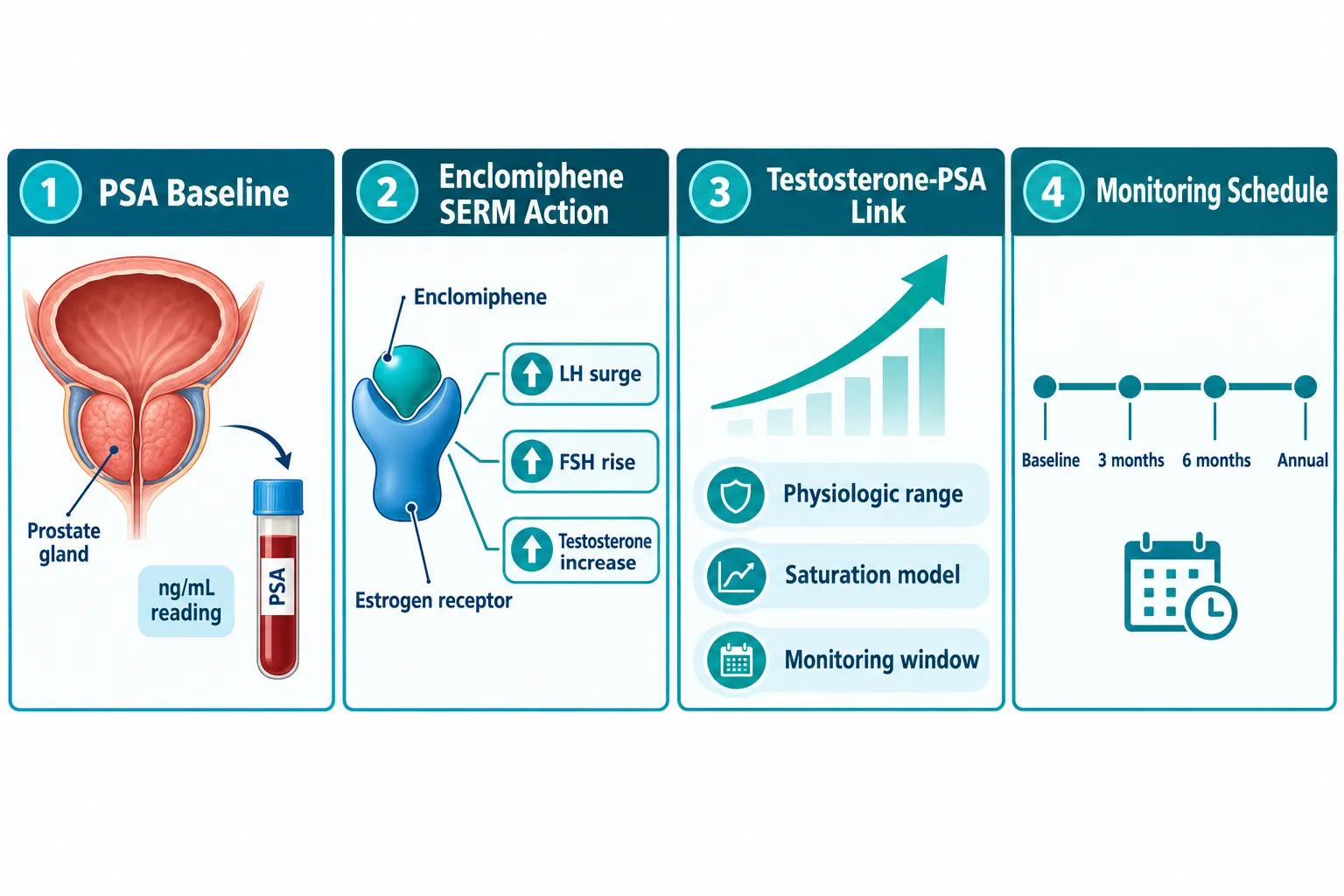
Prostate-specific antigen is a serine protease encoded by the KLK3 gene and secreted almost exclusively by prostate epithelial cells. Its primary physiologic role is liquefying seminal fluid, but because it leaks into circulation in proportion to prostate tissue volume and disruption, serum PSA has become the standard screening tool for prostate pathology.
Why does testosterone matter to PSA? Androgen receptors in prostate tissue directly regulate KLK3 transcription. When testosterone rises, whether from exogenous replacement or from endogenous stimulation, prostate cells can increase PSA secretion. This relationship is real but not linear. The "saturation model" of prostate androgen biology proposes that androgen receptors become fully occupied at relatively low testosterone concentrations (roughly 200-250 ng/dL), meaning that moving from low-normal to high-normal testosterone produces far less incremental PSA change than moving from castrate levels to low-normal. This model has important implications for how researchers interpret PSA data in enclomiphene studies.
Researchers exploring enclomiphene in male endocrine research and LH, FSH, and testosterone signaling need to understand this saturation dynamic before drawing conclusions from PSA fluctuations in study subjects.
Enclomiphene and PSA: What the Evidence Shows in 2026

Enclomiphene is the trans-isomer of clomiphene citrate. Unlike the mixed-isomer parent compound, it acts as a pure estrogen receptor antagonist at the hypothalamic-pituitary axis, blocking negative feedback and driving endogenous LH and FSH secretion, which in turn stimulates testicular testosterone production. This mechanism makes it conceptually distinct from exogenous testosterone, yet the downstream effect on prostate tissue is similar: higher circulating testosterone.
Phase III trials enrolling up to approximately 354 men over roughly six months have not shown a statistically significant PSA increase compared with placebo. No trial to date has demonstrated a cancer-incidence signal attributable to enclomiphene. Older comparative data pitting oral enclomiphene against transdermal testosterone gels found only small, clinically insignificant PSA changes with enclomiphene, changes that were not consistently observed with gels, suggesting that endogenous stimulation via a serm may affect PSA differently than direct exogenous androgen delivery.
For researchers building study designs, understanding how serms interact with polypeptide hormones in research provides essential context for interpreting hormone panels alongside PSA data.
Practical PSA Monitoring Thresholds
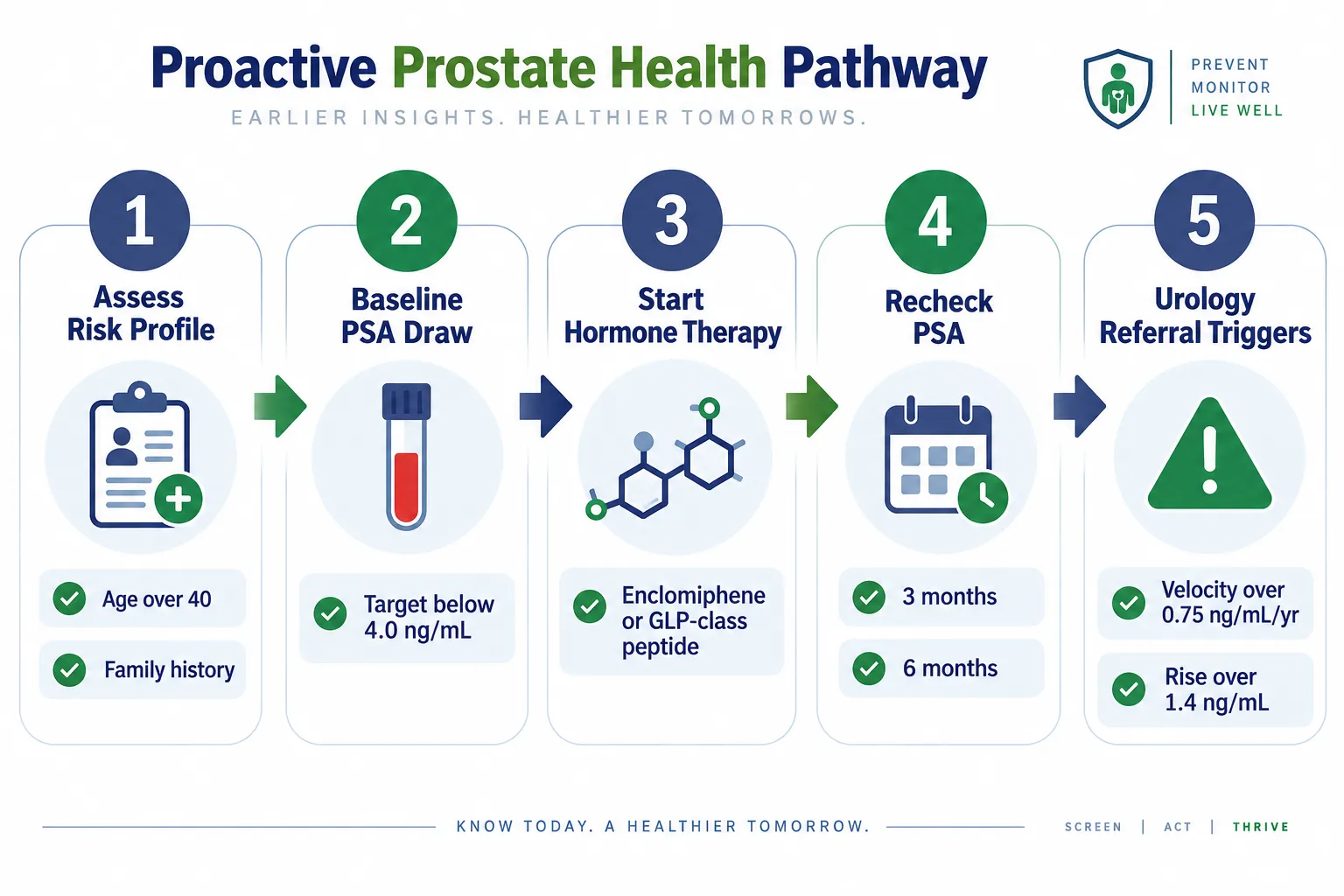
Current clinical guidance, updated through 2026, recommends the following framework for men receiving enclomiphene:
| Checkpoint | Action |
|---|---|
| Before starting (all men over 40) | Obtain baseline PSA |
| Baseline PSA > 4.0 ng/mL | Urology clearance before proceeding |
| Baseline PSA > 3.0 ng/mL + first-degree family history | Urology clearance before proceeding |
| 3-month recheck | Compare with baseline; note velocity |
| 6-month recheck | Continue periodic monitoring |
| PSA rise > 1.4 ng/mL in any 3-12-month window | Urology referral |
| PSA velocity > 0.75 ng/mL per year | Urology referral |
This framework mirrors Endocrine Society hypogonadism guidelines, which state that any testosterone-raising therapy, including enclomiphene, should be avoided in men with known prostate cancer, palpable nodules, or markedly elevated PSA at baseline.
GLP-Class Peptides and the PSA Interface: Where Research Stands
GLP-1 receptor agonists and the newer triple-agonist GLP-3 class agents (such as retatrutide) have generated enormous research interest for their metabolic and cardiovascular effects. Researchers following GLP-3 retatrutide and triple-agonist peptide phase 3 obesity data will note that current endocrine and urology guidance does not integrate GLP-class agents into PSA-specific monitoring frameworks.
This absence is meaningful, not an oversight. GLP-1 and GLP-3 receptors are expressed in pancreatic beta cells, the gut, the brain, and cardiovascular tissue, but not in prostate epithelium at levels that would be expected to alter PSA transcription. These peptides work through cyclic AMP-mediated pathways that are mechanistically separate from the androgen receptor axis driving PSA production.
Where GLP-class research does intersect with prostate health indirectly:
- Obesity is an established risk factor for aggressive prostate cancer; GLP-class agents that reduce visceral adiposity may theoretically reduce that background risk over time.
- Weight loss lowers serum estrogen (produced in adipose tissue), which can slightly alter the testosterone-estrogen ratio, a variable that enclomiphene also modulates.
- Researchers combining enclomiphene with GLP-class peptides in metabolic models, as explored in work on tesofensine, enclomiphene, and peptide-based approaches in metabolic research, should track PSA as part of a comprehensive safety panel even when GLP agents alone would not require it.
The key principle: PSA monitoring requirements are driven by the testosterone-raising component of any research protocol, not by the GLP-class peptide component.
Prostate Safety in Broader Hormone Research Contexts
Long-term observational data and multiple meta-analyses consistently show that testosterone replacement does not meaningfully accumulate in prostate tissue or provoke major biologic change beyond physiologic ranges. The American Urological Association permits carefully monitored testosterone therapy even in select men on active surveillance for low-risk prostate cancer, provided baseline and serial PSA plus imaging are tracked. This permissive but watchful stance extends logically to enclomiphene, which raises testosterone endogenously rather than exogenously.
Researchers working with growth hormone secretagogues alongside these agents can find relevant mechanistic background in the tesa and ipamorelin comparative analysis of growth hormone secretion mechanisms, as GH-axis peptides also affect body composition in ways that could influence the hormonal milieu relevant to PSA.
Conclusion
Prostate Specific Antigen and Hormone-Modulating Compounds: How PSA Monitoring Interfaces With Enclomiphene and GLP-Class Peptide Research comes down to one core principle: PSA is a downstream marker of androgen receptor activity in prostate tissue, and any compound that raises testosterone, directly or indirectly, warrants structured PSA surveillance. Enclomiphene raises endogenous testosterone and therefore fits within established monitoring protocols. GLP-class peptides, by contrast, operate through entirely different receptor pathways and carry no current evidence of PSA influence, though they may alter the broader hormonal environment when combined with serms.
Actionable steps for researchers and clinicians in 2026:
- Obtain a baseline PSA in all male subjects over 40 before initiating enclomiphene or any testosterone-raising protocol.
- Apply established velocity and threshold triggers (greater than 0.75 ng/mL per year; any single rise exceeding 1.4 ng/mL) to prompt urology evaluation.
- Do not apply PSA-specific monitoring requirements to GLP-class peptide protocols unless a testosterone-raising agent is co-administered.
- Document PSA alongside full hormone panels (LH, FSH, total and free testosterone) to distinguish therapy-driven changes from pathologic trends.
- Review the evolving literature on enclomiphene vs enclomiphene citrate formulation differences to ensure study compounds are correctly characterized before interpreting PSA data.
PSA monitoring is not a reason to avoid hormone-modulating research, it is the tool that makes that research safe and scientifically credible.