Call or Text 727-513-9780
  • Shopping Cart Shopping Cart
    0Shopping Cart
Pure Tested Peptides | America's most trusted Peptides for sale online
  • Peptides for sale
    • Oral Peptides for sale
      • Peptide Capsules for sale
      • BPC 157 Capsules 1000mcg
      • SLU-PP-332 Capsules | 1000 mcg
      • 5-Amino-1MQ 50mg Capsules
      • Tesofensine 500mcg
    • All Peptides for sale
    • Peptide Sprays
      • BPC 157 Nasal Spray Kit
      • BPC-157 TB500 Nasal Spray Kit
      • Semax Nasal Spray 10mg
      • Selank – Nasal Spray Kit – 10mg
      • Epithalon 50MG Nasal Spray Kit
      • Ipamorelin 10mg Nasal Spray
      • Klow Nasal Spray (BPC-157 + TB-500 + GHK-Cu + KPV) | 80mg
      • Hulk Nasal Spray Tesa / Ipa Blend 6/3 MG
      • Klow Nasal Spray
      • NAD + 500 mg Nasal Spray
      • PT-141 Nasal Spray Kit
    • GHRH Peptides
      • Ipa Peptides
      • CJC-1295 Peptides
        • CJC-1295 with DAC 5 mg
        • CJC-1295 without DAC 5 mg
        • CJC-1295 Ipa 10mg
      • Tesa Peptides
        • Tesa Peptide
        • Tesa 20 mg
    • GHK-Cu Peptides
      • All GHK-Cu Peptides
      • GHK-Cu 100mg
      • KLOW Peptide Blend – Buy KLOW blend online
    • BPC Peptides
      • All BPC Peptides
      • BPC-157
      • BPC-157 TB-500
      • BPC 157 capsules 1000mcg
    • SLU-PP-332 Peptides
      • All SLU-PP-332 Peptides
      • SLU-PP-332 5mg
    • GLP3 Peptides
      • GLP3-R
      • GLP3-R CAG 10mg
      • GLP3-R 20mg
    • PT-141 Peptides
      • PT-141 Peptides for sale
      • PT-141 10mg
      • PT-141 Nasal Spray
    • CAG Peptides
      • Lipo-C Peptide Blend
      • CAG 5mg
      • CAG 10mg
    • MOTS-C Peptides
      • MOTS-C Peptides for sale
      • MOTS-c peptide
      • MOTS-c 10mg *6 pack*
    • 5 Amino 1MQ Peptides
      • 5 Amino 1MQ Peptides for sale
      • 5-Amino-1MQ 50mg Capsules
      • 5-Amino-1MQ 5mg
    • Epithalon Peptides
      • Epithalon Peptides for sale
      • Epithalon 10mg
      • Epithalon 50mg
  • Shop
    • GLPs
      • 5-Amino-1MQ 50mg Capsules
      • 5-Amino-1MQ 5mg
      • GLP3-Reta
      • L-Carnitine 500mg/ml
      • Tesofensine 500mcg
      • SLU-PP-332 5mg
      • MOTS-c 10mg *6 pack*
    • Epithalon & BPC Peptides
      • Epithalon 10mg
      • Epithalon 50mg
      • BPC-157
      • BPC 157 capsules 1000mcg
      • BPC-157 TB-500
      • BPC-157 TB500 Nasal Spray Kit
      • BPC 157 Nasal Spray Kit
    • BPC TB-500 & NAD+ Peptides
      • NAD+ 500 mg
      • KLOW Peptide Blend – Buy KLOW blend online
      • GLOW Peptide Blend
      • TB 500 5mg
      • BPC 157 capsules 1000mcg – Supplement
      • BPC 157 Nasal Spray Kit
      • BPC-157
      • BPC-157 TB500 Nasal Spray Kit
      • BPC-157 TB-500
      • BPC 157 capsules 1000mcg
    • LL-37 Peptide
      • LL-37 10 mg
    • MOTS-C & Selank
      • MOTS-c peptide
      • Selank 10mg
    • GHK Peptides
      • GHK-Cu 100mg
      • GLOW Peptide Blend
      • KLOW Peptide Blend – Buy KLOW blend online
  • COAs
  • Wholesale
    • Wholesale Peptides for sale
  • PTP FAQ
  • Affiliates
    • Selank Peptide: Advanced Pharmacological Mechanisms Underlying Its Anxiolytic and Nootropic Effects in Research
      • 5-Amino-1MQ Peptide: Detailed Mechanisms of NNMT Inhibition and Its Impact on Cellular Metabolism Research
        • MOTS-C Peptide: Unraveling Its Role in Mitochondrial Dynamics and Energy Metabolism Research
          • Epithalon Peptide and Telomerase Regulation: Investigating Its Impact on Cellular Senescence and Lifespan Research Models
            • GLP2-T vs GLP2 Tirz Peptide: Understanding the Naming, Mechanistic Nuances, and Research Implications for Gut Health
      • Peptides and Polypeptides in Modern Pharmacology: What Research on Metoprolol, Prednisone, and Amlodipine Reveals
        • Polypeptide Peptides vs NSAIDs: What Naproxen and Diclofenac Teach Tissue-Repair Researchers About BPC‑157 and TB‑500
          • Peptides and Polypeptides in Endocrine Pharmacology: How GLP-1, GLP-2, and GLP-3 Retatrutide Differ From Classic Drugs Like Prednisone and Amlodipine
          • 5‑Amino‑1MQ Peptide and NNMT Inhibition: How It Compares With Statins Like Atorvastatin in Adipose and Lipid Metabolism Research
      • Enclomiphene, Estrogen Receptor Signaling, and Luteinizing Phase Biology: What Hormone Researchers Should Measure
        • Mesenchymal Stem Cells, BPC‑157, and GHK‑Cu: How Tissue Repair Peptides Compare With Classic NSAIDs Like Naproxen in Injury Models
          • Peptide Calculator Use Cases Beyond Growth Hormone: Working Through GLP‑3 Retatrutide, MOTS‑c, and BPC‑157 Research Dosing
        • Polypeptide Peptides in Endocrine and Metabolic Pharmacology: Lessons From Amlodipine, Prednisone, and Metoprolol
        • Peptides Calculator for Advanced Blends: Worked Examples for Tesamorelin, CJC‑1295, and Ipamorelin Stacks
          • Peptides and Polypeptides in Human Physiology: How Molecular Size Shapes Research Applications
            • Selank Peptide: Advanced Pharmacological Mechanisms Underlying Its Anxiolytic and Nootropic Effects in Research
          • 5-Amino-1MQ Peptide: Detailed Mechanisms of NNMT Inhibition and Its Impact on Cellular Metabolism Research
            • MOTS-C Peptide: Unraveling Its Role in Mitochondrial Dynamics and Energy Metabolism Research
              • Epithalon Peptide and Telomerase Regulation: Investigating Its Impact on Cellular Senescence and Lifespan Research Models
                • GLP2-T vs GLP2 Tirz Peptide: Understanding the Naming, Mechanistic Nuances, and Research Implications for Gut Health
                  • Peptides and Polypeptides in Endocrine Pharmacology: How GLP-1, GLP-2, and GLP-3 Retatrutide Differ From Classic Drugs Like Prednisone and Amlodipine
                    • Polypeptide Peptides vs NSAIDs: What Naproxen and Diclofenac Teach Tissue-Repair Researchers About BPC‑157 and TB‑500
                      • Peptides and Polypeptides in Modern Pharmacology: What Research on Metoprolol, Prednisone, and Amlodipine Reveals
                        • 5‑Amino‑1MQ Peptide and NNMT Inhibition: How It Compares With Statins Like Atorvastatin in Adipose and Lipid Metabolism Research
                        • Enclomiphene, Estrogen Receptor Signaling, and Luteinizing Phase Biology: What Hormone Researchers Should Measure
                        • Mesenchymal Stem Cells, BPC‑157, and GHK‑Cu: How Tissue Repair Peptides Compare With Classic NSAIDs Like Naproxen in Injury Models
                        • Peptide Calculator Use Cases Beyond Growth Hormone: Working Through GLP‑3 Retatrutide, MOTS‑c, and BPC‑157 Research Dosing
                        • Polypeptide Peptides in Endocrine and Metabolic Pharmacology: Lessons From Amlodipine, Prednisone, and Metoprolol
                        • Peptides Calculator for Advanced Blends: Worked Examples for Tesamorelin, CJC‑1295, and Ipamorelin Stacks
                        • Peptides and Polypeptides in Human Physiology: How Molecular Size Shapes Research Applications
                        • Selank Peptide: Advanced Pharmacological Mechanisms Underlying Its Anxiolytic and Nootropic Effects in Research
                        • MOTS-C Peptide: Unraveling Its Role in Mitochondrial Dynamics and Energy Metabolism Research
                        • Peptides and Polypeptides in Modern Pharmacology: What Research on Metoprolol, Prednisone, and Amlodipine Reveals
                        • Peptides and Polypeptides in Endocrine Pharmacology: How GLP-1, GLP-2, and GLP-3 Retatrutide Differ From Classic Drugs Like Prednisone and Amlodipine
                        • 5-Amino-1MQ Peptide: Detailed Mechanisms of NNMT Inhibition and Its Impact on Cellular Metabolism Research
                        • Mesenchymal Stem Cells, BPC‑157, and GHK‑Cu: How Tissue Repair Peptides Compare With Classic NSAIDs Like Naproxen in Injury Models
                        • Peptide Calculator Use Cases Beyond Growth Hormone: Working Through GLP‑3 Retatrutide, MOTS‑c, and BPC‑157 Research Dosing
                        • GLP2-T vs GLP2 Tirz Peptide: Understanding the Naming, Mechanistic Nuances, and Research Implications for Gut Health
                        • Polypeptide Peptides in Endocrine and Metabolic Pharmacology: Lessons From Amlodipine, Prednisone, and Metoprolol
                        • Polypeptide Peptides vs NSAIDs: What Naproxen and Diclofenac Teach Tissue-Repair Researchers About BPC‑157 and TB‑500
                        • Peptides and Polypeptides in Human Physiology: How Molecular Size Shapes Research Applications
                        • Peptides Calculator for Advanced Blends: Worked Examples for Tesamorelin, CJC‑1295, and Ipamorelin Stacks
                        • 5‑Amino‑1MQ Peptide and NNMT Inhibition: How It Compares With Statins Like Atorvastatin in Adipose and Lipid Metabolism Research
                        • Enclomiphene, Estrogen Receptor Signaling, and Luteinizing Phase Biology: What Hormone Researchers Should Measure
                        • Epithalon Peptide and Telomerase Regulation: Investigating Its Impact on Cellular Senescence and Lifespan Research Models
                        • Best research protocol Klow blend
                        • best time to take BPC-157
                        • best time to take DSIP (Delta Sleep Inducing Peptide)
                        • best time to take CJC-1295
                        • best time to take AOD-9604
                        • best time to take Follistatin 344
                        • best time to take Ipamorelin
                        • best time to take MK-677 (Ibutamoren)
                        • best time to take Ligandrol (LGD-4033) — research compound
                        • best time to take Ostarine (MK-2866) — research compound
                        • best time to take GHK-CU
                        • best time to take TB-500
                        • best time to take MOTS-c
                        • best time to take Semax
                        • best time to take RAD-140 (Testolone) — research compound
                        • best time to take Thymosin Alpha-1
                        • best time to take PEG-MGF
                        • Biolife Plasma, Octapharma Plasma, and Research Peptides: How Plasma Donation Labs Differ From Peptide Suppliers
                        • best time to take YK-11 — research compound
                        • best time to take PT-141 (Bremelanotide)
                        • Best research protocol Klow blend
                        • 5-Amino-1MQ and MOTS-C Synergy: Metabolic Signaling, Mitochondria, and Research Design
                        • BPC-157 and TB-500: Investigating Their Combined Effects on Angiogenesis and Cellular Migration in Tissue Repair Models
                        • BPC-157 Peptide: Gut Barrier Function, Inflammation, and Tissue-Recovery Research
                        • 5‑Amino‑1MQ and MOTS‑c Synergy in Metabolic Research: Designing NNMT and Mitochondrial Biogenesis Stacks
                        • CJC-1295 with DAC vs. Without DAC: Half-Life, Release Kinetics, and Research Implications
                        • CJC‑1295 with DAC vs. Without DAC: Expanding on Half‑Life Differences Using Tesamorelin and Ipamorelin Blend Case Studies
                        • Collagen Biology and Copper‑Binding Peptides: How GHK‑Cu, Glow Blend, and Klow Blend Interact with Skin and Connective Tissue
                        • Collagen Biology and Regenerative Peptides: How GHK‑Cu, Glow Blend, and Klow Blend Affect Extracellular Matrix Research
                    • DNA, Telomeres, and Longevity Peptides: Positioning Epithalon and MOTS‑c in Genetic Aging Research
                      • Enclomiphene Citrate: serm Mechanism, Testosterone Research, and Stack Compatibility
                        • Enclomiphene vs Enclomiphene Citrate: Formulation, Bioavailability, and Research Distinctions
                        • Epithalon Peptide Research: Telomerase Activation, Aging, and Pineal Gland Function
                        • Estrogen Receptor Signaling and Enclomiphene: How Selective Modulators Compare with Classic Polypeptide Hormones
                        • GHK-Cu Peptide: Advanced Mechanisms in Extracellular Matrix Remodeling and Wound Healing Research
                        • GHK-Cu Peptide: Collagen Synthesis, Wound Repair, and Skin-Barrier Research Models
                        • GLP-1 vs GLP-3 vs GLP-2: Peptide Classification and Research Applications
                        • GLP-2 Peptide Research Guide: Gut Barrier Function, Nutrient Absorption, and Intestinal Recovery Models
                        • GLP-3 Retatrutide vs. GLP-1 Drugs: What Triple-Agonist Biology Changes in Research Models
                        • Ipamorelin and Tesamorelin Combination: Synergistic GH Secretagogue Research and Dosing Protocols
                        • GLP2 Tirz Peptide: What It Is, Why the Name Exists, and How Researchers Should Interpret It
                        • Klow Blend Peptide Nasal Spray: What the Formulation Is Trying to Do in Cognitive Research
                        • Mitochondria, NNMT Inhibition, and Peptide Modulators: Where MOTS‑c and 5‑Amino‑1MQ Fit in Cellular Energy Research
                        • MOTS-c Peptide: Mitochondrial Function, Energy Metabolism, and What Researchers Measure
                        • MOTS-c vs. 5-Amino-1MQ: Which Metabolic Research Questions Each Compound Actually Answers
                        • Nasal Spray Peptides: Bioavailability, Administration, and Semax/Selank Research Applications
                        • PT-141 Peptide Research: Mechanism of Action and Melanocortin Receptor Signaling
                        • Retatrutide for Research: Mechanism, Structure, and GLP-1/GLP-3 Dual Action
                        • Retatrutide for Obesity and Type 2 Diabetes: What the Latest Trial Data Suggest
                        • Tesofensine Peptide Research: Mechanism, Appetite Suppression, and Neuropeptide Y Pathways
  • Contact
    • Contact Customer Service
    • Text Customer Support
  • About US
  • Shop all peptides
  • Affiliate Program
    • Affiliate Signup
  • Login / Register Login / Register Page Link Login / Register Page Link
  • Click to open the search input field Click to open the search input field Search
  • Menu Menu
Enclomiphene in Male Endocrine Research: LH, FSH, and Testosterone Signaling Without Clomiphene’s Mixed Isomers

Enclomiphene in Male Endocrine Research: LH, FSH, and Testosterone Signaling Without Clomiphene’s Mixed Isomers

August 21, 2026/0 Comments/in Uncategorized/by

Nearly half of all cases of male hypogonadism are classified as secondary, meaning the problem originates not in the testes but in the signaling chain above them. That distinction matters enormously when evaluating research tools, and it is precisely where enclomiphene in male endocrine research has attracted sustained scientific attention. By targeting the hypothalamic-pituitary-gonadal (HPG) axis as a pure trans-isomer selective estrogen receptor modulator (serm), enclomiphene offers a pharmacologically cleaner lens for studying LH, FSH, and testosterone signaling without clomiphene's mixed isomers complicating the data.

Key Takeaways

  • Enclomiphene is the pure trans-isomer of clomiphene, stripped of the cis-isomer (zuclomiphene) that contributes to estrogenic side effects and signal suppression.
  • It stimulates the HPG axis by blocking hypothalamic estrogen receptors, driving measurable increases in LH, FSH, and downstream testosterone.
  • Research data show enclomiphene preserves spermatogenesis, a key advantage over exogenous testosterone replacement therapy (TRT).
  • Hormone levels elevated by enclomiphene have demonstrated persistence after discontinuation in several study populations.
  • As of 2026, enclomiphene has not received formal regulatory approval for hypogonadism, and its use remains within investigational and research contexts.

The Isomer Problem: Why Clomiphene's Mixed Profile Limits Research Clarity
The Isomer Problem: Why Clomiphene's Mixed Profile Limits Research Clarity

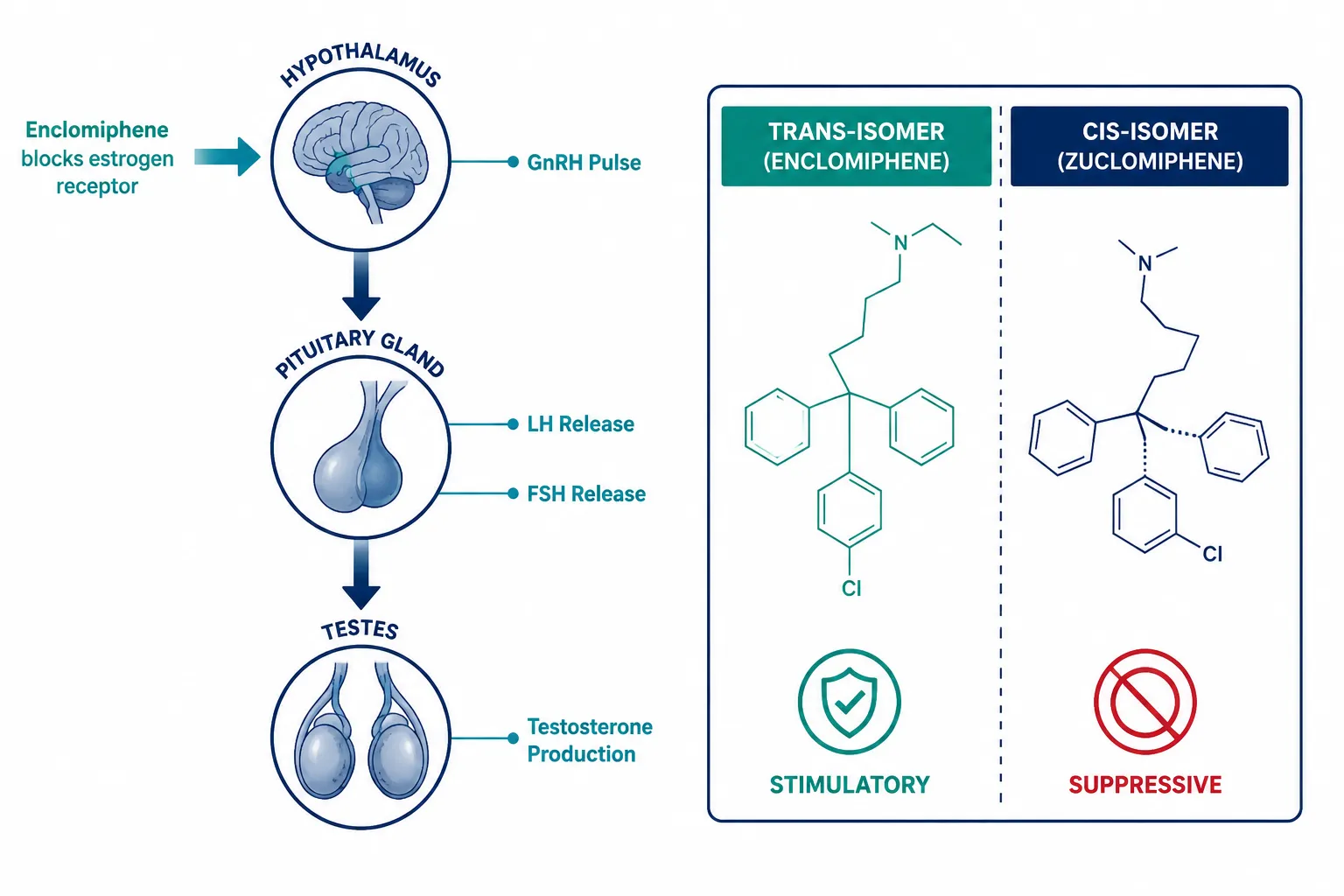
Clomiphene citrate has been used off-label in male endocrine contexts for decades. However, it is a racemic mixture, roughly equal parts trans-clomiphene (enclomiphene) and cis-clomiphene (zuclomiphene). These two isomers behave very differently at estrogen receptors.

Zuclomiphene acts as a partial estrogen agonist and has a much longer half-life, accumulating in tissue over time. This leads to elevated estradiol levels, potential mood disturbances, and visual side effects that have been documented in clinical literature. It also appears to partially suppress the very signaling pathway clomiphene is intended to stimulate.

Enclomiphene, by contrast, functions as a clean estrogen receptor antagonist at the hypothalamus. By occupying estrogen receptors there, it prevents the negative feedback signal that would otherwise suppress gonadotropin-releasing hormone (GnRH) pulsatility. The result is a reliable upstream stimulus for LH and FSH release from the pituitary.

This mechanistic clarity is why researchers exploring hormone research compounds have increasingly distinguished enclomiphene from its parent compound. The mixed-isomer problem in clomiphene is not a minor footnote, it is a confounding variable that makes interpreting hormonal outcomes genuinely difficult.

"Separating the trans-isomer from the cis-isomer is not just a chemistry exercise, it is the difference between a targeted signal and a noisy one."

LH, FSH, and Testosterone Responses in Enclomiphene Research
LH, FSH, and Testosterone Responses in Enclomiphene Research

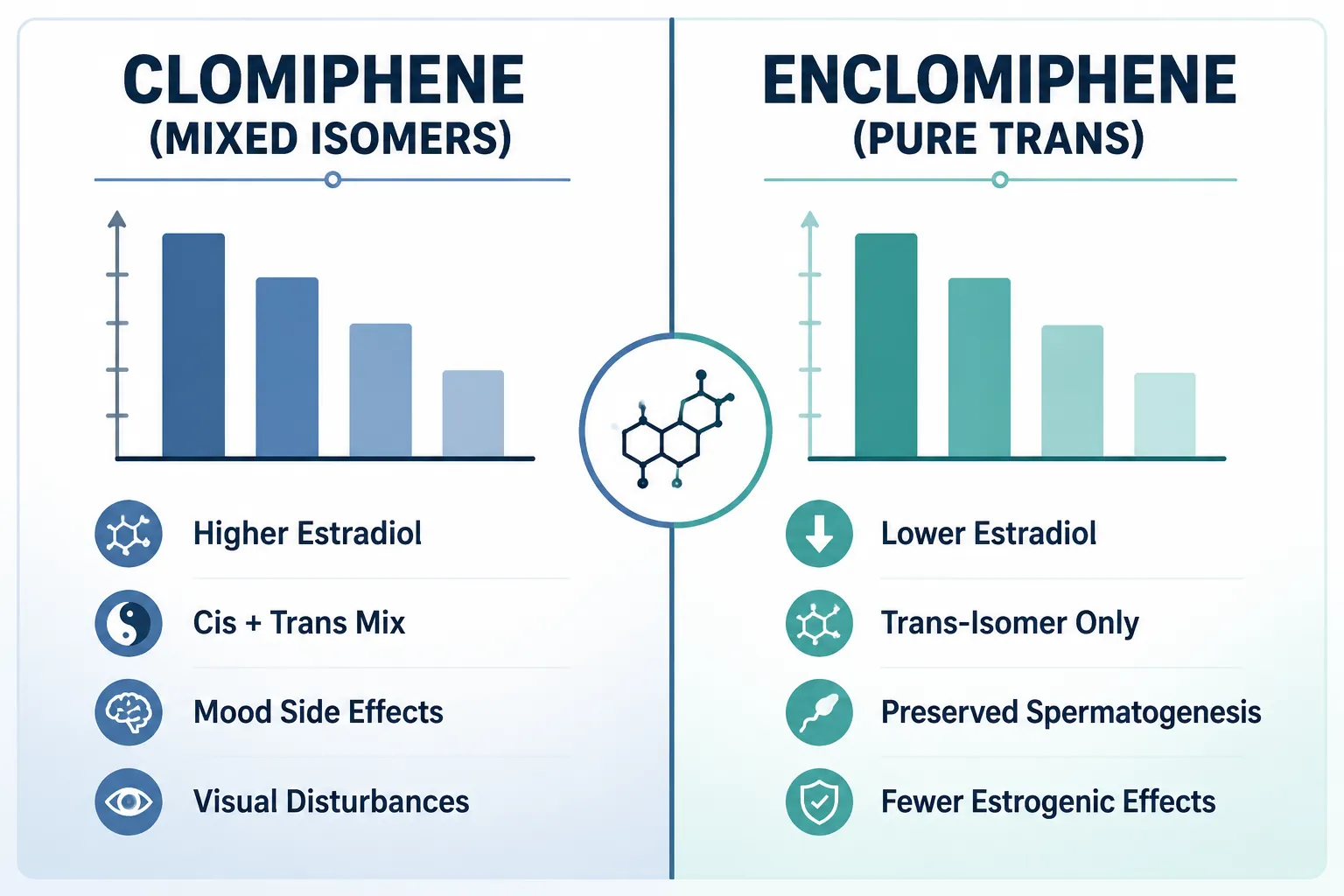
The hormonal data from enclomiphene studies are among the most compelling aspects of its research profile. Across multiple clinical investigations, enclomiphene administration produced robust, dose-dependent increases in:

  • Luteinizing hormone (LH): Elevated within days of administration, reflecting rapid hypothalamic receptor blockade
  • Follicle-stimulating hormone (FSH): Increased concurrently with LH, supporting both Leydig cell stimulation and spermatogenic signaling
  • Total testosterone: Restored toward or into normal physiological ranges in men with secondary hypogonadism

Critically, these hormonal elevations were achieved while keeping estradiol levels lower than those observed with clomiphene. This is a direct consequence of removing the estrogenic zuclomiphene isomer from the equation.

Meta-analytic reviews of serm therapy in male hypogonadism, which include enclomiphene data, consistently show testosterone improvements that are statistically comparable to testosterone gel in some endpoints, while preserving the endogenous production pathway. That preservation has significant downstream implications, particularly for fertility.

Researchers examining hormone research protocols have noted that enclomiphene's hormonal effects also demonstrate a notable persistence after discontinuation. Unlike exogenous testosterone, which suppresses the HPG axis and leads to rapid post-cessation decline, enclomiphene appears to recalibrate the axis rather than override it. This post-treatment persistence is a subject of active investigation.

Spermatogenesis: A Key Differentiator from TRT

Exogenous testosterone replacement therapy reliably suppresses LH and FSH, which in turn suppresses spermatogenesis. For men in whom fertility preservation is a research or clinical consideration, this represents a meaningful limitation of TRT as a comparator.

Enclomiphene, by stimulating FSH rather than replacing testosterone exogenously, supports continued spermatogenic signaling. Multiple studies have documented improvements in sperm concentration, motility, and morphology in men treated with enclomiphene, outcomes that stand in direct contrast to TRT's suppressive effects on semen parameters.

This distinction is central to understanding why enclomiphene in male endocrine research occupies a unique position relative to both clomiphene and testosterone-based interventions. For broader context on how signaling compounds interact with receptor systems, the literature on GPCR signaling provides useful mechanistic background.

Research Context, Regulatory Status, and 2026 Outlook
Research Context, Regulatory Status, and 2026 Outlook

Enclomiphene's regulatory history is instructive. The compound advanced through FDA Investigational New Drug (IND) processes with a specific focus on secondary hypogonadism, and early Phase II and Phase III data were sufficiently promising to attract significant interest. However, as of 2026, enclomiphene has not received formal approval for hypogonadism or testosterone support from any major regulatory body.

The 2026 British Society of Sexual Medicine (BSSM) position statement acknowledges enclomiphene among emerging options in the male hypogonadism landscape while stopping short of recommending it as a standard-of-care therapy. This reflects the current evidence gap: strong mechanistic rationale and encouraging trial data, but an incomplete formal approval pathway.

In practical research settings, enclomiphene is being studied with the following considerations in mind:

Research Variable Enclomiphene Profile
Isomer composition Pure trans-isomer only
Primary receptor action Estrogen receptor antagonist (hypothalamus)
LH/FSH effect Stimulatory
Estradiol impact Lower than clomiphene
Spermatogenesis Preserved or improved
Post-discontinuation persistence Documented in multiple studies
Regulatory status (2026) Investigational; no formal approval

Analysts tracking the male hormone therapeutics space in 2026 view enclomiphene as a compound with a credible path toward eventual approval, though timelines remain speculative. The compound's clean isomer profile continues to generate interest among researchers working across hormone research domains.

For those studying peptide and hormone interactions more broadly, related work on compounds like the IPA Sermorelin stack and Tesamorelin combined with Ipamorelin illustrates how upstream signaling modulators are being evaluated across multiple endocrine axes simultaneously.

Safety Profile Relative to Clomiphene and TRT

Enclomiphene's safety advantages over clomiphene are largely attributable to the absence of zuclomiphene. Fewer estrogen-related adverse effects, including reduced rates of mood changes and visual disturbances, have been reported in enclomiphene-specific trials compared to racemic clomiphene data.

Compared to TRT, enclomiphene carries a different risk profile rather than a uniformly safer one. It does not suppress the HPG axis, avoids the erythrocytosis risk associated with exogenous androgens, and does not impair fertility. However, it requires a functioning pituitary-gonadal axis to produce its effects, limiting its utility in primary hypogonadism research models.

Conclusion

Enclomiphene in male endocrine research represents a meaningful advance in the precision with which scientists can probe LH, FSH, and testosterone signaling without clomiphene's mixed isomers introducing confounding estrogenic variables. Its mechanism is well-characterized, its hormonal outcomes are reproducible, and its fertility-preserving profile distinguishes it clearly from exogenous testosterone approaches.

Actionable next steps for researchers and practitioners:

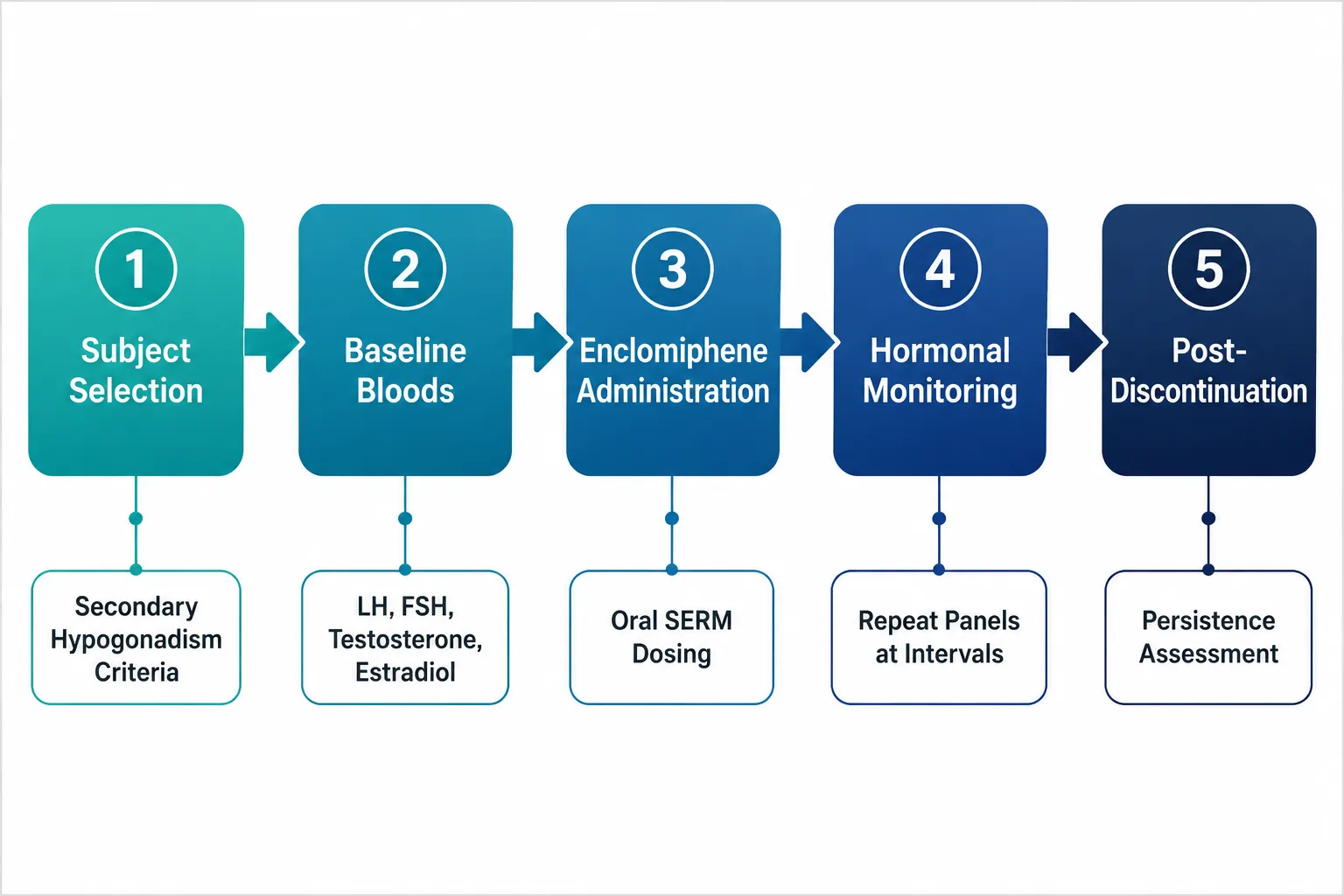
  1. Differentiate clearly between clomiphene and enclomiphene when reviewing or designing studies, the isomer distinction is not interchangeable.
  2. Monitor the full hormonal panel, LH, FSH, total testosterone, and estradiol, to capture enclomiphene's selective signaling profile accurately.
  3. Track post-discontinuation data as a distinct research endpoint, given evidence of HPG axis persistence.
  4. Follow regulatory developments closely; the 2026 landscape suggests the formal approval question remains open and consequential.
  5. Contextualize within broader endocrine research by cross-referencing findings with related signaling pathways and compound interactions.

The compound's selective isomer profile is not merely a chemical footnote, it is the foundation of its research value.

Tags: clomiphene isomers, enclomiphene, hormone signaling, hpg axis, lh fsh testosterone, male endocrine research, secondary hypogonadism, serm research
https://www.puretestedpeptides.com/wp-content/uploads/2026/08/enclomiphene-in-male-endocrine-research-lh-fsh-and-testosterone-signaling-withou.webp 1024 1536 https://www.puretestedpeptides.com/wp-content/uploads/2026/01/buy-peptides-online.jpg 2026-08-21 13:03:432026-08-21 13:03:43Enclomiphene in Male Endocrine Research: LH, FSH, and Testosterone Signaling Without Clomiphene’s Mixed Isomers
You might also like
Estrogen Receptor Biology for Peptide Researchers: How Enclomiphene and Related serms Interface With Endocrine Pathways Estrogen Receptor Biology for Peptide Researchers: How Enclomiphene and Related serms Interface With Endocrine Pathways
Where to Buy Research-Grade Enclomiphene and Enclomiphene Citrate: Purity, Certificates of Analysis, and Lab-Use Considerations Where to Buy Research-Grade Enclomiphene and Enclomiphene Citrate: Purity, Certificates of Analysis, and Lab-Use Considerations
Tesofensine, Enclomiphene, and Peptide-Based Approaches: How Small Molecules Fit Alongside GLP-3 and GH Secretagogues in Metabolic Research Tesofensine, Enclomiphene, and Peptide-Based Approaches: How Small Molecules Fit Alongside GLP-3 and GH Secretagogues in Metabolic Research
Enclomiphene and the Luteinizing Phase: Modeling Male Reproductive Hormone Fluctuations in Endocrine Research Enclomiphene and the Luteinizing Phase: Modeling Male Reproductive Hormone Fluctuations in Endocrine Research
Enclomiphene vs Enclomiphene Citrate: What Researchers Need to Know Before Choosing a Formulation Enclomiphene vs Enclomiphene Citrate: What Researchers Need to Know Before Choosing a Formulation
Enclomiphene vs Enclomiphene Citrate: Differences, Research Applications, and Dosing Considerations Enclomiphene vs Enclomiphene Citrate: Differences, Research Applications, and Dosing Considerations
Where Researchers Compare Enclomiphene vs Enclomiphene Citrate in Lab-Use Planning Where Researchers Compare Enclomiphene vs Enclomiphene Citrate in Lab-Use Planning
Peptides and Polypeptides in Endocrine Pharmacology: How Enclomiphene Interfaces With Estrogen Receptor Biology Peptides and Polypeptides in Endocrine Pharmacology: How Enclomiphene Interfaces With Estrogen Receptor Biology
0 replies

Leave a Reply

Want to join the discussion?
Feel free to contribute!

Leave a Reply Cancel reply

Your email address will not be published. Required fields are marked *

×

Helpful Links

  • My account
  • Cart
  • Checkout
  • Refund and Returns Policy
  • Privacy Policy
  • SMS Privacy Policy
  • Login
  • My Account
  • Logout

USA Made Lab Tested Peptides

All products are sold for research, laboratory, or analytical purposes only, and are not for human consumption


Pure Tested Peptides is a chemical supplier. Pure Tested Peptides is not a compounding / chemical compounding facility as defined under 503A of the Federal Food, Drug, and Cosmetic act. Pure Tested Peptides is not an outsourcing facility as defined under 503B of the Federal Food, Drug, and Cosmetic act.

The statements made within this website have not been evaluated by the US Food and Drug Administration. The products we offer are not intended to diagnose, treat, cure or prevent any disease.

Human/Animal Consumption Prohibited. Laboratory/In-Vitro Experimental Use Only

Link to: Collagen Signaling and Copper Peptides: What Researchers Measure With GHK-Cu and Related Skin Models Link to: Collagen Signaling and Copper Peptides: What Researchers Measure With GHK-Cu and Related Skin Models Collagen Signaling and Copper Peptides: What Researchers Measure With GHK-Cu...Collagen Signaling and Copper Peptides: What Researchers Measure With GHK-Cu and Related Skin Models Link to: Klow Peptide Nasal Spray: What It Is, How Researchers Evaluate It, and Why Formulation Matters Link to: Klow Peptide Nasal Spray: What It Is, How Researchers Evaluate It, and Why Formulation Matters Klow Peptide Nasal Spray: What It Is, How Researchers Evaluate It, and Why Formulation MattersKlow Peptide Nasal Spray: What It Is, How Researchers Evaluate It, and Why Formulation...
Scroll to top Scroll to top Scroll to top