Enclomiphene vs Enclomiphene Citrate: How Labs Choose Between Research Formulations and Vendors
{"cover":"Professional landscape format (1536×1024) hero image with bold text overlay (≤42 chars): 'Enclomiphene vs Enclomiphene Citrate: How', crisp white sans-serif on a deep navy semi-transparent overlay panel, centered with 8% safe margins from every edge. Background: bright clinical research laboratory scene in daylight, glass vials of white crystalline powder, molecular structure diagrams on a lightboard, stainless steel lab bench, clean scientific aesthetic. Teal, navy, and white palette. Editorial magazine-cover quality, high contrast, sharp focus on foreground vials.","content":["Four-panel labelled comparison infographic (1536×1024) on a clean white background with teal-and-navy palette: Panel 1 labeled 'Free Base Form' showing a molecular diagram of enclomiphene with callout lines pointing to 'No salt counterion', 'Higher lipophilicity', 'Solvent-sensitive'; Panel 2 labeled 'Citrate Salt Form' showing enclomiphene citrate molecule with callouts 'Citric acid counterion', 'Better aqueous solubility', 'Standard in clinical trials'; Panel 3 labeled 'Dosing Reference' with callout '12.5-25 mg range'; Panel 4 labeled 'COA Check' with callouts 'Purity %', 'Salt form confirmed', 'HPLC trace'. Thin dividing lines between panels, editorial medical-guide polish, labels 1-6 words each inside 5% safe margin.","Annotated step-by-step numbered flow diagram (1536×1024) on a light gray background with deep teal and charcoal palette showing a lab vendor evaluation process: Step 1 'Request COA' with callout arrow pointing to a document icon labeled 'HPLC + NMR required'; Step 2 'Confirm Salt Form' with callout 'Free base vs citrate'; Step 3 'Check Solvent Compatibility' with callout 'DMSO or aqueous buffer'; Step 4 'Verify Stability Data' with callout 'Storage temp, shelf life'; Step 5 'Cross-reference Literature Dose' with callout '12.5-25 mg citrate standard'. Bold numbered circles in teal, clean sans-serif labels, arrows connecting each step, editorial scientific-guide quality, fully inside 5% safe margins.","Split-screen editorial landscape image (1536×1024): left half shows a close-up of a printed Certificate of Analysis document on a stainless steel lab bench under bright studio lighting, with three short annotation callouts, 'Purity above 98%', 'Salt form declared', 'Endotoxin tested', in teal label boxes with thin pointer lines; right half shows a mid-shot of a South Asian female researcher in her 30s in a white lab coat examining a small amber glass vial against a bright window, expression focused and analytical. High-contrast split composition, navy dividing line down the center, warm daylight on the right, cool studio light on the left, magazine editorial quality."]
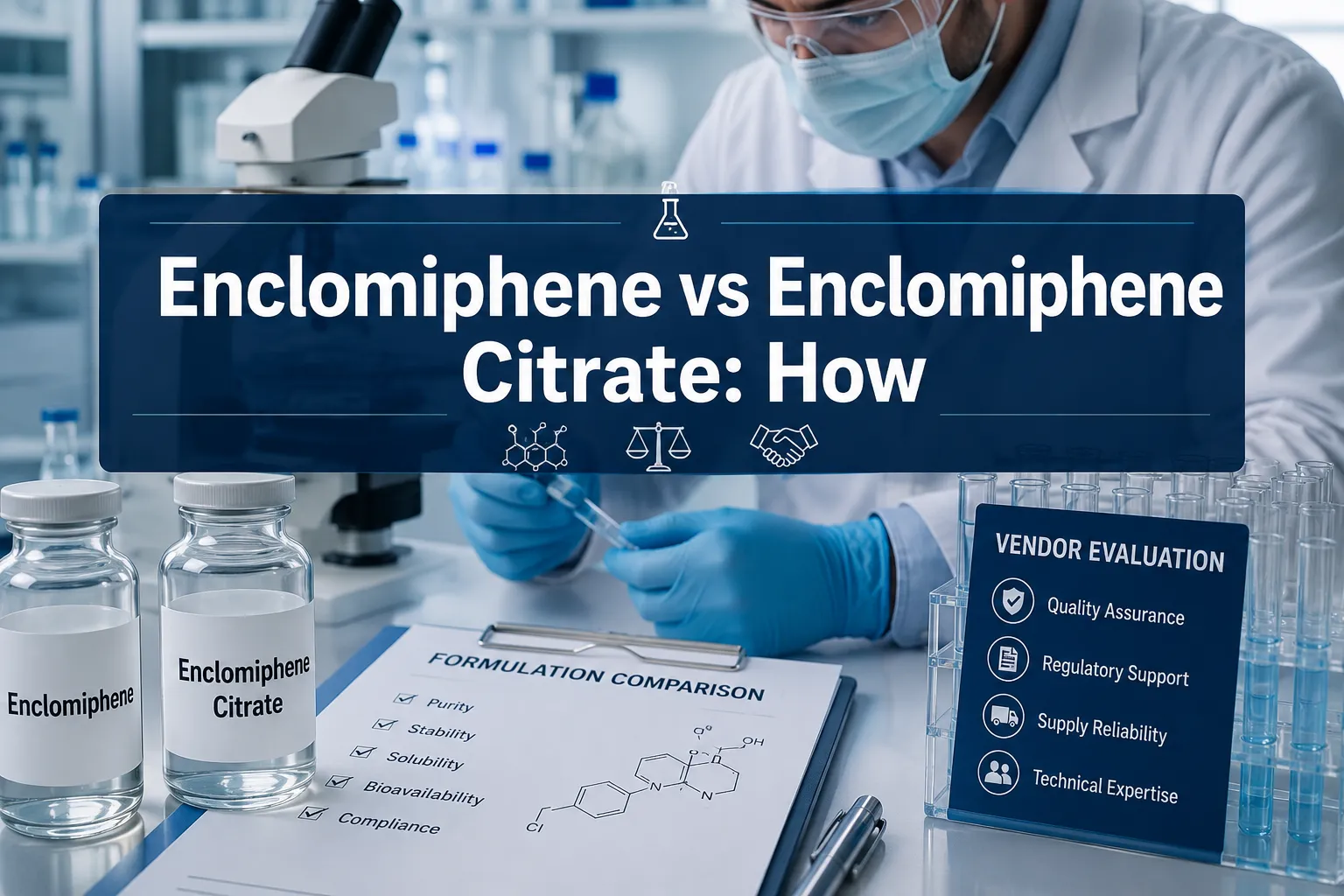
Only one letter separates the two names on most vendor catalogs, yet that difference carries real consequences for solubility, dosing math, and the validity of comparisons to published clinical data. Understanding the distinction between enclomiphene and enclomiphene citrate is not a trivial naming exercise, it is a foundational step in rigorous procurement for any research program working with selective estrogen receptor modulators (serms).
This guide focuses on the practical purchasing and formulation considerations that matter most: salt forms, solvent compatibility, stability, and how to interpret vendor Certificates of Analysis (COAs) when evaluating enclomiphene vs enclomiphene citrate and choosing between research formulations and vendors.
Key Takeaways
- Enclomiphene is the free base form; enclomiphene citrate is the salt form created by pairing enclomiphene with citric acid, they are not interchangeable by weight.
- All major clinical trials have used the citrate salt, making it the reference standard for dose comparisons.
- The free base form offers higher lipophilicity but lower aqueous solubility, which affects solvent choice in research settings.
- COA review should confirm salt form, purity by HPLC, and endotoxin levels before any procurement decision is made.
- Vendor transparency, including NMR data and batch-specific stability information, is the clearest signal of supply chain reliability.
Understanding the Chemistry: Free Base vs Salt Form
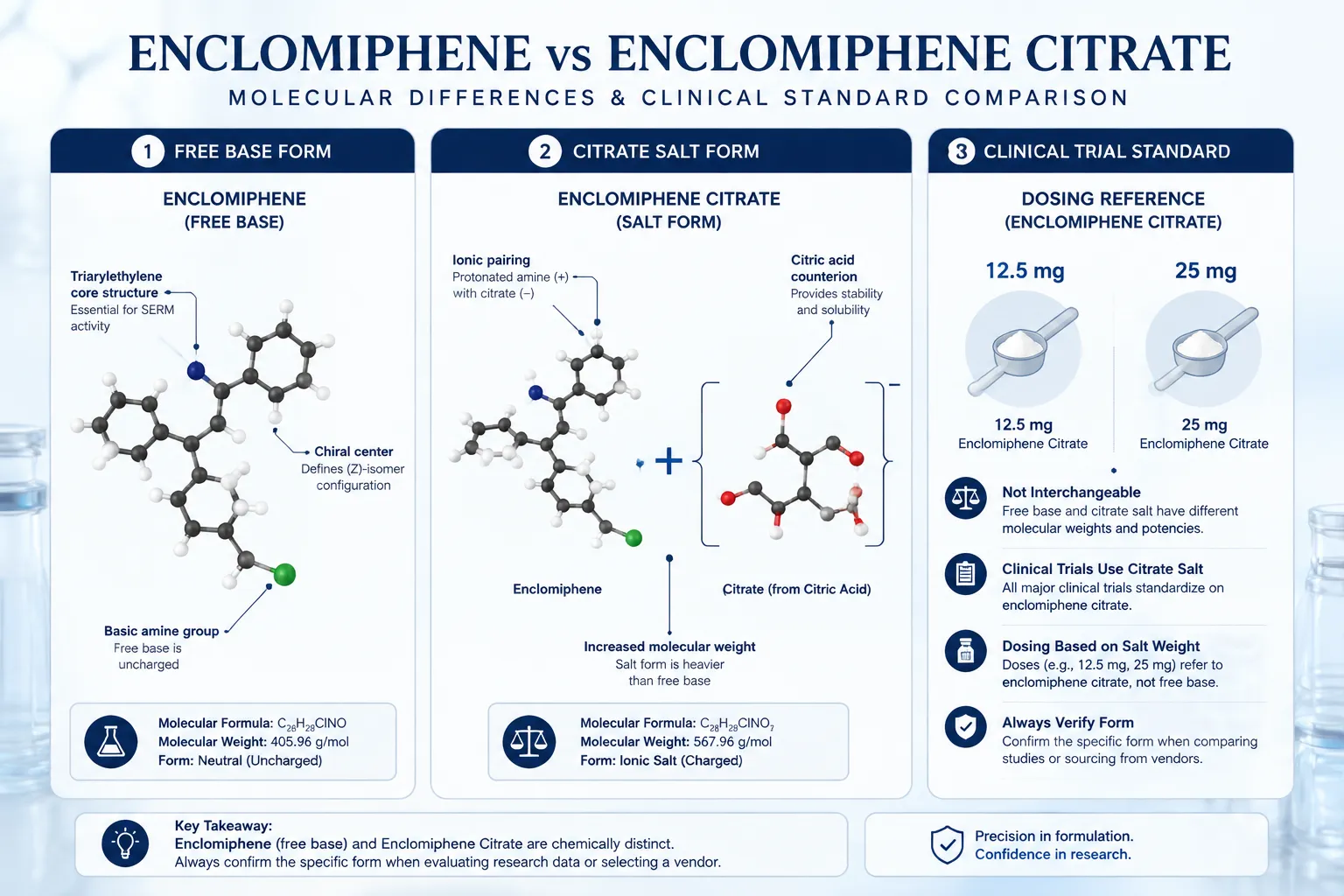
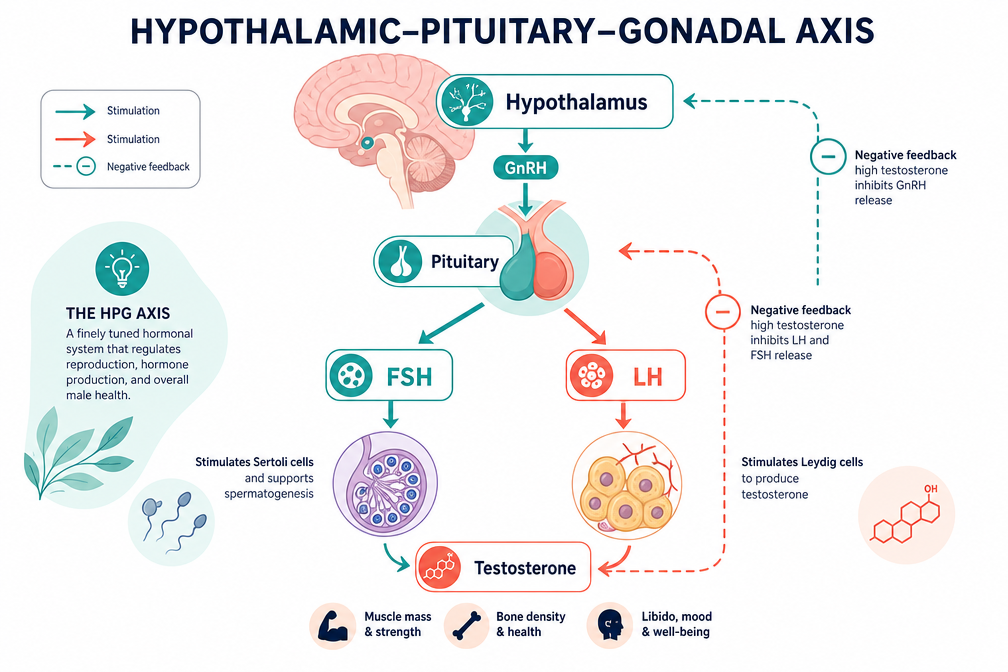
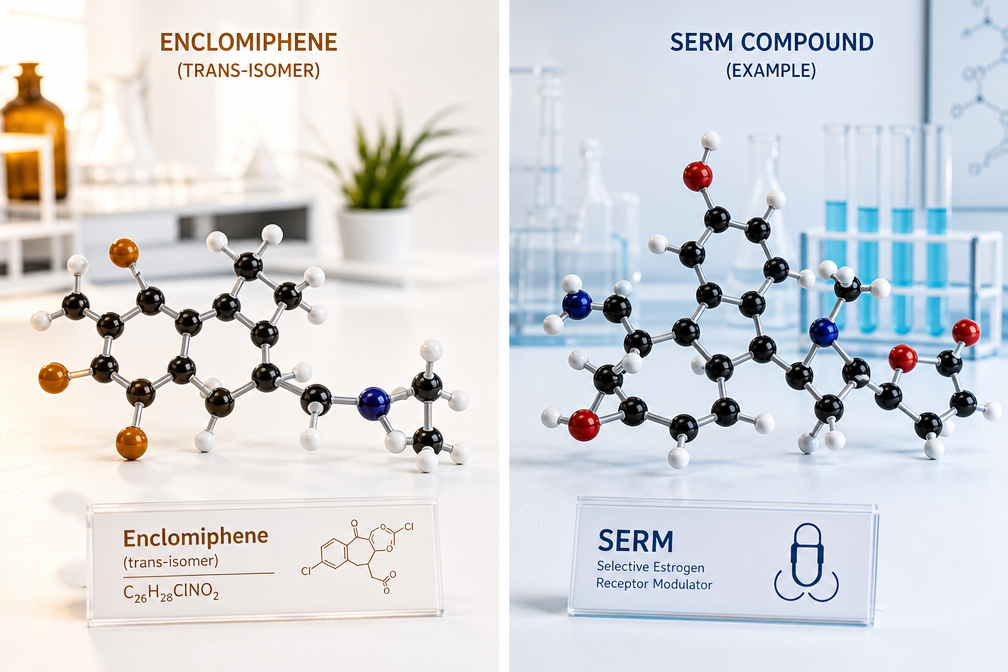
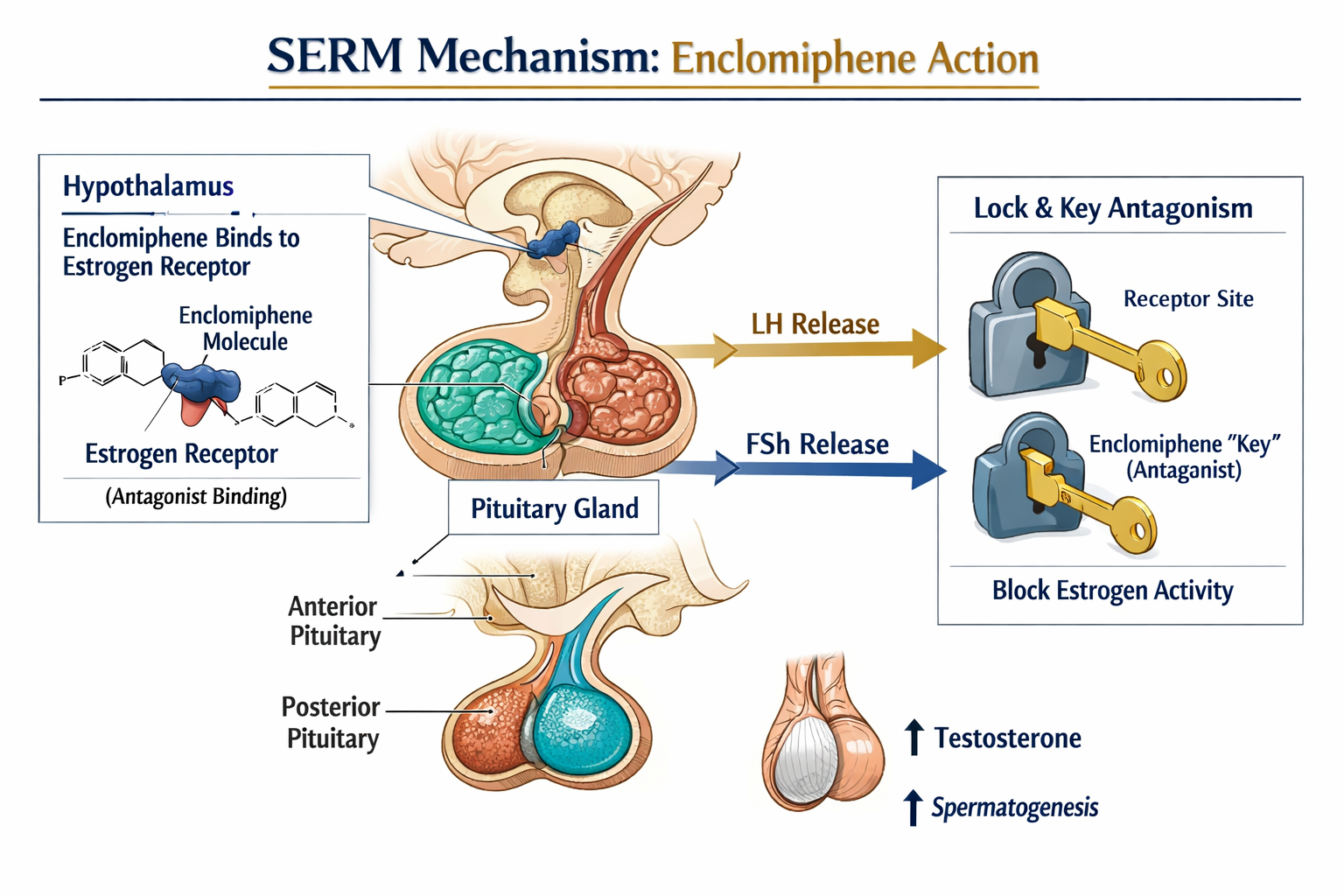
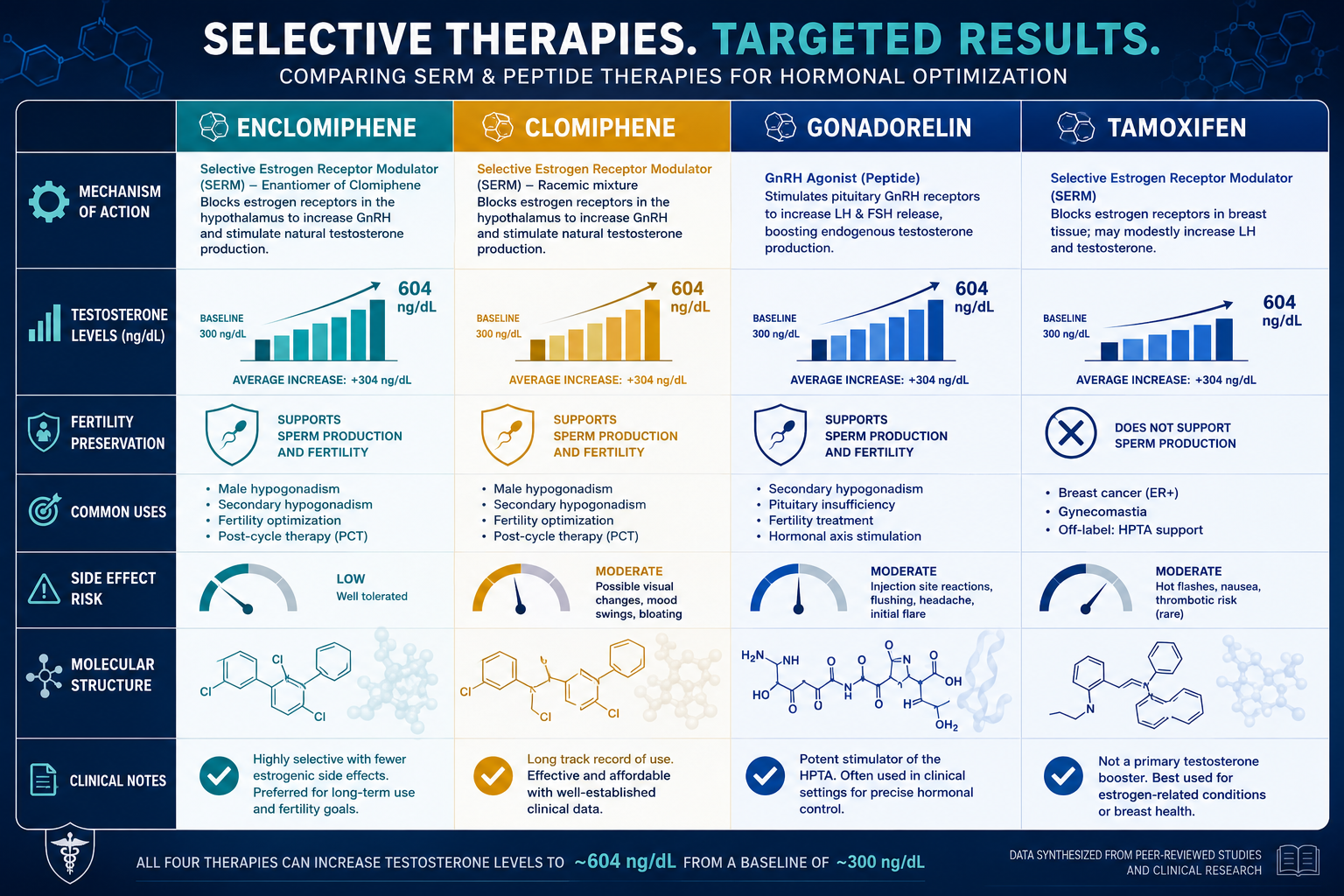
Enclomiphene is the trans-isomer of clomiphene, a serm that acts on hypothalamic estrogen receptors to stimulate endogenous gonadotropin release. When vendors list "enclomiphene" without qualification, they typically mean the free base form, the molecule without an ionic counterpart. "Enclomiphene citrate" refers to the same active molecule paired with citric acid to form a salt.
Why does this matter for labs?
The molecular weight difference is significant. Enclomiphene free base has a molecular weight of approximately 406 g/mol. Enclomiphene citrate adds the citrate counterion, raising the molecular weight to roughly 598 g/mol. That means a 25 mg dose of enclomiphene citrate does not deliver 25 mg of the active trans-isomer, it delivers proportionally less. Labs that fail to account for this difference will prepare solutions at incorrect molar concentrations, potentially compromising experimental reproducibility.
Solubility profiles also diverge:
| Property | Enclomiphene (Free Base) | Enclomiphene Citrate |
|---|---|---|
| Aqueous solubility | Low | Moderate |
| Lipophilicity | Higher | Lower |
| Preferred solvent | DMSO, ethanol | Aqueous buffers, DMSO |
| Clinical trial standard | No | Yes |
For researchers already familiar with sourcing frameworks for other research compounds, such as those described in guides on AOD-9604 storage and traceability, the same principle applies here: salt form affects both preparation protocol and shelf stability.
How Clinical Literature Shapes Formulation Choices
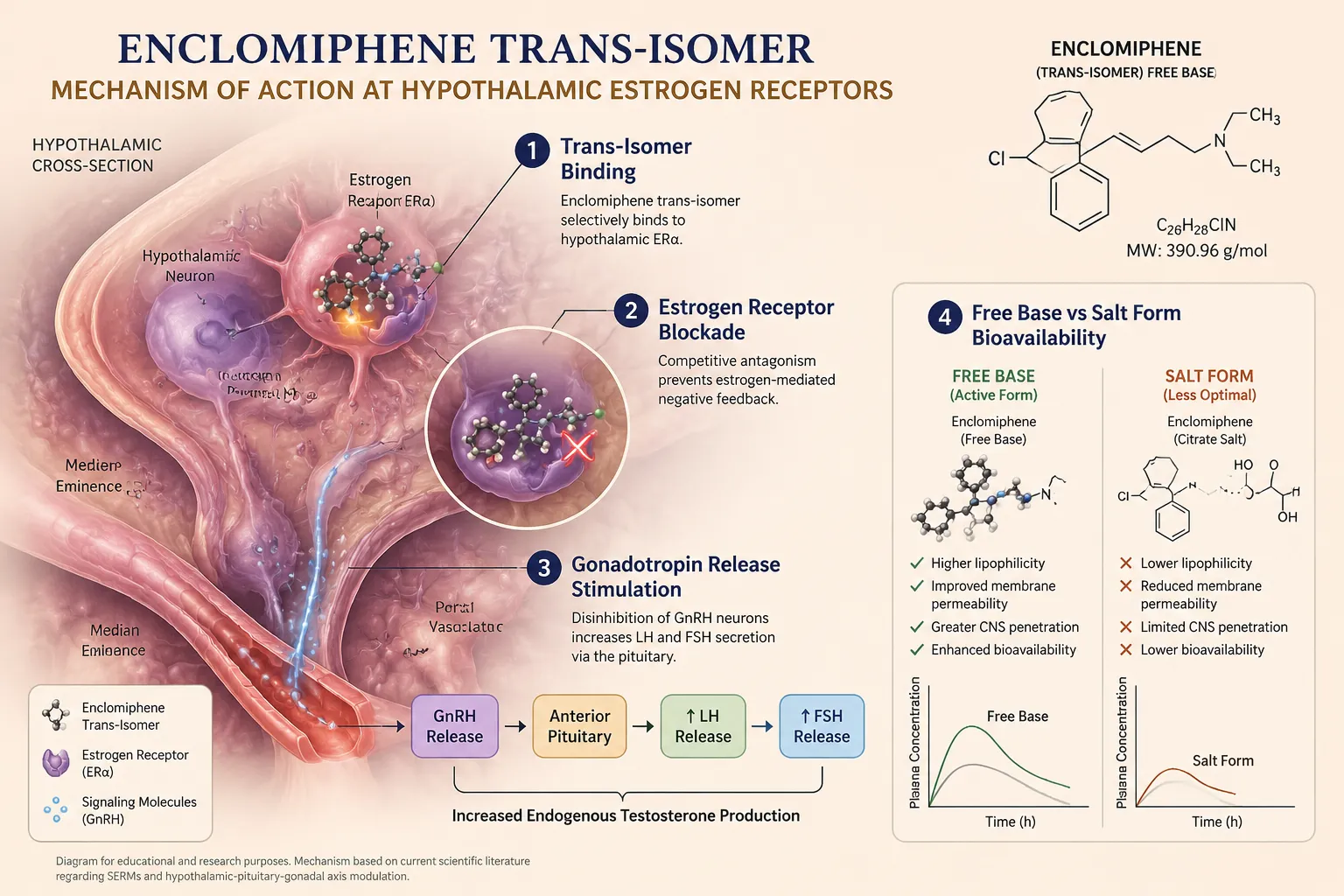
The clinical research record is unambiguous. Studies examining enclomiphene in functional hypogonadism have consistently used the citrate salt, with dosing patterns in trials typically ranging from 12.5 mg to 25 mg of enclomiphene citrate. A 2025 systematic review found that enclomiphene and clomiphene produced comparable testosterone restoration while preserving spermatogenesis, a meaningful distinction from exogenous testosterone therapy.
"Because all published efficacy and safety data reference the citrate salt, labs that use the free base form cannot directly map their in-vitro or preclinical findings onto human clinical benchmarks without a molar conversion step."
This is not a minor administrative detail. It is the difference between research that contributes to a translatable evidence base and research that exists in an isolated methodological silo.
As of mid-2026, no FDA-approved enclomiphene product exists. The compound retains investigational status, which means the regulatory environment for compounding and research supply remains fluid. Labs working in the broader hormone research space should monitor compounding pharmacy guidance closely, as regulatory shifts can affect both availability and permissible formulation types.
How Labs Choose Between Research Formulations and Vendors: A Practical Framework
When evaluating enclomiphene vs enclomiphene citrate and choosing between research formulations and vendors, experienced procurement teams apply a structured review process. The following framework reflects best practices drawn from the clinical and regulatory context.
Step 1: Confirm the Salt Form on the COA
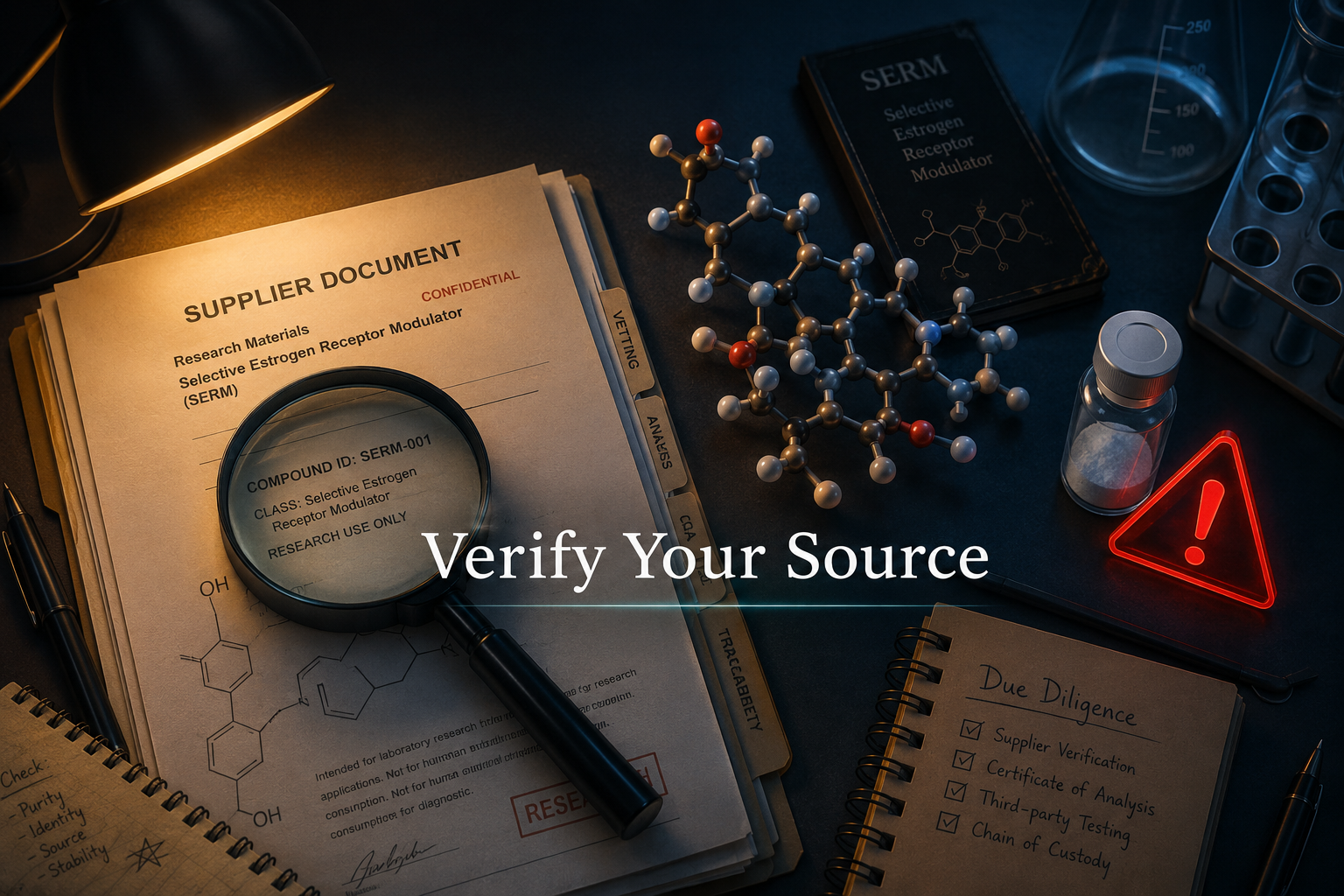
Every COA should explicitly state whether the material is the free base or citrate salt. If the document lists only "enclomiphene" without specifying the form, request clarification before purchasing. Ambiguity at this stage is a red flag.
Step 2: Review HPLC Purity Data
Purity should be confirmed by high-performance liquid chromatography (HPLC). Acceptable research-grade purity typically sits at 98% or above. Some vendors also provide nuclear magnetic resonance (NMR) spectroscopy data, which confirms molecular identity, not just purity. NMR data is a strong positive signal of vendor credibility.
Step 3: Check Isomeric Composition
Enclomiphene is the trans-isomer of clomiphene. Vendors sourcing from lower-quality synthesis pipelines may supply material with elevated zuclomiphene (the cis-isomer) contamination. The COA should confirm trans-isomer predominance.
Step 4: Evaluate Solvent Compatibility Documentation
Vendors should provide solubility data specific to the form they are selling. For aqueous-based assay systems, the citrate salt is the practical choice. For lipid-based or organic solvent systems, the free base may be appropriate. This mirrors the solvent-compatibility thinking applied in other research compound categories, including those covered in the GHK-Cu copper peptide sourcing guide.
Step 5: Verify Stability and Storage Specifications
Batch-specific stability data, including recommended storage temperature and projected shelf life, should accompany any research-grade order. Enclomiphene citrate is generally stable at -20°C when stored desiccated and away from light. Free base formulations may require tighter controls depending on the solvent system used.
Labs building out broader serm and peptide research programs can apply similar sourcing discipline across compound classes, the documentation-first approach outlined in resources like the BPC-157 core peptides documentation research guide translates directly to this workflow.
Interpreting COAs and Avoiding Common Vendor Pitfalls
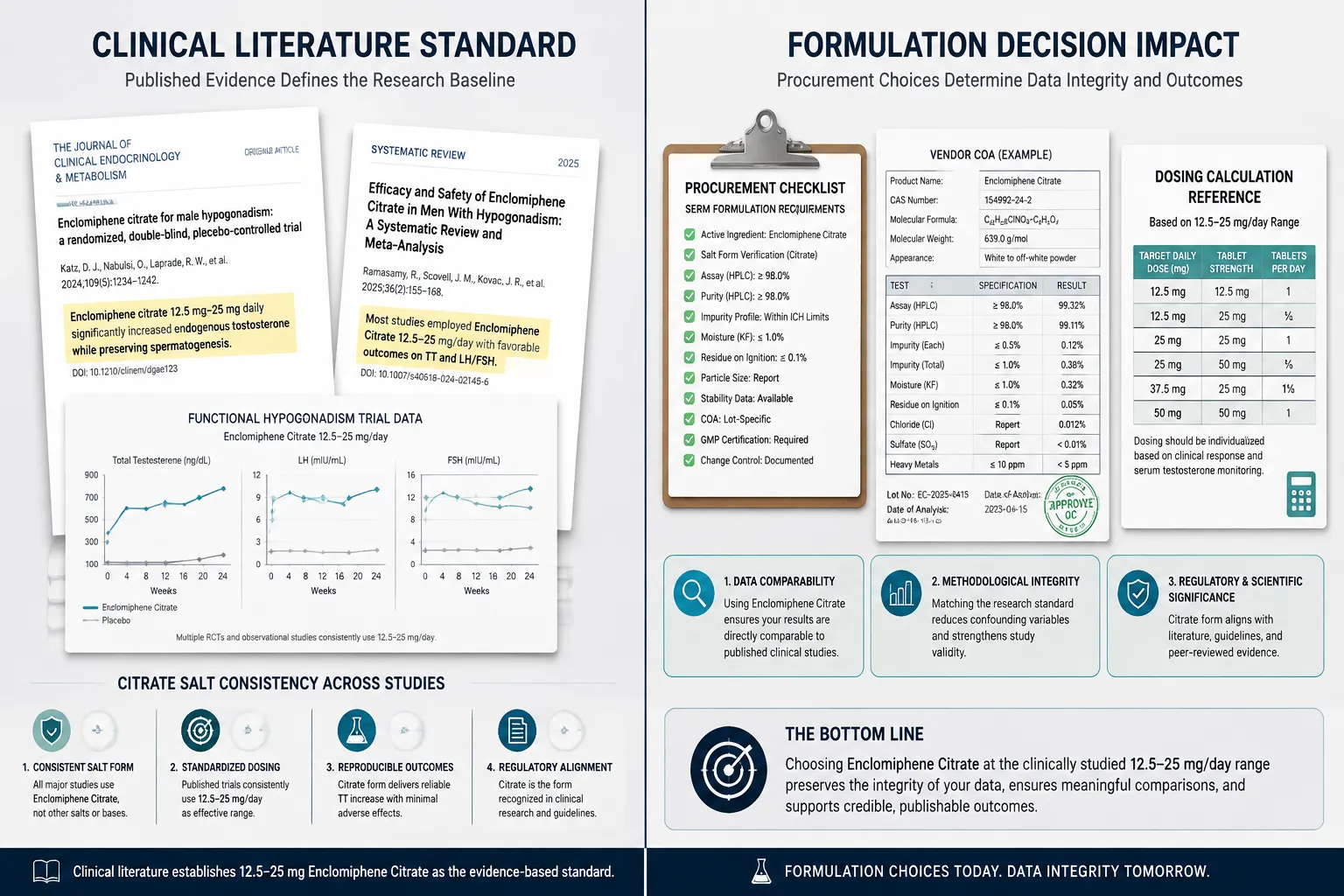
The COA is the single most important document in the vendor evaluation process. A well-constructed COA for enclomiphene citrate should include:
- Identity confirmation: HPLC chromatogram and NMR spectrum
- Purity result: Percentage purity with method stated
- Salt form declaration: Explicit statement of free base or citrate
- Isomeric ratio: Trans-isomer percentage confirmed
- Endotoxin testing: Particularly relevant for in-vivo research models
- Batch number and date: Enables traceability and reorder consistency
Vendors who resist providing full COA documentation, or who supply generic certificates not tied to a specific batch, should be deprioritized regardless of price.
For labs that also work with metabolic or mitochondrial research compounds, the same COA standards apply across the board, as illustrated in sourcing discussions for MOTS-C peptide and mitochondrial biogenesis research and SS-31 mitochondrial research themes.
Conclusion
The distinction between enclomiphene and enclomiphene citrate is not semantic, it is structural, chemical, and methodologically significant. Labs that treat the two names as interchangeable risk dosing errors, compromised data comparability, and wasted resources.
Actionable next steps for research teams:
- Audit existing inventory to confirm whether current stock is free base or citrate salt, and recalculate molar concentrations accordingly.
- Update procurement checklists to require explicit salt form declaration on all COAs.
- Prioritize vendors who supply batch-specific HPLC and NMR data, with confirmed trans-isomer purity above 98%.
- Align all dosing references to the citrate salt standard used in published clinical literature (12.5-25 mg range) to maintain translational validity.
- Monitor the regulatory environment through mid-2026 and beyond, as the compounding and investigational compound landscape for enclomiphene continues to evolve.
Rigorous formulation awareness is not an obstacle to productive research, it is the foundation that makes research results meaningful.