Call or Text 727-513-9780
  • Shopping Cart Shopping Cart
    0Shopping Cart
Pure Tested Peptides | America's most trusted Peptides for sale online
  • Peptides for sale
    • Oral Peptides for sale
      • Peptide Capsules for sale
      • BPC 157 Capsules 1000mcg
      • SLU-PP-332 Capsules | 1000 mcg
      • 5-Amino-1MQ 50mg Capsules
      • Tesofensine 500mcg
    • All Peptides for sale
    • Peptide Sprays
      • BPC 157 Nasal Spray Kit
      • BPC-157 TB500 Nasal Spray Kit
      • Semax Nasal Spray 10mg
      • Selank – Nasal Spray Kit – 10mg
      • Epithalon 50MG Nasal Spray Kit
      • Ipamorelin 10mg Nasal Spray
      • Klow Nasal Spray (BPC-157 + TB-500 + GHK-Cu + KPV) | 80mg
      • Hulk Nasal Spray Tesa / Ipa Blend 6/3 MG
      • Klow Nasal Spray
      • NAD + 500 mg Nasal Spray
      • PT-141 Nasal Spray Kit
    • GHRH Peptides
      • Ipa Peptides
      • CJC-1295 Peptides
        • CJC-1295 with DAC 5 mg
        • CJC-1295 without DAC 5 mg
        • CJC-1295 Ipa 10mg
      • Tesa Peptides
        • Tesa Peptide
        • Tesa 20 mg
    • GHK-Cu Peptides
      • All GHK-Cu Peptides
      • GHK-Cu 100mg
      • KLOW Peptide Blend – Buy KLOW blend online
    • BPC Peptides
      • All BPC Peptides
      • BPC-157
      • BPC-157 TB-500
      • BPC 157 capsules 1000mcg
    • SLU-PP-332 Peptides
      • All SLU-PP-332 Peptides
      • SLU-PP-332 5mg
    • GLP3 Peptides
    • PT-141 Peptides
      • PT-141 Peptides for sale
      • PT-141 10mg
      • PT-141 Nasal Spray
    • CAG Peptides
      • Lipo-C Peptide Blend
      • CAG 5mg
      • CAG 10mg
    • MOTS-C Peptides
      • MOTS-C Peptides for sale
      • MOTS-c peptide
      • MOTS-c 10mg *6 pack*
    • 5 Amino 1MQ Peptides
      • 5 Amino 1MQ Peptides for sale
      • 5-Amino-1MQ 50mg Capsules
      • 5-Amino-1MQ 5mg
    • Epithalon Peptides
      • Epithalon Peptides for sale
      • Epithalon 10mg
      • Epithalon 50mg
  • Shop
    • GLPs
      • 5-Amino-1MQ 50mg Capsules
      • 5-Amino-1MQ 5mg
      • L-Carnitine 500mg/ml
      • Tesofensine 500mcg
      • SLU-PP-332 5mg
      • MOTS-c 10mg *6 pack*
    • Epithalon & BPC Peptides
      • Epithalon 10mg
      • Epithalon 50mg
      • BPC-157
      • BPC 157 capsules 1000mcg
      • BPC-157 TB-500
      • BPC-157 TB500 Nasal Spray Kit
      • BPC 157 Nasal Spray Kit
    • BPC TB-500 & NAD+ Peptides
      • NAD+ 500 mg
      • KLOW Peptide Blend – Buy KLOW blend online
      • GLOW Peptide Blend
      • TB 500 5mg
      • BPC 157 capsules 1000mcg – Supplement
      • BPC 157 Nasal Spray Kit
      • BPC-157
      • BPC-157 TB500 Nasal Spray Kit
      • BPC-157 TB-500
      • BPC 157 capsules 1000mcg
    • LL-37 Peptide
      • LL-37 10 mg
    • MOTS-C & Selank
      • MOTS-c peptide
      • Selank 10mg
    • GHK Peptides
      • GHK-Cu 100mg
      • GLOW Peptide Blend
      • KLOW Peptide Blend – Buy KLOW blend online
  • COAs
  • Wholesale
    • Wholesale Peptides for sale
  • PTP FAQ
  • Affiliates
    • Selank Peptide: Advanced Pharmacological Mechanisms Underlying Its Anxiolytic and Nootropic Effects in Research
      • 5-Amino-1MQ Peptide: Detailed Mechanisms of NNMT Inhibition and Its Impact on Cellular Metabolism Research
        • MOTS-C Peptide: Unraveling Its Role in Mitochondrial Dynamics and Energy Metabolism Research
          • Epithalon Peptide and Telomerase Regulation: Investigating Its Impact on Cellular Senescence and Lifespan Research Models
            • GLP2-T vs GLP2 Tirz Peptide: Understanding the Naming, Mechanistic Nuances, and Research Implications for Gut Health
      • Peptides and Polypeptides in Modern Pharmacology: What Research on Metoprolol, Prednisone, and Amlodipine Reveals
        • Polypeptide Peptides vs NSAIDs: What Naproxen and Diclofenac Teach Tissue-Repair Researchers About BPC‑157 and TB‑500
          • Peptides and Polypeptides in Endocrine Pharmacology: How GLP-1, GLP-2, and GLP-3 Retatrutide Differ From Classic Drugs Like Prednisone and Amlodipine
          • 5‑Amino‑1MQ Peptide and NNMT Inhibition: How It Compares With Statins Like Atorvastatin in Adipose and Lipid Metabolism Research
      • Enclomiphene, Estrogen Receptor Signaling, and Luteinizing Phase Biology: What Hormone Researchers Should Measure
        • Mesenchymal Stem Cells, BPC‑157, and GHK‑Cu: How Tissue Repair Peptides Compare With Classic NSAIDs Like Naproxen in Injury Models
          • Peptide Calculator Use Cases Beyond Growth Hormone: Working Through GLP‑3 Retatrutide, MOTS‑c, and BPC‑157 Research Dosing
        • Polypeptide Peptides in Endocrine and Metabolic Pharmacology: Lessons From Amlodipine, Prednisone, and Metoprolol
        • Peptides Calculator for Advanced Blends: Worked Examples for Tesamorelin, CJC‑1295, and Ipamorelin Stacks
          • Peptides and Polypeptides in Human Physiology: How Molecular Size Shapes Research Applications
            • Selank Peptide: Advanced Pharmacological Mechanisms Underlying Its Anxiolytic and Nootropic Effects in Research
          • 5-Amino-1MQ Peptide: Detailed Mechanisms of NNMT Inhibition and Its Impact on Cellular Metabolism Research
            • MOTS-C Peptide: Unraveling Its Role in Mitochondrial Dynamics and Energy Metabolism Research
              • Epithalon Peptide and Telomerase Regulation: Investigating Its Impact on Cellular Senescence and Lifespan Research Models
                • GLP2-T vs GLP2 Tirz Peptide: Understanding the Naming, Mechanistic Nuances, and Research Implications for Gut Health
                  • Peptides and Polypeptides in Endocrine Pharmacology: How GLP-1, GLP-2, and GLP-3 Retatrutide Differ From Classic Drugs Like Prednisone and Amlodipine
                    • Polypeptide Peptides vs NSAIDs: What Naproxen and Diclofenac Teach Tissue-Repair Researchers About BPC‑157 and TB‑500
                      • Peptides and Polypeptides in Modern Pharmacology: What Research on Metoprolol, Prednisone, and Amlodipine Reveals
                        • 5‑Amino‑1MQ Peptide and NNMT Inhibition: How It Compares With Statins Like Atorvastatin in Adipose and Lipid Metabolism Research
                        • Enclomiphene, Estrogen Receptor Signaling, and Luteinizing Phase Biology: What Hormone Researchers Should Measure
                        • Mesenchymal Stem Cells, BPC‑157, and GHK‑Cu: How Tissue Repair Peptides Compare With Classic NSAIDs Like Naproxen in Injury Models
                        • Peptide Calculator Use Cases Beyond Growth Hormone: Working Through GLP‑3 Retatrutide, MOTS‑c, and BPC‑157 Research Dosing
                        • Polypeptide Peptides in Endocrine and Metabolic Pharmacology: Lessons From Amlodipine, Prednisone, and Metoprolol
                        • Peptides Calculator for Advanced Blends: Worked Examples for Tesamorelin, CJC‑1295, and Ipamorelin Stacks
                        • Peptides and Polypeptides in Human Physiology: How Molecular Size Shapes Research Applications
                        • Selank Peptide: Advanced Pharmacological Mechanisms Underlying Its Anxiolytic and Nootropic Effects in Research
                        • MOTS-C Peptide: Unraveling Its Role in Mitochondrial Dynamics and Energy Metabolism Research
                        • Peptides and Polypeptides in Modern Pharmacology: What Research on Metoprolol, Prednisone, and Amlodipine Reveals
                        • Peptides and Polypeptides in Endocrine Pharmacology: How GLP-1, GLP-2, and GLP-3 Retatrutide Differ From Classic Drugs Like Prednisone and Amlodipine
                        • 5-Amino-1MQ Peptide: Detailed Mechanisms of NNMT Inhibition and Its Impact on Cellular Metabolism Research
                        • Mesenchymal Stem Cells, BPC‑157, and GHK‑Cu: How Tissue Repair Peptides Compare With Classic NSAIDs Like Naproxen in Injury Models
                        • Peptide Calculator Use Cases Beyond Growth Hormone: Working Through GLP‑3 Retatrutide, MOTS‑c, and BPC‑157 Research Dosing
                        • GLP2-T vs GLP2 Tirz Peptide: Understanding the Naming, Mechanistic Nuances, and Research Implications for Gut Health
                        • Polypeptide Peptides in Endocrine and Metabolic Pharmacology: Lessons From Amlodipine, Prednisone, and Metoprolol
                        • Polypeptide Peptides vs NSAIDs: What Naproxen and Diclofenac Teach Tissue-Repair Researchers About BPC‑157 and TB‑500
                        • Peptides and Polypeptides in Human Physiology: How Molecular Size Shapes Research Applications
                        • Peptides Calculator for Advanced Blends: Worked Examples for Tesamorelin, CJC‑1295, and Ipamorelin Stacks
                        • 5‑Amino‑1MQ Peptide and NNMT Inhibition: How It Compares With Statins Like Atorvastatin in Adipose and Lipid Metabolism Research
                        • Enclomiphene, Estrogen Receptor Signaling, and Luteinizing Phase Biology: What Hormone Researchers Should Measure
                        • Epithalon Peptide and Telomerase Regulation: Investigating Its Impact on Cellular Senescence and Lifespan Research Models
                        • Best research protocol Klow blend
                        • best time to take BPC-157
                        • best time to take DSIP (Delta Sleep Inducing Peptide)
                        • best time to take CJC-1295
                        • best time to take AOD-9604
                        • best time to take Follistatin 344
                        • best time to take Ipamorelin
                        • best time to take MK-677 (Ibutamoren)
                        • best time to take Ligandrol (LGD-4033) — research compound
                        • best time to take Ostarine (MK-2866) — research compound
                        • best time to take GHK-CU
                        • best time to take TB-500
                        • best time to take MOTS-c
                        • best time to take Semax
                        • best time to take RAD-140 (Testolone) — research compound
                        • best time to take Thymosin Alpha-1
                        • best time to take PEG-MGF
                        • Biolife Plasma, Octapharma Plasma, and Research Peptides: How Plasma Donation Labs Differ From Peptide Suppliers
                        • best time to take YK-11 — research compound
                        • best time to take PT-141 (Bremelanotide)
                        • Best research protocol Klow blend
                        • 5-Amino-1MQ and MOTS-C Synergy: Metabolic Signaling, Mitochondria, and Research Design
                        • BPC-157 and TB-500: Investigating Their Combined Effects on Angiogenesis and Cellular Migration in Tissue Repair Models
                        • BPC-157 Peptide: Gut Barrier Function, Inflammation, and Tissue-Recovery Research
                        • 5‑Amino‑1MQ and MOTS‑c Synergy in Metabolic Research: Designing NNMT and Mitochondrial Biogenesis Stacks
                        • CJC-1295 with DAC vs. Without DAC: Half-Life, Release Kinetics, and Research Implications
                        • CJC‑1295 with DAC vs. Without DAC: Expanding on Half‑Life Differences Using Tesamorelin and Ipamorelin Blend Case Studies
                        • Collagen Biology and Copper‑Binding Peptides: How GHK‑Cu, Glow Blend, and Klow Blend Interact with Skin and Connective Tissue
                        • Collagen Biology and Regenerative Peptides: How GHK‑Cu, Glow Blend, and Klow Blend Affect Extracellular Matrix Research
                    • DNA, Telomeres, and Longevity Peptides: Positioning Epithalon and MOTS‑c in Genetic Aging Research
                      • Enclomiphene Citrate: serm Mechanism, Testosterone Research, and Stack Compatibility
                        • Enclomiphene vs Enclomiphene Citrate: Formulation, Bioavailability, and Research Distinctions
                        • Epithalon Peptide Research: Telomerase Activation, Aging, and Pineal Gland Function
                        • Estrogen Receptor Signaling and Enclomiphene: How Selective Modulators Compare with Classic Polypeptide Hormones
                        • GHK-Cu Peptide: Advanced Mechanisms in Extracellular Matrix Remodeling and Wound Healing Research
                        • GHK-Cu Peptide: Collagen Synthesis, Wound Repair, and Skin-Barrier Research Models
                        • GLP-1 vs GLP-3 vs GLP-2: Peptide Classification and Research Applications
                        • GLP-2 Peptide Research Guide: Gut Barrier Function, Nutrient Absorption, and Intestinal Recovery Models
                        • GLP-3 Retatrutide vs. GLP-1 Drugs: What Triple-Agonist Biology Changes in Research Models
                        • Ipamorelin and Tesamorelin Combination: Synergistic GH Secretagogue Research and Dosing Protocols
                        • GLP2 Tirz Peptide: What It Is, Why the Name Exists, and How Researchers Should Interpret It
                        • Klow Blend Peptide Nasal Spray: What the Formulation Is Trying to Do in Cognitive Research
                        • Mitochondria, NNMT Inhibition, and Peptide Modulators: Where MOTS‑c and 5‑Amino‑1MQ Fit in Cellular Energy Research
                        • MOTS-c Peptide: Mitochondrial Function, Energy Metabolism, and What Researchers Measure
                        • MOTS-c vs. 5-Amino-1MQ: Which Metabolic Research Questions Each Compound Actually Answers
                        • Nasal Spray Peptides: Bioavailability, Administration, and Semax/Selank Research Applications
                        • PT-141 Peptide Research: Mechanism of Action and Melanocortin Receptor Signaling
                        • Retatrutide for Research: Mechanism, Structure, and GLP-1/GLP-3 Dual Action
                        • Retatrutide for Obesity and Type 2 Diabetes: What the Latest Trial Data Suggest
                        • Tesofensine Peptide Research: Mechanism, Appetite Suppression, and Neuropeptide Y Pathways
  • Contact
    • Contact Customer Service
    • Text Customer Support
  • About US
  • Shop all peptides
  • Affiliate Program
    • Affiliate Signup
  • Login / Register Login / Register Page Link Login / Register Page Link
  • Click to open the search input field Click to open the search input field Search
  • Menu Menu

Tag Archive for: iron supplementation

Iron Pills and Peptide Research: Separating Anemia Correction From Metabolic and Mitochondrial Effects

Iron Pills and Peptide Research: Separating Anemia Correction From Metabolic and Mitochondrial Effects

November 10, 2026/0 Comments/in Uncategorized/by

Fatigue disappears after iron supplementation, but corrected hemoglobin does not always explain why. Research published in 2025 and 2026 confirms that iron deficiency disrupts mitochondrial ATP synthesis, shifts metabolism toward anaerobic glycolysis, and elevates lactate, pyruvate, and succinate long before a blood count flags clinical anemia. For researchers studying metabolic peptides such as MOTS-c and 5-Amino-1MQ, that distinction matters enormously. This article examines the full scope of Iron Pills and Peptide Research: Separating Anemia Correction From Metabolic and Mitochondrial Effects, covering what the latest studies show, why baseline iron variables must be recorded in every peptide model, and how oxidative stress bridges both fields.

Key Takeaways

  • Iron deficiency impairs mitochondrial electron transport and ATP output well before anemia develops, creating confounding variables in metabolic research.
  • Elevated succinate, lactate, and reduced ATP serve as metabolic biomarkers that go beyond hemoglobin when evaluating iron interventions.
  • Baseline ferritin, hemoglobin, and serum iron must be documented in MOTS-c, 5-Amino-1MQ, and endurance peptide studies to allow valid interpretation.
  • Peptides that target mitochondrial function, such as SS-31, may interact with iron-driven oxidative stress in ways that require careful experimental design.
  • High-dose iron supplementation carries oxidative risk; optimal dosing strategies balance anemia correction with protection against free-radical damage.

Beyond Hemoglobin: The Metabolic and Mitochondrial Burden of Iron Deficiency

Iron is not simply a building block for red blood cells. It is a core component of Complexes I through IV of the mitochondrial electron transport chain. When iron is insufficient, oxidative phosphorylation slows, ATP output drops, and cells compensate by burning glucose anaerobically, a metabolic shift reflected in elevated lactate and pyruvate. Succinate, a TCA-cycle intermediate, accumulates as a signal of impaired mitochondrial flux, and reactive oxygen species (ROS) production increases.
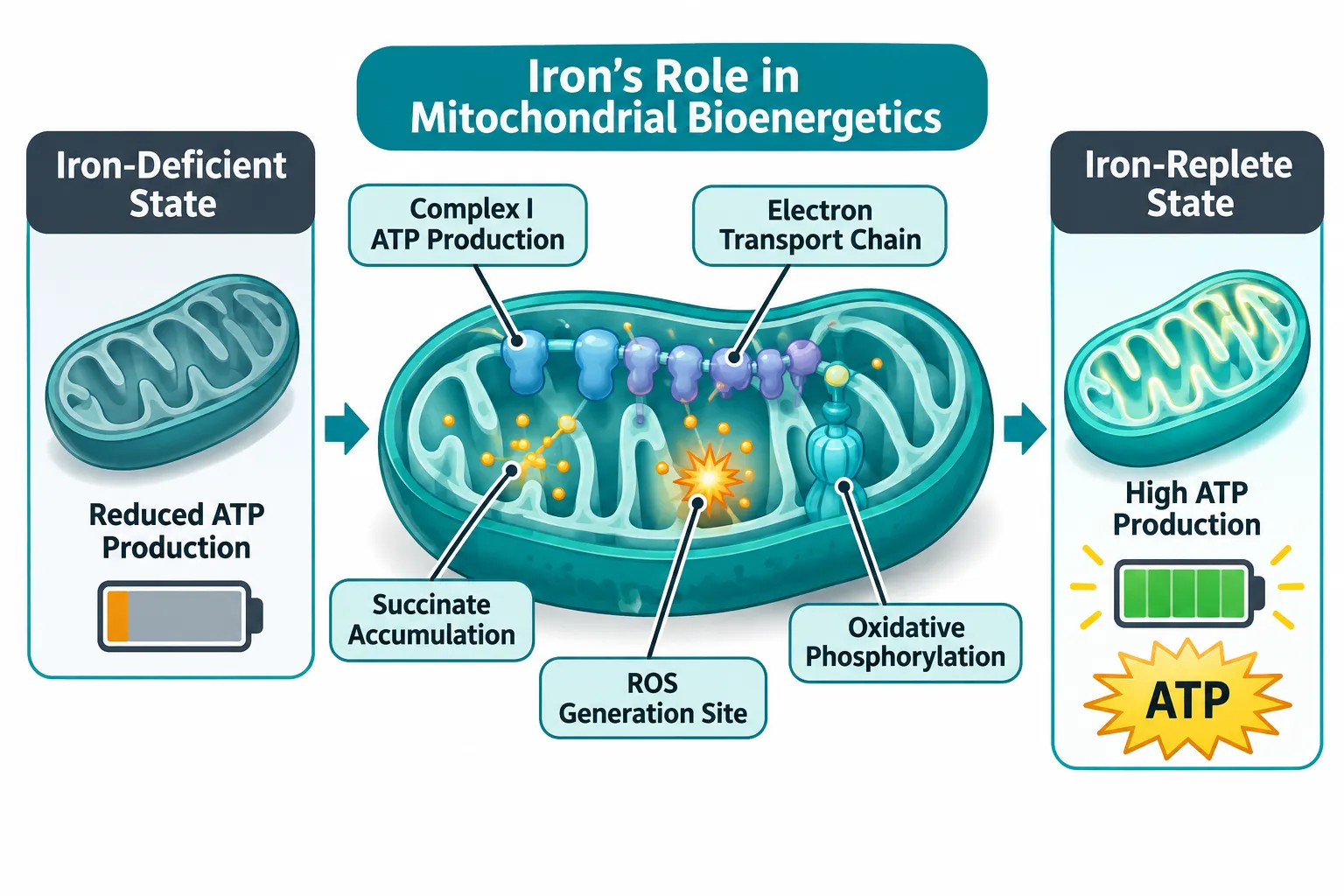
Beyond Hemoglobin: The Metabolic and Mitochondrial Burden of Iron Deficiency

Symptomatic fatigue and reduced exercise capacity can appear in iron-deficient individuals with completely normal hemoglobin. A 2025 review confirmed that iron repletion improves muscle function and aerobic performance as independent outcomes from anemia correction, and randomized data support oral iron supplementation improving unexplained fatigue in non-anemic women. The ongoing MyoIRON clinical trial captures this directly: participants with suboptimal but non-anemic iron stores are randomized to 150 mg elemental iron every other day for 12 weeks, measuring skeletal-muscle iron storage, mitochondrial protein expression, and single-leg exercise performance alongside conventional hematologic markers. The trial is an explicit attempt at separating anemia correction from metabolic and mitochondrial effects in a living system.

A 2024 rat study reinforced the point mechanistically. Animals receiving an iron-based supplement with vitamin B6 for 30 days showed substantially increased Complex I, and Complex II, driven ATP production in gastrocnemius and cerebellar mitochondria, without a corresponding rise in basal or succinate-stimulated ROS. Mitochondrial energy output improved without worsening oxidative stress, a finding that cannot be reduced to simple erythropoiesis.


Iron Pills and Peptide Research: Why MOTS-c and 5-Amino-1MQ Studies Need Iron Variables

MOTS-c is a mitochondria-derived peptide encoded in the 12S rRNA region of mitochondrial DNA. Its primary research interest lies in metabolic regulation, specifically AMPK activation, glucose uptake, and mitochondrial biogenesis. 5-Amino-1MQ is a small-molecule inhibitor of NNMT (nicotinamide N-methyltransferase) linked to energy expenditure, fat metabolism, and NAD+ pathway regulation. Both targets sit directly within the same metabolic machinery that iron deficiency disrupts.
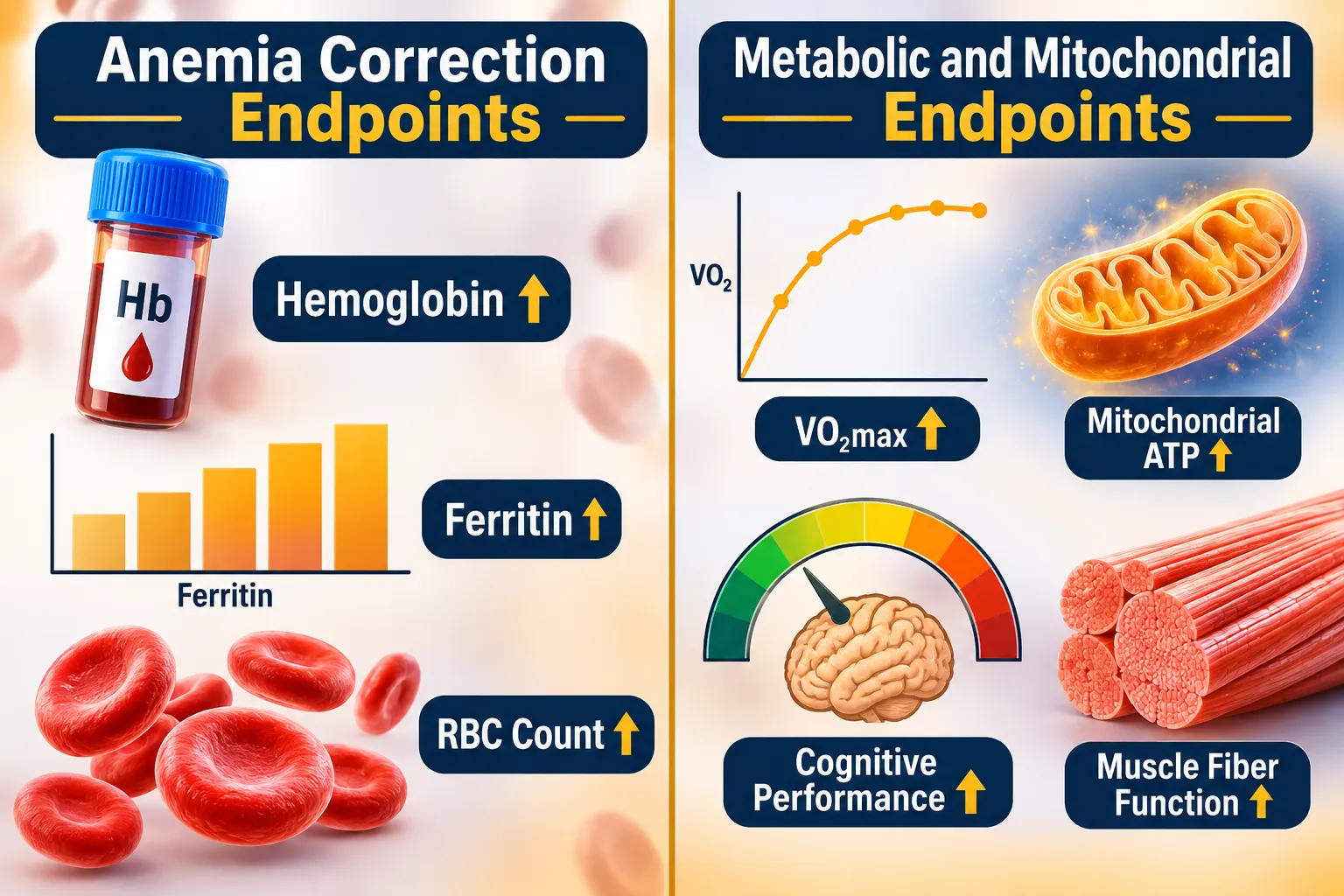
Iron Pills and Peptide Research: Why MOTS-c and 5-Amino-1MQ Studies Need Iron Variables

When an animal or human subject enters a MOTS-c or 5-Amino-1MQ study in an iron-deficient state, several confounders activate simultaneously:

Variable Iron-Deficient Effect Peptide Research Impact
Mitochondrial ATP output Reduced Complex I/II activity Masks or mimics peptide effect on energy
ROS production Elevated Inflates oxidative stress readings
AMPK signaling Activated by low energy charge Confounds MOTS-c AMPK data
VO2max / aerobic capacity Decreased Distorts endurance endpoint comparisons
Muscle glycolytic shift Increased lactate/pyruvate Alters substrate utilization metrics

This is not a hypothetical concern. A large 2025 intravenous iron trial in heart failure patients showed improvements in functional capacity and quality of life that were partly attributed to improved cardiac and skeletal muscle energetics, effects distinct from anemia correction. If iron status was not measured at baseline in those subjects, the metabolic improvements would have been attributed entirely to the therapeutic intervention under study.

Core principle: In any peptide model targeting metabolic or mitochondrial outcomes, an undocumented low-ferritin subject is an uncontrolled variable.

For researchers exploring SS-31 mitochondrial research themes alongside iron protocols, this overlap is especially relevant. SS-31 targets cardiolipin on the inner mitochondrial membrane, stabilizing cristae architecture and reducing ROS leak, the same ROS that iron-driven Fenton chemistry can amplify. Studies of SS31 mitochondrial dynamics therefore benefit from documented iron and oxidative-stress baselines.


Oxidative Stress, Hepcidin, and the Peptide Research Frontier

Iron Pills and Peptide Research: Separating Anemia Correction From Metabolic and Mitochondrial Effects becomes most complex at the intersection of oxidative biology. Free, unliganded iron catalyzes hydroxyl radical formation via the Fenton reaction. High-dose oral or intravenous iron therefore carries oxidative risk at the mitochondrial membrane, the very site that peptides like SS-31 are designed to protect.
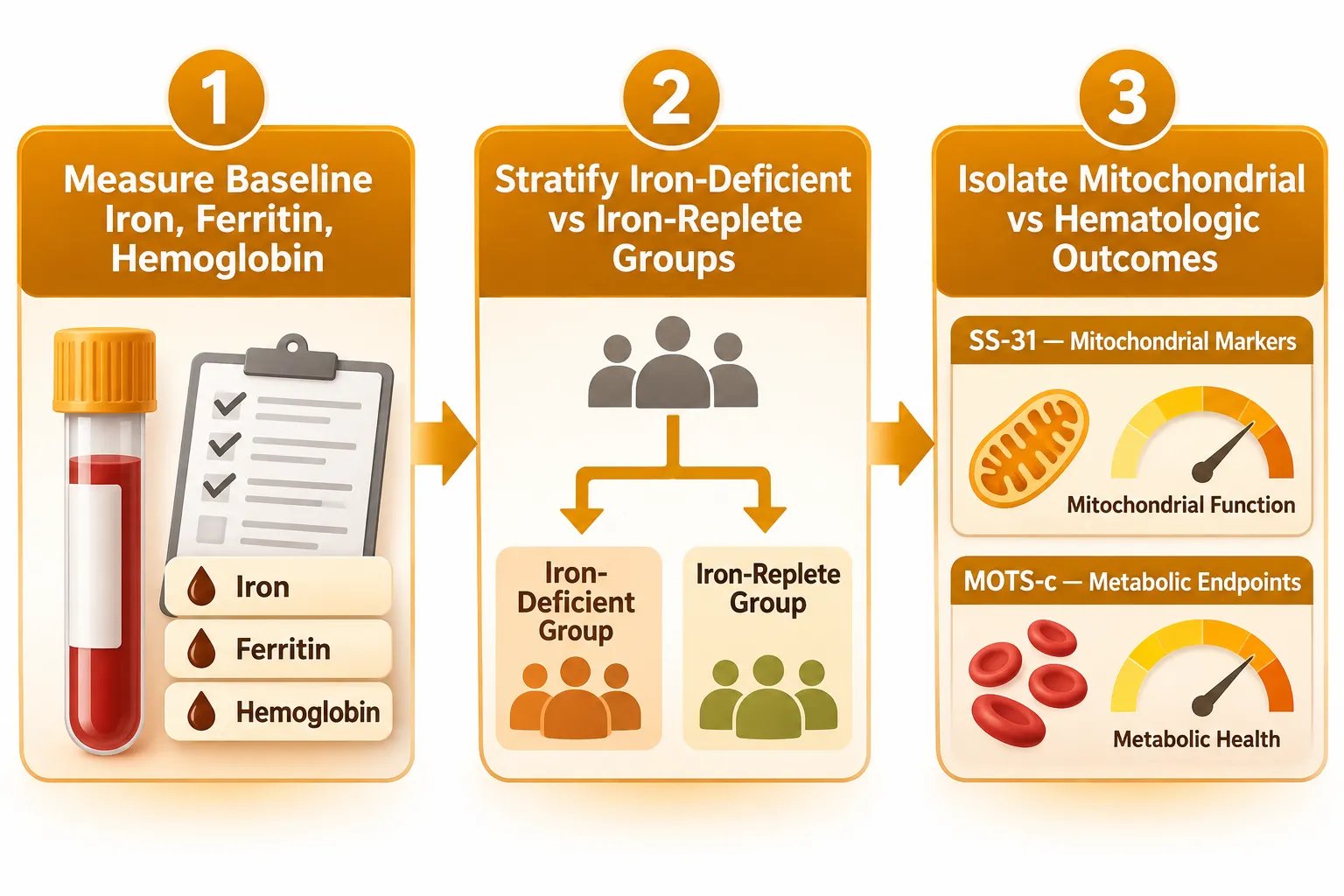
Oxidative Stress, Hepcidin, and the Peptide Research Frontier

A 2026 review highlighted this oxidative risk explicitly, noting that dosing strategies must balance anemia correction with prevention of cellular oxidative injury. That balance is dose- and timing-dependent, and it interacts with antioxidant peptide activity in ways that have not yet been systematically characterized.

A second complication arises in metabolic disease. In subjects with obesity, chronic inflammation upregulates hepcidin, the master iron-regulatory hormone, restricting iron availability to tissues. Iron deficiency in this population impairs attention, memory, executive function, and aerobic performance before hemoglobin falls. For peptide studies aimed at visceral fat or metabolic syndrome, areas covered extensively in visceral fat research, a subject's inflammatory iron restriction represents a silent confounder that inflates apparent peptide efficacy when iron normalizes incidentally.

Unabsorbed luminal iron from oral supplementation also alters gut microbial communities, potentially modulating inflammatory signaling and systemic metabolic tone through pathways that overlap with GLP-class peptide research. Researchers following developments in GLP-3 peptide studies should note that iron-microbiome interactions may affect metabolic endpoints used in those models.

Recommended baseline variables for any metabolic or mitochondrial peptide study:

  • Serum ferritin (iron stores)
  • Hemoglobin and hematocrit
  • Serum iron and transferrin saturation
  • C-reactive protein (to flag inflammatory iron restriction)
  • Lactate and pyruvate ratios (as markers of glycolytic shift)

For neurodevelopmental models, iron is a cofactor for myelination and neurotransmitter synthesis, both energy-intensive processes. Cognitive peptide studies that omit iron status risk attributing brain-energy improvements to the peptide when simple iron repletion drove the result. Reviewing SS-31 kidney health research illustrates how organ-specific energy demands interact with mitochondrial protectants in ways that iron status modulates at the cellular level.


Conclusion

The evidence from 2025 and 2026 is unambiguous: iron deficiency alters mitochondrial function, metabolic substrate use, and oxidative stress in ways that are independent of hemoglobin status. For peptide researchers working with MOTS-c, 5-Amino-1MQ, SS-31, or endurance-performance models, iron variables are not background noise, they are primary confounders.

Actionable next steps for research teams:

  1. Screen all subjects for serum ferritin, hemoglobin, transferrin saturation, and CRP before enrollment in any metabolic or mitochondrial peptide study.
  2. Stratify or exclude iron-deficient individuals unless iron status is itself a study variable.
  3. When evaluating mitochondrial peptides, record baseline lactate-to-pyruvate ratios and VO2max alongside standard iron panels.
  4. For studies using SS-31 or similar antioxidant peptides, document iron dosing and timing to separate peptide-driven ROS reduction from iron-dose-driven oxidative load.
  5. Consult published resources on SS-31 peptide benefits and LL-37 versus SS-31 comparative research for reference frameworks when designing combination protocols.

Separating anemia correction from metabolic and mitochondrial effects is not academic fine-tuning, it is the difference between a valid result and a confounded one.

https://www.puretestedpeptides.com/wp-content/uploads/2026/11/iron-pills-and-peptide-research-separating-anemia-correction-from-metabolic-and.webp 1024 1536 https://www.puretestedpeptides.com/wp-content/uploads/2026/01/buy-peptides-online.jpg 2026-11-10 14:05:212026-11-10 14:05:21Iron Pills and Peptide Research: Separating Anemia Correction From Metabolic and Mitochondrial Effects
×

Helpful Links

  • My account
  • Cart
  • Checkout
  • Refund and Returns Policy
  • Privacy Policy
  • SMS Privacy Policy
  • Login
  • My Account
  • Logout

USA Made Lab Tested Peptides

All products are sold for research, laboratory, or analytical purposes only, and are not for human consumption


Pure Tested Peptides is a chemical supplier. Pure Tested Peptides is not a compounding / chemical compounding facility as defined under 503A of the Federal Food, Drug, and Cosmetic act. Pure Tested Peptides is not an outsourcing facility as defined under 503B of the Federal Food, Drug, and Cosmetic act.

The statements made within this website have not been evaluated by the US Food and Drug Administration. The products we offer are not intended to diagnose, treat, cure or prevent any disease.

Human/Animal Consumption Prohibited. Laboratory/In-Vitro Experimental Use Only

Scroll to top Scroll to top Scroll to top