Call or Text 727-513-9780
  • Shopping Cart Shopping Cart
    0Shopping Cart
Pure Tested Peptides | America's most trusted Peptides for sale online
  • Peptides for sale
    • Oral Peptides for sale
      • Peptide Capsules for sale
      • BPC 157 Capsules 1000mcg
      • SLU-PP-332 Capsules | 1000 mcg
      • 5-Amino-1MQ 50mg Capsules
      • Tesofensine 500mcg
    • All Peptides for sale
    • Peptide Sprays
      • BPC 157 Nasal Spray Kit
      • BPC-157 TB500 Nasal Spray Kit
      • Semax Nasal Spray 10mg
      • Selank – Nasal Spray Kit – 10mg
      • Epithalon 50MG Nasal Spray Kit
      • Ipamorelin 10mg Nasal Spray
      • Klow Nasal Spray (BPC-157 + TB-500 + GHK-Cu + KPV) | 80mg
      • Hulk Nasal Spray Tesa / Ipa Blend 6/3 MG
      • Klow Nasal Spray
      • NAD + 500 mg Nasal Spray
      • PT-141 Nasal Spray Kit
    • GHRH Peptides
      • Ipa Peptides
      • CJC-1295 Peptides
        • CJC-1295 with DAC 5 mg
        • CJC-1295 without DAC 5 mg
        • CJC-1295 Ipa 10mg
      • Tesa Peptides
        • Tesa Peptide
        • Tesa 20 mg
    • GHK-Cu Peptides
      • All GHK-Cu Peptides
      • GHK-Cu 100mg
      • KLOW Peptide Blend – Buy KLOW blend online
    • BPC Peptides
      • All BPC Peptides
      • BPC-157
      • BPC-157 TB-500
      • BPC 157 capsules 1000mcg
    • SLU-PP-332 Peptides
      • All SLU-PP-332 Peptides
      • SLU-PP-332 5mg
    • GLP3 Peptides
    • PT-141 Peptides
      • PT-141 Peptides for sale
      • PT-141 10mg
      • PT-141 Nasal Spray
    • CAG Peptides
      • Lipo-C Peptide Blend
      • CAG 5mg
      • CAG 10mg
    • MOTS-C Peptides
      • MOTS-C Peptides for sale
      • MOTS-c peptide
      • MOTS-c 10mg *6 pack*
    • 5 Amino 1MQ Peptides
      • 5 Amino 1MQ Peptides for sale
      • 5-Amino-1MQ 50mg Capsules
      • 5-Amino-1MQ 5mg
    • Epithalon Peptides
      • Epithalon Peptides for sale
      • Epithalon 10mg
      • Epithalon 50mg
  • Shop
    • GLPs
      • 5-Amino-1MQ 50mg Capsules
      • 5-Amino-1MQ 5mg
      • L-Carnitine 500mg/ml
      • Tesofensine 500mcg
      • SLU-PP-332 5mg
      • MOTS-c 10mg *6 pack*
    • Epithalon & BPC Peptides
      • Epithalon 10mg
      • Epithalon 50mg
      • BPC-157
      • BPC 157 capsules 1000mcg
      • BPC-157 TB-500
      • BPC-157 TB500 Nasal Spray Kit
      • BPC 157 Nasal Spray Kit
    • BPC TB-500 & NAD+ Peptides
      • NAD+ 500 mg
      • KLOW Peptide Blend – Buy KLOW blend online
      • GLOW Peptide Blend
      • TB 500 5mg
      • BPC 157 capsules 1000mcg – Supplement
      • BPC 157 Nasal Spray Kit
      • BPC-157
      • BPC-157 TB500 Nasal Spray Kit
      • BPC-157 TB-500
      • BPC 157 capsules 1000mcg
    • LL-37 Peptide
      • LL-37 10 mg
    • MOTS-C & Selank
      • MOTS-c peptide
      • Selank 10mg
    • GHK Peptides
      • GHK-Cu 100mg
      • GLOW Peptide Blend
      • KLOW Peptide Blend – Buy KLOW blend online
  • COAs
  • Wholesale
    • Wholesale Peptides for sale
  • PTP FAQ
  • Affiliates
    • Selank Peptide: Advanced Pharmacological Mechanisms Underlying Its Anxiolytic and Nootropic Effects in Research
      • 5-Amino-1MQ Peptide: Detailed Mechanisms of NNMT Inhibition and Its Impact on Cellular Metabolism Research
        • MOTS-C Peptide: Unraveling Its Role in Mitochondrial Dynamics and Energy Metabolism Research
          • Epithalon Peptide and Telomerase Regulation: Investigating Its Impact on Cellular Senescence and Lifespan Research Models
            • GLP2-T vs GLP2 Tirz Peptide: Understanding the Naming, Mechanistic Nuances, and Research Implications for Gut Health
      • Peptides and Polypeptides in Modern Pharmacology: What Research on Metoprolol, Prednisone, and Amlodipine Reveals
        • Polypeptide Peptides vs NSAIDs: What Naproxen and Diclofenac Teach Tissue-Repair Researchers About BPC‑157 and TB‑500
          • Peptides and Polypeptides in Endocrine Pharmacology: How GLP-1, GLP-2, and GLP-3 Retatrutide Differ From Classic Drugs Like Prednisone and Amlodipine
          • 5‑Amino‑1MQ Peptide and NNMT Inhibition: How It Compares With Statins Like Atorvastatin in Adipose and Lipid Metabolism Research
      • Enclomiphene, Estrogen Receptor Signaling, and Luteinizing Phase Biology: What Hormone Researchers Should Measure
        • Mesenchymal Stem Cells, BPC‑157, and GHK‑Cu: How Tissue Repair Peptides Compare With Classic NSAIDs Like Naproxen in Injury Models
          • Peptide Calculator Use Cases Beyond Growth Hormone: Working Through GLP‑3 Retatrutide, MOTS‑c, and BPC‑157 Research Dosing
        • Polypeptide Peptides in Endocrine and Metabolic Pharmacology: Lessons From Amlodipine, Prednisone, and Metoprolol
        • Peptides Calculator for Advanced Blends: Worked Examples for Tesamorelin, CJC‑1295, and Ipamorelin Stacks
          • Peptides and Polypeptides in Human Physiology: How Molecular Size Shapes Research Applications
            • Selank Peptide: Advanced Pharmacological Mechanisms Underlying Its Anxiolytic and Nootropic Effects in Research
          • 5-Amino-1MQ Peptide: Detailed Mechanisms of NNMT Inhibition and Its Impact on Cellular Metabolism Research
            • MOTS-C Peptide: Unraveling Its Role in Mitochondrial Dynamics and Energy Metabolism Research
              • Epithalon Peptide and Telomerase Regulation: Investigating Its Impact on Cellular Senescence and Lifespan Research Models
                • GLP2-T vs GLP2 Tirz Peptide: Understanding the Naming, Mechanistic Nuances, and Research Implications for Gut Health
                  • Peptides and Polypeptides in Endocrine Pharmacology: How GLP-1, GLP-2, and GLP-3 Retatrutide Differ From Classic Drugs Like Prednisone and Amlodipine
                    • Polypeptide Peptides vs NSAIDs: What Naproxen and Diclofenac Teach Tissue-Repair Researchers About BPC‑157 and TB‑500
                      • Peptides and Polypeptides in Modern Pharmacology: What Research on Metoprolol, Prednisone, and Amlodipine Reveals
                        • 5‑Amino‑1MQ Peptide and NNMT Inhibition: How It Compares With Statins Like Atorvastatin in Adipose and Lipid Metabolism Research
                        • Enclomiphene, Estrogen Receptor Signaling, and Luteinizing Phase Biology: What Hormone Researchers Should Measure
                        • Mesenchymal Stem Cells, BPC‑157, and GHK‑Cu: How Tissue Repair Peptides Compare With Classic NSAIDs Like Naproxen in Injury Models
                        • Peptide Calculator Use Cases Beyond Growth Hormone: Working Through GLP‑3 Retatrutide, MOTS‑c, and BPC‑157 Research Dosing
                        • Polypeptide Peptides in Endocrine and Metabolic Pharmacology: Lessons From Amlodipine, Prednisone, and Metoprolol
                        • Peptides Calculator for Advanced Blends: Worked Examples for Tesamorelin, CJC‑1295, and Ipamorelin Stacks
                        • Peptides and Polypeptides in Human Physiology: How Molecular Size Shapes Research Applications
                        • Selank Peptide: Advanced Pharmacological Mechanisms Underlying Its Anxiolytic and Nootropic Effects in Research
                        • MOTS-C Peptide: Unraveling Its Role in Mitochondrial Dynamics and Energy Metabolism Research
                        • Peptides and Polypeptides in Modern Pharmacology: What Research on Metoprolol, Prednisone, and Amlodipine Reveals
                        • Peptides and Polypeptides in Endocrine Pharmacology: How GLP-1, GLP-2, and GLP-3 Retatrutide Differ From Classic Drugs Like Prednisone and Amlodipine
                        • 5-Amino-1MQ Peptide: Detailed Mechanisms of NNMT Inhibition and Its Impact on Cellular Metabolism Research
                        • Mesenchymal Stem Cells, BPC‑157, and GHK‑Cu: How Tissue Repair Peptides Compare With Classic NSAIDs Like Naproxen in Injury Models
                        • Peptide Calculator Use Cases Beyond Growth Hormone: Working Through GLP‑3 Retatrutide, MOTS‑c, and BPC‑157 Research Dosing
                        • GLP2-T vs GLP2 Tirz Peptide: Understanding the Naming, Mechanistic Nuances, and Research Implications for Gut Health
                        • Polypeptide Peptides in Endocrine and Metabolic Pharmacology: Lessons From Amlodipine, Prednisone, and Metoprolol
                        • Polypeptide Peptides vs NSAIDs: What Naproxen and Diclofenac Teach Tissue-Repair Researchers About BPC‑157 and TB‑500
                        • Peptides and Polypeptides in Human Physiology: How Molecular Size Shapes Research Applications
                        • Peptides Calculator for Advanced Blends: Worked Examples for Tesamorelin, CJC‑1295, and Ipamorelin Stacks
                        • 5‑Amino‑1MQ Peptide and NNMT Inhibition: How It Compares With Statins Like Atorvastatin in Adipose and Lipid Metabolism Research
                        • Enclomiphene, Estrogen Receptor Signaling, and Luteinizing Phase Biology: What Hormone Researchers Should Measure
                        • Epithalon Peptide and Telomerase Regulation: Investigating Its Impact on Cellular Senescence and Lifespan Research Models
                        • Best research protocol Klow blend
                        • best time to take BPC-157
                        • best time to take DSIP (Delta Sleep Inducing Peptide)
                        • best time to take CJC-1295
                        • best time to take AOD-9604
                        • best time to take Follistatin 344
                        • best time to take Ipamorelin
                        • best time to take MK-677 (Ibutamoren)
                        • best time to take Ligandrol (LGD-4033) — research compound
                        • best time to take Ostarine (MK-2866) — research compound
                        • best time to take GHK-CU
                        • best time to take TB-500
                        • best time to take MOTS-c
                        • best time to take Semax
                        • best time to take RAD-140 (Testolone) — research compound
                        • best time to take Thymosin Alpha-1
                        • best time to take PEG-MGF
                        • Biolife Plasma, Octapharma Plasma, and Research Peptides: How Plasma Donation Labs Differ From Peptide Suppliers
                        • best time to take YK-11 — research compound
                        • best time to take PT-141 (Bremelanotide)
                        • Best research protocol Klow blend
                        • 5-Amino-1MQ and MOTS-C Synergy: Metabolic Signaling, Mitochondria, and Research Design
                        • BPC-157 and TB-500: Investigating Their Combined Effects on Angiogenesis and Cellular Migration in Tissue Repair Models
                        • BPC-157 Peptide: Gut Barrier Function, Inflammation, and Tissue-Recovery Research
                        • 5‑Amino‑1MQ and MOTS‑c Synergy in Metabolic Research: Designing NNMT and Mitochondrial Biogenesis Stacks
                        • CJC-1295 with DAC vs. Without DAC: Half-Life, Release Kinetics, and Research Implications
                        • CJC‑1295 with DAC vs. Without DAC: Expanding on Half‑Life Differences Using Tesamorelin and Ipamorelin Blend Case Studies
                        • Collagen Biology and Copper‑Binding Peptides: How GHK‑Cu, Glow Blend, and Klow Blend Interact with Skin and Connective Tissue
                        • Collagen Biology and Regenerative Peptides: How GHK‑Cu, Glow Blend, and Klow Blend Affect Extracellular Matrix Research
                    • DNA, Telomeres, and Longevity Peptides: Positioning Epithalon and MOTS‑c in Genetic Aging Research
                      • Enclomiphene Citrate: serm Mechanism, Testosterone Research, and Stack Compatibility
                        • Enclomiphene vs Enclomiphene Citrate: Formulation, Bioavailability, and Research Distinctions
                        • Epithalon Peptide Research: Telomerase Activation, Aging, and Pineal Gland Function
                        • Estrogen Receptor Signaling and Enclomiphene: How Selective Modulators Compare with Classic Polypeptide Hormones
                        • GHK-Cu Peptide: Advanced Mechanisms in Extracellular Matrix Remodeling and Wound Healing Research
                        • GHK-Cu Peptide: Collagen Synthesis, Wound Repair, and Skin-Barrier Research Models
                        • GLP-1 vs GLP-3 vs GLP-2: Peptide Classification and Research Applications
                        • GLP-2 Peptide Research Guide: Gut Barrier Function, Nutrient Absorption, and Intestinal Recovery Models
                        • GLP-3 Retatrutide vs. GLP-1 Drugs: What Triple-Agonist Biology Changes in Research Models
                        • Ipamorelin and Tesamorelin Combination: Synergistic GH Secretagogue Research and Dosing Protocols
                        • GLP2 Tirz Peptide: What It Is, Why the Name Exists, and How Researchers Should Interpret It
                        • Klow Blend Peptide Nasal Spray: What the Formulation Is Trying to Do in Cognitive Research
                        • Mitochondria, NNMT Inhibition, and Peptide Modulators: Where MOTS‑c and 5‑Amino‑1MQ Fit in Cellular Energy Research
                        • MOTS-c Peptide: Mitochondrial Function, Energy Metabolism, and What Researchers Measure
                        • MOTS-c vs. 5-Amino-1MQ: Which Metabolic Research Questions Each Compound Actually Answers
                        • Nasal Spray Peptides: Bioavailability, Administration, and Semax/Selank Research Applications
                        • PT-141 Peptide Research: Mechanism of Action and Melanocortin Receptor Signaling
                        • Retatrutide for Research: Mechanism, Structure, and GLP-1/GLP-3 Dual Action
                        • Retatrutide for Obesity and Type 2 Diabetes: What the Latest Trial Data Suggest
                        • Tesofensine Peptide Research: Mechanism, Appetite Suppression, and Neuropeptide Y Pathways
  • Contact
    • Contact Customer Service
    • Text Customer Support
  • About US
  • Shop all peptides
  • Affiliate Program
    • Affiliate Signup
  • Login / Register Login / Register Page Link Login / Register Page Link
  • Click to open the search input field Click to open the search input field Search
  • Menu Menu

Tag Archive for: losartan raas peptide study

Amlodipine, Metoprolol, and Losartan in Peptide Experiments: Choosing Cardiovascular Control Arms

Amlodipine, Metoprolol, and Losartan in Peptide Experiments: Choosing Cardiovascular Control Arms

October 21, 2026/0 Comments/in Uncategorized/by

Fewer than one in five published peptide cardiovascular studies include a mechanistically matched small-molecule control arm, a gap that makes it nearly impossible to separate a peptide's novel activity from effects shared with established drugs. For researchers working with retatrutide, growth-hormone secretagogues, natriuretic peptides, or any vascular-active compound, the choice between amlodipine, metoprolol, and losartan in peptide experiments is not a formality. It is a core design decision that determines whether the data can actually answer a mechanistic question.

Key Takeaways

  • Amlodipine, metoprolol, and losartan target three distinct cardiovascular axes, calcium influx, beta-adrenergic signaling, and RAAS, so the right control depends entirely on the peptide's suspected pathway.
  • Mismatching a control drug to a peptide target confounds results; a beta-blocker control is irrelevant in a calcium-handling study.
  • Standard in vitro concentration ranges for these agents are well-established and should bracket the peptide's tested range.
  • Shared readouts (force of contraction, cAMP levels, BNP secretion) allow direct comparison between drug controls and peptide effects.
  • Building rigorous reference benchmarks around control arms strengthens the experimental framework for any cardiovascular peptide study.

Why Mechanistic Matching Is the First Rule
Why Mechanistic Matching Is the First Rule

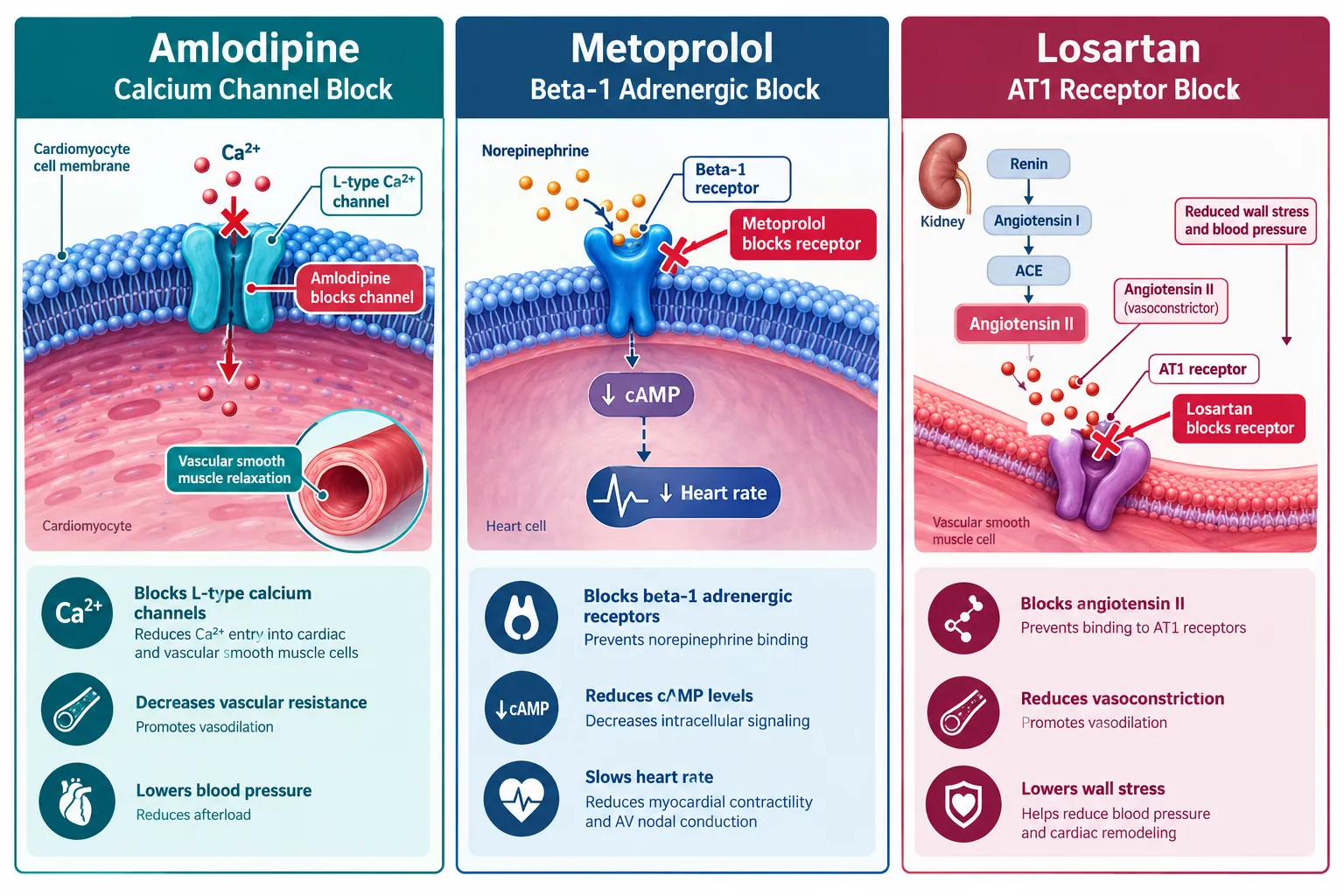
The phrase "positive control" is often used loosely in peptide research. In cardiovascular contexts, a true control arm must share the target pathway of the experimental compound, not merely produce a measurable hemodynamic effect. Amlodipine, metoprolol, and losartan in peptide experiments serve as mechanistic anchors, each isolating a separate axis of cardiovascular regulation.

Amlodipine blocks L-type voltage-gated calcium channels in cardiomyocytes and vascular smooth muscle. It is the appropriate control when a peptide is expected to alter intracellular calcium handling, reduce vascular tone through calcium-dependent mechanisms, or modulate excitation-contraction coupling. Studies examining SS-31 analogs or mitochondria-targeted peptides with cardiac calcium implications, for example, benefit directly from an amlodipine reference arm. For researchers sourcing materials for such models, reviewing SS-31 10mg research peptide considerations provides useful background on experimental framing.

Metoprolol, a selective beta-1 adrenergic receptor antagonist, is the logical control for peptides that intersect sympathetic nervous system signaling, heart rate, cAMP-PKA pathways, or cardiomyocyte survival under adrenergic stress. Growth-hormone secretagogues and ghrelin-axis peptides can activate signaling cascades that overlap with adrenergic pathways, making metoprolol a relevant comparator. Understanding peptide half-life considerations also informs dosing schedules when aligning a peptide's exposure window with metoprolol's pharmacodynamic duration.

Losartan, an angiotensin II type-1 receptor antagonist, belongs in experiments involving natriuretic peptides, wall-stress signaling, or RAAS-interacting compounds. Retatrutide and other multi-receptor peptides show hemodynamic effects that partially overlap with RAAS modulation; losartan quantifies that component. Researchers exploring the GLP-3 peptide signaling pathway will find that angiotensin-receptor control arms help isolate GLP-receptor-specific effects from broader vasoregulatory noise.


Concentration Ranges and Key Readouts
Concentration Ranges and Key Readouts

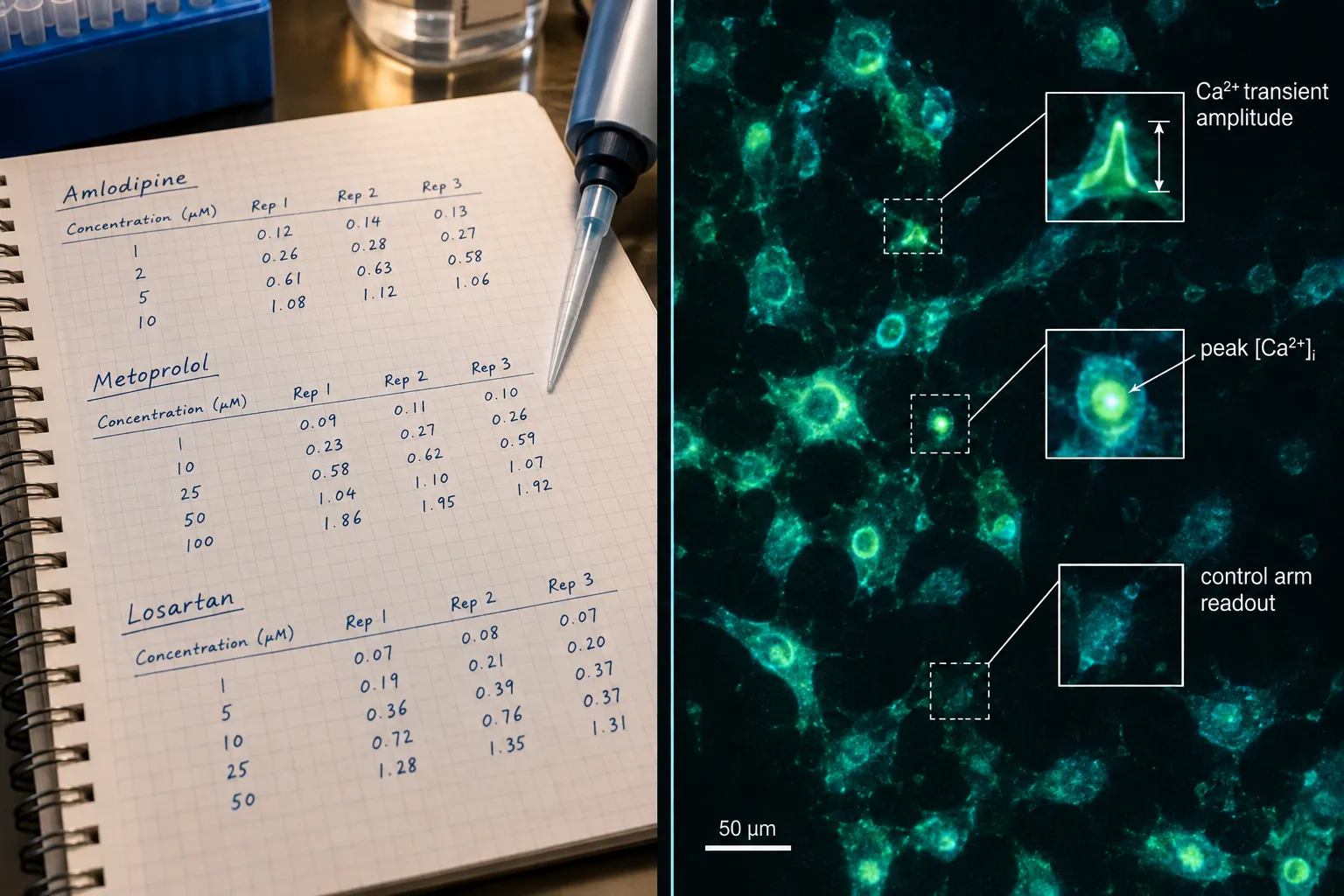
Selecting the right drug is only half the problem. Using it at a physiologically and experimentally relevant concentration is equally critical.

Standard in vitro working ranges:

Drug Typical In Vitro Range Primary Readout
Amlodipine 1-10 µM Peak [Ca2+]i, L-type current amplitude
Metoprolol 1-100 µM cAMP levels, heart rate (in intact preparations)
Losartan 1-50 µM BNP/ANP secretion, MAPK phosphorylation

These ranges should bracket the concentration-response curve of the experimental peptide. If a peptide is tested at 10 nM to 1 µM, the control drug should also span a comparable effect range so that the comparison is meaningful rather than arbitrary.

Readouts deserve equal attention. For calcium-handling studies, peak calcium transient amplitude and sarcoplasmic reticulum load mirror the readouts used with amlodipine directly. For beta-adrenergic work, cAMP quantification and phospholamban phosphorylation status are standard. For RAAS-oriented experiments, brain natriuretic peptide secretion and ERK1/2 activation are well-validated endpoints.

Researchers building rigorous benchmarking workflows should consult resources on Bachem and reference standards for building robust peptide benchmarks to ensure the purity and characterization of both control and experimental compounds meet publication-grade standards.


Practical Framework for Choosing Among the Three Agents
Practical Framework for Choosing Among the Three Agents

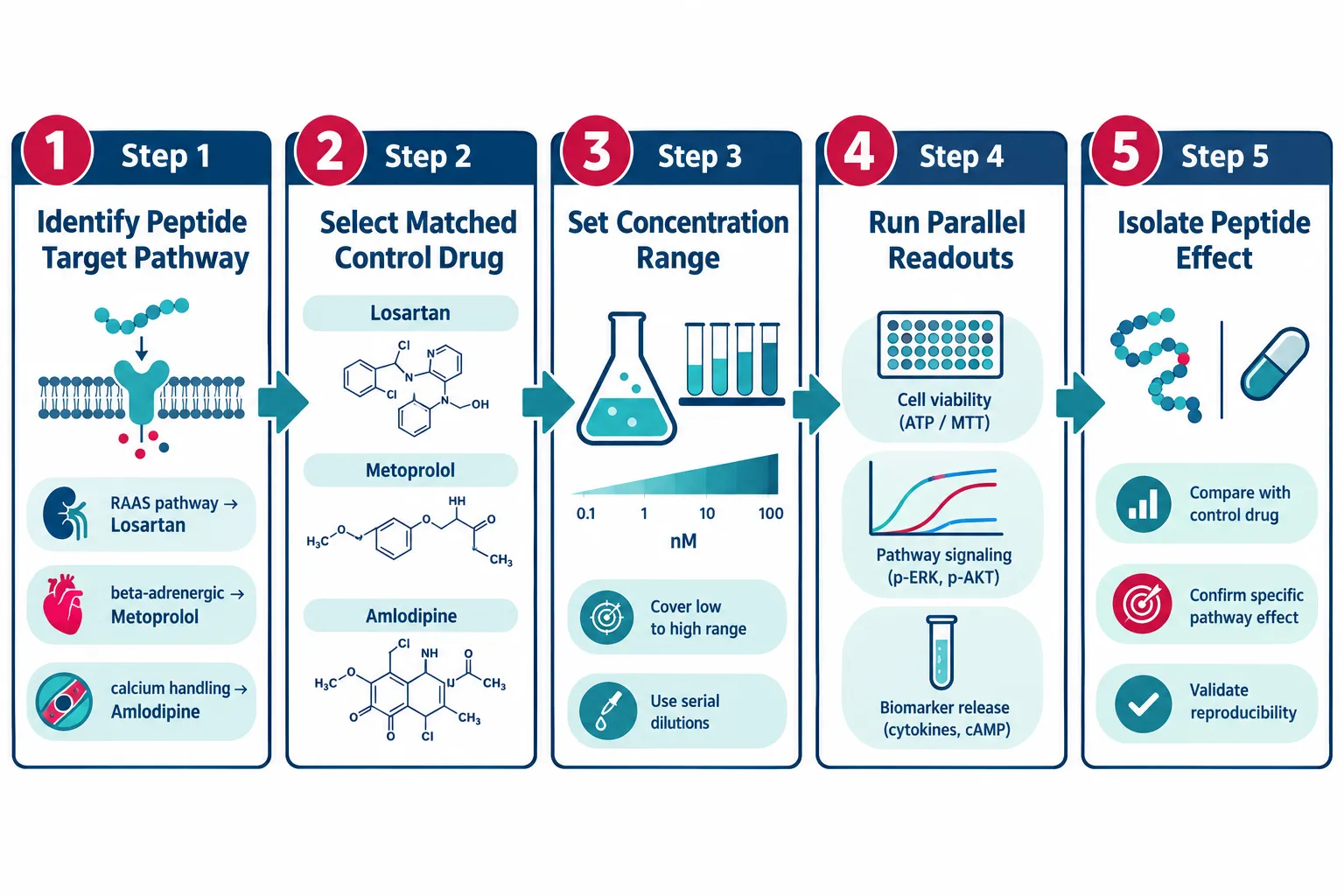
The following decision logic applies when designing control arms for cardiovascular peptide experiments:

  1. Map the peptide's suspected receptor target. Does it bind a GPCR linked to Gq/calcium, Gs/cAMP, or a receptor tyrosine kinase with downstream RAAS crosstalk?
  2. Select the drug that blocks the same downstream node. Calcium node → amlodipine. cAMP/adrenergic node → metoprolol. Angiotensin/wall-stress node → losartan.
  3. Consider multi-pathway peptides. Retatrutide acts on GLP-1R, GIP-R, and glucagon receptors simultaneously. Its hemodynamic profile may require both a losartan arm (for RAAS overlap) and a metoprolol arm (for sympathetic activation overlap). Using a single control drug in a multi-receptor study risks misattributing effects.
  4. Avoid confounded control arms. Running amlodipine alongside a peptide that has no known calcium-channel interaction adds noise without interpretive value. Worse, a pharmacodynamically mismatched control can create an apparent "superiority" for the peptide that reflects the control's irrelevance rather than the peptide's potency.

For GLP-axis peptides specifically, cross-referencing the GLP-1 peptide buy: generational research concepts and sourcing notes page helps contextualize which receptor subtypes are relevant when choosing angiotensin versus adrenergic controls.

Similarly, researchers working on BPC-157 or TB-500 vascular regeneration studies should align control arm selection with documented angiogenic and adrenergic crosstalk. The TB-500 buy: controlled experimental models and QC workflow resource addresses model-selection principles that apply directly to control arm design.

Key principle: A control arm that cannot be mechanistically explained in the methods section is not a control arm, it is a variable.


Conclusion

Implementing amlodipine, metoprolol, and losartan in peptide experiments is most effective when each agent is matched precisely to the target pathway under investigation. Amlodipine anchors calcium-handling studies, metoprolol isolates adrenergic and survival signaling comparisons, and losartan controls for RAAS and natriuretic peptide pathway contributions.

Actionable next steps for researchers in 2026:

  • Before finalizing a protocol, map the peptide's receptor-to-effector cascade and identify which of the three drug mechanisms overlaps with it.
  • Use published concentration-response data for each control drug to set bracketing doses that match the peptide's tested range.
  • For multi-receptor peptides like retatrutide, consider running two control arms in parallel rather than choosing a single agent.
  • Document the mechanistic rationale for control arm selection explicitly in the methods section to satisfy peer-review scrutiny.
  • Maintain compound purity documentation for both control drugs and experimental peptides to ensure readout differences reflect biology, not chemistry.

Rigorous control arm selection does not slow experiments, it is what makes their results interpretable.

https://www.puretestedpeptides.com/wp-content/uploads/2026/10/amlodipine-metoprolol-and-losartan-in-peptide-experiments-choosing-cardiovascula.webp 1024 1536 https://www.puretestedpeptides.com/wp-content/uploads/2026/01/buy-peptides-online.jpg 2026-10-21 13:05:202026-10-21 13:05:20Amlodipine, Metoprolol, and Losartan in Peptide Experiments: Choosing Cardiovascular Control Arms
×

Helpful Links

  • My account
  • Cart
  • Checkout
  • Refund and Returns Policy
  • Privacy Policy
  • SMS Privacy Policy
  • Login
  • My Account
  • Logout

USA Made Lab Tested Peptides

All products are sold for research, laboratory, or analytical purposes only, and are not for human consumption


Pure Tested Peptides is a chemical supplier. Pure Tested Peptides is not a compounding / chemical compounding facility as defined under 503A of the Federal Food, Drug, and Cosmetic act. Pure Tested Peptides is not an outsourcing facility as defined under 503B of the Federal Food, Drug, and Cosmetic act.

The statements made within this website have not been evaluated by the US Food and Drug Administration. The products we offer are not intended to diagnose, treat, cure or prevent any disease.

Human/Animal Consumption Prohibited. Laboratory/In-Vitro Experimental Use Only

Scroll to top Scroll to top Scroll to top