Call or Text 727-513-9780
  • Shopping Cart Shopping Cart
    0Shopping Cart
Pure Tested Peptides | America's most trusted Peptides for sale online
  • Peptides for sale
    • Oral Peptides for sale
      • Peptide Capsules for sale
      • BPC 157 Capsules 1000mcg
      • SLU-PP-332 Capsules | 1000 mcg
      • 5-Amino-1MQ 50mg Capsules
      • Tesofensine 500mcg
    • All Peptides for sale
    • Peptide Sprays
      • BPC 157 Nasal Spray Kit
      • BPC-157 TB500 Nasal Spray Kit
      • Semax Nasal Spray 10mg
      • Selank – Nasal Spray Kit – 10mg
      • Epithalon 50MG Nasal Spray Kit
      • Ipamorelin 10mg Nasal Spray
      • Klow Nasal Spray (BPC-157 + TB-500 + GHK-Cu + KPV) | 80mg
      • Hulk Nasal Spray Tesa / Ipa Blend 6/3 MG
      • Klow Nasal Spray
      • NAD + 500 mg Nasal Spray
      • PT-141 Nasal Spray Kit
    • GHRH Peptides
      • Ipa Peptides
      • CJC-1295 Peptides
        • CJC-1295 with DAC 5 mg
        • CJC-1295 without DAC 5 mg
        • CJC-1295 Ipa 10mg
      • Tesa Peptides
        • Tesa Peptide
        • Tesa 20 mg
    • GHK-Cu Peptides
      • All GHK-Cu Peptides
      • GHK-Cu 100mg
      • KLOW Peptide Blend – Buy KLOW blend online
    • BPC Peptides
      • All BPC Peptides
      • BPC-157
      • BPC-157 TB-500
      • BPC 157 capsules 1000mcg
    • SLU-PP-332 Peptides
      • All SLU-PP-332 Peptides
      • SLU-PP-332 5mg
    • GLP3 Peptides
      • GLP3-R
      • GLP3-R CAG 10mg
      • GLP3-R 20mg
    • PT-141 Peptides
      • PT-141 Peptides for sale
      • PT-141 10mg
      • PT-141 Nasal Spray
    • CAG Peptides
      • Lipo-C Peptide Blend
      • CAG 5mg
      • CAG 10mg
    • MOTS-C Peptides
      • MOTS-C Peptides for sale
      • MOTS-c peptide
      • MOTS-c 10mg *6 pack*
    • 5 Amino 1MQ Peptides
      • 5 Amino 1MQ Peptides for sale
      • 5-Amino-1MQ 50mg Capsules
      • 5-Amino-1MQ 5mg
    • Epithalon Peptides
      • Epithalon Peptides for sale
      • Epithalon 10mg
      • Epithalon 50mg
  • Shop
    • GLPs
      • 5-Amino-1MQ 50mg Capsules
      • 5-Amino-1MQ 5mg
      • GLP3-Reta
      • L-Carnitine 500mg/ml
      • Tesofensine 500mcg
      • SLU-PP-332 5mg
      • MOTS-c 10mg *6 pack*
    • Epithalon & BPC Peptides
      • Epithalon 10mg
      • Epithalon 50mg
      • BPC-157
      • BPC 157 capsules 1000mcg
      • BPC-157 TB-500
      • BPC-157 TB500 Nasal Spray Kit
      • BPC 157 Nasal Spray Kit
    • BPC TB-500 & NAD+ Peptides
      • NAD+ 500 mg
      • KLOW Peptide Blend – Buy KLOW blend online
      • GLOW Peptide Blend
      • TB 500 5mg
      • BPC 157 capsules 1000mcg – Supplement
      • BPC 157 Nasal Spray Kit
      • BPC-157
      • BPC-157 TB500 Nasal Spray Kit
      • BPC-157 TB-500
      • BPC 157 capsules 1000mcg
    • LL-37 Peptide
      • LL-37 10 mg
    • MOTS-C & Selank
      • MOTS-c peptide
      • Selank 10mg
    • GHK Peptides
      • GHK-Cu 100mg
      • GLOW Peptide Blend
      • KLOW Peptide Blend – Buy KLOW blend online
  • COAs
  • Wholesale
    • Wholesale Peptides for sale
  • PTP FAQ
  • Affiliates
    • Selank Peptide: Advanced Pharmacological Mechanisms Underlying Its Anxiolytic and Nootropic Effects in Research
      • 5-Amino-1MQ Peptide: Detailed Mechanisms of NNMT Inhibition and Its Impact on Cellular Metabolism Research
        • MOTS-C Peptide: Unraveling Its Role in Mitochondrial Dynamics and Energy Metabolism Research
          • Epithalon Peptide and Telomerase Regulation: Investigating Its Impact on Cellular Senescence and Lifespan Research Models
            • GLP2-T vs GLP2 Tirz Peptide: Understanding the Naming, Mechanistic Nuances, and Research Implications for Gut Health
      • Peptides and Polypeptides in Modern Pharmacology: What Research on Metoprolol, Prednisone, and Amlodipine Reveals
        • Polypeptide Peptides vs NSAIDs: What Naproxen and Diclofenac Teach Tissue-Repair Researchers About BPC‑157 and TB‑500
          • Peptides and Polypeptides in Endocrine Pharmacology: How GLP-1, GLP-2, and GLP-3 Retatrutide Differ From Classic Drugs Like Prednisone and Amlodipine
          • 5‑Amino‑1MQ Peptide and NNMT Inhibition: How It Compares With Statins Like Atorvastatin in Adipose and Lipid Metabolism Research
      • Enclomiphene, Estrogen Receptor Signaling, and Luteinizing Phase Biology: What Hormone Researchers Should Measure
        • Mesenchymal Stem Cells, BPC‑157, and GHK‑Cu: How Tissue Repair Peptides Compare With Classic NSAIDs Like Naproxen in Injury Models
          • Peptide Calculator Use Cases Beyond Growth Hormone: Working Through GLP‑3 Retatrutide, MOTS‑c, and BPC‑157 Research Dosing
        • Polypeptide Peptides in Endocrine and Metabolic Pharmacology: Lessons From Amlodipine, Prednisone, and Metoprolol
        • Peptides Calculator for Advanced Blends: Worked Examples for Tesamorelin, CJC‑1295, and Ipamorelin Stacks
          • Peptides and Polypeptides in Human Physiology: How Molecular Size Shapes Research Applications
            • Selank Peptide: Advanced Pharmacological Mechanisms Underlying Its Anxiolytic and Nootropic Effects in Research
          • 5-Amino-1MQ Peptide: Detailed Mechanisms of NNMT Inhibition and Its Impact on Cellular Metabolism Research
            • MOTS-C Peptide: Unraveling Its Role in Mitochondrial Dynamics and Energy Metabolism Research
              • Epithalon Peptide and Telomerase Regulation: Investigating Its Impact on Cellular Senescence and Lifespan Research Models
                • GLP2-T vs GLP2 Tirz Peptide: Understanding the Naming, Mechanistic Nuances, and Research Implications for Gut Health
                  • Peptides and Polypeptides in Endocrine Pharmacology: How GLP-1, GLP-2, and GLP-3 Retatrutide Differ From Classic Drugs Like Prednisone and Amlodipine
                    • Polypeptide Peptides vs NSAIDs: What Naproxen and Diclofenac Teach Tissue-Repair Researchers About BPC‑157 and TB‑500
                      • Peptides and Polypeptides in Modern Pharmacology: What Research on Metoprolol, Prednisone, and Amlodipine Reveals
                        • 5‑Amino‑1MQ Peptide and NNMT Inhibition: How It Compares With Statins Like Atorvastatin in Adipose and Lipid Metabolism Research
                        • Enclomiphene, Estrogen Receptor Signaling, and Luteinizing Phase Biology: What Hormone Researchers Should Measure
                        • Mesenchymal Stem Cells, BPC‑157, and GHK‑Cu: How Tissue Repair Peptides Compare With Classic NSAIDs Like Naproxen in Injury Models
                        • Peptide Calculator Use Cases Beyond Growth Hormone: Working Through GLP‑3 Retatrutide, MOTS‑c, and BPC‑157 Research Dosing
                        • Polypeptide Peptides in Endocrine and Metabolic Pharmacology: Lessons From Amlodipine, Prednisone, and Metoprolol
                        • Peptides Calculator for Advanced Blends: Worked Examples for Tesamorelin, CJC‑1295, and Ipamorelin Stacks
                        • Peptides and Polypeptides in Human Physiology: How Molecular Size Shapes Research Applications
                        • Selank Peptide: Advanced Pharmacological Mechanisms Underlying Its Anxiolytic and Nootropic Effects in Research
                        • MOTS-C Peptide: Unraveling Its Role in Mitochondrial Dynamics and Energy Metabolism Research
                        • Peptides and Polypeptides in Modern Pharmacology: What Research on Metoprolol, Prednisone, and Amlodipine Reveals
                        • Peptides and Polypeptides in Endocrine Pharmacology: How GLP-1, GLP-2, and GLP-3 Retatrutide Differ From Classic Drugs Like Prednisone and Amlodipine
                        • 5-Amino-1MQ Peptide: Detailed Mechanisms of NNMT Inhibition and Its Impact on Cellular Metabolism Research
                        • Mesenchymal Stem Cells, BPC‑157, and GHK‑Cu: How Tissue Repair Peptides Compare With Classic NSAIDs Like Naproxen in Injury Models
                        • Peptide Calculator Use Cases Beyond Growth Hormone: Working Through GLP‑3 Retatrutide, MOTS‑c, and BPC‑157 Research Dosing
                        • GLP2-T vs GLP2 Tirz Peptide: Understanding the Naming, Mechanistic Nuances, and Research Implications for Gut Health
                        • Polypeptide Peptides in Endocrine and Metabolic Pharmacology: Lessons From Amlodipine, Prednisone, and Metoprolol
                        • Polypeptide Peptides vs NSAIDs: What Naproxen and Diclofenac Teach Tissue-Repair Researchers About BPC‑157 and TB‑500
                        • Peptides and Polypeptides in Human Physiology: How Molecular Size Shapes Research Applications
                        • Peptides Calculator for Advanced Blends: Worked Examples for Tesamorelin, CJC‑1295, and Ipamorelin Stacks
                        • 5‑Amino‑1MQ Peptide and NNMT Inhibition: How It Compares With Statins Like Atorvastatin in Adipose and Lipid Metabolism Research
                        • Enclomiphene, Estrogen Receptor Signaling, and Luteinizing Phase Biology: What Hormone Researchers Should Measure
                        • Epithalon Peptide and Telomerase Regulation: Investigating Its Impact on Cellular Senescence and Lifespan Research Models
                        • Best research protocol Klow blend
                        • best time to take BPC-157
                        • best time to take DSIP (Delta Sleep Inducing Peptide)
                        • best time to take CJC-1295
                        • best time to take AOD-9604
                        • best time to take Follistatin 344
                        • best time to take Ipamorelin
                        • best time to take MK-677 (Ibutamoren)
                        • best time to take Ligandrol (LGD-4033) — research compound
                        • best time to take Ostarine (MK-2866) — research compound
                        • best time to take GHK-CU
                        • best time to take TB-500
                        • best time to take MOTS-c
                        • best time to take Semax
                        • best time to take RAD-140 (Testolone) — research compound
                        • best time to take Thymosin Alpha-1
                        • best time to take PEG-MGF
                        • Biolife Plasma, Octapharma Plasma, and Research Peptides: How Plasma Donation Labs Differ From Peptide Suppliers
                        • best time to take YK-11 — research compound
                        • best time to take PT-141 (Bremelanotide)
                        • Best research protocol Klow blend
                        • 5-Amino-1MQ and MOTS-C Synergy: Metabolic Signaling, Mitochondria, and Research Design
                        • BPC-157 and TB-500: Investigating Their Combined Effects on Angiogenesis and Cellular Migration in Tissue Repair Models
                        • BPC-157 Peptide: Gut Barrier Function, Inflammation, and Tissue-Recovery Research
                        • 5‑Amino‑1MQ and MOTS‑c Synergy in Metabolic Research: Designing NNMT and Mitochondrial Biogenesis Stacks
                        • CJC-1295 with DAC vs. Without DAC: Half-Life, Release Kinetics, and Research Implications
                        • CJC‑1295 with DAC vs. Without DAC: Expanding on Half‑Life Differences Using Tesamorelin and Ipamorelin Blend Case Studies
                        • Collagen Biology and Copper‑Binding Peptides: How GHK‑Cu, Glow Blend, and Klow Blend Interact with Skin and Connective Tissue
                        • Collagen Biology and Regenerative Peptides: How GHK‑Cu, Glow Blend, and Klow Blend Affect Extracellular Matrix Research
                    • DNA, Telomeres, and Longevity Peptides: Positioning Epithalon and MOTS‑c in Genetic Aging Research
                      • Enclomiphene Citrate: serm Mechanism, Testosterone Research, and Stack Compatibility
                        • Enclomiphene vs Enclomiphene Citrate: Formulation, Bioavailability, and Research Distinctions
                        • Epithalon Peptide Research: Telomerase Activation, Aging, and Pineal Gland Function
                        • Estrogen Receptor Signaling and Enclomiphene: How Selective Modulators Compare with Classic Polypeptide Hormones
                        • GHK-Cu Peptide: Advanced Mechanisms in Extracellular Matrix Remodeling and Wound Healing Research
                        • GHK-Cu Peptide: Collagen Synthesis, Wound Repair, and Skin-Barrier Research Models
                        • GLP-1 vs GLP-3 vs GLP-2: Peptide Classification and Research Applications
                        • GLP-2 Peptide Research Guide: Gut Barrier Function, Nutrient Absorption, and Intestinal Recovery Models
                        • GLP-3 Retatrutide vs. GLP-1 Drugs: What Triple-Agonist Biology Changes in Research Models
                        • Ipamorelin and Tesamorelin Combination: Synergistic GH Secretagogue Research and Dosing Protocols
                        • GLP2 Tirz Peptide: What It Is, Why the Name Exists, and How Researchers Should Interpret It
                        • Klow Blend Peptide Nasal Spray: What the Formulation Is Trying to Do in Cognitive Research
                        • Mitochondria, NNMT Inhibition, and Peptide Modulators: Where MOTS‑c and 5‑Amino‑1MQ Fit in Cellular Energy Research
                        • MOTS-c Peptide: Mitochondrial Function, Energy Metabolism, and What Researchers Measure
                        • MOTS-c vs. 5-Amino-1MQ: Which Metabolic Research Questions Each Compound Actually Answers
                        • Nasal Spray Peptides: Bioavailability, Administration, and Semax/Selank Research Applications
                        • PT-141 Peptide Research: Mechanism of Action and Melanocortin Receptor Signaling
                        • Retatrutide for Research: Mechanism, Structure, and GLP-1/GLP-3 Dual Action
                        • Retatrutide for Obesity and Type 2 Diabetes: What the Latest Trial Data Suggest
                        • Tesofensine Peptide Research: Mechanism, Appetite Suppression, and Neuropeptide Y Pathways
  • Contact
    • Contact Customer Service
    • Text Customer Support
  • About US
  • Shop all peptides
  • Affiliate Program
    • Affiliate Signup
  • Login / Register Login / Register Page Link Login / Register Page Link
  • Click to open the search input field Click to open the search input field Search
  • Menu Menu

Tag Archive for: mechanism of action

Understanding Polypeptide Peptides: Mechanism of Action in Research Applications

Understanding Polypeptide Peptides: Mechanism of Action in Research Applications

August 20, 2026/0 Comments/in Uncategorized/by

The global peptide therapeutics market was valued at approximately USD 68 billion in 2024 and is projected to reach roughly USD 175 billion by 2031, a compound annual growth rate near 15%. Behind that growth sits a single driving force: a deeper understanding of how polypeptide peptides work at the molecular level and what that means for research design.

For researchers moving from general biology into peptide-specific work, the terminology can feel overwhelming. "Polypeptide" and "peptide" are often used interchangeably, yet the distinction in chain length, secondary structure, and receptor interaction changes every research question that follows. This guide on understanding polypeptide peptides: mechanism of action in research applications translates that complexity into practical lab language.

Key Takeaways

  • Polypeptides are amino acid chains whose length, charge, and secondary structure directly determine how they interact with cells and tissues.
  • Core mechanisms include receptor binding, cellular uptake, endosomal escape, and cytosolic release, each step is a variable a researcher can tune.
  • Stimuli-responsive polypeptide carriers can activate selectively at tumor sites, in the gut, or across the blood-brain barrier.
  • Formulation choices, nanoparticles, hydrogels, PEGylation, cyclization, protect peptides from degradation and shape their pharmacokinetics.
  • With over 800 peptide drug projects currently in development, polypeptide mechanisms are central to oncology, metabolic disease, CNS research, and antimicrobial pipelines.

What Are Polypeptide Peptides and Why Do Definitions Matter in Research

A peptide is a short chain of amino acids linked by peptide bonds. A polypeptide is a longer chain, typically more than 50 residues, that can fold into defined secondary structures such as alpha-helices or beta-sheets. That structural difference is not academic. A helical polypeptide carries a different surface charge distribution than a random coil, and that difference controls how it binds receptors, crosses membranes, and survives enzymatic degradation in biological fluids.
What Are Polypeptide Peptides and Why Do Definitions Matter in Research

For researchers sourcing compounds, it also affects formulation. Shorter peptides may be candidates for oral peptides for sale formats, while longer, more structured polypeptides often require injectable or nanoparticle-based delivery to preserve their active conformation. Understanding this distinction prevents mismatched experimental designs before a single assay is run.

Three structural features that shape mechanism of action:

Feature Research Impact
Chain length Determines folding, receptor fit, and metabolic stability
Net charge (cationic/anionic) Controls membrane interaction and endosomal escape efficiency
Secondary structure (helix, sheet) Dictates self-assembly behavior and biological target specificity

Core Mechanisms: How Polypeptide Peptides Act Inside Cells

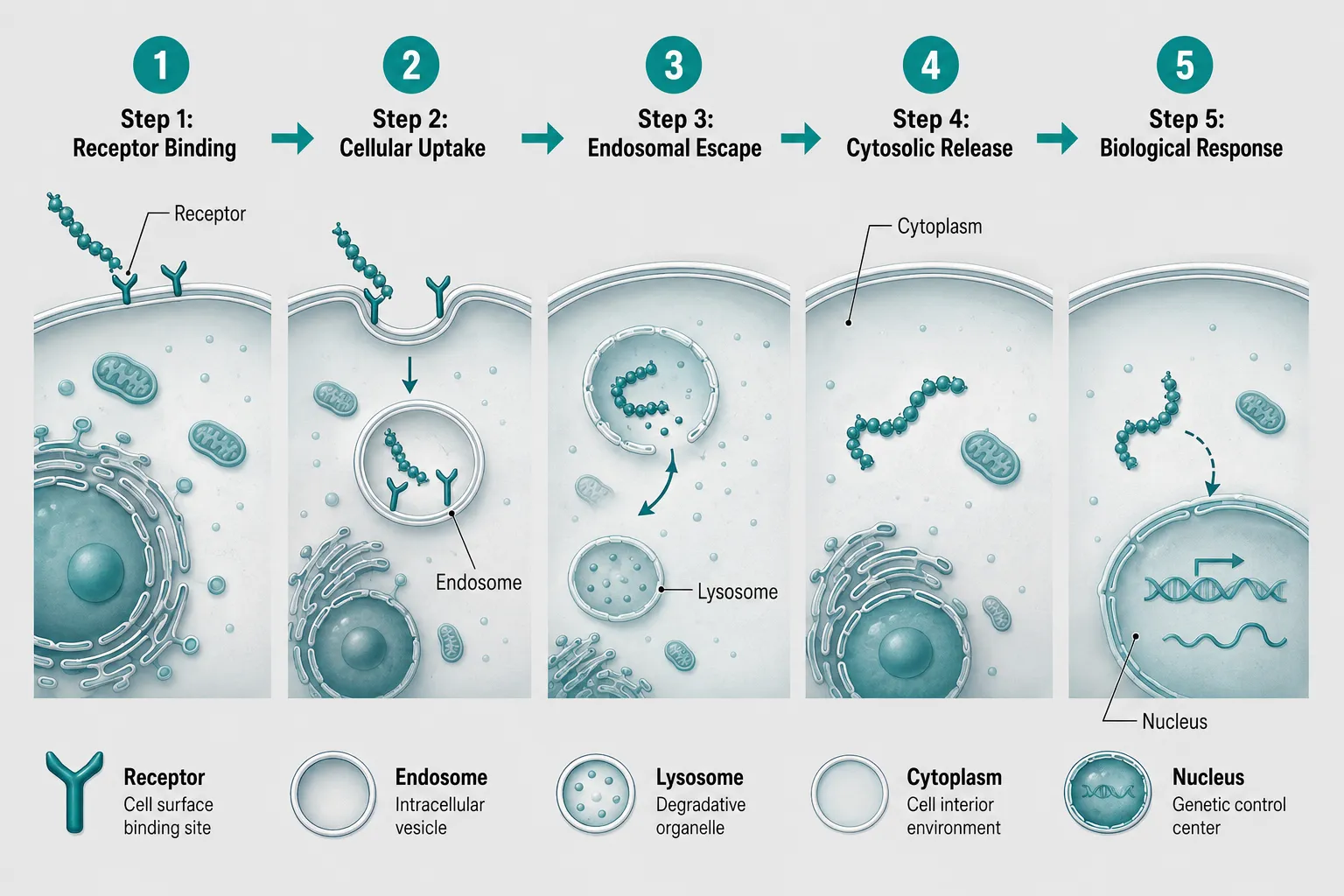
Understanding polypeptide peptides: mechanism of action in research applications begins with a five-step cellular journey that every research protocol must account for.

Step 1, Receptor binding. Polypeptides recognize specific cell-surface receptors through shape and charge complementarity. GLP-1 peptides, for example, bind the glucagon-like peptide-1 receptor with high specificity, triggering downstream signaling cascades relevant to metabolic research. Researchers exploring this pathway can review the GLP-3, GLP-1, and GLP-2 explained: a researcher's guide to the peptide family for mechanistic context.

Step 2, Cellular uptake. Peptides enter cells primarily through endocytosis or direct membrane penetration. Which pathway dominates depends on the peptide's charge, size, and the cell type being studied. Most mRNA-carrying polypeptide systems rely predominantly on endocytosis for internalization.

Step 3, Endosomal escape. This is the critical bottleneck. After endocytosis, peptides are trapped in acidifying endosomes that route toward lysosomal degradation. Cationic helical polypeptides can disrupt endosomal membranes through membrane stress, releasing their cargo into the cytosol. Recent KAIST research demonstrated that a helical quaternary amine polypeptide nanoparticle achieves this while simultaneously triggering immunogenic cell death signals, combining gene delivery and cancer immunotherapy in a single platform.

Step 4, Cytosolic release and translation. Once in the cytoplasm, nucleic acid cargo is released and translated. The efficiency of this step depends on how well the polypeptide carrier dissociates from its payload under intracellular conditions.

Step 5, Biological response. The downstream effect, gene expression, receptor activation, immune modulation, is what the researcher measures. Every upstream variable influences this output.
Core Mechanisms: How Polypeptide Peptides Act Inside Cells

Formulation Strategies That Change Research Outcomes

Mechanism of action does not exist in isolation from formulation. A polypeptide with ideal receptor affinity will fail in vivo if it degrades in serum before reaching its target. This is where understanding polypeptide peptides: mechanism of action in research applications becomes inseparable from delivery science.

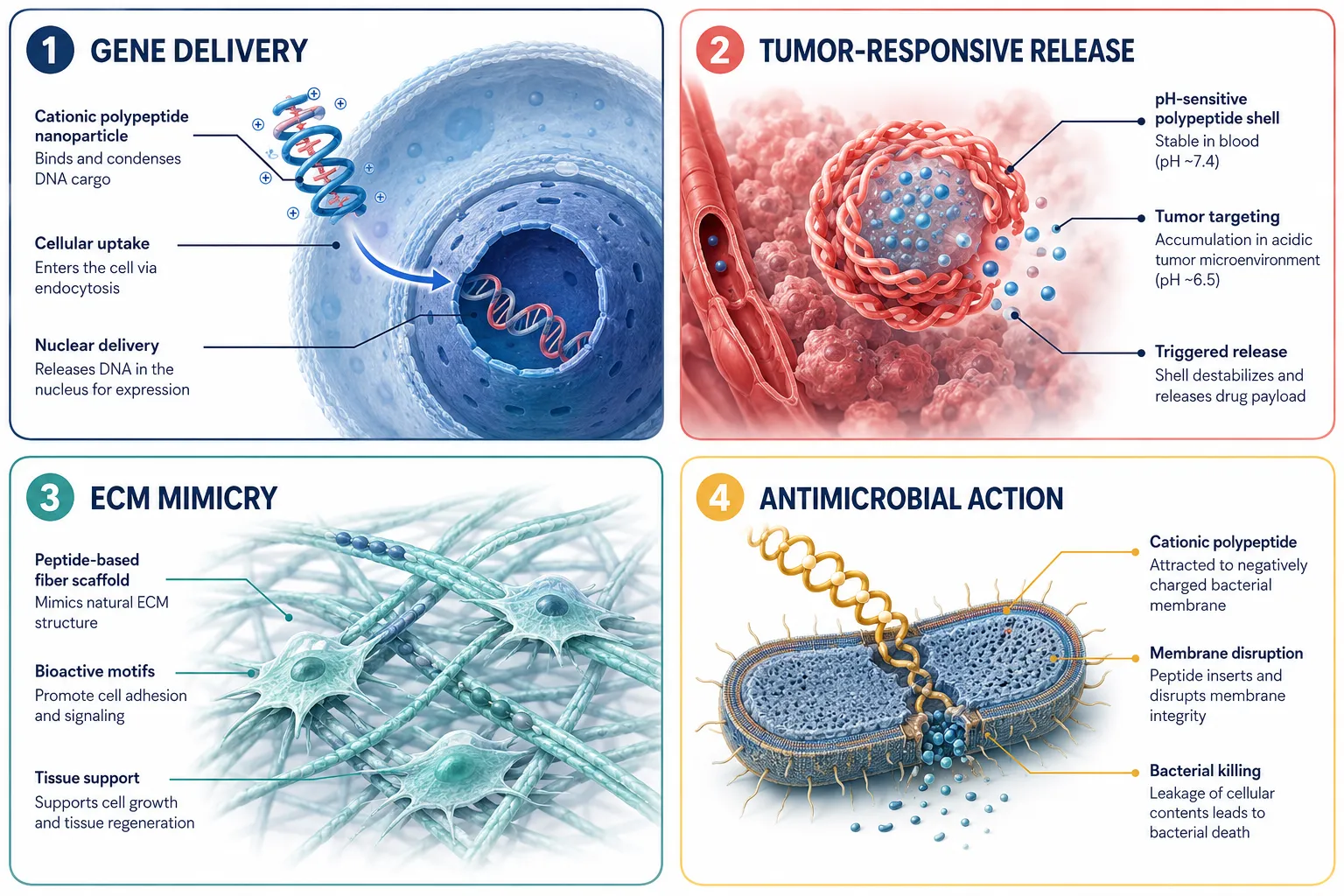
Stimuli-responsive systems engineer polypeptide carriers to activate only under specific conditions, low pH, elevated glutathione, or tumor-associated enzymes. This selectivity improves target specificity and reduces off-target effects, a key consideration in oncology research pipelines. For mitochondria-targeted research, the SS-31 10mg research peptide considerations page provides a concrete example of how a short, charge-rich peptide is formulated for organelle-level action.

ECM-mimicking scaffolds use polypeptide fiber membranes to replicate extracellular matrix architecture, supporting cell adhesion and proliferation in tissue engineering and wound-healing studies. These systems work because the polypeptide's secondary structure physically resembles native collagen or fibronectin networks.

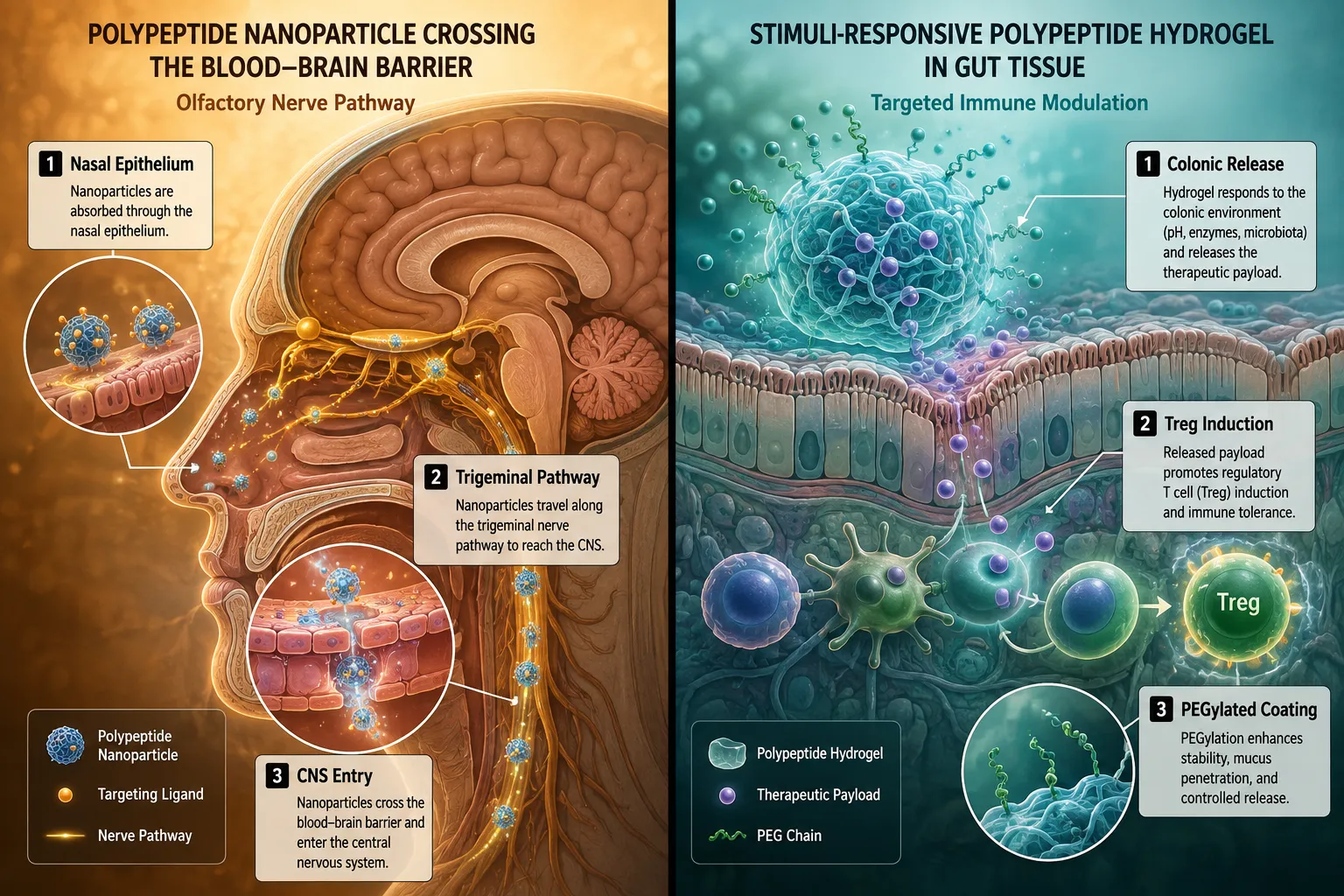
CNS delivery represents a newer frontier. Intranasal polypeptide delivery can bypass the blood-brain barrier via olfactory and trigeminal nerve pathways, enabling direct CNS access. The underlying transport mechanisms remain an active research area. Neurologically active peptides such as those discussed in Semax and Selank peptides: comparative research on neurogenesis and synaptic plasticity illustrate how CNS-targeted polypeptides are being studied in practice.

Key formulation tools researchers use:

  • PEGylation, attaches polyethylene glycol chains to extend circulation half-life
  • Cyclization and stereochemical modification, resists proteolytic degradation
  • Lipid and polymer nanoparticles, protect peptide cargo and enable targeted colonic or tumor-site release
  • Hydrogels, provide sustained local release for tissue engineering or IBD applications

Half-life is a particularly important variable in growth hormone research. The CJC-1295 without DAC: why half-life matters in growth hormone research article explores how small structural changes dramatically alter a polypeptide's pharmacokinetic profile, a principle that applies broadly across peptide research categories. Additional context on this topic is available through the growth hormone research resource library.
Formulation Strategies That Change Research Outcomes

"Polypeptide carriers are not passive vehicles, their sequence, charge, and structure actively program the biological outcome at every step from membrane contact to cytosolic release."

Conclusion

Polypeptide research in 2026 is defined by precision: precise sequence design, precise delivery engineering, and precise measurement of mechanism-specific outcomes. Researchers who understand the five-step cellular mechanism, binding, uptake, endosomal escape, cytosolic release, and biological response, are positioned to design experiments that generate meaningful, reproducible data rather than ambiguous results caused by formulation failures.

Actionable next steps for researchers:

  1. Map the specific mechanism step your compound is intended to target before selecting a formulation strategy.
  2. Match chain length and secondary structure requirements to delivery format, not every peptide suits every route of administration.
  3. Evaluate stimuli-responsive carrier designs when working in tumor, gut, or CNS microenvironments where selectivity is critical.
  4. Consult half-life data early; small structural modifications can shift pharmacokinetics significantly and alter experimental windows.
  5. Source compounds from verified suppliers with documented purity data to ensure that observed biological effects reflect the peptide's mechanism, not contaminant activity.

With approximately 300 peptide drug projects in clinical stages and more than 80 in Phase III or pre-registration, the mechanistic foundations covered here are no longer theoretical, they are the operating language of modern peptide science.

https://www.puretestedpeptides.com/wp-content/uploads/2026/08/understanding-polypeptide-peptides-mechanism-of-action-in-research-applications.webp 1024 1536 https://www.puretestedpeptides.com/wp-content/uploads/2026/01/buy-peptides-online.jpg 2026-08-20 13:04:542026-08-20 13:04:54Understanding Polypeptide Peptides: Mechanism of Action in Research Applications
×

Helpful Links

  • My account
  • Cart
  • Checkout
  • Refund and Returns Policy
  • Privacy Policy
  • SMS Privacy Policy
  • Login
  • My Account
  • Logout

USA Made Lab Tested Peptides

All products are sold for research, laboratory, or analytical purposes only, and are not for human consumption


Pure Tested Peptides is a chemical supplier. Pure Tested Peptides is not a compounding / chemical compounding facility as defined under 503A of the Federal Food, Drug, and Cosmetic act. Pure Tested Peptides is not an outsourcing facility as defined under 503B of the Federal Food, Drug, and Cosmetic act.

The statements made within this website have not been evaluated by the US Food and Drug Administration. The products we offer are not intended to diagnose, treat, cure or prevent any disease.

Human/Animal Consumption Prohibited. Laboratory/In-Vitro Experimental Use Only

Scroll to top Scroll to top Scroll to top