

MOTS‑c and 5‑Amino‑1MQ Beyond Adiposity: How Labs Are Starting to Explore Cognitive, Cardiometabolic, and Longevity Endpoints
Mitochondria do more than generate ATP, they secrete signaling molecules that influence the brain, heart, and aging clock simultaneously. That biological reality is driving a new wave of research interest in two compounds: MOTS‑c, a mitochondria-derived peptide, and 5‑Amino‑1MQ (5A1MQ), a small-molecule NNMT inhibitor. Most public discussion has centered on their anti-obesity effects, but the frontier of MOTS‑c and 5‑Amino‑1MQ beyond adiposity, how labs are starting to explore cognitive, cardiometabolic, and longevity endpoints, is where the most scientifically interesting questions now live.
Key Takeaways
- MOTS‑c completed its first Phase 2 cardiometabolic trial in 2025, showing modest but significant benefits; a 2026 prediabetes trial is ongoing.
- Cognitive endpoints for MOTS‑c remain preclinical and contested, with blood-brain barrier penetration still unresolved.
- 5‑Amino‑1MQ has robust preclinical metabolic data but has not yet entered human trials for any indication.
- Both compounds are framed as potential longevity agents, but human evidence for aging biomarkers is largely observational.
- Evidence lags significantly behind marketing narratives at longevity clinics, researchers urge caution.
What MOTS‑c and 5‑Amino‑1MQ Actually Do
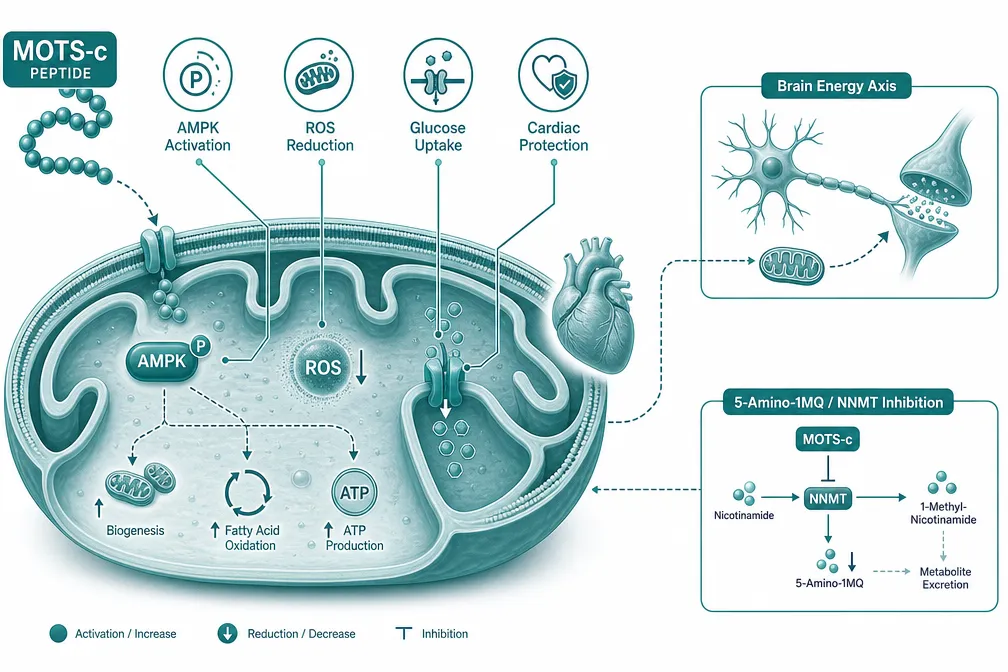
MOTS‑c is a 16-amino-acid peptide encoded in mitochondrial DNA. It activates AMPK, reduces reactive oxygen species, and improves glucose uptake in skeletal muscle. Researchers increasingly describe it as a "mitochondrial hormone", a circulating signal that coordinates whole-body energy sensing rather than acting locally. Levels decline with age and rise with exercise, which has made it a subject of longevity biology interest.
5‑Amino‑1MQ works through a different mechanism. It inhibits nicotinamide N-methyltransferase (NNMT), an enzyme overexpressed in adipose tissue during obesity. By blocking NNMT, 5A1MQ raises NAD+ precursor availability and shifts cellular metabolism toward fat oxidation. In diet-induced obese mouse models, the compound produced robust reductions in body weight and fat mass without significant toxicity signals.
Both compounds intersect at a common node: mitochondrial efficiency and metabolic reprogramming. That shared biology is why researchers studying one often look at the other, and why SS-31 and MOTS-c are frequently paired in mitochondria-focused research stacks. For researchers sourcing verified material, buying MOTS-c peptide from a lab-tested supplier is a standard first step before designing any preclinical protocol.
Cardiometabolic and Cognitive Frontiers: Where the Data Actually Stands
Cardiometabolic Evidence
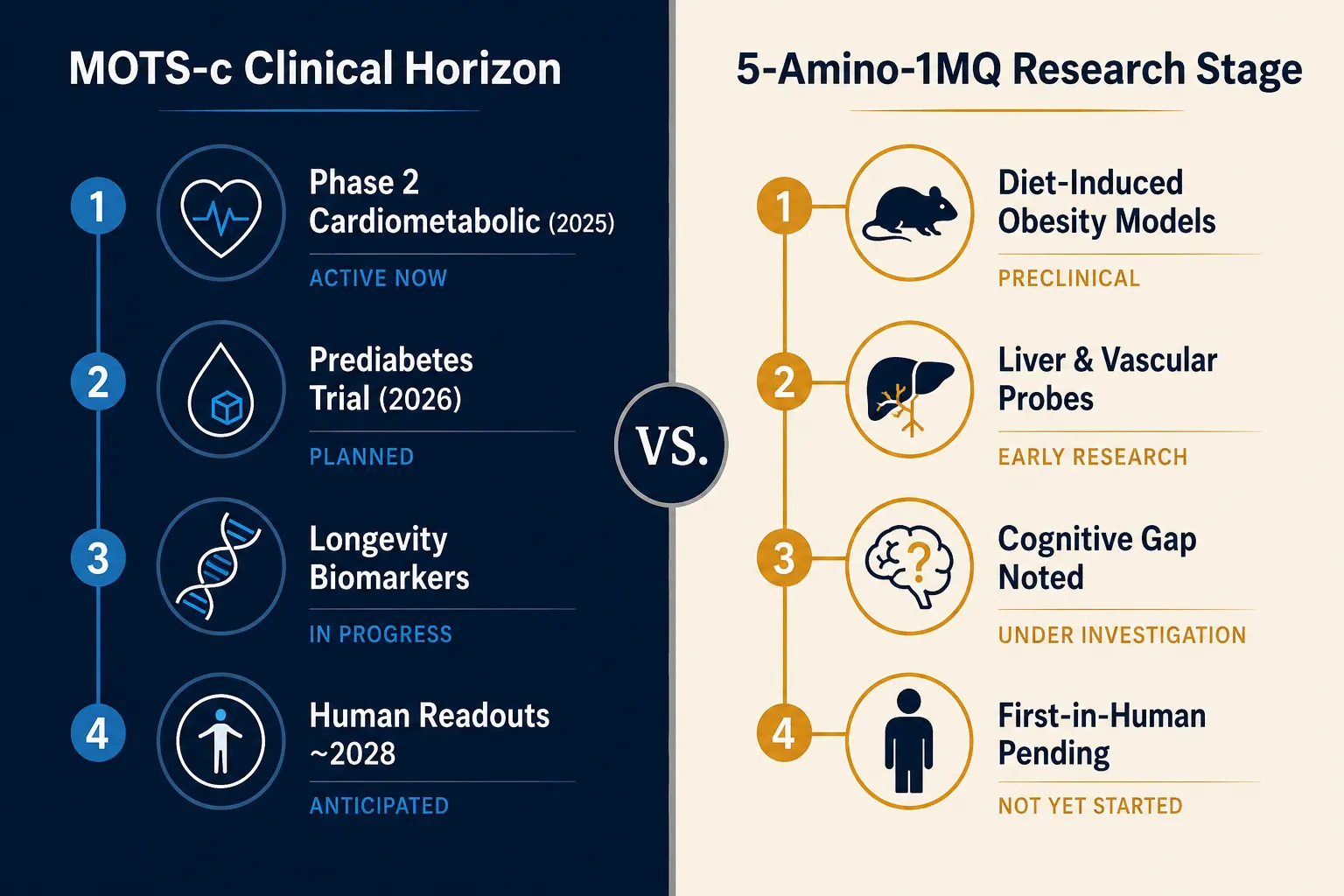
The most concrete human data belongs to MOTS‑c. A Phase 2 trial completed in 2025 reported modest but statistically significant cardiometabolic improvements, including insulin sensitivity and lipid markers, in its target population. The word "modest" matters here; expert commentary has been careful not to overstate the signal. A follow-on Phase 2a trial launched in 2026 specifically targets prediabetes with broader mechanistic endpoints, including vascular biomarkers and inflammatory markers alongside glycemic outcomes. Definitive cardiometabolic readouts are not expected before approximately 2028.
Preclinical cardiac data are more striking. MOTS‑c appears to protect the diabetic heart by preserving mitochondrial membrane integrity and reducing oxidative stress in cardiomyocytes. This is consistent with the broader research theme explored in SS-31 mitochondrial research, where mitochondria-targeted peptides show cardioprotective properties across multiple model systems.
For 5‑Amino‑1MQ, cardiometabolic work is earlier-stage. Animal studies probing liver fat accumulation and vascular inflammation are underway, but no human data exist. The compound's NNMT inhibition mechanism theoretically reduces metabolic inflammation, a driver of cardiovascular risk, but that pathway has not been validated in clinical populations. Researchers interested in the metabolic axis may also want to review GLP-3 retatrutide and the future of metabolic research for context on how the broader field is evolving.
Cognitive Endpoints
This is where the gap between marketing and science is widest. MOTS‑c's cognitive potential is entirely preclinical, and the evidence is mixed. Some rodent studies suggest it may reduce neuroinflammation and support brain energy metabolism, plausible given that neurons are among the most mitochondria-dense cells in the body. However, blood-brain barrier (BBB) penetration remains unresolved. Peripheral injection does not guarantee central nervous system exposure, and conflicting claims about MOTS‑c's BBB permeability circulate widely in longevity clinic marketing without adequate support.
For 5‑Amino‑1MQ, cognitive endpoints are essentially absent from the published literature. No preclinical models have systematically tested its effects on memory, neuroinflammation, or synaptic function. Researchers exploring peptide cognitive endpoints will find far more developed data in neuropeptide categories like Semax and Selank, covered in depth in the comparative research on neurogenesis and synaptic plasticity.
Key distinction: MOTS‑c has a plausible cognitive mechanism but unconfirmed CNS access. 5‑Amino‑1MQ has no meaningful cognitive dataset at all.
Longevity Endpoints and What Researchers Should Watch

The longevity framing around MOTS‑c is scientifically grounded in one important respect: circulating MOTS‑c levels in humans correlate inversely with age and positively with physical fitness. Centenarian studies have found elevated MOTS‑c relative to age-matched controls. These are observational associations, not intervention evidence, but they anchor the hypothesis that restoring youthful MOTS‑c levels could slow aging-related decline.
Aging biomarker endpoints being considered for future trials include:
- Telomere length and telomerase activity, connected to mitochondrial health signals
- Inflammatory cytokines (IL-6, TNF-alpha), modulated by AMPK activation
- Epigenetic clocks, increasingly used as surrogate aging endpoints in peptide trials
- Vascular stiffness measures, relevant to both cardiometabolic and longevity outcomes
For 5‑Amino‑1MQ, longevity research is speculative. NAD+ pathway involvement is the primary theoretical link, since NNMT inhibition increases NAD+ precursor flux, a mechanism shared with well-studied longevity compounds. But without first-in-human data, longevity claims remain hypothesis-generating rather than evidence-based.
Researchers building aging-focused protocols may find relevant context in aging support research categories and in the hTERT-related work tagged under hTERT longevity research.
Conclusion
The research trajectory for MOTS‑c and 5‑Amino‑1MQ beyond adiposity, spanning cognitive, cardiometabolic, and longevity endpoints, is genuinely promising but unevenly developed. MOTS‑c has crossed into human trials with modest early signals and a plausible mechanistic story for vascular and brain energy benefits. 5‑Amino‑1MQ remains a preclinical compound with strong metabolic data and an untested cognitive profile.
Actionable next steps for researchers and clinicians:
- Track the 2026 MOTS‑c prediabetes Phase 2a trial for mechanistic endpoint data, these results will clarify whether cardiometabolic benefits extend beyond glycemic control.
- Treat cognitive claims for both compounds as hypothesis-generating until BBB penetration and CNS efficacy are confirmed in controlled studies.
- Use longevity biomarker panels (epigenetic clocks, vascular stiffness, inflammatory markers) as outcome measures in any preclinical stack design, not just body composition.
- Apply strict sourcing standards; lab-tested peptides with documented purity are non-negotiable for reproducible research.
- Revisit the evidence base in 2028 when more definitive cardiometabolic readouts from MOTS‑c trials are expected to be available.
The science is moving, but it is moving at the pace of rigorous trials, not marketing timelines.