

Mesenchymal Stem Cells and Mitochondrial Peptides: Where MOTS-c and 5-Amino-1MQ Fit in Regenerative Cell Models
Fewer than 1% of the cells in adult bone marrow are mesenchymal stem cells, yet those rare cells sit at the center of some of the most ambitious regenerative medicine research of 2026. As scientists probe the energy demands that govern whether these cells repair tissue or enter senescence, two compounds have attracted growing attention: MOTS-c, a mitochondrial-encoded peptide, and 5-Amino-1MQ, a small-molecule NNMT inhibitor. Understanding how mesenchymal stem cells and mitochondrial peptides interact, and where MOTS-c and 5-Amino-1MQ fit in regenerative cell models, requires a clear-eyed look at both the promising preclinical data and the significant gaps that still exist before either compound reaches clinical use.
Key Takeaways
- Mesenchymal stem cells (MSCs) depend heavily on mitochondrial health for their regenerative function, making mitochondrial peptides a logical area of study.
- MOTS-c activates the AMPK/SIRT1 pathway and has shown measurable effects on MSC apoptosis, oxidative stress, and osteogenic differentiation in preclinical models.
- 5-Amino-1MQ raises intracellular NAD+ by inhibiting NNMT, which may support MSC energetic status, but no regenerative cell therapy trials exist for it.
- Context matters: MOTS-c improved aged MSC homeostasis in some models but paradoxically increased senescence markers in obese MSC models.
- Both compounds remain strictly research-only as of 2026, with no completed human clinical trials in regenerative medicine.
Why Mitochondrial Health Governs MSC Behavior
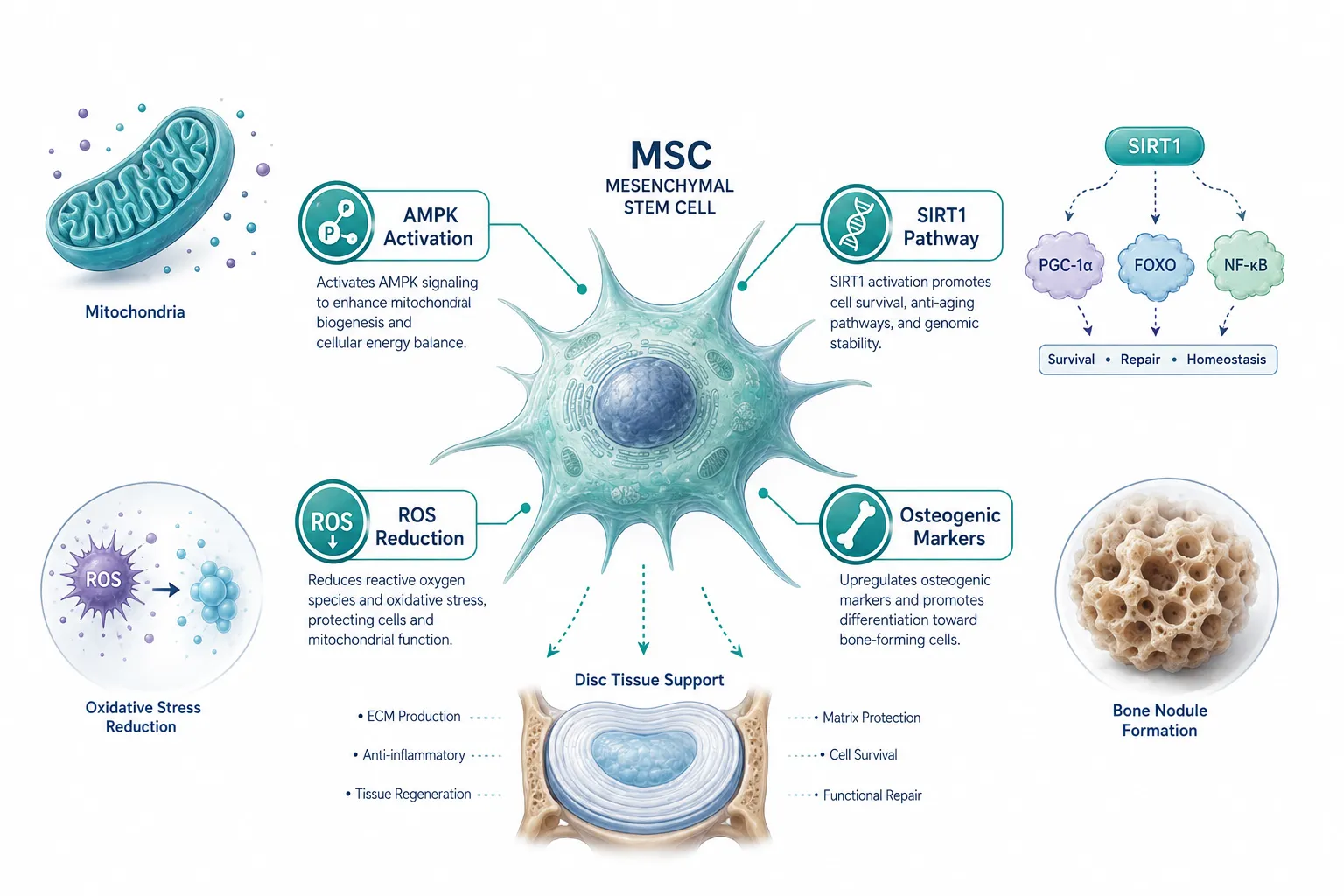
Mesenchymal stem cells are not passive building blocks. They actively sense their metabolic environment and adjust their fate accordingly, differentiating into bone, cartilage, or fat cells depending on energy signals. Mitochondria are central to this process. When mitochondrial function declines, MSCs accumulate reactive oxygen species (ROS), enter senescence, and lose their capacity to repair damaged tissue.
This is precisely why researchers studying stem cell biology have turned toward mitochondrial peptides as potential modulators of MSC behavior. Rather than acting as simple growth factors, these peptides target the upstream energy-sensing machinery that determines cell fate.
Key mitochondrial pathways relevant to MSC function:
| Pathway | Role in MSCs | Linked Compound |
|---|---|---|
| AMPK | Energy sensor; promotes survival | MOTS-c |
| SIRT1 | Deacetylase; reduces senescence | MOTS-c |
| NAD+/NNMT axis | Fuels sirtuin activity | 5-Amino-1MQ |
| mTORC1 | Controls growth and aging | MOTS-c (inhibits) |
When ROS levels rise, as they do in aging, obesity, or disc degeneration, MSC apoptosis increases and reparative output drops. Compounds that restore mitochondrial balance therefore represent a mechanistically sound approach to enhancing cell-based therapies.
MOTS-c in Regenerative Cell Models: What the Data Show
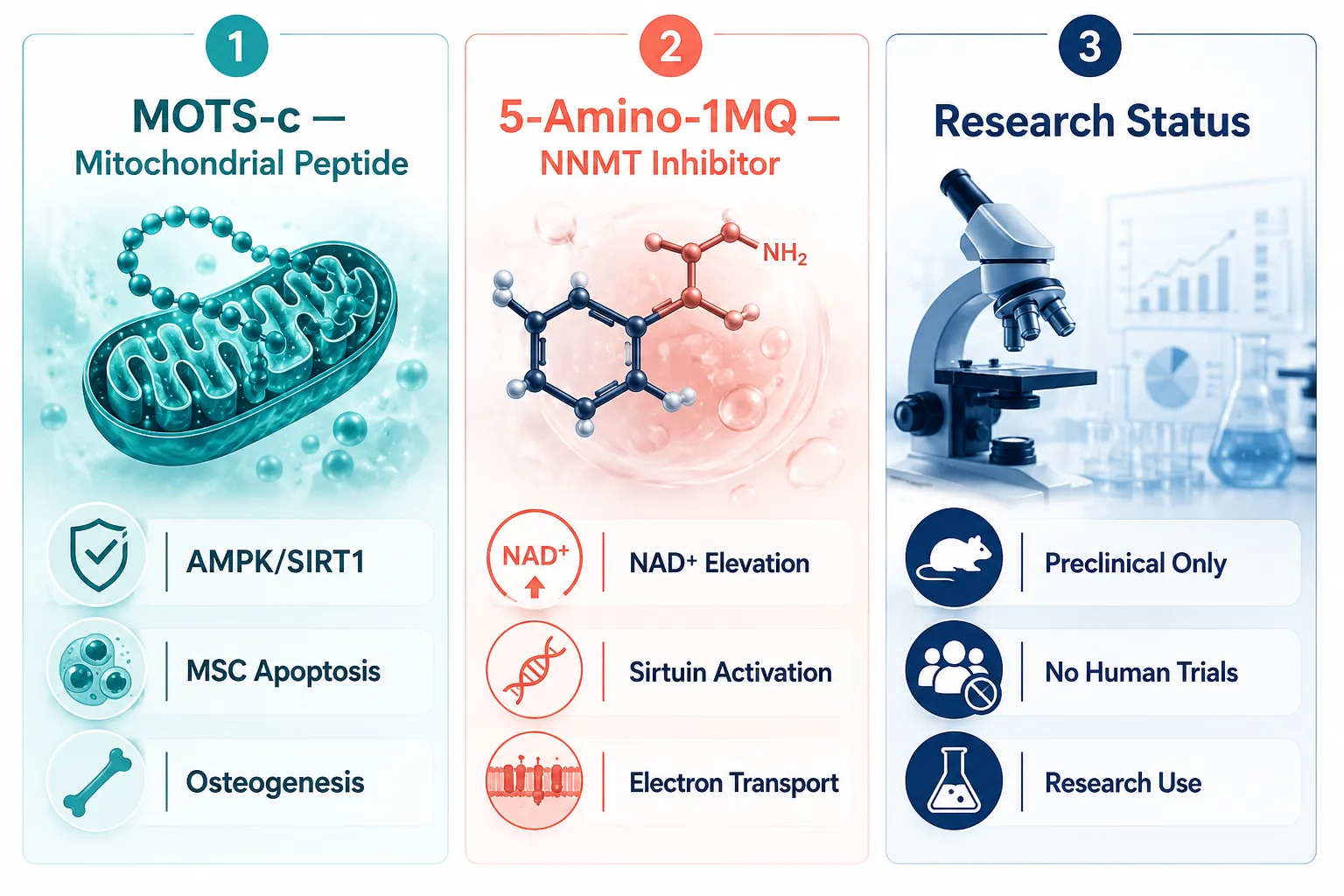
MOTS-c is a 16-amino-acid peptide encoded by mitochondrial DNA. Its discovery reframed mitochondria not just as energy factories but as signaling organelles capable of producing bioactive molecules. In the context of mesenchymal stem cells and mitochondrial peptides, MOTS-c has generated some of the most specific preclinical data available.
Disc and scaffold research: In a 2025 study, MOTS-c was incorporated into self-assembling peptide hydrogels to support nucleus pulposus-derived MSCs in a model of intervertebral disc degeneration. MOTS-c reduced oxidant-induced MSC apoptosis by approximately 48%, cut senescent cell populations by 52%, and lowered ROS by 35%, all through AMPK/SIRT1 activation. This positions MOTS-c as a potential bioactive scaffold component for tissue repair peptides research focused on spinal disc regeneration.
Bone formation: Multiple bone-focused studies show MOTS-c promoting osteogenic differentiation of bone marrow MSCs via TGF-beta/Smad signaling. Treated cells upregulate osteocalcin, ALP, and Runx2, forming more mineralized nodules and supporting faster fracture healing in animal models. These findings make MOTS-c an interesting candidate for MSC-seeded bone scaffolds, though all evidence remains preclinical.
Aged MSC rejuvenation: A study on aged placental-derived human MSCs found that MOTS-c improved cellular morphology, activated AMPK, inhibited mTORC1, reduced oxygen consumption and ROS, and enhanced overall mitochondrial homeostasis. The implication is that MOTS-c could help rejuvenate donor MSCs before transplantation or during ex vivo expansion.
Important caveat: A 2026 study on obese human MSCs found that exogenous MOTS-c restored AMPK activity but paradoxically increased senescence markers (p16, p21), elevated TNF-alpha, and reduced reparative function in a kidney injury model. This context-dependent response is a critical reminder that metabolic activation does not automatically translate into improved regenerative capacity.
Researchers exploring synergistic peptides should note that MOTS-c's effects appear highly dependent on the metabolic state of the target cell population. For more on MOTS-c alongside related mitochondrial compounds, see the Mots C Elamipretide research page.
5-Amino-1MQ: NAD+ Elevation and Its Theoretical Role in MSC Models
5-Amino-1MQ is not a peptide in the traditional sense. It is a small synthetic molecule that inhibits nicotinamide N-methyltransferase (NNMT), an enzyme that consumes methyl groups and degrades NAD+ precursors. By blocking NNMT, 5-Amino-1MQ raises intracellular NAD+ levels, which in turn activates the sirtuin family of deacetylases (SIRT1 through SIRT7) and supports mitochondrial electron transport chain function.
In the framework of mesenchymal stem cells and mitochondrial peptides, this mechanism is theoretically attractive. MSCs with higher NAD+ levels would have more fuel for sirtuin-driven stress resistance and metabolic flexibility, qualities that matter enormously during the oxidative stress of tissue injury.
Why 5-Amino-1MQ is relevant to regenerative cell models:
- Raises NAD+, the substrate that powers SIRT1, the same deacetylase MOTS-c activates through AMPK
- Supports mitochondrial electron transport, reducing the energy deficit that drives MSC senescence
- Could theoretically complement MOTS-c in a single peptide vs stack research design
However, published work on 5-Amino-1MQ remains focused on preclinical metabolic and weight-management models. No regenerative cell therapy trials exist. The compound is sold exclusively as a research chemical with no IND filings or Phase 1 studies on record as of 2026.
Regulatory Status and the Gap Between Promise and Practice

Understanding where MOTS-c and 5-Amino-1MQ fit in regenerative cell models also means understanding what they are not yet cleared to do.
MOTS-c regulatory status as of mid-2026:
- No completed human clinical trials
- No FDA approval for any medical use
- The FDA's Pharmacy Compounding Advisory Committee discussed MOTS-c bulk substances in July 2026 and recommended advisory inclusion on the Section 503A Bulks List, but this is not market approval and does not authorize routine clinical compounding
- Human evidence is limited to observational data on endogenous MOTS-c levels and genetic associations
5-Amino-1MQ regulatory status:
- Research chemical only; no IND or Phase 1 studies
- No registered clinical trials in regenerative medicine
- Preclinical data focused on metabolic and fat-loss models
Expert reviewers in 2026 have cautioned against framing MOTS-c as a proven longevity or regenerative therapy. All interventional data come from animal or cell models. There is no established dosing, safety, or pharmacokinetic framework in humans. Those interested in the broader landscape of IPA peptides and related research compounds should approach these agents with the same disciplined skepticism applied to any early-stage research tool.
Conclusion
The intersection of mesenchymal stem cells and mitochondrial peptides represents one of the more scientifically grounded frontiers in regenerative biology. MOTS-c has demonstrated measurable effects on MSC apoptosis, senescence, ROS levels, and osteogenic differentiation across multiple preclinical models. 5-Amino-1MQ offers a complementary NAD+-elevating mechanism that could, in theory, enhance MSC energetic resilience. Together, they illustrate how mitochondrial signaling shapes stem cell fate, and why that axis is worth studying carefully.
Actionable next steps for researchers:
- Evaluate MOTS-c in the specific MSC subtype and metabolic context relevant to the target tissue, obese or metabolically stressed donor cells may respond differently than healthy ones.
- Consider whether a combined NNMT inhibitor and mitochondrial peptide approach (using single peptide protocols as a baseline) adds mechanistic clarity to NAD+/SIRT1 pathway studies.
- Restrict use of both compounds to controlled preclinical research settings until human pharmacokinetic and safety data exist.
- Monitor FDA advisory developments around MOTS-c compounding status, as the regulatory landscape may shift as early as late 2026 or 2027.
The science is advancing. The clinical authorization is not yet there. That distinction is what separates rigorous regenerative research from premature application.