Call or Text 727-513-9780
  • Shopping Cart Shopping Cart
    0Shopping Cart
Pure Tested Peptides | America's most trusted Peptides for sale online
  • Peptides for sale
    • Oral Peptides for sale
      • Peptide Capsules for sale
      • BPC 157 Capsules 1000mcg
      • SLU-PP-332 Capsules | 1000 mcg
      • 5-Amino-1MQ 50mg Capsules
      • Tesofensine 500mcg
    • All Peptides for sale
    • Peptide Sprays
      • BPC 157 Nasal Spray Kit
      • BPC-157 TB500 Nasal Spray Kit
      • Semax Nasal Spray 10mg
      • Selank – Nasal Spray Kit – 10mg
      • Epithalon 50MG Nasal Spray Kit
      • Ipamorelin 10mg Nasal Spray
      • Klow Nasal Spray (BPC-157 + TB-500 + GHK-Cu + KPV) | 80mg
      • Hulk Nasal Spray Tesa / Ipa Blend 6/3 MG
      • Klow Nasal Spray
      • NAD + 500 mg Nasal Spray
      • PT-141 Nasal Spray Kit
    • GHRH Peptides
      • Ipa Peptides
      • CJC-1295 Peptides
        • CJC-1295 with DAC 5 mg
        • CJC-1295 without DAC 5 mg
        • CJC-1295 Ipa 10mg
      • Tesa Peptides
        • Tesa Peptide
        • Tesa 20 mg
    • GHK-Cu Peptides
      • All GHK-Cu Peptides
      • GHK-Cu 100mg
      • KLOW Peptide Blend – Buy KLOW blend online
    • BPC Peptides
      • All BPC Peptides
      • BPC-157
      • BPC-157 TB-500
      • BPC 157 capsules 1000mcg
    • SLU-PP-332 Peptides
      • All SLU-PP-332 Peptides
      • SLU-PP-332 5mg
    • GLP3 Peptides
    • PT-141 Peptides
      • PT-141 Peptides for sale
      • PT-141 10mg
      • PT-141 Nasal Spray
    • CAG Peptides
      • Lipo-C Peptide Blend
      • CAG 5mg
      • CAG 10mg
    • MOTS-C Peptides
      • MOTS-C Peptides for sale
      • MOTS-c peptide
      • MOTS-c 10mg *6 pack*
    • 5 Amino 1MQ Peptides
      • 5 Amino 1MQ Peptides for sale
      • 5-Amino-1MQ 50mg Capsules
      • 5-Amino-1MQ 5mg
    • Epithalon Peptides
      • Epithalon Peptides for sale
      • Epithalon 10mg
      • Epithalon 50mg
  • Shop
    • GLPs
      • 5-Amino-1MQ 50mg Capsules
      • 5-Amino-1MQ 5mg
      • L-Carnitine 500mg/ml
      • Tesofensine 500mcg
      • SLU-PP-332 5mg
      • MOTS-c 10mg *6 pack*
    • Epithalon & BPC Peptides
      • Epithalon 10mg
      • Epithalon 50mg
      • BPC-157
      • BPC 157 capsules 1000mcg
      • BPC-157 TB-500
      • BPC-157 TB500 Nasal Spray Kit
      • BPC 157 Nasal Spray Kit
    • BPC TB-500 & NAD+ Peptides
      • NAD+ 500 mg
      • KLOW Peptide Blend – Buy KLOW blend online
      • GLOW Peptide Blend
      • TB 500 5mg
      • BPC 157 capsules 1000mcg – Supplement
      • BPC 157 Nasal Spray Kit
      • BPC-157
      • BPC-157 TB500 Nasal Spray Kit
      • BPC-157 TB-500
      • BPC 157 capsules 1000mcg
    • LL-37 Peptide
      • LL-37 10 mg
    • MOTS-C & Selank
      • MOTS-c peptide
      • Selank 10mg
    • GHK Peptides
      • GHK-Cu 100mg
      • GLOW Peptide Blend
      • KLOW Peptide Blend – Buy KLOW blend online
  • COAs
  • Wholesale
    • Wholesale Peptides for sale
  • PTP FAQ
  • Affiliates
    • Selank Peptide: Advanced Pharmacological Mechanisms Underlying Its Anxiolytic and Nootropic Effects in Research
      • 5-Amino-1MQ Peptide: Detailed Mechanisms of NNMT Inhibition and Its Impact on Cellular Metabolism Research
        • MOTS-C Peptide: Unraveling Its Role in Mitochondrial Dynamics and Energy Metabolism Research
          • Epithalon Peptide and Telomerase Regulation: Investigating Its Impact on Cellular Senescence and Lifespan Research Models
            • GLP2-T vs GLP2 Tirz Peptide: Understanding the Naming, Mechanistic Nuances, and Research Implications for Gut Health
      • Peptides and Polypeptides in Modern Pharmacology: What Research on Metoprolol, Prednisone, and Amlodipine Reveals
        • Polypeptide Peptides vs NSAIDs: What Naproxen and Diclofenac Teach Tissue-Repair Researchers About BPC‑157 and TB‑500
          • Peptides and Polypeptides in Endocrine Pharmacology: How GLP-1, GLP-2, and GLP-3 Retatrutide Differ From Classic Drugs Like Prednisone and Amlodipine
          • 5‑Amino‑1MQ Peptide and NNMT Inhibition: How It Compares With Statins Like Atorvastatin in Adipose and Lipid Metabolism Research
      • Enclomiphene, Estrogen Receptor Signaling, and Luteinizing Phase Biology: What Hormone Researchers Should Measure
        • Mesenchymal Stem Cells, BPC‑157, and GHK‑Cu: How Tissue Repair Peptides Compare With Classic NSAIDs Like Naproxen in Injury Models
          • Peptide Calculator Use Cases Beyond Growth Hormone: Working Through GLP‑3 Retatrutide, MOTS‑c, and BPC‑157 Research Dosing
        • Polypeptide Peptides in Endocrine and Metabolic Pharmacology: Lessons From Amlodipine, Prednisone, and Metoprolol
        • Peptides Calculator for Advanced Blends: Worked Examples for Tesamorelin, CJC‑1295, and Ipamorelin Stacks
          • Peptides and Polypeptides in Human Physiology: How Molecular Size Shapes Research Applications
            • Selank Peptide: Advanced Pharmacological Mechanisms Underlying Its Anxiolytic and Nootropic Effects in Research
          • 5-Amino-1MQ Peptide: Detailed Mechanisms of NNMT Inhibition and Its Impact on Cellular Metabolism Research
            • MOTS-C Peptide: Unraveling Its Role in Mitochondrial Dynamics and Energy Metabolism Research
              • Epithalon Peptide and Telomerase Regulation: Investigating Its Impact on Cellular Senescence and Lifespan Research Models
                • GLP2-T vs GLP2 Tirz Peptide: Understanding the Naming, Mechanistic Nuances, and Research Implications for Gut Health
                  • Peptides and Polypeptides in Endocrine Pharmacology: How GLP-1, GLP-2, and GLP-3 Retatrutide Differ From Classic Drugs Like Prednisone and Amlodipine
                    • Polypeptide Peptides vs NSAIDs: What Naproxen and Diclofenac Teach Tissue-Repair Researchers About BPC‑157 and TB‑500
                      • Peptides and Polypeptides in Modern Pharmacology: What Research on Metoprolol, Prednisone, and Amlodipine Reveals
                        • 5‑Amino‑1MQ Peptide and NNMT Inhibition: How It Compares With Statins Like Atorvastatin in Adipose and Lipid Metabolism Research
                        • Enclomiphene, Estrogen Receptor Signaling, and Luteinizing Phase Biology: What Hormone Researchers Should Measure
                        • Mesenchymal Stem Cells, BPC‑157, and GHK‑Cu: How Tissue Repair Peptides Compare With Classic NSAIDs Like Naproxen in Injury Models
                        • Peptide Calculator Use Cases Beyond Growth Hormone: Working Through GLP‑3 Retatrutide, MOTS‑c, and BPC‑157 Research Dosing
                        • Polypeptide Peptides in Endocrine and Metabolic Pharmacology: Lessons From Amlodipine, Prednisone, and Metoprolol
                        • Peptides Calculator for Advanced Blends: Worked Examples for Tesamorelin, CJC‑1295, and Ipamorelin Stacks
                        • Peptides and Polypeptides in Human Physiology: How Molecular Size Shapes Research Applications
                        • Selank Peptide: Advanced Pharmacological Mechanisms Underlying Its Anxiolytic and Nootropic Effects in Research
                        • MOTS-C Peptide: Unraveling Its Role in Mitochondrial Dynamics and Energy Metabolism Research
                        • Peptides and Polypeptides in Modern Pharmacology: What Research on Metoprolol, Prednisone, and Amlodipine Reveals
                        • Peptides and Polypeptides in Endocrine Pharmacology: How GLP-1, GLP-2, and GLP-3 Retatrutide Differ From Classic Drugs Like Prednisone and Amlodipine
                        • 5-Amino-1MQ Peptide: Detailed Mechanisms of NNMT Inhibition and Its Impact on Cellular Metabolism Research
                        • Mesenchymal Stem Cells, BPC‑157, and GHK‑Cu: How Tissue Repair Peptides Compare With Classic NSAIDs Like Naproxen in Injury Models
                        • Peptide Calculator Use Cases Beyond Growth Hormone: Working Through GLP‑3 Retatrutide, MOTS‑c, and BPC‑157 Research Dosing
                        • GLP2-T vs GLP2 Tirz Peptide: Understanding the Naming, Mechanistic Nuances, and Research Implications for Gut Health
                        • Polypeptide Peptides in Endocrine and Metabolic Pharmacology: Lessons From Amlodipine, Prednisone, and Metoprolol
                        • Polypeptide Peptides vs NSAIDs: What Naproxen and Diclofenac Teach Tissue-Repair Researchers About BPC‑157 and TB‑500
                        • Peptides and Polypeptides in Human Physiology: How Molecular Size Shapes Research Applications
                        • Peptides Calculator for Advanced Blends: Worked Examples for Tesamorelin, CJC‑1295, and Ipamorelin Stacks
                        • 5‑Amino‑1MQ Peptide and NNMT Inhibition: How It Compares With Statins Like Atorvastatin in Adipose and Lipid Metabolism Research
                        • Enclomiphene, Estrogen Receptor Signaling, and Luteinizing Phase Biology: What Hormone Researchers Should Measure
                        • Epithalon Peptide and Telomerase Regulation: Investigating Its Impact on Cellular Senescence and Lifespan Research Models
                        • Best research protocol Klow blend
                        • best time to take BPC-157
                        • best time to take DSIP (Delta Sleep Inducing Peptide)
                        • best time to take CJC-1295
                        • best time to take AOD-9604
                        • best time to take Follistatin 344
                        • best time to take Ipamorelin
                        • best time to take MK-677 (Ibutamoren)
                        • best time to take Ligandrol (LGD-4033) — research compound
                        • best time to take Ostarine (MK-2866) — research compound
                        • best time to take GHK-CU
                        • best time to take TB-500
                        • best time to take MOTS-c
                        • best time to take Semax
                        • best time to take RAD-140 (Testolone) — research compound
                        • best time to take Thymosin Alpha-1
                        • best time to take PEG-MGF
                        • Biolife Plasma, Octapharma Plasma, and Research Peptides: How Plasma Donation Labs Differ From Peptide Suppliers
                        • best time to take YK-11 — research compound
                        • best time to take PT-141 (Bremelanotide)
                        • Best research protocol Klow blend
                        • 5-Amino-1MQ and MOTS-C Synergy: Metabolic Signaling, Mitochondria, and Research Design
                        • BPC-157 and TB-500: Investigating Their Combined Effects on Angiogenesis and Cellular Migration in Tissue Repair Models
                        • BPC-157 Peptide: Gut Barrier Function, Inflammation, and Tissue-Recovery Research
                        • 5‑Amino‑1MQ and MOTS‑c Synergy in Metabolic Research: Designing NNMT and Mitochondrial Biogenesis Stacks
                        • CJC-1295 with DAC vs. Without DAC: Half-Life, Release Kinetics, and Research Implications
                        • CJC‑1295 with DAC vs. Without DAC: Expanding on Half‑Life Differences Using Tesamorelin and Ipamorelin Blend Case Studies
                        • Collagen Biology and Copper‑Binding Peptides: How GHK‑Cu, Glow Blend, and Klow Blend Interact with Skin and Connective Tissue
                        • Collagen Biology and Regenerative Peptides: How GHK‑Cu, Glow Blend, and Klow Blend Affect Extracellular Matrix Research
                    • DNA, Telomeres, and Longevity Peptides: Positioning Epithalon and MOTS‑c in Genetic Aging Research
                      • Enclomiphene Citrate: serm Mechanism, Testosterone Research, and Stack Compatibility
                        • Enclomiphene vs Enclomiphene Citrate: Formulation, Bioavailability, and Research Distinctions
                        • Epithalon Peptide Research: Telomerase Activation, Aging, and Pineal Gland Function
                        • Estrogen Receptor Signaling and Enclomiphene: How Selective Modulators Compare with Classic Polypeptide Hormones
                        • GHK-Cu Peptide: Advanced Mechanisms in Extracellular Matrix Remodeling and Wound Healing Research
                        • GHK-Cu Peptide: Collagen Synthesis, Wound Repair, and Skin-Barrier Research Models
                        • GLP-1 vs GLP-3 vs GLP-2: Peptide Classification and Research Applications
                        • GLP-2 Peptide Research Guide: Gut Barrier Function, Nutrient Absorption, and Intestinal Recovery Models
                        • GLP-3 Retatrutide vs. GLP-1 Drugs: What Triple-Agonist Biology Changes in Research Models
                        • Ipamorelin and Tesamorelin Combination: Synergistic GH Secretagogue Research and Dosing Protocols
                        • GLP2 Tirz Peptide: What It Is, Why the Name Exists, and How Researchers Should Interpret It
                        • Klow Blend Peptide Nasal Spray: What the Formulation Is Trying to Do in Cognitive Research
                        • Mitochondria, NNMT Inhibition, and Peptide Modulators: Where MOTS‑c and 5‑Amino‑1MQ Fit in Cellular Energy Research
                        • MOTS-c Peptide: Mitochondrial Function, Energy Metabolism, and What Researchers Measure
                        • MOTS-c vs. 5-Amino-1MQ: Which Metabolic Research Questions Each Compound Actually Answers
                        • Nasal Spray Peptides: Bioavailability, Administration, and Semax/Selank Research Applications
                        • PT-141 Peptide Research: Mechanism of Action and Melanocortin Receptor Signaling
                        • Retatrutide for Research: Mechanism, Structure, and GLP-1/GLP-3 Dual Action
                        • Retatrutide for Obesity and Type 2 Diabetes: What the Latest Trial Data Suggest
                        • Tesofensine Peptide Research: Mechanism, Appetite Suppression, and Neuropeptide Y Pathways
  • Contact
    • Contact Customer Service
    • Text Customer Support
  • About US
  • Shop all peptides
  • Affiliate Program
    • Affiliate Signup
  • Login / Register Login / Register Page Link Login / Register Page Link
  • Click to open the search input field Click to open the search input field Search
  • Menu Menu

Tag Archive for: olfactory transport

Intranasal Peptide Research Methods: Deposition, Mucosal Permeability, Excipient Controls, and Brain-Exposure Questions

Intranasal Peptide Research Methods: Deposition, Mucosal Permeability, Excipient Controls, and Brain-Exposure Questions

September 25, 2026/0 Comments/in Uncategorized/by

Fewer than 5% of intranasal peptide doses typically reach systemic circulation when compared with subcutaneous injection, yet the same formulation can produce measurably higher brain concentrations than an intravenous dose of the identical compound. That apparent paradox sits at the heart of modern intranasal peptide research methods: deposition, mucosal permeability, excipient controls, and brain-exposure questions, and it explains why researchers studying peptides such as Semax, Selank, and related neuropeptide formulations need a rigorous, method-specific framework rather than generic pharmacokinetic assumptions.

Key Takeaways

  • Nasal deposition, mucosal absorption, and brain exposure are three distinct, measurable variables that must be characterized separately in any intranasal peptide program.
  • Device geometry and actuation parameters govern whether a peptide deposits in the olfactory zone (relevant to nose-to-brain transport) or the lower turbinates (relevant to systemic absorption).
  • Peptide molecular weight is the strongest single predictor of intranasal systemic bioavailability; peptides under 1 kDa can achieve meaningful absorption, while larger peptides require excipient support.
  • Excipient selection drives both permeability and safety outcomes; regulatory expectations now include cilia function assays and nasal histopathology for any formulation using permeation enhancers.
  • Translating animal nose-to-brain pharmacokinetic data to human CNS exposure remains the field's most significant unsolved methodological problem as of 2026.

Mapping Nasal Deposition: Why Region Matters
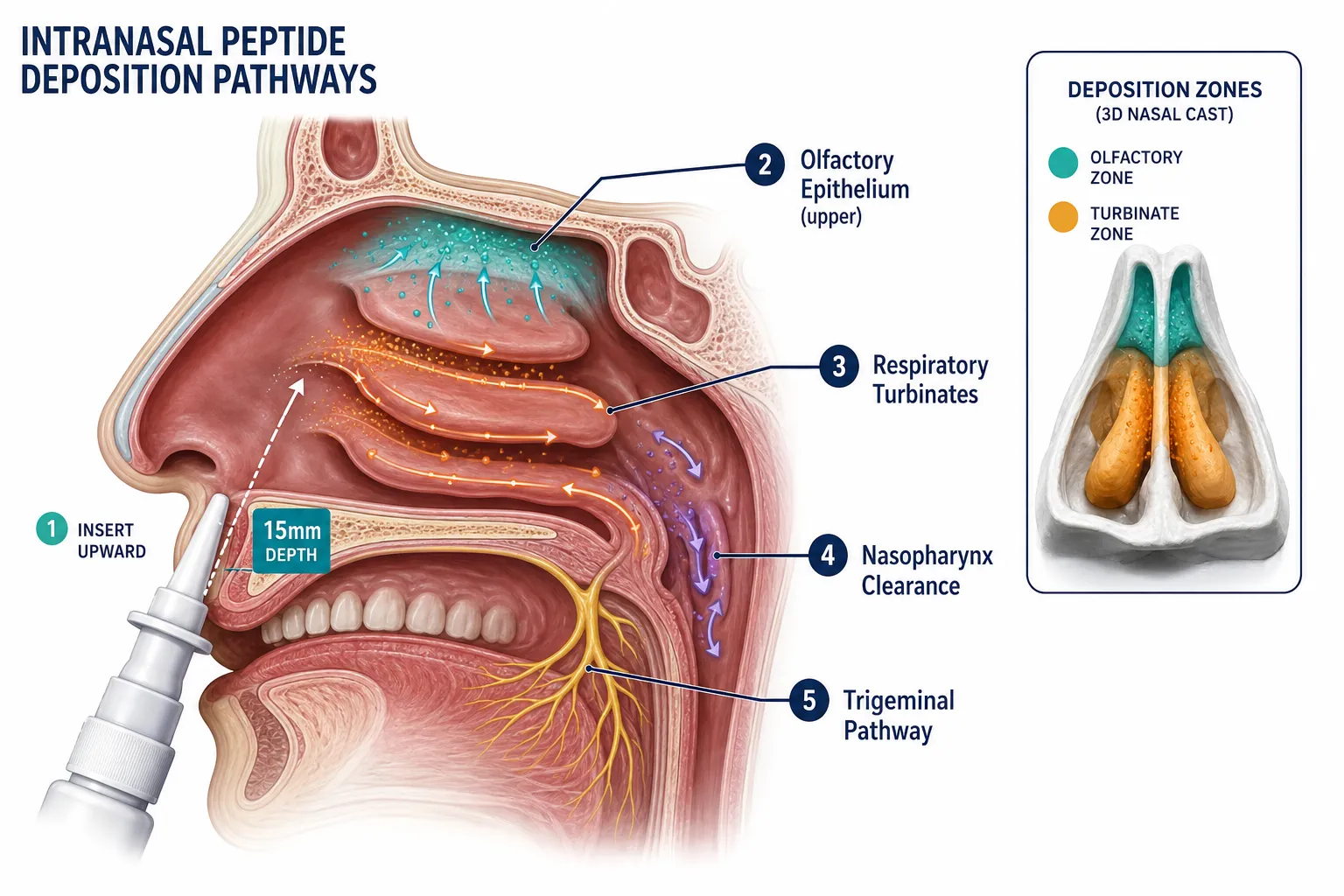
Mapping Nasal Deposition: Why Region Matters

The nasal cavity is not a uniform surface. It divides functionally into a lower respiratory region lined with ciliated columnar epithelium and an upper olfactory region that connects directly to the olfactory bulb and, via the trigeminal nerve, to deeper brain structures. For systemic delivery, the respiratory turbinates provide a large vascularized surface. For nose-to-brain targeting, the olfactory epithelium is the critical zone, and it occupies only a small fraction of the total mucosal area.

Why this distinction shapes the entire research design:

  • A peptide deposited on the lower turbinates enters mucociliary clearance within minutes, limiting contact time and absorption.
  • A peptide reaching the olfactory cleft can follow axonal or perineural transport pathways to bypass the blood-brain barrier entirely.
  • Standard commercial nasal sprays are designed for turbinate deposition; nose-to-brain programs require deliberate device selection and validated deposition confirmation.

Deposition Characterization Techniques

Researchers currently use three primary methods to map where a peptide actually lands:

Method What It Measures Key Limitation
3D-printed nasal cast + spectrophotometry Regional drug mass after zone-wise rinsing Anatomical variability across donors
Radiolabeled scintigraphic imaging Real-time deposition in living subjects Regulatory complexity, radiation exposure
Transparent replica + high-resolution imaging Spray plume mechanics linked to deposition Does not capture mucosal biology

Physics-based parametric modeling, using transparent nasal replicas and software-assisted color-mask quantification, is gaining traction as a way to predict regional deposition from device and actuation parameters without animal studies. Studies comparing six commercial spray devices at a standardized 15 mm insertion depth have shown that plume angle and droplet size alone can determine whether olfactory or turbinate deposition dominates, a finding with direct implications for any researcher selecting a delivery device for neuropeptide work.

For researchers exploring nasal spray peptide delivery formats or nasal spray with PT-141, understanding device-specific deposition profiles is a prerequisite, not an afterthought.


Mucosal Permeability and Excipient Controls
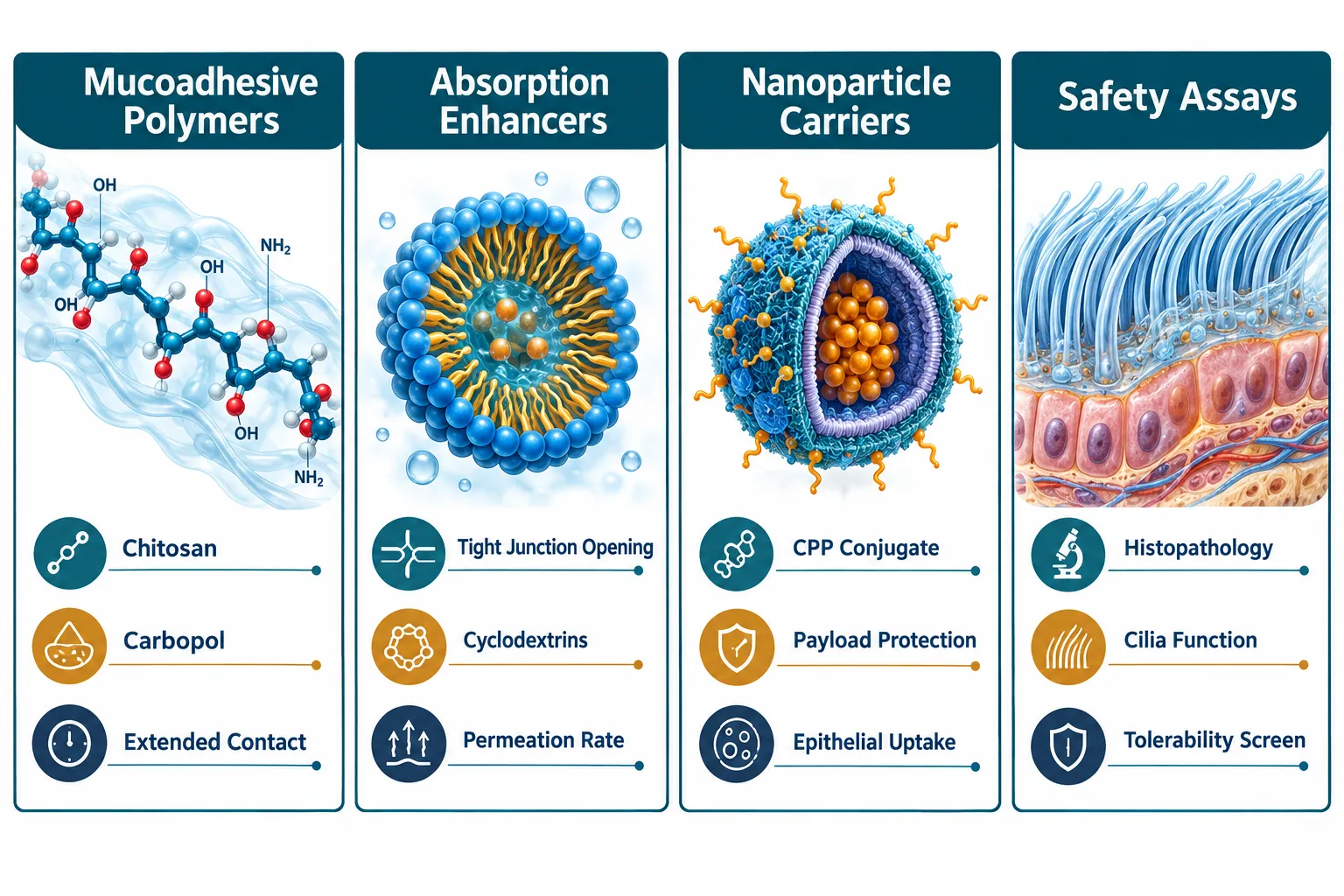
Mucosal Permeability and Excipient Controls

Once a peptide reaches the mucosal surface, absorption depends on molecular weight, lipophilicity, enzymatic stability, and the formulation's excipient profile. Molecular weight is the dominant variable for systemic bioavailability: peptides under approximately 1 kDa (roughly ten amino acids or fewer) can achieve meaningful intranasal absorption without excipient support, while larger peptides show steep declines in fractional absorption unless carriers or enhancers are used.

"The inverse relationship between peptide molecular weight and intranasal bioavailability is among the most reproducible findings in nasal pharmacokinetics, and among the most frequently ignored in early-stage formulation decisions."

Excipient Classes and Their Functions

Mucoadhesive polymers such as chitosan and carbopol extend mucosal contact time, slowing mucociliary clearance and increasing the window for absorption. Chitosan also acts as a mild permeation enhancer by transiently loosening tight junctions between epithelial cells.

Cyclodextrins improve peptide solubility and protect against enzymatic degradation at the mucosal surface, which is rich in proteases.

Surfactants and absorption enhancers open paracellular routes more aggressively but carry a corresponding mucosal safety burden.

Polymeric nanoparticles and cell-penetrating peptide (CPP) conjugates represent the most advanced tier, enabling intracellular transport across the epithelial layer. Despite promising animal data, no nanoparticle-based nose-to-brain system had reached clinical trial stage as of early 2026, underscoring the translational gap.

Safety and Regulatory Expectations

Regulatory agencies now expect a defined safety package for any formulation using permeation enhancers or novel excipients:

  • Nasal mucosal histopathology (acute and chronic exposure)
  • Cilia beat frequency and morphology assays
  • Local tolerability studies at the intended dose frequency
  • Reversibility data for any observed mucosal changes

Researchers working with peptides that require enhanced permeability, including those studying peptide dosing protocols or evaluating formulation strategies for compounds like those discussed in SS-31 mechanism and research, should build mucosal safety endpoints into study design from the outset rather than treating them as late-stage add-ons.


Brain-Exposure Questions: Separating CNS from Systemic Pharmacokinetics
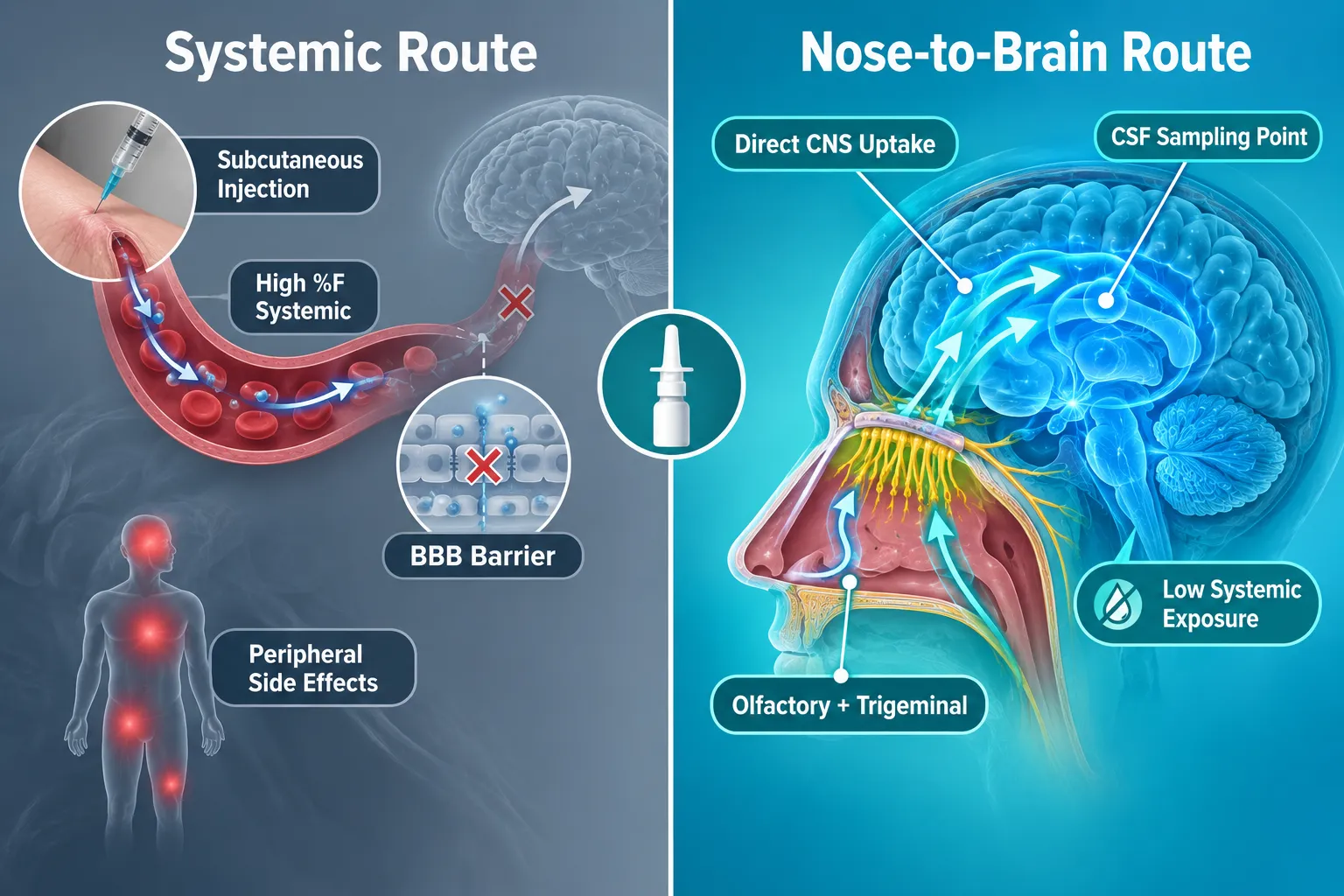
Brain-Exposure Questions: Separating CNS from Systemic Pharmacokinetics

The most methodologically complex aspect of intranasal peptide research methods is quantifying brain exposure independently of systemic exposure. The two are not equivalent, and conflating them produces misleading conclusions.

The core distinction:

  • Systemic bioavailability (%F) measures the fraction of the dose entering general circulation, typically assessed via plasma concentration-time curves referenced against subcutaneous or intravenous dosing.
  • Brain exposure is best measured directly via cerebrospinal fluid (CSF) sampling or brain tissue analysis in animal models, and cannot be reliably inferred from plasma data for nose-to-brain programs.

Intranasal GLP-1/GIP dual agonist peptides, intranasal insulin, and interferon-beta-1b have all demonstrated the defining pattern of nose-to-brain delivery: low systemic exposure paired with significantly elevated brain concentrations compared with intravenous or oral routes. This dichotomy is not an artifact, it reflects genuine olfactory and trigeminal transport that bypasses the blood-brain barrier.

Current Methodological Gaps

Despite consistent animal findings, several problems limit translation to human CNS pharmacokinetics:

  1. No validated in vitro model accurately replicates the human olfactory epithelium's transport characteristics.
  2. CSF sampling in humans is invasive, limiting PK characterization to sparse time points.
  3. Standardized animal paradigms for nose-to-brain transport do not yet exist, making cross-study comparisons unreliable.
  4. Anatomical scaling between rodent and human nasal geometry introduces large uncertainty when extrapolating olfactory deposition fractions.

Regulators increasingly expect quantitative deposition imaging linked to PK modeling for nose-to-brain programs, a requirement that makes early investment in nasal cast studies and CSF sampling protocols strategically necessary rather than optional. Researchers evaluating compounds with potential CNS applications, including those reviewing polypeptide peptides in cardiometabolic models or examining CJC-1295 pharmacokinetic comparisons, should treat brain-exposure quantification as a distinct study objective with its own sampling strategy.

Sourcing research-grade material with verified purity is equally foundational. Impurities in peptide formulations can confound both permeability measurements and CNS exposure data. Resources such as evaluating purity for research-grade peptide formulations offer useful frameworks for assessing supplier quality before committing material to in vivo studies.


Conclusion

A rigorous approach to intranasal peptide research requires treating nasal deposition, mucosal permeability, and brain exposure as three distinct measurement problems, not a single pharmacokinetic endpoint. The actionable steps for researchers in 2026 are clear:

  1. Select and validate the delivery device using nasal cast studies before committing to in vivo work; device geometry determines whether olfactory or turbinate deposition dominates.
  2. Match excipient strategy to peptide molecular weight; small peptides may need only mucoadhesives, while larger peptides require carriers or enhancers with a full mucosal safety package.
  3. Design separate PK endpoints for systemic and CNS exposure; do not infer brain concentrations from plasma data in nose-to-brain programs.
  4. Incorporate standardized deposition metrics early, as regulatory expectations for quantitative imaging linked to PK modeling are rising across the field.
  5. Source verified, research-grade peptide material to ensure that formulation variables, not impurity profiles, drive experimental outcomes.

The nose-to-brain route offers genuine advantages for neuropeptide research, but those advantages are only accessible through disciplined, method-specific study design.

https://www.puretestedpeptides.com/wp-content/uploads/2026/09/intranasal-peptide-research-methods-deposition-mucosal-permeability-excipient-co.webp 1024 1536 https://www.puretestedpeptides.com/wp-content/uploads/2026/01/buy-peptides-online.jpg 2026-09-25 13:03:542026-09-25 13:03:54Intranasal Peptide Research Methods: Deposition, Mucosal Permeability, Excipient Controls, and Brain-Exposure Questions
×

Helpful Links

  • My account
  • Cart
  • Checkout
  • Refund and Returns Policy
  • Privacy Policy
  • SMS Privacy Policy
  • Login
  • My Account
  • Logout

USA Made Lab Tested Peptides

All products are sold for research, laboratory, or analytical purposes only, and are not for human consumption


Pure Tested Peptides is a chemical supplier. Pure Tested Peptides is not a compounding / chemical compounding facility as defined under 503A of the Federal Food, Drug, and Cosmetic act. Pure Tested Peptides is not an outsourcing facility as defined under 503B of the Federal Food, Drug, and Cosmetic act.

The statements made within this website have not been evaluated by the US Food and Drug Administration. The products we offer are not intended to diagnose, treat, cure or prevent any disease.

Human/Animal Consumption Prohibited. Laboratory/In-Vitro Experimental Use Only

Scroll to top Scroll to top Scroll to top