

Intranasal Peptide Research Methods: Deposition, Mucosal Permeability, Excipient Controls, and Brain-Exposure Questions
Fewer than 5% of intranasal peptide doses typically reach systemic circulation when compared with subcutaneous injection, yet the same formulation can produce measurably higher brain concentrations than an intravenous dose of the identical compound. That apparent paradox sits at the heart of modern intranasal peptide research methods: deposition, mucosal permeability, excipient controls, and brain-exposure questions, and it explains why researchers studying peptides such as Semax, Selank, and related neuropeptide formulations need a rigorous, method-specific framework rather than generic pharmacokinetic assumptions.
Key Takeaways
- Nasal deposition, mucosal absorption, and brain exposure are three distinct, measurable variables that must be characterized separately in any intranasal peptide program.
- Device geometry and actuation parameters govern whether a peptide deposits in the olfactory zone (relevant to nose-to-brain transport) or the lower turbinates (relevant to systemic absorption).
- Peptide molecular weight is the strongest single predictor of intranasal systemic bioavailability; peptides under 1 kDa can achieve meaningful absorption, while larger peptides require excipient support.
- Excipient selection drives both permeability and safety outcomes; regulatory expectations now include cilia function assays and nasal histopathology for any formulation using permeation enhancers.
- Translating animal nose-to-brain pharmacokinetic data to human CNS exposure remains the field's most significant unsolved methodological problem as of 2026.
Mapping Nasal Deposition: Why Region Matters
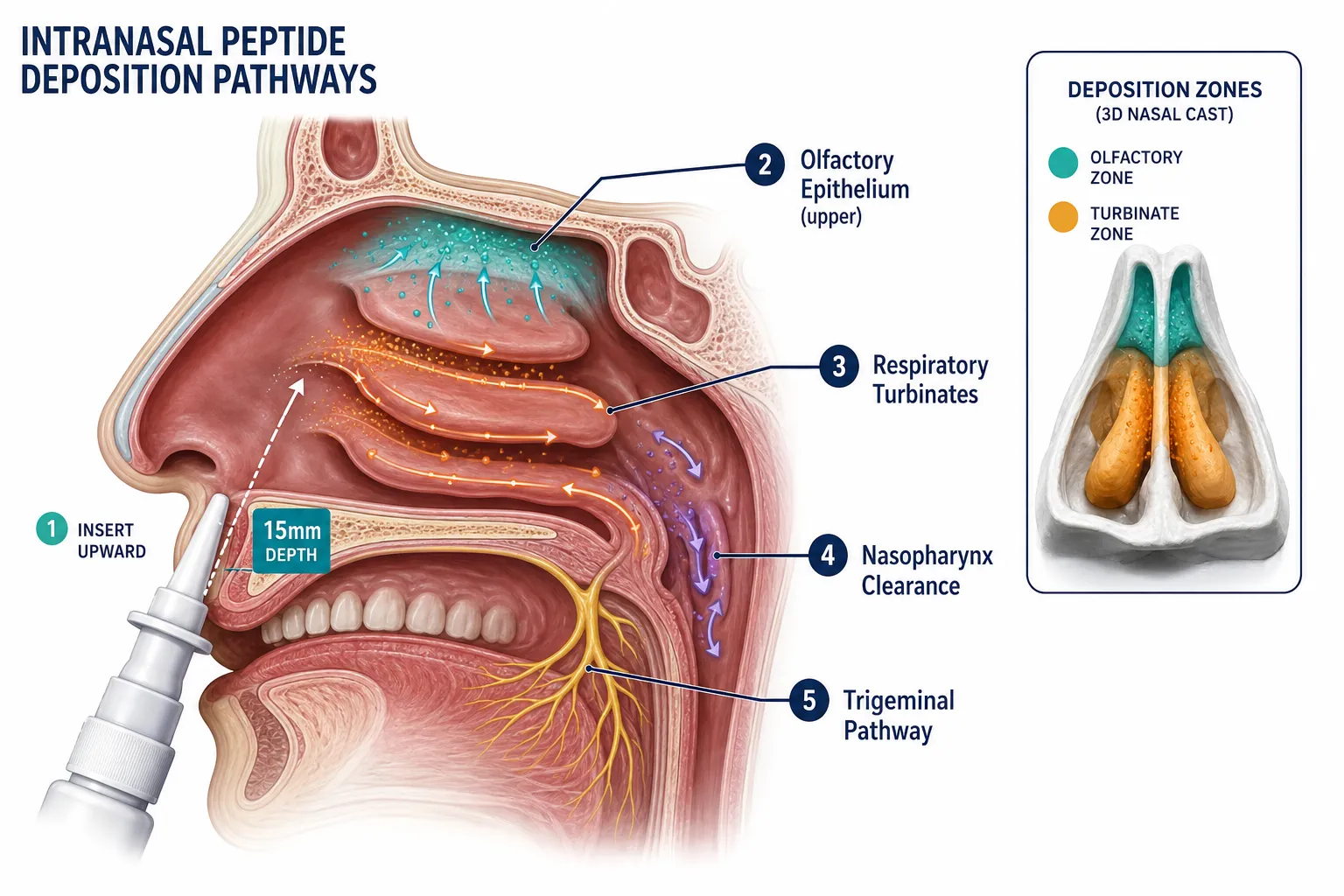
The nasal cavity is not a uniform surface. It divides functionally into a lower respiratory region lined with ciliated columnar epithelium and an upper olfactory region that connects directly to the olfactory bulb and, via the trigeminal nerve, to deeper brain structures. For systemic delivery, the respiratory turbinates provide a large vascularized surface. For nose-to-brain targeting, the olfactory epithelium is the critical zone, and it occupies only a small fraction of the total mucosal area.
Why this distinction shapes the entire research design:
- A peptide deposited on the lower turbinates enters mucociliary clearance within minutes, limiting contact time and absorption.
- A peptide reaching the olfactory cleft can follow axonal or perineural transport pathways to bypass the blood-brain barrier entirely.
- Standard commercial nasal sprays are designed for turbinate deposition; nose-to-brain programs require deliberate device selection and validated deposition confirmation.
Deposition Characterization Techniques
Researchers currently use three primary methods to map where a peptide actually lands:
| Method | What It Measures | Key Limitation |
|---|---|---|
| 3D-printed nasal cast + spectrophotometry | Regional drug mass after zone-wise rinsing | Anatomical variability across donors |
| Radiolabeled scintigraphic imaging | Real-time deposition in living subjects | Regulatory complexity, radiation exposure |
| Transparent replica + high-resolution imaging | Spray plume mechanics linked to deposition | Does not capture mucosal biology |
Physics-based parametric modeling, using transparent nasal replicas and software-assisted color-mask quantification, is gaining traction as a way to predict regional deposition from device and actuation parameters without animal studies. Studies comparing six commercial spray devices at a standardized 15 mm insertion depth have shown that plume angle and droplet size alone can determine whether olfactory or turbinate deposition dominates, a finding with direct implications for any researcher selecting a delivery device for neuropeptide work.
For researchers exploring nasal spray peptide delivery formats or nasal spray with PT-141, understanding device-specific deposition profiles is a prerequisite, not an afterthought.
Mucosal Permeability and Excipient Controls
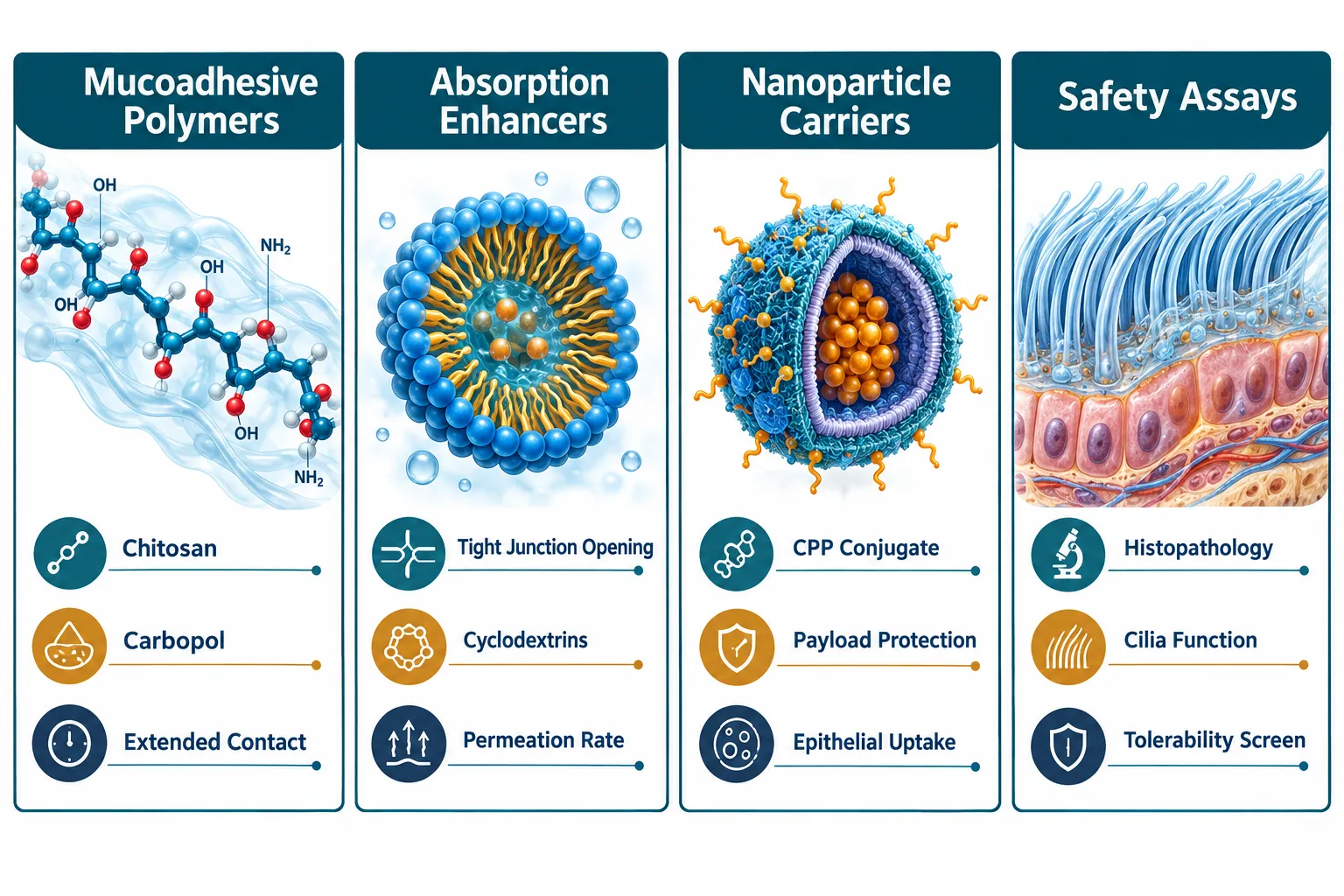
Once a peptide reaches the mucosal surface, absorption depends on molecular weight, lipophilicity, enzymatic stability, and the formulation's excipient profile. Molecular weight is the dominant variable for systemic bioavailability: peptides under approximately 1 kDa (roughly ten amino acids or fewer) can achieve meaningful intranasal absorption without excipient support, while larger peptides show steep declines in fractional absorption unless carriers or enhancers are used.
"The inverse relationship between peptide molecular weight and intranasal bioavailability is among the most reproducible findings in nasal pharmacokinetics, and among the most frequently ignored in early-stage formulation decisions."
Excipient Classes and Their Functions
Mucoadhesive polymers such as chitosan and carbopol extend mucosal contact time, slowing mucociliary clearance and increasing the window for absorption. Chitosan also acts as a mild permeation enhancer by transiently loosening tight junctions between epithelial cells.
Cyclodextrins improve peptide solubility and protect against enzymatic degradation at the mucosal surface, which is rich in proteases.
Surfactants and absorption enhancers open paracellular routes more aggressively but carry a corresponding mucosal safety burden.
Polymeric nanoparticles and cell-penetrating peptide (CPP) conjugates represent the most advanced tier, enabling intracellular transport across the epithelial layer. Despite promising animal data, no nanoparticle-based nose-to-brain system had reached clinical trial stage as of early 2026, underscoring the translational gap.
Safety and Regulatory Expectations
Regulatory agencies now expect a defined safety package for any formulation using permeation enhancers or novel excipients:
- Nasal mucosal histopathology (acute and chronic exposure)
- Cilia beat frequency and morphology assays
- Local tolerability studies at the intended dose frequency
- Reversibility data for any observed mucosal changes
Researchers working with peptides that require enhanced permeability, including those studying peptide dosing protocols or evaluating formulation strategies for compounds like those discussed in SS-31 mechanism and research, should build mucosal safety endpoints into study design from the outset rather than treating them as late-stage add-ons.
Brain-Exposure Questions: Separating CNS from Systemic Pharmacokinetics
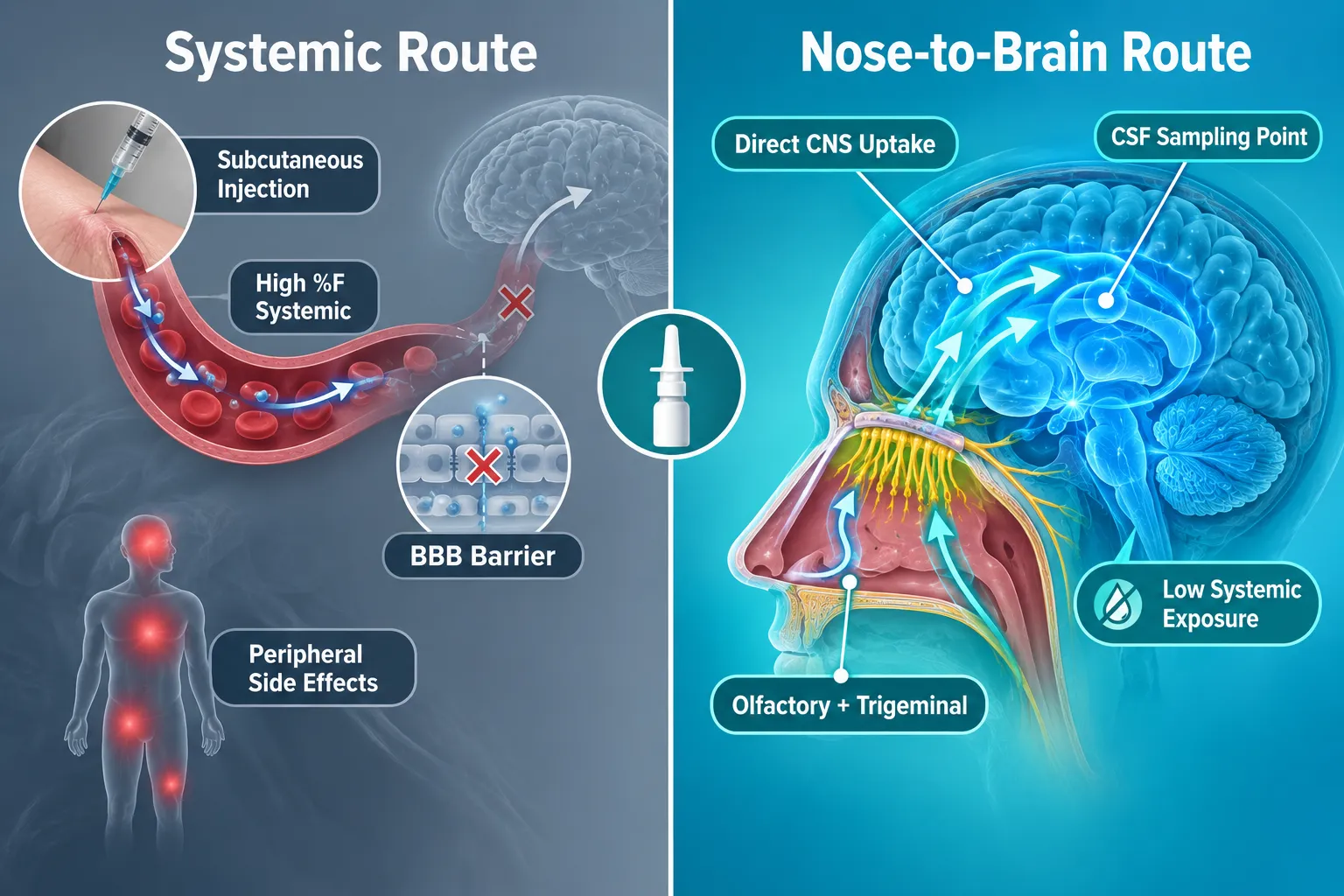
The most methodologically complex aspect of intranasal peptide research methods is quantifying brain exposure independently of systemic exposure. The two are not equivalent, and conflating them produces misleading conclusions.
The core distinction:
- Systemic bioavailability (%F) measures the fraction of the dose entering general circulation, typically assessed via plasma concentration-time curves referenced against subcutaneous or intravenous dosing.
- Brain exposure is best measured directly via cerebrospinal fluid (CSF) sampling or brain tissue analysis in animal models, and cannot be reliably inferred from plasma data for nose-to-brain programs.
Intranasal GLP-1/GIP dual agonist peptides, intranasal insulin, and interferon-beta-1b have all demonstrated the defining pattern of nose-to-brain delivery: low systemic exposure paired with significantly elevated brain concentrations compared with intravenous or oral routes. This dichotomy is not an artifact, it reflects genuine olfactory and trigeminal transport that bypasses the blood-brain barrier.
Current Methodological Gaps
Despite consistent animal findings, several problems limit translation to human CNS pharmacokinetics:
- No validated in vitro model accurately replicates the human olfactory epithelium's transport characteristics.
- CSF sampling in humans is invasive, limiting PK characterization to sparse time points.
- Standardized animal paradigms for nose-to-brain transport do not yet exist, making cross-study comparisons unreliable.
- Anatomical scaling between rodent and human nasal geometry introduces large uncertainty when extrapolating olfactory deposition fractions.
Regulators increasingly expect quantitative deposition imaging linked to PK modeling for nose-to-brain programs, a requirement that makes early investment in nasal cast studies and CSF sampling protocols strategically necessary rather than optional. Researchers evaluating compounds with potential CNS applications, including those reviewing polypeptide peptides in cardiometabolic models or examining CJC-1295 pharmacokinetic comparisons, should treat brain-exposure quantification as a distinct study objective with its own sampling strategy.
Sourcing research-grade material with verified purity is equally foundational. Impurities in peptide formulations can confound both permeability measurements and CNS exposure data. Resources such as evaluating purity for research-grade peptide formulations offer useful frameworks for assessing supplier quality before committing material to in vivo studies.
Conclusion
A rigorous approach to intranasal peptide research requires treating nasal deposition, mucosal permeability, and brain exposure as three distinct measurement problems, not a single pharmacokinetic endpoint. The actionable steps for researchers in 2026 are clear:
- Select and validate the delivery device using nasal cast studies before committing to in vivo work; device geometry determines whether olfactory or turbinate deposition dominates.
- Match excipient strategy to peptide molecular weight; small peptides may need only mucoadhesives, while larger peptides require carriers or enhancers with a full mucosal safety package.
- Design separate PK endpoints for systemic and CNS exposure; do not infer brain concentrations from plasma data in nose-to-brain programs.
- Incorporate standardized deposition metrics early, as regulatory expectations for quantitative imaging linked to PK modeling are rising across the field.
- Source verified, research-grade peptide material to ensure that formulation variables, not impurity profiles, drive experimental outcomes.
The nose-to-brain route offers genuine advantages for neuropeptide research, but those advantages are only accessible through disciplined, method-specific study design.


Leave a Reply
Want to join the discussion?Feel free to contribute!