Call or Text 727-513-9780
  • Shopping Cart Shopping Cart
    0Shopping Cart
Pure Tested Peptides | America's most trusted Peptides for sale online
  • Peptides for sale
    • Oral Peptides for sale
      • Peptide Capsules for sale
      • BPC 157 Capsules 1000mcg
      • SLU-PP-332 Capsules | 1000 mcg
      • 5-Amino-1MQ 50mg Capsules
      • Tesofensine 500mcg
    • All Peptides for sale
    • Peptide Sprays
      • BPC 157 Nasal Spray Kit
      • BPC-157 TB500 Nasal Spray Kit
      • Semax Nasal Spray 10mg
      • Selank – Nasal Spray Kit – 10mg
      • Epithalon 50MG Nasal Spray Kit
      • Ipamorelin 10mg Nasal Spray
      • Klow Nasal Spray (BPC-157 + TB-500 + GHK-Cu + KPV) | 80mg
      • Hulk Nasal Spray Tesa / Ipa Blend 6/3 MG
      • Klow Nasal Spray
      • NAD + 500 mg Nasal Spray
      • PT-141 Nasal Spray Kit
    • GHRH Peptides
      • Ipa Peptides
      • CJC-1295 Peptides
        • CJC-1295 with DAC 5 mg
        • CJC-1295 without DAC 5 mg
        • CJC-1295 Ipa 10mg
      • Tesa Peptides
        • Tesa Peptide
        • Tesa 20 mg
    • GHK-Cu Peptides
      • All GHK-Cu Peptides
      • GHK-Cu 100mg
      • KLOW Peptide Blend – Buy KLOW blend online
    • BPC Peptides
      • All BPC Peptides
      • BPC-157
      • BPC-157 TB-500
      • BPC 157 capsules 1000mcg
    • SLU-PP-332 Peptides
      • All SLU-PP-332 Peptides
      • SLU-PP-332 5mg
    • GLP3 Peptides
    • PT-141 Peptides
      • PT-141 Peptides for sale
      • PT-141 10mg
      • PT-141 Nasal Spray
    • CAG Peptides
      • Lipo-C Peptide Blend
      • CAG 5mg
      • CAG 10mg
    • MOTS-C Peptides
      • MOTS-C Peptides for sale
      • MOTS-c peptide
      • MOTS-c 10mg *6 pack*
    • 5 Amino 1MQ Peptides
      • 5 Amino 1MQ Peptides for sale
      • 5-Amino-1MQ 50mg Capsules
      • 5-Amino-1MQ 5mg
    • Epithalon Peptides
      • Epithalon Peptides for sale
      • Epithalon 10mg
      • Epithalon 50mg
  • Shop
    • GLPs
      • 5-Amino-1MQ 50mg Capsules
      • 5-Amino-1MQ 5mg
      • L-Carnitine 500mg/ml
      • Tesofensine 500mcg
      • SLU-PP-332 5mg
      • MOTS-c 10mg *6 pack*
    • Epithalon & BPC Peptides
      • Epithalon 10mg
      • Epithalon 50mg
      • BPC-157
      • BPC 157 capsules 1000mcg
      • BPC-157 TB-500
      • BPC-157 TB500 Nasal Spray Kit
      • BPC 157 Nasal Spray Kit
    • BPC TB-500 & NAD+ Peptides
      • NAD+ 500 mg
      • KLOW Peptide Blend – Buy KLOW blend online
      • GLOW Peptide Blend
      • TB 500 5mg
      • BPC 157 capsules 1000mcg – Supplement
      • BPC 157 Nasal Spray Kit
      • BPC-157
      • BPC-157 TB500 Nasal Spray Kit
      • BPC-157 TB-500
      • BPC 157 capsules 1000mcg
    • LL-37 Peptide
      • LL-37 10 mg
    • MOTS-C & Selank
      • MOTS-c peptide
      • Selank 10mg
    • GHK Peptides
      • GHK-Cu 100mg
      • GLOW Peptide Blend
      • KLOW Peptide Blend – Buy KLOW blend online
  • COAs
  • Wholesale
    • Wholesale Peptides for sale
  • PTP FAQ
  • Affiliates
    • Selank Peptide: Advanced Pharmacological Mechanisms Underlying Its Anxiolytic and Nootropic Effects in Research
      • 5-Amino-1MQ Peptide: Detailed Mechanisms of NNMT Inhibition and Its Impact on Cellular Metabolism Research
        • MOTS-C Peptide: Unraveling Its Role in Mitochondrial Dynamics and Energy Metabolism Research
          • Epithalon Peptide and Telomerase Regulation: Investigating Its Impact on Cellular Senescence and Lifespan Research Models
            • GLP2-T vs GLP2 Tirz Peptide: Understanding the Naming, Mechanistic Nuances, and Research Implications for Gut Health
      • Peptides and Polypeptides in Modern Pharmacology: What Research on Metoprolol, Prednisone, and Amlodipine Reveals
        • Polypeptide Peptides vs NSAIDs: What Naproxen and Diclofenac Teach Tissue-Repair Researchers About BPC‑157 and TB‑500
          • Peptides and Polypeptides in Endocrine Pharmacology: How GLP-1, GLP-2, and GLP-3 Retatrutide Differ From Classic Drugs Like Prednisone and Amlodipine
          • 5‑Amino‑1MQ Peptide and NNMT Inhibition: How It Compares With Statins Like Atorvastatin in Adipose and Lipid Metabolism Research
      • Enclomiphene, Estrogen Receptor Signaling, and Luteinizing Phase Biology: What Hormone Researchers Should Measure
        • Mesenchymal Stem Cells, BPC‑157, and GHK‑Cu: How Tissue Repair Peptides Compare With Classic NSAIDs Like Naproxen in Injury Models
          • Peptide Calculator Use Cases Beyond Growth Hormone: Working Through GLP‑3 Retatrutide, MOTS‑c, and BPC‑157 Research Dosing
        • Polypeptide Peptides in Endocrine and Metabolic Pharmacology: Lessons From Amlodipine, Prednisone, and Metoprolol
        • Peptides Calculator for Advanced Blends: Worked Examples for Tesamorelin, CJC‑1295, and Ipamorelin Stacks
          • Peptides and Polypeptides in Human Physiology: How Molecular Size Shapes Research Applications
            • Selank Peptide: Advanced Pharmacological Mechanisms Underlying Its Anxiolytic and Nootropic Effects in Research
          • 5-Amino-1MQ Peptide: Detailed Mechanisms of NNMT Inhibition and Its Impact on Cellular Metabolism Research
            • MOTS-C Peptide: Unraveling Its Role in Mitochondrial Dynamics and Energy Metabolism Research
              • Epithalon Peptide and Telomerase Regulation: Investigating Its Impact on Cellular Senescence and Lifespan Research Models
                • GLP2-T vs GLP2 Tirz Peptide: Understanding the Naming, Mechanistic Nuances, and Research Implications for Gut Health
                  • Peptides and Polypeptides in Endocrine Pharmacology: How GLP-1, GLP-2, and GLP-3 Retatrutide Differ From Classic Drugs Like Prednisone and Amlodipine
                    • Polypeptide Peptides vs NSAIDs: What Naproxen and Diclofenac Teach Tissue-Repair Researchers About BPC‑157 and TB‑500
                      • Peptides and Polypeptides in Modern Pharmacology: What Research on Metoprolol, Prednisone, and Amlodipine Reveals
                        • 5‑Amino‑1MQ Peptide and NNMT Inhibition: How It Compares With Statins Like Atorvastatin in Adipose and Lipid Metabolism Research
                        • Enclomiphene, Estrogen Receptor Signaling, and Luteinizing Phase Biology: What Hormone Researchers Should Measure
                        • Mesenchymal Stem Cells, BPC‑157, and GHK‑Cu: How Tissue Repair Peptides Compare With Classic NSAIDs Like Naproxen in Injury Models
                        • Peptide Calculator Use Cases Beyond Growth Hormone: Working Through GLP‑3 Retatrutide, MOTS‑c, and BPC‑157 Research Dosing
                        • Polypeptide Peptides in Endocrine and Metabolic Pharmacology: Lessons From Amlodipine, Prednisone, and Metoprolol
                        • Peptides Calculator for Advanced Blends: Worked Examples for Tesamorelin, CJC‑1295, and Ipamorelin Stacks
                        • Peptides and Polypeptides in Human Physiology: How Molecular Size Shapes Research Applications
                        • Selank Peptide: Advanced Pharmacological Mechanisms Underlying Its Anxiolytic and Nootropic Effects in Research
                        • MOTS-C Peptide: Unraveling Its Role in Mitochondrial Dynamics and Energy Metabolism Research
                        • Peptides and Polypeptides in Modern Pharmacology: What Research on Metoprolol, Prednisone, and Amlodipine Reveals
                        • Peptides and Polypeptides in Endocrine Pharmacology: How GLP-1, GLP-2, and GLP-3 Retatrutide Differ From Classic Drugs Like Prednisone and Amlodipine
                        • 5-Amino-1MQ Peptide: Detailed Mechanisms of NNMT Inhibition and Its Impact on Cellular Metabolism Research
                        • Mesenchymal Stem Cells, BPC‑157, and GHK‑Cu: How Tissue Repair Peptides Compare With Classic NSAIDs Like Naproxen in Injury Models
                        • Peptide Calculator Use Cases Beyond Growth Hormone: Working Through GLP‑3 Retatrutide, MOTS‑c, and BPC‑157 Research Dosing
                        • GLP2-T vs GLP2 Tirz Peptide: Understanding the Naming, Mechanistic Nuances, and Research Implications for Gut Health
                        • Polypeptide Peptides in Endocrine and Metabolic Pharmacology: Lessons From Amlodipine, Prednisone, and Metoprolol
                        • Polypeptide Peptides vs NSAIDs: What Naproxen and Diclofenac Teach Tissue-Repair Researchers About BPC‑157 and TB‑500
                        • Peptides and Polypeptides in Human Physiology: How Molecular Size Shapes Research Applications
                        • Peptides Calculator for Advanced Blends: Worked Examples for Tesamorelin, CJC‑1295, and Ipamorelin Stacks
                        • 5‑Amino‑1MQ Peptide and NNMT Inhibition: How It Compares With Statins Like Atorvastatin in Adipose and Lipid Metabolism Research
                        • Enclomiphene, Estrogen Receptor Signaling, and Luteinizing Phase Biology: What Hormone Researchers Should Measure
                        • Epithalon Peptide and Telomerase Regulation: Investigating Its Impact on Cellular Senescence and Lifespan Research Models
                        • Best research protocol Klow blend
                        • best time to take BPC-157
                        • best time to take DSIP (Delta Sleep Inducing Peptide)
                        • best time to take CJC-1295
                        • best time to take AOD-9604
                        • best time to take Follistatin 344
                        • best time to take Ipamorelin
                        • best time to take MK-677 (Ibutamoren)
                        • best time to take Ligandrol (LGD-4033) — research compound
                        • best time to take Ostarine (MK-2866) — research compound
                        • best time to take GHK-CU
                        • best time to take TB-500
                        • best time to take MOTS-c
                        • best time to take Semax
                        • best time to take RAD-140 (Testolone) — research compound
                        • best time to take Thymosin Alpha-1
                        • best time to take PEG-MGF
                        • Biolife Plasma, Octapharma Plasma, and Research Peptides: How Plasma Donation Labs Differ From Peptide Suppliers
                        • best time to take YK-11 — research compound
                        • best time to take PT-141 (Bremelanotide)
                        • Best research protocol Klow blend
                        • 5-Amino-1MQ and MOTS-C Synergy: Metabolic Signaling, Mitochondria, and Research Design
                        • BPC-157 and TB-500: Investigating Their Combined Effects on Angiogenesis and Cellular Migration in Tissue Repair Models
                        • BPC-157 Peptide: Gut Barrier Function, Inflammation, and Tissue-Recovery Research
                        • 5‑Amino‑1MQ and MOTS‑c Synergy in Metabolic Research: Designing NNMT and Mitochondrial Biogenesis Stacks
                        • CJC-1295 with DAC vs. Without DAC: Half-Life, Release Kinetics, and Research Implications
                        • CJC‑1295 with DAC vs. Without DAC: Expanding on Half‑Life Differences Using Tesamorelin and Ipamorelin Blend Case Studies
                        • Collagen Biology and Copper‑Binding Peptides: How GHK‑Cu, Glow Blend, and Klow Blend Interact with Skin and Connective Tissue
                        • Collagen Biology and Regenerative Peptides: How GHK‑Cu, Glow Blend, and Klow Blend Affect Extracellular Matrix Research
                    • DNA, Telomeres, and Longevity Peptides: Positioning Epithalon and MOTS‑c in Genetic Aging Research
                      • Enclomiphene Citrate: serm Mechanism, Testosterone Research, and Stack Compatibility
                        • Enclomiphene vs Enclomiphene Citrate: Formulation, Bioavailability, and Research Distinctions
                        • Epithalon Peptide Research: Telomerase Activation, Aging, and Pineal Gland Function
                        • Estrogen Receptor Signaling and Enclomiphene: How Selective Modulators Compare with Classic Polypeptide Hormones
                        • GHK-Cu Peptide: Advanced Mechanisms in Extracellular Matrix Remodeling and Wound Healing Research
                        • GHK-Cu Peptide: Collagen Synthesis, Wound Repair, and Skin-Barrier Research Models
                        • GLP-1 vs GLP-3 vs GLP-2: Peptide Classification and Research Applications
                        • GLP-2 Peptide Research Guide: Gut Barrier Function, Nutrient Absorption, and Intestinal Recovery Models
                        • GLP-3 Retatrutide vs. GLP-1 Drugs: What Triple-Agonist Biology Changes in Research Models
                        • Ipamorelin and Tesamorelin Combination: Synergistic GH Secretagogue Research and Dosing Protocols
                        • GLP2 Tirz Peptide: What It Is, Why the Name Exists, and How Researchers Should Interpret It
                        • Klow Blend Peptide Nasal Spray: What the Formulation Is Trying to Do in Cognitive Research
                        • Mitochondria, NNMT Inhibition, and Peptide Modulators: Where MOTS‑c and 5‑Amino‑1MQ Fit in Cellular Energy Research
                        • MOTS-c Peptide: Mitochondrial Function, Energy Metabolism, and What Researchers Measure
                        • MOTS-c vs. 5-Amino-1MQ: Which Metabolic Research Questions Each Compound Actually Answers
                        • Nasal Spray Peptides: Bioavailability, Administration, and Semax/Selank Research Applications
                        • PT-141 Peptide Research: Mechanism of Action and Melanocortin Receptor Signaling
                        • Retatrutide for Research: Mechanism, Structure, and GLP-1/GLP-3 Dual Action
                        • Retatrutide for Obesity and Type 2 Diabetes: What the Latest Trial Data Suggest
                        • Tesofensine Peptide Research: Mechanism, Appetite Suppression, and Neuropeptide Y Pathways
  • Contact
    • Contact Customer Service
    • Text Customer Support
  • About US
  • Shop all peptides
  • Affiliate Program
    • Affiliate Signup
  • Login / Register Login / Register Page Link Login / Register Page Link
  • Click to open the search input field Click to open the search input field Search
  • Menu Menu

Tag Archive for: peptide dosing protocol

PT-141 Peptide Research Safety Guide: Dosing, Timing, and Tolerability Questions Labs Ask

PT-141 Peptide Research Safety Guide: Dosing, Timing, and Tolerability Questions Labs Ask

September 15, 2026/0 Comments/in Uncategorized/by

Roughly 40% of participants in early PT-141 clinical trials experienced nausea significant enough to require protocol adjustments, yet the compound still advanced through multiple phases of human study and reached regulatory approval. That tension between biological activity and tolerability management sits at the heart of every serious PT-141 Peptide Research Safety Guide: Dosing, Timing, and Tolerability Questions Labs Ask.

This article moves past mechanism basics. It focuses on the practical protocol questions that researchers, study designers, and compounding labs raise once they already understand how PT-141 (bremelanotide) activates melanocortin receptors.

Key Takeaways

  • PT-141 has a well-characterized dose-dependent tolerability profile; nausea is the primary limiting adverse event and is strongly tied to dose size.
  • Approved subcutaneous dosing sits at 1.75 mg, but research protocols often start lower (0.5-1.0 mg) and titrate carefully.
  • Frequency of administration is a critical variable, hyperpigmentation risk rises sharply with repeated, closely spaced dosing.
  • Cardiovascular monitoring, especially blood pressure, is a non-negotiable safety checkpoint in any responsible study design.
  • Male and female research populations show meaningfully different tolerability patterns that labs must account for in study design.

What the Approved Dose Framework Tells Researchers

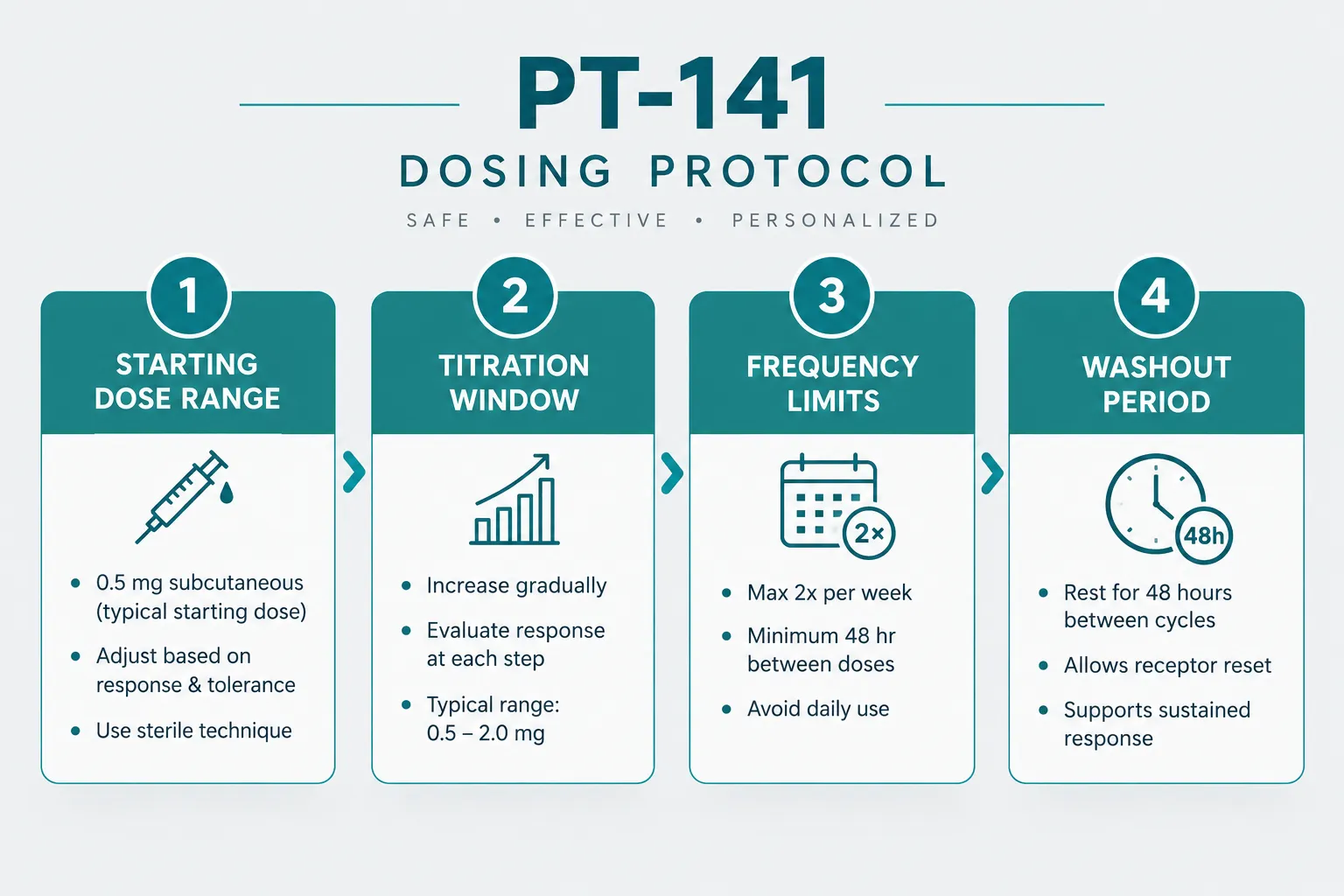
The FDA-approved subcutaneous dose of 1.75 mg, administered approximately 45 minutes before anticipated activity, forms the baseline reference point for any PT-141 Peptide Research Safety Guide: Dosing, Timing, and Tolerability Questions Labs Ask. Clinical monographs specify a maximum of one dose per 24 hours and no more than one dose every 72 hours in standard use.
What the Approved Dose Framework Tells Researchers

For research settings, these boundaries matter because they define the outer edge of a well-studied safety envelope. Most investigational protocols use this approved framework as a ceiling, not a starting point. Common research titration approaches include:

  • Starting dose: 0.5 mg subcutaneous to assess individual response
  • Intermediate dose: 1.0 mg if the 0.5 mg dose is well tolerated after two to three exposures
  • Standard research dose: 1.75 mg, consistent with the approved label
  • Frequency limit: No more than twice weekly in most current study designs, with a minimum 48-hour gap between doses

"The dose is only half the equation. How often a subject receives PT-141 determines a different set of risks entirely."

Intranasal administration was studied in earlier trials at doses up to 20 mg. Maximum-tolerated dose data from that work helped define the nausea threshold that now informs subcutaneous titration strategies. Subcutaneous delivery produces a more controlled absorption curve and is the standard route in current research.

For labs sourcing compounds for controlled studies, working with lab tested peptides is a baseline quality requirement before any dosing protocol can be considered valid.

Tolerability Profile: The Questions Labs Must Answer First

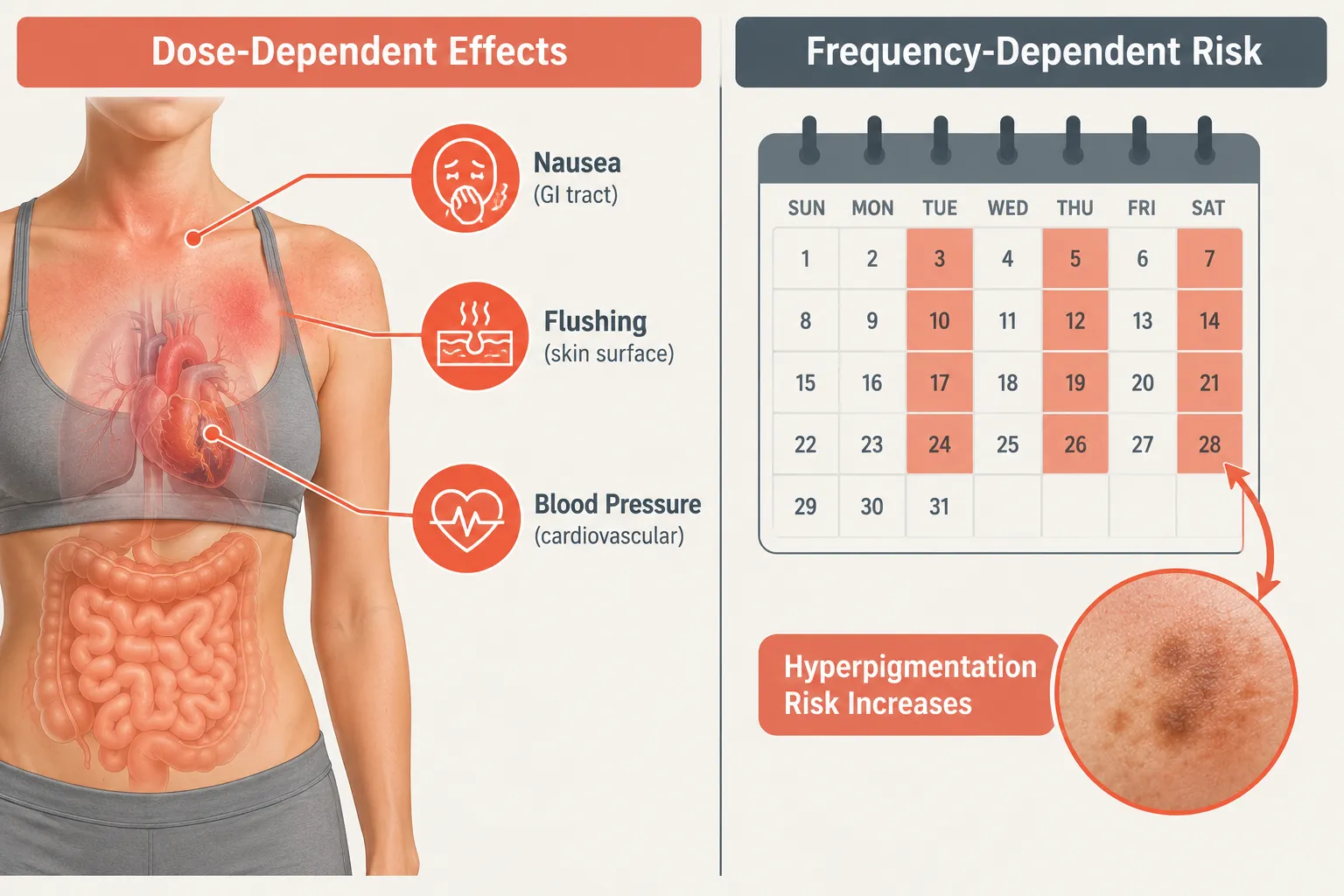
Every credible PT-141 Peptide Research Safety Guide: Dosing, Timing, and Tolerability Questions Labs Ask places tolerability assessment before efficacy measurement. The adverse event profile is well-characterized and dose-dependent.
Tolerability Profile: The Questions Labs Must Answer First

Nausea and Gastrointestinal Effects

Nausea is the most commonly reported adverse event across all PT-141 trials. Key findings from clinical data include:

  • Nausea incidence rises sharply above 1.75 mg
  • Onset typically occurs within 30-60 minutes of administration
  • Duration is usually under two hours at approved doses
  • Pre-dosing with a light meal reduces severity in most subjects

Labs designing multi-dose studies should build nausea scoring into every session log. Dropout rates in trials that did not manage nausea proactively were meaningfully higher than in those with structured tolerability support.

Cardiovascular and Blood Pressure Monitoring

PT-141 produces a transient, dose-dependent decrease in blood pressure followed by a rebound increase. This biphasic cardiovascular effect is one of the most important safety questions labs must address. Standard monitoring requirements include:

Monitoring Point Timing Relative to Dose
Baseline blood pressure 10 minutes before administration
First post-dose check 30 minutes after administration
Peak effect window 45-90 minutes after administration
Return-to-baseline check 3 hours after administration

Subjects with pre-existing cardiovascular conditions are typically excluded from PT-141 research protocols for this reason.

Skin Hyperpigmentation

This adverse effect is strongly frequency-dependent rather than dose-dependent. Melanocortin receptor activation drives melanin production, and repeated stimulation accumulates the effect. Labs running extended or repeat-dose studies must:

  • Document baseline skin tone and any existing pigmentation changes
  • Limit dosing frequency to no more than twice weekly
  • Include washout periods of at least two weeks between study phases
  • Monitor focal injection sites separately from systemic pigmentation changes

Male vs. Female Research Populations and Off-Label Study Design

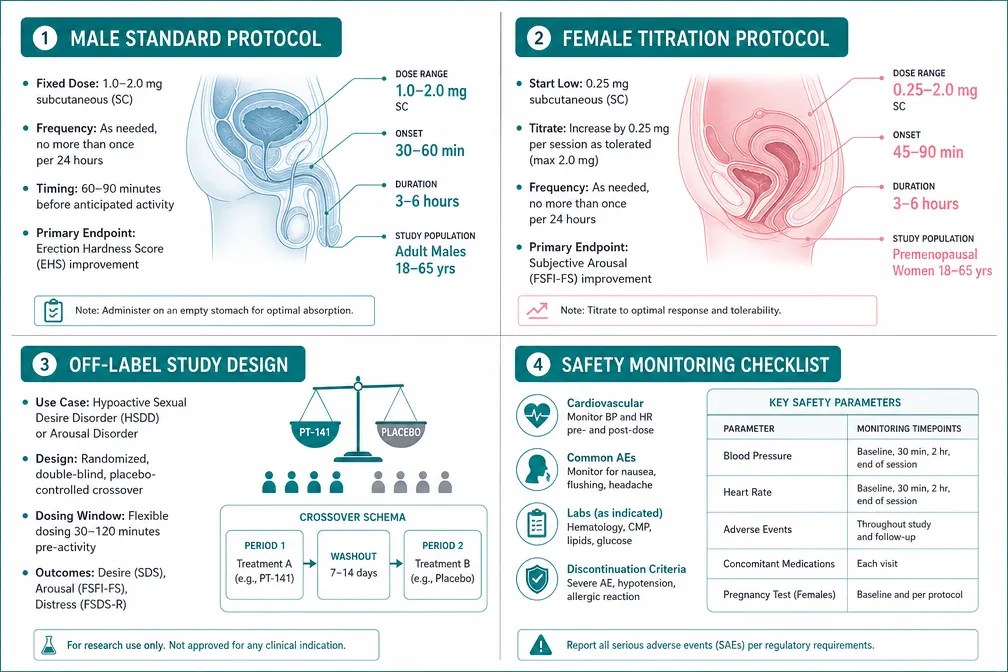
The approved indication for PT-141 is hypoactive sexual desire disorder in premenopausal women. However, a significant portion of current research examines male populations and other off-label applications, which raises distinct study design questions.
Male vs. Female Research Populations and Off-Label Study Design

In female populations, the tolerability profile aligns closely with label data. Hormonal cycle phase at time of dosing is a variable some protocols now track, as receptor sensitivity may fluctuate across the cycle.

In male populations, research data suggest comparable efficacy signals at similar doses, but the tolerability curve differs slightly. Flushing and transient blood pressure changes appear more pronounced in some male cohorts. Labs designing male-focused studies often use a more conservative titration schedule.

Off-label research considerations for labs in 2026 include:

  • Clearly defined primary endpoints that do not rely solely on subjective self-report
  • Structured washout periods between study phases (minimum two weeks)
  • Exclusion criteria that address cardiovascular risk, active skin conditions, and concurrent melanocortin-affecting medications
  • Ethics board documentation that explicitly addresses the off-label nature of the research

Researchers comparing PT-141 to other peptides with central nervous system or receptor-mediated mechanisms may also find value in reviewing Semax research and Semax peptide literature for parallel study design frameworks. Similarly, labs building multi-peptide research panels sometimes reference SS-31 mitochondrial research themes for safety monitoring methodology applicable across peptide classes. For labs sourcing multiple compounds, wholesale peptides for sale options can support broader research programs, and GHK-Cu peptide studies offer additional reference points for skin-related adverse event monitoring protocols.

Conclusion

The PT-141 Peptide Research Safety Guide: Dosing, Timing, and Tolerability Questions Labs Ask comes down to three operational priorities: start low and titrate deliberately, treat frequency as a distinct risk variable from dose size, and build cardiovascular monitoring into every session regardless of subject health status.

Actionable next steps for labs:

  1. Establish a written titration protocol starting at 0.5 mg before moving to the 1.75 mg reference dose.
  2. Cap dosing frequency at twice weekly and document all inter-dose intervals.
  3. Implement a standardized blood pressure monitoring timeline at every administration session.
  4. Include skin pigmentation photography at baseline and at each study phase checkpoint.
  5. Differentiate male and female cohort protocols rather than applying a single design across populations.
  6. Source compounds only from suppliers providing documented purity and sterility testing.

Research into PT-141 continues to generate useful safety data in 2026. Labs that build rigorous tolerability frameworks from the start produce cleaner datasets and reduce the risk of protocol-disrupting adverse events mid-study.

https://www.puretestedpeptides.com/wp-content/uploads/2026/09/pt-141-peptide-research-safety-guide-dosing-timing-and-tolerability-questions-la.webp 1024 1536 https://www.puretestedpeptides.com/wp-content/uploads/2026/01/buy-peptides-online.jpg 2026-09-15 13:04:362026-09-15 13:04:36PT-141 Peptide Research Safety Guide: Dosing, Timing, and Tolerability Questions Labs Ask
×

Helpful Links

  • My account
  • Cart
  • Checkout
  • Refund and Returns Policy
  • Privacy Policy
  • SMS Privacy Policy
  • Login
  • My Account
  • Logout

USA Made Lab Tested Peptides

All products are sold for research, laboratory, or analytical purposes only, and are not for human consumption


Pure Tested Peptides is a chemical supplier. Pure Tested Peptides is not a compounding / chemical compounding facility as defined under 503A of the Federal Food, Drug, and Cosmetic act. Pure Tested Peptides is not an outsourcing facility as defined under 503B of the Federal Food, Drug, and Cosmetic act.

The statements made within this website have not been evaluated by the US Food and Drug Administration. The products we offer are not intended to diagnose, treat, cure or prevent any disease.

Human/Animal Consumption Prohibited. Laboratory/In-Vitro Experimental Use Only

Scroll to top Scroll to top Scroll to top