Call or Text 727-513-9780
  • Shopping Cart Shopping Cart
    0Shopping Cart
Pure Tested Peptides | America's most trusted Peptides for sale online
  • Peptides for sale
    • Oral Peptides for sale
      • Peptide Capsules for sale
      • BPC 157 Capsules 1000mcg
      • SLU-PP-332 Capsules | 1000 mcg
      • 5-Amino-1MQ 50mg Capsules
      • Tesofensine 500mcg
    • All Peptides for sale
    • Peptide Sprays
      • BPC 157 Nasal Spray Kit
      • BPC-157 TB500 Nasal Spray Kit
      • Semax Nasal Spray 10mg
      • Selank – Nasal Spray Kit – 10mg
      • Epithalon 50MG Nasal Spray Kit
      • Ipamorelin 10mg Nasal Spray
      • Klow Nasal Spray (BPC-157 + TB-500 + GHK-Cu + KPV) | 80mg
      • Hulk Nasal Spray Tesa / Ipa Blend 6/3 MG
      • Klow Nasal Spray
      • NAD + 500 mg Nasal Spray
      • PT-141 Nasal Spray Kit
    • GHRH Peptides
      • Ipa Peptides
      • CJC-1295 Peptides
        • CJC-1295 with DAC 5 mg
        • CJC-1295 without DAC 5 mg
        • CJC-1295 Ipa 10mg
      • Tesa Peptides
        • Tesa Peptide
        • Tesa 20 mg
    • GHK-Cu Peptides
      • All GHK-Cu Peptides
      • GHK-Cu 100mg
      • KLOW Peptide Blend – Buy KLOW blend online
    • BPC Peptides
      • All BPC Peptides
      • BPC-157
      • BPC-157 TB-500
      • BPC 157 capsules 1000mcg
    • SLU-PP-332 Peptides
      • All SLU-PP-332 Peptides
      • SLU-PP-332 5mg
    • GLP3 Peptides
      • GLP3-R
      • GLP3-R CAG 10mg
      • GLP3-R 20mg
    • PT-141 Peptides
      • PT-141 Peptides for sale
      • PT-141 10mg
      • PT-141 Nasal Spray
    • CAG Peptides
      • Lipo-C Peptide Blend
      • CAG 5mg
      • CAG 10mg
    • MOTS-C Peptides
      • MOTS-C Peptides for sale
      • MOTS-c peptide
      • MOTS-c 10mg *6 pack*
    • 5 Amino 1MQ Peptides
      • 5 Amino 1MQ Peptides for sale
      • 5-Amino-1MQ 50mg Capsules
      • 5-Amino-1MQ 5mg
    • Epithalon Peptides
      • Epithalon Peptides for sale
      • Epithalon 10mg
      • Epithalon 50mg
  • Shop
    • GLPs
      • 5-Amino-1MQ 50mg Capsules
      • 5-Amino-1MQ 5mg
      • GLP3-Reta
      • L-Carnitine 500mg/ml
      • Tesofensine 500mcg
      • SLU-PP-332 5mg
      • MOTS-c 10mg *6 pack*
    • Epithalon & BPC Peptides
      • Epithalon 10mg
      • Epithalon 50mg
      • BPC-157
      • BPC 157 capsules 1000mcg
      • BPC-157 TB-500
      • BPC-157 TB500 Nasal Spray Kit
      • BPC 157 Nasal Spray Kit
    • BPC TB-500 & NAD+ Peptides
      • NAD+ 500 mg
      • KLOW Peptide Blend – Buy KLOW blend online
      • GLOW Peptide Blend
      • TB 500 5mg
      • BPC 157 capsules 1000mcg – Supplement
      • BPC 157 Nasal Spray Kit
      • BPC-157
      • BPC-157 TB500 Nasal Spray Kit
      • BPC-157 TB-500
      • BPC 157 capsules 1000mcg
    • LL-37 Peptide
      • LL-37 10 mg
    • MOTS-C & Selank
      • MOTS-c peptide
      • Selank 10mg
    • GHK Peptides
      • GHK-Cu 100mg
      • GLOW Peptide Blend
      • KLOW Peptide Blend – Buy KLOW blend online
  • COAs
  • Wholesale
    • Wholesale Peptides for sale
  • PTP FAQ
  • Affiliates
    • Affiliate Program
    • Affiliate Signup
  • Contact
    • Contact Customer Service
    • Text Customer Support
  • About US
  • Shop all peptides
  • Login / Register Login / Register Page Link Login / Register Page Link
  • Click to open the search input field Click to open the search input field Search
  • Menu Menu

Tag Archive for: peptide naming confusion

GLP-2-T and GLP2 Tirz Peptides: Naming Confusion, Mechanistic Differences, and Research Use Cases

GLP-2-T and GLP2 Tirz Peptides: Naming Confusion, Mechanistic Differences, and Research Use Cases

July 13, 2026/0 Comments/in Uncategorized/by

GLP-2-T vs GLP2 Tirz Peptides cover image

Researchers searching for "GLP-2 Tirz" in 2026 frequently land on content about tirzepatide, a dual incretin agonist, when they actually need information about GLP-2-T, a modified analog of glucagon-like peptide-2 studied for gut barrier biology. That single naming overlap can derail an entire literature review. Understanding GLP-2-T and GLP2 Tirz Peptides: Naming Confusion, Mechanistic Differences, and Research Use Cases is therefore not just an academic exercise; it directly shapes which experimental model a researcher selects and which receptor pathways they target.

Key Takeaways

  • "GLP-2 Tirz" is an informal, technically inaccurate label for tirzepatide, a GLP-1/GIP dual agonist with no direct GLP-2 pathway activity.
  • GLP-2-T is a research-grade, stability-enhanced analog of the endogenous peptide GLP-2, focused on intestinal mucosal biology.
  • The two compounds act on completely different receptors and serve distinct research purposes.
  • Informal generational numbering (GLP-2, GLP-3) for incretin drugs creates systematic confusion in the research community.
  • Selecting the correct compound requires understanding both receptor targets and the biological systems under study.

Where the Naming Confusion Originates

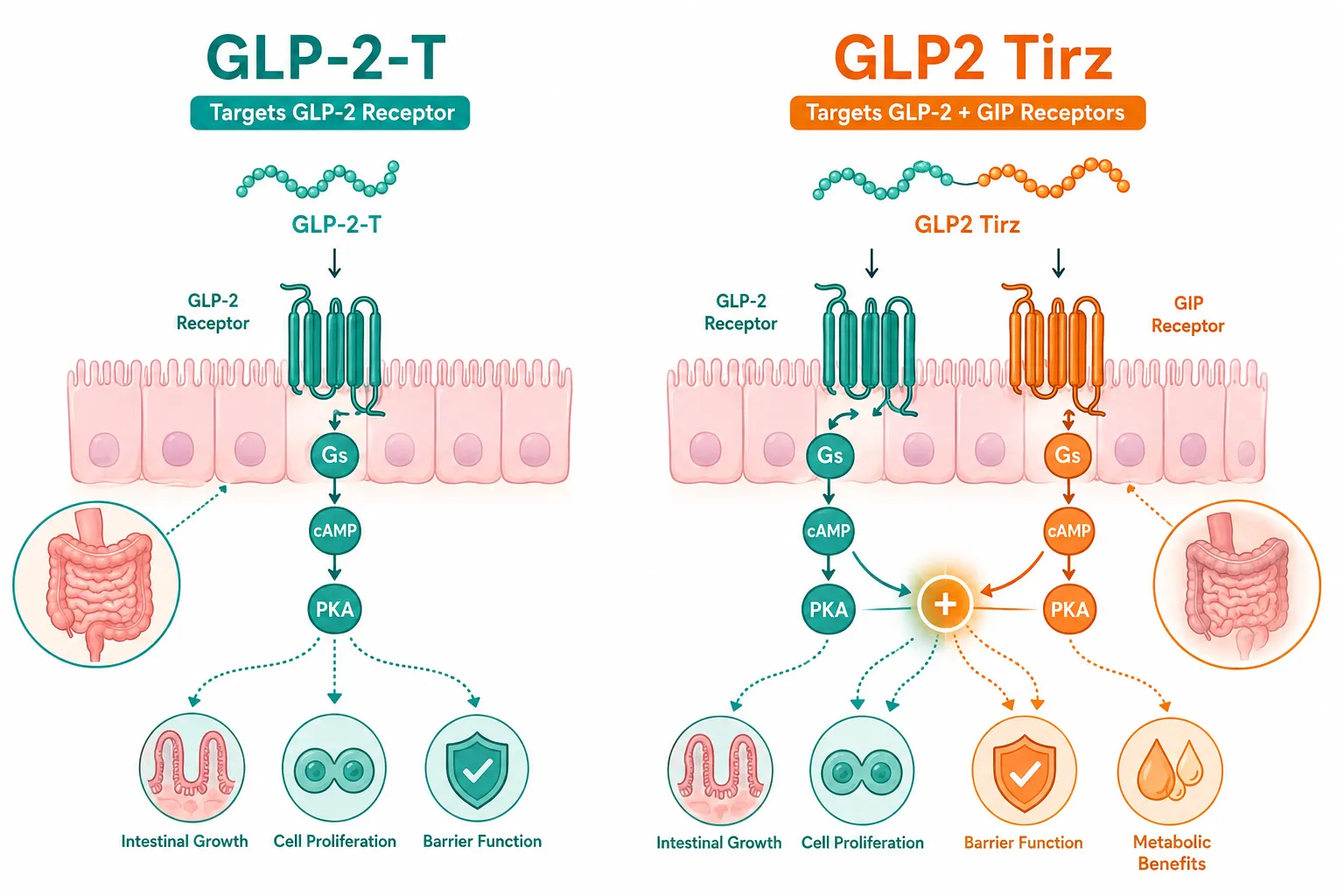
Split diagram comparing GLP-2-T and Tirzepatide molecular pathways

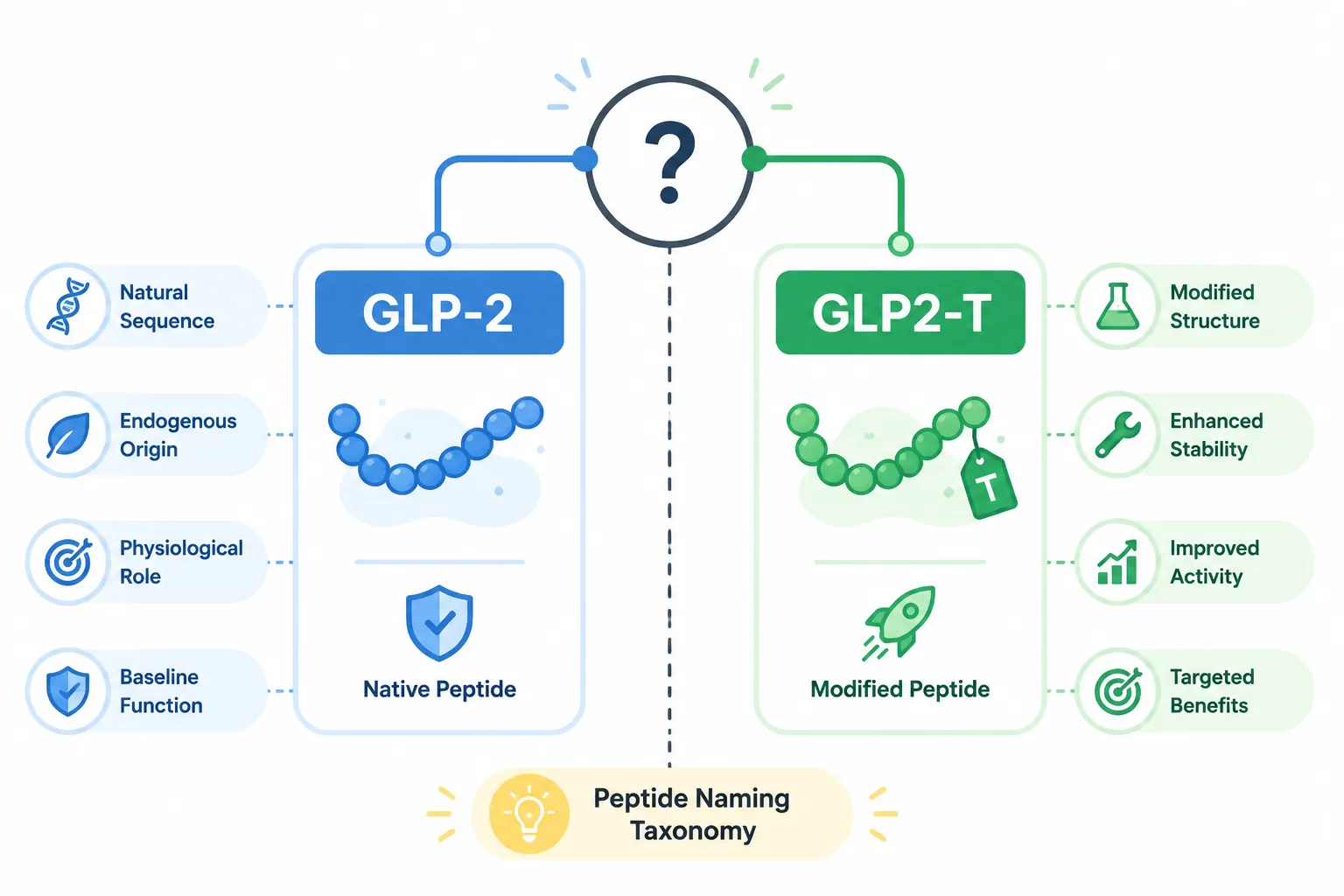
The confusion around GLP-2-T and GLP2 Tirz Peptides stems from an informal numbering convention that circulates in research blogs, supplement forums, and even some vendor catalogs. In this system, semaglutide is called "GLP-1," tirzepatide is called "GLP-2," and retatrutide is called "GLP-3." The logic follows the number of receptor targets each drug engages.

The problem: these numbers already belong to real, endogenous peptides.

  • GLP-1 (glucagon-like peptide-1): a well-characterized incretin hormone.
  • GLP-2 (glucagon-like peptide-2): a 33-amino acid hormone secreted by intestinal L-cells, primarily involved in gut mucosal growth and barrier function.
  • GLP-3: not a recognized endogenous hormone; "retatrutide" is its informal nickname, targeting GLP-1, GIP, and glucagon receptors.

The World Health Organization's International Nonproprietary Names system designates the generic name tirzepatide, with the stem "-tirz-" signaling its dual incretin activity. Calling tirzepatide "GLP-2 Tirz" blends an endogenous peptide name with a drug suffix, producing a label that implies receptor overlap where none exists.

For researchers exploring incretin-based metabolic research, the GLP-1-T incretin research themes page provides a useful parallel on how GLP-1 analogs are properly categorized. Similarly, the GLP-3 Reta research page illustrates how the triple-agonist space is being studied without conflating it with endogenous peptide families.


Mechanistic Differences: Two Compounds, Two Entirely Different Systems

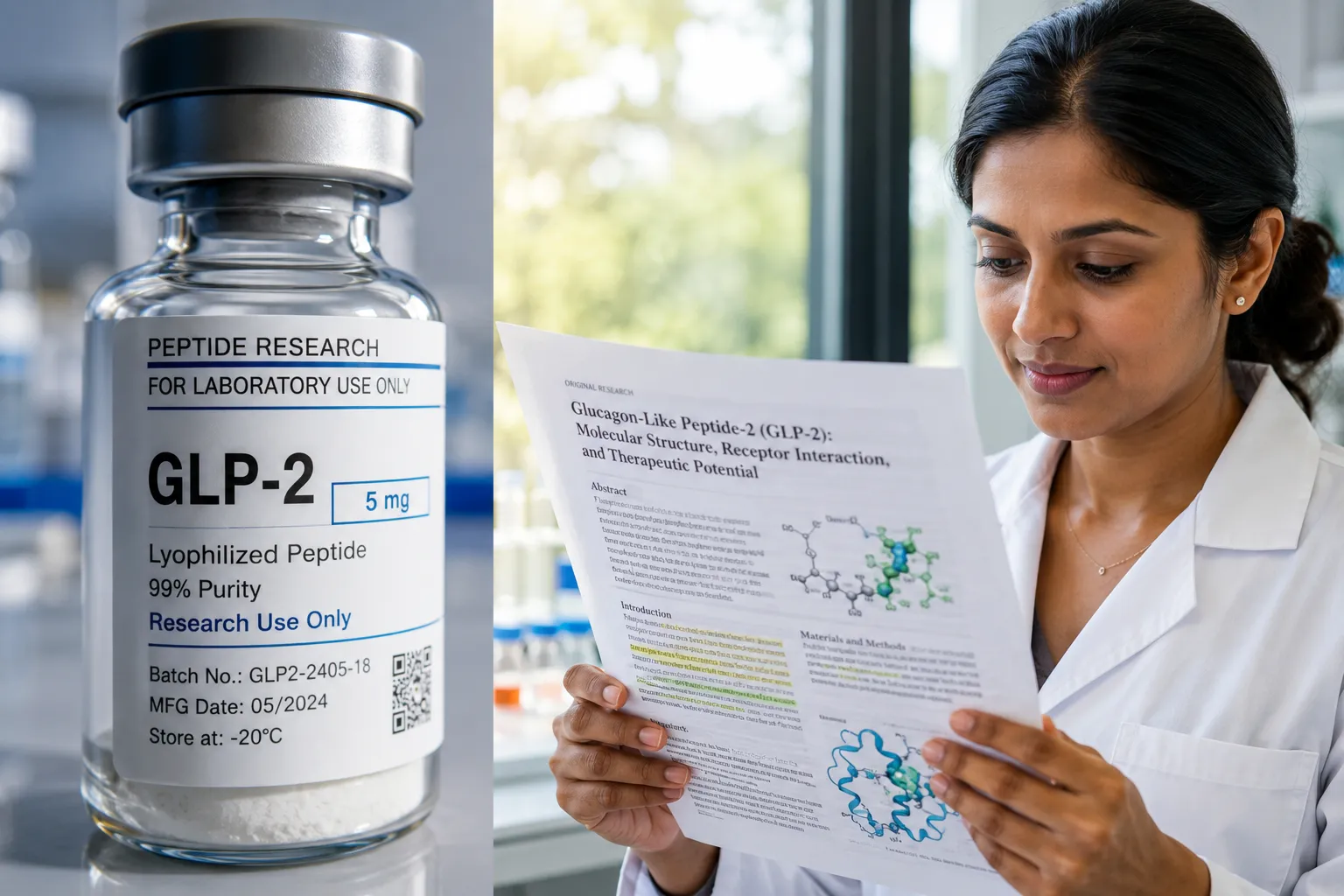
Researcher's lab bench with peptide vials and pathway research cards

The core issue in the GLP-2-T and GLP2 Tirz Peptides naming confusion is that these compounds act through fundamentally separate biological systems.

How GLP-2 and GLP-2-T Work

GLP-2 is co-released with GLP-1 from enteroendocrine L-cells after nutrient intake. Its primary roles include:

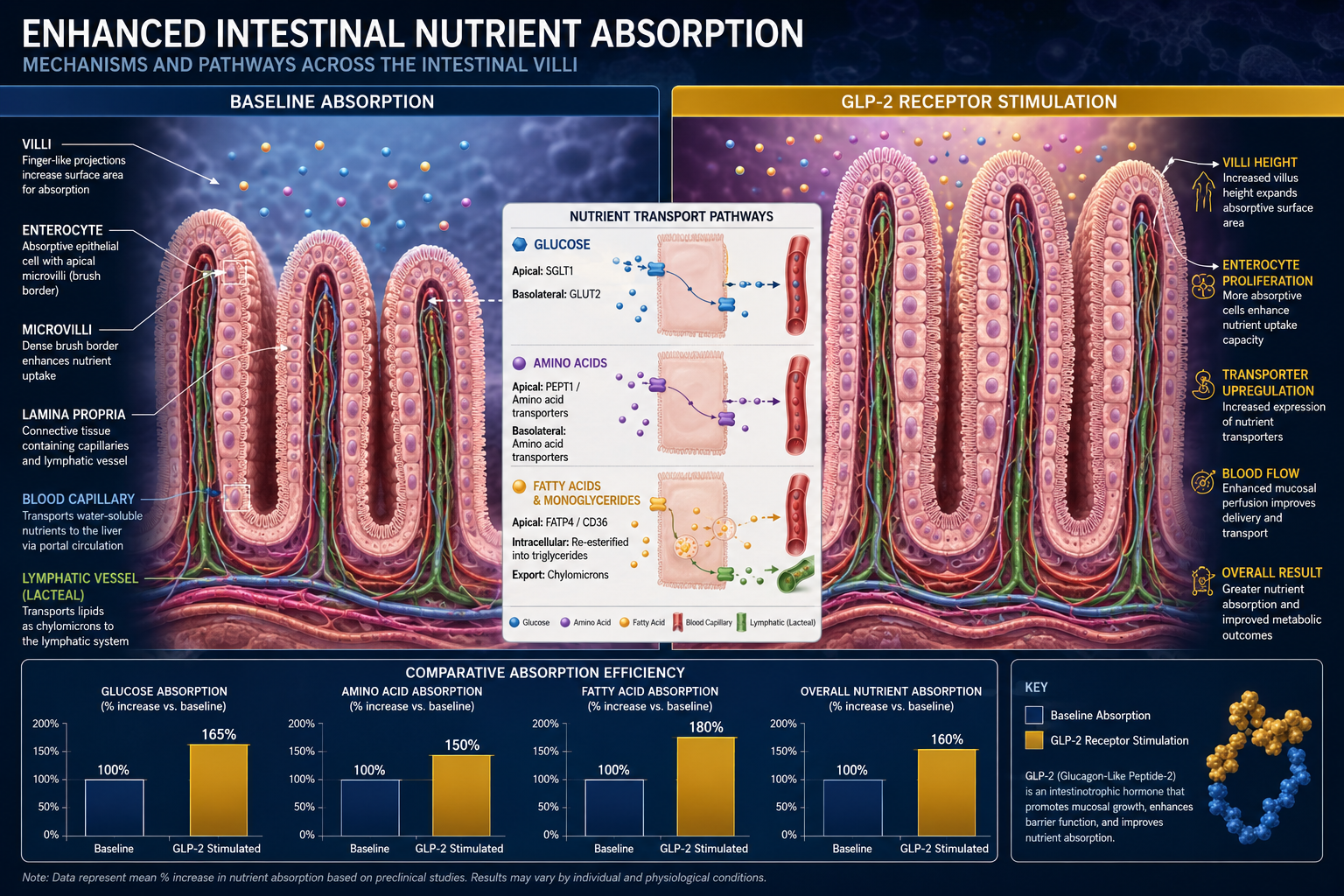
  • Promoting intestinal mucosal growth and villus elongation
  • Supporting tight junction regulation and gut barrier integrity
  • Modulating enteric nervous system signaling

Critically, the GLP-2 receptor is expressed in the enteric nervous system rather than directly on intestinal epithelial cells, which means GLP-2 acts through an indirect mechanism involving neural intermediaries.

GLP-2-T is a modified, stability-enhanced analog of this endogenous peptide. Its structural modifications extend its half-life, allowing researchers to study longer-lasting gut mucosal effects without repeated peptide dosing in experimental setups. This makes it a practical tool for intestinal barrier and villus growth models.

How Tirzepatide (Informally "GLP-2 Tirz") Works

Tirzepatide is a dual agonist at the GLP-1 receptor and the glucose-dependent insulinotropic polypeptide (GIP) receptor. Its research-relevant actions include:

  • Stimulating glucose-dependent insulin secretion
  • Suppressing appetite via central GLP-1 receptor pathways
  • Modulating fat metabolism through GIP receptor activity

Tirzepatide has no direct activity at the GLP-2 receptor. Placing it under a "GLP-2" label is therefore mechanistically misleading. Researchers interested in dual incretin signaling may also find value in reviewing cagrilintide synergy with GLP-1 to understand how complementary peptide combinations are studied in metabolic contexts.

Feature GLP-2-T Tirzepatide ("GLP-2 Tirz")
Receptor target GLP-2 receptor GLP-1 + GIP receptors
Primary system Intestinal/gut mucosal Metabolic/pancreatic
Research focus Gut barrier, villi growth Insulin secretion, appetite
Endogenous basis GLP-2 analog Synthetic dual agonist

Research Use Cases: Selecting the Right Compound

GLP-2-T research use cases infographic with four key application icons

Understanding GLP-2-T and GLP2 Tirz Peptides: Naming Confusion, Mechanistic Differences, and Research Use Cases becomes most practical when deciding which compound belongs in a specific experimental design.

GLP-2-T Research Applications

GLP-2-T is primarily examined in preclinical gut biology models for:

  1. Intestinal villi growth and maintenance, studying how mucosal architecture responds to GLP-2 receptor stimulation
  2. Gut barrier permeability models, examining tight junction proteins and paracellular transport
  3. Enteric nervous system signaling, probing how GLP-2 receptor activation translates into epithelial responses via neural intermediaries
  4. Metabolic gut hub research, because the gut functions as a metabolic signaling organ, GLP-2-T is increasingly discussed alongside metabolic peptides

Recent research directions have also explored long-acting GLP-2 analogs through lipidation strategies, which enhance half-life and gut-tropic efficacy in rodent models, a design principle that informs GLP-2-T's structural modifications.

For researchers building multi-peptide protocols, longevity peptide research and MOTS-C mechanism and research offer context on how gut-metabolic signaling intersects with broader longevity pathways.

Tirzepatide Research Applications

Tirzepatide is studied for:

  • Glucose homeostasis and beta-cell function models
  • Adipose tissue metabolism via GIP receptor pathways
  • Appetite regulation through central GLP-1 receptor mechanisms

These are entirely separate research domains from GLP-2-T's intestinal focus. Researchers who require verified, lab-tested compounds for either pathway should consult resources on peptide purity testing to ensure compound integrity before experimental use.

Key distinction: If the research question involves gut mucosal biology, tight junctions, or intestinal villi, GLP-2-T is the relevant compound. If the question involves insulin secretion, appetite, or dual incretin signaling, tirzepatide is the appropriate subject, and it should be referred to by its correct INN name.


Conclusion

The naming overlap between GLP-2-T and "GLP-2 Tirz" (tirzepatide) is not a minor stylistic issue, it represents a mechanistic mismatch that can send researchers down the wrong experimental path. GLP-2-T targets the GLP-2 receptor and serves gut mucosal biology research. Tirzepatide targets GLP-1 and GIP receptors and belongs to metabolic and incretin research. They share no receptor overlap, no shared biological system, and no interchangeable research applications.

Actionable next steps for researchers:

  • Use the WHO-designated INN name "tirzepatide" in all literature and protocols, not the informal "GLP-2 Tirz" label.
  • Confirm receptor targets before selecting a compound for any experimental model.
  • Cross-reference vendor catalogs against peer-reviewed receptor pharmacology data.
  • Explore the all peptides for sale resource for context on how research-grade peptides are classified and combined.
  • Review innovative peptide delivery systems for updates on stability-enhancing modifications relevant to GLP-2-T analog design.

Precise nomenclature is the foundation of reproducible science. Resolving this naming confusion is the first step toward cleaner experimental design and more reliable results.

https://www.puretestedpeptides.com/wp-content/uploads/2026/07/glp-2-t-and-glp2-tirz-peptides-naming-confusion-mechanistic-differences-and-rese-1.png 1024 1536 https://www.puretestedpeptides.com/wp-content/uploads/2026/01/buy-peptides-online.jpg 2026-07-13 13:18:122026-07-13 13:18:14GLP-2-T and GLP2 Tirz Peptides: Naming Confusion, Mechanistic Differences, and Research Use Cases
GLP-2-T vs GLP-2 Tirz: Gut Barrier Biology, Nutrient Absorption, and Naming Confusion in Research

GLP-2-T vs GLP-2 Tirz: Gut Barrier Biology, Nutrient Absorption, and Naming Confusion in Research

June 27, 2026/0 Comments/in Uncategorized/by

Researchers searching for information on GLP-2 gut biology in 2026 frequently land in the wrong place — not because the science is inaccessible, but because two very different compounds share dangerously similar shorthand labels. The debate around GLP-2-T vs GLP-2 Tirz: Gut Barrier Biology, Nutrient Absorption, and Naming Confusion in Research is less about advanced pharmacology and more about a fundamental labeling problem that derails literature searches and misguides early-stage research decisions.

Key Takeaways

  • GLP-2-T most commonly refers to teduglutide, a GLP-2 analog engineered for intestinal trophic effects.
  • GLP-2 Tirz is informal shorthand sometimes applied to tirzepatide's secondary GLP-2-like activity, though tirzepatide is primarily a GIP/GLP-1 dual agonist.
  • These two compounds act through different primary receptors and serve distinct research purposes.
  • Gut barrier integrity and nutrient absorption are central to GLP-2-T research; metabolic signaling is central to tirzepatide research.
  • Naming clarity is essential before selecting peptides for any gut-focused research protocol.

Understanding the Two Compounds at the Center of the Confusion

Understanding the Two Compounds at the Center of the Confusion

The shorthand "GLP-2-T" most reliably points to teduglutide, a 33-amino-acid GLP-2 analog developed specifically for its intestinotrophic properties. It was engineered by substituting alanine at position 2 with glycine, which protects it from rapid degradation by dipeptidyl peptidase-4 (DPP-4). This modification extends its half-life and amplifies its action at the GLP-2 receptor (GLP-2R), which is expressed primarily on intestinal subepithelial myofibroblasts and enteric neurons.

"GLP-2 Tirz," by contrast, is informal community shorthand sometimes applied to tirzepatide when discussing its reported secondary effects on intestinal function. Tirzepatide is a dual GIP receptor and GLP-1 receptor agonist. It does not act primarily through the GLP-2 receptor. Any GLP-2-like intestinal effects observed in tirzepatide research are likely downstream or indirect, not receptor-mediated in the same way as teduglutide.

Feature GLP-2-T (Teduglutide) GLP-2 Tirz (Tirzepatide context)
Primary receptor target GLP-2R GIP-R / GLP-1R
Structural basis GLP-2 analog GIP/GLP-1 hybrid peptide
Primary research focus Gut barrier, intestinal growth Metabolic regulation, body weight
DPP-4 resistance Yes (engineered) Yes (fatty acid conjugation)
GLP-2R direct agonism Direct Not established

For researchers exploring multi-pathway peptide biology, the GIP receptor and its importance provides useful context on how GIP-axis signaling intersects with gut and metabolic function.


Gut Barrier Biology and Nutrient Absorption in GLP-2-T vs GLP-2 Tirz Research

Gut Barrier Biology and Nutrient Absorption in GLP-2-T vs GLP-2 Tirz Research

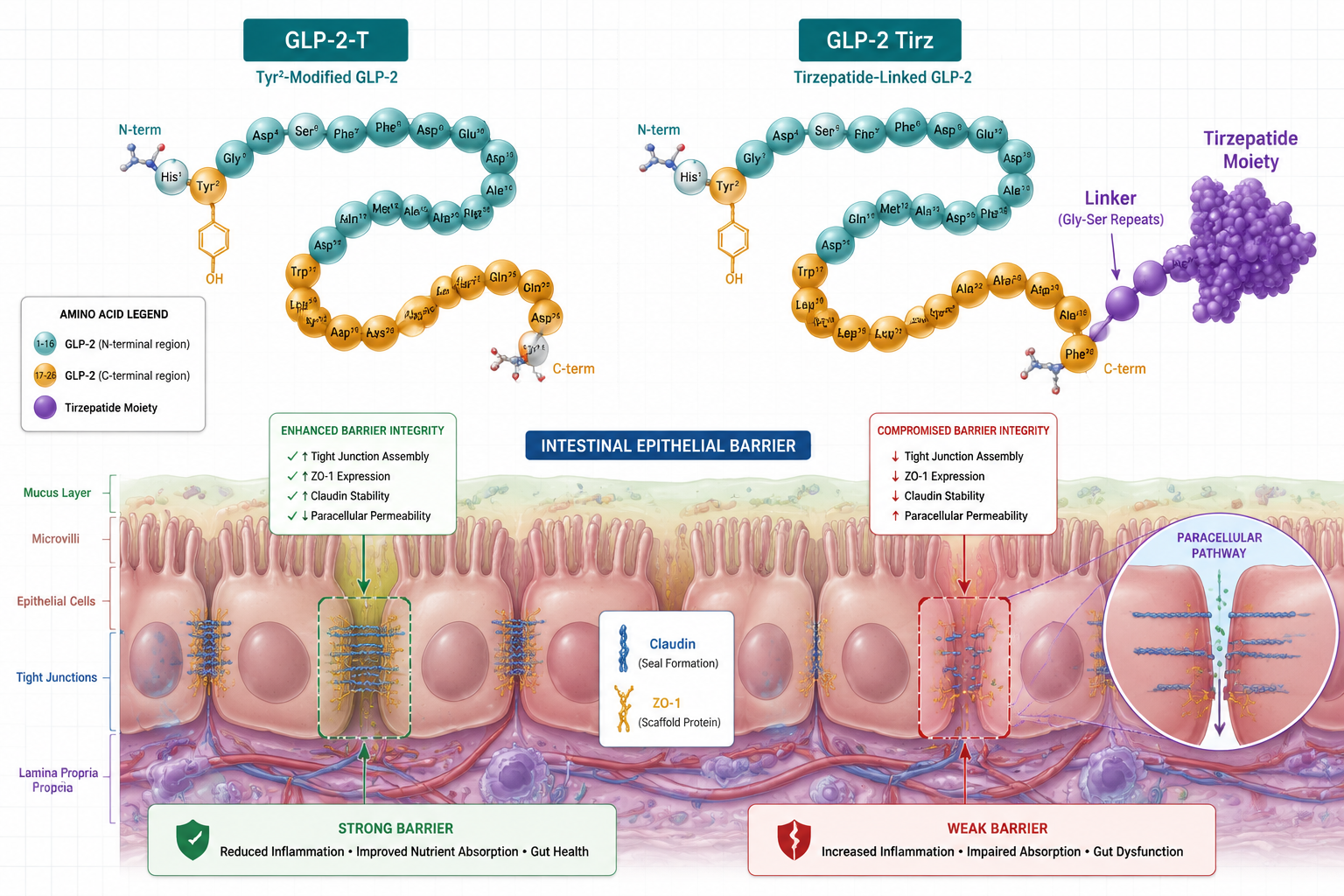
The gut barrier is a single-cell-thick layer of enterocytes held together by tight junction proteins including claudin, occludin, and ZO-1. When this barrier is compromised, luminal antigens and bacteria translocate into systemic circulation — a process linked to inflammatory and metabolic disease.

GLP-2-T (teduglutide) has a well-characterized mechanism for supporting this barrier. Activation of GLP-2R on subepithelial myofibroblasts triggers release of growth factors including keratinocyte growth factor (KGF) and insulin-like growth factor-1 (IGF-1). These promote:

  • Crypt cell proliferation and villus elongation
  • Increased tight junction protein expression
  • Enhanced mucosal blood flow
  • Reduced intestinal permeability

This makes teduglutide one of the most direct tools in gut barrier research. Its effects on nutrient absorption are a direct consequence: longer villi mean greater absorptive surface area.

Tirzepatide's relationship with gut barrier biology is less direct. GLP-1 receptor agonism is known to slow gastric emptying and modulate intestinal motility, which can influence nutrient absorption timing. Some preclinical data suggest GLP-1 signaling may have modest barrier-supportive effects, but these are not equivalent to direct GLP-2R activation.

Researchers working on gut-healing peptide combinations may also find the BPC-157 research themes relevant, as BPC-157 has been studied for its own effects on mucosal integrity through separate mechanisms. Similarly, BPC-157 and TB-500 combination research explores complementary tissue repair pathways.


Resolving the Naming Confusion in GLP-2-T vs GLP-2 Tirz Research

Resolving the Naming Confusion in GLP-2-T vs GLP-2 Tirz Research

The naming confusion in GLP-2-T vs GLP-2 Tirz: Gut Barrier Biology, Nutrient Absorption, and Naming Confusion in Research stems from three overlapping problems:

  1. Abbreviation collision — "GLP-2-T" is used for teduglutide in clinical literature but occasionally appears as shorthand for "GLP-2 component of tirzepatide" in community forums.
  2. Receptor family conflation — GLP-1, GLP-2, and GIP are all incretin-related peptides, making cross-labeling common among non-specialist readers.
  3. Secondary effects misattributed as primary mechanisms — When tirzepatide produces gut-related outcomes, some researchers incorrectly attribute this to GLP-2 receptor activity.

A practical rule: if a study is examining intestinal villus height, crypt depth, tight junction protein expression, or short bowel syndrome models, it is almost certainly using GLP-2-T (teduglutide). If the study examines insulin secretion, body weight, or lipid metabolism, the compound is more likely tirzepatide or a GLP-1/GIP agonist.

For broader context on how multi-receptor peptide compounds are categorized, the GLP-1 peptides product tag and the GLP-3 / retatrutide research page offer useful comparative framing. Researchers interested in how innovative delivery systems affect peptide receptor selectivity may also benefit from reviewing innovative peptide delivery systems.


Conclusion

The confusion surrounding GLP-2-T vs GLP-2 Tirz: Gut Barrier Biology, Nutrient Absorption, and Naming Confusion in Research is solvable with precise language. Teduglutide (GLP-2-T) is a direct GLP-2 receptor agonist with established research applications in gut barrier biology and nutrient absorption. Tirzepatide, regardless of informal "GLP-2 Tirz" labeling, is a GIP/GLP-1 dual agonist with metabolic rather than intestinotrophic primary mechanisms.

Actionable next steps for researchers:

  • Always verify the receptor target before selecting a compound for gut-focused protocols.
  • Cross-reference abbreviations against the compound's structural class, not just its name.
  • When reviewing community discussions, treat "GLP-2 Tirz" as an informal label that requires verification against primary literature.
  • Consult verified sourcing platforms that provide certificates of analysis to confirm compound identity before any research use, such as those found at quality testing protocols.

Naming precision is not a minor detail in peptide research — it is the foundation on which valid experimental design is built.


References

  • Jeppesen, P. B., et al. (2012). Teduglutide reduces need for parenteral support among patients with short bowel syndrome with intestinal failure. Gastroenterology, 143(6), 1473-1481.
  • Drucker, D. J. (2002). Biological actions and therapeutic potential of the glucagon-like peptides. Gastroenterology, 122(2), 531-544.
  • Frampton, J. E. (2012). Teduglutide: a review of its use in the management of short bowel syndrome. Drugs, 72(9), 1209-1220.
  • Frias, J. P., et al. (2021). Tirzepatide versus semaglutide once weekly in patients with type 2 diabetes. New England Journal of Medicine, 385(6), 503-515.
  • Cani, P. D., et al. (2009). Changes in gut microbiota control inflammation in obese mice through a mechanism involving GLP-2-driven improvement of gut permeability. Gut, 58(8), 1091-1103.
https://www.puretestedpeptides.com/wp-content/uploads/2026/06/GLP-2-T-vs-GLP-2-Tirz-Gut-Barrier-Biology-Nutrient-Absorption-and-Naming-Confusion-in-Research.png 1024 1536 https://www.puretestedpeptides.com/wp-content/uploads/2026/01/buy-peptides-online.jpg 2026-06-27 13:04:342026-06-27 13:04:34GLP-2-T vs GLP-2 Tirz: Gut Barrier Biology, Nutrient Absorption, and Naming Confusion in Research
What Is the GLP3 Peptide? Research Distinctions, Naming Confusion, and How It Relates to Retatrutide

What Is the GLP3 Peptide? Research Distinctions, Naming Confusion, and How It Relates to Retatrutide

June 10, 2026/0 Comments/in Uncategorized/by

A single informal label is causing genuine confusion across research communities, patient forums, and peptide catalogs in 2026: "GLP-3." Researchers searching for this term are often looking for something very different from what the name implies. Understanding what the GLP-3 peptide actually refers to — and why that label is scientifically inaccurate — matters for anyone tracking the latest developments in metabolic research.

Key Takeaways

  • There is no hormone called "GLP-3." The term is an informal nickname, not a recognized scientific designation.
  • "GLP-3" almost always refers to retatrutide (LY3437943), a triple-agonist investigational compound developed by Eli Lilly.
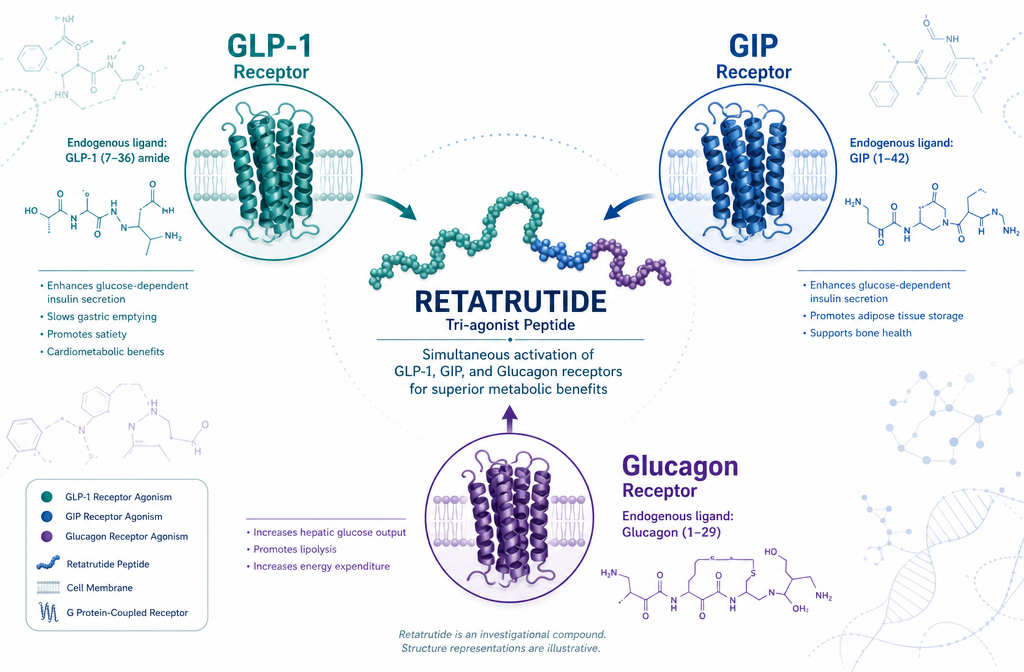
  • Retatrutide simultaneously targets three receptors: GLP-1, GIP, and glucagon.
  • Phase 3 trial data shows approximately 28% average weight loss over 18 months — results comparable to bariatric surgery.
  • As of 2026, retatrutide is not FDA-approved and remains under active clinical investigation.

Key Takeaways

Understanding the Naming Confusion Around "GLP-3"

The phrase "GLP-3 peptide" does not correspond to any recognized hormone in human physiology. The glucagon-like peptide family includes GLP-1 and GLP-2, both derived from the proglucagon gene. GLP-1 is well-established for its role in insulin secretion and appetite regulation. GLP-2 supports intestinal growth. No GLP-3 exists in the official scientific literature.

So where does the term come from? It appears to have emerged organically from online communities and informal research discussions as shorthand for retatrutide — a compound that acts on three separate receptor pathways. The logic is loose: "triple action" became "GLP-3" in casual usage. The label stuck, even though it misrepresents the compound's actual mechanism.

This kind of naming drift is not unusual in peptide research. For a broader look at how terminology evolves in this field, the ultimate guide to peptide therapy provides useful context on how compounds are classified and discussed.


What Is the GLP3 Peptide? Research Distinctions, Naming Confusion, and How It Relates to Retatrutide — The Core Answer

Retatrutide (development code LY3437943) is the compound most commonly referenced when someone asks about the "GLP-3 peptide." It is an investigational drug developed by Eli Lilly that activates three distinct hormone receptors simultaneously:

Receptor Primary Research Function
GLP-1 Reduces appetite, slows gastric emptying
GIP Improves insulin sensitivity, supports fat distribution
Glucagon Increases energy expenditure, promotes fat breakdown via thermogenesis

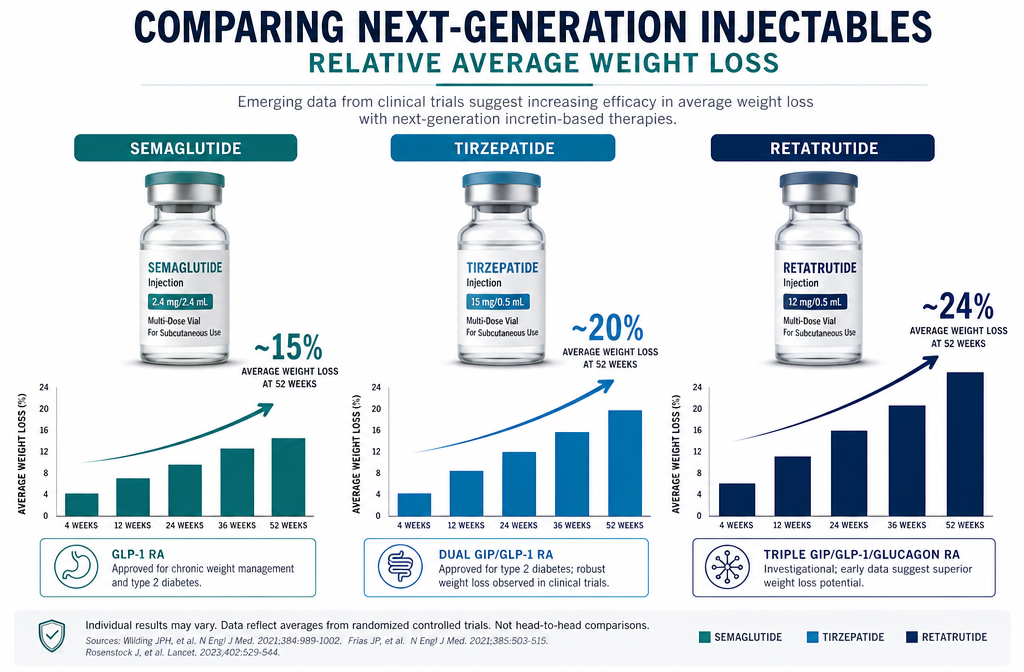
This triple-agonist profile is what separates retatrutide from earlier-generation compounds. Semaglutide targets GLP-1 alone. Tirzepatide targets GLP-1 and GIP. Retatrutide adds glucagon receptor activation on top of both, creating a broader metabolic effect.

For researchers already familiar with the GLP-1 peptide research landscape, retatrutide represents a meaningful step forward in receptor-targeting strategy. Those planning research with this compound should also review GLP-3 triple agonist research planning resources before sourcing.


What Is the GLP3 Peptide? Research Distinctions, Naming Confusion, and How It Relates to Retatrutide — The Core Answer

Phase 3 Data and Regulatory Status in 2026

The clinical results for retatrutide are among the most discussed in metabolic medicine this year. In Phase 3 trials, participants achieved an average weight loss of approximately 28% over 18 months — a figure that rivals outcomes typically seen with bariatric surgery. No other injectable medication has produced comparable numbers in trial data to date.

"Retatrutide's Phase 3 results represent the highest weight loss figures recorded for any injectable medication in clinical trials."

Despite these results, retatrutide is not FDA-approved as of 2026. Eli Lilly anticipates filing for FDA approval in 2026–2027, with potential commercial availability projected for late 2027 or 2028, contingent on successful trial completion and regulatory review.

Beyond weight loss, researchers are examining retatrutide's potential influence on type 2 diabetes, cardiovascular risk factors, and metabolic liver disease. The GIP receptor and its importance in metabolic signaling provides additional background on one of the three pathways retatrutide engages.


What Is the GLP3 Peptide? Research Distinctions, Naming Confusion, and How It Relates to Retatrutide — Practical Implications for Researchers

For researchers navigating this space, the terminology distinction has real consequences. Searching for "GLP-3 peptide" may return inconsistent results across databases, catalogs, and literature because the label is not standardized. Using the correct terminology — triple agonist, GLP-1/GIP/glucagon receptor agonist, or retatrutide/LY3437943 — will yield more reliable and reproducible search results.

Retatrutide is administered as a once-weekly subcutaneous injection, a delivery format consistent with other compounds in the GLP-1 class. Researchers interested in innovative peptide delivery systems will find the subcutaneous format familiar, though the triple-receptor profile introduces unique considerations for study design.

Those tracking the broader metabolic peptide landscape may also find value in reviewing AOD-9604 metabolic research and SLU-PP-332 metabolic research themes for comparative context on fat metabolism pathways.


What Is the GLP3 Peptide? Research Distinctions, Naming Confusion, and How It Relates to Retatrutide — Practical Implications

Conclusion

The "GLP-3 peptide" is not a real hormone — it is a widely circulated misnomer for retatrutide, a triple-agonist compound targeting GLP-1, GIP, and glucagon receptors. Clarifying this distinction is essential for accurate research planning, catalog navigation, and literature review.

Actionable next steps for researchers:

  • Use "retatrutide," "LY3437943," or "triple agonist" in database and catalog searches instead of "GLP-3."
  • Review the GIP receptor pathway alongside GLP-1 mechanisms before designing studies.
  • Monitor FDA filing updates from Eli Lilly, expected in the 2026–2027 window.
  • Consult what is new in peptide research for ongoing developments in this fast-moving field.

Precise terminology is not a minor detail in peptide research — it directly affects sourcing accuracy, study reproducibility, and regulatory compliance awareness.

https://www.puretestedpeptides.com/wp-content/uploads/2026/06/What-Is-the-GLP3-Peptide-Research-Distinctions-Naming-Confusion-and-How-It-Relates-to-Retatrutide.png 672 1024 https://www.puretestedpeptides.com/wp-content/uploads/2026/01/buy-peptides-online.jpg 2026-06-10 13:06:532026-06-10 13:06:53What Is the GLP3 Peptide? Research Distinctions, Naming Confusion, and How It Relates to Retatrutide
×

Helpful Links

  • My account
  • Cart
  • Checkout
  • Refund and Returns Policy
  • Privacy Policy
  • SMS Privacy Policy
  • Login
  • My Account
  • Logout

USA Made Lab Tested Peptides

All products are sold for research, laboratory, or analytical purposes only, and are not for human consumption


Pure Tested Peptides is a chemical supplier. Pure Tested Peptides is not a compounding / chemical compounding facility as defined under 503A of the Federal Food, Drug, and Cosmetic act. Pure Tested Peptides is not an outsourcing facility as defined under 503B of the Federal Food, Drug, and Cosmetic act.

The statements made within this website have not been evaluated by the US Food and Drug Administration. The products we offer are not intended to diagnose, treat, cure or prevent any disease.

Human/Animal Consumption Prohibited. Laboratory/In-Vitro Experimental Use Only

Scroll to top Scroll to top Scroll to top