Call or Text 727-513-9780
  • Shopping Cart Shopping Cart
    0Shopping Cart
Pure Tested Peptides | America's most trusted Peptides for sale online
  • Peptides for sale
    • Oral Peptides for sale
      • Peptide Capsules for sale
      • BPC 157 Capsules 1000mcg
      • SLU-PP-332 Capsules | 1000 mcg
      • 5-Amino-1MQ 50mg Capsules
      • Tesofensine 500mcg
    • All Peptides for sale
    • Peptide Sprays
      • BPC 157 Nasal Spray Kit
      • BPC-157 TB500 Nasal Spray Kit
      • Semax Nasal Spray 10mg
      • Selank – Nasal Spray Kit – 10mg
      • Epithalon 50MG Nasal Spray Kit
      • Ipamorelin 10mg Nasal Spray
      • Klow Nasal Spray (BPC-157 + TB-500 + GHK-Cu + KPV) | 80mg
      • Hulk Nasal Spray Tesa / Ipa Blend 6/3 MG
      • Klow Nasal Spray
      • NAD + 500 mg Nasal Spray
      • PT-141 Nasal Spray Kit
    • GHRH Peptides
      • Ipa Peptides
      • CJC-1295 Peptides
        • CJC-1295 with DAC 5 mg
        • CJC-1295 without DAC 5 mg
        • CJC-1295 Ipa 10mg
      • Tesa Peptides
        • Tesa Peptide
        • Tesa 20 mg
    • GHK-Cu Peptides
      • All GHK-Cu Peptides
      • GHK-Cu 100mg
      • KLOW Peptide Blend – Buy KLOW blend online
    • BPC Peptides
      • All BPC Peptides
      • BPC-157
      • BPC-157 TB-500
      • BPC 157 capsules 1000mcg
    • SLU-PP-332 Peptides
      • All SLU-PP-332 Peptides
      • SLU-PP-332 5mg
    • GLP3 Peptides
    • PT-141 Peptides
      • PT-141 Peptides for sale
      • PT-141 10mg
      • PT-141 Nasal Spray
    • CAG Peptides
      • Lipo-C Peptide Blend
      • CAG 5mg
      • CAG 10mg
    • MOTS-C Peptides
      • MOTS-C Peptides for sale
      • MOTS-c peptide
      • MOTS-c 10mg *6 pack*
    • 5 Amino 1MQ Peptides
      • 5 Amino 1MQ Peptides for sale
      • 5-Amino-1MQ 50mg Capsules
      • 5-Amino-1MQ 5mg
    • Epithalon Peptides
      • Epithalon Peptides for sale
      • Epithalon 10mg
      • Epithalon 50mg
  • Shop
    • GLPs
      • 5-Amino-1MQ 50mg Capsules
      • 5-Amino-1MQ 5mg
      • L-Carnitine 500mg/ml
      • Tesofensine 500mcg
      • SLU-PP-332 5mg
      • MOTS-c 10mg *6 pack*
    • Epithalon & BPC Peptides
      • Epithalon 10mg
      • Epithalon 50mg
      • BPC-157
      • BPC 157 capsules 1000mcg
      • BPC-157 TB-500
      • BPC-157 TB500 Nasal Spray Kit
      • BPC 157 Nasal Spray Kit
    • BPC TB-500 & NAD+ Peptides
      • NAD+ 500 mg
      • KLOW Peptide Blend – Buy KLOW blend online
      • GLOW Peptide Blend
      • TB 500 5mg
      • BPC 157 capsules 1000mcg – Supplement
      • BPC 157 Nasal Spray Kit
      • BPC-157
      • BPC-157 TB500 Nasal Spray Kit
      • BPC-157 TB-500
      • BPC 157 capsules 1000mcg
    • LL-37 Peptide
      • LL-37 10 mg
    • MOTS-C & Selank
      • MOTS-c peptide
      • Selank 10mg
    • GHK Peptides
      • GHK-Cu 100mg
      • GLOW Peptide Blend
      • KLOW Peptide Blend – Buy KLOW blend online
  • COAs
  • Wholesale
    • Wholesale Peptides for sale
  • PTP FAQ
  • Affiliates
    • Selank Peptide: Advanced Pharmacological Mechanisms Underlying Its Anxiolytic and Nootropic Effects in Research
      • 5-Amino-1MQ Peptide: Detailed Mechanisms of NNMT Inhibition and Its Impact on Cellular Metabolism Research
        • MOTS-C Peptide: Unraveling Its Role in Mitochondrial Dynamics and Energy Metabolism Research
          • Epithalon Peptide and Telomerase Regulation: Investigating Its Impact on Cellular Senescence and Lifespan Research Models
            • GLP2-T vs GLP2 Tirz Peptide: Understanding the Naming, Mechanistic Nuances, and Research Implications for Gut Health
      • Peptides and Polypeptides in Modern Pharmacology: What Research on Metoprolol, Prednisone, and Amlodipine Reveals
        • Polypeptide Peptides vs NSAIDs: What Naproxen and Diclofenac Teach Tissue-Repair Researchers About BPC‑157 and TB‑500
          • Peptides and Polypeptides in Endocrine Pharmacology: How GLP-1, GLP-2, and GLP-3 Retatrutide Differ From Classic Drugs Like Prednisone and Amlodipine
          • 5‑Amino‑1MQ Peptide and NNMT Inhibition: How It Compares With Statins Like Atorvastatin in Adipose and Lipid Metabolism Research
      • Enclomiphene, Estrogen Receptor Signaling, and Luteinizing Phase Biology: What Hormone Researchers Should Measure
        • Mesenchymal Stem Cells, BPC‑157, and GHK‑Cu: How Tissue Repair Peptides Compare With Classic NSAIDs Like Naproxen in Injury Models
          • Peptide Calculator Use Cases Beyond Growth Hormone: Working Through GLP‑3 Retatrutide, MOTS‑c, and BPC‑157 Research Dosing
        • Polypeptide Peptides in Endocrine and Metabolic Pharmacology: Lessons From Amlodipine, Prednisone, and Metoprolol
        • Peptides Calculator for Advanced Blends: Worked Examples for Tesamorelin, CJC‑1295, and Ipamorelin Stacks
          • Peptides and Polypeptides in Human Physiology: How Molecular Size Shapes Research Applications
            • Selank Peptide: Advanced Pharmacological Mechanisms Underlying Its Anxiolytic and Nootropic Effects in Research
          • 5-Amino-1MQ Peptide: Detailed Mechanisms of NNMT Inhibition and Its Impact on Cellular Metabolism Research
            • MOTS-C Peptide: Unraveling Its Role in Mitochondrial Dynamics and Energy Metabolism Research
              • Epithalon Peptide and Telomerase Regulation: Investigating Its Impact on Cellular Senescence and Lifespan Research Models
                • GLP2-T vs GLP2 Tirz Peptide: Understanding the Naming, Mechanistic Nuances, and Research Implications for Gut Health
                  • Peptides and Polypeptides in Endocrine Pharmacology: How GLP-1, GLP-2, and GLP-3 Retatrutide Differ From Classic Drugs Like Prednisone and Amlodipine
                    • Polypeptide Peptides vs NSAIDs: What Naproxen and Diclofenac Teach Tissue-Repair Researchers About BPC‑157 and TB‑500
                      • Peptides and Polypeptides in Modern Pharmacology: What Research on Metoprolol, Prednisone, and Amlodipine Reveals
                        • 5‑Amino‑1MQ Peptide and NNMT Inhibition: How It Compares With Statins Like Atorvastatin in Adipose and Lipid Metabolism Research
                        • Enclomiphene, Estrogen Receptor Signaling, and Luteinizing Phase Biology: What Hormone Researchers Should Measure
                        • Mesenchymal Stem Cells, BPC‑157, and GHK‑Cu: How Tissue Repair Peptides Compare With Classic NSAIDs Like Naproxen in Injury Models
                        • Peptide Calculator Use Cases Beyond Growth Hormone: Working Through GLP‑3 Retatrutide, MOTS‑c, and BPC‑157 Research Dosing
                        • Polypeptide Peptides in Endocrine and Metabolic Pharmacology: Lessons From Amlodipine, Prednisone, and Metoprolol
                        • Peptides Calculator for Advanced Blends: Worked Examples for Tesamorelin, CJC‑1295, and Ipamorelin Stacks
                        • Peptides and Polypeptides in Human Physiology: How Molecular Size Shapes Research Applications
                        • Selank Peptide: Advanced Pharmacological Mechanisms Underlying Its Anxiolytic and Nootropic Effects in Research
                        • MOTS-C Peptide: Unraveling Its Role in Mitochondrial Dynamics and Energy Metabolism Research
                        • Peptides and Polypeptides in Modern Pharmacology: What Research on Metoprolol, Prednisone, and Amlodipine Reveals
                        • Peptides and Polypeptides in Endocrine Pharmacology: How GLP-1, GLP-2, and GLP-3 Retatrutide Differ From Classic Drugs Like Prednisone and Amlodipine
                        • 5-Amino-1MQ Peptide: Detailed Mechanisms of NNMT Inhibition and Its Impact on Cellular Metabolism Research
                        • Mesenchymal Stem Cells, BPC‑157, and GHK‑Cu: How Tissue Repair Peptides Compare With Classic NSAIDs Like Naproxen in Injury Models
                        • Peptide Calculator Use Cases Beyond Growth Hormone: Working Through GLP‑3 Retatrutide, MOTS‑c, and BPC‑157 Research Dosing
                        • GLP2-T vs GLP2 Tirz Peptide: Understanding the Naming, Mechanistic Nuances, and Research Implications for Gut Health
                        • Polypeptide Peptides in Endocrine and Metabolic Pharmacology: Lessons From Amlodipine, Prednisone, and Metoprolol
                        • Polypeptide Peptides vs NSAIDs: What Naproxen and Diclofenac Teach Tissue-Repair Researchers About BPC‑157 and TB‑500
                        • Peptides and Polypeptides in Human Physiology: How Molecular Size Shapes Research Applications
                        • Peptides Calculator for Advanced Blends: Worked Examples for Tesamorelin, CJC‑1295, and Ipamorelin Stacks
                        • 5‑Amino‑1MQ Peptide and NNMT Inhibition: How It Compares With Statins Like Atorvastatin in Adipose and Lipid Metabolism Research
                        • Enclomiphene, Estrogen Receptor Signaling, and Luteinizing Phase Biology: What Hormone Researchers Should Measure
                        • Epithalon Peptide and Telomerase Regulation: Investigating Its Impact on Cellular Senescence and Lifespan Research Models
                        • Best research protocol Klow blend
                        • best time to take BPC-157
                        • best time to take DSIP (Delta Sleep Inducing Peptide)
                        • best time to take CJC-1295
                        • best time to take AOD-9604
                        • best time to take Follistatin 344
                        • best time to take Ipamorelin
                        • best time to take MK-677 (Ibutamoren)
                        • best time to take Ligandrol (LGD-4033) — research compound
                        • best time to take Ostarine (MK-2866) — research compound
                        • best time to take GHK-CU
                        • best time to take TB-500
                        • best time to take MOTS-c
                        • best time to take Semax
                        • best time to take RAD-140 (Testolone) — research compound
                        • best time to take Thymosin Alpha-1
                        • best time to take PEG-MGF
                        • Biolife Plasma, Octapharma Plasma, and Research Peptides: How Plasma Donation Labs Differ From Peptide Suppliers
                        • best time to take YK-11 — research compound
                        • best time to take PT-141 (Bremelanotide)
                        • Best research protocol Klow blend
                        • 5-Amino-1MQ and MOTS-C Synergy: Metabolic Signaling, Mitochondria, and Research Design
                        • BPC-157 and TB-500: Investigating Their Combined Effects on Angiogenesis and Cellular Migration in Tissue Repair Models
                        • BPC-157 Peptide: Gut Barrier Function, Inflammation, and Tissue-Recovery Research
                        • 5‑Amino‑1MQ and MOTS‑c Synergy in Metabolic Research: Designing NNMT and Mitochondrial Biogenesis Stacks
                        • CJC-1295 with DAC vs. Without DAC: Half-Life, Release Kinetics, and Research Implications
                        • CJC‑1295 with DAC vs. Without DAC: Expanding on Half‑Life Differences Using Tesamorelin and Ipamorelin Blend Case Studies
                        • Collagen Biology and Copper‑Binding Peptides: How GHK‑Cu, Glow Blend, and Klow Blend Interact with Skin and Connective Tissue
                        • Collagen Biology and Regenerative Peptides: How GHK‑Cu, Glow Blend, and Klow Blend Affect Extracellular Matrix Research
                    • DNA, Telomeres, and Longevity Peptides: Positioning Epithalon and MOTS‑c in Genetic Aging Research
                      • Enclomiphene Citrate: serm Mechanism, Testosterone Research, and Stack Compatibility
                        • Enclomiphene vs Enclomiphene Citrate: Formulation, Bioavailability, and Research Distinctions
                        • Epithalon Peptide Research: Telomerase Activation, Aging, and Pineal Gland Function
                        • Estrogen Receptor Signaling and Enclomiphene: How Selective Modulators Compare with Classic Polypeptide Hormones
                        • GHK-Cu Peptide: Advanced Mechanisms in Extracellular Matrix Remodeling and Wound Healing Research
                        • GHK-Cu Peptide: Collagen Synthesis, Wound Repair, and Skin-Barrier Research Models
                        • GLP-1 vs GLP-3 vs GLP-2: Peptide Classification and Research Applications
                        • GLP-2 Peptide Research Guide: Gut Barrier Function, Nutrient Absorption, and Intestinal Recovery Models
                        • GLP-3 Retatrutide vs. GLP-1 Drugs: What Triple-Agonist Biology Changes in Research Models
                        • Ipamorelin and Tesamorelin Combination: Synergistic GH Secretagogue Research and Dosing Protocols
                        • GLP2 Tirz Peptide: What It Is, Why the Name Exists, and How Researchers Should Interpret It
                        • Klow Blend Peptide Nasal Spray: What the Formulation Is Trying to Do in Cognitive Research
                        • Mitochondria, NNMT Inhibition, and Peptide Modulators: Where MOTS‑c and 5‑Amino‑1MQ Fit in Cellular Energy Research
                        • MOTS-c Peptide: Mitochondrial Function, Energy Metabolism, and What Researchers Measure
                        • MOTS-c vs. 5-Amino-1MQ: Which Metabolic Research Questions Each Compound Actually Answers
                        • Nasal Spray Peptides: Bioavailability, Administration, and Semax/Selank Research Applications
                        • PT-141 Peptide Research: Mechanism of Action and Melanocortin Receptor Signaling
                        • Retatrutide for Research: Mechanism, Structure, and GLP-1/GLP-3 Dual Action
                        • Retatrutide for Obesity and Type 2 Diabetes: What the Latest Trial Data Suggest
                        • Tesofensine Peptide Research: Mechanism, Appetite Suppression, and Neuropeptide Y Pathways
  • Contact
    • Contact Customer Service
    • Text Customer Support
  • About US
  • Shop all peptides
  • Affiliate Program
    • Affiliate Signup
  • Login / Register Login / Register Page Link Login / Register Page Link
  • Click to open the search input field Click to open the search input field Search
  • Menu Menu

Tag Archive for: peptide research comparability

Why Peptide Research Results Are Hard to Compare: Sequence Identity, Salt Form, Purity, Vehicle, and Assay Context

Why Peptide Research Results Are Hard to Compare: Sequence Identity, Salt Form, Purity, Vehicle, and Assay Context

September 28, 2026/0 Comments/in Uncategorized/by

Two research teams test what appears to be the same peptide. One reports robust receptor activation at 100 nM. The other sees no significant effect below 1 µM. Neither team made an error. The divergence comes from variables that never appear in the abstract, and understanding those variables is exactly why peptide research results are hard to compare across studies, suppliers, and model systems.

Key Takeaways

  • A peptide sequence name does not fully identify a compound; stereochemistry, terminus modifications, and counterions all alter biological behavior
  • Salt form and residual counterions such as trifluoroacetate (TFA) can introduce cytotoxic artifacts that distort assay results
  • Purity figures are only meaningful when the analytical method, instrument platform, and impurity profile are disclosed
  • Vehicle, buffer pH, reconstitution solvent, and handling temperature each shift effective peptide concentration and aggregation state
  • Assay context, species, receptor density, dose normalization basis, and readout method, determines whether two studies are genuinely comparable

Sequence Identity Is Not as Simple as It Looks

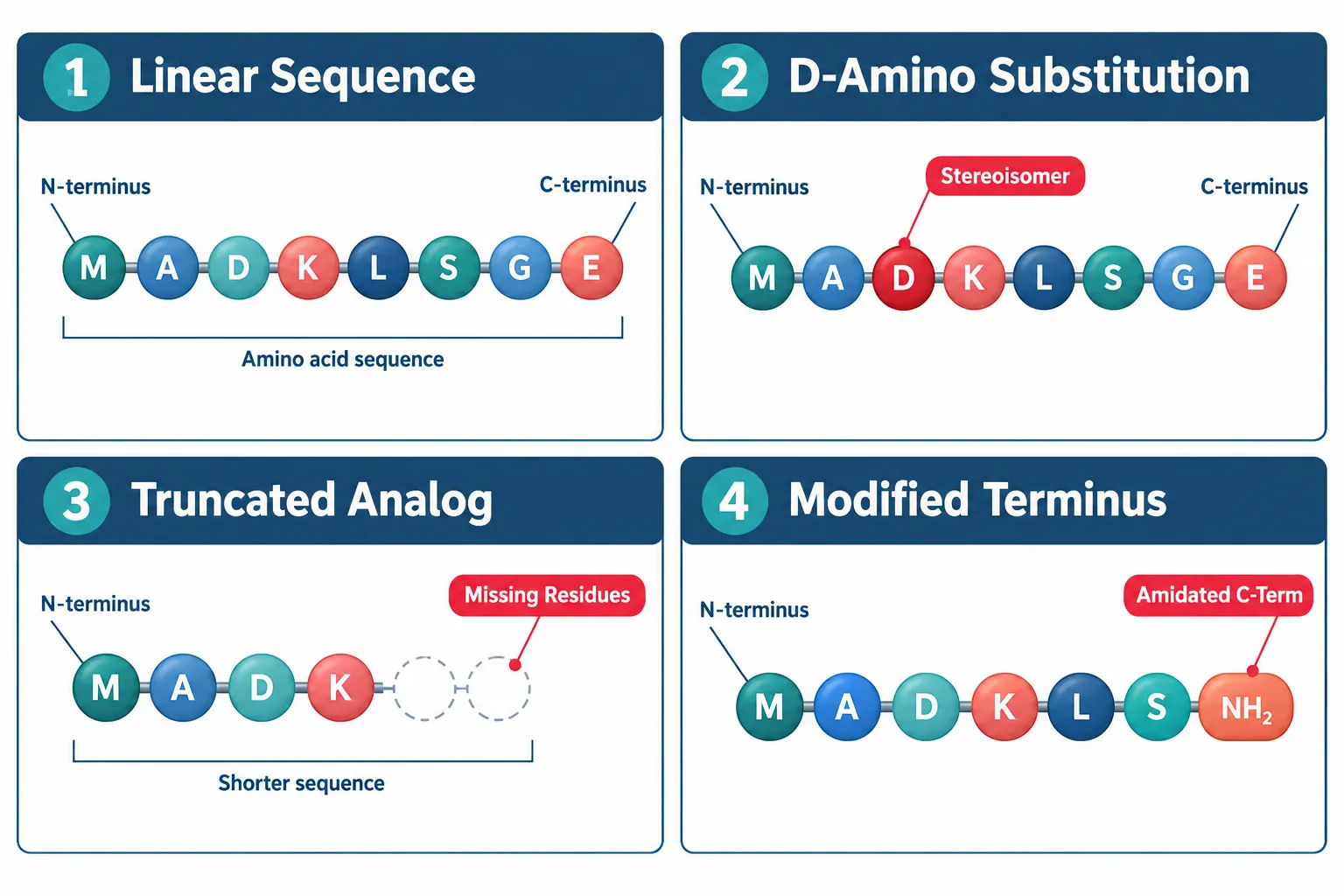
When researchers cite a peptide by its one-letter amino acid string, they are describing connectivity only. That string says nothing about stereochemistry, terminus status, backbone modifications, or cyclic constraints. A peptide containing even one D-amino acid substitution can show dramatically different protease resistance and receptor binding compared to its all-L counterpart, yet both compounds may carry the same sequence notation in a publication.
Sequence Identity Is Not as Simple as It Looks

Terminus modifications compound this problem further. An amidated C-terminus changes the charge distribution across the molecule. An acetylated N-terminus alters hydrogen-bonding capacity. Regulatory guidance effective in 2026 explicitly states that sequence identity alone is insufficient for comparability assessments and requires orthogonal analytical methods to confirm structural equivalence. A 2026 reproducibility framework formalizes this by introducing a six-field specification, sequence, stereochemistry, terminus status, modification type, supplier lot, and certificate data, arguing that a sequence string "defines connectivity only."

Researchers sourcing compounds such as Ipamorelin peptide for sale or GHK-Cu peptide for sale should request full structural confirmation, not just a sequence match, before drawing cross-study comparisons.


Salt Form, Purity, and Why the Numbers Mislead

The Counterion Problem

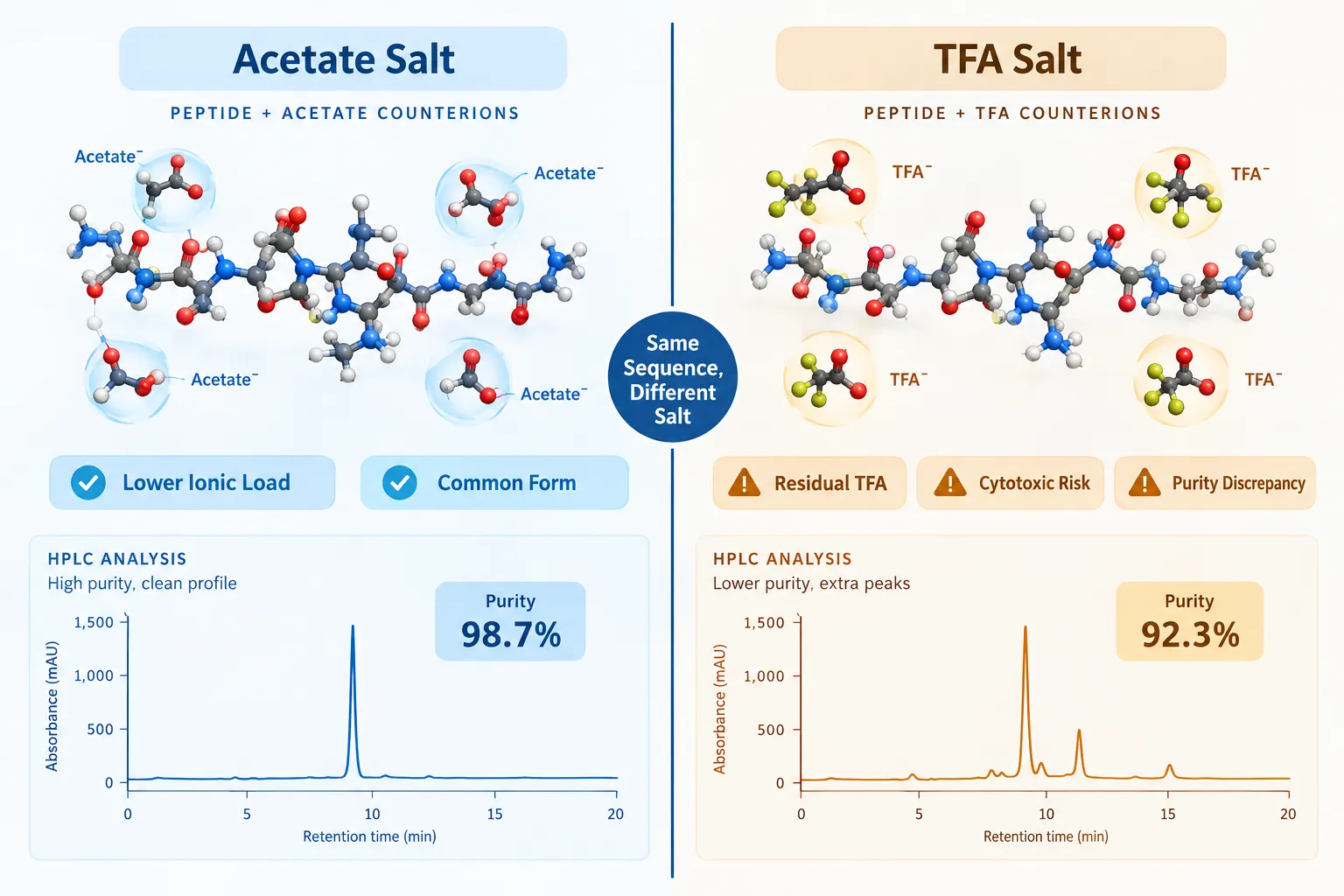
Most synthetic peptides are supplied as salts. The two most common counterions are acetate and trifluoroacetate (TFA). TFA is a byproduct of standard Fmoc solid-phase synthesis and is not always removed during purification. Residual TFA has documented cytotoxic effects in cell-based assays. A compound reported at 95% purity as a TFA salt and the same compound at 95% purity as an acetate salt are not functionally equivalent, even though the purity figures look identical on paper.
The Counterion Problem

Purity Figures Without Context Are Incomplete

Purity is reported as a percentage, but that number depends entirely on the analytical method used to generate it. Reversed-phase HPLC at 214 nm is the most common approach, but it weights peptide bonds rather than mass. A 2026 researcher's guide positions HPLC combined with mass spectrometry (MS) as the gold standard, noting that purity definitions and vehicle choices are among the leading drivers of inter-study divergence. Without knowing the detection wavelength, column chemistry, gradient conditions, and whether MS confirmation was performed, a purity certificate is difficult to interpret.

This matters especially for structurally complex or modified peptides. Research into compounds like SS-31 peptide or cagrilintide peptide, both of which carry specific structural features, requires purity data tied to orthogonal methods, not a single HPLC trace.

Key insight: “A sequence name is not an identifier unless coupled to supplier, lot, and certificate data.”, 2026 peptide research standards

Vehicle, Assay Context, and Dose Normalization

How Vehicle and Handling Shift Results

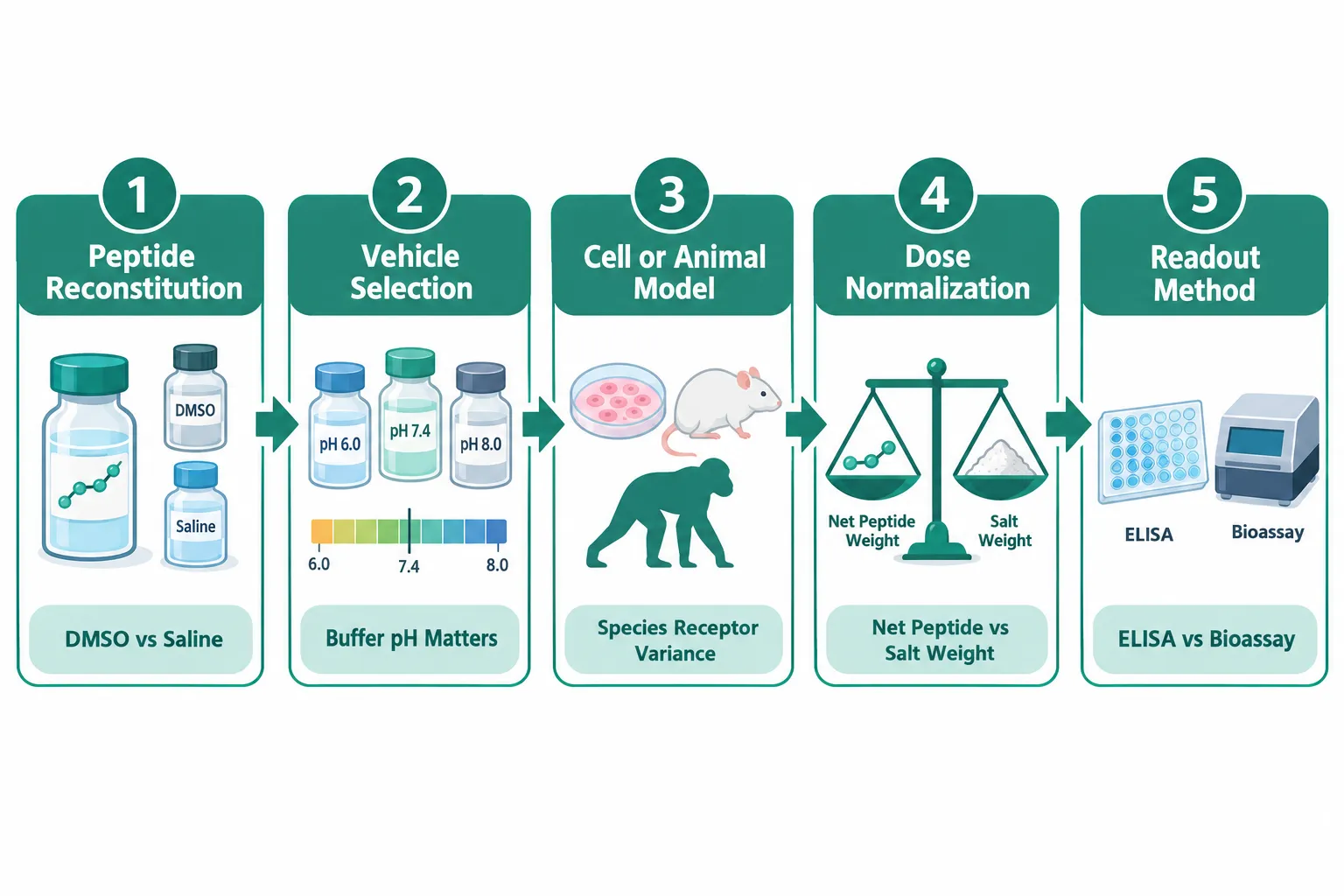
Even a perfectly characterized peptide can behave differently depending on how it is reconstituted and delivered. DMSO, aqueous buffers, saline, and serum-containing media each interact with peptide secondary structure in distinct ways. Some peptides aggregate readily in aqueous solution; others require a co-solvent to achieve true monomeric dispersion. Temperature during reconstitution, freeze-thaw cycles, and storage duration all affect aggregation state and therefore effective concentration at the receptor.

Buffer pH is equally critical. A peptide with multiple ionizable residues will carry a different net charge at pH 7.0 versus pH 7.4. That charge difference alters membrane interaction, receptor docking, and even metabolic stability in cell culture media.
How Vehicle and Handling Shift Results

Dose Normalization: Net Peptide vs. Salt Weight

One of the most overlooked sources of non-comparability is how dose is expressed. When a peptide is supplied as a TFA or acetate salt, the counterion contributes to the total mass. A 1 mg vial of a peptide TFA salt may contain only 0.80-0.88 mg of actual peptide, depending on the molecular weight ratio. If one study doses by salt weight and another by net peptide content, the effective molar doses differ, sometimes by 15-20%, without any note in the methods section.

Researchers working with GLP-3 peptide analogs or visceral fat research models should confirm whether reported doses reflect salt weight or net peptide content before comparing results across publications.

Model System and Readout Method

Species differences in receptor expression, receptor density, and downstream signaling cascades mean that results from a rodent model do not translate directly to human cell lines, and vice versa. An immunogenicity review from mid-2025 highlighted ongoing regulatory uncertainty about "how different is too different" when quality attributes vary across batches or suppliers.

Readout method adds another layer. An ELISA measuring a downstream marker, a radioligand binding assay measuring receptor occupancy, and a functional bioassay measuring cellular response can each produce different apparent potency rankings for the same set of compounds. None of these methods is wrong; they simply measure different things.


Practical Steps for Improving Comparability

Researchers can reduce non-comparability by adopting a structured documentation approach before and after any experiment:

Variable Minimum Disclosure
Sequence Full sequence with stereochemistry and terminus status
Salt form Counterion identity and conversion factor used
Purity Method, instrument, wavelength, and lot number
Vehicle Reconstitution solvent, buffer, pH, and storage conditions
Dose Net peptide content, not salt weight
Assay Species, cell line, receptor density, and readout method

Sourcing from suppliers who provide full analytical packages, including HPLC traces, MS confirmation, and counterion disclosure, is the single most effective way to reduce pre-experimental uncertainty. Platforms that offer wholesale peptides for sale with batch-specific certificates of analysis make this documentation easier to obtain and archive.

For AI-designed or novel peptides entering research pipelines, a July 2026 analysis of computational peptide design identifies physical validation and full contextual reporting as the primary bottleneck to reproducibility, reinforcing that the problem is not unique to commercially sourced compounds.


Conclusion

Why peptide research results are hard to compare comes down to a chain of underreported variables: sequence notation that omits stereochemistry and modifications, counterion identity that affects both mass calculation and cell viability, purity figures that depend on undisclosed analytical conditions, vehicles that alter aggregation and effective concentration, and assay contexts that measure fundamentally different biological endpoints.

Actionable next steps for researchers:

  1. Request and archive full structural specifications, not just sequence strings, for every compound used
  2. Confirm counterion identity and apply the appropriate mass correction factor before calculating molar doses
  3. Report purity with method details, including instrument, column, wavelength, and gradient
  4. Document reconstitution solvent, buffer pH, storage temperature, and freeze-thaw history in the methods section
  5. When comparing across studies, map each variable in the table above before drawing mechanistic conclusions

Adopting these practices does not eliminate all sources of divergence, but it transforms vague disagreements between studies into tractable, resolvable differences, which is the foundation of reproducible science.

https://www.puretestedpeptides.com/wp-content/uploads/2026/09/why-peptide-research-results-are-hard-to-compare-sequence-identity-salt-form-pur.webp 1024 1536 https://www.puretestedpeptides.com/wp-content/uploads/2026/01/buy-peptides-online.jpg 2026-09-28 13:03:392026-09-28 13:03:39Why Peptide Research Results Are Hard to Compare: Sequence Identity, Salt Form, Purity, Vehicle, and Assay Context
×

Helpful Links

  • My account
  • Cart
  • Checkout
  • Refund and Returns Policy
  • Privacy Policy
  • SMS Privacy Policy
  • Login
  • My Account
  • Logout

USA Made Lab Tested Peptides

All products are sold for research, laboratory, or analytical purposes only, and are not for human consumption


Pure Tested Peptides is a chemical supplier. Pure Tested Peptides is not a compounding / chemical compounding facility as defined under 503A of the Federal Food, Drug, and Cosmetic act. Pure Tested Peptides is not an outsourcing facility as defined under 503B of the Federal Food, Drug, and Cosmetic act.

The statements made within this website have not been evaluated by the US Food and Drug Administration. The products we offer are not intended to diagnose, treat, cure or prevent any disease.

Human/Animal Consumption Prohibited. Laboratory/In-Vitro Experimental Use Only

Scroll to top Scroll to top Scroll to top