GHK-Cu Peptide vs Conventional Collagen Supplements: Copper-Dependent Signaling, Matrix Readouts, and Model Selection
Fewer than 5% of oral collagen trials measure extracellular matrix (ECM) components beyond skin hydration, yet those matrix-level readouts are precisely what separates mechanistic skin research from marketing data. That gap defines the entire debate around GHK-Cu Peptide vs Conventional Collagen Supplements: Copper-Dependent Signaling, Matrix Readouts, and Model Selection. Understanding how each approach interacts with fibroblasts, copper availability, and specific ECM markers is essential for researchers choosing the right model and the right tool.
Key Takeaways
- GHK-Cu operates through active copper-dependent signaling, not passive amino acid supply.
- Matrix readouts for GHK-Cu include collagen I and III, elastin, glycosaminoglycans, and MMP/TIMP ratios.
- Oral collagen RCTs show modest, often hydration-focused outcomes with notable funding bias.
- Model selection, fibroblast assay, 3D skin equivalent, or RCT, determines which endpoints are measurable.
- Regenerative research in 2026 is increasingly favoring signaling peptides over substrate supplementation.
Copper-Dependent Signaling: How GHK-Cu Differs Mechanistically
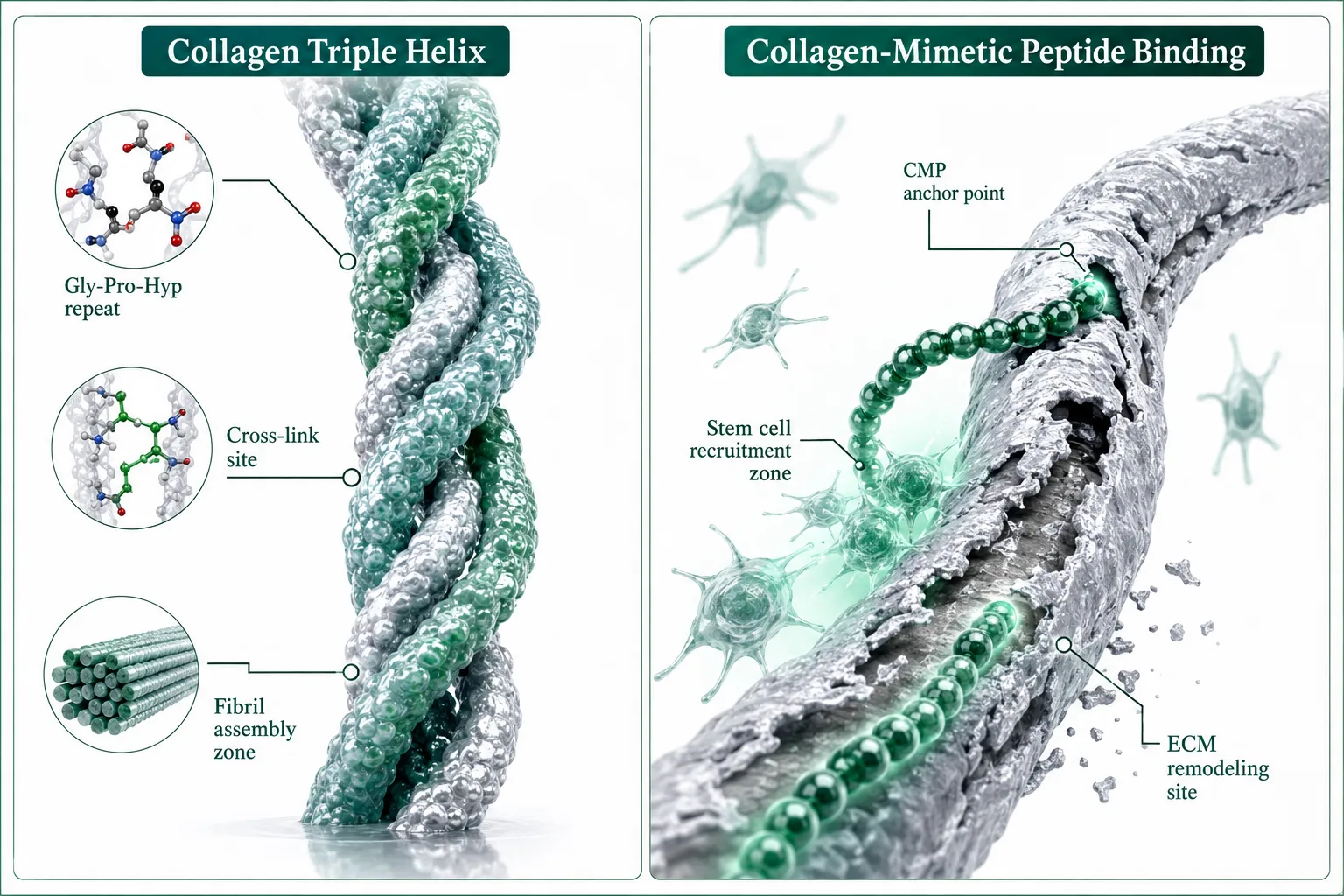
The tripeptide glycine-histidine-lysine (GHK) binds copper(II) ions with high affinity to form GHK-Cu. This is not a passive nutrient delivery system. The copper complex acts as a signaling ligand, binding integrin beta-1 receptors on fibroblasts and triggering a downstream cascade that includes TGF-beta pathway activation, Wnt signaling modulation, and direct transcriptional changes in collagen gene expression.
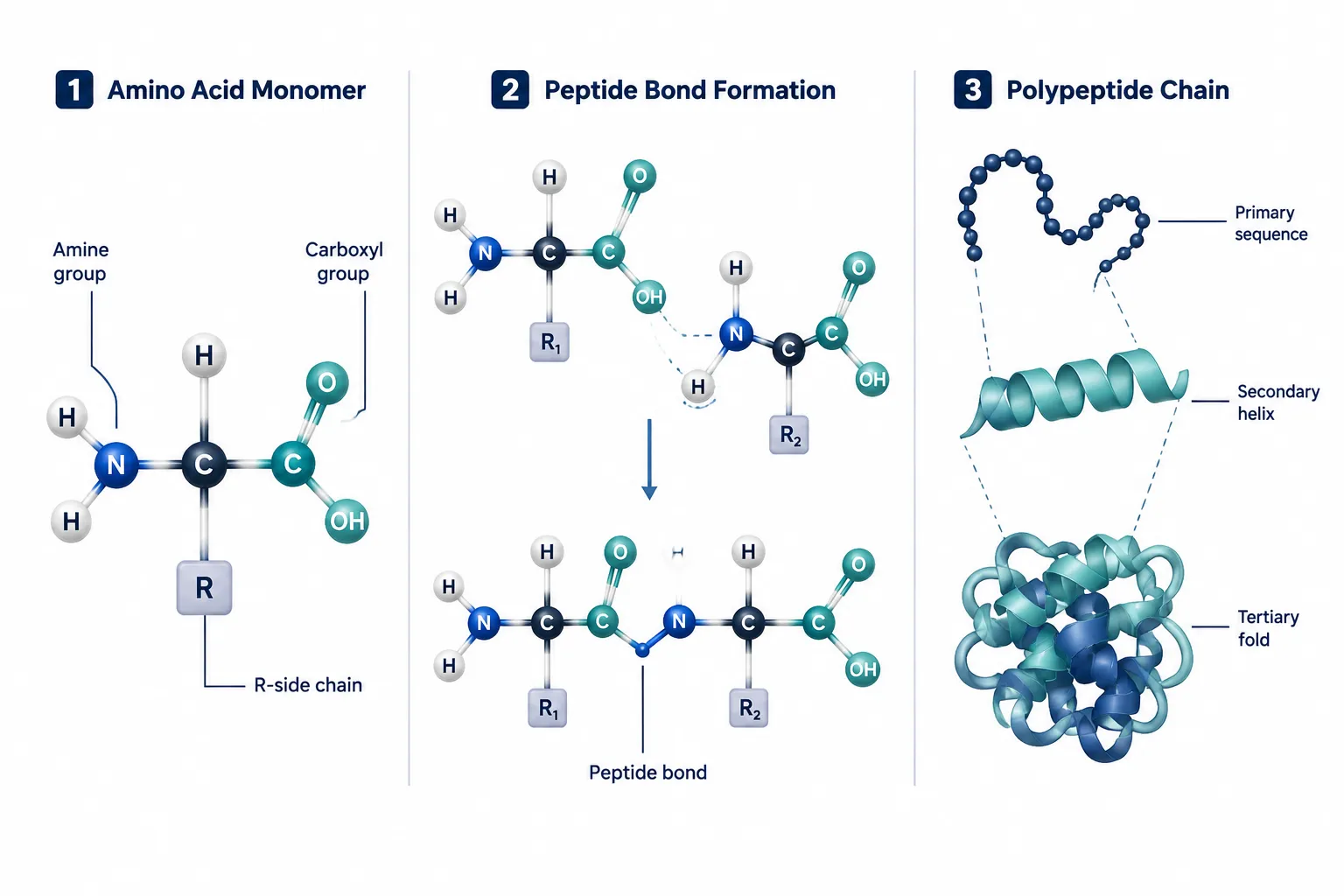
Conventional oral collagen supplements, whether hydrolyzed, bioactive collagen peptides (BCP), or low-molecular-weight collagen peptides (LMWCP), function differently. They supply proline, hydroxyproline, and glycine as raw substrates. The body uses these amino acids opportunistically, but no targeted receptor activation occurs. There is no copper co-factor, no integrin engagement, and no guaranteed upregulation of specific matrix genes.
Key mechanistic differences at a glance:
| Feature | GHK-Cu | Oral Collagen Peptides |
|---|---|---|
| Receptor engagement | Integrin beta-1 | None confirmed |
| Copper dependency | Yes (structural) | No |
| TGF-beta activation | Documented | Not demonstrated |
| MMP/TIMP modulation | Yes | Indirect at best |
| Primary action | Signaling | Substrate supply |
This distinction matters enormously for model selection. If a study aims to measure receptor-mediated ECM remodeling, GHK-Cu is the appropriate research tool. If the goal is to assess amino acid bioavailability, oral collagen is the correct comparator.
For researchers evaluating purity and copper-complex integrity in research-grade formulations, the guide to research-grade Glow Blend Peptide purity and copper-complex compatibility provides relevant sourcing context.
Matrix Readouts: What the ECM Data Actually Shows
When fibroblast assays measure GHK-Cu activity, the relevant endpoints extend well beyond total collagen output. Researchers track:
- Collagen type I and III synthesis (via ELISA or immunofluorescence)
- Elastin deposition (critical for skin elasticity, often omitted in oral collagen trials)
- Glycosaminoglycans (GAGs) including hyaluronic acid and dermatan sulfate
- Proteoglycan expression such as decorin and versican
- MMP-1 suppression and TIMP-1 upregulation (net anti-degradation signal)
GHK-Cu consistently upregulates collagen I and III in 2D fibroblast cultures and 3D skin equivalents. Critically, it also suppresses matrix metalloproteinases, particularly MMP-1, the primary collagenase, while increasing TIMP-1. This creates a net anabolic environment in the ECM.
Oral collagen RCTs, by contrast, most commonly report skin hydration, elasticity scores, and wrinkle depth, outcomes that are real but surface-level. A 2025 RCT on bioactive collagen peptides did demonstrate sustained effects on skin elasticity after washout, and low-molecular-weight collagen peptide studies have shown modest improvements in aging-skin endpoints. However, direct collagen I/III quantification, elastin fiber density, and MMP/TIMP ratios are rarely primary endpoints in these trials.
"The absence of ECM-level endpoints in most oral collagen trials does not mean those effects are absent, it means the studies were not designed to detect them."
Funding source analysis across 2024-2026 oral collagen literature reveals a strong industry sponsorship signal, which correlates with outcome favorability. This does not invalidate the data, but it does call for cautious interpretation when comparing it to mechanistic GHK-Cu fibroblast data.
Researchers interested in peptide mechanisms across different compound classes can explore the Peptides 101 resource covering structure, mechanisms, and research applications for broader context.
Model Selection for GHK-Cu Peptide vs Conventional Collagen Supplements Research
Choosing the right experimental model is the most consequential decision in GHK-Cu Peptide vs Conventional Collagen Supplements research. Each model answers a different question.
Fibroblast monolayer assays are ideal for isolating receptor-mediated signaling. GHK-Cu at nanomolar-to-micromolar concentrations produces measurable collagen I/III increases within 48-72 hours. Controls must include copper-free GHK, free copper(II) alone, and vehicle-only conditions to deconvolute the contribution of the copper ion from the peptide-receptor interaction.
3D skin equivalent models (reconstructed human epidermis or full-thickness constructs) add spatial context. They allow measurement of epidermal thickness, dermal density, and GAG distribution, endpoints impossible in monolayer culture.
Wound-healing scratch assays and excisional wound models favor GHK-Cu as a research tool because its MMP-modulating and anti-inflammatory properties are directly relevant to tissue repair kinetics.
Oral collagen RCTs are best suited for systemic bioavailability and patient-reported outcome research. They are poorly suited for mechanistic ECM claims without biopsy-based collagen quantification.
For researchers sourcing additional peptide comparators, resources on LL-37 versus SS-31 benefits and MOTS-C peptide products offer relevant reference points for multi-peptide study design.
Conclusion
The comparison of GHK-Cu Peptide vs Conventional Collagen Supplements: Copper-Dependent Signaling, Matrix Readouts, and Model Selection is not a question of which product is "better", it is a question of what each tool is designed to do. GHK-Cu is a copper-dependent signaling molecule that activates fibroblasts, modulates MMP/TIMP balance, and drives measurable collagen I/III and elastin synthesis. Oral collagen peptides supply amino acid substrates with modest, hydration-focused clinical outcomes.
Actionable next steps for researchers:
- Define the ECM endpoint first, collagen I/III, elastin, GAGs, or MMP/TIMP ratio, before selecting a model.
- Use fibroblast assays or 3D skin equivalents when mechanistic signaling data is the goal.
- Include copper-stripped controls in all GHK-Cu experiments to isolate peptide-specific effects.
- Treat oral collagen RCT data as complementary, not equivalent, to in vitro matrix readouts.
- Source research-grade GHK-Cu with verified copper-complex integrity and purity documentation.
As regenerative aesthetics research in 2026 continues shifting toward signaling peptides, the methodological rigor applied to model selection and matrix readouts will determine which findings hold up to scrutiny.