Call or Text 727-513-9780
  • Shopping Cart Shopping Cart
    0Shopping Cart
Pure Tested Peptides | America's most trusted Peptides for sale online
  • Peptides for sale
    • Oral Peptides for sale
      • Peptide Capsules for sale
      • BPC 157 Capsules 1000mcg
      • SLU-PP-332 Capsules | 1000 mcg
      • 5-Amino-1MQ 50mg Capsules
      • Tesofensine 500mcg
    • All Peptides for sale
    • Peptide Sprays
      • BPC 157 Nasal Spray Kit
      • BPC-157 TB500 Nasal Spray Kit
      • Semax Nasal Spray 10mg
      • Selank – Nasal Spray Kit – 10mg
      • Epithalon 50MG Nasal Spray Kit
      • Ipamorelin 10mg Nasal Spray
      • Klow Nasal Spray (BPC-157 + TB-500 + GHK-Cu + KPV) | 80mg
      • Hulk Nasal Spray Tesa / Ipa Blend 6/3 MG
      • Klow Nasal Spray
      • NAD + 500 mg Nasal Spray
      • PT-141 Nasal Spray Kit
    • GHRH Peptides
      • Ipa Peptides
      • CJC-1295 Peptides
        • CJC-1295 with DAC 5 mg
        • CJC-1295 without DAC 5 mg
        • CJC-1295 Ipa 10mg
      • Tesa Peptides
        • Tesa Peptide
        • Tesa 20 mg
    • GHK-Cu Peptides
      • All GHK-Cu Peptides
      • GHK-Cu 100mg
      • KLOW Peptide Blend – Buy KLOW blend online
    • BPC Peptides
      • All BPC Peptides
      • BPC-157
      • BPC-157 TB-500
      • BPC 157 capsules 1000mcg
    • SLU-PP-332 Peptides
      • All SLU-PP-332 Peptides
      • SLU-PP-332 5mg
    • GLP3 Peptides
      • GLP3-R
      • GLP3-R CAG 10mg
      • GLP3-R 20mg
    • PT-141 Peptides
      • PT-141 Peptides for sale
      • PT-141 10mg
      • PT-141 Nasal Spray
    • CAG Peptides
      • Lipo-C Peptide Blend
      • CAG 5mg
      • CAG 10mg
    • MOTS-C Peptides
      • MOTS-C Peptides for sale
      • MOTS-c peptide
      • MOTS-c 10mg *6 pack*
    • 5 Amino 1MQ Peptides
      • 5 Amino 1MQ Peptides for sale
      • 5-Amino-1MQ 50mg Capsules
      • 5-Amino-1MQ 5mg
    • Epithalon Peptides
      • Epithalon Peptides for sale
      • Epithalon 10mg
      • Epithalon 50mg
  • Shop
    • GLPs
      • 5-Amino-1MQ 50mg Capsules
      • 5-Amino-1MQ 5mg
      • GLP3-Reta
      • L-Carnitine 500mg/ml
      • Tesofensine 500mcg
      • SLU-PP-332 5mg
      • MOTS-c 10mg *6 pack*
    • Epithalon & BPC Peptides
      • Epithalon 10mg
      • Epithalon 50mg
      • BPC-157
      • BPC 157 capsules 1000mcg
      • BPC-157 TB-500
      • BPC-157 TB500 Nasal Spray Kit
      • BPC 157 Nasal Spray Kit
    • BPC TB-500 & NAD+ Peptides
      • NAD+ 500 mg
      • KLOW Peptide Blend – Buy KLOW blend online
      • GLOW Peptide Blend
      • TB 500 5mg
      • BPC 157 capsules 1000mcg – Supplement
      • BPC 157 Nasal Spray Kit
      • BPC-157
      • BPC-157 TB500 Nasal Spray Kit
      • BPC-157 TB-500
      • BPC 157 capsules 1000mcg
    • LL-37 Peptide
      • LL-37 10 mg
    • MOTS-C & Selank
      • MOTS-c peptide
      • Selank 10mg
    • GHK Peptides
      • GHK-Cu 100mg
      • GLOW Peptide Blend
      • KLOW Peptide Blend – Buy KLOW blend online
  • COAs
  • Wholesale
    • Wholesale Peptides for sale
  • PTP FAQ
  • Affiliates
    • Selank Peptide: Advanced Pharmacological Mechanisms Underlying Its Anxiolytic and Nootropic Effects in Research
      • 5-Amino-1MQ Peptide: Detailed Mechanisms of NNMT Inhibition and Its Impact on Cellular Metabolism Research
        • MOTS-C Peptide: Unraveling Its Role in Mitochondrial Dynamics and Energy Metabolism Research
          • Epithalon Peptide and Telomerase Regulation: Investigating Its Impact on Cellular Senescence and Lifespan Research Models
            • GLP2-T vs GLP2 Tirz Peptide: Understanding the Naming, Mechanistic Nuances, and Research Implications for Gut Health
      • Peptides and Polypeptides in Modern Pharmacology: What Research on Metoprolol, Prednisone, and Amlodipine Reveals
        • Polypeptide Peptides vs NSAIDs: What Naproxen and Diclofenac Teach Tissue-Repair Researchers About BPC‑157 and TB‑500
          • Peptides and Polypeptides in Endocrine Pharmacology: How GLP-1, GLP-2, and GLP-3 Retatrutide Differ From Classic Drugs Like Prednisone and Amlodipine
          • 5‑Amino‑1MQ Peptide and NNMT Inhibition: How It Compares With Statins Like Atorvastatin in Adipose and Lipid Metabolism Research
      • Enclomiphene, Estrogen Receptor Signaling, and Luteinizing Phase Biology: What Hormone Researchers Should Measure
        • Mesenchymal Stem Cells, BPC‑157, and GHK‑Cu: How Tissue Repair Peptides Compare With Classic NSAIDs Like Naproxen in Injury Models
          • Peptide Calculator Use Cases Beyond Growth Hormone: Working Through GLP‑3 Retatrutide, MOTS‑c, and BPC‑157 Research Dosing
        • Polypeptide Peptides in Endocrine and Metabolic Pharmacology: Lessons From Amlodipine, Prednisone, and Metoprolol
        • Peptides Calculator for Advanced Blends: Worked Examples for Tesamorelin, CJC‑1295, and Ipamorelin Stacks
          • Peptides and Polypeptides in Human Physiology: How Molecular Size Shapes Research Applications
            • Selank Peptide: Advanced Pharmacological Mechanisms Underlying Its Anxiolytic and Nootropic Effects in Research
          • 5-Amino-1MQ Peptide: Detailed Mechanisms of NNMT Inhibition and Its Impact on Cellular Metabolism Research
            • MOTS-C Peptide: Unraveling Its Role in Mitochondrial Dynamics and Energy Metabolism Research
              • Epithalon Peptide and Telomerase Regulation: Investigating Its Impact on Cellular Senescence and Lifespan Research Models
                • GLP2-T vs GLP2 Tirz Peptide: Understanding the Naming, Mechanistic Nuances, and Research Implications for Gut Health
                  • Peptides and Polypeptides in Endocrine Pharmacology: How GLP-1, GLP-2, and GLP-3 Retatrutide Differ From Classic Drugs Like Prednisone and Amlodipine
                    • Polypeptide Peptides vs NSAIDs: What Naproxen and Diclofenac Teach Tissue-Repair Researchers About BPC‑157 and TB‑500
                      • Peptides and Polypeptides in Modern Pharmacology: What Research on Metoprolol, Prednisone, and Amlodipine Reveals
                        • 5‑Amino‑1MQ Peptide and NNMT Inhibition: How It Compares With Statins Like Atorvastatin in Adipose and Lipid Metabolism Research
                        • Enclomiphene, Estrogen Receptor Signaling, and Luteinizing Phase Biology: What Hormone Researchers Should Measure
                        • Mesenchymal Stem Cells, BPC‑157, and GHK‑Cu: How Tissue Repair Peptides Compare With Classic NSAIDs Like Naproxen in Injury Models
                        • Peptide Calculator Use Cases Beyond Growth Hormone: Working Through GLP‑3 Retatrutide, MOTS‑c, and BPC‑157 Research Dosing
                        • Polypeptide Peptides in Endocrine and Metabolic Pharmacology: Lessons From Amlodipine, Prednisone, and Metoprolol
                        • Peptides Calculator for Advanced Blends: Worked Examples for Tesamorelin, CJC‑1295, and Ipamorelin Stacks
                        • Peptides and Polypeptides in Human Physiology: How Molecular Size Shapes Research Applications
                        • Selank Peptide: Advanced Pharmacological Mechanisms Underlying Its Anxiolytic and Nootropic Effects in Research
                        • MOTS-C Peptide: Unraveling Its Role in Mitochondrial Dynamics and Energy Metabolism Research
                        • Peptides and Polypeptides in Modern Pharmacology: What Research on Metoprolol, Prednisone, and Amlodipine Reveals
                        • Peptides and Polypeptides in Endocrine Pharmacology: How GLP-1, GLP-2, and GLP-3 Retatrutide Differ From Classic Drugs Like Prednisone and Amlodipine
                        • 5-Amino-1MQ Peptide: Detailed Mechanisms of NNMT Inhibition and Its Impact on Cellular Metabolism Research
                        • Mesenchymal Stem Cells, BPC‑157, and GHK‑Cu: How Tissue Repair Peptides Compare With Classic NSAIDs Like Naproxen in Injury Models
                        • Peptide Calculator Use Cases Beyond Growth Hormone: Working Through GLP‑3 Retatrutide, MOTS‑c, and BPC‑157 Research Dosing
                        • GLP2-T vs GLP2 Tirz Peptide: Understanding the Naming, Mechanistic Nuances, and Research Implications for Gut Health
                        • Polypeptide Peptides in Endocrine and Metabolic Pharmacology: Lessons From Amlodipine, Prednisone, and Metoprolol
                        • Polypeptide Peptides vs NSAIDs: What Naproxen and Diclofenac Teach Tissue-Repair Researchers About BPC‑157 and TB‑500
                        • Peptides and Polypeptides in Human Physiology: How Molecular Size Shapes Research Applications
                        • Peptides Calculator for Advanced Blends: Worked Examples for Tesamorelin, CJC‑1295, and Ipamorelin Stacks
                        • 5‑Amino‑1MQ Peptide and NNMT Inhibition: How It Compares With Statins Like Atorvastatin in Adipose and Lipid Metabolism Research
                        • Enclomiphene, Estrogen Receptor Signaling, and Luteinizing Phase Biology: What Hormone Researchers Should Measure
                        • Epithalon Peptide and Telomerase Regulation: Investigating Its Impact on Cellular Senescence and Lifespan Research Models
                        • Best research protocol Klow blend
                        • best time to take BPC-157
                        • best time to take DSIP (Delta Sleep Inducing Peptide)
                        • best time to take CJC-1295
                        • best time to take AOD-9604
                        • best time to take Follistatin 344
                        • best time to take Ipamorelin
                        • best time to take MK-677 (Ibutamoren)
                        • best time to take Ligandrol (LGD-4033) — research compound
                        • best time to take Ostarine (MK-2866) — research compound
                        • best time to take GHK-CU
                        • best time to take TB-500
                        • best time to take MOTS-c
                        • best time to take Semax
                        • best time to take RAD-140 (Testolone) — research compound
                        • best time to take Thymosin Alpha-1
                        • best time to take PEG-MGF
                        • Biolife Plasma, Octapharma Plasma, and Research Peptides: How Plasma Donation Labs Differ From Peptide Suppliers
                        • best time to take YK-11 — research compound
                        • best time to take PT-141 (Bremelanotide)
                        • Best research protocol Klow blend
                        • 5-Amino-1MQ and MOTS-C Synergy: Metabolic Signaling, Mitochondria, and Research Design
                        • BPC-157 and TB-500: Investigating Their Combined Effects on Angiogenesis and Cellular Migration in Tissue Repair Models
                        • BPC-157 Peptide: Gut Barrier Function, Inflammation, and Tissue-Recovery Research
                        • 5‑Amino‑1MQ and MOTS‑c Synergy in Metabolic Research: Designing NNMT and Mitochondrial Biogenesis Stacks
                        • CJC-1295 with DAC vs. Without DAC: Half-Life, Release Kinetics, and Research Implications
                        • CJC‑1295 with DAC vs. Without DAC: Expanding on Half‑Life Differences Using Tesamorelin and Ipamorelin Blend Case Studies
                        • Collagen Biology and Copper‑Binding Peptides: How GHK‑Cu, Glow Blend, and Klow Blend Interact with Skin and Connective Tissue
                        • Collagen Biology and Regenerative Peptides: How GHK‑Cu, Glow Blend, and Klow Blend Affect Extracellular Matrix Research
                    • DNA, Telomeres, and Longevity Peptides: Positioning Epithalon and MOTS‑c in Genetic Aging Research
                      • Enclomiphene Citrate: serm Mechanism, Testosterone Research, and Stack Compatibility
                        • Enclomiphene vs Enclomiphene Citrate: Formulation, Bioavailability, and Research Distinctions
                        • Epithalon Peptide Research: Telomerase Activation, Aging, and Pineal Gland Function
                        • Estrogen Receptor Signaling and Enclomiphene: How Selective Modulators Compare with Classic Polypeptide Hormones
                        • GHK-Cu Peptide: Advanced Mechanisms in Extracellular Matrix Remodeling and Wound Healing Research
                        • GHK-Cu Peptide: Collagen Synthesis, Wound Repair, and Skin-Barrier Research Models
                        • GLP-1 vs GLP-3 vs GLP-2: Peptide Classification and Research Applications
                        • GLP-2 Peptide Research Guide: Gut Barrier Function, Nutrient Absorption, and Intestinal Recovery Models
                        • GLP-3 Retatrutide vs. GLP-1 Drugs: What Triple-Agonist Biology Changes in Research Models
                        • Ipamorelin and Tesamorelin Combination: Synergistic GH Secretagogue Research and Dosing Protocols
                        • GLP2 Tirz Peptide: What It Is, Why the Name Exists, and How Researchers Should Interpret It
                        • Klow Blend Peptide Nasal Spray: What the Formulation Is Trying to Do in Cognitive Research
                        • Mitochondria, NNMT Inhibition, and Peptide Modulators: Where MOTS‑c and 5‑Amino‑1MQ Fit in Cellular Energy Research
                        • MOTS-c Peptide: Mitochondrial Function, Energy Metabolism, and What Researchers Measure
                        • MOTS-c vs. 5-Amino-1MQ: Which Metabolic Research Questions Each Compound Actually Answers
                        • Nasal Spray Peptides: Bioavailability, Administration, and Semax/Selank Research Applications
                        • PT-141 Peptide Research: Mechanism of Action and Melanocortin Receptor Signaling
                        • Retatrutide for Research: Mechanism, Structure, and GLP-1/GLP-3 Dual Action
                        • Retatrutide for Obesity and Type 2 Diabetes: What the Latest Trial Data Suggest
                        • Tesofensine Peptide Research: Mechanism, Appetite Suppression, and Neuropeptide Y Pathways
  • Contact
    • Contact Customer Service
    • Text Customer Support
  • About US
  • Shop all peptides
  • Affiliate Program
    • Affiliate Signup
  • Login / Register Login / Register Page Link Login / Register Page Link
  • Click to open the search input field Click to open the search input field Search
  • Menu Menu

Tag Archive for: skin tissue research

GHK-Cu Peptide and Collagen: How Copper-Binding Polypeptides Interact With Classic Collagen Pathways in Skin and Tissue Research

GHK-Cu Peptide and Collagen: How Copper-Binding Polypeptides Interact With Classic Collagen Pathways in Skin and Tissue Research

August 1, 2026/0 Comments/in Uncategorized/by

Collagen makes up roughly 30% of all protein in the human body, yet most people trying to support it reach for a powder rather than a signal. That distinction matters enormously in research. The study of GHK-Cu peptide and collagen has revealed that copper-binding polypeptides do not simply add raw material to skin and tissue; they interact directly with the genetic and enzymatic machinery that governs collagen synthesis, cross-linking, and extracellular matrix (ECM) remodeling. Understanding that mechanism separates informed research from guesswork.

Key Takeaways

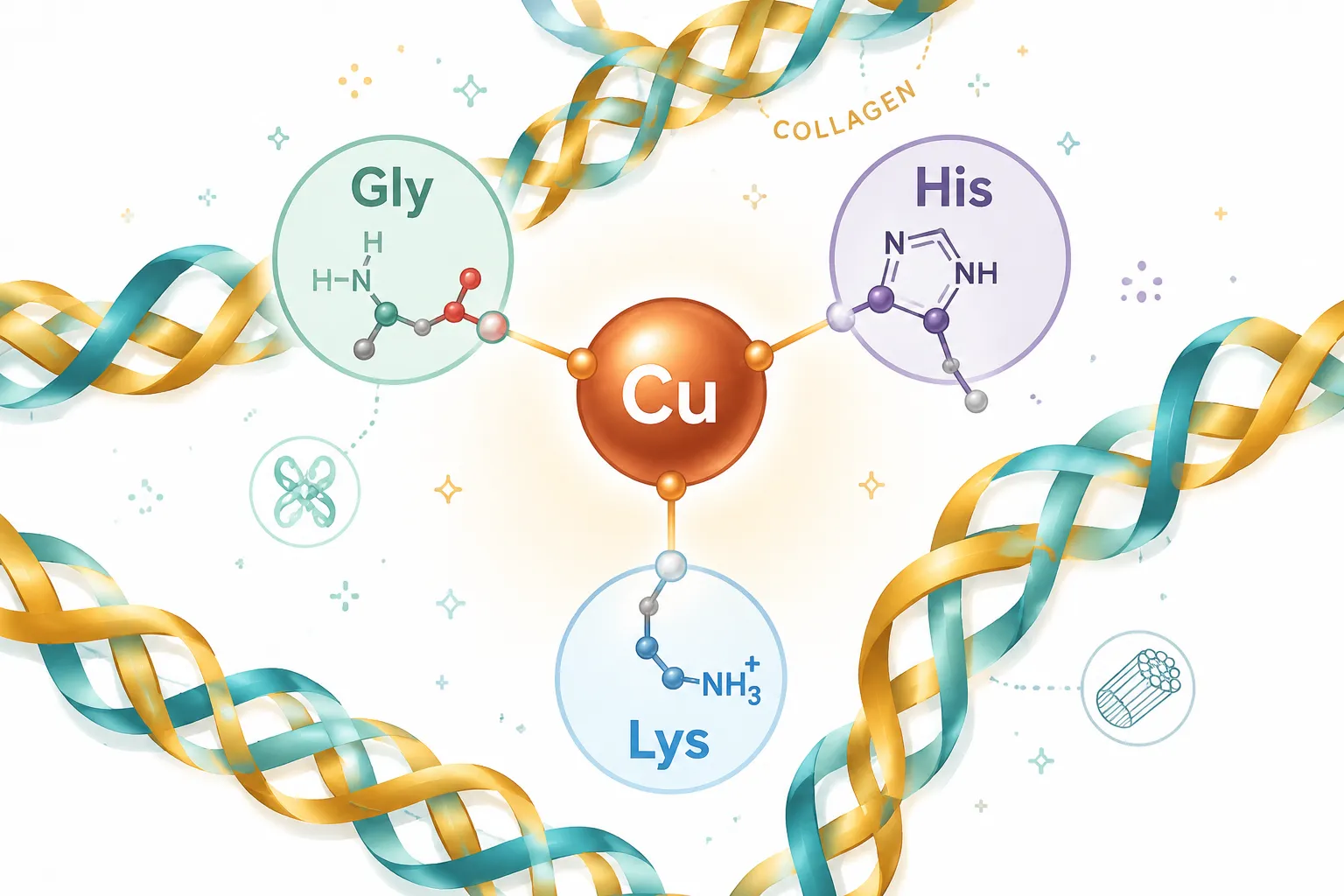
  • GHK-Cu is a naturally occurring copper-binding tripeptide (Glycine-Histidine-Lysine) that modulates collagen gene expression rather than acting as a structural building block.
  • Copper within the GHK-Cu complex activates lysyl oxidase, the enzyme responsible for cross-linking collagen fibers into durable ECM scaffolds.
  • Research shows GHK-Cu upregulates collagen types I and III while simultaneously regulating matrix metalloproteinases (MMPs) to balance ECM breakdown and repair.
  • Copper-binding peptides differ fundamentally from oral collagen supplements, which work through amino acid delivery rather than receptor-level signaling.
  • Sourcing purity-verified peptides is critical for any research application involving GHK-Cu and collagen pathways.
Key Takeaways

The Molecular Basis of GHK-Cu Peptide and Collagen Pathway Activation

GHK-Cu stands for Glycine-Histidine-Lysine complexed with a copper (Cu2+) ion. This tripeptide was first isolated from human plasma in the early 1970s by Dr. Loren Pickart, who observed that older plasma lost the ability to support liver tissue function that younger plasma retained. The active fraction was GHK.

The copper ion is not incidental. It is structurally integral. The histidine residue coordinates the Cu2+ ion through its imidazole nitrogen, creating a stable chelate that allows the peptide to interact with cell surface receptors and nuclear signaling pathways. Without copper, the peptide's biological activity is substantially reduced.

How GHK-Cu signals collagen production:

  • Binds to cell surface receptors on fibroblasts
  • Activates TGF-beta (transforming growth factor beta) pathways
  • Upregulates mRNA expression for collagen type I and type III
  • Stimulates decorin and other proteoglycans that organize collagen fibers

"GHK-Cu does not donate collagen, it instructs cells to make more of it, and to make it correctly."

This signaling distinction is why researchers studying tissue repair and skin biology treat GHK-Cu as a regulatory molecule rather than a nutritional substrate. For those exploring other peptides with tissue-level effects, TB-500 peptide research offers a useful parallel in ECM-adjacent signaling.

ECM Remodeling: How Copper-Binding Polypeptides Interact With Classic Collagen Pathways in Skin and Tissue Research

The extracellular matrix is not a static scaffold. It is a dynamic environment that is continuously broken down and rebuilt. GHK-Cu participates in both sides of this process, which is what makes it particularly interesting in skin aging and wound-healing research.

Lysyl Oxidase Activation and Collagen Cross-Linking

Copper is a required cofactor for lysyl oxidase (LOX), the enzyme that catalyzes the cross-linking of collagen and elastin fibers. Cross-linking is what gives collagen its tensile strength. GHK-Cu delivers bioavailable copper directly to fibroblasts and other connective tissue cells, supporting LOX activity in a targeted way.

Process Role of GHK-Cu
Collagen synthesis Upregulates COL1A1 and COL3A1 gene expression
Cross-linking Supplies Cu2+ to lysyl oxidase
ECM degradation Modulates MMP-1, MMP-2, and MMP-9 activity
Anti-inflammatory Downregulates NF-kB signaling

Matrix Metalloproteinase Regulation

One of the more nuanced findings in GHK-Cu research is its dual role with MMPs. These enzymes degrade collagen and are necessary for healthy tissue turnover. Chronic overexpression of MMPs, common in aged or UV-damaged skin, leads to net collagen loss. GHK-Cu has been shown in cell culture studies to reduce excess MMP activity while preserving the baseline turnover needed for healthy ECM remodeling.

This balance is not replicated by oral collagen supplements, which have no direct MMP-modulating effect. Researchers interested in comparing peptide mechanisms across tissue types may also find value in reviewing BPC-157 and TB-500 blend research, which addresses related repair pathways.

Matrix Metalloproteinase Regulation

GHK-Cu Versus Oral Collagen Supplements: A Mechanistic Comparison

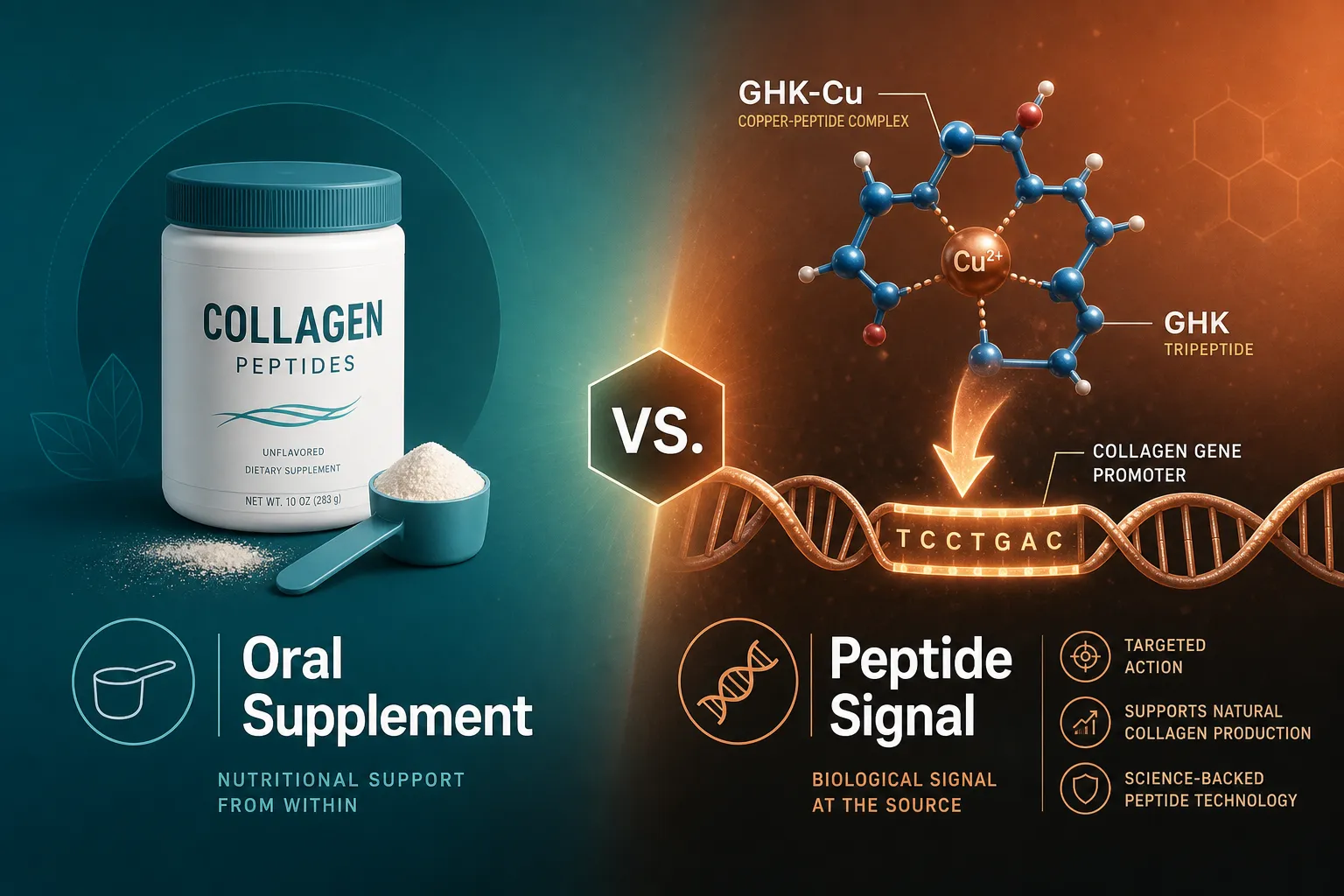
The commercial collagen supplement market is built on a straightforward premise: consume hydrolyzed collagen peptides, absorb the amino acids, and provide fibroblasts with raw material. This approach has some research support, particularly for joint comfort outcomes. However, it operates at a fundamentally different level than GHK-Cu peptide and collagen pathway modulation.

Key mechanistic differences:

  • Oral collagen: Delivers glycine, proline, and hydroxyproline as substrate; no direct gene expression effect
  • GHK-Cu: Acts as a signaling ligand; triggers fibroblast gene transcription programs
  • Oral collagen: Bioavailability depends on gut absorption and systemic amino acid competition
  • GHK-Cu: Exerts local effects at the tissue level through topical or injectable delivery in research settings

This is not an argument against either approach. It is a clarification that they are not interchangeable. Researchers studying skin biology, wound healing, or tissue engineering should treat them as complementary rather than equivalent tools.

For those exploring the broader peptide research landscape, resources on where to buy research peptides and what not to mix with peptides provide essential sourcing and safety context.
GHK-Cu Versus Oral Collagen Supplements: A Mechanistic Comparison

Research Applications and Sourcing Considerations in 2026

Current research in 2026 continues to expand the known scope of GHK-Cu activity. Beyond skin, published studies have examined its role in lung tissue repair, nerve regeneration, and anti-inflammatory signaling. The peptide appears in gene expression databases as a modulator of over 4,000 human genes, many of which intersect with ECM biology.

For researchers working with GHK-Cu in laboratory settings, purity and verification are non-negotiable. Copper-binding peptides are sensitive to oxidation and improper storage. A contaminated or degraded sample will not reproduce published results. Researchers sourcing peptides for collagen-related studies should also consider how GHK-Cu might be combined with other compounds, for example, Epithalon peptide research addresses telomere-related aging pathways that intersect with collagen biology at the cellular level.

Those building a broader research protocol may also benefit from reviewing aging support peptide categories to understand how GHK-Cu fits within a wider tissue-health framework.

Conclusion

The research on GHK-Cu peptide and collagen interaction represents one of the clearest examples of how copper-binding polypeptides interact with classic collagen pathways in skin and tissue research, not by adding building blocks, but by activating the biological programs that build, organize, and maintain collagen architecture. The peptide's ability to upregulate collagen gene expression, support lysyl oxidase cross-linking, and modulate MMP activity places it in a mechanistic category that oral supplements cannot occupy.

Actionable next steps for researchers:

  1. Review published fibroblast cell culture studies on GHK-Cu and COL1A1/COL3A1 expression before designing protocols.
  2. Source GHK-Cu only from vendors who provide third-party purity certificates and mass spectrometry data.
  3. Distinguish clearly between GHK-Cu's signaling role and the substrate role of hydrolyzed collagen when designing experiments or interpreting results.
  4. Explore complementary peptides, such as those in TB-500 and BPC-157 blend research, when studying multi-pathway tissue repair.
  5. Store copper-binding peptides per manufacturer specifications to preserve Cu2+ chelation integrity.

The field is active, the mechanisms are well-characterized, and the sourcing infrastructure for verified research-grade GHK-Cu is accessible. The next step is applying rigorous methodology to a peptide that has already demonstrated significant biological relevance.

https://www.puretestedpeptides.com/wp-content/uploads/2026/08/ghk-cu-peptide-and-collagen-how-copper-binding-polypeptides-interact-with-classi.webp 1024 1536 https://www.puretestedpeptides.com/wp-content/uploads/2026/01/buy-peptides-online.jpg 2026-08-01 13:05:132026-08-01 13:05:13GHK-Cu Peptide and Collagen: How Copper-Binding Polypeptides Interact With Classic Collagen Pathways in Skin and Tissue Research
×

Helpful Links

  • My account
  • Cart
  • Checkout
  • Refund and Returns Policy
  • Privacy Policy
  • SMS Privacy Policy
  • Login
  • My Account
  • Logout

USA Made Lab Tested Peptides

All products are sold for research, laboratory, or analytical purposes only, and are not for human consumption


Pure Tested Peptides is a chemical supplier. Pure Tested Peptides is not a compounding / chemical compounding facility as defined under 503A of the Federal Food, Drug, and Cosmetic act. Pure Tested Peptides is not an outsourcing facility as defined under 503B of the Federal Food, Drug, and Cosmetic act.

The statements made within this website have not been evaluated by the US Food and Drug Administration. The products we offer are not intended to diagnose, treat, cure or prevent any disease.

Human/Animal Consumption Prohibited. Laboratory/In-Vitro Experimental Use Only

Scroll to top Scroll to top Scroll to top