Call or Text 727-513-9780
  • Shopping Cart Shopping Cart
    0Shopping Cart
Pure Tested Peptides | America's most trusted Peptides for sale online
  • Peptides for sale
    • Oral Peptides for sale
      • Peptide Capsules for sale
      • BPC 157 Capsules 1000mcg
      • SLU-PP-332 Capsules | 1000 mcg
      • 5-Amino-1MQ 50mg Capsules
      • Tesofensine 500mcg
    • All Peptides for sale
    • Peptide Sprays
      • BPC 157 Nasal Spray Kit
      • BPC-157 TB500 Nasal Spray Kit
      • Semax Nasal Spray 10mg
      • Selank – Nasal Spray Kit – 10mg
      • Epithalon 50MG Nasal Spray Kit
      • Ipamorelin 10mg Nasal Spray
      • Klow Nasal Spray (BPC-157 + TB-500 + GHK-Cu + KPV) | 80mg
      • Hulk Nasal Spray Tesa / Ipa Blend 6/3 MG
      • Klow Nasal Spray
      • NAD + 500 mg Nasal Spray
      • PT-141 Nasal Spray Kit
    • GHRH Peptides
      • Ipa Peptides
      • CJC-1295 Peptides
        • CJC-1295 with DAC 5 mg
        • CJC-1295 without DAC 5 mg
        • CJC-1295 Ipa 10mg
      • Tesa Peptides
        • Tesa Peptide
        • Tesa 20 mg
    • GHK-Cu Peptides
      • All GHK-Cu Peptides
      • GHK-Cu 100mg
      • KLOW Peptide Blend – Buy KLOW blend online
    • BPC Peptides
      • All BPC Peptides
      • BPC-157
      • BPC-157 TB-500
      • BPC 157 capsules 1000mcg
    • SLU-PP-332 Peptides
      • All SLU-PP-332 Peptides
      • SLU-PP-332 5mg
    • GLP3 Peptides
    • PT-141 Peptides
      • PT-141 Peptides for sale
      • PT-141 10mg
      • PT-141 Nasal Spray
    • CAG Peptides
      • Lipo-C Peptide Blend
      • CAG 5mg
      • CAG 10mg
    • MOTS-C Peptides
      • MOTS-C Peptides for sale
      • MOTS-c peptide
      • MOTS-c 10mg *6 pack*
    • 5 Amino 1MQ Peptides
      • 5 Amino 1MQ Peptides for sale
      • 5-Amino-1MQ 50mg Capsules
      • 5-Amino-1MQ 5mg
    • Epithalon Peptides
      • Epithalon Peptides for sale
      • Epithalon 10mg
      • Epithalon 50mg
  • Shop
    • GLPs
      • 5-Amino-1MQ 50mg Capsules
      • 5-Amino-1MQ 5mg
      • L-Carnitine 500mg/ml
      • Tesofensine 500mcg
      • SLU-PP-332 5mg
      • MOTS-c 10mg *6 pack*
    • Epithalon & BPC Peptides
      • Epithalon 10mg
      • Epithalon 50mg
      • BPC-157
      • BPC 157 capsules 1000mcg
      • BPC-157 TB-500
      • BPC-157 TB500 Nasal Spray Kit
      • BPC 157 Nasal Spray Kit
    • BPC TB-500 & NAD+ Peptides
      • NAD+ 500 mg
      • KLOW Peptide Blend – Buy KLOW blend online
      • GLOW Peptide Blend
      • TB 500 5mg
      • BPC 157 capsules 1000mcg – Supplement
      • BPC 157 Nasal Spray Kit
      • BPC-157
      • BPC-157 TB500 Nasal Spray Kit
      • BPC-157 TB-500
      • BPC 157 capsules 1000mcg
    • LL-37 Peptide
      • LL-37 10 mg
    • MOTS-C & Selank
      • MOTS-c peptide
      • Selank 10mg
    • GHK Peptides
      • GHK-Cu 100mg
      • GLOW Peptide Blend
      • KLOW Peptide Blend – Buy KLOW blend online
  • COAs
  • Wholesale
    • Wholesale Peptides for sale
  • PTP FAQ
  • Affiliates
    • Selank Peptide: Advanced Pharmacological Mechanisms Underlying Its Anxiolytic and Nootropic Effects in Research
      • 5-Amino-1MQ Peptide: Detailed Mechanisms of NNMT Inhibition and Its Impact on Cellular Metabolism Research
        • MOTS-C Peptide: Unraveling Its Role in Mitochondrial Dynamics and Energy Metabolism Research
          • Epithalon Peptide and Telomerase Regulation: Investigating Its Impact on Cellular Senescence and Lifespan Research Models
            • GLP2-T vs GLP2 Tirz Peptide: Understanding the Naming, Mechanistic Nuances, and Research Implications for Gut Health
      • Peptides and Polypeptides in Modern Pharmacology: What Research on Metoprolol, Prednisone, and Amlodipine Reveals
        • Polypeptide Peptides vs NSAIDs: What Naproxen and Diclofenac Teach Tissue-Repair Researchers About BPC‑157 and TB‑500
          • Peptides and Polypeptides in Endocrine Pharmacology: How GLP-1, GLP-2, and GLP-3 Retatrutide Differ From Classic Drugs Like Prednisone and Amlodipine
          • 5‑Amino‑1MQ Peptide and NNMT Inhibition: How It Compares With Statins Like Atorvastatin in Adipose and Lipid Metabolism Research
      • Enclomiphene, Estrogen Receptor Signaling, and Luteinizing Phase Biology: What Hormone Researchers Should Measure
        • Mesenchymal Stem Cells, BPC‑157, and GHK‑Cu: How Tissue Repair Peptides Compare With Classic NSAIDs Like Naproxen in Injury Models
          • Peptide Calculator Use Cases Beyond Growth Hormone: Working Through GLP‑3 Retatrutide, MOTS‑c, and BPC‑157 Research Dosing
        • Polypeptide Peptides in Endocrine and Metabolic Pharmacology: Lessons From Amlodipine, Prednisone, and Metoprolol
        • Peptides Calculator for Advanced Blends: Worked Examples for Tesamorelin, CJC‑1295, and Ipamorelin Stacks
          • Peptides and Polypeptides in Human Physiology: How Molecular Size Shapes Research Applications
            • Selank Peptide: Advanced Pharmacological Mechanisms Underlying Its Anxiolytic and Nootropic Effects in Research
          • 5-Amino-1MQ Peptide: Detailed Mechanisms of NNMT Inhibition and Its Impact on Cellular Metabolism Research
            • MOTS-C Peptide: Unraveling Its Role in Mitochondrial Dynamics and Energy Metabolism Research
              • Epithalon Peptide and Telomerase Regulation: Investigating Its Impact on Cellular Senescence and Lifespan Research Models
                • GLP2-T vs GLP2 Tirz Peptide: Understanding the Naming, Mechanistic Nuances, and Research Implications for Gut Health
                  • Peptides and Polypeptides in Endocrine Pharmacology: How GLP-1, GLP-2, and GLP-3 Retatrutide Differ From Classic Drugs Like Prednisone and Amlodipine
                    • Polypeptide Peptides vs NSAIDs: What Naproxen and Diclofenac Teach Tissue-Repair Researchers About BPC‑157 and TB‑500
                      • Peptides and Polypeptides in Modern Pharmacology: What Research on Metoprolol, Prednisone, and Amlodipine Reveals
                        • 5‑Amino‑1MQ Peptide and NNMT Inhibition: How It Compares With Statins Like Atorvastatin in Adipose and Lipid Metabolism Research
                        • Enclomiphene, Estrogen Receptor Signaling, and Luteinizing Phase Biology: What Hormone Researchers Should Measure
                        • Mesenchymal Stem Cells, BPC‑157, and GHK‑Cu: How Tissue Repair Peptides Compare With Classic NSAIDs Like Naproxen in Injury Models
                        • Peptide Calculator Use Cases Beyond Growth Hormone: Working Through GLP‑3 Retatrutide, MOTS‑c, and BPC‑157 Research Dosing
                        • Polypeptide Peptides in Endocrine and Metabolic Pharmacology: Lessons From Amlodipine, Prednisone, and Metoprolol
                        • Peptides Calculator for Advanced Blends: Worked Examples for Tesamorelin, CJC‑1295, and Ipamorelin Stacks
                        • Peptides and Polypeptides in Human Physiology: How Molecular Size Shapes Research Applications
                        • Selank Peptide: Advanced Pharmacological Mechanisms Underlying Its Anxiolytic and Nootropic Effects in Research
                        • MOTS-C Peptide: Unraveling Its Role in Mitochondrial Dynamics and Energy Metabolism Research
                        • Peptides and Polypeptides in Modern Pharmacology: What Research on Metoprolol, Prednisone, and Amlodipine Reveals
                        • Peptides and Polypeptides in Endocrine Pharmacology: How GLP-1, GLP-2, and GLP-3 Retatrutide Differ From Classic Drugs Like Prednisone and Amlodipine
                        • 5-Amino-1MQ Peptide: Detailed Mechanisms of NNMT Inhibition and Its Impact on Cellular Metabolism Research
                        • Mesenchymal Stem Cells, BPC‑157, and GHK‑Cu: How Tissue Repair Peptides Compare With Classic NSAIDs Like Naproxen in Injury Models
                        • Peptide Calculator Use Cases Beyond Growth Hormone: Working Through GLP‑3 Retatrutide, MOTS‑c, and BPC‑157 Research Dosing
                        • GLP2-T vs GLP2 Tirz Peptide: Understanding the Naming, Mechanistic Nuances, and Research Implications for Gut Health
                        • Polypeptide Peptides in Endocrine and Metabolic Pharmacology: Lessons From Amlodipine, Prednisone, and Metoprolol
                        • Polypeptide Peptides vs NSAIDs: What Naproxen and Diclofenac Teach Tissue-Repair Researchers About BPC‑157 and TB‑500
                        • Peptides and Polypeptides in Human Physiology: How Molecular Size Shapes Research Applications
                        • Peptides Calculator for Advanced Blends: Worked Examples for Tesamorelin, CJC‑1295, and Ipamorelin Stacks
                        • 5‑Amino‑1MQ Peptide and NNMT Inhibition: How It Compares With Statins Like Atorvastatin in Adipose and Lipid Metabolism Research
                        • Enclomiphene, Estrogen Receptor Signaling, and Luteinizing Phase Biology: What Hormone Researchers Should Measure
                        • Epithalon Peptide and Telomerase Regulation: Investigating Its Impact on Cellular Senescence and Lifespan Research Models
                        • Best research protocol Klow blend
                        • best time to take BPC-157
                        • best time to take DSIP (Delta Sleep Inducing Peptide)
                        • best time to take CJC-1295
                        • best time to take AOD-9604
                        • best time to take Follistatin 344
                        • best time to take Ipamorelin
                        • best time to take MK-677 (Ibutamoren)
                        • best time to take Ligandrol (LGD-4033) — research compound
                        • best time to take Ostarine (MK-2866) — research compound
                        • best time to take GHK-CU
                        • best time to take TB-500
                        • best time to take MOTS-c
                        • best time to take Semax
                        • best time to take RAD-140 (Testolone) — research compound
                        • best time to take Thymosin Alpha-1
                        • best time to take PEG-MGF
                        • Biolife Plasma, Octapharma Plasma, and Research Peptides: How Plasma Donation Labs Differ From Peptide Suppliers
                        • best time to take YK-11 — research compound
                        • best time to take PT-141 (Bremelanotide)
                        • Best research protocol Klow blend
                        • 5-Amino-1MQ and MOTS-C Synergy: Metabolic Signaling, Mitochondria, and Research Design
                        • BPC-157 and TB-500: Investigating Their Combined Effects on Angiogenesis and Cellular Migration in Tissue Repair Models
                        • BPC-157 Peptide: Gut Barrier Function, Inflammation, and Tissue-Recovery Research
                        • 5‑Amino‑1MQ and MOTS‑c Synergy in Metabolic Research: Designing NNMT and Mitochondrial Biogenesis Stacks
                        • CJC-1295 with DAC vs. Without DAC: Half-Life, Release Kinetics, and Research Implications
                        • CJC‑1295 with DAC vs. Without DAC: Expanding on Half‑Life Differences Using Tesamorelin and Ipamorelin Blend Case Studies
                        • Collagen Biology and Copper‑Binding Peptides: How GHK‑Cu, Glow Blend, and Klow Blend Interact with Skin and Connective Tissue
                        • Collagen Biology and Regenerative Peptides: How GHK‑Cu, Glow Blend, and Klow Blend Affect Extracellular Matrix Research
                    • DNA, Telomeres, and Longevity Peptides: Positioning Epithalon and MOTS‑c in Genetic Aging Research
                      • Enclomiphene Citrate: serm Mechanism, Testosterone Research, and Stack Compatibility
                        • Enclomiphene vs Enclomiphene Citrate: Formulation, Bioavailability, and Research Distinctions
                        • Epithalon Peptide Research: Telomerase Activation, Aging, and Pineal Gland Function
                        • Estrogen Receptor Signaling and Enclomiphene: How Selective Modulators Compare with Classic Polypeptide Hormones
                        • GHK-Cu Peptide: Advanced Mechanisms in Extracellular Matrix Remodeling and Wound Healing Research
                        • GHK-Cu Peptide: Collagen Synthesis, Wound Repair, and Skin-Barrier Research Models
                        • GLP-1 vs GLP-3 vs GLP-2: Peptide Classification and Research Applications
                        • GLP-2 Peptide Research Guide: Gut Barrier Function, Nutrient Absorption, and Intestinal Recovery Models
                        • GLP-3 Retatrutide vs. GLP-1 Drugs: What Triple-Agonist Biology Changes in Research Models
                        • Ipamorelin and Tesamorelin Combination: Synergistic GH Secretagogue Research and Dosing Protocols
                        • GLP2 Tirz Peptide: What It Is, Why the Name Exists, and How Researchers Should Interpret It
                        • Klow Blend Peptide Nasal Spray: What the Formulation Is Trying to Do in Cognitive Research
                        • Mitochondria, NNMT Inhibition, and Peptide Modulators: Where MOTS‑c and 5‑Amino‑1MQ Fit in Cellular Energy Research
                        • MOTS-c Peptide: Mitochondrial Function, Energy Metabolism, and What Researchers Measure
                        • MOTS-c vs. 5-Amino-1MQ: Which Metabolic Research Questions Each Compound Actually Answers
                        • Nasal Spray Peptides: Bioavailability, Administration, and Semax/Selank Research Applications
                        • PT-141 Peptide Research: Mechanism of Action and Melanocortin Receptor Signaling
                        • Retatrutide for Research: Mechanism, Structure, and GLP-1/GLP-3 Dual Action
                        • Retatrutide for Obesity and Type 2 Diabetes: What the Latest Trial Data Suggest
                        • Tesofensine Peptide Research: Mechanism, Appetite Suppression, and Neuropeptide Y Pathways
  • Contact
    • Contact Customer Service
    • Text Customer Support
  • About US
  • Shop all peptides
  • Affiliate Program
    • Affiliate Signup
  • Login / Register Login / Register Page Link Login / Register Page Link
  • Click to open the search input field Click to open the search input field Search
  • Menu Menu

Tag Archive for: statin peptide combination

Atorvastatin and Research Peptides: Designing Lipid and Liver-Control Groups for Metabolic Studies

Atorvastatin and Research Peptides: Designing Lipid and Liver-Control Groups for Metabolic Studies

October 6, 2026/0 Comments/in Uncategorized/by

Cardiovascular disease remains the leading cause of death worldwide, yet fewer than half of high-risk research subjects in preclinical metabolic models reach target lipid endpoints without a standardized control framework. Designing rigorous control groups is where most metabolic studies succeed or fail, and the intersection of Atorvastatin and Research Peptides: Designing Lipid and Liver-Control Groups for Metabolic Studies sits at the center of that challenge. As novel peptides such as retatrutide, MOTS-c, and 5-amino-1MQ enter metabolic research pipelines, pairing them against a well-characterized statin benchmark like atorvastatin is no longer optional, it is methodologically essential.

Key Takeaways

  • Atorvastatin reliably lowers LDL, triglycerides, and non-HDL cholesterol, making it the gold-standard lipid control comparator in metabolic studies.
  • Liver safety endpoints, particularly ALT, AST, and histological steatosis scores, must be tracked in every atorvastatin-containing control arm.
  • Peptide arms (retatrutide, MOTS-c, 5-amino-1MQ) require a statin-exposed control group to isolate peptide-specific metabolic contributions.
  • Western-type diet (WTD) models with and without atorvastatin remain the canonical structure for NAFLD and hyperlipidemia research designs.
  • Multi-arm study designs that combine diet, statin exposure, and peptide co-therapy now represent the evolving standard in 2026 metabolic research.

Why Atorvastatin Anchors Lipid and Liver-Control Group Design
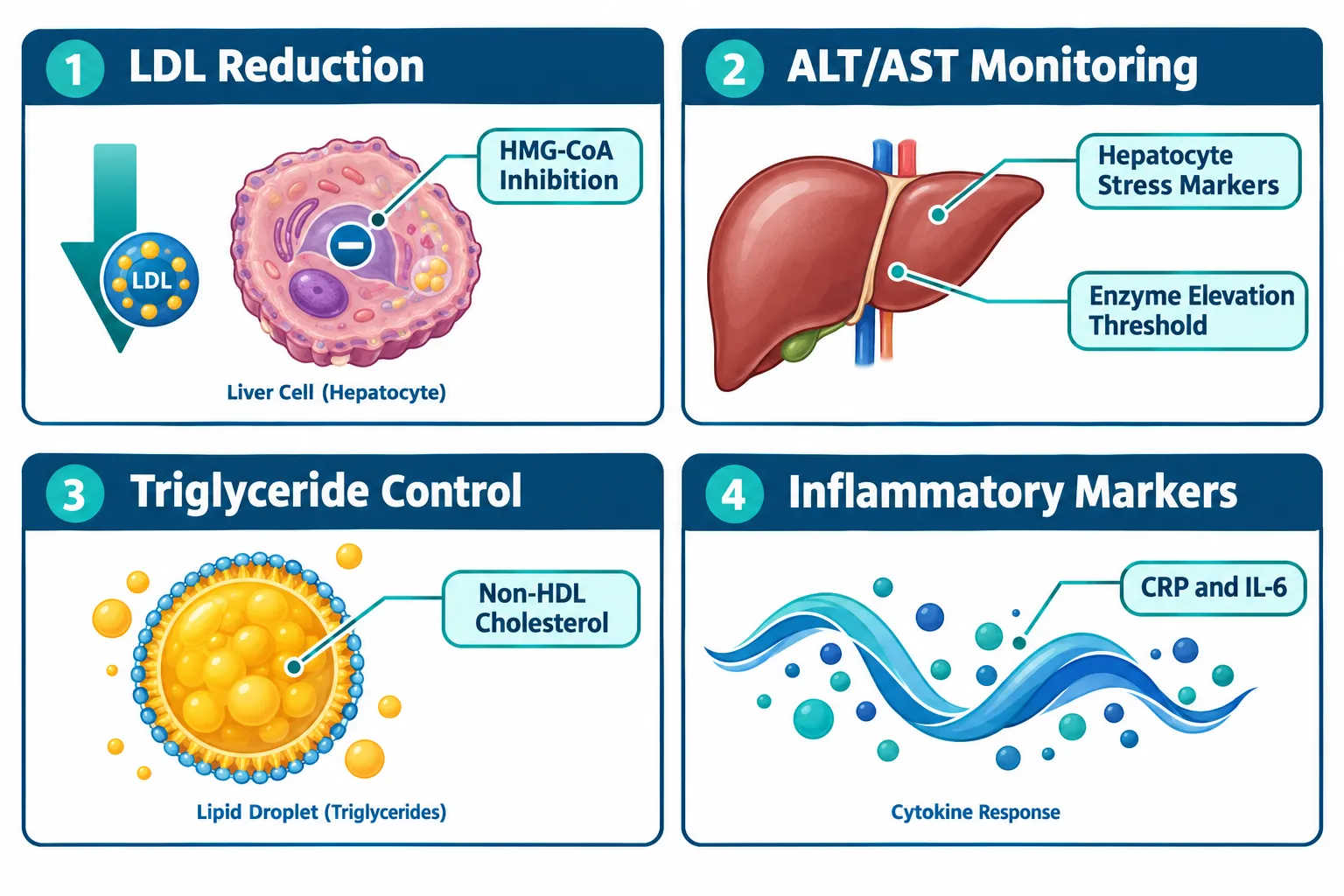
Why Atorvastatin Anchors Lipid and Liver-Control Group Design

Atorvastatin is a high-intensity HMG-CoA reductase inhibitor with a well-mapped pharmacological profile. In metabolic research, that predictability is an asset. When a study introduces a novel peptide, researchers need a control arm whose lipid and liver effects are already understood, atorvastatin provides exactly that anchor.

Key lipid biomarkers affected by atorvastatin exposure include:

  • LDL cholesterol, typically reduced 40-55% at standard research doses
  • Triglycerides, modestly lowered, relevant in high-fat diet models
  • Non-HDL cholesterol, a composite marker that captures atherogenic particle burden
  • HDL cholesterol, marginally elevated, though not the primary endpoint

On the liver side, atorvastatin is metabolized extensively through CYP3A4 hepatic pathways. This makes ALT (alanine aminotransferase) and AST (aspartate aminotransferase) critical safety and efficacy readouts in every control arm. Current evidence from 2026 confirms that atorvastatin is safe even in subjects with advanced chronic liver disease, though transient enzyme elevations can occur and must be tracked systematically.

"A control group without liver enzyme monitoring is not a control group, it is an incomplete experiment."

For NAFLD and NASH models, atorvastatin also reduces hepatic steatosis scores and portal pressure markers. This means the "normal + atorvastatin" control arm carries meaningful liver biology, not just a lipid signal.


Structuring Multi-Arm Designs for Retatrutide, MOTS-c, and 5-Amino-1MQ Studies
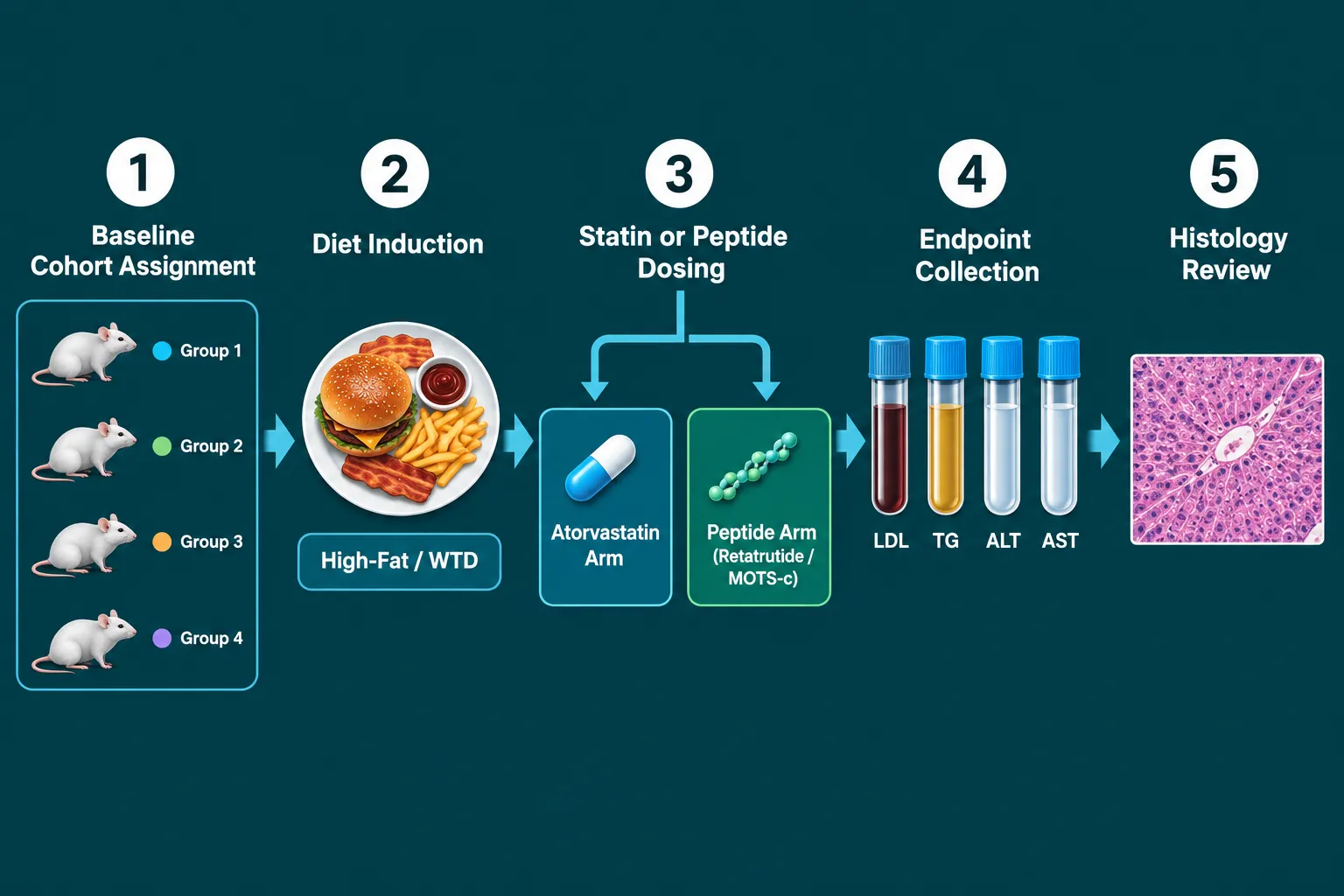
Structuring Multi-Arm Designs for Retatrutide, MOTS-c, and 5-Amino-1MQ Studies

When Atorvastatin and Research Peptides: Designing Lipid and Liver-Control Groups for Metabolic Studies are combined in a multi-arm preclinical model, the architecture of the study determines what conclusions are actually possible. A poorly structured design cannot separate statin effects from peptide effects, and that ambiguity destroys interpretive value.

Recommended Multi-Arm Framework

Arm Diet Statin Peptide Primary Readouts
Vehicle Control Standard chow None None Baseline LDL, ALT, AST
Lipid Control WTD Atorvastatin None LDL, TG, non-HDL, ALT
Peptide Arm A WTD None Retatrutide GLP receptor activity, lipids
Peptide Arm B WTD None MOTS-c Mitochondrial markers, AST
Combination Arm WTD Atorvastatin Retatrutide or MOTS-c All lipid + liver endpoints

Retatrutide targets GLP-1, GIP, and glucagon receptors simultaneously, producing meaningful reductions in body weight and triglycerides. For researchers exploring this compound, the Buy Retatrutide Peptide resource provides relevant formulation context. When placed against an atorvastatin lipid-control arm, the incremental triglyceride and non-HDL reduction attributable to retatrutide becomes statistically isolatable.

MOTS-c operates through mitochondrial AMPK activation, influencing glucose metabolism and fatty acid oxidation. Its liver effects, particularly on hepatic lipid accumulation, overlap with atorvastatin's steatosis-reducing properties. Researchers sourcing this compound can reference the Buy MOTS-c Peptide page for purity and dosing specifications. The MOTS-c Peptide Dosage Calculator is also a practical tool for designing consistent dosing protocols.

5-amino-1MQ inhibits NNMT (nicotinamide N-methyltransferase), shifting cellular metabolism toward fat oxidation. Its inflammatory marker profile, including CRP and IL-6, makes it particularly important to track alongside ALT and AST in the atorvastatin control arm, since both compounds affect hepatic inflammatory tone.

For broader context on how these peptides compare mechanistically to small-molecule drugs, the article on Polypeptide Peptides in Cardiometabolic Models provides a strong conceptual foundation.


Liver-Centric Endpoints and Inflammatory Marker Integration
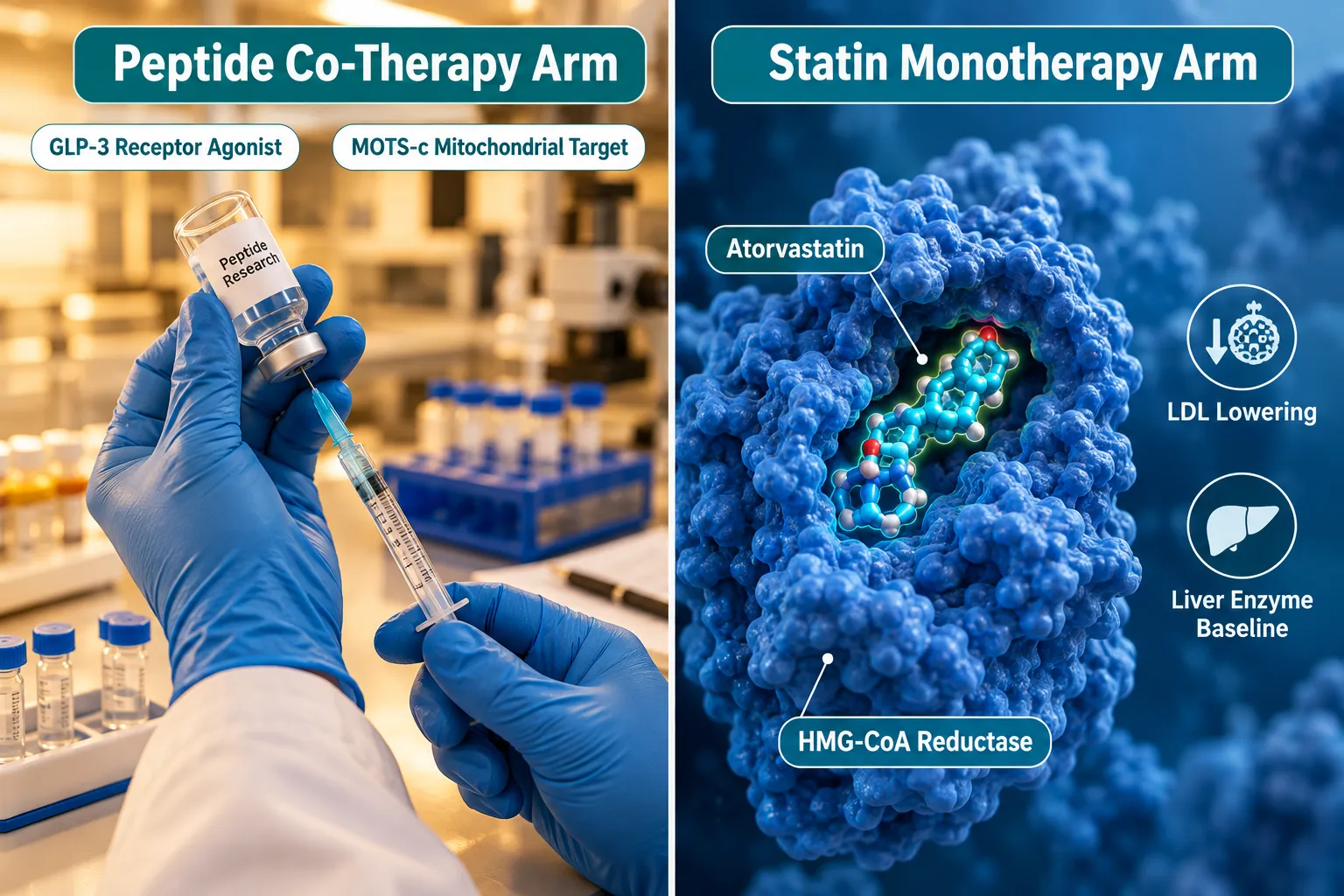
Liver-Centric Endpoints and Inflammatory Marker Integration

The most common failure in Atorvastatin and Research Peptides: Designing Lipid and Liver-Control Groups for Metabolic Studies is treating liver safety as secondary. In 2026, the evidence base has shifted firmly: liver endpoints are co-primary, not supplementary.

Liver-centric endpoints to include in every control arm:

  1. ALT and AST, tracked at baseline, mid-study, and endpoint; atorvastatin can cause transient elevations that must be distinguished from peptide-induced changes
  2. Hepatic steatosis score, histological grading from liver biopsy or MRI-based fat fraction
  3. Portal pressure markers, relevant in advanced NAFLD/NASH models
  4. Liver-to-body weight ratio, a rapid structural readout in rodent models

Inflammatory markers add a second interpretive layer. CRP, IL-6, and TNF-alpha are all modulated by atorvastatin through pleiotropic anti-inflammatory mechanisms. When a peptide like MOTS-c or GLP-3 peptide also reduces inflammatory load, the atorvastatin control arm provides the benchmark against which that reduction is measured.

Combination therapy designs, such as "phosphatidylcholine (PPC) alone" versus "PPC + atorvastatin", demonstrate how isolating statin-specific contributions requires a clean single-agent control. The same logic applies when adding SS-31 peptides to a metabolic model: the mitochondria-targeted antioxidant effects of SS-31 must be separated from atorvastatin's lipid-lowering signal through deliberate arm structure.

Monitoring schedule best practices:

  • Collect lipid panels at weeks 0, 4, 8, and 12 minimum
  • Run liver enzyme panels at the same intervals
  • Reserve histology for endpoint only (terminal in rodent models)
  • Include fasting insulin and HOMA-IR as metabolic co-endpoints

Conclusion

Designing rigorous control groups for metabolic peptide research is not a procedural formality, it is the scientific foundation on which every meaningful comparison rests. Atorvastatin's well-characterized effects on LDL, triglycerides, non-HDL cholesterol, ALT, and AST make it the most defensible lipid and liver-control comparator available for studies involving retatrutide, MOTS-c, or 5-amino-1MQ.

Actionable next steps for researchers in 2026:

  • Build a minimum five-arm design that separates vehicle, statin, peptide, and combination conditions
  • Pre-specify all liver enzyme thresholds as stopping rules and safety endpoints
  • Use Western-type diet induction as the metabolic stressor to activate both lipid and hepatic pathways
  • Align inflammatory marker panels (CRP, IL-6) with lipid and liver readouts for mechanistic depth
  • Consult formulation-specific resources for peptide purity verification before dosing begins

A well-structured control group does not slow research down, it makes the data worth publishing.

https://www.puretestedpeptides.com/wp-content/uploads/2026/10/atorvastatin-and-research-peptides-designing-lipid-and-liver-control-groups-for.webp 672 1008 https://www.puretestedpeptides.com/wp-content/uploads/2026/01/buy-peptides-online.jpg 2026-10-06 13:10:132026-10-06 13:10:13Atorvastatin and Research Peptides: Designing Lipid and Liver-Control Groups for Metabolic Studies
×

Helpful Links

  • My account
  • Cart
  • Checkout
  • Refund and Returns Policy
  • Privacy Policy
  • SMS Privacy Policy
  • Login
  • My Account
  • Logout

USA Made Lab Tested Peptides

All products are sold for research, laboratory, or analytical purposes only, and are not for human consumption


Pure Tested Peptides is a chemical supplier. Pure Tested Peptides is not a compounding / chemical compounding facility as defined under 503A of the Federal Food, Drug, and Cosmetic act. Pure Tested Peptides is not an outsourcing facility as defined under 503B of the Federal Food, Drug, and Cosmetic act.

The statements made within this website have not been evaluated by the US Food and Drug Administration. The products we offer are not intended to diagnose, treat, cure or prevent any disease.

Human/Animal Consumption Prohibited. Laboratory/In-Vitro Experimental Use Only

Scroll to top Scroll to top Scroll to top