

5-Amino-1MQ and MOTS-c: How to Design a Time-Course Study for NNMT, Mitochondrial, and Lipid-Flux Readouts
Fewer than 5% of preclinical metabolic studies that combine two mechanistically distinct agents include a formal time-course design, yet the temporal gap between acute signaling events and chronic metabolic adaptation is precisely where false-negative and false-positive interpretations cluster. Designing a rigorous time-course study for 5-Amino-1MQ and MOTS-c requires separating at least three distinct biological windows: immediate enzyme inhibition and peptide signaling, intermediate mitochondrial remodeling, and long-range lipid-flux stabilization.
This guide lays out a framework for researchers planning a 5-Amino-1MQ and MOTS-c study targeting NNMT, mitochondrial, and lipid-flux readouts, drawing on the strongest preclinical evidence available as of 2026.
Key Takeaways
- 5-Amino-1MQ inhibits nicotinamide N-methyltransferase (NNMT) selectively, raising SAM availability and shifting NAD+ metabolism within hours of dosing.
- MOTS-c is a mitochondrial-derived peptide (MDP) that activates stress-responsive kinase pathways, with exercise and diabetic models showing measurable effects across 8-week windows.
- A three-phase time-course, acute (days 1-3), adaptive (days 7-14), and chronic (days 21-28), maps each agent's dominant biological window without conflating effects.
- Tissue-specific sampling (adipose vs. skeletal muscle) is essential because NNMT expression and mitochondrial density differ substantially across compartments.
- Neither synergy nor antagonism should be assumed; the study design must include an interaction term to detect genuine combinatorial effects statistically.
Understanding the Agents: NNMT Inhibition and Mitochondrial Peptide Signaling
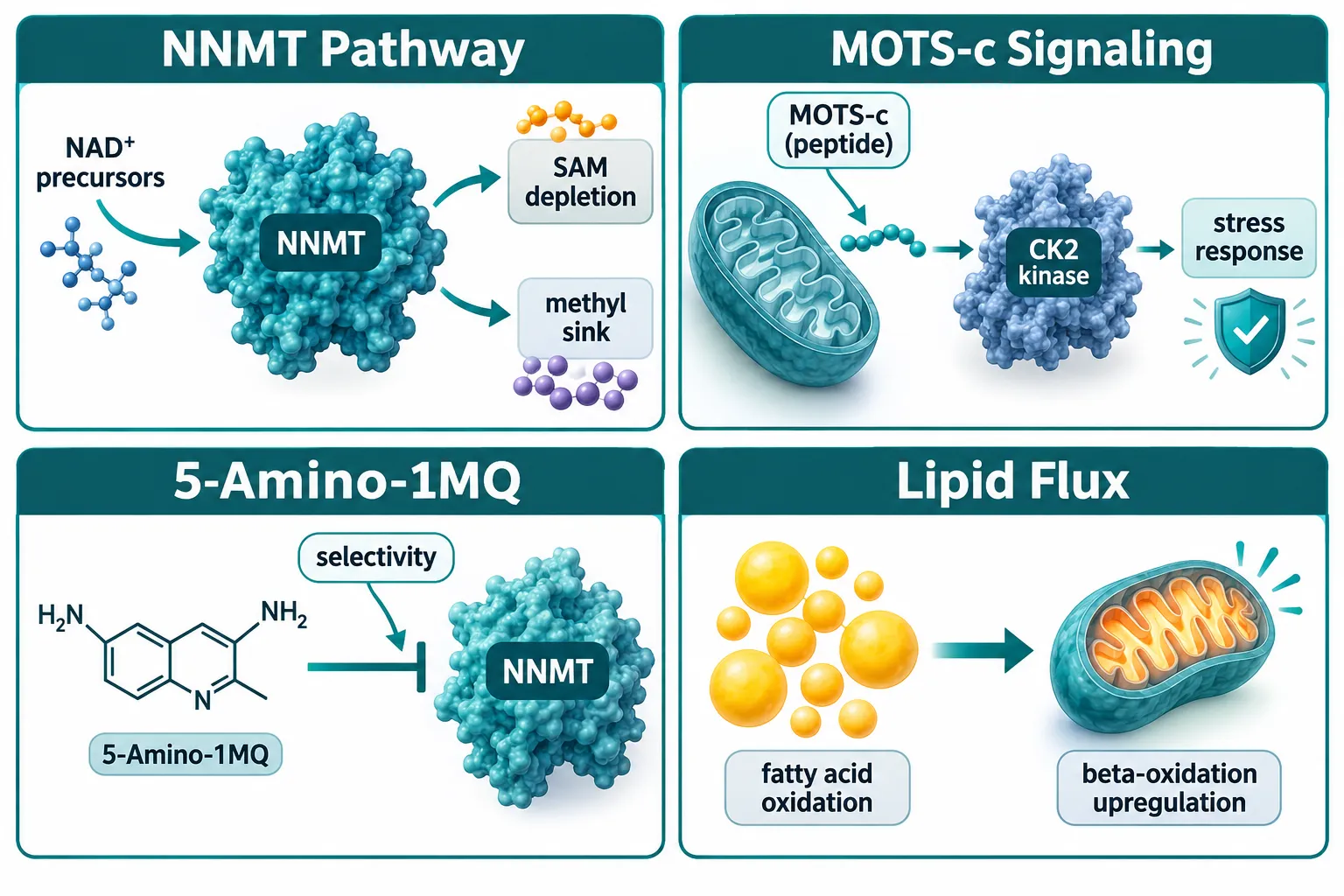
5-Amino-1MQ is a small-molecule inhibitor of NNMT, the enzyme that methylates nicotinamide using S-adenosylmethionine (SAM) as a methyl donor. When NNMT is overactive, common in obese and aging metabolic tissue, it creates a "methyl sink" that depletes SAM, suppresses epigenetic methylation, and reduces the NAD+ precursor pool. Inhibiting NNMT with 5-Amino-1MQ reverses this drain. Preclinical obesity studies using 28-30-day treatment windows have shown reductions in adiposity and improvements in metabolic markers without evidence of off-target toxicity, though the compound remains in preclinical status with no approved human indication as of 2026.
Separately, MOTS-c peptide is a 16-amino-acid peptide encoded within the mitochondrial genome. It operates through casein kinase 2 (CK2) and stress-responsive nuclear translocation, influencing AMPK pathways and insulin sensitization. Exercise models show MOTS-c levels rising within the first week and sustaining through 8-week protocols. Diabetic rodent models demonstrate that exogenous MOTS-c administration improves glucose uptake and mitochondrial respiration, though dose-response curves plateau and even invert at supraphysiological concentrations.
The two agents do not share a direct molecular target, which is precisely why a combined study demands temporal precision. NNMT inhibition alters the upstream NAD+ and methyl-donor landscape; MOTS-c acts downstream at mitochondrial stress-response nodes. These are parallel, not sequential, pathways, meaning the interaction term in any statistical model is an empirical question, not a foregone conclusion.
"The assumption of synergy between NNMT inhibitors and mitochondrial peptides is a hypothesis to test, not a premise to design around."
Researchers exploring mitochondrial peptide mechanisms may also find value in reviewing SS-31 mitochondrial research as a comparative MDP framework, since SS-31's cardiolipin-binding mechanism offers a useful contrast to MOTS-c's nuclear translocation pathway.
Designing a 5-Amino-1MQ and MOTS-c Time-Course Study for NNMT, Mitochondrial, and Lipid-Flux Readouts
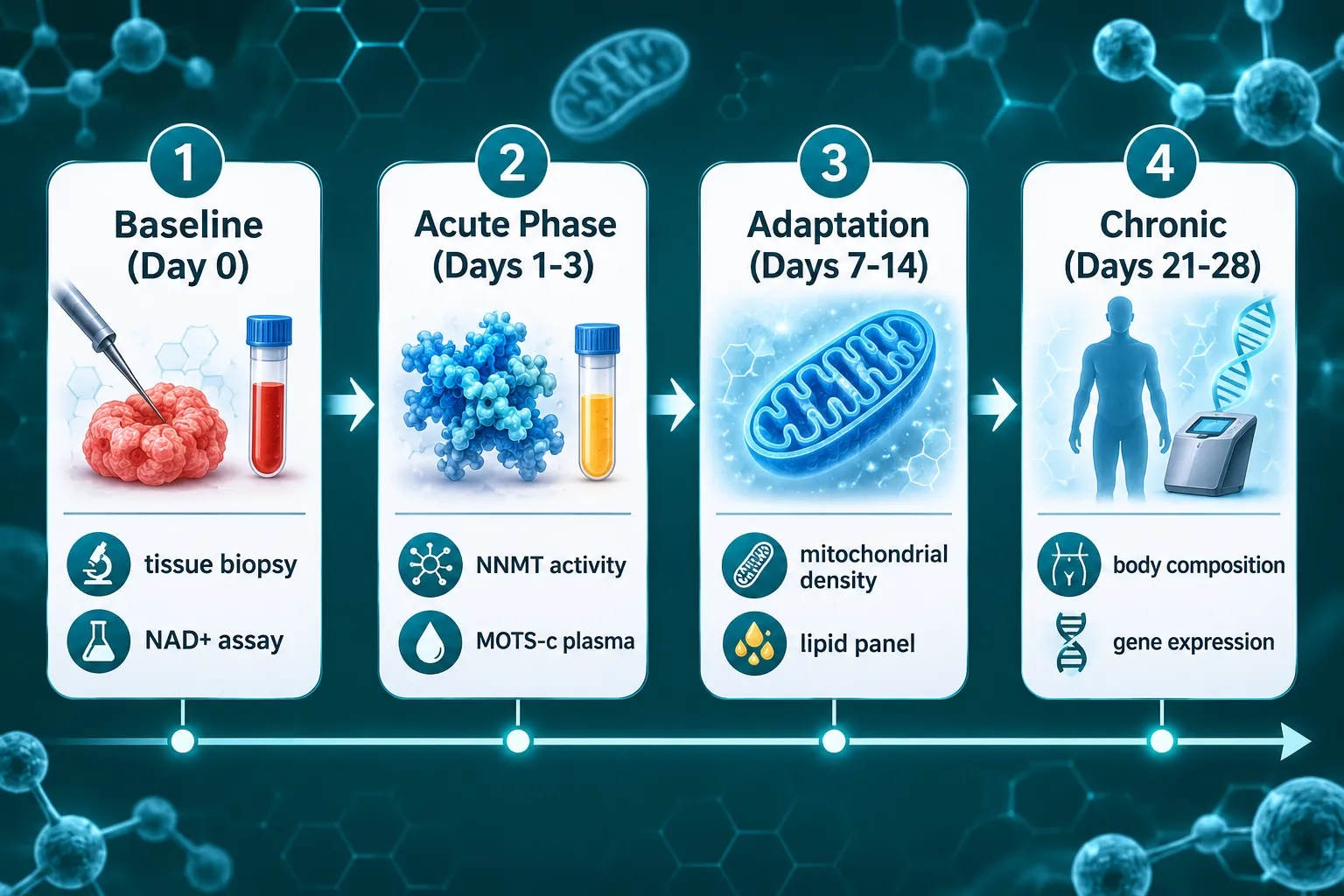
The core design principle is temporal separation. Three phases anchor the schedule:
Phase 1, Acute (Days 0-3)
- Measure baseline NNMT enzyme activity by LC-MS quantification of 1-methylnicotinamide (1-MNA) in plasma and tissue lysate.
- Assess MOTS-c plasma levels at 2h, 6h, and 24h post-first dose to characterize pharmacokinetic peaks.
- Record mitochondrial membrane potential in freshly isolated cells (adipose stromal-vascular fraction and myotubes separately).
- Key readout: Does 5-Amino-1MQ suppress 1-MNA within 24 hours? Does MOTS-c alter CK2 phosphorylation acutely?
Phase 2, Adaptive (Days 7-14)
- Measure mitochondrial biogenesis markers: PGC-1alpha mRNA, mtDNA copy number, and citrate synthase activity.
- Assess NAD+/NADH ratio, which should shift if NNMT inhibition is functionally engaged.
- Run a lipid oxidation panel: plasma free fatty acids, beta-hydroxybutyrate, and respiratory exchange ratio (RER) if using live animals.
- Key readout: Is mitochondrial density changing, and does it differ between monotherapy arms and combination?
Phase 3, Chronic (Days 21-28)
- Full body composition (MRI or DEXA in rodent models).
- Tissue-level NNMT protein expression by Western blot across liver, white adipose, and gastrocnemius.
- Targeted lipidomics: triglyceride species turnover, phospholipid remodeling, and ceramide content.
- Transcriptomic snapshot at day 28 for pathway enrichment analysis.
| Timepoint | Primary Readout | Tissue Source |
|---|---|---|
| Day 0 (baseline) | NNMT activity, MOTS-c plasma | Blood, adipose |
| Day 1-3 (acute) | 1-MNA, CK2 phosphorylation | Plasma, myotubes |
| Day 7-14 (adaptive) | PGC-1alpha, NAD+/NADH, RER | Muscle, liver |
| Day 21-28 (chronic) | Lipidomics, body composition | Adipose, whole animal |
For NAD+ pathway context, supplementary data comparing NAD500 formulations can help calibrate expected magnitude of NAD+ shifts.
Tissue-Specific Sampling and Lipid-Flux Readouts
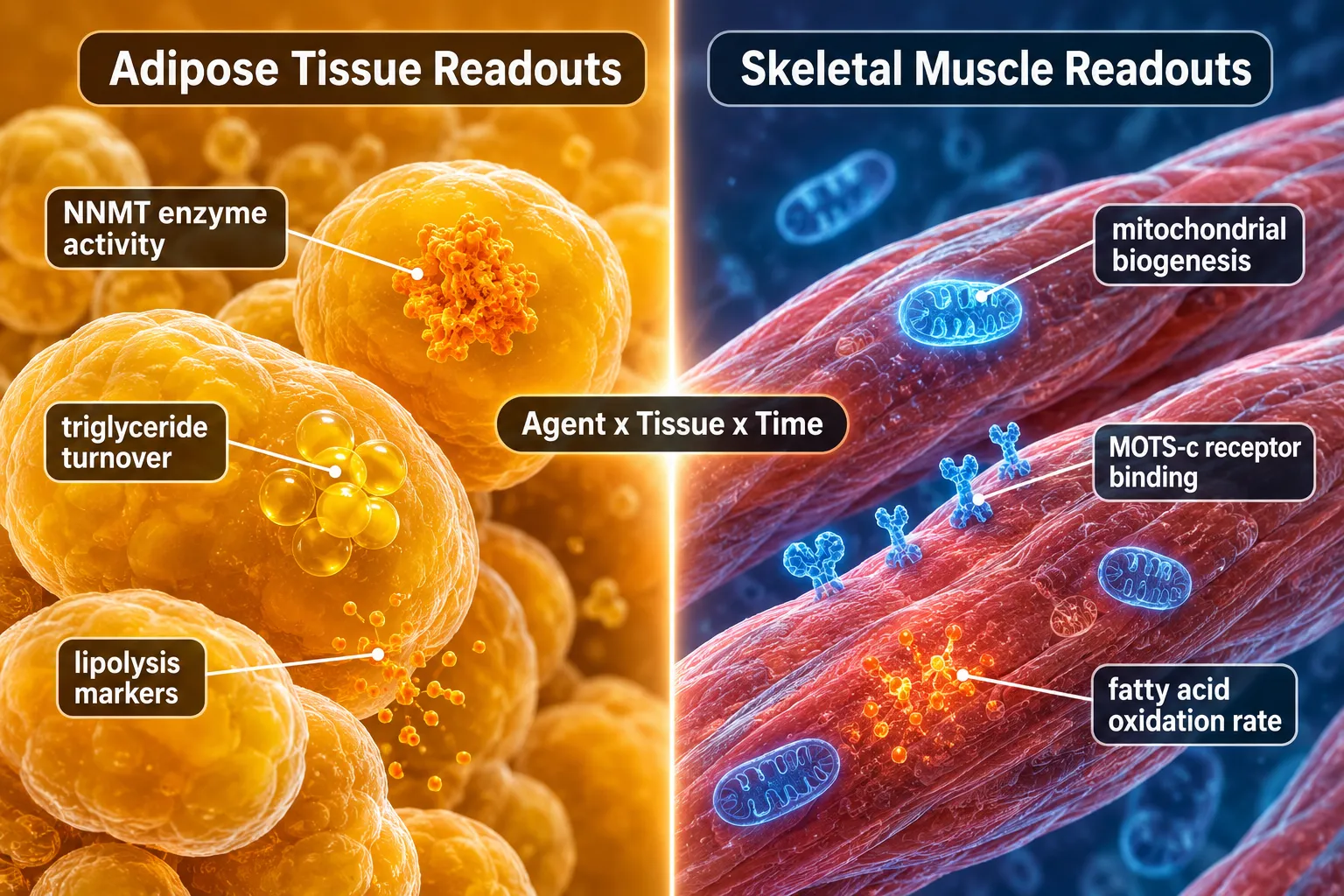
NNMT expression is not uniform across tissues. It is highest in white adipose tissue and liver, intermediate in skeletal muscle, and low in cardiac muscle. MOTS-c's targets, by contrast, are most functionally active in skeletal muscle and metabolically stressed tissue. This asymmetry means a single tissue biopsy strategy will miss the full picture.
Adipose tissue sampling priorities:
- NNMT enzyme activity (primary inhibition target)
- Triglyceride turnover rates using isotope-labeled tracers
- Lipolysis markers: HSL phosphorylation, ATGL expression
Skeletal muscle sampling priorities:
- Mitochondrial density and cristae morphology (electron microscopy at day 14 and 28)
- MOTS-c downstream targets: AMPK phosphorylation, glucose transporter 4 (GLUT4) translocation
- Fatty acid oxidation rate via palmitate oxidation assay
A four-arm design is recommended: vehicle control, 5-Amino-1MQ alone, MOTS-c alone, and combination. The statistical model must include an Agent x Tissue x Time interaction term. Without it, researchers risk attributing a tissue-specific or time-locked effect to a compound-level interaction that does not exist in another compartment or at another timepoint.
Lipid-flux readouts deserve their own measurement plan. Flux is not a snapshot; it requires serial sampling. Plasma triglyceride clearance measured at 0h, 2h, and 4h post-oral fat challenge at day 7 and day 28 provides a simple, translatable index of lipid-flux change over the course of the study. Pairing this with tissue ceramide and diacylglycerol profiling at sacrifice adds mechanistic depth without excessive cost.
For comparison context on metabolic peptides targeting visceral fat, the Adipotide 5mg line of research illustrates how adipose-targeted agents are characterized in preclinical settings. Researchers interested in broader lipid-modifying peptide comparisons may also review SS-31 peptides for sale as a mitochondria-targeted structural comparator.
Conclusion
Designing a time-course study for 5-Amino-1MQ and MOTS-c: how to design a time-course study for NNMT, mitochondrial, and lipid-flux readouts is not simply a scheduling exercise, it is a conceptual commitment to treating acute signaling, metabolic adaptation, and chronic remodeling as distinct biological phenomena that require dedicated measurement strategies.
Actionable next steps for researchers in 2026:
- Pre-register the three-phase design with explicit interaction terms before data collection begins.
- Select tissue biopsy sites based on NNMT expression atlas data, not convenience.
- Use serial lipid clearance tests (day 7 and day 28) rather than single-timepoint snapshots.
- Report all four arms independently before pooling any interaction analysis.
- Treat any combined effect, positive or negative, as hypothesis-generating for the next study, not a clinical claim.
The preclinical signal for both agents is strong. The translational gap remains real. Rigorous temporal design is the most direct way to close that gap responsibly.