Call or Text 727-513-9780
  • Shopping Cart Shopping Cart
    0Shopping Cart
Pure Tested Peptides | America's most trusted Peptides for sale online
  • Peptides for sale
    • Oral Peptides for sale
      • Peptide Capsules for sale
      • BPC 157 Capsules 1000mcg
      • SLU-PP-332 Capsules | 1000 mcg
      • 5-Amino-1MQ 50mg Capsules
      • Tesofensine 500mcg
    • All Peptides for sale
    • Peptide Sprays
      • BPC 157 Nasal Spray Kit
      • BPC-157 TB500 Nasal Spray Kit
      • Semax Nasal Spray 10mg
      • Selank – Nasal Spray Kit – 10mg
      • Epithalon 50MG Nasal Spray Kit
      • Ipamorelin 10mg Nasal Spray
      • Klow Nasal Spray (BPC-157 + TB-500 + GHK-Cu + KPV) | 80mg
      • Hulk Nasal Spray Tesa / Ipa Blend 6/3 MG
      • Klow Nasal Spray
      • NAD + 500 mg Nasal Spray
      • PT-141 Nasal Spray Kit
    • GHRH Peptides
      • Ipa Peptides
      • CJC-1295 Peptides
        • CJC-1295 with DAC 5 mg
        • CJC-1295 without DAC 5 mg
        • CJC-1295 Ipa 10mg
      • Tesa Peptides
        • Tesa Peptide
        • Tesa 20 mg
    • GHK-Cu Peptides
      • All GHK-Cu Peptides
      • GHK-Cu 100mg
      • KLOW Peptide Blend – Buy KLOW blend online
    • BPC Peptides
      • All BPC Peptides
      • BPC-157
      • BPC-157 TB-500
      • BPC 157 capsules 1000mcg
    • SLU-PP-332 Peptides
      • All SLU-PP-332 Peptides
      • SLU-PP-332 5mg
    • GLP3 Peptides
    • PT-141 Peptides
      • PT-141 Peptides for sale
      • PT-141 10mg
      • PT-141 Nasal Spray
    • CAG Peptides
      • Lipo-C Peptide Blend
      • CAG 5mg
      • CAG 10mg
    • MOTS-C Peptides
      • MOTS-C Peptides for sale
      • MOTS-c peptide
      • MOTS-c 10mg *6 pack*
    • 5 Amino 1MQ Peptides
      • 5 Amino 1MQ Peptides for sale
      • 5-Amino-1MQ 50mg Capsules
      • 5-Amino-1MQ 5mg
    • Epithalon Peptides
      • Epithalon Peptides for sale
      • Epithalon 10mg
      • Epithalon 50mg
  • Shop
    • GLPs
      • 5-Amino-1MQ 50mg Capsules
      • 5-Amino-1MQ 5mg
      • L-Carnitine 500mg/ml
      • Tesofensine 500mcg
      • SLU-PP-332 5mg
      • MOTS-c 10mg *6 pack*
    • Epithalon & BPC Peptides
      • Epithalon 10mg
      • Epithalon 50mg
      • BPC-157
      • BPC 157 capsules 1000mcg
      • BPC-157 TB-500
      • BPC-157 TB500 Nasal Spray Kit
      • BPC 157 Nasal Spray Kit
    • BPC TB-500 & NAD+ Peptides
      • NAD+ 500 mg
      • KLOW Peptide Blend – Buy KLOW blend online
      • GLOW Peptide Blend
      • TB 500 5mg
      • BPC 157 capsules 1000mcg – Supplement
      • BPC 157 Nasal Spray Kit
      • BPC-157
      • BPC-157 TB500 Nasal Spray Kit
      • BPC-157 TB-500
      • BPC 157 capsules 1000mcg
    • LL-37 Peptide
      • LL-37 10 mg
    • MOTS-C & Selank
      • MOTS-c peptide
      • Selank 10mg
    • GHK Peptides
      • GHK-Cu 100mg
      • GLOW Peptide Blend
      • KLOW Peptide Blend – Buy KLOW blend online
  • COAs
  • Wholesale
    • Wholesale Peptides for sale
  • PTP FAQ
  • Affiliates
    • Selank Peptide: Advanced Pharmacological Mechanisms Underlying Its Anxiolytic and Nootropic Effects in Research
      • 5-Amino-1MQ Peptide: Detailed Mechanisms of NNMT Inhibition and Its Impact on Cellular Metabolism Research
        • MOTS-C Peptide: Unraveling Its Role in Mitochondrial Dynamics and Energy Metabolism Research
          • Epithalon Peptide and Telomerase Regulation: Investigating Its Impact on Cellular Senescence and Lifespan Research Models
            • GLP2-T vs GLP2 Tirz Peptide: Understanding the Naming, Mechanistic Nuances, and Research Implications for Gut Health
      • Peptides and Polypeptides in Modern Pharmacology: What Research on Metoprolol, Prednisone, and Amlodipine Reveals
        • Polypeptide Peptides vs NSAIDs: What Naproxen and Diclofenac Teach Tissue-Repair Researchers About BPC‑157 and TB‑500
          • Peptides and Polypeptides in Endocrine Pharmacology: How GLP-1, GLP-2, and GLP-3 Retatrutide Differ From Classic Drugs Like Prednisone and Amlodipine
          • 5‑Amino‑1MQ Peptide and NNMT Inhibition: How It Compares With Statins Like Atorvastatin in Adipose and Lipid Metabolism Research
      • Enclomiphene, Estrogen Receptor Signaling, and Luteinizing Phase Biology: What Hormone Researchers Should Measure
        • Mesenchymal Stem Cells, BPC‑157, and GHK‑Cu: How Tissue Repair Peptides Compare With Classic NSAIDs Like Naproxen in Injury Models
          • Peptide Calculator Use Cases Beyond Growth Hormone: Working Through GLP‑3 Retatrutide, MOTS‑c, and BPC‑157 Research Dosing
        • Polypeptide Peptides in Endocrine and Metabolic Pharmacology: Lessons From Amlodipine, Prednisone, and Metoprolol
        • Peptides Calculator for Advanced Blends: Worked Examples for Tesamorelin, CJC‑1295, and Ipamorelin Stacks
          • Peptides and Polypeptides in Human Physiology: How Molecular Size Shapes Research Applications
            • Selank Peptide: Advanced Pharmacological Mechanisms Underlying Its Anxiolytic and Nootropic Effects in Research
          • 5-Amino-1MQ Peptide: Detailed Mechanisms of NNMT Inhibition and Its Impact on Cellular Metabolism Research
            • MOTS-C Peptide: Unraveling Its Role in Mitochondrial Dynamics and Energy Metabolism Research
              • Epithalon Peptide and Telomerase Regulation: Investigating Its Impact on Cellular Senescence and Lifespan Research Models
                • GLP2-T vs GLP2 Tirz Peptide: Understanding the Naming, Mechanistic Nuances, and Research Implications for Gut Health
                  • Peptides and Polypeptides in Endocrine Pharmacology: How GLP-1, GLP-2, and GLP-3 Retatrutide Differ From Classic Drugs Like Prednisone and Amlodipine
                    • Polypeptide Peptides vs NSAIDs: What Naproxen and Diclofenac Teach Tissue-Repair Researchers About BPC‑157 and TB‑500
                      • Peptides and Polypeptides in Modern Pharmacology: What Research on Metoprolol, Prednisone, and Amlodipine Reveals
                        • 5‑Amino‑1MQ Peptide and NNMT Inhibition: How It Compares With Statins Like Atorvastatin in Adipose and Lipid Metabolism Research
                        • Enclomiphene, Estrogen Receptor Signaling, and Luteinizing Phase Biology: What Hormone Researchers Should Measure
                        • Mesenchymal Stem Cells, BPC‑157, and GHK‑Cu: How Tissue Repair Peptides Compare With Classic NSAIDs Like Naproxen in Injury Models
                        • Peptide Calculator Use Cases Beyond Growth Hormone: Working Through GLP‑3 Retatrutide, MOTS‑c, and BPC‑157 Research Dosing
                        • Polypeptide Peptides in Endocrine and Metabolic Pharmacology: Lessons From Amlodipine, Prednisone, and Metoprolol
                        • Peptides Calculator for Advanced Blends: Worked Examples for Tesamorelin, CJC‑1295, and Ipamorelin Stacks
                        • Peptides and Polypeptides in Human Physiology: How Molecular Size Shapes Research Applications
                        • Selank Peptide: Advanced Pharmacological Mechanisms Underlying Its Anxiolytic and Nootropic Effects in Research
                        • MOTS-C Peptide: Unraveling Its Role in Mitochondrial Dynamics and Energy Metabolism Research
                        • Peptides and Polypeptides in Modern Pharmacology: What Research on Metoprolol, Prednisone, and Amlodipine Reveals
                        • Peptides and Polypeptides in Endocrine Pharmacology: How GLP-1, GLP-2, and GLP-3 Retatrutide Differ From Classic Drugs Like Prednisone and Amlodipine
                        • 5-Amino-1MQ Peptide: Detailed Mechanisms of NNMT Inhibition and Its Impact on Cellular Metabolism Research
                        • Mesenchymal Stem Cells, BPC‑157, and GHK‑Cu: How Tissue Repair Peptides Compare With Classic NSAIDs Like Naproxen in Injury Models
                        • Peptide Calculator Use Cases Beyond Growth Hormone: Working Through GLP‑3 Retatrutide, MOTS‑c, and BPC‑157 Research Dosing
                        • GLP2-T vs GLP2 Tirz Peptide: Understanding the Naming, Mechanistic Nuances, and Research Implications for Gut Health
                        • Polypeptide Peptides in Endocrine and Metabolic Pharmacology: Lessons From Amlodipine, Prednisone, and Metoprolol
                        • Polypeptide Peptides vs NSAIDs: What Naproxen and Diclofenac Teach Tissue-Repair Researchers About BPC‑157 and TB‑500
                        • Peptides and Polypeptides in Human Physiology: How Molecular Size Shapes Research Applications
                        • Peptides Calculator for Advanced Blends: Worked Examples for Tesamorelin, CJC‑1295, and Ipamorelin Stacks
                        • 5‑Amino‑1MQ Peptide and NNMT Inhibition: How It Compares With Statins Like Atorvastatin in Adipose and Lipid Metabolism Research
                        • Enclomiphene, Estrogen Receptor Signaling, and Luteinizing Phase Biology: What Hormone Researchers Should Measure
                        • Epithalon Peptide and Telomerase Regulation: Investigating Its Impact on Cellular Senescence and Lifespan Research Models
                        • Best research protocol Klow blend
                        • best time to take BPC-157
                        • best time to take DSIP (Delta Sleep Inducing Peptide)
                        • best time to take CJC-1295
                        • best time to take AOD-9604
                        • best time to take Follistatin 344
                        • best time to take Ipamorelin
                        • best time to take MK-677 (Ibutamoren)
                        • best time to take Ligandrol (LGD-4033) — research compound
                        • best time to take Ostarine (MK-2866) — research compound
                        • best time to take GHK-CU
                        • best time to take TB-500
                        • best time to take MOTS-c
                        • best time to take Semax
                        • best time to take RAD-140 (Testolone) — research compound
                        • best time to take Thymosin Alpha-1
                        • best time to take PEG-MGF
                        • Biolife Plasma, Octapharma Plasma, and Research Peptides: How Plasma Donation Labs Differ From Peptide Suppliers
                        • best time to take YK-11 — research compound
                        • best time to take PT-141 (Bremelanotide)
                        • Best research protocol Klow blend
                        • 5-Amino-1MQ and MOTS-C Synergy: Metabolic Signaling, Mitochondria, and Research Design
                        • BPC-157 and TB-500: Investigating Their Combined Effects on Angiogenesis and Cellular Migration in Tissue Repair Models
                        • BPC-157 Peptide: Gut Barrier Function, Inflammation, and Tissue-Recovery Research
                        • 5‑Amino‑1MQ and MOTS‑c Synergy in Metabolic Research: Designing NNMT and Mitochondrial Biogenesis Stacks
                        • CJC-1295 with DAC vs. Without DAC: Half-Life, Release Kinetics, and Research Implications
                        • CJC‑1295 with DAC vs. Without DAC: Expanding on Half‑Life Differences Using Tesamorelin and Ipamorelin Blend Case Studies
                        • Collagen Biology and Copper‑Binding Peptides: How GHK‑Cu, Glow Blend, and Klow Blend Interact with Skin and Connective Tissue
                        • Collagen Biology and Regenerative Peptides: How GHK‑Cu, Glow Blend, and Klow Blend Affect Extracellular Matrix Research
                    • DNA, Telomeres, and Longevity Peptides: Positioning Epithalon and MOTS‑c in Genetic Aging Research
                      • Enclomiphene Citrate: serm Mechanism, Testosterone Research, and Stack Compatibility
                        • Enclomiphene vs Enclomiphene Citrate: Formulation, Bioavailability, and Research Distinctions
                        • Epithalon Peptide Research: Telomerase Activation, Aging, and Pineal Gland Function
                        • Estrogen Receptor Signaling and Enclomiphene: How Selective Modulators Compare with Classic Polypeptide Hormones
                        • GHK-Cu Peptide: Advanced Mechanisms in Extracellular Matrix Remodeling and Wound Healing Research
                        • GHK-Cu Peptide: Collagen Synthesis, Wound Repair, and Skin-Barrier Research Models
                        • GLP-1 vs GLP-3 vs GLP-2: Peptide Classification and Research Applications
                        • GLP-2 Peptide Research Guide: Gut Barrier Function, Nutrient Absorption, and Intestinal Recovery Models
                        • GLP-3 Retatrutide vs. GLP-1 Drugs: What Triple-Agonist Biology Changes in Research Models
                        • Ipamorelin and Tesamorelin Combination: Synergistic GH Secretagogue Research and Dosing Protocols
                        • GLP2 Tirz Peptide: What It Is, Why the Name Exists, and How Researchers Should Interpret It
                        • Klow Blend Peptide Nasal Spray: What the Formulation Is Trying to Do in Cognitive Research
                        • Mitochondria, NNMT Inhibition, and Peptide Modulators: Where MOTS‑c and 5‑Amino‑1MQ Fit in Cellular Energy Research
                        • MOTS-c Peptide: Mitochondrial Function, Energy Metabolism, and What Researchers Measure
                        • MOTS-c vs. 5-Amino-1MQ: Which Metabolic Research Questions Each Compound Actually Answers
                        • Nasal Spray Peptides: Bioavailability, Administration, and Semax/Selank Research Applications
                        • PT-141 Peptide Research: Mechanism of Action and Melanocortin Receptor Signaling
                        • Retatrutide for Research: Mechanism, Structure, and GLP-1/GLP-3 Dual Action
                        • Retatrutide for Obesity and Type 2 Diabetes: What the Latest Trial Data Suggest
                        • Tesofensine Peptide Research: Mechanism, Appetite Suppression, and Neuropeptide Y Pathways
  • Contact
    • Contact Customer Service
    • Text Customer Support
  • About US
  • Shop all peptides
  • Affiliate Program
    • Affiliate Signup
  • Login / Register Login / Register Page Link Login / Register Page Link
  • Click to open the search input field Click to open the search input field Search
  • Menu Menu

Tag Archive for: vehicle-control design

Phosphate-Buffered Saline for Peptide Research: Osmolality, pH Drift, and Vehicle-Control Design

Phosphate-Buffered Saline for Peptide Research: Osmolality, pH Drift, and Vehicle-Control Design

October 5, 2026/0 Comments/in Uncategorized/by

Fewer than half of published peptide studies explicitly report the osmolality of their vehicle solution, yet that single omission can invalidate injection-site comparisons, confound receptor-binding data, and mask sequence-specific degradation. Getting phosphate-buffered saline for peptide research right, from osmolality and pH drift to vehicle-control design, is not a minor procedural detail. It is a foundational experimental decision.

Key Takeaways

  • Standard 1X PBS at pH 7.4 with an osmolality of 280-315 mOsm/kg is isotonic with plasma and appropriate for most short-term peptide assays.
  • pH drift during storage, not osmolality alone, is the primary driver of hydrolysis and deamidation in PBS-stored peptides.
  • PBS is not universally recommended as a primary reconstitution medium; marginally soluble or deamidation-prone peptides may need alternative buffers.
  • Vehicle controls must match the active peptide solution in both PBS formulation and osmolality to isolate pharmacologic effects.
  • Peptides reconstituted in PBS typically have a working shelf life of one to four weeks at 4 degrees C, depending on sequence sensitivity.

PBS Composition, Osmolality, and Why Isotonicity Matters

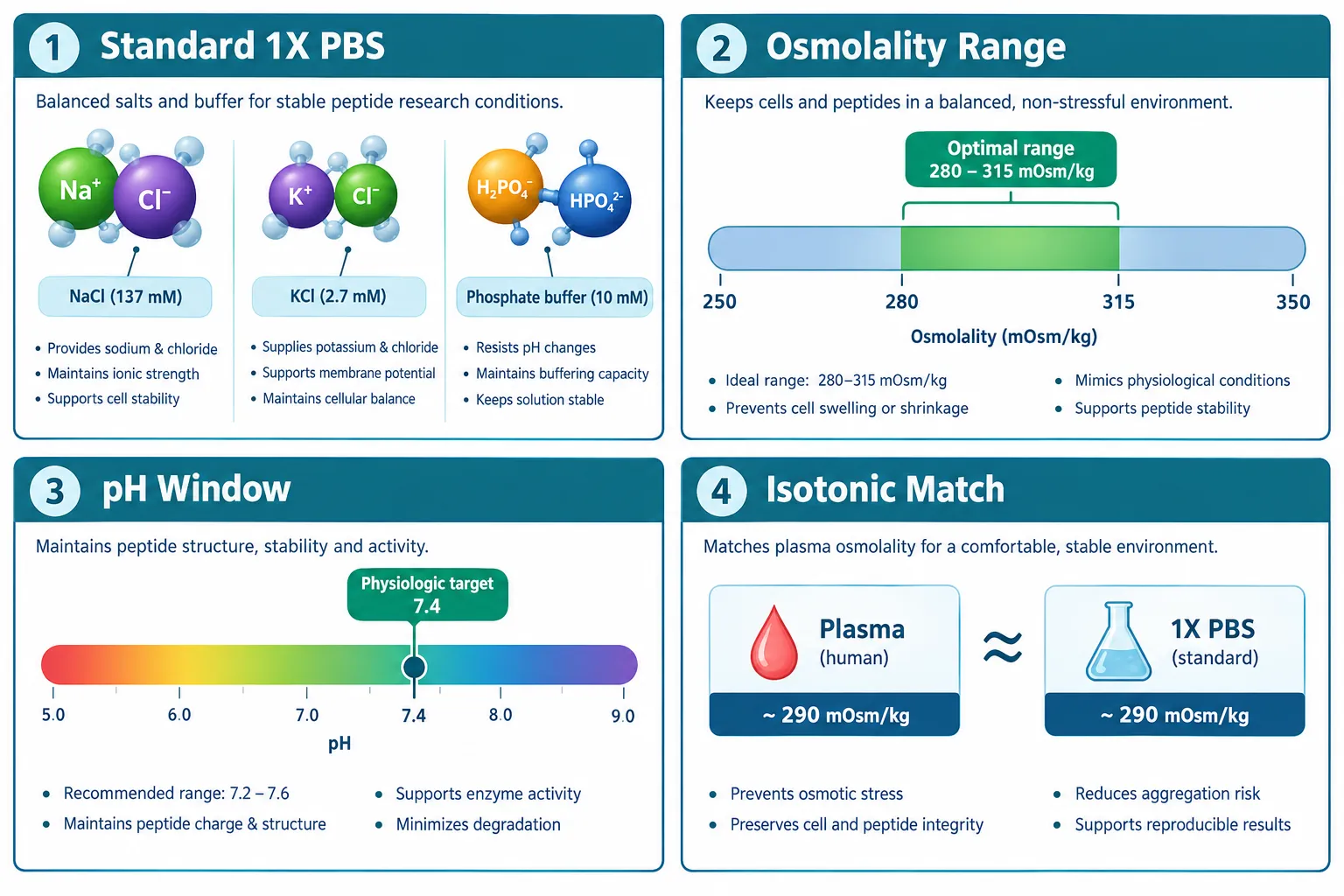
Standard 1X PBS used in peptide work contains approximately 137 mM NaCl, 2.7 mM KCl, and a 10 mM phosphate buffer. Together, these components yield an osmolality in the 280-315 mOsm/kg range, which closely mirrors physiological plasma osmolality. Modern commercial PBS products marketed specifically for peptide and cellular assays now explicitly specify osmolality around 290-310 mOsm/kg, framing this as "physiological osmotic conditions" rather than leaving it as an implied property.
PBS Composition, Osmolality, and Why Isotonicity Matters

Why does osmolality matter so much? Hypo-osmotic vehicles cause cells to swell; hyperosmotic vehicles cause shrinkage. Both alter membrane permeability and local pharmacokinetics at injection sites, introducing confounding variables that have nothing to do with the peptide being studied. A diluent-selection review from 2026 notes that vehicles outside the 280-300 mOsm/kg window are associated with increased injection-site irritation and altered local peptide uptake. For researchers sourcing peptides such as those reviewed in resources covering GH analogue peptides or SS-31 mitochondrial research themes, matching vehicle osmolality to the physiologic range is a prerequisite for clean data.

Practical osmolality checklist:

Parameter Target Value Risk if Outside Range
Osmolality 280-315 mOsm/kg Injection-site irritation, altered PK
pH 7.4 (± 0.1) Hydrolysis, deamidation, aggregation
NaCl concentration ~137 mM Precipitation for low-solubility peptides
Phosphate buffer ~10 mM Catalytic hydrolysis at higher concentrations

pH Drift in PBS: The Hidden Stability Risk

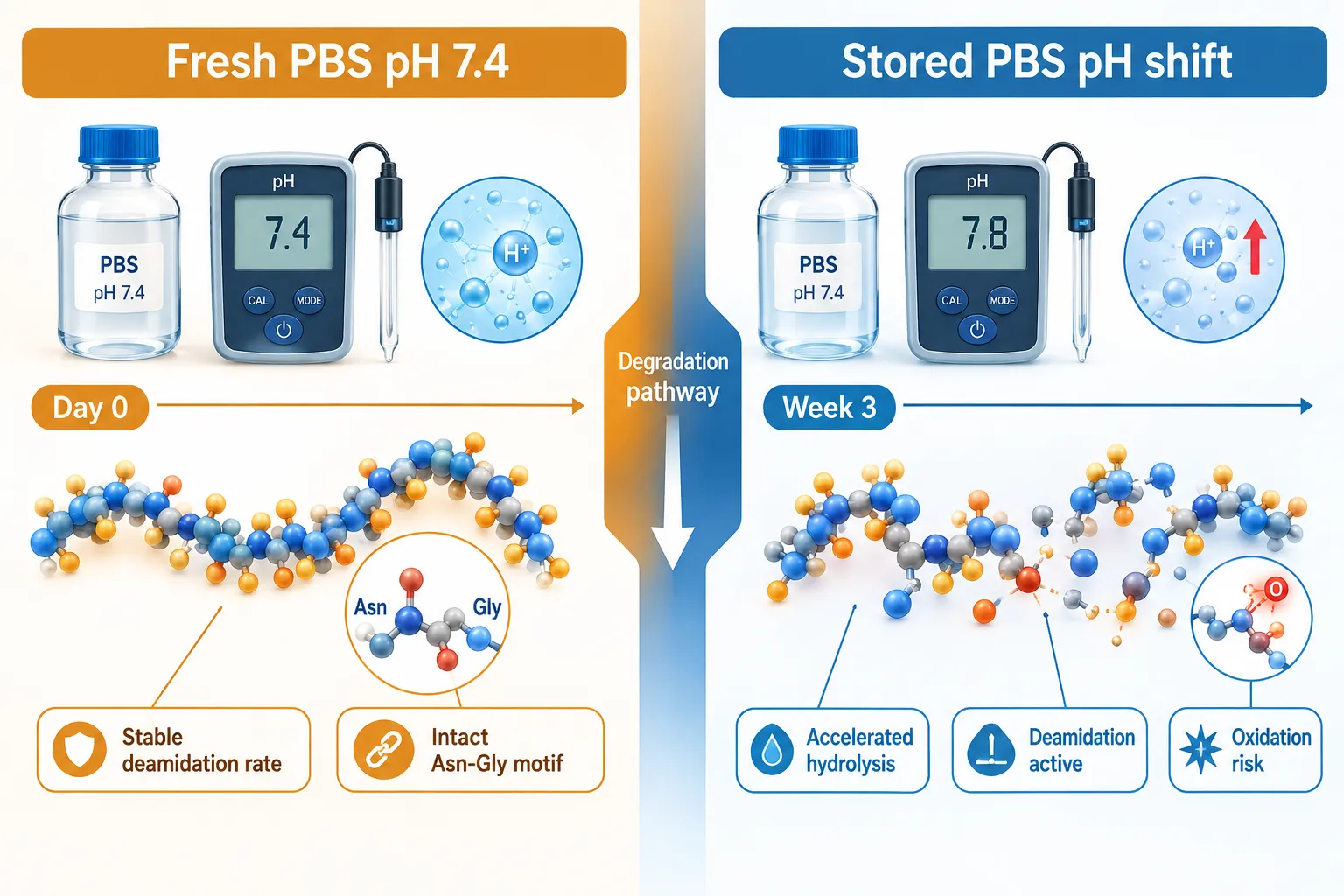
Osmolality sets the stage, but pH drift is the real antagonist in long-term peptide storage. PBS provides good initial pH control at 7.4, yet gradual drift during storage can accelerate hydrolysis, deamidation, and oxidation independently of osmolality. Even a shift of 0.2-0.3 pH units can materially shorten the working-stock stability of sensitive sequences.
pH Drift in PBS: The Hidden Stability Risk

The mechanism is specific. Phosphate buffers at physiologic pH promote general acid-base catalysis. Deamidation of asparagine-containing peptides, particularly those with Asn-Gly motifs, proceeds measurably faster in phosphate buffer than in unbuffered water at the same nominal pH. This means that even a well-prepared PBS stock does not offer indefinite protection.

"Peptides reconstituted in PBS typically have a working shelf life of about one to four weeks at 4 degrees C, depending on sequence and susceptibility to hydrolysis or deamidation."

Sequences at elevated risk in PBS:

  • Peptides containing Asn-Gly motifs (deamidation-prone)
  • Methionine-containing peptides (oxidation risk)
  • Peptides with labile ester or amide bonds (hydrolysis risk)
  • Marginally soluble peptides with high ionic-strength sensitivity

For researchers working with complex peptide formulations, such as those described in the polypeptide peptides in cardiometabolic models overview, understanding these sequence-specific risks before committing to PBS as a vehicle is essential.

When to consider alternatives to PBS:

  • Deamidation-prone sequences: histidine buffer (pH 5.5-7) or acetate buffer (pH 3.5-5.5)
  • Long-term storage beyond four weeks: reduced-phosphate or non-phosphate formulations
  • Marginally soluble peptides: HEPES-buffered saline or low-salt alternatives
  • Peptides with metal-binding motifs: avoid PBS due to phosphate-divalent cation interactions

Vehicle-Control Design Using Phosphate-Buffered Saline for Peptide Research

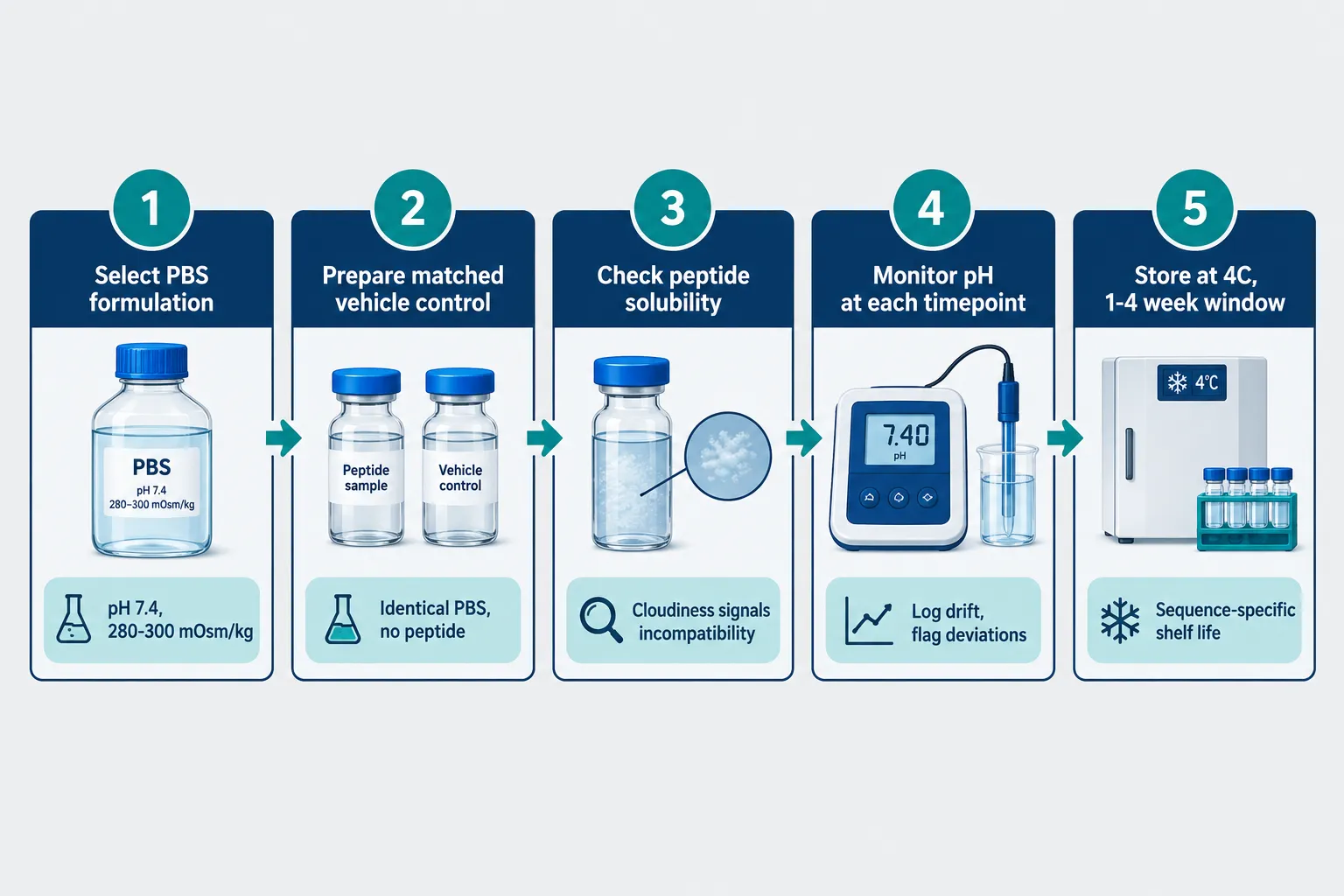
Designing a proper vehicle control is where phosphate-buffered saline for peptide research moves from chemistry into experimental rigor. The vehicle control must be identical to the active peptide solution in every parameter except the presence of the peptide itself. That means matching pH, osmolality, buffer concentration, and preparation method, not simply using "PBS" as a generic label.
Vehicle-Control Design Using Phosphate-Buffered Saline for Peptide Research

Core principles for matched vehicle-control design:

  1. Use the same PBS lot for both vehicle control and active peptide solution to eliminate batch-to-batch variability.
  2. Verify osmolality of both solutions with an osmometer before use; do not rely solely on calculated values.
  3. Monitor pH at each experimental timepoint, not just at preparation. Log any drift and flag deviations exceeding 0.1 pH units.
  4. Check solubility visually after adding PBS to the peptide. Cloudiness or particulate formation signals incompatibility; switch to an alternative buffer rather than proceeding.
  5. Store vehicle control under identical conditions, same temperature, same container type, same light exposure, as the peptide solution.

Researchers sourcing peptides from a best peptide supplier should request certificate-of-analysis data that includes solubility recommendations, as these directly inform whether PBS is an appropriate vehicle for a given sequence.

For studies involving receptor-binding assays, cell-based models, or preclinical in vivo work, including research with peptides such as those discussed in resources on where to buy research-grade Glow Blend peptide, a matched PBS vehicle control at pH 7.4 and 280-300 mOsm/kg remains the standard baseline. Deviating from this standard without documentation introduces uncontrolled variables that reviewers and regulatory bodies will flag.

Buffer alternatives at a glance:

Buffer pH Range Best Use Case
PBS (pH 7.4) 6.8-7.6 Cell-based assays, receptor binding, short-term in vivo
HEPES-buffered saline 7.0-7.6 High ionic-strength-sensitive peptides
Histidine buffer 5.5-7.0 Deamidation-prone sequences, formulation stability
Acetate buffer 3.5-5.5 Acidic-pH stability studies

Expert consensus in 2026 points toward conditional PBS use with tighter experimental controls, not abandonment. PBS remains the appropriate vehicle for physiologic, short-duration experiments where its osmolality and pH profile are genuine advantages. The movement is toward tailored buffer systems for long-term storage and sequence-specific challenges, with PBS retained as the default for well-characterized, water-soluble peptides in cell culture and receptor-binding contexts. Researchers exploring newer peptide classes, including those reviewed in the SLUPP332 oral versus injectable research discussion, will find that route of administration adds another layer of vehicle-selection complexity that PBS alone may not address.


Conclusion

Phosphate-buffered saline for peptide research remains a cornerstone vehicle, but it demands deliberate selection rather than default use. The practical steps are clear: verify osmolality falls within 280-315 mOsm/kg, confirm pH at 7.4 before and during storage, monitor for pH drift that accelerates deamidation and hydrolysis, and design vehicle controls that are compositionally identical to the active solution. For deamidation-prone, marginally soluble, or metal-binding peptides, pivot to histidine, acetate, or HEPES-based buffers before data collection begins rather than after anomalies appear. Document every parameter, use the same PBS lot across all arms of a study, and treat visible precipitation as a hard incompatibility signal. These steps will protect data integrity, reduce confounding, and produce vehicle-control comparisons that hold up to scrutiny.

https://www.puretestedpeptides.com/wp-content/uploads/2026/10/phosphate-buffered-saline-for-peptide-research-osmolality-ph-drift-and-vehicle-c.webp 1024 1536 https://www.puretestedpeptides.com/wp-content/uploads/2026/01/buy-peptides-online.jpg 2026-10-05 13:04:002026-10-05 13:04:00Phosphate-Buffered Saline for Peptide Research: Osmolality, pH Drift, and Vehicle-Control Design
×

Helpful Links

  • My account
  • Cart
  • Checkout
  • Refund and Returns Policy
  • Privacy Policy
  • SMS Privacy Policy
  • Login
  • My Account
  • Logout

USA Made Lab Tested Peptides

All products are sold for research, laboratory, or analytical purposes only, and are not for human consumption


Pure Tested Peptides is a chemical supplier. Pure Tested Peptides is not a compounding / chemical compounding facility as defined under 503A of the Federal Food, Drug, and Cosmetic act. Pure Tested Peptides is not an outsourcing facility as defined under 503B of the Federal Food, Drug, and Cosmetic act.

The statements made within this website have not been evaluated by the US Food and Drug Administration. The products we offer are not intended to diagnose, treat, cure or prevent any disease.

Human/Animal Consumption Prohibited. Laboratory/In-Vitro Experimental Use Only

Scroll to top Scroll to top Scroll to top