Call or Text 727-513-9780
  • Shopping Cart Shopping Cart
    0Shopping Cart
Pure Tested Peptides | America's most trusted Peptides for sale online
  • Peptides for sale
    • Oral Peptides for sale
      • Peptide Capsules for sale
      • BPC 157 Capsules 1000mcg
      • SLU-PP-332 Capsules | 1000 mcg
      • 5-Amino-1MQ 50mg Capsules
      • Tesofensine 500mcg
    • All Peptides for sale
    • Peptide Sprays
      • BPC 157 Nasal Spray Kit
      • BPC-157 TB500 Nasal Spray Kit
      • Semax Nasal Spray 10mg
      • Selank – Nasal Spray Kit – 10mg
      • Epithalon 50MG Nasal Spray Kit
      • Ipamorelin 10mg Nasal Spray
      • Klow Nasal Spray (BPC-157 + TB-500 + GHK-Cu + KPV) | 80mg
      • Hulk Nasal Spray Tesa / Ipa Blend 6/3 MG
      • Klow Nasal Spray
      • NAD + 500 mg Nasal Spray
      • PT-141 Nasal Spray Kit
    • GHRH Peptides
      • Ipa Peptides
      • CJC-1295 Peptides
        • CJC-1295 with DAC 5 mg
        • CJC-1295 without DAC 5 mg
        • CJC-1295 Ipa 10mg
      • Tesa Peptides
        • Tesa Peptide
        • Tesa 20 mg
    • GHK-Cu Peptides
      • All GHK-Cu Peptides
      • GHK-Cu 100mg
      • KLOW Peptide Blend – Buy KLOW blend online
    • BPC Peptides
      • All BPC Peptides
      • BPC-157
      • BPC-157 TB-500
      • BPC 157 capsules 1000mcg
    • SLU-PP-332 Peptides
      • All SLU-PP-332 Peptides
      • SLU-PP-332 5mg
    • GLP3 Peptides
    • PT-141 Peptides
      • PT-141 Peptides for sale
      • PT-141 10mg
      • PT-141 Nasal Spray
    • CAG Peptides
      • Lipo-C Peptide Blend
      • CAG 5mg
      • CAG 10mg
    • MOTS-C Peptides
      • MOTS-C Peptides for sale
      • MOTS-c peptide
      • MOTS-c 10mg *6 pack*
    • 5 Amino 1MQ Peptides
      • 5 Amino 1MQ Peptides for sale
      • 5-Amino-1MQ 50mg Capsules
      • 5-Amino-1MQ 5mg
    • Epithalon Peptides
      • Epithalon Peptides for sale
      • Epithalon 10mg
      • Epithalon 50mg
  • Shop
    • GLPs
      • 5-Amino-1MQ 50mg Capsules
      • 5-Amino-1MQ 5mg
      • L-Carnitine 500mg/ml
      • Tesofensine 500mcg
      • SLU-PP-332 5mg
      • MOTS-c 10mg *6 pack*
    • Epithalon & BPC Peptides
      • Epithalon 10mg
      • Epithalon 50mg
      • BPC-157
      • BPC 157 capsules 1000mcg
      • BPC-157 TB-500
      • BPC-157 TB500 Nasal Spray Kit
      • BPC 157 Nasal Spray Kit
    • BPC TB-500 & NAD+ Peptides
      • NAD+ 500 mg
      • KLOW Peptide Blend – Buy KLOW blend online
      • GLOW Peptide Blend
      • TB 500 5mg
      • BPC 157 capsules 1000mcg – Supplement
      • BPC 157 Nasal Spray Kit
      • BPC-157
      • BPC-157 TB500 Nasal Spray Kit
      • BPC-157 TB-500
      • BPC 157 capsules 1000mcg
    • LL-37 Peptide
      • LL-37 10 mg
    • MOTS-C & Selank
      • MOTS-c peptide
      • Selank 10mg
    • GHK Peptides
      • GHK-Cu 100mg
      • GLOW Peptide Blend
      • KLOW Peptide Blend – Buy KLOW blend online
  • COAs
  • Wholesale
    • Wholesale Peptides for sale
  • PTP FAQ
  • Affiliates
    • Selank Peptide: Advanced Pharmacological Mechanisms Underlying Its Anxiolytic and Nootropic Effects in Research
      • 5-Amino-1MQ Peptide: Detailed Mechanisms of NNMT Inhibition and Its Impact on Cellular Metabolism Research
        • MOTS-C Peptide: Unraveling Its Role in Mitochondrial Dynamics and Energy Metabolism Research
          • Epithalon Peptide and Telomerase Regulation: Investigating Its Impact on Cellular Senescence and Lifespan Research Models
            • GLP2-T vs GLP2 Tirz Peptide: Understanding the Naming, Mechanistic Nuances, and Research Implications for Gut Health
      • Peptides and Polypeptides in Modern Pharmacology: What Research on Metoprolol, Prednisone, and Amlodipine Reveals
        • Polypeptide Peptides vs NSAIDs: What Naproxen and Diclofenac Teach Tissue-Repair Researchers About BPC‑157 and TB‑500
          • Peptides and Polypeptides in Endocrine Pharmacology: How GLP-1, GLP-2, and GLP-3 Retatrutide Differ From Classic Drugs Like Prednisone and Amlodipine
          • 5‑Amino‑1MQ Peptide and NNMT Inhibition: How It Compares With Statins Like Atorvastatin in Adipose and Lipid Metabolism Research
      • Enclomiphene, Estrogen Receptor Signaling, and Luteinizing Phase Biology: What Hormone Researchers Should Measure
        • Mesenchymal Stem Cells, BPC‑157, and GHK‑Cu: How Tissue Repair Peptides Compare With Classic NSAIDs Like Naproxen in Injury Models
          • Peptide Calculator Use Cases Beyond Growth Hormone: Working Through GLP‑3 Retatrutide, MOTS‑c, and BPC‑157 Research Dosing
        • Polypeptide Peptides in Endocrine and Metabolic Pharmacology: Lessons From Amlodipine, Prednisone, and Metoprolol
        • Peptides Calculator for Advanced Blends: Worked Examples for Tesamorelin, CJC‑1295, and Ipamorelin Stacks
          • Peptides and Polypeptides in Human Physiology: How Molecular Size Shapes Research Applications
            • Selank Peptide: Advanced Pharmacological Mechanisms Underlying Its Anxiolytic and Nootropic Effects in Research
          • 5-Amino-1MQ Peptide: Detailed Mechanisms of NNMT Inhibition and Its Impact on Cellular Metabolism Research
            • MOTS-C Peptide: Unraveling Its Role in Mitochondrial Dynamics and Energy Metabolism Research
              • Epithalon Peptide and Telomerase Regulation: Investigating Its Impact on Cellular Senescence and Lifespan Research Models
                • GLP2-T vs GLP2 Tirz Peptide: Understanding the Naming, Mechanistic Nuances, and Research Implications for Gut Health
                  • Peptides and Polypeptides in Endocrine Pharmacology: How GLP-1, GLP-2, and GLP-3 Retatrutide Differ From Classic Drugs Like Prednisone and Amlodipine
                    • Polypeptide Peptides vs NSAIDs: What Naproxen and Diclofenac Teach Tissue-Repair Researchers About BPC‑157 and TB‑500
                      • Peptides and Polypeptides in Modern Pharmacology: What Research on Metoprolol, Prednisone, and Amlodipine Reveals
                        • 5‑Amino‑1MQ Peptide and NNMT Inhibition: How It Compares With Statins Like Atorvastatin in Adipose and Lipid Metabolism Research
                        • Enclomiphene, Estrogen Receptor Signaling, and Luteinizing Phase Biology: What Hormone Researchers Should Measure
                        • Mesenchymal Stem Cells, BPC‑157, and GHK‑Cu: How Tissue Repair Peptides Compare With Classic NSAIDs Like Naproxen in Injury Models
                        • Peptide Calculator Use Cases Beyond Growth Hormone: Working Through GLP‑3 Retatrutide, MOTS‑c, and BPC‑157 Research Dosing
                        • Polypeptide Peptides in Endocrine and Metabolic Pharmacology: Lessons From Amlodipine, Prednisone, and Metoprolol
                        • Peptides Calculator for Advanced Blends: Worked Examples for Tesamorelin, CJC‑1295, and Ipamorelin Stacks
                        • Peptides and Polypeptides in Human Physiology: How Molecular Size Shapes Research Applications
                        • Selank Peptide: Advanced Pharmacological Mechanisms Underlying Its Anxiolytic and Nootropic Effects in Research
                        • MOTS-C Peptide: Unraveling Its Role in Mitochondrial Dynamics and Energy Metabolism Research
                        • Peptides and Polypeptides in Modern Pharmacology: What Research on Metoprolol, Prednisone, and Amlodipine Reveals
                        • Peptides and Polypeptides in Endocrine Pharmacology: How GLP-1, GLP-2, and GLP-3 Retatrutide Differ From Classic Drugs Like Prednisone and Amlodipine
                        • 5-Amino-1MQ Peptide: Detailed Mechanisms of NNMT Inhibition and Its Impact on Cellular Metabolism Research
                        • Mesenchymal Stem Cells, BPC‑157, and GHK‑Cu: How Tissue Repair Peptides Compare With Classic NSAIDs Like Naproxen in Injury Models
                        • Peptide Calculator Use Cases Beyond Growth Hormone: Working Through GLP‑3 Retatrutide, MOTS‑c, and BPC‑157 Research Dosing
                        • GLP2-T vs GLP2 Tirz Peptide: Understanding the Naming, Mechanistic Nuances, and Research Implications for Gut Health
                        • Polypeptide Peptides in Endocrine and Metabolic Pharmacology: Lessons From Amlodipine, Prednisone, and Metoprolol
                        • Polypeptide Peptides vs NSAIDs: What Naproxen and Diclofenac Teach Tissue-Repair Researchers About BPC‑157 and TB‑500
                        • Peptides and Polypeptides in Human Physiology: How Molecular Size Shapes Research Applications
                        • Peptides Calculator for Advanced Blends: Worked Examples for Tesamorelin, CJC‑1295, and Ipamorelin Stacks
                        • 5‑Amino‑1MQ Peptide and NNMT Inhibition: How It Compares With Statins Like Atorvastatin in Adipose and Lipid Metabolism Research
                        • Enclomiphene, Estrogen Receptor Signaling, and Luteinizing Phase Biology: What Hormone Researchers Should Measure
                        • Epithalon Peptide and Telomerase Regulation: Investigating Its Impact on Cellular Senescence and Lifespan Research Models
                        • Best research protocol Klow blend
                        • best time to take BPC-157
                        • best time to take DSIP (Delta Sleep Inducing Peptide)
                        • best time to take CJC-1295
                        • best time to take AOD-9604
                        • best time to take Follistatin 344
                        • best time to take Ipamorelin
                        • best time to take MK-677 (Ibutamoren)
                        • best time to take Ligandrol (LGD-4033) — research compound
                        • best time to take Ostarine (MK-2866) — research compound
                        • best time to take GHK-CU
                        • best time to take TB-500
                        • best time to take MOTS-c
                        • best time to take Semax
                        • best time to take RAD-140 (Testolone) — research compound
                        • best time to take Thymosin Alpha-1
                        • best time to take PEG-MGF
                        • Biolife Plasma, Octapharma Plasma, and Research Peptides: How Plasma Donation Labs Differ From Peptide Suppliers
                        • best time to take YK-11 — research compound
                        • best time to take PT-141 (Bremelanotide)
                        • Best research protocol Klow blend
                        • 5-Amino-1MQ and MOTS-C Synergy: Metabolic Signaling, Mitochondria, and Research Design
                        • BPC-157 and TB-500: Investigating Their Combined Effects on Angiogenesis and Cellular Migration in Tissue Repair Models
                        • BPC-157 Peptide: Gut Barrier Function, Inflammation, and Tissue-Recovery Research
                        • 5‑Amino‑1MQ and MOTS‑c Synergy in Metabolic Research: Designing NNMT and Mitochondrial Biogenesis Stacks
                        • CJC-1295 with DAC vs. Without DAC: Half-Life, Release Kinetics, and Research Implications
                        • CJC‑1295 with DAC vs. Without DAC: Expanding on Half‑Life Differences Using Tesamorelin and Ipamorelin Blend Case Studies
                        • Collagen Biology and Copper‑Binding Peptides: How GHK‑Cu, Glow Blend, and Klow Blend Interact with Skin and Connective Tissue
                        • Collagen Biology and Regenerative Peptides: How GHK‑Cu, Glow Blend, and Klow Blend Affect Extracellular Matrix Research
                    • DNA, Telomeres, and Longevity Peptides: Positioning Epithalon and MOTS‑c in Genetic Aging Research
                      • Enclomiphene Citrate: serm Mechanism, Testosterone Research, and Stack Compatibility
                        • Enclomiphene vs Enclomiphene Citrate: Formulation, Bioavailability, and Research Distinctions
                        • Epithalon Peptide Research: Telomerase Activation, Aging, and Pineal Gland Function
                        • Estrogen Receptor Signaling and Enclomiphene: How Selective Modulators Compare with Classic Polypeptide Hormones
                        • GHK-Cu Peptide: Advanced Mechanisms in Extracellular Matrix Remodeling and Wound Healing Research
                        • GHK-Cu Peptide: Collagen Synthesis, Wound Repair, and Skin-Barrier Research Models
                        • GLP-1 vs GLP-3 vs GLP-2: Peptide Classification and Research Applications
                        • GLP-2 Peptide Research Guide: Gut Barrier Function, Nutrient Absorption, and Intestinal Recovery Models
                        • GLP-3 Retatrutide vs. GLP-1 Drugs: What Triple-Agonist Biology Changes in Research Models
                        • Ipamorelin and Tesamorelin Combination: Synergistic GH Secretagogue Research and Dosing Protocols
                        • GLP2 Tirz Peptide: What It Is, Why the Name Exists, and How Researchers Should Interpret It
                        • Klow Blend Peptide Nasal Spray: What the Formulation Is Trying to Do in Cognitive Research
                        • Mitochondria, NNMT Inhibition, and Peptide Modulators: Where MOTS‑c and 5‑Amino‑1MQ Fit in Cellular Energy Research
                        • MOTS-c Peptide: Mitochondrial Function, Energy Metabolism, and What Researchers Measure
                        • MOTS-c vs. 5-Amino-1MQ: Which Metabolic Research Questions Each Compound Actually Answers
                        • Nasal Spray Peptides: Bioavailability, Administration, and Semax/Selank Research Applications
                        • PT-141 Peptide Research: Mechanism of Action and Melanocortin Receptor Signaling
                        • Retatrutide for Research: Mechanism, Structure, and GLP-1/GLP-3 Dual Action
                        • Retatrutide for Obesity and Type 2 Diabetes: What the Latest Trial Data Suggest
                        • Tesofensine Peptide Research: Mechanism, Appetite Suppression, and Neuropeptide Y Pathways
  • Contact
    • Contact Customer Service
    • Text Customer Support
  • About US
  • Shop all peptides
  • Affiliate Program
    • Affiliate Signup
  • Login / Register Login / Register Page Link Login / Register Page Link
  • Click to open the search input field Click to open the search input field Search
  • Menu Menu
5-Amino-1MQ and MOTS-c Synergy: What Makes the Combination Interesting in Metabolic Research

5-Amino-1MQ and MOTS-c Synergy: What Makes the Combination Interesting in Metabolic Research

September 15, 2026/0 Comments/in Uncategorized/by

Metabolic disease now affects more than one billion people worldwide, yet most approved interventions target only a single pathway. That single-target limitation is precisely why researchers are turning toward compound combinations that work on different parts of the same system simultaneously. The study of 5-Amino-1MQ and MOTS-c synergy: what makes the combination interesting in metabolic research sits at the center of this shift, drawing attention for its mechanistic logic even before formal clinical trials have begun.

Key Takeaways

  • 5-Amino-1MQ inhibits the NNMT enzyme, preserving NAD+ and driving thermogenesis in preclinical fat models.
  • MOTS-c is a mitochondria-derived peptide that activates AMPK and modulates mTOR signaling, with stronger human evidence than 5-Amino-1MQ.
  • The two compounds target complementary, non-redundant pathways, which is the core rationale for pairing them.
  • Neither compound is approved for human therapeutic use; both remain research-only, and MOTS-c is banned in competitive sport.
  • Triple mitochondrial stacks combining NAD+ precursors, MOTS-c, and 5-Amino-1MQ are emerging in 2026 research discussions, though human data is absent.

How Each Compound Works Independently

Understanding the synergy starts with understanding each agent on its own terms.

5-Amino-1MQ is a small-molecule inhibitor of nicotinamide N-methyltransferase (NNMT), an enzyme highly expressed in fat tissue. When NNMT is active, it consumes S-adenosylmethionine (SAM) and depletes the NAD+ pool. By blocking NNMT, 5-Amino-1MQ preserves cellular NAD+, raises the SAM-to-SAH ratio, and shifts white adipocytes toward a more thermogenic phenotype. In obese mouse models reported through 2024-2026, NNMT inhibition with this compound limited weight gain, reduced fat mass, and improved liver pathology markers associated with non-alcoholic fatty liver disease (NAFLD). Researchers sourcing this compound can review options under 5-amino peptide research products or 5-Amino-1MQ 60 capsule formulations.

MOTS-c is a 16-amino-acid peptide encoded within the mitochondrial genome, specifically the 12S rRNA region. It functions as a mitochondrial-derived signaling molecule that translocates to the nucleus under metabolic stress. Its primary downstream effect is activation of AMP-activated protein kinase (AMPK), the cell's master energy sensor. Secondary effects include modulation of mTOR signaling and improvements in insulin sensitivity. MOTS-c has a more mature evidence base than 5-Amino-1MQ, with data spanning rodent models, aging studies, and early human observations in exercise physiology. Those researching this peptide can explore MOTS-c from Peptide Sciences.
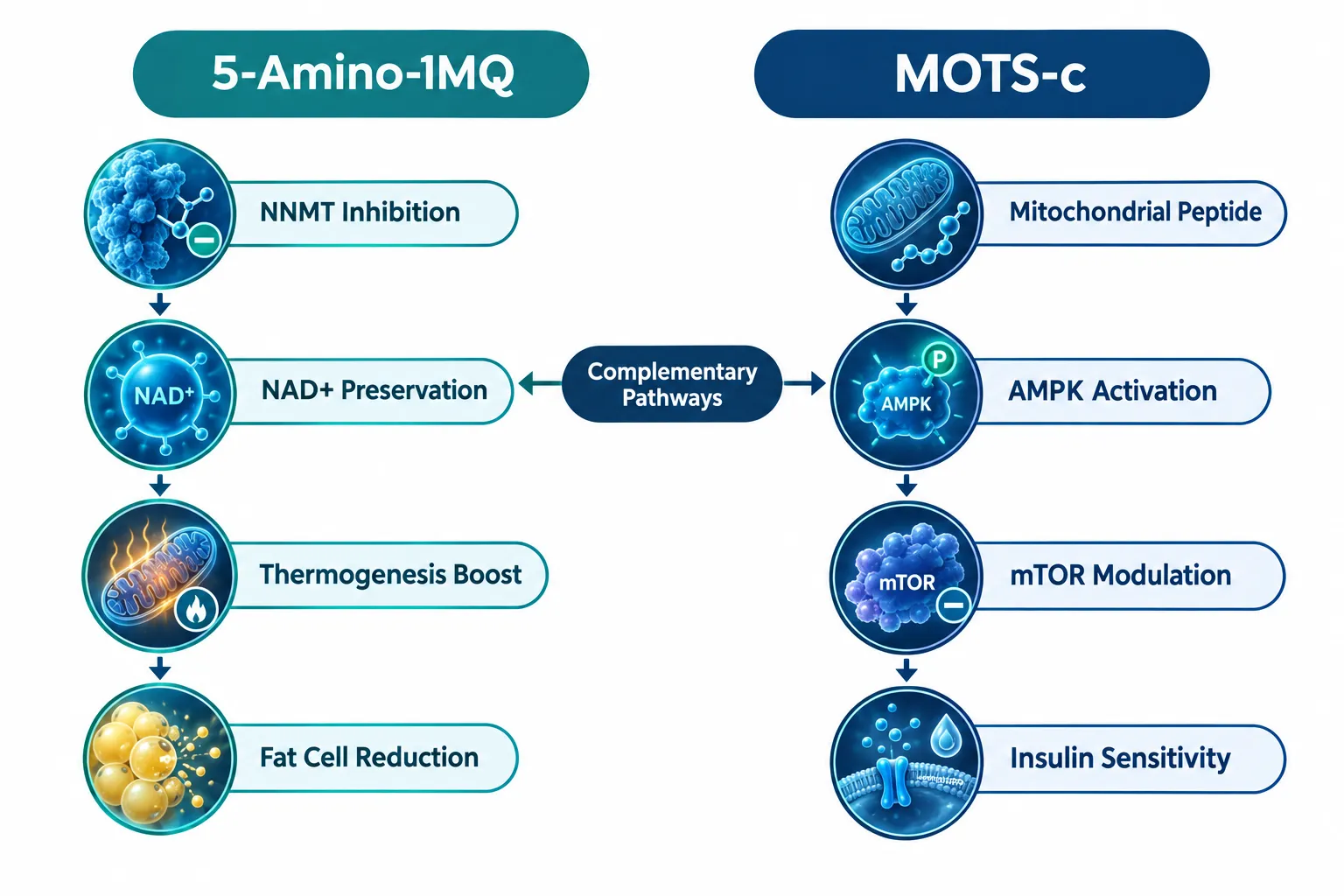
How Each Compound Works Independently

The Mechanistic Case for 5-Amino-1MQ and MOTS-c Synergy in Metabolic Research

"Complementary, not redundant" is the phrase researchers use most often when describing why these two compounds are paired.

The logic is straightforward. 5-Amino-1MQ works upstream in the NAD+ biosynthesis and methylation axis. MOTS-c works at the AMPK/mTOR node. These are distinct steps in the same broader metabolic network, which means:

Feature 5-Amino-1MQ MOTS-c
Primary target NNMT enzyme AMPK activation
Key substrate NAD+ / SAM pool Mitochondrial stress signals
Main tissue effect White adipose thermogenesis Skeletal muscle, liver, cardiac
Evidence stage Preclinical (rodent, 2024-2026) Preclinical + early human
Regulatory status Research only Research only; banned in sport

When NAD+ is preserved by NNMT inhibition, mitochondrial function improves. When AMPK is simultaneously activated by MOTS-c, the cell is signaled to increase fatty acid oxidation and reduce anabolic mTOR activity. The two signals reinforce each other without competing for the same receptor or enzyme. This is the mechanistic core of the 5-Amino-1MQ and MOTS-c synergy argument.

Researchers studying related mitochondria-targeted peptides, such as those reviewed in the SS-31 mechanism and research overview, will recognize a similar logic: compounds that protect mitochondrial membrane integrity can amplify the effects of signaling peptides that depend on healthy mitochondrial function.
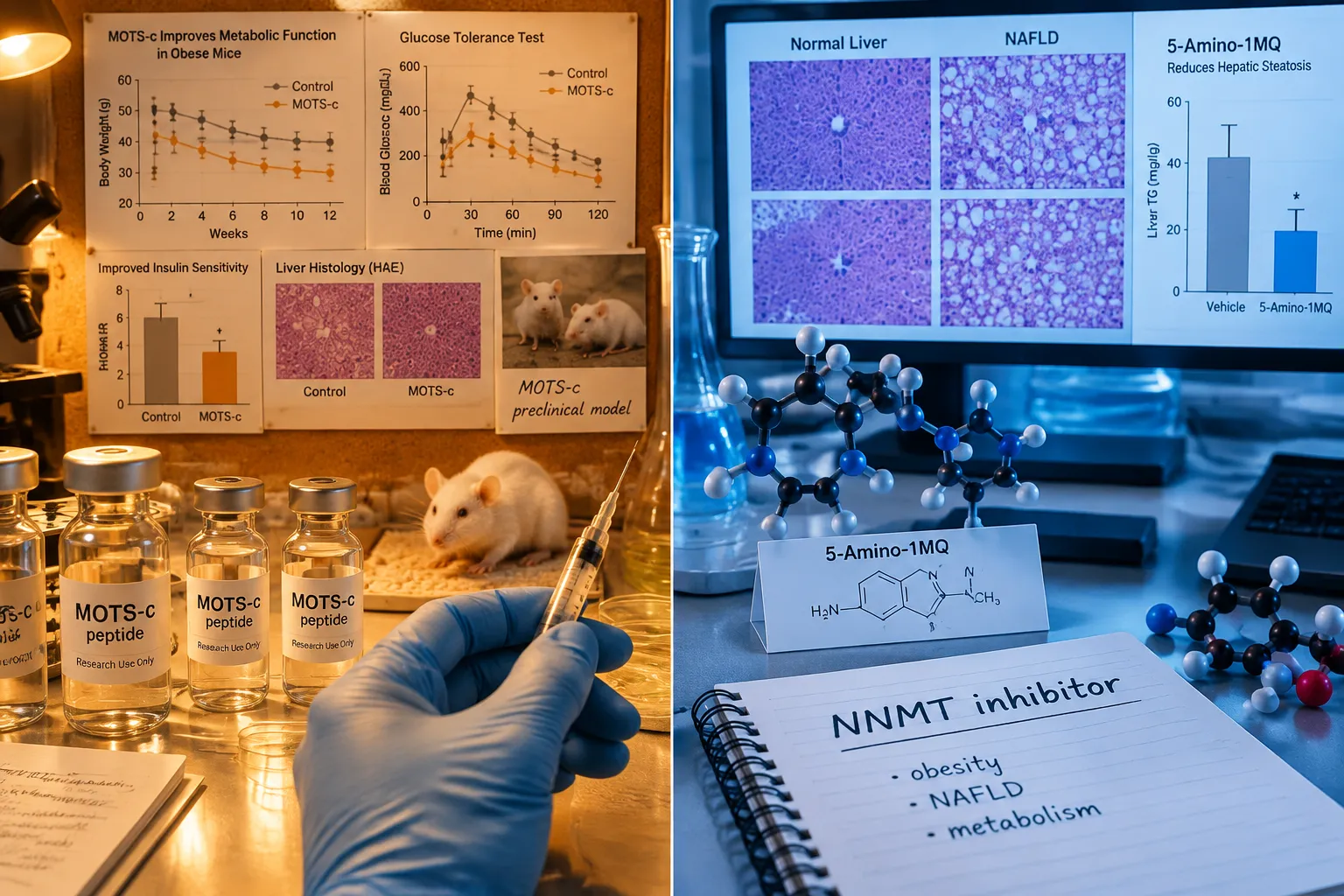
The Mechanistic Case for 5-Amino-1MQ and MOTS-c Synergy in Metabolic Research

Emerging Stacking Protocols and What Makes This Combination Interesting in Metabolic Research

In 2026, research community discussions have moved beyond single-compound protocols toward triple mitochondrial stacks that combine an NAD+ precursor (such as NMN or NR), MOTS-c, and 5-Amino-1MQ. The rationale for the three-way combination is layered:

  1. NAD+ precursors provide raw substrate for sirtuin activation and mitochondrial repair.
  2. 5-Amino-1MQ prevents NNMT from consuming that NAD+ before it can be used.
  3. MOTS-c activates AMPK to ensure the cell actually burns the available energy rather than storing it.

For the two-compound pairing specifically, practical research protocols in 2026 emphasize staggered dosing rather than simultaneous administration. The reasoning is pharmacokinetic: allowing 5-Amino-1MQ to elevate NAD+ levels before MOTS-c is introduced may create a more favorable intracellular environment for AMPK signaling. Endpoint monitoring in such protocols typically tracks fasting glucose, insulin sensitivity markers, body composition changes, and liver enzyme panels.

Researchers interested in peptide stacking logic more broadly may find useful context in the IPA Sermorelin stack research article and the detailed CJC-1295 pharmacokinetic comparison, both of which illustrate how sequencing affects compound performance. For a broader view of how peptides compare to small-molecule drugs in cardiometabolic models, the polypeptide peptides in cardiometabolic models review provides relevant background.
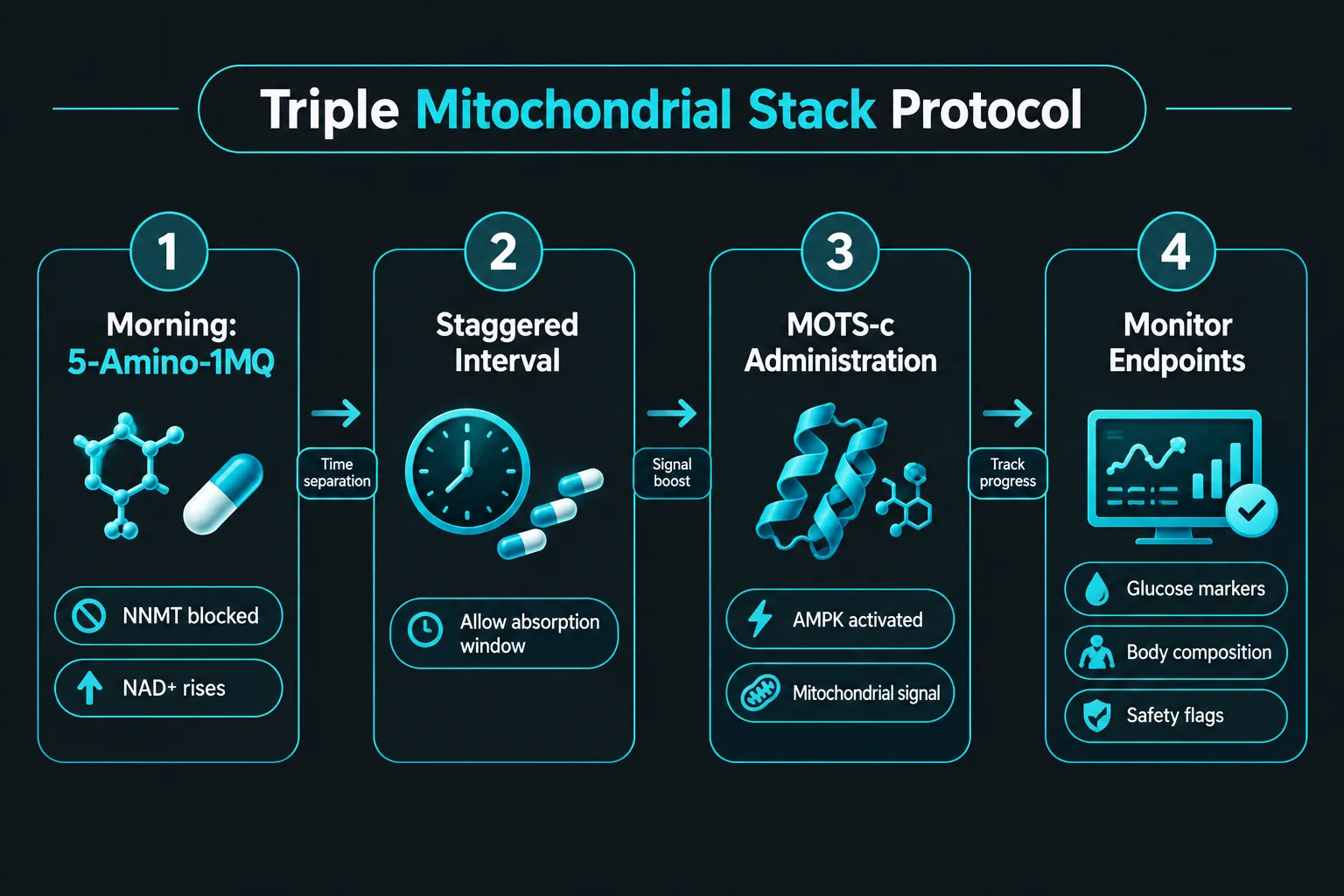
Emerging Stacking Protocols and What Makes This Combination Interesting in Metabolic Research

Safety Considerations and the Limits of Current Evidence

Enthusiasm for the combination must be balanced against what is not yet known.

Known unknowns include:

  • No published human pharmacokinetic data for the combination
  • No dose-ranging safety studies for the pairing in any species
  • Unknown interaction effects at the NAD+/AMPK convergence point under chronic dosing
  • MOTS-c is classified as a prohibited substance in competitive sport by WADA, creating legal and ethical considerations for athlete-adjacent research

The evidence asymmetry between the two compounds is also worth noting. MOTS-c has a more developed research profile, including cardiac metabolism studies and aging-related data. 5-Amino-1MQ's most compelling data comes from the 2024-2026 wave of NNMT-inhibition studies in obese rodent models. Extrapolating preclinical findings to human applications remains speculative for both, and doubly so for their combination.

Predicted future applications in obesity, NAFLD, metabolic syndrome, and aging-related metabolic decline are scientifically plausible given the mechanisms involved. However, plausibility is not evidence, and researchers should treat current protocols as hypothesis-generating rather than therapeutically validated.

Conclusion

The scientific interest in 5-Amino-1MQ and MOTS-c synergy: what makes the combination interesting in metabolic research rests on a sound mechanistic foundation. NAD+ preservation through NNMT inhibition and AMPK activation through mitochondrial peptide signaling are genuinely complementary processes. The preclinical data for each compound independently is promising, particularly the 2024-2026 NNMT-inhibition findings for liver and adipose outcomes.

Actionable next steps for researchers:

  • Review the primary NNMT-inhibition literature before designing combination protocols.
  • Apply staggered dosing sequences and document pharmacokinetic windows carefully.
  • Select validated endpoints (glucose, insulin, body composition, liver enzymes) rather than relying on subjective outcomes.
  • Monitor regulatory updates on MOTS-c status, particularly in sport and clinical research contexts.
  • Treat any human-adjacent findings as preliminary until peer-reviewed combination studies exist.

The combination is not yet proven. It is, however, one of the more rationally designed pairings in current metabolic peptide research, and that distinction alone makes it worth watching closely.

Tags: 5-amino-1mq, ampk activation, metabolic research, mitochondrial peptides, mots-c, nad+ preservation, nnmt inhibition, peptide synergy
https://www.puretestedpeptides.com/wp-content/uploads/2026/09/5-amino-1mq-and-mots-c-synergy-what-makes-the-combination-interesting-in-metabol.webp 1024 1536 https://www.puretestedpeptides.com/wp-content/uploads/2026/01/buy-peptides-online.jpg 2026-09-15 13:04:162026-09-15 13:04:165-Amino-1MQ and MOTS-c Synergy: What Makes the Combination Interesting in Metabolic Research
You might also like
Peptides 101 for Research-Use Only Buyers: Structure, Mechanisms, and Where GLP-3, MOTS-c, and 5-Amino-1MQ Fit In Peptides 101 for Research-Use Only Buyers: Structure, Mechanisms, and Where GLP-3, MOTS-c, and 5-Amino-1MQ Fit In
Peptides and Polypeptides in Mitochondrial Research: How MOTS-c and 5-Amino-1MQ Interact With Mitochondria and ATP Peptides and Polypeptides in Mitochondrial Research: How MOTS-c and 5-Amino-1MQ Interact With Mitochondria and ATP
Adenosine Triphosphate, Cellular Energy, and Metabolic Peptides: How MOTS‑c and 5‑Amino‑1MQ Influence ATP-Linked Pathways Adenosine Triphosphate, Cellular Energy, and Metabolic Peptides: How MOTS‑c and 5‑Amino‑1MQ Influence ATP-Linked Pathways
Top 5 Research Peptides for Metabolic Health: An Updated Buyer's Guide Top 5 Research Peptides for Metabolic Health: An Updated Buyer’s Guide
MOTS-c and 5-Amino-1MQ Synergy: Optimizing Mitochondrial Function and Metabolic Research MOTS-c and 5-Amino-1MQ Synergy: Optimizing Mitochondrial Function and Metabolic Research
Retatrutide in 2026: Why Phase 3 Trial Updates Are Shifting GLP-3 Search Demand Retatrutide in 2026: Why Phase 3 Trial Updates Are Shifting GLP-3 Search Demand
5-Amino-1MQ Peptide: Investigating Its Impact on NAD+ Metabolism and Cellular Energetics in Research Models 5-Amino-1MQ Peptide: Investigating Its Impact on NAD+ Metabolism and Cellular Energetics in Research Models
BPC-157 and TB-500 Synergy: Advanced Tissue Repair and Regeneration Protocols BPC-157 and TB-500 Synergy: Advanced Tissue Repair and Regeneration Protocols
0 replies

Leave a Reply

Want to join the discussion?
Feel free to contribute!

Leave a Reply Cancel reply

Your email address will not be published. Required fields are marked *

×

Helpful Links

  • My account
  • Cart
  • Checkout
  • Refund and Returns Policy
  • Privacy Policy
  • SMS Privacy Policy
  • Login
  • My Account
  • Logout

USA Made Lab Tested Peptides

All products are sold for research, laboratory, or analytical purposes only, and are not for human consumption


Pure Tested Peptides is a chemical supplier. Pure Tested Peptides is not a compounding / chemical compounding facility as defined under 503A of the Federal Food, Drug, and Cosmetic act. Pure Tested Peptides is not an outsourcing facility as defined under 503B of the Federal Food, Drug, and Cosmetic act.

The statements made within this website have not been evaluated by the US Food and Drug Administration. The products we offer are not intended to diagnose, treat, cure or prevent any disease.

Human/Animal Consumption Prohibited. Laboratory/In-Vitro Experimental Use Only

Link to: Enclomiphene Citrate vs Enclomiphene: Stability, Storage, and Research Handling Link to: Enclomiphene Citrate vs Enclomiphene: Stability, Storage, and Research Handling Enclomiphene Citrate vs Enclomiphene: Stability, Storage, and Research Hand...Enclomiphene Citrate vs Enclomiphene: Stability, Storage, and Research Handling Link to: BPC-157 and TB-500 Synergy: What Researchers Should Know About Combined Tissue Repair Models Link to: BPC-157 and TB-500 Synergy: What Researchers Should Know About Combined Tissue Repair Models BPC-157 and TB-500 Synergy: What Researchers Should Know About Combined Tissue Repair ModelsBPC-157 and TB-500 Synergy: What Researchers Should Know About Combined Tissue...
Scroll to top Scroll to top Scroll to top