Call or Text 727-513-9780
  • Shopping Cart Shopping Cart
    0Shopping Cart
Pure Tested Peptides | America's most trusted Peptides for sale online
  • Peptides for sale
    • Oral Peptides for sale
      • Peptide Capsules for sale
      • BPC 157 Capsules 1000mcg
      • SLU-PP-332 Capsules | 1000 mcg
      • 5-Amino-1MQ 50mg Capsules
      • Tesofensine 500mcg
    • All Peptides for sale
    • Peptide Sprays
      • BPC 157 Nasal Spray Kit
      • BPC-157 TB500 Nasal Spray Kit
      • Semax Nasal Spray 10mg
      • Selank – Nasal Spray Kit – 10mg
      • Epithalon 50MG Nasal Spray Kit
      • Ipamorelin 10mg Nasal Spray
      • Klow Nasal Spray (BPC-157 + TB-500 + GHK-Cu + KPV) | 80mg
      • Hulk Nasal Spray Tesa / Ipa Blend 6/3 MG
      • Klow Nasal Spray
      • NAD + 500 mg Nasal Spray
      • PT-141 Nasal Spray Kit
    • GHRH Peptides
      • Ipa Peptides
      • CJC-1295 Peptides
        • CJC-1295 with DAC 5 mg
        • CJC-1295 without DAC 5 mg
        • CJC-1295 Ipa 10mg
      • Tesa Peptides
        • Tesa Peptide
        • Tesa 20 mg
    • GHK-Cu Peptides
      • All GHK-Cu Peptides
      • GHK-Cu 100mg
      • KLOW Peptide Blend – Buy KLOW blend online
    • BPC Peptides
      • All BPC Peptides
      • BPC-157
      • BPC-157 TB-500
      • BPC 157 capsules 1000mcg
    • SLU-PP-332 Peptides
      • All SLU-PP-332 Peptides
      • SLU-PP-332 5mg
    • GLP3 Peptides
    • PT-141 Peptides
      • PT-141 Peptides for sale
      • PT-141 10mg
      • PT-141 Nasal Spray
    • CAG Peptides
      • Lipo-C Peptide Blend
      • CAG 5mg
      • CAG 10mg
    • MOTS-C Peptides
      • MOTS-C Peptides for sale
      • MOTS-c peptide
      • MOTS-c 10mg *6 pack*
    • 5 Amino 1MQ Peptides
      • 5 Amino 1MQ Peptides for sale
      • 5-Amino-1MQ 50mg Capsules
      • 5-Amino-1MQ 5mg
    • Epithalon Peptides
      • Epithalon Peptides for sale
      • Epithalon 10mg
      • Epithalon 50mg
  • Shop
    • GLPs
      • 5-Amino-1MQ 50mg Capsules
      • 5-Amino-1MQ 5mg
      • L-Carnitine 500mg/ml
      • Tesofensine 500mcg
      • SLU-PP-332 5mg
      • MOTS-c 10mg *6 pack*
    • Epithalon & BPC Peptides
      • Epithalon 10mg
      • Epithalon 50mg
      • BPC-157
      • BPC 157 capsules 1000mcg
      • BPC-157 TB-500
      • BPC-157 TB500 Nasal Spray Kit
      • BPC 157 Nasal Spray Kit
    • BPC TB-500 & NAD+ Peptides
      • NAD+ 500 mg
      • KLOW Peptide Blend – Buy KLOW blend online
      • GLOW Peptide Blend
      • TB 500 5mg
      • BPC 157 capsules 1000mcg – Supplement
      • BPC 157 Nasal Spray Kit
      • BPC-157
      • BPC-157 TB500 Nasal Spray Kit
      • BPC-157 TB-500
      • BPC 157 capsules 1000mcg
    • LL-37 Peptide
      • LL-37 10 mg
    • MOTS-C & Selank
      • MOTS-c peptide
      • Selank 10mg
    • GHK Peptides
      • GHK-Cu 100mg
      • GLOW Peptide Blend
      • KLOW Peptide Blend – Buy KLOW blend online
  • COAs
  • Wholesale
    • Wholesale Peptides for sale
  • PTP FAQ
  • Affiliates
    • Selank Peptide: Advanced Pharmacological Mechanisms Underlying Its Anxiolytic and Nootropic Effects in Research
      • 5-Amino-1MQ Peptide: Detailed Mechanisms of NNMT Inhibition and Its Impact on Cellular Metabolism Research
        • MOTS-C Peptide: Unraveling Its Role in Mitochondrial Dynamics and Energy Metabolism Research
          • Epithalon Peptide and Telomerase Regulation: Investigating Its Impact on Cellular Senescence and Lifespan Research Models
            • GLP2-T vs GLP2 Tirz Peptide: Understanding the Naming, Mechanistic Nuances, and Research Implications for Gut Health
      • Peptides and Polypeptides in Modern Pharmacology: What Research on Metoprolol, Prednisone, and Amlodipine Reveals
        • Polypeptide Peptides vs NSAIDs: What Naproxen and Diclofenac Teach Tissue-Repair Researchers About BPC‑157 and TB‑500
          • Peptides and Polypeptides in Endocrine Pharmacology: How GLP-1, GLP-2, and GLP-3 Retatrutide Differ From Classic Drugs Like Prednisone and Amlodipine
          • 5‑Amino‑1MQ Peptide and NNMT Inhibition: How It Compares With Statins Like Atorvastatin in Adipose and Lipid Metabolism Research
      • Enclomiphene, Estrogen Receptor Signaling, and Luteinizing Phase Biology: What Hormone Researchers Should Measure
        • Mesenchymal Stem Cells, BPC‑157, and GHK‑Cu: How Tissue Repair Peptides Compare With Classic NSAIDs Like Naproxen in Injury Models
          • Peptide Calculator Use Cases Beyond Growth Hormone: Working Through GLP‑3 Retatrutide, MOTS‑c, and BPC‑157 Research Dosing
        • Polypeptide Peptides in Endocrine and Metabolic Pharmacology: Lessons From Amlodipine, Prednisone, and Metoprolol
        • Peptides Calculator for Advanced Blends: Worked Examples for Tesamorelin, CJC‑1295, and Ipamorelin Stacks
          • Peptides and Polypeptides in Human Physiology: How Molecular Size Shapes Research Applications
            • Selank Peptide: Advanced Pharmacological Mechanisms Underlying Its Anxiolytic and Nootropic Effects in Research
          • 5-Amino-1MQ Peptide: Detailed Mechanisms of NNMT Inhibition and Its Impact on Cellular Metabolism Research
            • MOTS-C Peptide: Unraveling Its Role in Mitochondrial Dynamics and Energy Metabolism Research
              • Epithalon Peptide and Telomerase Regulation: Investigating Its Impact on Cellular Senescence and Lifespan Research Models
                • GLP2-T vs GLP2 Tirz Peptide: Understanding the Naming, Mechanistic Nuances, and Research Implications for Gut Health
                  • Peptides and Polypeptides in Endocrine Pharmacology: How GLP-1, GLP-2, and GLP-3 Retatrutide Differ From Classic Drugs Like Prednisone and Amlodipine
                    • Polypeptide Peptides vs NSAIDs: What Naproxen and Diclofenac Teach Tissue-Repair Researchers About BPC‑157 and TB‑500
                      • Peptides and Polypeptides in Modern Pharmacology: What Research on Metoprolol, Prednisone, and Amlodipine Reveals
                        • 5‑Amino‑1MQ Peptide and NNMT Inhibition: How It Compares With Statins Like Atorvastatin in Adipose and Lipid Metabolism Research
                        • Enclomiphene, Estrogen Receptor Signaling, and Luteinizing Phase Biology: What Hormone Researchers Should Measure
                        • Mesenchymal Stem Cells, BPC‑157, and GHK‑Cu: How Tissue Repair Peptides Compare With Classic NSAIDs Like Naproxen in Injury Models
                        • Peptide Calculator Use Cases Beyond Growth Hormone: Working Through GLP‑3 Retatrutide, MOTS‑c, and BPC‑157 Research Dosing
                        • Polypeptide Peptides in Endocrine and Metabolic Pharmacology: Lessons From Amlodipine, Prednisone, and Metoprolol
                        • Peptides Calculator for Advanced Blends: Worked Examples for Tesamorelin, CJC‑1295, and Ipamorelin Stacks
                        • Peptides and Polypeptides in Human Physiology: How Molecular Size Shapes Research Applications
                        • Selank Peptide: Advanced Pharmacological Mechanisms Underlying Its Anxiolytic and Nootropic Effects in Research
                        • MOTS-C Peptide: Unraveling Its Role in Mitochondrial Dynamics and Energy Metabolism Research
                        • Peptides and Polypeptides in Modern Pharmacology: What Research on Metoprolol, Prednisone, and Amlodipine Reveals
                        • Peptides and Polypeptides in Endocrine Pharmacology: How GLP-1, GLP-2, and GLP-3 Retatrutide Differ From Classic Drugs Like Prednisone and Amlodipine
                        • 5-Amino-1MQ Peptide: Detailed Mechanisms of NNMT Inhibition and Its Impact on Cellular Metabolism Research
                        • Mesenchymal Stem Cells, BPC‑157, and GHK‑Cu: How Tissue Repair Peptides Compare With Classic NSAIDs Like Naproxen in Injury Models
                        • Peptide Calculator Use Cases Beyond Growth Hormone: Working Through GLP‑3 Retatrutide, MOTS‑c, and BPC‑157 Research Dosing
                        • GLP2-T vs GLP2 Tirz Peptide: Understanding the Naming, Mechanistic Nuances, and Research Implications for Gut Health
                        • Polypeptide Peptides in Endocrine and Metabolic Pharmacology: Lessons From Amlodipine, Prednisone, and Metoprolol
                        • Polypeptide Peptides vs NSAIDs: What Naproxen and Diclofenac Teach Tissue-Repair Researchers About BPC‑157 and TB‑500
                        • Peptides and Polypeptides in Human Physiology: How Molecular Size Shapes Research Applications
                        • Peptides Calculator for Advanced Blends: Worked Examples for Tesamorelin, CJC‑1295, and Ipamorelin Stacks
                        • 5‑Amino‑1MQ Peptide and NNMT Inhibition: How It Compares With Statins Like Atorvastatin in Adipose and Lipid Metabolism Research
                        • Enclomiphene, Estrogen Receptor Signaling, and Luteinizing Phase Biology: What Hormone Researchers Should Measure
                        • Epithalon Peptide and Telomerase Regulation: Investigating Its Impact on Cellular Senescence and Lifespan Research Models
                        • Best research protocol Klow blend
                        • best time to take BPC-157
                        • best time to take DSIP (Delta Sleep Inducing Peptide)
                        • best time to take CJC-1295
                        • best time to take AOD-9604
                        • best time to take Follistatin 344
                        • best time to take Ipamorelin
                        • best time to take MK-677 (Ibutamoren)
                        • best time to take Ligandrol (LGD-4033) — research compound
                        • best time to take Ostarine (MK-2866) — research compound
                        • best time to take GHK-CU
                        • best time to take TB-500
                        • best time to take MOTS-c
                        • best time to take Semax
                        • best time to take RAD-140 (Testolone) — research compound
                        • best time to take Thymosin Alpha-1
                        • best time to take PEG-MGF
                        • Biolife Plasma, Octapharma Plasma, and Research Peptides: How Plasma Donation Labs Differ From Peptide Suppliers
                        • best time to take YK-11 — research compound
                        • best time to take PT-141 (Bremelanotide)
                        • Best research protocol Klow blend
                        • 5-Amino-1MQ and MOTS-C Synergy: Metabolic Signaling, Mitochondria, and Research Design
                        • BPC-157 and TB-500: Investigating Their Combined Effects on Angiogenesis and Cellular Migration in Tissue Repair Models
                        • BPC-157 Peptide: Gut Barrier Function, Inflammation, and Tissue-Recovery Research
                        • 5‑Amino‑1MQ and MOTS‑c Synergy in Metabolic Research: Designing NNMT and Mitochondrial Biogenesis Stacks
                        • CJC-1295 with DAC vs. Without DAC: Half-Life, Release Kinetics, and Research Implications
                        • CJC‑1295 with DAC vs. Without DAC: Expanding on Half‑Life Differences Using Tesamorelin and Ipamorelin Blend Case Studies
                        • Collagen Biology and Copper‑Binding Peptides: How GHK‑Cu, Glow Blend, and Klow Blend Interact with Skin and Connective Tissue
                        • Collagen Biology and Regenerative Peptides: How GHK‑Cu, Glow Blend, and Klow Blend Affect Extracellular Matrix Research
                    • DNA, Telomeres, and Longevity Peptides: Positioning Epithalon and MOTS‑c in Genetic Aging Research
                      • Enclomiphene Citrate: serm Mechanism, Testosterone Research, and Stack Compatibility
                        • Enclomiphene vs Enclomiphene Citrate: Formulation, Bioavailability, and Research Distinctions
                        • Epithalon Peptide Research: Telomerase Activation, Aging, and Pineal Gland Function
                        • Estrogen Receptor Signaling and Enclomiphene: How Selective Modulators Compare with Classic Polypeptide Hormones
                        • GHK-Cu Peptide: Advanced Mechanisms in Extracellular Matrix Remodeling and Wound Healing Research
                        • GHK-Cu Peptide: Collagen Synthesis, Wound Repair, and Skin-Barrier Research Models
                        • GLP-1 vs GLP-3 vs GLP-2: Peptide Classification and Research Applications
                        • GLP-2 Peptide Research Guide: Gut Barrier Function, Nutrient Absorption, and Intestinal Recovery Models
                        • GLP-3 Retatrutide vs. GLP-1 Drugs: What Triple-Agonist Biology Changes in Research Models
                        • Ipamorelin and Tesamorelin Combination: Synergistic GH Secretagogue Research and Dosing Protocols
                        • GLP2 Tirz Peptide: What It Is, Why the Name Exists, and How Researchers Should Interpret It
                        • Klow Blend Peptide Nasal Spray: What the Formulation Is Trying to Do in Cognitive Research
                        • Mitochondria, NNMT Inhibition, and Peptide Modulators: Where MOTS‑c and 5‑Amino‑1MQ Fit in Cellular Energy Research
                        • MOTS-c Peptide: Mitochondrial Function, Energy Metabolism, and What Researchers Measure
                        • MOTS-c vs. 5-Amino-1MQ: Which Metabolic Research Questions Each Compound Actually Answers
                        • Nasal Spray Peptides: Bioavailability, Administration, and Semax/Selank Research Applications
                        • PT-141 Peptide Research: Mechanism of Action and Melanocortin Receptor Signaling
                        • Retatrutide for Research: Mechanism, Structure, and GLP-1/GLP-3 Dual Action
                        • Retatrutide for Obesity and Type 2 Diabetes: What the Latest Trial Data Suggest
                        • Tesofensine Peptide Research: Mechanism, Appetite Suppression, and Neuropeptide Y Pathways
  • Contact
    • Contact Customer Service
    • Text Customer Support
  • About US
  • Shop all peptides
  • Affiliate Program
    • Affiliate Signup
  • Login / Register Login / Register Page Link Login / Register Page Link
  • Click to open the search input field Click to open the search input field Search
  • Menu Menu
5-Amino-1MQ Research Assays: How NNMT-Related Readouts Can Be Separated From MOTS-c and SLU-PP-332 Effects

5-Amino-1MQ Research Assays: How NNMT-Related Readouts Can Be Separated From MOTS-c and SLU-PP-332 Effects

September 25, 2026/0 Comments/in Uncategorized/by

Three metabolically active compounds, 5-Amino-1MQ, MOTS-c, and SLU-PP-332, each touch mitochondrial energy metabolism, yet they do so through entirely different molecular mechanisms. When researchers design experiments involving more than one of these agents, conflated readouts are a genuine risk. Understanding the 5-Amino-1MQ research assays framework, specifically how NNMT-related readouts can be separated from MOTS-c and SLU-PP-332 effects, is essential for generating interpretable, publication-quality preclinical data.

Key Takeaways

  • 5-Amino-1MQ is a substrate-competitive NNMT inhibitor; its primary assay endpoints are NNMT enzyme activity, 1-methylnicotinamide (1-MNA) levels, and NAD+/SAM pool dynamics.
  • MOTS-c signals through AMPK phosphorylation and one-carbon metabolism remodeling, pathways that are mechanistically orthogonal to NNMT inhibition.
  • SLU-PP-332 activates estrogen-related receptors (ERRs) to drive transcriptional programs for mitochondrial biogenesis, a downstream node distinct from NNMT substrate competition.
  • Factorial experimental designs with single-agent control arms are the most reliable way to attribute effects to each compound.
  • As of 2026, all available efficacy data for 5-Amino-1MQ remain preclinical; no human trials have been published.

Understanding the NNMT Pathway: The Biochemical Basis of 5-Amino-1MQ Assays
Understanding the NNMT Pathway: The Biochemical Basis of 5-Amino-1MQ Assays

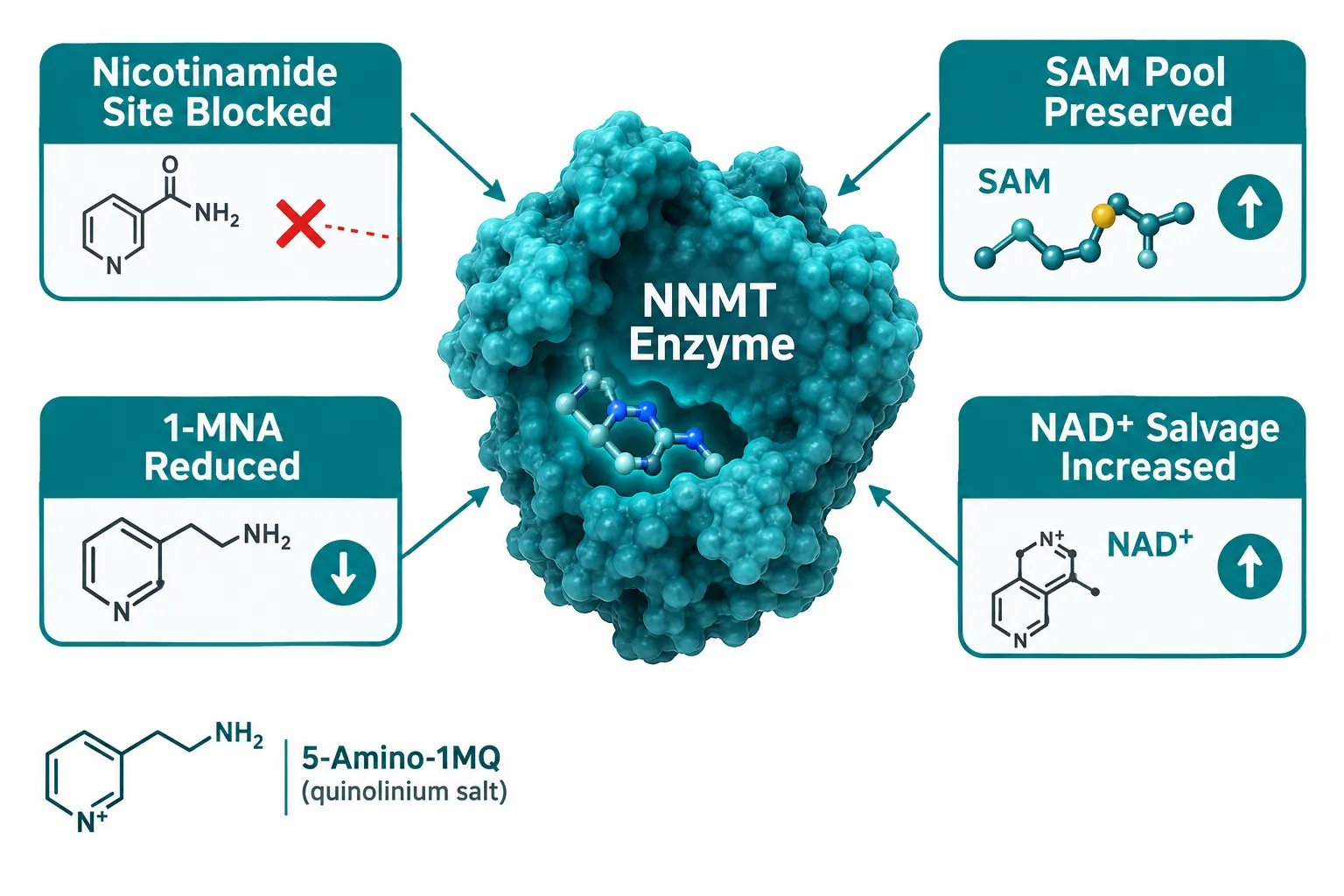
5-Amino-1MQ is a cell-permeable quinolinium salt that competitively inhibits nicotinamide N-methyltransferase (NNMT) at the nicotinamide binding site. NNMT normally consumes S-adenosylmethionine (SAM) to methylate nicotinamide, producing 1-MNA. By blocking this reaction, 5-Amino-1MQ preserves SAM and redirects nicotinamide back into the NAD+ salvage pathway. Reported in vitro data place the IC50 for human NNMT at approximately 1.2 µM, with cellular models showing 1.2-1.6-fold increases in intracellular NAD+.

The most cited preclinical evidence comes from a 2018 mouse study in which 20 mg/kg administered for 11 days reversed diet-induced obesity without reducing food intake, a result attributed to NNMT inhibition shifting adipose tissue toward fat oxidation. More recently, aged-mouse data published in 2026 showed that 5-Amino-1MQ combined with exercise improved grip strength beyond exercise alone, extending the compound's assay relevance into sarcopenia-like models.

Primary NNMT-centric assay endpoints to track:

Endpoint What It Measures Why It Is NNMT-Specific
NNMT enzyme activity Catalytic rate of nicotinamide methylation Direct measure of inhibitor engagement
1-MNA concentration Product of NNMT reaction Falls with effective inhibition
Nicotinamide pool Substrate availability Rises as NNMT is blocked
SAM/SAH ratio Methyl-donor status Increases when NNMT is not consuming SAM
NAD+ salvage flux Isotope-traced NAD+ synthesis Rises as nicotinamide is redirected

These endpoints are naturally separable from MOTS-c and SLU-PP-332 readouts because neither of those agents directly modulates NNMT catalytic activity or 1-MNA output. For researchers sourcing the compound, exploring the 5-amino peptide product category provides context on purity specifications and research-use designations relevant to assay planning.


Mapping the Mechanistic Differences: MOTS-c and SLU-PP-332 Versus NNMT Inhibition
Mapping the Mechanistic Differences: MOTS-c and SLU-PP-332 Versus NNMT Inhibition

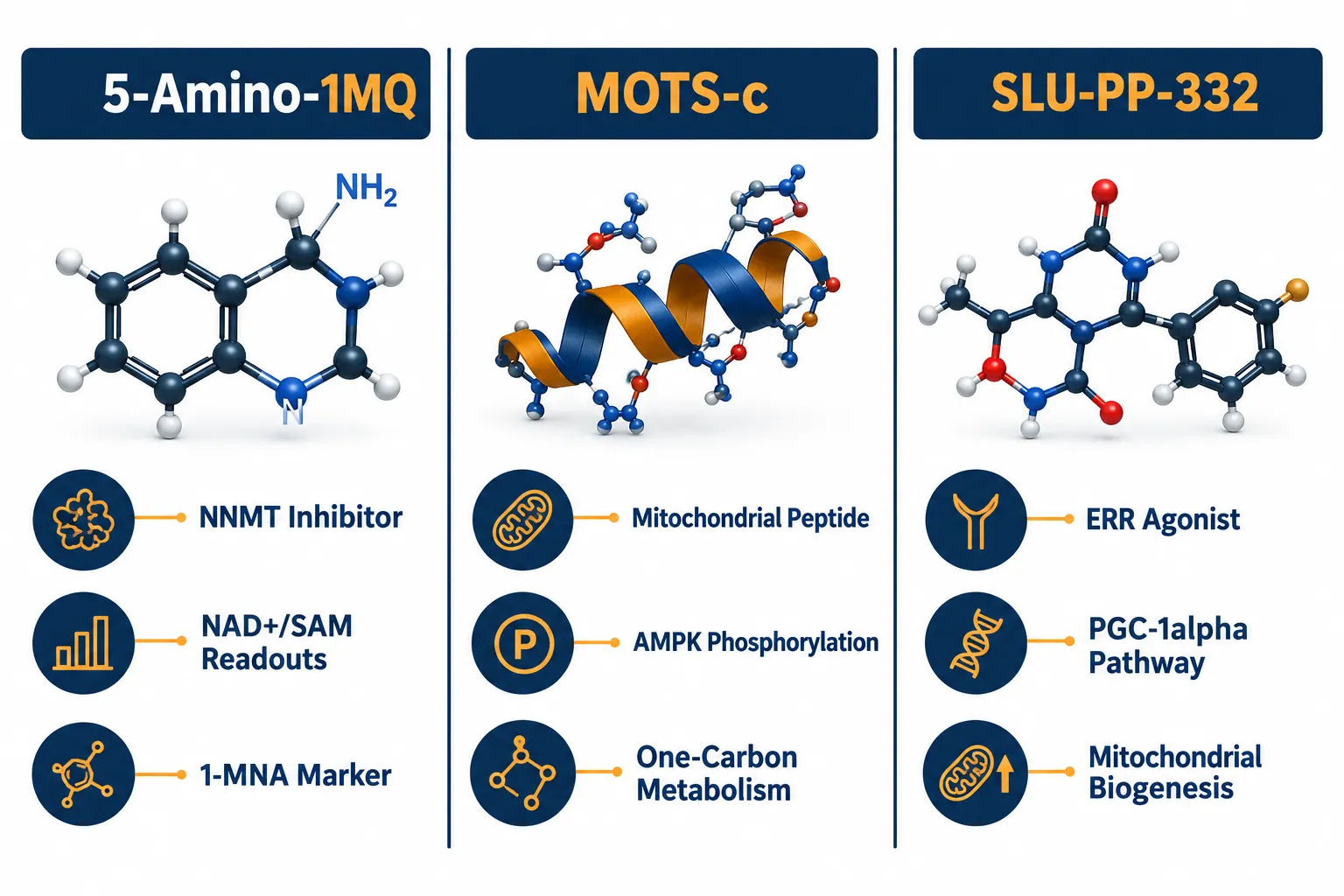
The core challenge in multi-agent metabolic research is that MOTS-c, SLU-PP-332, and 5-Amino-1MQ all converge on mitochondrial energy output, but at entirely different upstream nodes.

MOTS-c: AMPK Signaling and One-Carbon Metabolism

MOTS-c is a mitochondria-encoded peptide that activates AMP-activated protein kinase (AMPK) and remodels folate and one-carbon metabolism. Its downstream effects include phosphorylation of ACC (acetyl-CoA carboxylase) and activation of stress-response transcriptional programs. These readouts are mechanistically orthogonal to substrate-competitive NNMT inhibition.

MOTS-c-specific assay markers:

  • AMPK phosphorylation (Thr172)
  • Downstream ACC activity
  • Folate cycle intermediates
  • Stress-response gene expression panels

Researchers pairing MOTS-c with 5-Amino-1MQ, a combination studied alongside related mitochondrial peptides, as discussed in resources on SS31 and MOTS-c research applications, should reserve AMPK phosphorylation readouts exclusively for MOTS-c attribution. Changes in 1-MNA or SAM pools should not be attributed to MOTS-c exposure.

SLU-PP-332: ERR Agonism and Transcriptional Biogenesis

SLU-PP-332 is a pan-ERR (estrogen-related receptor) agonist studied for its exercise-mimetic and mitochondrial biogenesis effects. It drives transcriptional programs through ERR target genes and PGC-1alpha-linked pathways, increasing mitochondrial DNA copy number and oxidative capacity. No published animal or human studies of SLU-PP-332 combined with 5-Amino-1MQ existed as of mid-2026.

"NNMT inhibition increases NAD+/SAM upstream, while ERR agonism drives downstream transcription of oxidative-metabolism genes, these are distinct nodes, not redundant ones."

SLU-PP-332-specific assay markers:

  • ERR target gene expression (ESRRA, ESRRB, ESRRG)
  • PGC-1alpha mRNA and protein levels
  • Mitochondrial DNA copy number
  • Oxygen consumption rate (as an ERR-driven output)

Conceptual analyses in 2026 explicitly frame any combined use of SLU-PP-332 and 5-Amino-1MQ as hypothesis-generating only, recommending parallel single-agent arms to prevent conflating ERR-mediated transcriptional changes with NNMT-driven NAD+/SAM modulation. Researchers interested in related mitochondrial peptide mechanisms can also consult work on SS-31 mechanism and research applications for comparative pathway context.


Designing Assays That Cleanly Separate NNMT-Related Readouts From MOTS-c and SLU-PP-332 Effects
Designing Assays That Cleanly Separate NNMT-Related Readouts From MOTS-c and SLU-PP-332 Effects

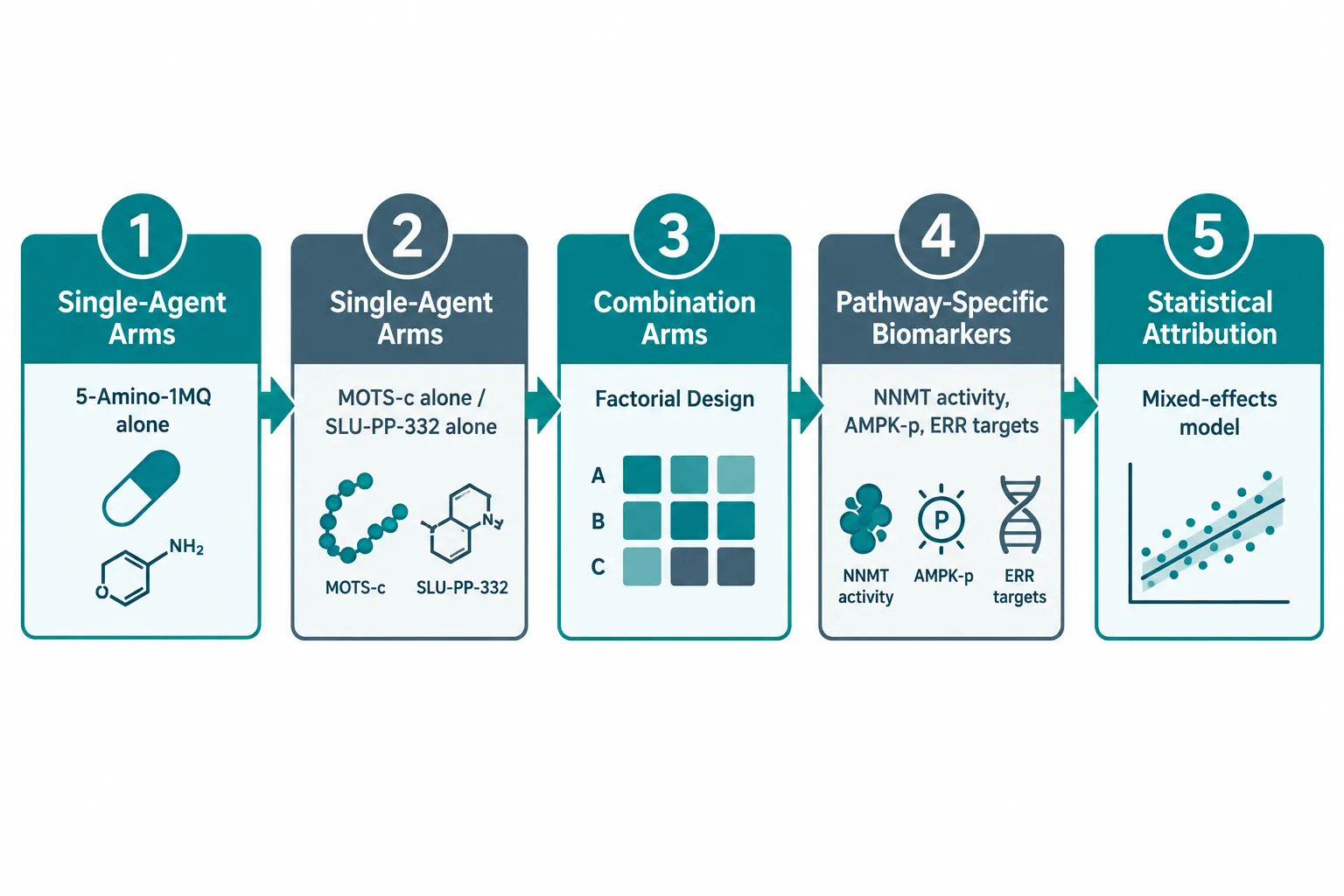
Translating mechanistic knowledge into clean experimental design requires structured factorial layouts and pathway-anchored biomarker panels. The following framework reflects current best practices for 5-Amino-1MQ research assays where NNMT-related readouts must be separated from MOTS-c and SLU-PP-332 effects.

Experimental Architecture

A robust multi-agent study should include:

  1. Vehicle control arm, baseline for all endpoints
  2. 5-Amino-1MQ single-agent arm, isolates NNMT inhibition effects
  3. MOTS-c single-agent arm, isolates AMPK/one-carbon effects
  4. SLU-PP-332 single-agent arm, isolates ERR transcriptional effects
  5. Combination arms, factorial pairings and full triple combination

This structure allows statistical attribution of any observed change to a specific mechanism rather than the combination as a whole.

Biomarker Panel Assignment

Compound Primary Readout Category Key Markers
5-Amino-1MQ Enzymology / Metabolomics NNMT activity, 1-MNA, NAD+, SAM/SAH
MOTS-c Phosphoproteomics / Signaling p-AMPK, p-ACC, folate intermediates
SLU-PP-332 Transcriptomics / Biogenesis ERR targets, PGC-1alpha, mtDNA copy number

Controlling for Confounders

Several metabolic outputs, oxygen consumption rate, ATP production, and fatty acid oxidation flux, can be influenced by all three agents through different upstream routes. These shared endpoints should be treated as secondary, integrative readouts rather than attribution markers. Isotope tracing (e.g., 13C-labeled nicotinamide for NAD+ flux) provides the strongest evidence for NNMT-specific pathway engagement and cannot be mimicked by ERR agonism or AMPK activation.

All 5-Amino-1MQ work should be conducted with reagents carrying batch-specific certificates of analysis confirming purity at or above 99%, strictly within in vitro or ex vivo systems where exposure concentration and timing can be precisely controlled. This is consistent with the compound's current status as a research-only agent with no FDA-approved indication and no published human trials as of 2026. For parallel reading on rigorous preclinical peptide assay design, the overview of SS-31 10mg research peptide considerations offers useful methodological context.

A forward-looking note: Expert commentary in 2026 anticipates that the next major step for 5-Amino-1MQ will be formal GLP toxicology studies followed by early-phase human trials targeting obesity, fatty liver, or age-related muscle decline. Future multi-omic panels integrating metabolomics, phosphoproteomics, and transcriptomics will likely become the standard framework for dissecting NNMT versus ERR versus MOTS-c contributions in complex experimental designs. This remains speculative, pending formal study initiation.


Conclusion

Separating NNMT-related readouts from MOTS-c and SLU-PP-332 effects is not merely a technical preference, it is a prerequisite for interpretable data. The 5-Amino-1MQ research assays framework outlined here provides a practical roadmap: anchor NNMT attribution to enzyme activity, 1-MNA, and NAD+/SAM flux; assign AMPK phosphorylation and one-carbon intermediates to MOTS-c; and reserve ERR transcriptional signatures and mitochondrial biogenesis markers for SLU-PP-332.

Actionable next steps for researchers:

  • Build single-agent control arms into every multi-compound study before adding combination arms.
  • Use isotope-traced NAD+ salvage assays as the gold-standard NNMT-specific readout.
  • Treat oxygen consumption rate and ATP output as integrative, not attributive, endpoints.
  • Source 5-Amino-1MQ with verified COA documentation and maintain strict in vitro or ex vivo protocols.
  • Interpret all findings within the current preclinical-only evidence base, no human trial data exist as of 2026.

Rigorous pathway separation today will produce the mechanistic clarity needed for the human-trial assay panels that the field anticipates in the coming years.

Tags: 5-amino-1mq, metabolic research compounds, mots-c research, nad+ salvage pathway, nnmt enzyme activity, nnmt inhibitor, research assay design, slu-pp-332
https://www.puretestedpeptides.com/wp-content/uploads/2026/09/5-amino-1mq-research-assays-how-nnmt-related-readouts-can-be-separated-from-mots.webp 1024 1536 https://www.puretestedpeptides.com/wp-content/uploads/2026/01/buy-peptides-online.jpg 2026-09-25 13:09:272026-09-25 13:09:275-Amino-1MQ Research Assays: How NNMT-Related Readouts Can Be Separated From MOTS-c and SLU-PP-332 Effects
You might also like
Peptides vs Polypeptides: How Molecular Size and Structure Change Research Questions Peptides vs Polypeptides: How Molecular Size and Structure Change Research Questions
DNA, Mitochondria, and Research Peptides: How MOTS-c and 5-Amino-1MQ Interface With Cellular Energy and Genomic Pathways DNA, Mitochondria, and Research Peptides: How MOTS-c and 5-Amino-1MQ Interface With Cellular Energy and Genomic Pathways
Adenosine Triphosphate, Cellular Energy, and Metabolic Peptides: How MOTS‑c and 5‑Amino‑1MQ Influence ATP-Linked Pathways Adenosine Triphosphate, Cellular Energy, and Metabolic Peptides: How MOTS‑c and 5‑Amino‑1MQ Influence ATP-Linked Pathways
Mesenchymal Stem Cells and Mitochondrial Peptides: Where MOTS-c and 5-Amino-1MQ Fit in Regenerative Cell Models Mesenchymal Stem Cells and Mitochondrial Peptides: Where MOTS-c and 5-Amino-1MQ Fit in Regenerative Cell Models
5-Amino-1MQ and MOTS-c Synergy: How Mitochondrial Peptides Target Adiposity and Insulin Resistance in Experimental Models 5-Amino-1MQ and MOTS-c Synergy: How Mitochondrial Peptides Target Adiposity and Insulin Resistance in Experimental Models
Creatine Supplementation vs. 5-Amino-1MQ: Comparing NNMT Inhibition and Phosphagen Energy Systems in Muscle Cell Models Creatine Supplementation vs. 5-Amino-1MQ: Comparing NNMT Inhibition and Phosphagen Energy Systems in Muscle Cell Models
MOTS-c and 5-Amino-1MQ Synergy: Optimizing Mitochondrial Function and Metabolic Research MOTS-c and 5-Amino-1MQ Synergy: Optimizing Mitochondrial Function and Metabolic Research
Slupp332 With 5-Amino-1MQ: What This Advanced Metabolic Stack Means in Research Models Slupp332 With 5-Amino-1MQ: What This Advanced Metabolic Stack Means in Research Models
0 replies

Leave a Reply

Want to join the discussion?
Feel free to contribute!

Leave a Reply Cancel reply

Your email address will not be published. Required fields are marked *

×

Helpful Links

  • My account
  • Cart
  • Checkout
  • Refund and Returns Policy
  • Privacy Policy
  • SMS Privacy Policy
  • Login
  • My Account
  • Logout

USA Made Lab Tested Peptides

All products are sold for research, laboratory, or analytical purposes only, and are not for human consumption


Pure Tested Peptides is a chemical supplier. Pure Tested Peptides is not a compounding / chemical compounding facility as defined under 503A of the Federal Food, Drug, and Cosmetic act. Pure Tested Peptides is not an outsourcing facility as defined under 503B of the Federal Food, Drug, and Cosmetic act.

The statements made within this website have not been evaluated by the US Food and Drug Administration. The products we offer are not intended to diagnose, treat, cure or prevent any disease.

Human/Animal Consumption Prohibited. Laboratory/In-Vitro Experimental Use Only

Link to: Semax Nasal Spray Research Products Compared: Formulation Transparency, Assay Documentation, and Use-Case Fit Link to: Semax Nasal Spray Research Products Compared: Formulation Transparency, Assay Documentation, and Use-Case Fit Semax Nasal Spray Research Products Compared: Formulation Transparency, Assay...Semax Nasal Spray Research Products Compared: Formulation Transparency, Assay Documentation, and Use-Case Fit Link to: Retatrutide 2026 Trial Data vs Earlier Obesity Models: What Researchers Should Compare Before Drawing Conclusions Link to: Retatrutide 2026 Trial Data vs Earlier Obesity Models: What Researchers Should Compare Before Drawing Conclusions Retatrutide 2026 Trial Data vs Earlier Obesity Models: What Researchers Should Compare Before Drawing ConclusionsRetatrutide 2026 Trial Data vs Earlier Obesity Models: What Researchers Should...
Scroll to top Scroll to top Scroll to top