

Slupp332 With 5-Amino-1MQ: What This Advanced Metabolic Stack Means in Research Models
,
Fewer than five years ago, the idea of pairing a nuclear receptor agonist with an enzyme inhibitor to simultaneously mimic exercise and reset cellular energy metabolism would have seemed like a distant theoretical exercise. By mid-2026, the combination of SLU-PP-332 and 5-Amino-1MQ has become one of the most discussed dual-compound stacks in preclinical metabolic research circles. Understanding Slupp332 With 5-Amino-1MQ: What This Advanced Metabolic Stack Means in Research Models requires unpacking two distinct but complementary mechanisms and asking a sharper question: why are researchers pairing them at all?
Key Takeaways
- SLU-PP-332 is a pan-ERR agonist that activates estrogen-related receptors to drive mitochondrial biogenesis and fatty acid oxidation in preclinical models.
- 5-Amino-1MQ is an NNMT inhibitor that elevates NAD+ availability and disrupts the methyl-sink pathway linked to adipogenesis.
- The combination targets two separate but interconnected metabolic bottlenecks, which is the primary rationale for stacking them in research settings.
- All available data as of 2026 remain preclinical; neither compound is approved for human therapeutic use.
- Purity and characterization standards are critical variables when sourcing either compound for controlled experimental work.
What SLU-PP-332 and 5-Amino-1MQ Each Do Individually
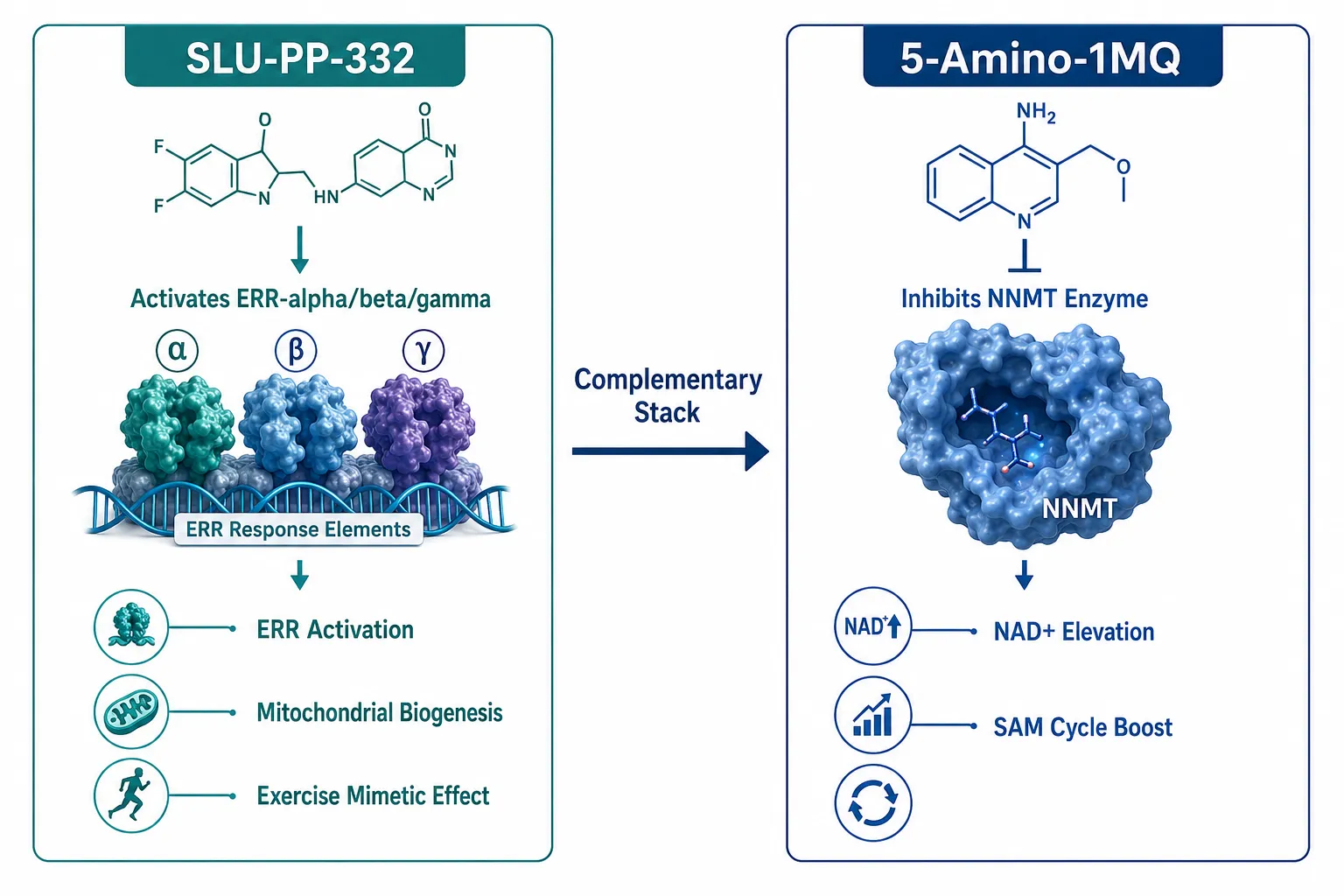
SLU-PP-332 is a small-molecule agonist of the estrogen-related receptor (ERR) family, specifically ERR-alpha, ERR-beta, and ERR-gamma. These nuclear receptors regulate genes involved in mitochondrial biogenesis, oxidative phosphorylation, and fatty acid metabolism. When activated in cell and rodent models, SLU-PP-332 has been shown to increase endurance-related gene expression in skeletal muscle, reduce fat accumulation, and improve markers of metabolic flexibility. Researchers have described it informally as an "exercise mimetic" because its downstream signaling overlaps with pathways activated by sustained aerobic activity.
5-Amino-1MQ works through an entirely different entry point. It selectively inhibits nicotinamide N-methyltransferase (NNMT), an enzyme that consumes S-adenosylmethionine (SAM) to methylate nicotinamide. When NNMT is overactive, a state commonly observed in obese adipose tissue, it depletes both SAM and the NAD+ precursor pool. By blocking NNMT, 5-Amino-1MQ frees up these substrates, elevating intracellular NAD+ and reducing the epigenetic signals that promote fat cell expansion. In vitro studies have linked this mechanism to reduced adipocyte differentiation and improved energy sensing via sirtuins and PARP enzymes.
For researchers exploring metabolic dysfunction, the top research peptides for metabolic health provide useful context for where these compounds sit within the broader landscape of investigational agents.
"The value of understanding each compound in isolation is that it makes the rationale for combining them far more defensible in a research design."
The Rationale Behind Slupp332 With 5-Amino-1MQ: What This Advanced Metabolic Stack Means in Research Models
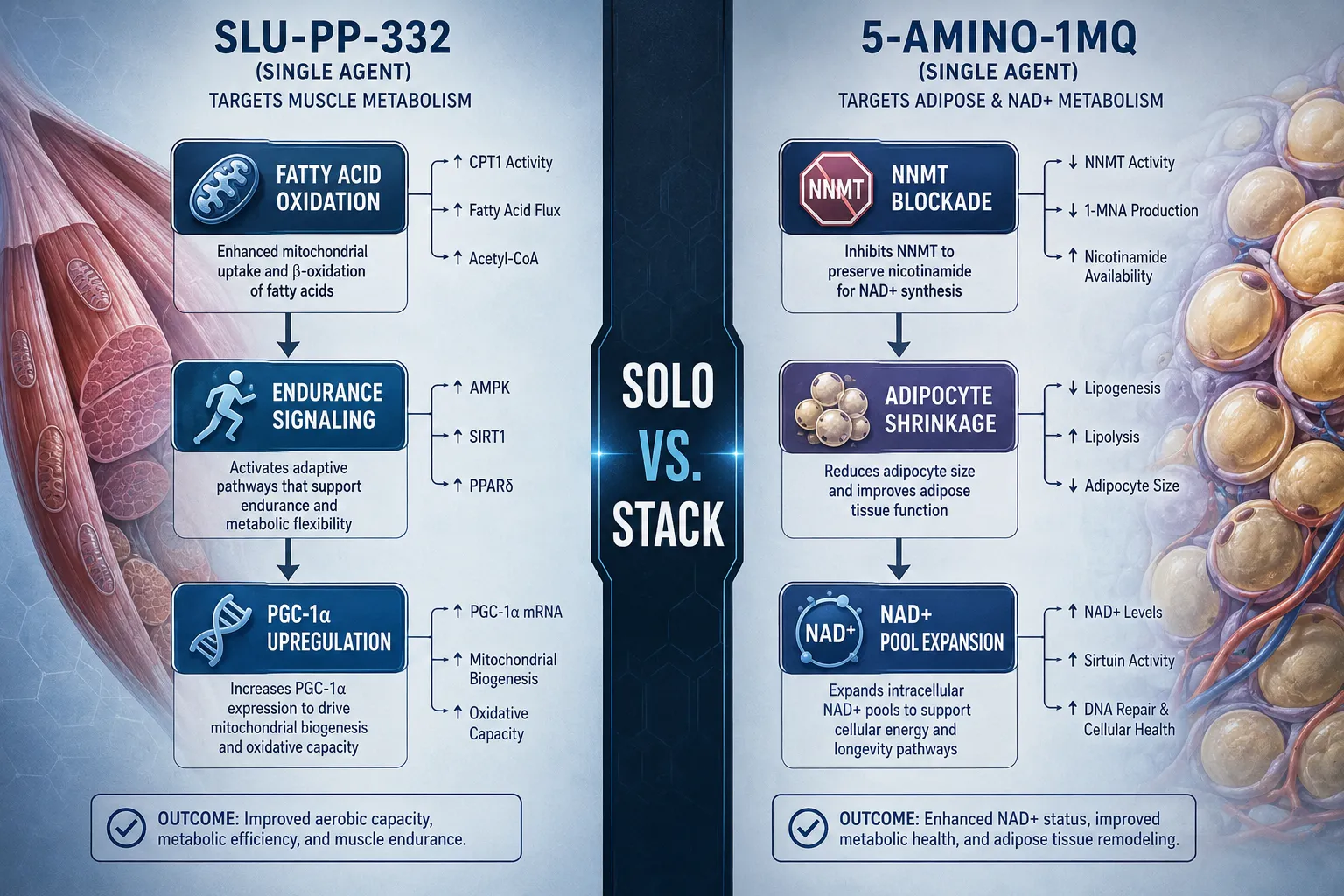
The logic behind combining these two agents is not additive, it is complementary at the mechanistic level.
SLU-PP-332 drives mitochondrial capacity upward. It tells the cell to build more oxidative machinery and burn more fuel. However, if the NAD+ pool is depleted, as it often is in metabolically compromised tissue, the downstream sirtuins and energy sensors that depend on NAD+ cannot respond efficiently. This is where 5-Amino-1MQ enters the equation. By restoring NAD+ availability through NNMT inhibition, it supplies the cofactor that SLU-PP-332-driven mitochondrial activity needs to function optimally.
Researchers are not simply combining two trending compounds. The pairing addresses two distinct failure points in metabolic disease: insufficient mitochondrial drive (targeted by SLU-PP-332) and insufficient cofactor availability (targeted by 5-Amino-1MQ). Addressing both simultaneously in a model is what makes the stack scientifically interesting rather than redundant.
This dual-target approach also aligns with emerging interest in combination metabolic therapies. Research into agents like retatrutide has demonstrated that triple-agonist research is reframing liver fat endpoints, reinforcing the broader trend toward multi-pathway intervention in metabolic disease models.
Key mechanistic interactions being examined in 2026 research models include:
- Mitochondrial density, whether ERR activation paired with elevated NAD+ produces synergistic increases in mitochondrial copy number
- Adipocyte remodeling, whether NNMT inhibition amplifies the fat-oxidation signal initiated by SLU-PP-332
- Sirtuin activity, whether the NAD+ elevation from 5-Amino-1MQ enhances SIRT1 and SIRT3 responses downstream of ERR signaling
- Metabolic gene expression panels, whether combined dosing produces distinct transcriptomic signatures versus either compound alone
Researchers working with hormone research protocols have noted that ERR-gamma in particular has significant overlap with thyroid and estrogen receptor signaling, adding another layer of relevance to the ERR-targeting mechanism.
Research Design Considerations for This Stack in 2026
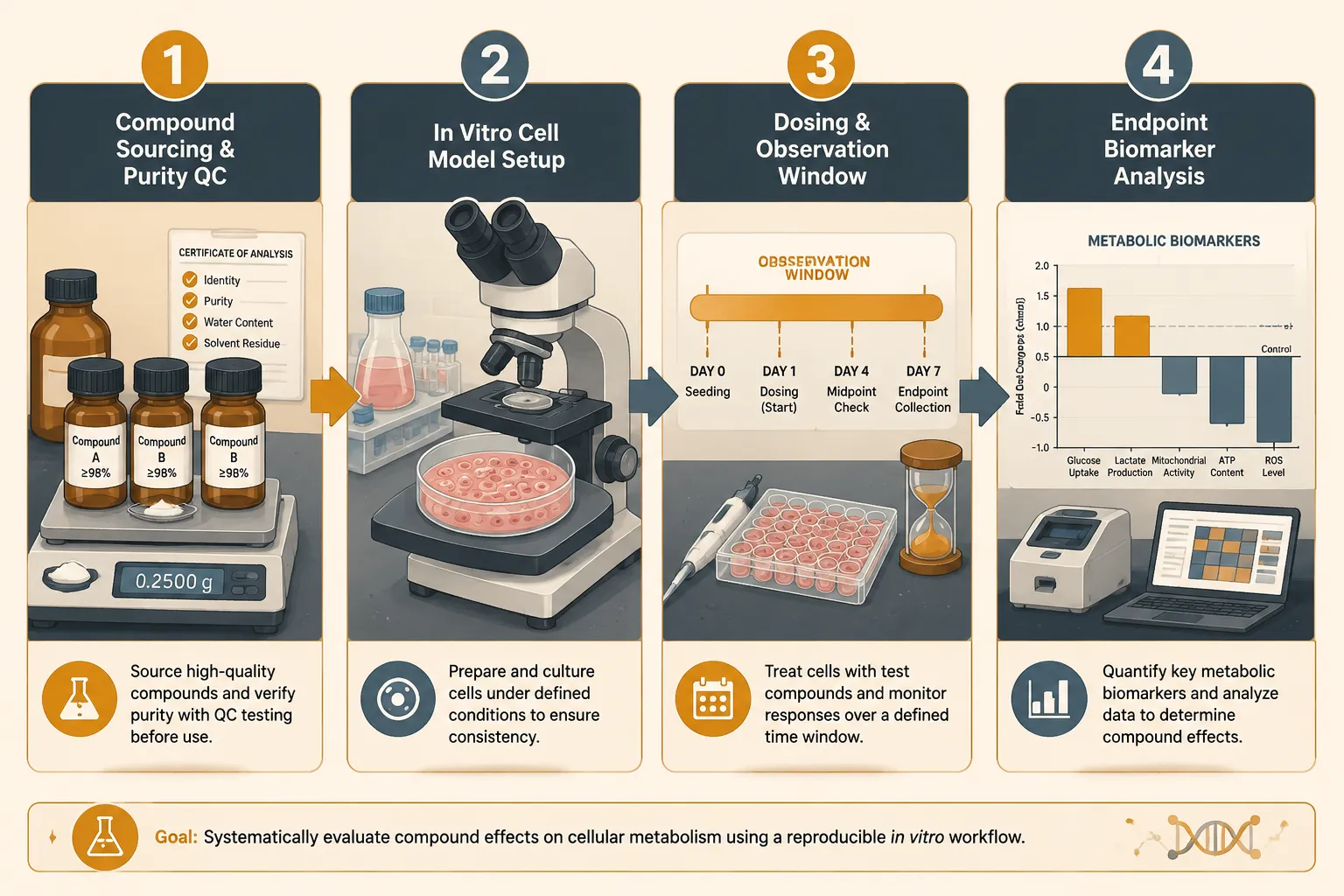
Translating the theoretical rationale into a controlled experiment requires careful attention to several variables. The following table summarizes the primary design considerations researchers are working through in 2026:
| Variable | SLU-PP-332 Specific | 5-Amino-1MQ Specific | Stack Consideration |
|---|---|---|---|
| Purity threshold | Greater than 98% HPLC | Greater than 98% HPLC | Independent CoA for each lot |
| In vitro stability | DMSO stock, 4 degrees C | Aqueous solubility moderate | Separate vehicle controls needed |
| Endpoint markers | PGC-1 alpha, TFAM, CPT1 | NAD+/NADH ratio, SIRT1 | Overlapping sirtuin panel |
| Regulatory status | Research chemical only | Research chemical only | Not for human administration |
Quality control is not optional in this context. In vitro characterization studies published in 2026 have highlighted that SLU-PP-332 metabolizes relatively quickly in microsomal assays, making lot-to-lot consistency and precise dosing windows essential for reproducible results. Researchers sourcing compounds for this type of work should apply the same rigor discussed in resources covering TB-500 in controlled experimental models and QC workflow.
The regulatory position is unambiguous: both SLU-PP-332 and 5-Amino-1MQ are classified as research chemicals. Neither has completed clinical trials nor received approval from any regulatory authority for therapeutic use in humans. Any discussion of this stack outside a controlled research context falls outside the scope of current evidence.
Researchers interested in how other investigational compounds are being characterized for hormone research compounds will find useful methodological parallels when designing endpoints for ERR-targeting agents.
Conclusion
The combination of SLU-PP-332 and 5-Amino-1MQ represents a mechanistically coherent research stack, not a random pairing of trending compounds. Slupp332 With 5-Amino-1MQ: What This Advanced Metabolic Stack Means in Research Models ultimately comes down to a dual-target hypothesis: activate mitochondrial programming through ERR agonism while simultaneously ensuring the NAD+ cofactor supply is sufficient to support that activation. The logic is sound at the preclinical level, and 2026 has seen growing experimental interest in testing whether the combination produces effects that neither compound achieves alone.
For researchers considering this stack, the actionable next steps are clear:
- Establish independent purity documentation for each compound before any experimental use.
- Design separate vehicle controls to account for differing solubility profiles.
- Select a biomarker panel that captures both ERR-downstream targets and NAD+-dependent enzyme activity.
- Treat all findings as preclinical and avoid extrapolating to human outcomes without a robust clinical evidence base.
The field is moving quickly, and the mechanistic rationale for this combination is compelling enough to warrant rigorous investigation. Staying grounded in controlled methodology is what will determine whether this stack becomes a footnote or a meaningful contribution to metabolic research.


Leave a Reply
Want to join the discussion?Feel free to contribute!