

5-Amino-1MQ and MOTS-c Co-Treatment: A Matrix for Dose-Response, Additivity, and Interaction Testing
Preclinical data show that combining NNMT inhibition with mitochondrial peptide signaling can increase fat oxidation by roughly 47% above baseline, yet no published, peer-reviewed study has formally tested 5-Amino-1MQ and MOTS-c together in any model, human or animal. That gap between mechanistic promise and experimental evidence is precisely why a rigorous combination-study framework matters. Designing 5-Amino-1MQ and MOTS-c co-treatment: a matrix for dose-response, additivity, and interaction testing is not a dosing guide, it is a blueprint for generating credible data where none currently exists.
Key Takeaways
- 5-Amino-1MQ inhibits NNMT and raises NAD+ in adipose tissue; MOTS-c activates AMPK in skeletal muscle, the pathways are complementary, not overlapping.
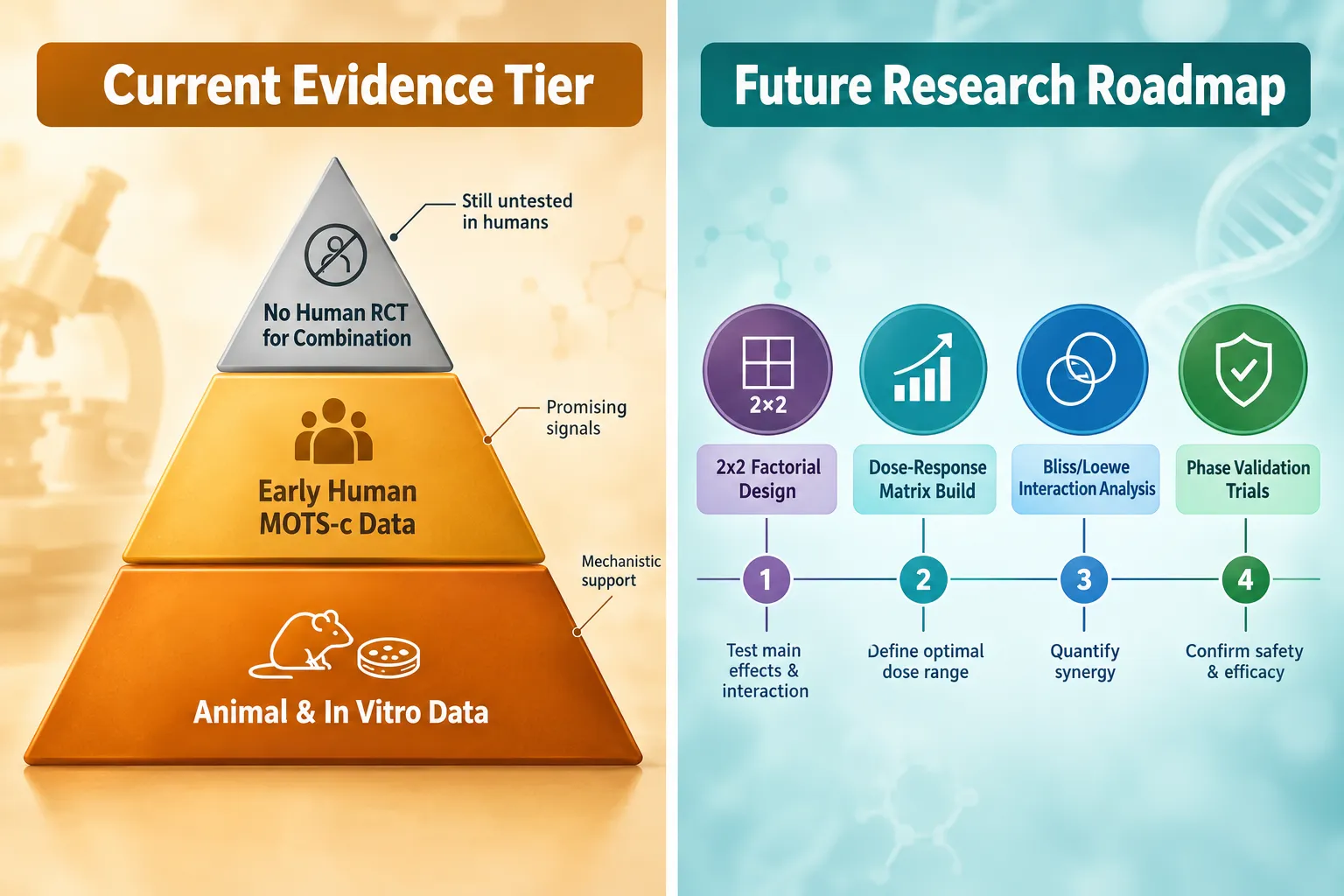
- No published study has tested the two compounds together; any combination matrix is currently hypothetical experimental design, not completed research.
- A 2×2 factorial layout (vehicle, each agent alone, combination) is the minimum structure needed to detect true interaction effects.
- Bliss independence and Loewe additivity models are the standard analytical tools for quantifying whether a combination is additive, synergistic, or antagonistic.
- Both compounds are sold for research use only; 5-Amino-1MQ has no registered human trials, while MOTS-c has limited early human mechanistic data.
Why These Two Compounds Belong in the Same Experimental Frame
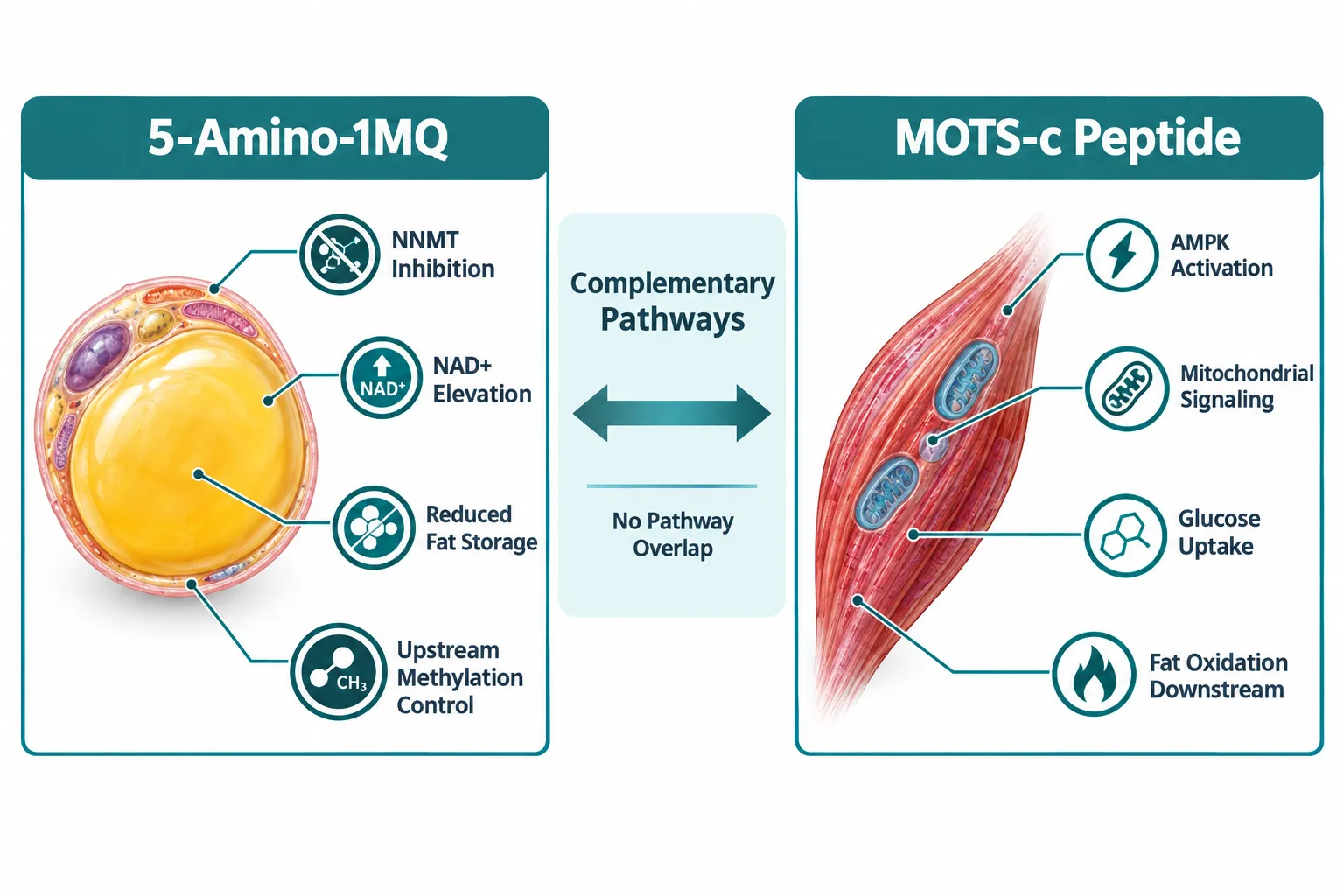
Understanding the rationale for 5-Amino-1MQ and MOTS-c co-treatment begins with their distinct, non-overlapping mechanisms.
5-Amino-1MQ is a small-molecule inhibitor of nicotinamide N-methyltransferase (NNMT), an enzyme that consumes NAD+ precursors in white adipose tissue. By suppressing NNMT, the compound elevates intracellular NAD+ and alters methylation-dependent regulation of fat storage. In obese mouse models, it reduced body weight without changing food intake or lean mass, a profile that suggests a direct effect on adipose metabolism rather than appetite suppression. Researchers can explore 5-Amino-1MQ capsules as a reference-grade research compound.
MOTS-c is a 16-amino-acid peptide encoded in mitochondrial DNA. It activates AMPK and related metabolic stress pathways, primarily in skeletal muscle, enhancing glucose uptake and fat oxidation. Unlike 5-Amino-1MQ, MOTS-c has early human mechanistic data in metabolic and exercise contexts. Researchers can review MOTS-c and Elamipretide for context on mitochondrial-targeted peptide combinations.
The conceptual logic for pairing them is straightforward: 5-Amino-1MQ acts upstream on NNMT and NAD+ in white fat; MOTS-c acts downstream on mitochondrial signaling and AMPK in muscle. There is no obvious pathway competition, which creates a plausible, though unproven, basis for additivity or synergy.
"Mechanistic complementarity is a hypothesis, not a result. It justifies building a dose-response matrix; it does not replace one."
Building the Experimental Matrix: Factorial Design and Dose Selection
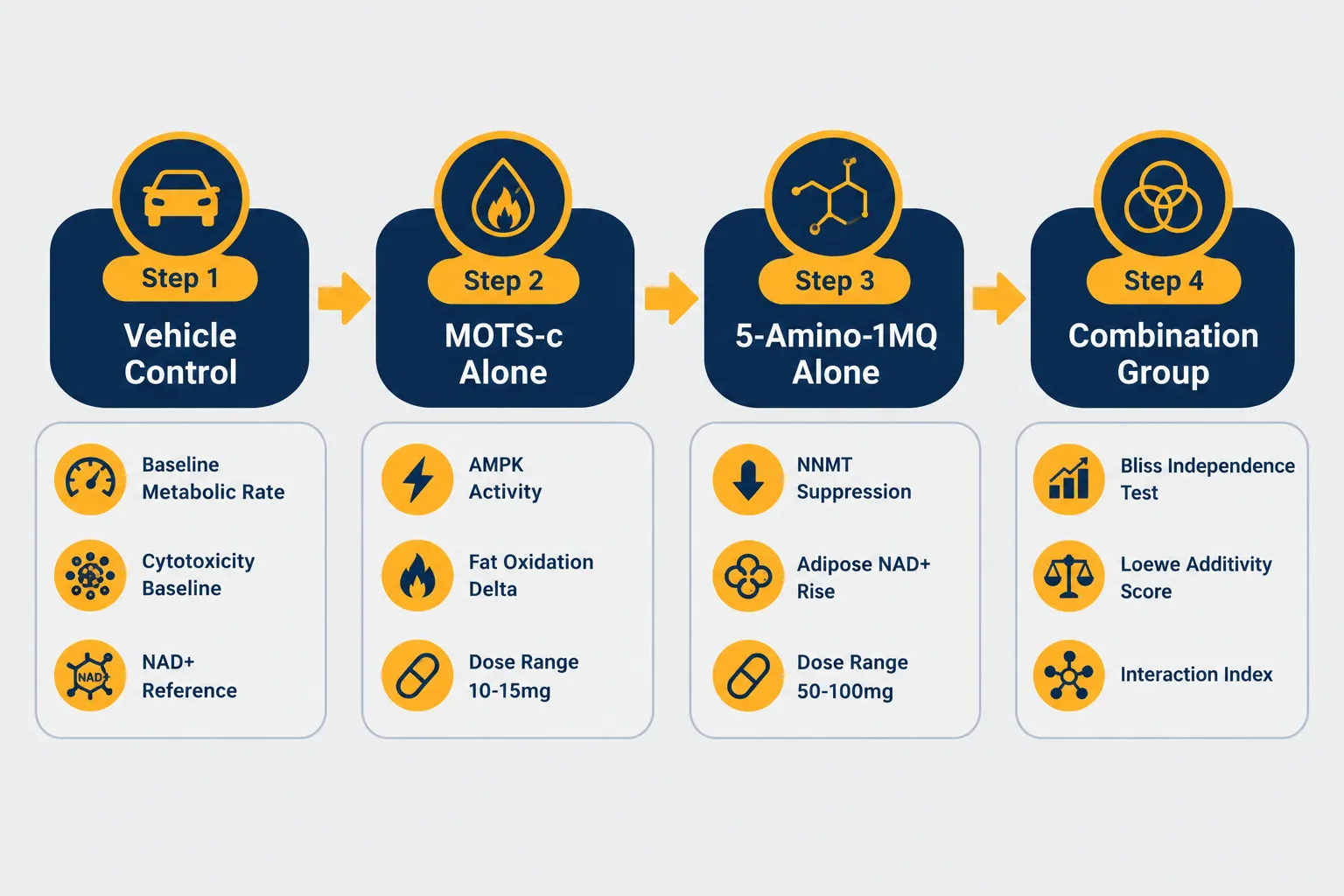
The foundation of 5-Amino-1MQ and MOTS-c co-treatment: a matrix for dose-response, additivity, and interaction testing is a properly structured factorial experiment. A 2×2 factorial layout, vehicle control, MOTS-c alone, 5-Amino-1MQ alone, and the combination, is the minimum design capable of detecting interaction effects. Anything less cannot distinguish true synergy from simple additive responses.
Dose Range Selection
Research-oriented protocols commonly reference the following ranges, extrapolated from animal and mechanistic data rather than large randomized human trials:
| Compound | Typical Research Range | Route |
|---|---|---|
| 5-Amino-1MQ | 50-100 mg once daily | Oral |
| MOTS-c | 10-15 mg once daily | Subcutaneous |
For a proper dose-response matrix, each compound should be tested at a minimum of three concentration levels (low, mid, high) within these ranges. This produces a 3×3 grid of nine treatment conditions plus vehicle control, sufficient to fit a response surface and identify the concentration pair that maximizes effect while minimizing off-target risk.
Endpoints to Measure
A credible matrix requires mechanistic endpoints, not just body-weight readouts:
- NAD+ and SAM pool quantification, both pathways influence NAD+ availability by different mechanisms, and their interaction on methyl donor pools is currently unknown
- AMPK phosphorylation, primary downstream marker of MOTS-c activity
- NNMT enzyme activity, direct measure of 5-Amino-1MQ target engagement
- Mitochondrial oxygen consumption rate (OCR), Seahorse or equivalent assay
- Cytotoxicity controls, cell viability at every dose level to separate metabolic effects from toxicity artifacts
Omitting cytotoxicity controls is a common methodological error in preclinical peptide research. Any apparent "synergy" in a metabolic endpoint is uninterpretable if cell viability is simultaneously compromised.
Interaction Analysis: Bliss, Loewe, and What the Data Actually Need to Show
Once dose-response data are collected, the analytical framework determines whether the combination qualifies as additive, synergistic, or antagonistic. Two models dominate combination pharmacology:
Bliss Independence assumes that each agent acts independently. The expected combined effect is calculated as: E(A+B) = E(A) + E(B) − E(A)×E(B). If the observed effect exceeds this prediction, synergy is indicated; if it falls short, antagonism is present.
Loewe Additivity treats the two drugs as if they were dilutions of each other. It calculates a combination index (CI): CI < 1 indicates synergy, CI = 1 indicates additivity, CI > 1 indicates antagonism. Loewe is generally preferred when the two compounds share a common downstream endpoint, in this case, fat oxidation or AMPK activity.
For 5-Amino-1MQ and MOTS-c co-treatment: a matrix for dose-response, additivity, and interaction testing, researchers should apply both models and report where they agree and diverge. Discordance between Bliss and Loewe often signals that the mechanistic assumption of independence or dose-equivalence needs revision, itself a valuable finding.
A Critical Caution on NAD+ Interaction
Both compounds influence NAD+ availability, though by different mechanisms. 5-Amino-1MQ raises NAD+ by blocking its consumption via NNMT; MOTS-c influences NAD+-dependent AMPK signaling from the mitochondrial side. Whether co-administration amplifies NAD+ effects, creates redundancy, or produces unexpected depletion of shared methyl donor (SAM) pools is unknown. This interaction should be treated as an explicit hypothesis within the matrix, not an assumed benefit.
Multi-compound stacks that combine these agents with NAD+ precursors, some commercial vials contain approximately 10 mg 5-Amino-1MQ, 10 mg MOTS-c, and 100 mg NAD+, add a third variable that further complicates interaction modeling. Researchers interested in related mitochondrial peptide combinations can also review SS-31 and MOTS-c stacks for comparative mechanistic context.
When sourcing compounds for any in-vitro or animal study, purity verification is non-negotiable. Lab-tested peptides with documented certificate-of-analysis data are the baseline standard for credible preclinical work.
Conclusion
The scientific case for exploring 5-Amino-1MQ and MOTS-c co-treatment: a matrix for dose-response, additivity, and interaction testing rests on mechanistic complementarity, upstream NNMT inhibition in adipose tissue paired with downstream AMPK activation in skeletal muscle. That complementarity is conceptually sound, but it remains a hypothesis. No peer-reviewed study has yet tested this combination formally.
Actionable next steps for researchers:
- Design a 3×3 dose-response matrix with vehicle control and measure at least four mechanistic endpoints, including cytotoxicity at every concentration.
- Apply both Bliss independence and Loewe additivity models to the combination data; report the combination index and flag any discordance between models.
- Explicitly test NAD+ and SAM pool effects as a primary endpoint, not a secondary observation, this is the most likely site of unexpected interaction.
- Use only purity-verified, lab-tested compounds and document batch-level CoA data in any publication.
- Frame all findings as hypothesis-generating until Phase-grade human trial data exist; 5-Amino-1MQ remains entirely preclinical, and no human dose-response validation for either compound in combination has been registered.
The matrix described here does not yet exist in the literature. Building it rigorously is the work that needs to happen before any clinical extrapolation is warranted.


Leave a Reply
Want to join the discussion?Feel free to contribute!