Call or Text 727-513-9780
  • Shopping Cart Shopping Cart
    0Shopping Cart
Pure Tested Peptides | America's most trusted Peptides for sale online
  • Peptides for sale
    • Oral Peptides for sale
      • Peptide Capsules for sale
      • BPC 157 Capsules 1000mcg
      • SLU-PP-332 Capsules | 1000 mcg
      • 5-Amino-1MQ 50mg Capsules
      • Tesofensine 500mcg
    • All Peptides for sale
    • Peptide Sprays
      • BPC 157 Nasal Spray Kit
      • BPC-157 TB500 Nasal Spray Kit
      • Semax Nasal Spray 10mg
      • Selank – Nasal Spray Kit – 10mg
      • Epithalon 50MG Nasal Spray Kit
      • Ipamorelin 10mg Nasal Spray
      • Klow Nasal Spray (BPC-157 + TB-500 + GHK-Cu + KPV) | 80mg
      • Hulk Nasal Spray Tesa / Ipa Blend 6/3 MG
      • Klow Nasal Spray
      • NAD + 500 mg Nasal Spray
      • PT-141 Nasal Spray Kit
    • GHRH Peptides
      • Ipa Peptides
      • CJC-1295 Peptides
        • CJC-1295 with DAC 5 mg
        • CJC-1295 without DAC 5 mg
        • CJC-1295 Ipa 10mg
      • Tesa Peptides
        • Tesa Peptide
        • Tesa 20 mg
    • GHK-Cu Peptides
      • All GHK-Cu Peptides
      • GHK-Cu 100mg
      • KLOW Peptide Blend – Buy KLOW blend online
    • BPC Peptides
      • All BPC Peptides
      • BPC-157
      • BPC-157 TB-500
      • BPC 157 capsules 1000mcg
    • SLU-PP-332 Peptides
      • All SLU-PP-332 Peptides
      • SLU-PP-332 5mg
    • GLP3 Peptides
    • PT-141 Peptides
      • PT-141 Peptides for sale
      • PT-141 10mg
      • PT-141 Nasal Spray
    • CAG Peptides
      • Lipo-C Peptide Blend
      • CAG 5mg
      • CAG 10mg
    • MOTS-C Peptides
      • MOTS-C Peptides for sale
      • MOTS-c peptide
      • MOTS-c 10mg *6 pack*
    • 5 Amino 1MQ Peptides
      • 5 Amino 1MQ Peptides for sale
      • 5-Amino-1MQ 50mg Capsules
      • 5-Amino-1MQ 5mg
    • Epithalon Peptides
      • Epithalon Peptides for sale
      • Epithalon 10mg
      • Epithalon 50mg
  • Shop
    • GLPs
      • 5-Amino-1MQ 50mg Capsules
      • 5-Amino-1MQ 5mg
      • L-Carnitine 500mg/ml
      • Tesofensine 500mcg
      • SLU-PP-332 5mg
      • MOTS-c 10mg *6 pack*
    • Epithalon & BPC Peptides
      • Epithalon 10mg
      • Epithalon 50mg
      • BPC-157
      • BPC 157 capsules 1000mcg
      • BPC-157 TB-500
      • BPC-157 TB500 Nasal Spray Kit
      • BPC 157 Nasal Spray Kit
    • BPC TB-500 & NAD+ Peptides
      • NAD+ 500 mg
      • KLOW Peptide Blend – Buy KLOW blend online
      • GLOW Peptide Blend
      • TB 500 5mg
      • BPC 157 capsules 1000mcg – Supplement
      • BPC 157 Nasal Spray Kit
      • BPC-157
      • BPC-157 TB500 Nasal Spray Kit
      • BPC-157 TB-500
      • BPC 157 capsules 1000mcg
    • LL-37 Peptide
      • LL-37 10 mg
    • MOTS-C & Selank
      • MOTS-c peptide
      • Selank 10mg
    • GHK Peptides
      • GHK-Cu 100mg
      • GLOW Peptide Blend
      • KLOW Peptide Blend – Buy KLOW blend online
  • COAs
  • Wholesale
    • Wholesale Peptides for sale
  • PTP FAQ
  • Affiliates
    • Selank Peptide: Advanced Pharmacological Mechanisms Underlying Its Anxiolytic and Nootropic Effects in Research
      • 5-Amino-1MQ Peptide: Detailed Mechanisms of NNMT Inhibition and Its Impact on Cellular Metabolism Research
        • MOTS-C Peptide: Unraveling Its Role in Mitochondrial Dynamics and Energy Metabolism Research
          • Epithalon Peptide and Telomerase Regulation: Investigating Its Impact on Cellular Senescence and Lifespan Research Models
            • GLP2-T vs GLP2 Tirz Peptide: Understanding the Naming, Mechanistic Nuances, and Research Implications for Gut Health
      • Peptides and Polypeptides in Modern Pharmacology: What Research on Metoprolol, Prednisone, and Amlodipine Reveals
        • Polypeptide Peptides vs NSAIDs: What Naproxen and Diclofenac Teach Tissue-Repair Researchers About BPC‑157 and TB‑500
          • Peptides and Polypeptides in Endocrine Pharmacology: How GLP-1, GLP-2, and GLP-3 Retatrutide Differ From Classic Drugs Like Prednisone and Amlodipine
          • 5‑Amino‑1MQ Peptide and NNMT Inhibition: How It Compares With Statins Like Atorvastatin in Adipose and Lipid Metabolism Research
      • Enclomiphene, Estrogen Receptor Signaling, and Luteinizing Phase Biology: What Hormone Researchers Should Measure
        • Mesenchymal Stem Cells, BPC‑157, and GHK‑Cu: How Tissue Repair Peptides Compare With Classic NSAIDs Like Naproxen in Injury Models
          • Peptide Calculator Use Cases Beyond Growth Hormone: Working Through GLP‑3 Retatrutide, MOTS‑c, and BPC‑157 Research Dosing
        • Polypeptide Peptides in Endocrine and Metabolic Pharmacology: Lessons From Amlodipine, Prednisone, and Metoprolol
        • Peptides Calculator for Advanced Blends: Worked Examples for Tesamorelin, CJC‑1295, and Ipamorelin Stacks
          • Peptides and Polypeptides in Human Physiology: How Molecular Size Shapes Research Applications
            • Selank Peptide: Advanced Pharmacological Mechanisms Underlying Its Anxiolytic and Nootropic Effects in Research
          • 5-Amino-1MQ Peptide: Detailed Mechanisms of NNMT Inhibition and Its Impact on Cellular Metabolism Research
            • MOTS-C Peptide: Unraveling Its Role in Mitochondrial Dynamics and Energy Metabolism Research
              • Epithalon Peptide and Telomerase Regulation: Investigating Its Impact on Cellular Senescence and Lifespan Research Models
                • GLP2-T vs GLP2 Tirz Peptide: Understanding the Naming, Mechanistic Nuances, and Research Implications for Gut Health
                  • Peptides and Polypeptides in Endocrine Pharmacology: How GLP-1, GLP-2, and GLP-3 Retatrutide Differ From Classic Drugs Like Prednisone and Amlodipine
                    • Polypeptide Peptides vs NSAIDs: What Naproxen and Diclofenac Teach Tissue-Repair Researchers About BPC‑157 and TB‑500
                      • Peptides and Polypeptides in Modern Pharmacology: What Research on Metoprolol, Prednisone, and Amlodipine Reveals
                        • 5‑Amino‑1MQ Peptide and NNMT Inhibition: How It Compares With Statins Like Atorvastatin in Adipose and Lipid Metabolism Research
                        • Enclomiphene, Estrogen Receptor Signaling, and Luteinizing Phase Biology: What Hormone Researchers Should Measure
                        • Mesenchymal Stem Cells, BPC‑157, and GHK‑Cu: How Tissue Repair Peptides Compare With Classic NSAIDs Like Naproxen in Injury Models
                        • Peptide Calculator Use Cases Beyond Growth Hormone: Working Through GLP‑3 Retatrutide, MOTS‑c, and BPC‑157 Research Dosing
                        • Polypeptide Peptides in Endocrine and Metabolic Pharmacology: Lessons From Amlodipine, Prednisone, and Metoprolol
                        • Peptides Calculator for Advanced Blends: Worked Examples for Tesamorelin, CJC‑1295, and Ipamorelin Stacks
                        • Peptides and Polypeptides in Human Physiology: How Molecular Size Shapes Research Applications
                        • Selank Peptide: Advanced Pharmacological Mechanisms Underlying Its Anxiolytic and Nootropic Effects in Research
                        • MOTS-C Peptide: Unraveling Its Role in Mitochondrial Dynamics and Energy Metabolism Research
                        • Peptides and Polypeptides in Modern Pharmacology: What Research on Metoprolol, Prednisone, and Amlodipine Reveals
                        • Peptides and Polypeptides in Endocrine Pharmacology: How GLP-1, GLP-2, and GLP-3 Retatrutide Differ From Classic Drugs Like Prednisone and Amlodipine
                        • 5-Amino-1MQ Peptide: Detailed Mechanisms of NNMT Inhibition and Its Impact on Cellular Metabolism Research
                        • Mesenchymal Stem Cells, BPC‑157, and GHK‑Cu: How Tissue Repair Peptides Compare With Classic NSAIDs Like Naproxen in Injury Models
                        • Peptide Calculator Use Cases Beyond Growth Hormone: Working Through GLP‑3 Retatrutide, MOTS‑c, and BPC‑157 Research Dosing
                        • GLP2-T vs GLP2 Tirz Peptide: Understanding the Naming, Mechanistic Nuances, and Research Implications for Gut Health
                        • Polypeptide Peptides in Endocrine and Metabolic Pharmacology: Lessons From Amlodipine, Prednisone, and Metoprolol
                        • Polypeptide Peptides vs NSAIDs: What Naproxen and Diclofenac Teach Tissue-Repair Researchers About BPC‑157 and TB‑500
                        • Peptides and Polypeptides in Human Physiology: How Molecular Size Shapes Research Applications
                        • Peptides Calculator for Advanced Blends: Worked Examples for Tesamorelin, CJC‑1295, and Ipamorelin Stacks
                        • 5‑Amino‑1MQ Peptide and NNMT Inhibition: How It Compares With Statins Like Atorvastatin in Adipose and Lipid Metabolism Research
                        • Enclomiphene, Estrogen Receptor Signaling, and Luteinizing Phase Biology: What Hormone Researchers Should Measure
                        • Epithalon Peptide and Telomerase Regulation: Investigating Its Impact on Cellular Senescence and Lifespan Research Models
                        • Best research protocol Klow blend
                        • best time to take BPC-157
                        • best time to take DSIP (Delta Sleep Inducing Peptide)
                        • best time to take CJC-1295
                        • best time to take AOD-9604
                        • best time to take Follistatin 344
                        • best time to take Ipamorelin
                        • best time to take MK-677 (Ibutamoren)
                        • best time to take Ligandrol (LGD-4033) — research compound
                        • best time to take Ostarine (MK-2866) — research compound
                        • best time to take GHK-CU
                        • best time to take TB-500
                        • best time to take MOTS-c
                        • best time to take Semax
                        • best time to take RAD-140 (Testolone) — research compound
                        • best time to take Thymosin Alpha-1
                        • best time to take PEG-MGF
                        • Biolife Plasma, Octapharma Plasma, and Research Peptides: How Plasma Donation Labs Differ From Peptide Suppliers
                        • best time to take YK-11 — research compound
                        • best time to take PT-141 (Bremelanotide)
                        • Best research protocol Klow blend
                        • 5-Amino-1MQ and MOTS-C Synergy: Metabolic Signaling, Mitochondria, and Research Design
                        • BPC-157 and TB-500: Investigating Their Combined Effects on Angiogenesis and Cellular Migration in Tissue Repair Models
                        • BPC-157 Peptide: Gut Barrier Function, Inflammation, and Tissue-Recovery Research
                        • 5‑Amino‑1MQ and MOTS‑c Synergy in Metabolic Research: Designing NNMT and Mitochondrial Biogenesis Stacks
                        • CJC-1295 with DAC vs. Without DAC: Half-Life, Release Kinetics, and Research Implications
                        • CJC‑1295 with DAC vs. Without DAC: Expanding on Half‑Life Differences Using Tesamorelin and Ipamorelin Blend Case Studies
                        • Collagen Biology and Copper‑Binding Peptides: How GHK‑Cu, Glow Blend, and Klow Blend Interact with Skin and Connective Tissue
                        • Collagen Biology and Regenerative Peptides: How GHK‑Cu, Glow Blend, and Klow Blend Affect Extracellular Matrix Research
                    • DNA, Telomeres, and Longevity Peptides: Positioning Epithalon and MOTS‑c in Genetic Aging Research
                      • Enclomiphene Citrate: serm Mechanism, Testosterone Research, and Stack Compatibility
                        • Enclomiphene vs Enclomiphene Citrate: Formulation, Bioavailability, and Research Distinctions
                        • Epithalon Peptide Research: Telomerase Activation, Aging, and Pineal Gland Function
                        • Estrogen Receptor Signaling and Enclomiphene: How Selective Modulators Compare with Classic Polypeptide Hormones
                        • GHK-Cu Peptide: Advanced Mechanisms in Extracellular Matrix Remodeling and Wound Healing Research
                        • GHK-Cu Peptide: Collagen Synthesis, Wound Repair, and Skin-Barrier Research Models
                        • GLP-1 vs GLP-3 vs GLP-2: Peptide Classification and Research Applications
                        • GLP-2 Peptide Research Guide: Gut Barrier Function, Nutrient Absorption, and Intestinal Recovery Models
                        • GLP-3 Retatrutide vs. GLP-1 Drugs: What Triple-Agonist Biology Changes in Research Models
                        • Ipamorelin and Tesamorelin Combination: Synergistic GH Secretagogue Research and Dosing Protocols
                        • GLP2 Tirz Peptide: What It Is, Why the Name Exists, and How Researchers Should Interpret It
                        • Klow Blend Peptide Nasal Spray: What the Formulation Is Trying to Do in Cognitive Research
                        • Mitochondria, NNMT Inhibition, and Peptide Modulators: Where MOTS‑c and 5‑Amino‑1MQ Fit in Cellular Energy Research
                        • MOTS-c Peptide: Mitochondrial Function, Energy Metabolism, and What Researchers Measure
                        • MOTS-c vs. 5-Amino-1MQ: Which Metabolic Research Questions Each Compound Actually Answers
                        • Nasal Spray Peptides: Bioavailability, Administration, and Semax/Selank Research Applications
                        • PT-141 Peptide Research: Mechanism of Action and Melanocortin Receptor Signaling
                        • Retatrutide for Research: Mechanism, Structure, and GLP-1/GLP-3 Dual Action
                        • Retatrutide for Obesity and Type 2 Diabetes: What the Latest Trial Data Suggest
                        • Tesofensine Peptide Research: Mechanism, Appetite Suppression, and Neuropeptide Y Pathways
  • Contact
    • Contact Customer Service
    • Text Customer Support
  • About US
  • Shop all peptides
  • Affiliate Program
    • Affiliate Signup
  • Login / Register Login / Register Page Link Login / Register Page Link
  • Click to open the search input field Click to open the search input field Search
  • Menu Menu
ACE Inhibitors Explained: How Lisinopril and Angiotensin-Converting Enzyme Signaling Can Confound Peptide Vascular Studies

ACE Inhibitors Explained: How Lisinopril and Angiotensin-Converting Enzyme Signaling Can Confound Peptide Vascular Studies

October 12, 2026/0 Comments/in Uncategorized/by

Nearly one in three adults worldwide takes a medication that directly reshapes the body's peptide signaling landscape — yet most vascular peptide studies fail to account for it. Angiotensin-converting enzyme (ACE) inhibitors, led by the widely prescribed lisinopril, do far more than lower blood pressure. They fundamentally alter the concentrations of angiotensin II, bradykinin, and a cascade of downstream peptides that researchers use as biomarkers and endpoints. Understanding ACE inhibitors explained through the lens of vascular peptide research is not just useful — it is essential for producing reproducible, interpretable data.

Key Takeaways

  • ACE inhibitors like lisinopril block the conversion of angiotensin I to angiotensin II, but also elevate bradykinin, Ac-SDKP, and angiotensin-(1-7), altering the entire vascular peptide environment.
  • Background ACE inhibitor use in study subjects creates a shifted peptide "baseline" that can make experimental results misleading if not controlled for.
  • Dietary and research-use peptides can independently inhibit ACE, adding another layer of confounding in vascular studies.
  • ACE inhibition measurably reduces collagen-related peptide biomarkers, affecting tissue-remodeling endpoints.
  • Rigorous study design requires screening, stratification, and biomarker adjustment for ACE inhibitor exposure.

How ACE Biology Drives Vascular Peptide Signaling
How ACE Biology Drives Vascular Peptide Signaling

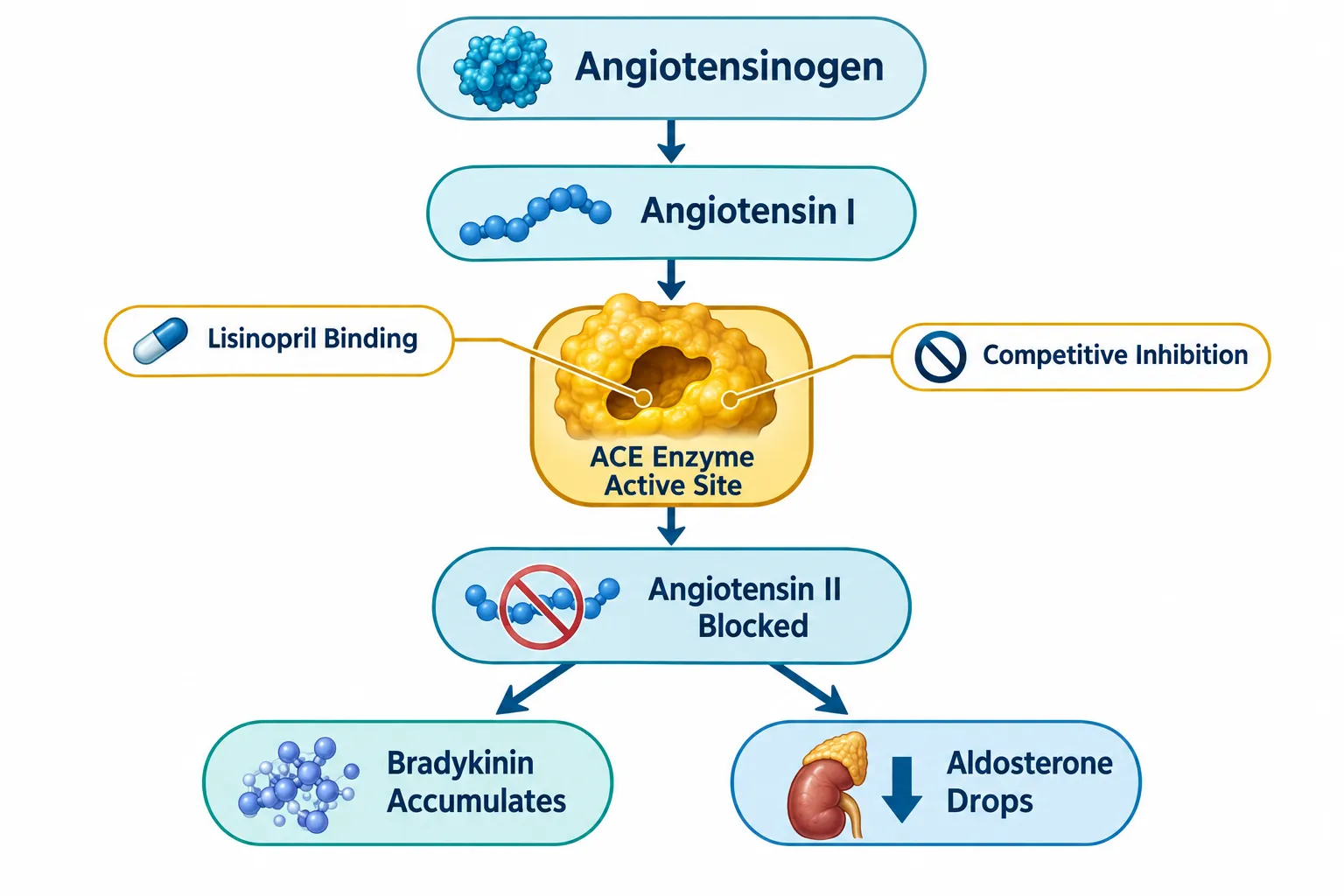
The renin-angiotensin-aldosterone system (RAAS) is one of the most studied hormonal axes in cardiovascular medicine. At its center sits angiotensin-converting enzyme — a peptidyl dipeptidase anchored to vascular endothelium. ACE cleaves two amino acids from angiotensin I to generate angiotensin II, a potent vasoconstrictor that raises blood pressure, stimulates aldosterone release, and promotes vascular smooth-muscle contraction.

Lisinopril binds competitively to the ACE active site, blocking this conversion. The result is a drop in circulating angiotensin II and a parallel reduction in aldosterone and vasopressor activity. Blood pressure falls. But the enzymatic blockade does not stop there.

ACE also degrades bradykinin, a vasodepressor peptide that promotes vasodilation and natriuresis. When ACE is inhibited, bradykinin accumulates. Current regulatory labeling for lisinopril acknowledges that elevated bradykinin may contribute to the drug's therapeutic effects, though its precise role remains under investigation. Beyond bradykinin, ACE inhibition raises levels of:

Peptide Species Direction of Change Vascular Effect
Angiotensin II Decreases Less vasoconstriction
Bradykinin Increases Vasodilation
Ac-SDKP Increases Anti-fibrotic, vasodilatory
Angiotensin-(1-7) Increases Vasodilation, anti-proliferative

This multi-peptide shift is not a side effect — it is a core feature of ACE inhibitor pharmacology. For researchers studying vascular peptide biology, it represents a significant source of confounding.

"Any background ACE inhibition — whether from a drug or a dietary source — can substantially skew vascular peptide profiles in experimental studies."


ACE Inhibitors Explained: Why Lisinopril Confounds Peptide Vascular Studies
ACE Inhibitors Explained: Why Lisinopril Confounds Peptide Vascular Studies

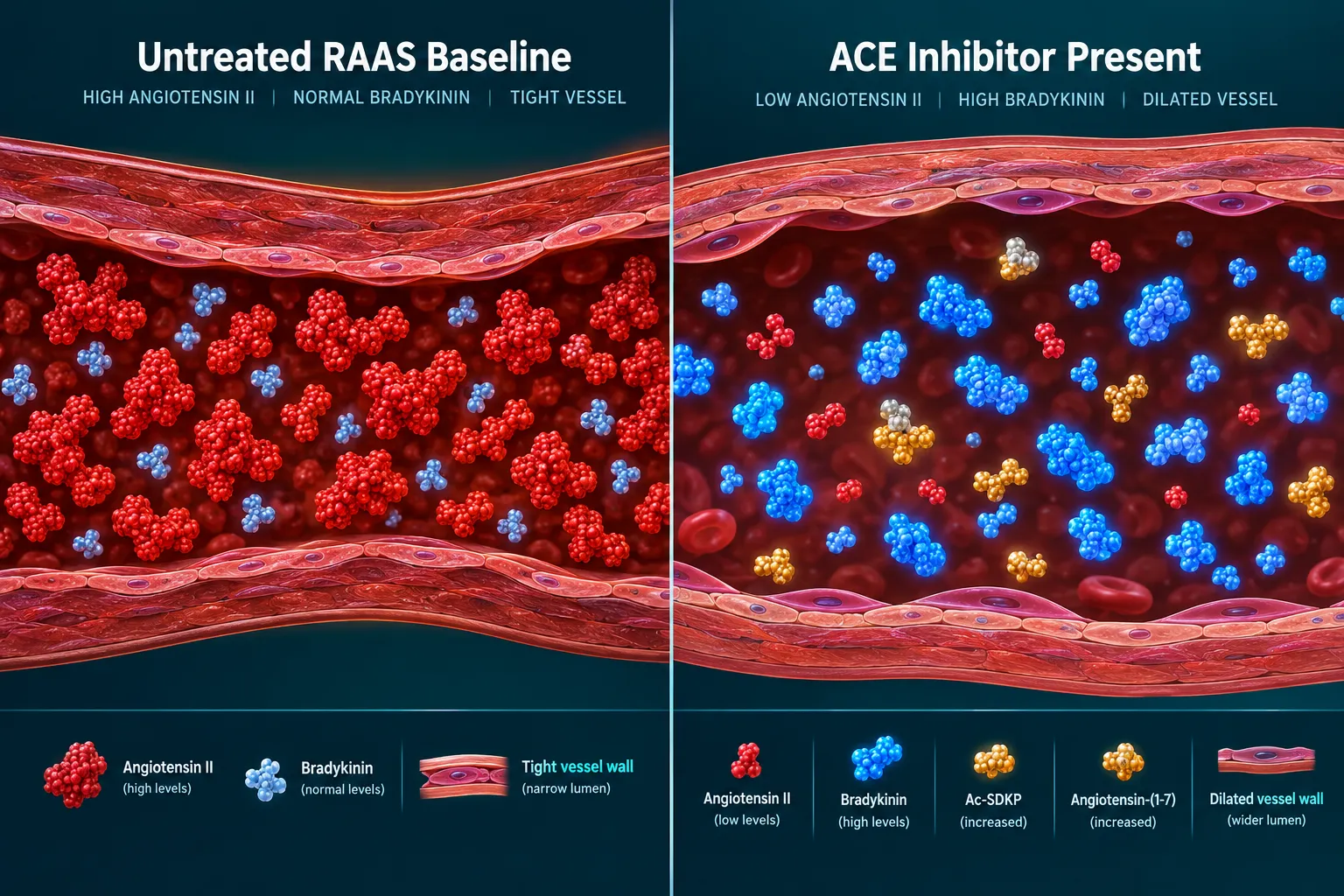
The confounding problem becomes clearest when examining what happens to the peptide environment inside study subjects already taking lisinopril. Their "baseline" is not a neutral RAAS state. It is a pharmacologically shifted landscape with suppressed angiotensin II, elevated kinins, and altered angiotensin peptide degradation kinetics.

Research published in 2026 confirms that ACE-inhibiting agents significantly alter the degradation kinetics and half-life of upstream angiotensin peptides, including angiotensin-(1-12). This means that not just angiotensin II, but the entire spectrum of RAAS peptides, is affected. Studies that enroll subjects on lisinopril without stratification will pool two biologically distinct peptide environments.

Three specific confounding mechanisms stand out:

  1. Shifted angiotensin II levels — The primary endpoint in many vascular studies, angiotensin II, is directly suppressed. Effect sizes will be compressed or reversed.
  2. Elevated bradykinin and Ac-SDKP — These vasodilatory peptides oppose the actions of test compounds, masking or amplifying observed vascular responses.
  3. Altered collagen-related peptide biomarkers — ACE inhibitor therapy produces mean reductions of roughly 20% in serum procollagen III peptide (PIIIP) and significant decreases in other collagen markers. Studies using these peptides to assess tissue remodeling will find systematically lower values in ACE-inhibitor-exposed subjects.

This last point matters for cardiometabolic research. Peptide-based biomarkers of myocardial fibrosis and vascular remodeling are widely used in heart failure and hypertension trials. If ACE inhibitor status is not documented and controlled, the signal is corrupted.

For researchers exploring peptide compounds with vascular or mitochondrial protective properties — such as those described in resources on SS31 peptide benefits or the synergy of LL-37 and SS31 — understanding the pharmacological background of study subjects is critical to interpreting results accurately.


Dietary and Research Peptides as Hidden ACE Inhibitors

A less-recognized confounding source is the peptides themselves. Food-derived and synthetic peptides can independently inhibit ACE at pharmacologically relevant concentrations.

Broccoli-derived peptides — including HLVNK, LTEVR, and LLDGR — have been shown to reduce intracellular angiotensin II and inhibit ERK and p38 MAPK phosphorylation in vascular smooth-muscle cells. Marine muscle protein hydrolysate yields peptides such as APFLAG with measurable ACE IC50 values near 69.5 µM, acting through SRC and STAT3 signaling. These are the same pathways affected by lisinopril.

This creates a layered confounding problem in peptide vascular studies:

  • Pharmaceutical ACE inhibitors shift the subject's baseline peptide environment.
  • Dietary ACE-inhibitory peptides from food sources can mimic or augment drug effects.
  • Research-use peptides under investigation may themselves carry ACE-inhibitory activity that interacts with background drug therapy.

Researchers reviewing foundational peptide mechanisms will find the Peptides 101 for research-use only buyers guide a useful reference for understanding how peptide structure drives receptor selectivity. Similarly, building robust peptide benchmarks with Bachem reference standards is directly relevant to establishing clean experimental controls.

For studies involving metabolic peptides, understanding how GLP-related compounds interact with vascular tone — as explored in resources on GLP peptides for sale — adds another dimension to study design. Likewise, researchers examining cardiometabolic endpoints should consult data on tesa peptide benefits for context on growth-hormone-releasing peptides and vascular outcomes.


Practical Controls for ACE Inhibitor Confounding in Vascular Research
Practical Controls for ACE Inhibitor Confounding in Vascular Research

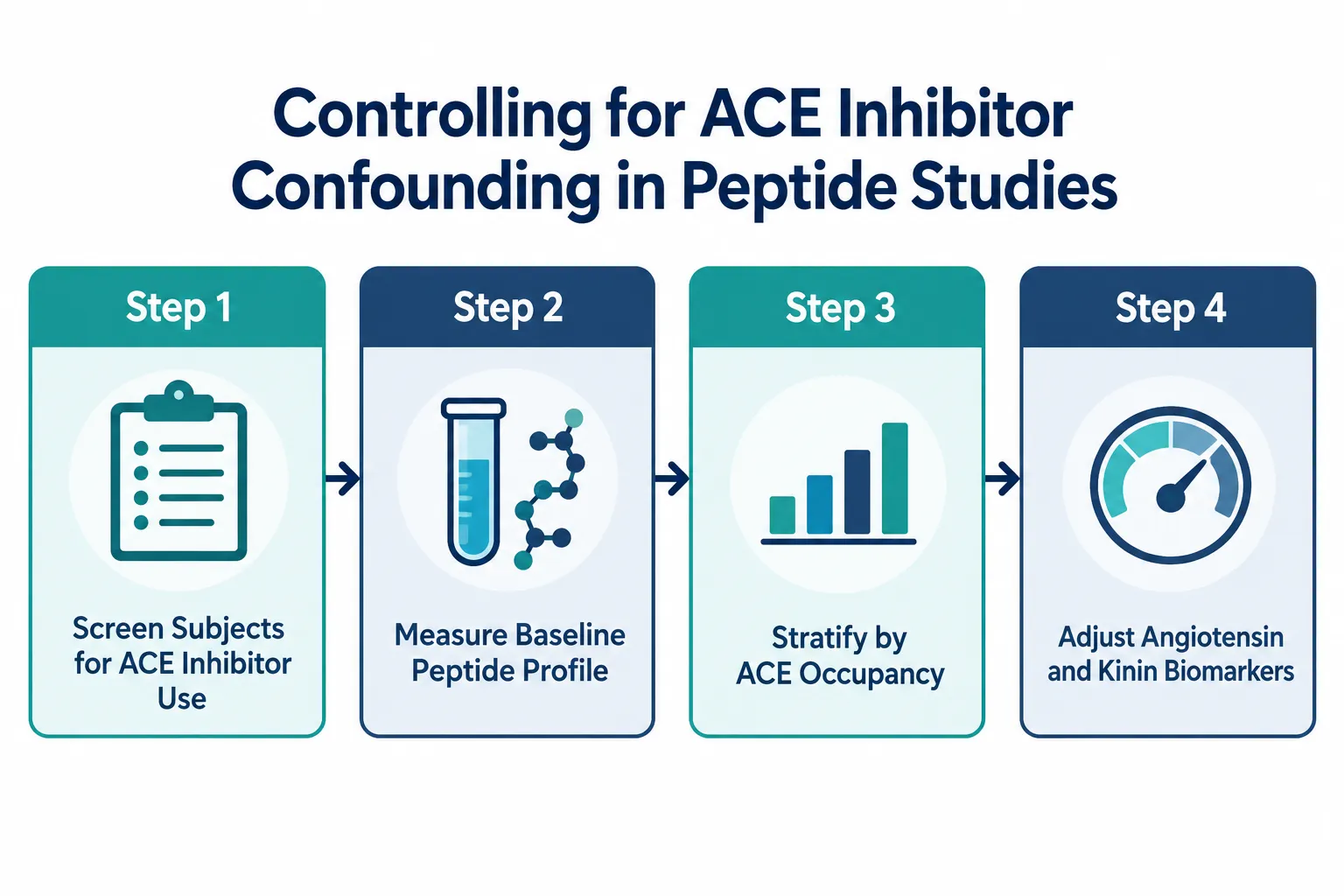
Addressing ACE inhibitor confounding requires deliberate study design. The following protocol elements are now considered best practice in rigorous vascular peptide research as of 2026:

Screening and Enrollment

  • Document all ACE inhibitor and ARB use at enrollment.
  • Exclude or separately stratify subjects on lisinopril or equivalent agents.
  • Screen for dietary patterns high in ACE-inhibitory peptide sources.

Biomarker Adjustment

  • Measure baseline bradykinin, Ac-SDKP, and angiotensin-(1-7) alongside angiotensin II.
  • Use angiotensin-(1-12) degradation kinetics as a proxy for ACE occupancy.
  • Adjust collagen-related peptide endpoints (PIIIP, PIP, PICP) for ACE inhibitor status.

Imaging and Occupancy Measurement

  • Nuclear imaging tools using lisinopril radioconjugates can now quantify tissue ACE occupancy directly, allowing researchers to correct for pre-existing ACE inhibitor binding in concurrent peptide pharmacodynamic measurements.

These controls are not optional refinements — they are the difference between interpretable data and noise. Lisinopril remains antihypertensive even in low-renin states, meaning its vascular effects span a broad clinical spectrum that cannot be predicted from renin status alone.


Conclusion

ACE inhibitors explained in full reveal a pharmacological footprint that extends far beyond blood pressure control. Lisinopril and its class alter angiotensin II, bradykinin, Ac-SDKP, angiotensin-(1-7), and collagen-related peptide biomarkers simultaneously. For vascular and cardiometabolic peptide researchers, this creates a multi-layered confounding problem that corrupts endpoints, compresses effect sizes, and undermines reproducibility.

Actionable next steps for researchers in 2026:

  • Implement mandatory ACE inhibitor screening in all vascular peptide study enrollment protocols.
  • Add kinin and angiotensin-(1-7) panels to standard biomarker batteries.
  • Treat dietary ACE-inhibitory peptide exposure as a covariate, not background noise.
  • Consult updated reference standards and benchmark documentation before finalizing study designs.
  • Anticipate that regulatory and journal reviewers will increasingly require ACE inhibitor status disclosure in vascular peptide trial reports.

The field is moving toward whole-RAAS and kinin-system peptidome profiling as standard practice. Researchers who build these controls into their protocols now will produce data that stands up to scrutiny — and advances the science of peptide vascular biology rather than obscuring it.

Tags: ace inhibitors, angiotensin ii, angiotensin-converting enzyme, bradykinin, lisinopril, peptide biomarkers, raas signaling, vascular peptide research
https://www.puretestedpeptides.com/wp-content/uploads/2026/10/ace-inhibitors-explained-how-lisinopril-and-angiotensin-converting-enzyme-signal.webp 1024 1536 https://www.puretestedpeptides.com/wp-content/uploads/2026/01/buy-peptides-online.jpg 2026-10-12 13:05:272026-10-12 13:05:27ACE Inhibitors Explained: How Lisinopril and Angiotensin-Converting Enzyme Signaling Can Confound Peptide Vascular Studies
You might also like
ACE Inhibitors and Research Peptides: Designing Blood-Pressure Controls Around Lisinopril and Growth-Hormone Secretagogues ACE Inhibitors and Research Peptides: Designing Blood-Pressure Controls Around Lisinopril and Growth-Hormone Secretagogues
Epithalon Peptide in Longevity Research: Telomeres, Cellular Aging, and What Labs Measure Epithalon Peptide in Longevity Research: Telomeres, Cellular Aging, and What Labs Measure
Prostate Specific Antigen, Peptides, and Polypeptide Hormones: What Research Labs Measure in Hormone and serm Studies Prostate Specific Antigen, Peptides, and Polypeptide Hormones: What Research Labs Measure in Hormone and serm Studies
Lisinopril, ACE Pathways, and Growth Hormone Secretagogues: Designing Safe Peptide Research With Cardiovascular Readouts Lisinopril, ACE Pathways, and Growth Hormone Secretagogues: Designing Safe Peptide Research With Cardiovascular Readouts
0 replies

Leave a Reply

Want to join the discussion?
Feel free to contribute!

Leave a Reply Cancel reply

Your email address will not be published. Required fields are marked *

×

Helpful Links

  • My account
  • Cart
  • Checkout
  • Refund and Returns Policy
  • Privacy Policy
  • SMS Privacy Policy
  • Login
  • My Account
  • Logout

USA Made Lab Tested Peptides

All products are sold for research, laboratory, or analytical purposes only, and are not for human consumption


Pure Tested Peptides is a chemical supplier. Pure Tested Peptides is not a compounding / chemical compounding facility as defined under 503A of the Federal Food, Drug, and Cosmetic act. Pure Tested Peptides is not an outsourcing facility as defined under 503B of the Federal Food, Drug, and Cosmetic act.

The statements made within this website have not been evaluated by the US Food and Drug Administration. The products we offer are not intended to diagnose, treat, cure or prevent any disease.

Human/Animal Consumption Prohibited. Laboratory/In-Vitro Experimental Use Only

Link to: Selank vs Semax Peptide Research: Choosing Behavioral, Inflammatory, and Neurotrophic Readouts Link to: Selank vs Semax Peptide Research: Choosing Behavioral, Inflammatory, and Neurotrophic Readouts Selank vs Semax Peptide Research: Choosing Behavioral, Inflammatory, and Neurotrophic...Selank vs Semax Peptide Research: Choosing Behavioral, Inflammatory, and Neurotrophic Readouts Link to: Retatrutide Triple-Agonist Research After Phase 3: Separating GLP-1, GIP, and Glucagon Effects in Combination Models Link to: Retatrutide Triple-Agonist Research After Phase 3: Separating GLP-1, GIP, and Glucagon Effects in Combination Models Retatrutide Triple-Agonist Research After Phase 3: Separating GLP-1, GIP, and Glucagon Effects in Combination ModelsRetatrutide Triple-Agonist Research After Phase 3: Separating GLP-1, GIP, and...
Scroll to top Scroll to top Scroll to top