

Coenzyme Q10 and MOTS-c Integration: Designing Mitochondrial Energetics and ATP Synthesis Models
Mitochondria consume roughly 90% of the oxygen the human body uses, yet most researchers still model ATP synthesis around a single variable at a time. As interest grows in multi-target mitochondrial strategies, the scientific community has begun asking whether Coenzyme Q10 and MOTS-c integration: designing mitochondrial energetics and ATP synthesis models could unlock more accurate frameworks for understanding cellular energy output, especially under stress, aging, and exercise conditions.
Key Takeaways
- CoQ10 is the mobile electron carrier in the inner mitochondrial membrane, directly controlling proton-motive force and ATP synthase turnover.
- MOTS-c is a 16-amino-acid mitochondrial-derived peptide encoded in the 12S rRNA region that activates AMPK and modulates substrate availability and oxidative phosphorylation efficiency.
- Both agents act within mitochondria but through fundamentally different mechanisms, electron transport versus metabolic signaling.
- No validated combined CoQ10 + MOTS-c ATP synthesis model yet exists; current evidence supports modeling them as parallel, not yet interacting, modulators.
- Designing integrated models requires new perturbation experiments across distinct metabolic states before synergistic parameters can be defined.
How CoQ10 Drives Electron Transport and ATP Flux
CoQ10, also called ubiquinone, is a lipophilic molecule embedded in the inner mitochondrial membrane. Its primary job is straightforward but critical: shuttle electrons from Complexes I and II to Complex III, sustaining the proton gradient that powers ATP synthase.
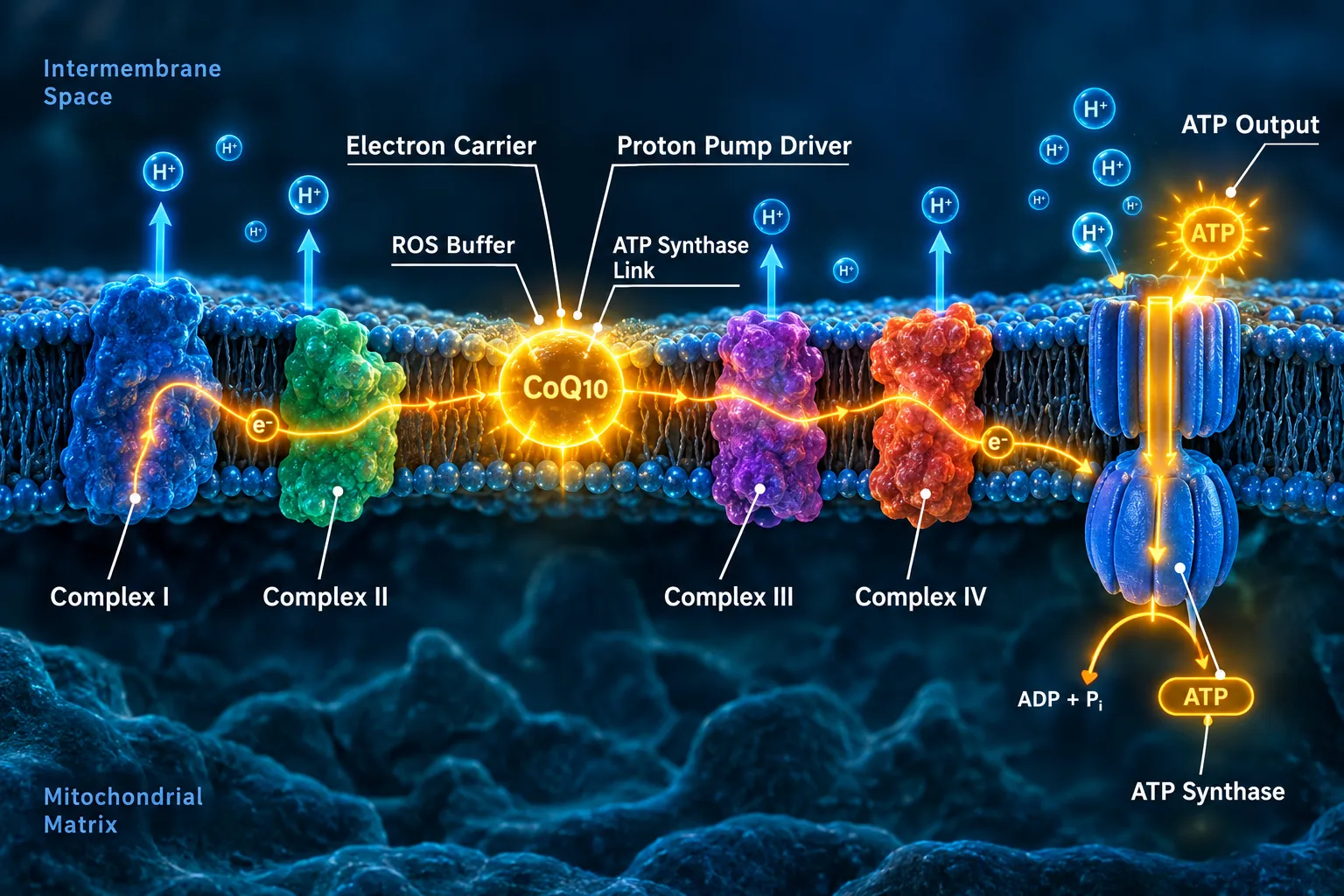
This electron-carrying role gives CoQ10 two distinct functions that any ATP synthesis model must represent explicitly:
| Function | Mechanism | Impact on ATP Output |
|---|---|---|
| Bioenergetic | Electron transfer → proton pumping → ΔΨm maintenance | Directly increases ATP synthase turnover |
| Antioxidant | Reduced CoQ10 (ubiquinol) neutralizes ROS | Protects membrane integrity; prevents uncoupling |
Preclinical and clinical data from 2025-2026 quantify these effects. One randomized controlled trial involving 180 participants over 12 weeks reported an approximately 18-24% increase in mitochondrial ATP production and a roughly 14% rise in mitochondrial density following CoQ10 supplementation. Researchers modeling electron-transport-based ATP flux can use those effect sizes as quantitative priors or boundary constraints.
For researchers interested in how related mitochondrial-targeting peptides influence membrane dynamics, the SS-31 mitochondrial dynamics research literature provides a useful parallel framework focused on cardiolipin stabilization and inner-membrane integrity.
MOTS-c as a Metabolic Signaling Node
Where CoQ10 works at the electron-transfer level, MOTS-c operates one layer higher, at the signaling level. MOTS-c is a 16-amino-acid peptide encoded by the mitochondrial genome's 12S rRNA region, first identified in 2015. It functions as a stress-responsive signal that links mitochondrial status to whole-cell metabolic adaptation.
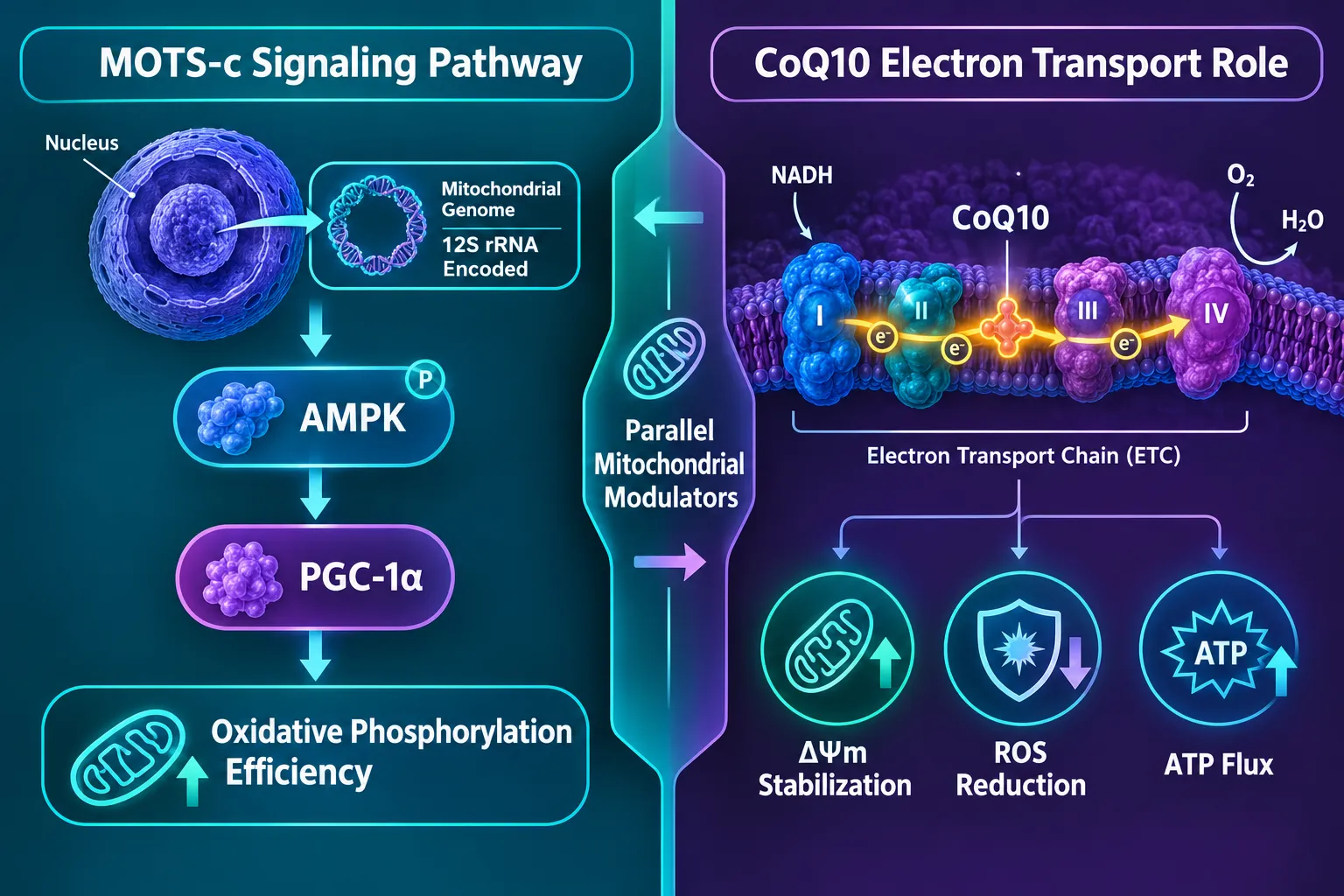
MOTS-c's core mechanisms include:
- AMPK activation, redirects substrate use toward fat oxidation and glucose efficiency
- PGC-1α modulation, improves oxidative phosphorylation quality without necessarily increasing mitochondrial mass
- ROS management, reduces reactive oxygen species emission under stress
- Metabolic flexibility, enhances the cell's ability to shift between fuel sources during energy deficit
A 2026 transgenic mouse study demonstrated that MOTS-c administration increased oxidative phosphorylation efficiency and lowered ROS emission without changing respiratory protein content. This finding is architecturally important: MOTS-c appears to make existing mitochondrial machinery work better rather than building more of it.
Key insight: MOTS-c's context-dependence is a critical modeling variable. Its effects can be protective or maladaptive depending on the metabolic environment, a nuance that separates it from a simple "on/off" switch.
For a deeper look at related SS-31 mitochondrial research themes, including how mitochondria-targeted peptides are studied in experimental frameworks, those resources complement the MOTS-c mechanistic picture.
Designing Integrated CoQ10 and MOTS-c Mitochondrial Energetics Models
Building a robust framework for Coenzyme Q10 and MOTS-c integration: designing mitochondrial energetics and ATP synthesis models requires acknowledging both the promise and the gap. As of 2026, no published study has formally coupled these two agents in a validated computational or experimental ATP synthesis model. Current expert consensus frames them as parallel modulators, not yet proven to interact directly.
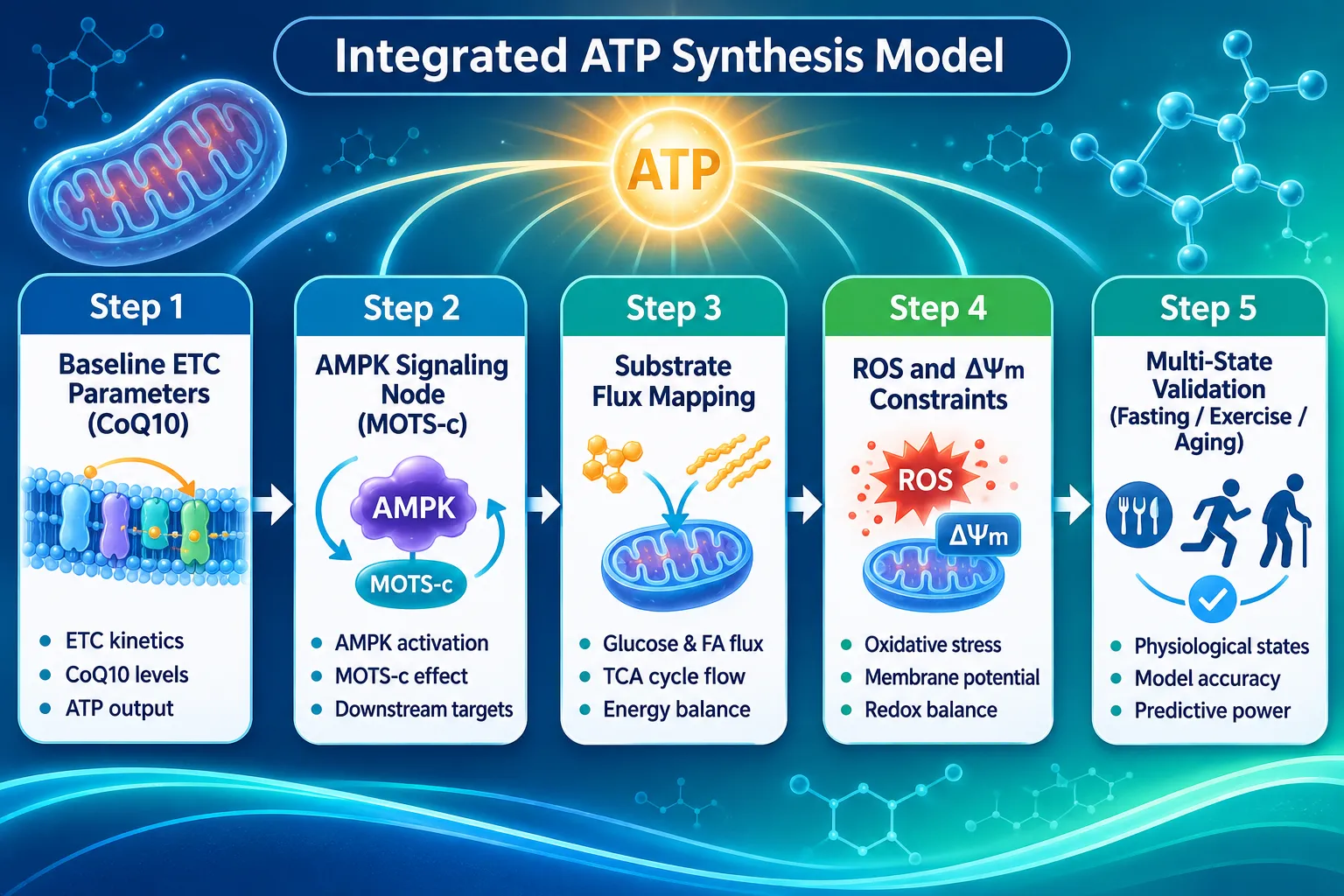
Still, the mechanistic logic for a phased model architecture is sound:
Step 1, Define CoQ10 as the ETC kinetic parameter
Represent CoQ10 concentration and redox state as rate-controlling variables in electron transfer between Complexes I/II and III. Include its effect on ΔΨm and ATP synthase rotational rate.
Step 2, Insert MOTS-c as an upstream signaling node
Model MOTS-c's AMPK/PGC-1α activity as a regulatory input that controls substrate flux (glycolysis vs. fatty-acid oxidation) entering the ETC. This is separate from, but upstream of, CoQ10's electron-carrying function.
Step 3, Map ROS as a shared output variable
Both CoQ10 (via ubiquinol buffering) and MOTS-c (via AMPK-linked antioxidant responses) reduce ROS. A combined model must treat ROS as a dynamic constraint on membrane potential, not a static background factor.
Step 4, Define metabolic state conditions
MOTS-c is explicitly context-dependent. Models must be run across distinct states, fasting, aerobic exercise, aging, and metabolic disease, because intervention effects will differ nonlinearly across these conditions.
Step 5, Validate through perturbation experiments
The most authoritative current position is that robust CoQ10, MOTS-c integration requires new multi-omics experiments that perturb each agent alone and in combination before synergistic or antagonistic parameters can be empirically quantified.
This framework applies directly to skeletal muscle energetics research, where both agents have shown measurable effects on physical endurance, age-related sarcopenia, and muscle ATP demand-supply balance. Research on SS-31 elamipretide provides an adjacent example of how mitochondria-targeted peptides are characterized in preclinical models, a methodological template worth consulting when designing CoQ10 + MOTS-c assay protocols.
Additionally, researchers reviewing mitochondrial-focused experimental workflows may find the TB-500 controlled experimental models and QC workflow resource useful for quality-control benchmarks applicable to bioenergetics assay design.
For those tracking broader peptide-based approaches to metabolic optimization, the SS-31 kidney health research literature illustrates how mitochondrial efficiency metrics translate across different tissue contexts, relevant when extrapolating ATP synthesis models beyond muscle.
Conclusion
The science supporting Coenzyme Q10 and MOTS-c integration: designing mitochondrial energetics and ATP synthesis models is directionally compelling but structurally incomplete. CoQ10 provides well-quantified, kinetically tractable electron transport support; MOTS-c provides a context-sensitive metabolic signaling layer with demonstrated effects on AMPK, substrate flexibility, and ROS reduction. Together, they offer the building blocks of a two-tier model, one governing electron flux, the other governing the metabolic environment in which that flux operates.
Actionable next steps for researchers and modelers:
- Use existing CoQ10 dose-response data (18-24% ATP increase benchmarks) as parameter constraints in ETC kinetic models.
- Incorporate MOTS-c as an AMPK/PGC-1α regulatory node, not a direct ETC modifier.
- Design perturbation experiments that test each agent independently before combining them, across at least three metabolic states.
- Treat ROS and ΔΨm as shared dynamic outputs, not constants, in any combined simulation.
- Follow emerging multi-omics studies that may finally provide the empirical interaction data needed to move beyond parallel modeling toward true integration.
The next generation of mitochondrial energetics models will not be built on a single molecule. Integrating CoQ10's electron-transport precision with MOTS-c's adaptive signaling intelligence is the logical direction, but it demands rigorous experimental validation before the framework earns the label "validated."


Leave a Reply
Want to join the discussion?Feel free to contribute!