

Folic Acid, Folate Pathways, and Epithalon: Measuring DNA Methylation Rates in Cellular Aging Models
"
Doubling serum folate concentrations is associated with an epigenetic age difference of nearly one year younger than chronological age, a finding that repositions nutritional biochemistry as a serious tool in longevity research. When this observation is placed alongside emerging data on the tetrapeptide Epithalon and its proposed influence on telomerase activity, the intersection of folic acid, folate pathways, and Epithalon in measuring DNA methylation rates in cellular aging models becomes one of the more compelling frontiers in geroscience today. This article examines how methyl donor availability shapes epigenomic stability, how Epithalon may amplify or depend on that substrate pool, and what the current measurement science actually shows.
Key Takeaways
- Folate drives one-carbon metabolism, producing S-adenosylmethionine (SAM), the universal methyl donor that powers DNA methylation and epigenetic age regulation.
- Both folate deficiency and excess can accelerate epigenetic aging, indicating that a precise physiological range matters more than simple supplementation.
- Enriched L-5-methyltetrahydrofolate (L-5-MTHF) formulations can increase intracellular SAM by roughly 71% and boost DNA methylation activity up to 14-fold in human cell models.
- Epithalon, a synthetic tetrapeptide, has shown preliminary evidence of reducing Horvath DNA methylation age in fibroblast models, though this work remains non-peer-reviewed.
- Methyl donor availability is a plausible co-determinant of how effectively Epithalon-stimulated telomerase activity translates into stable epigenetic clock reversal.
How Folate Fuels DNA Methylation in Aging Cells
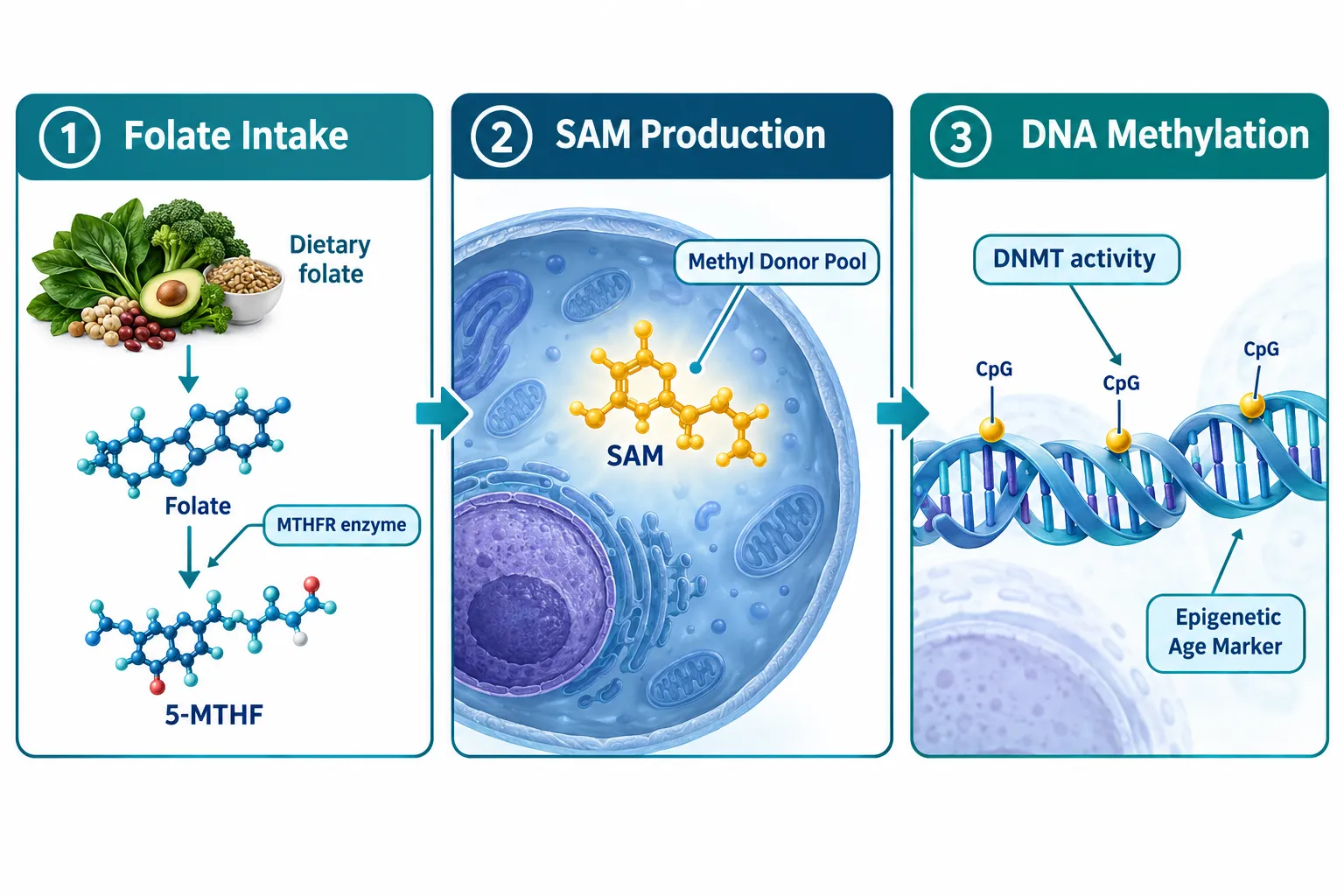
At the core of cellular aging lies a biochemical relay known as one-carbon metabolism. Dietary folate, after conversion to L-5-methyltetrahydrofolate (L-5-MTHF), donates a methyl group to homocysteine, regenerating methionine. Methionine is then adenosylated to form SAM, the molecule that hands methyl groups directly to DNA methyltransferases (DNMTs). Without adequate SAM, DNMTs stall, and the genome drifts toward the hypomethylation pattern that characterizes aged tissue.
This is not a theoretical chain. Research published in 2026 confirmed that a choline-enriched L-5-MTHF ingredient increased intracellular SAM by approximately 71% and enhanced DNA methylation activity up to 14-fold versus controls in a human cell model. The magnitude of that effect challenges the assumption that folate status is a minor variable in methylation biology.
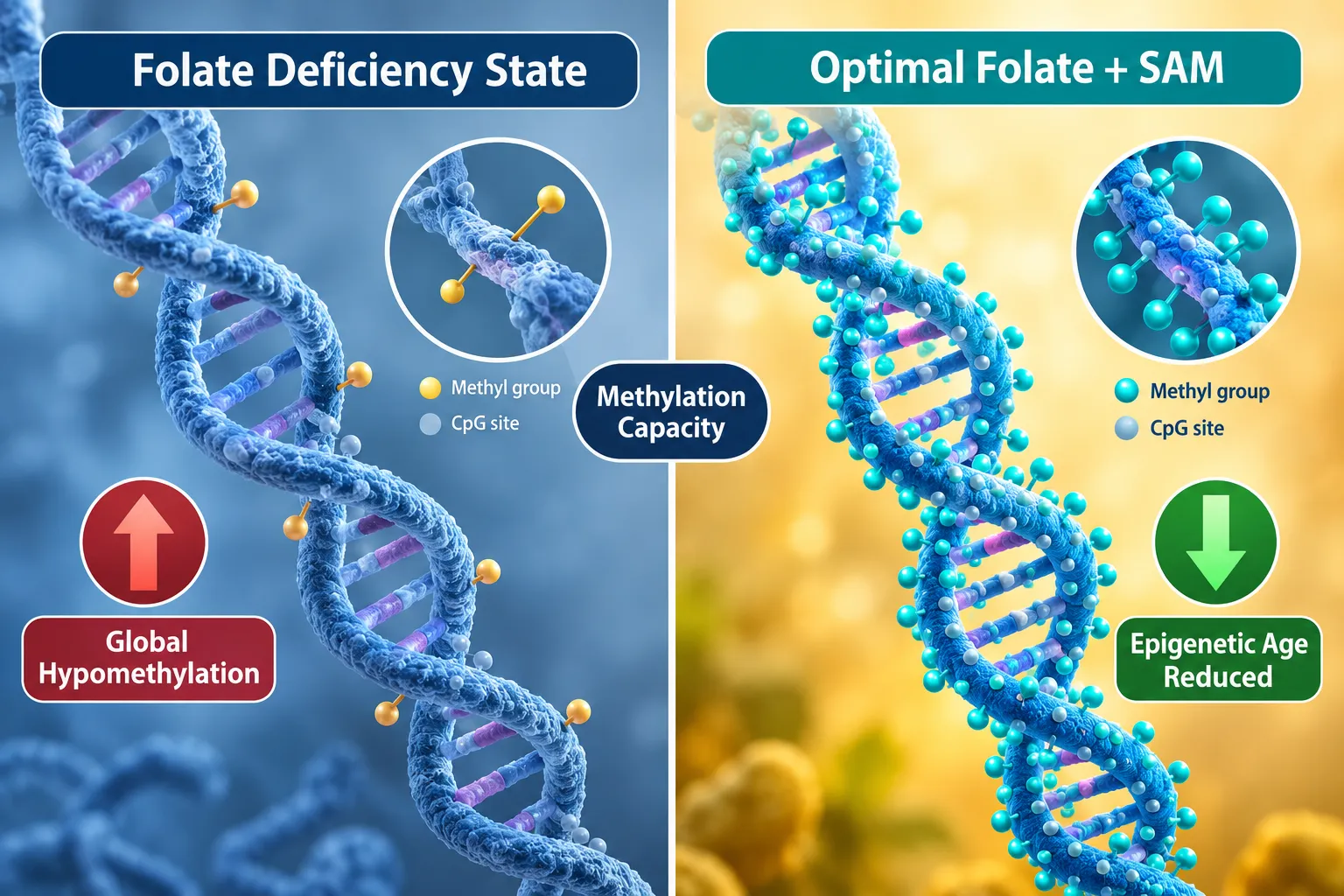
Aging itself sets the stage for methylation dysfunction in a specific pattern: global genomic hypomethylation paired with promoter hypermethylation at tumor-suppressor loci such as p16. Studies in aged mouse colon show that dietary folate supplementation can partially correct both defects simultaneously, while the same intervention has little measurable effect in young animals. Age-dependent responsiveness matters, the older the cell population, the more methylation pathways appear to depend on an adequate folate supply.
One-carbon metabolism also involves vitamins B6 and B12, choline, betaine, and methionine. The SAM-to-S-adenosylhomocysteine (SAH) ratio functions as a cellular methylation index, and anything that shifts this ratio downward, elevated homocysteine, B-vitamin depletion, or genetic MTHFR variants, predicts faster epigenetic aging. A 2026 GeroScience analysis of older adults confirmed that higher serum folate longitudinally predicts slower biological aging, while higher homocysteine predicts the reverse.
Exploring aging support peptide research alongside folate biochemistry offers a more complete picture of how multiple pathways converge on the epigenome.
The Non-Linear Relationship: When Folate Becomes a Problem
A critical nuance often missing from popular discussions of folate and aging is the dose-response curve. A 2025 study using the PhenoAgeAccel epigenetic clock reported a threshold around 732.9 ng/mL of red blood cell (RBC) folate. Below this point, each 1 ng/mL increase in RBC folate reduced epigenetic age acceleration by 0.0027 years. Above it, each 1 ng/mL increase raised epigenetic age acceleration by 0.0058 years, a reversal of effect that is larger in magnitude than the benefit below the threshold.
This non-linearity has practical significance:
| Folate Status | Effect on PhenoAgeAccel | Primary Mechanism |
|---|---|---|
| Deficient (below threshold) | Accelerates aging | Global hypomethylation, DNMT substrate shortage |
| Optimal (near threshold) | Slows aging | Balanced SAM:SAH ratio, stable CpG methylation |
| Excess (above threshold) | May accelerate aging | Disrupted methylation programming, unmetabolized folic acid |
A 2023 review reinforced this by identifying high synthetic folic acid intake as a potential driver of carcinogenesis and adverse methylation reprogramming, distinct risks from the natural folate found in food. The distinction between synthetic folic acid and reduced folate forms (such as L-5-MTHF) is therefore not merely semantic; it has downstream consequences for aging-relevant CpG sites.
Developmental timing also matters. Research indicates that folic acid supplementation during juvenile-pubertal periods can set long-term methylation patterns that influence aging decades later, suggesting that lifetime folate exposure history shapes the starting point for any adult intervention.
Folic Acid, Folate Pathways, and Epithalon: Measuring DNA Methylation Rates in Cellular Aging Models
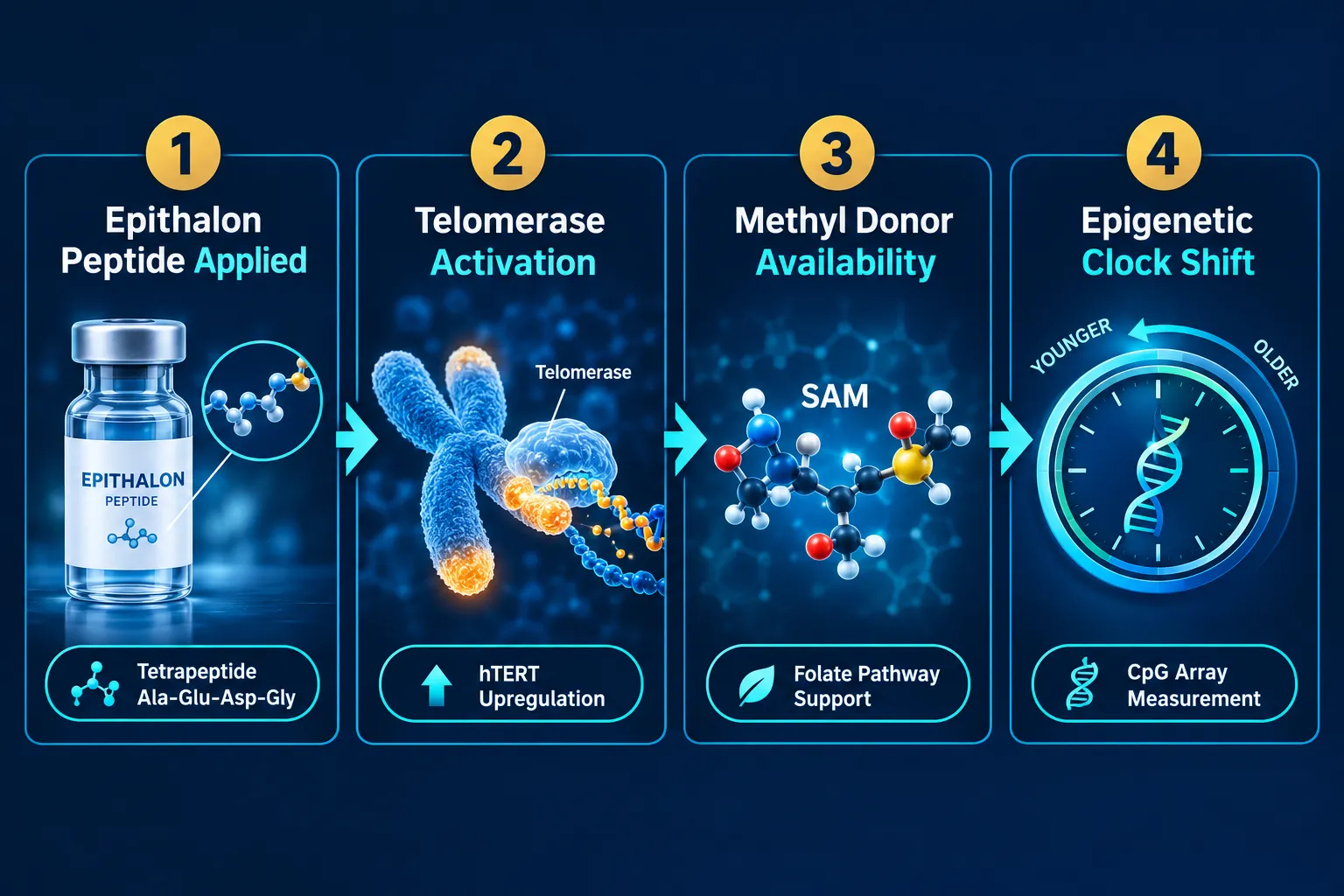
Epithalon (Ala-Glu-Asp-Gly) is a synthetic tetrapeptide derived from the pineal gland extract Epithalamin. Its primary proposed mechanism is upregulation of hTERT, the catalytic subunit of telomerase, which elongates telomeres and is thought to secondarily shift epigenetic clock readings. The connection to folate pathways is mechanistic: telomerase activation without adequate methyl donors to maintain CpG methylation patterns may produce incomplete or unstable epigenetic rejuvenation.
Preliminary in vitro data from non-peer-reviewed work reports that WI-38 lung fibroblasts treated with Epithalon over eight weeks (passages 28-38) showed a 2.4-3.6-year reduction in Horvath DNA methylation age relative to passage-matched controls, measured on Illumina EPIC 850K CpG arrays. The effect size was comparable to hTERT overexpression. While this work has not undergone peer review and should be treated as hypothesis-generating rather than conclusive, it raises a pointed question: what happens to that effect size when methyl donor availability is constrained?
The logic follows directly from biochemistry. Epithalon-stimulated telomerase may protect telomere length and signal epigenetic reprogramming, but the DNMTs that execute the resulting methylation changes need SAM. If intracellular SAM is depleted, through folate inadequacy, high homocysteine, or MTHFR polymorphism, the downstream methylation writing cannot keep pace with the upstream telomerase signal.
Research on SS-31 mitochondrial dynamics and related peptides illustrates a parallel principle: peptide-mediated signals require healthy cellular infrastructure to express their full effect. The MOTS-C peptide research similarly demonstrates that mitochondrial peptides work within the broader metabolic context of the cell rather than independently of it.
Measuring DNA methylation rates in these models typically employs one of three approaches:
- Illumina EPIC 850K arrays, genome-wide CpG profiling used to calculate epigenetic clock ages (Horvath, PhenoAge, GrimAge)
- Global methylation assays (e.g., LINE-1 bisulfite sequencing), quantifies overall genomic methylation level
- Locus-specific methylation (pyrosequencing, ddPCR), targets aging-sensitive promoters such as p16, ELOVL2, or FHL2
A 2026 review on senescence methylation signatures found that removing senescent cells via senolytics did not reliably reverse epigenetic aging markers, in some models, it even accelerated them. This underscores that epigenetic clock readings are not simply a count of damaged cells; they reflect active methylation writing processes that must be continuously supported, precisely where folate and methyl donors become indispensable co-factors for any peptide-based intervention.
For researchers exploring SS-31 Elamipretide or MOTS-C in aging models, the folate-methylation axis represents an often-overlooked variable that may confound inter-experiment comparisons if not controlled. Similarly, understanding peptide half-life dynamics is essential when designing dosing protocols that align Epithalon exposure with peak intracellular SAM availability.
Conclusion
The evidence assembled in 2026 paints a consistent picture: folate and one-carbon metabolism are not background variables in aging research, they are rate-limiting determinants of how effectively any epigenetic intervention can rewrite the methylation landscape. For researchers working at the intersection of folic acid, folate pathways, and Epithalon in measuring DNA methylation rates in cellular aging models, several actionable priorities emerge.
Next steps for researchers and practitioners:
- Baseline methylation status before intervention. Establish RBC folate, plasma homocysteine, SAM:SAH ratio, and MTHFR genotype before attributing clock changes to any peptide treatment.
- Use L-5-MTHF over synthetic folic acid. Reduced-form folate avoids unmetabolized folic acid accumulation and more reliably raises intracellular SAM, particularly in individuals with common MTHFR variants.
- Design Epithalon studies with matched methyl donor conditions. Comparing Epithalon-treated fibroblasts across high-SAM versus low-SAM media would directly test whether telomerase-mediated clock reversal is methyl-donor-dependent.
- Apply multi-clock analysis. PhenoAge, GrimAge, and Horvath clocks weight different CpG sites and may respond differently to folate-Epithalon co-interventions.
- Treat preliminary Epithalon data as a hypothesis, not a conclusion. Peer-reviewed, controlled replication with folate status as a co-variable is the essential next step.
Cellular aging is a writable process. The methyl group economy that folate sustains may be the ink.


Leave a Reply
Want to join the discussion?Feel free to contribute!