

MOTS-c and 5-Amino-1MQ: A Tissue- and Time-Resolved Framework for Separating Mitochondrial Adaptation From NNMT Inhibition
Only a handful of molecules currently challenge researchers to rethink how mitochondria and metabolic enzymes communicate across different tissues and timescales. MOTS-c and 5-Amino-1MQ represent two such molecules, and the growing tendency to stack them together as a single "metabolic synergy" narrative risks collapsing two biochemically distinct mechanisms into one oversimplified story. A tissue- and time-resolved framework for separating mitochondrial adaptation from NNMT inhibition is not merely academic, it is the only honest lens through which MOTS-c and 5-Amino-1MQ research can be evaluated with clarity.
Key Takeaways
- MOTS-c is a mitochondria-derived peptide that functions as a context-dependent stress signal, with levels rising acutely after exercise and normalizing within hours.
- 5-Amino-1MQ is a selective NNMT inhibitor that redirects nicotinamide into NAD+ salvage, acting primarily at a downstream enzymatic checkpoint.
- Apparent synergy between these two agents may simply reflect independent pathway effects occurring in different tissues at different times.
- Preclinical evidence supports adipose-focused NNMT inhibition and fat-mass reduction; both compounds remain in the research phase as of 2026.
- Interpreting combined readouts requires separating acute skeletal muscle signals from chronic adipose adaptations before drawing mechanistic conclusions.
Understanding MOTS-c as a Mitochondrial Adaptation Signal
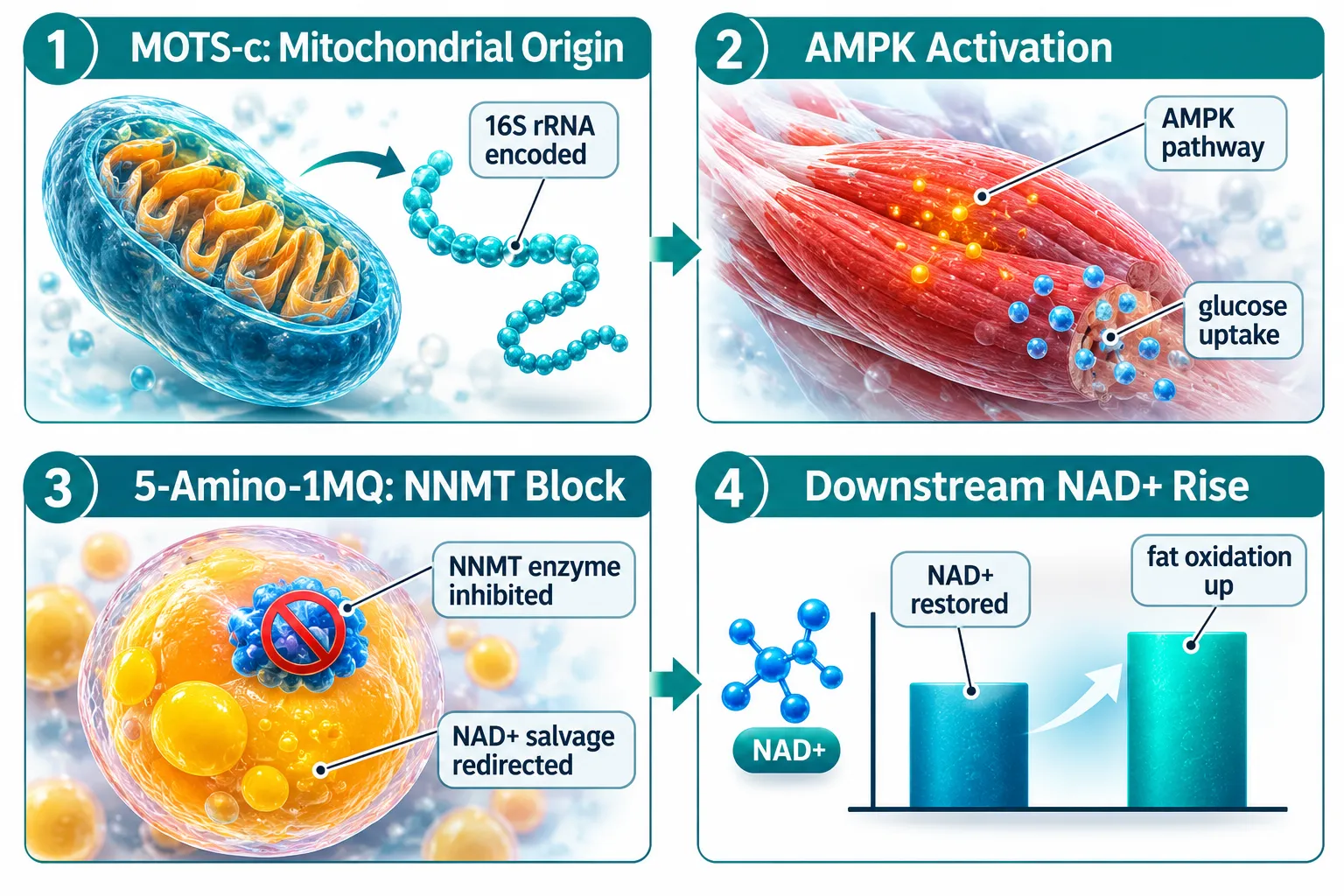
MOTS-c is encoded within the 16S ribosomal RNA gene of the mitochondrial genome, an unusual origin for a biologically active peptide. Under conditions of cellular stress, such as exercise, caloric restriction, or metabolic demand, mitochondria release MOTS-c into the cytoplasm and eventually into circulation.
What makes MOTS-c especially relevant is its context-dependence. It does not act uniformly across tissues. In skeletal muscle, MOTS-c activates the AMPK pathway, promoting glucose uptake and fatty acid oxidation. In the liver, its effects on insulin sensitivity appear to involve FOXO transcription factor modulation. These are not static effects, they are time-resolved responses that peak acutely and normalize within hours.
"MOTS-c behaves less like a therapeutic drug and more like a transient biological alarm, its value lies in when it fires, not just that it fires."
This temporal profile matters enormously for research design. An assay measuring MOTS-c signaling at the four-hour mark post-exercise will produce fundamentally different data than one measuring at 24 hours. Conflating these timepoints obscures whether an observed metabolic change is driven by MOTS-c itself or by downstream adaptive processes that have already diverged from the initial signal.
For researchers exploring mitochondrial support compounds, resources on SS31 mitochondrial research themes offer useful comparative context, since SS-31 similarly targets mitochondrial membrane dynamics through a distinct but related mechanism.
Tissue-Resolved Readouts: Why the Framework Matters
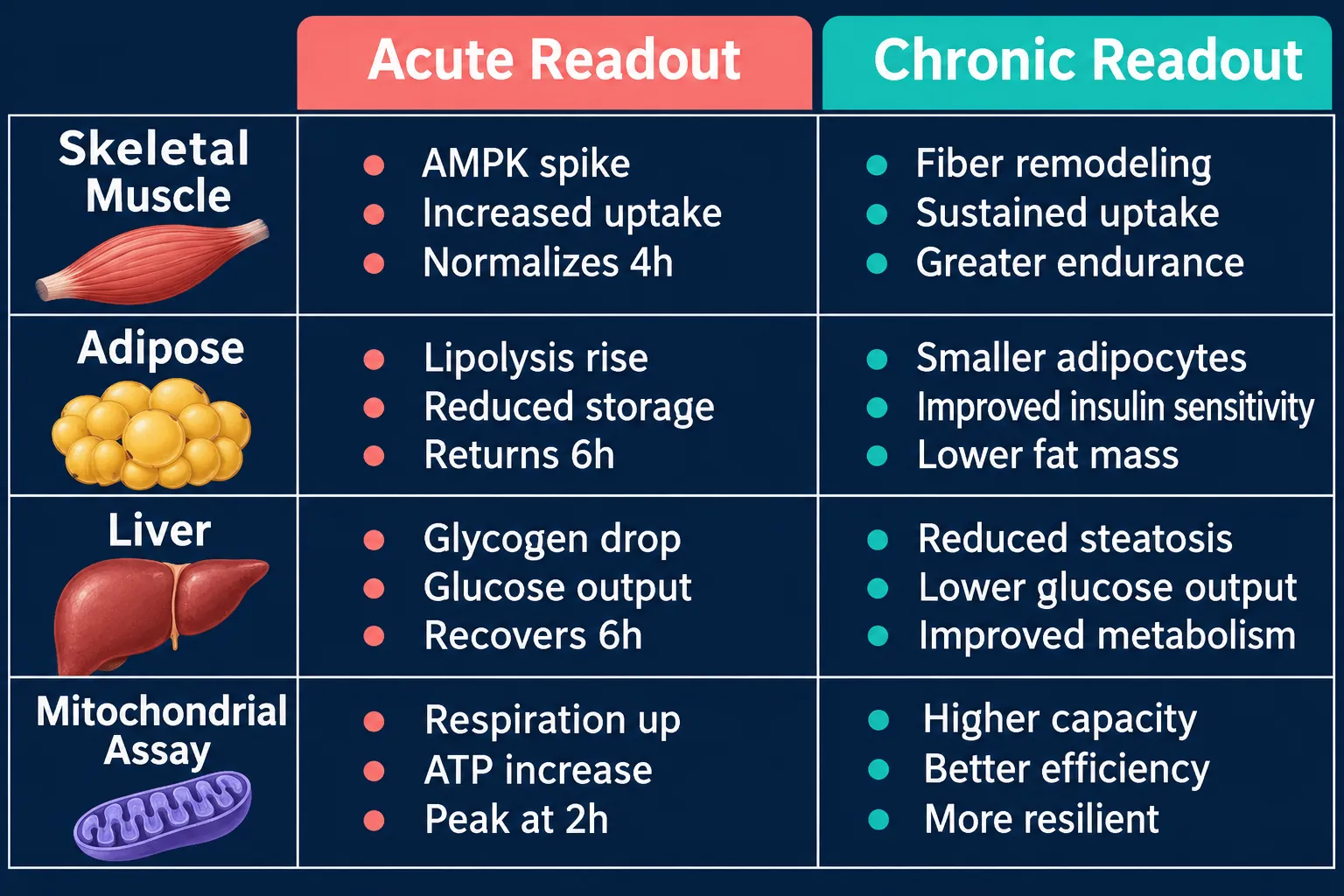
One of the most common interpretive errors in metabolic peptide research is pooling tissue-level data without controlling for timing. When examining MOTS-c and 5-Amino-1MQ together, each tissue tells a different story at a different clock.
Tissue-by-time response summary:
| Tissue | MOTS-c Acute Effect | MOTS-c Chronic Effect | 5-Amino-1MQ Primary Effect |
|---|---|---|---|
| Skeletal Muscle | AMPK activation, glucose uptake spike | Normalizes within hours | Minimal direct action |
| Adipose | Modest lipid signaling | Mild sustained effect | Primary target: NNMT inhibition, fat-mass reduction |
| Liver | Insulin sensitization signals | Unclear long-term profile | Indirect NAD+ pathway support |
| Mitochondrial Assay | Oxidative phosphorylation response | Dependent on stress context | NAD+ substrate availability shift |
5-Amino-1MQ works by blocking nicotinamide N-methyltransferase (NNMT), an enzyme highly expressed in adipose tissue. When NNMT is inhibited, nicotinamide is redirected toward NAD+ biosynthesis via the salvage pathway. This raises intracellular NAD+ levels in fat tissue, which in turn activates sirtuins and supports mitochondrial biogenesis, but this is a slow, chronic adaptation, not an acute spike.
The preclinical evidence in rodent models shows meaningful reductions in fat mass when NNMT is selectively inhibited. The reported mean terminal elimination half-life of 5-Amino-1MQ sits around 3.8 hours, which means dosing intervals directly influence whether NNMT inhibition is sustained enough to produce the chronic adipose remodeling seen in animal studies.
Researchers investigating mitochondrial peptide combinations may also find value in reviewing SS31 and MOTS-c comparative product research to understand how cardiolipin-targeting peptides interact with exercise-responsive signals.
Separating Independent Pathways From True Synergy
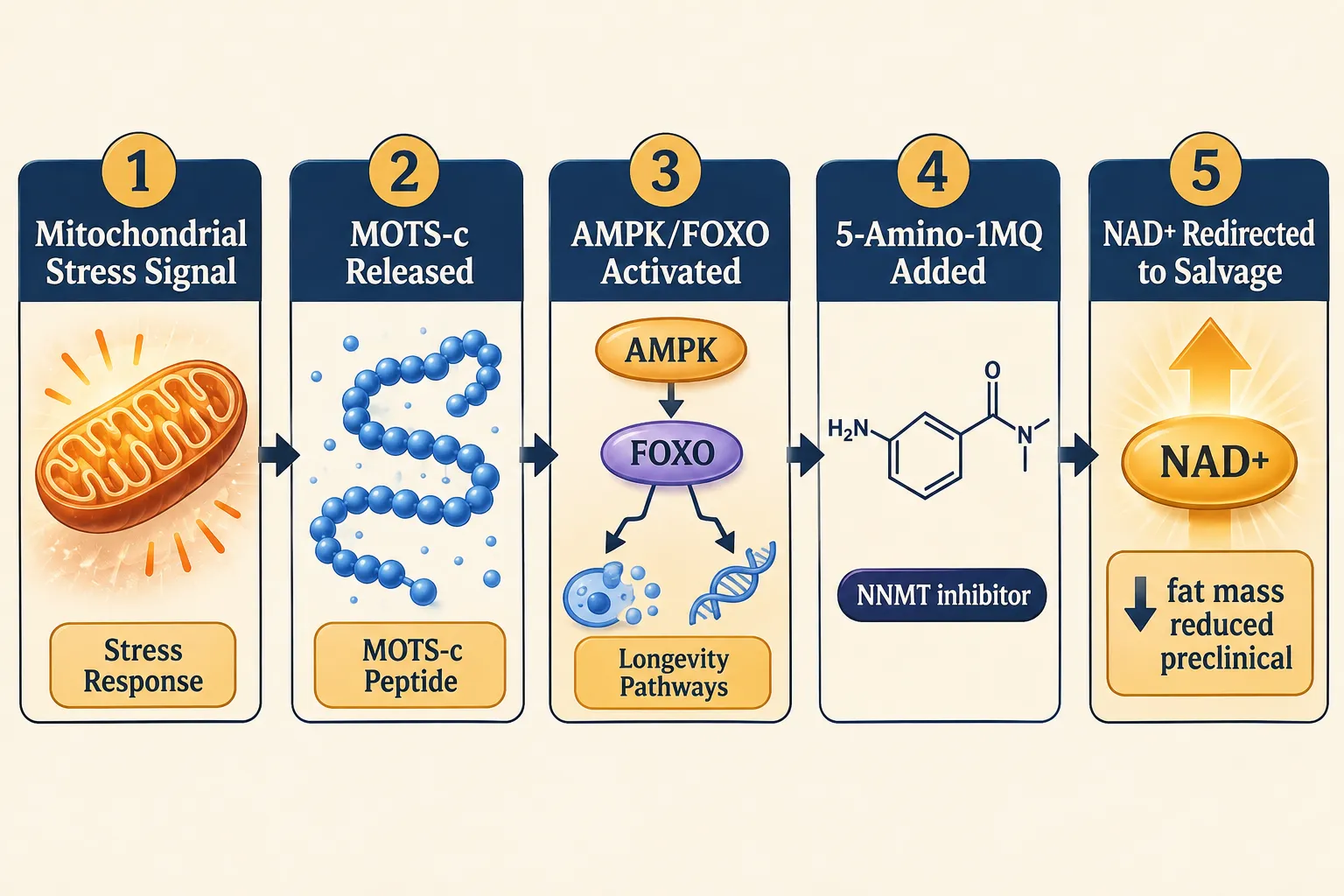
The commercial narrative around combining MOTS-c, 5-Amino-1MQ, and NAD+ precursors as a unified metabolic stack is growing rapidly in 2026. The framing is appealing: an upstream mitochondrial alarm (MOTS-c) paired with a downstream enzymatic brake release (5-Amino-1MQ) sounds mechanistically elegant. However, elegance is not evidence.
Three criteria are needed before claiming genuine synergy:
- Pathway convergence, both agents must act on the same downstream node, not merely on thematically related outcomes.
- Temporal overlap, the active windows of each compound must coincide meaningfully in the relevant tissue.
- Tissue co-localization, both must be active in the same cellular compartment at the same time.
By these criteria, much of what is labeled "synergy" in current marketing is more accurately described as additive independent effects, two separate mechanisms producing separate benefits that happen to both fall under the "metabolic improvement" umbrella.
MOTS-c fires acutely in skeletal muscle. 5-Amino-1MQ acts chronically in adipose. These are different tissues, different timescales, and different pathway entry points. An integrated NAD+/NNMT/AMPK model does connect them conceptually, but mechanistic models require experimental validation across matched tissues and timepoints before they justify combined-dosing protocols.
Claims about energy enhancement or mood improvement associated with these combinations are, as of current evidence, largely anecdotal and marketing-driven. Both compounds remain strictly in the preclinical research phase, and neither has cleared clinical trial benchmarks validating the stacked-compound approach.
Researchers also tracking growth hormone-axis peptides for metabolic context may find comparative pharmacokinetic data useful via resources like Tesamorelin vs Ipamorelin as a model for how distinct mechanisms are evaluated separately before combination protocols are considered.
Additional mitochondrial peptide research context is available for those exploring SS-31 mechanism and research and SS-31 kidney health research, where tissue-specific readouts have been more systematically characterized.
Conclusion
The tissue- and time-resolved framework for separating mitochondrial adaptation from NNMT inhibition is not a theoretical nicety, it is the methodological baseline that rigorous MOTS-c and 5-Amino-1MQ research demands. Treating these two compounds as a unified stack without controlling for tissue specificity and measurement timing will produce results that are difficult to interpret and even harder to replicate.
Actionable next steps for researchers and informed readers:
- Design assays that measure MOTS-c activity at both acute (1-4 hour) and chronic (24-72 hour) post-stimulus windows, disaggregated by tissue type.
- Evaluate 5-Amino-1MQ effects primarily in adipose-derived cell models, where NNMT expression is highest and preclinical evidence is strongest.
- Resist conflating thematically related outcomes with mechanistic synergy, require pathway convergence, temporal overlap, and tissue co-localization data before drawing combined-effect conclusions.
- Treat energy and mood narratives associated with these compounds as hypothesis-generating, not evidence-based, until clinical trial data emerges.
- Reference existing mitochondrial peptide research, including SS31 peptide dosage guidance, as a model for how rigorous single-compound characterization should precede multi-compound protocol design.
Both MOTS-c and 5-Amino-1MQ hold genuine scientific promise. That promise is best protected, not undermined, by insisting on the kind of tissue-resolved, time-matched experimental discipline this framework provides.


Leave a Reply
Want to join the discussion?Feel free to contribute!