Call or Text 727-513-9780
  • Shopping Cart Shopping Cart
    0Shopping Cart
Pure Tested Peptides | America's most trusted Peptides for sale online
  • Peptides for sale
    • Oral Peptides for sale
      • Peptide Capsules for sale
      • BPC 157 Capsules 1000mcg
      • SLU-PP-332 Capsules | 1000 mcg
      • 5-Amino-1MQ 50mg Capsules
      • Tesofensine 500mcg
    • All Peptides for sale
    • Peptide Sprays
      • BPC 157 Nasal Spray Kit
      • BPC-157 TB500 Nasal Spray Kit
      • Semax Nasal Spray 10mg
      • Selank – Nasal Spray Kit – 10mg
      • Epithalon 50MG Nasal Spray Kit
      • Ipamorelin 10mg Nasal Spray
      • Klow Nasal Spray (BPC-157 + TB-500 + GHK-Cu + KPV) | 80mg
      • Hulk Nasal Spray Tesa / Ipa Blend 6/3 MG
      • Klow Nasal Spray
      • NAD + 500 mg Nasal Spray
      • PT-141 Nasal Spray Kit
    • GHRH Peptides
      • Ipa Peptides
      • CJC-1295 Peptides
        • CJC-1295 with DAC 5 mg
        • CJC-1295 without DAC 5 mg
        • CJC-1295 Ipa 10mg
      • Tesa Peptides
        • Tesa Peptide
        • Tesa 20 mg
    • GHK-Cu Peptides
      • All GHK-Cu Peptides
      • GHK-Cu 100mg
      • KLOW Peptide Blend – Buy KLOW blend online
    • BPC Peptides
      • All BPC Peptides
      • BPC-157
      • BPC-157 TB-500
      • BPC 157 capsules 1000mcg
    • SLU-PP-332 Peptides
      • All SLU-PP-332 Peptides
      • SLU-PP-332 5mg
    • GLP3 Peptides
      • GLP3-R
      • GLP3-R CAG 10mg
      • GLP3-R 20mg
    • PT-141 Peptides
      • PT-141 Peptides for sale
      • PT-141 10mg
      • PT-141 Nasal Spray
    • CAG Peptides
      • Lipo-C Peptide Blend
      • CAG 5mg
      • CAG 10mg
    • MOTS-C Peptides
      • MOTS-C Peptides for sale
      • MOTS-c peptide
      • MOTS-c 10mg *6 pack*
    • 5 Amino 1MQ Peptides
      • 5 Amino 1MQ Peptides for sale
      • 5-Amino-1MQ 50mg Capsules
      • 5-Amino-1MQ 5mg
    • Epithalon Peptides
      • Epithalon Peptides for sale
      • Epithalon 10mg
      • Epithalon 50mg
  • Shop
    • GLPs
      • 5-Amino-1MQ 50mg Capsules
      • 5-Amino-1MQ 5mg
      • GLP3-Reta
      • L-Carnitine 500mg/ml
      • Tesofensine 500mcg
      • SLU-PP-332 5mg
      • MOTS-c 10mg *6 pack*
    • Epithalon & BPC Peptides
      • Epithalon 10mg
      • Epithalon 50mg
      • BPC-157
      • BPC 157 capsules 1000mcg
      • BPC-157 TB-500
      • BPC-157 TB500 Nasal Spray Kit
      • BPC 157 Nasal Spray Kit
    • BPC TB-500 & NAD+ Peptides
      • NAD+ 500 mg
      • KLOW Peptide Blend – Buy KLOW blend online
      • GLOW Peptide Blend
      • TB 500 5mg
      • BPC 157 capsules 1000mcg – Supplement
      • BPC 157 Nasal Spray Kit
      • BPC-157
      • BPC-157 TB500 Nasal Spray Kit
      • BPC-157 TB-500
      • BPC 157 capsules 1000mcg
    • LL-37 Peptide
      • LL-37 10 mg
    • MOTS-C & Selank
      • MOTS-c peptide
      • Selank 10mg
    • GHK Peptides
      • GHK-Cu 100mg
      • GLOW Peptide Blend
      • KLOW Peptide Blend – Buy KLOW blend online
  • COAs
  • Wholesale
    • Wholesale Peptides for sale
  • PTP FAQ
  • Affiliates
    • Selank Peptide: Advanced Pharmacological Mechanisms Underlying Its Anxiolytic and Nootropic Effects in Research
      • 5-Amino-1MQ Peptide: Detailed Mechanisms of NNMT Inhibition and Its Impact on Cellular Metabolism Research
        • MOTS-C Peptide: Unraveling Its Role in Mitochondrial Dynamics and Energy Metabolism Research
          • Epithalon Peptide and Telomerase Regulation: Investigating Its Impact on Cellular Senescence and Lifespan Research Models
            • GLP2-T vs GLP2 Tirz Peptide: Understanding the Naming, Mechanistic Nuances, and Research Implications for Gut Health
      • Peptides and Polypeptides in Modern Pharmacology: What Research on Metoprolol, Prednisone, and Amlodipine Reveals
        • Polypeptide Peptides vs NSAIDs: What Naproxen and Diclofenac Teach Tissue-Repair Researchers About BPC‑157 and TB‑500
          • Peptides and Polypeptides in Endocrine Pharmacology: How GLP-1, GLP-2, and GLP-3 Retatrutide Differ From Classic Drugs Like Prednisone and Amlodipine
          • 5‑Amino‑1MQ Peptide and NNMT Inhibition: How It Compares With Statins Like Atorvastatin in Adipose and Lipid Metabolism Research
      • Enclomiphene, Estrogen Receptor Signaling, and Luteinizing Phase Biology: What Hormone Researchers Should Measure
        • Mesenchymal Stem Cells, BPC‑157, and GHK‑Cu: How Tissue Repair Peptides Compare With Classic NSAIDs Like Naproxen in Injury Models
          • Peptide Calculator Use Cases Beyond Growth Hormone: Working Through GLP‑3 Retatrutide, MOTS‑c, and BPC‑157 Research Dosing
        • Polypeptide Peptides in Endocrine and Metabolic Pharmacology: Lessons From Amlodipine, Prednisone, and Metoprolol
        • Peptides Calculator for Advanced Blends: Worked Examples for Tesamorelin, CJC‑1295, and Ipamorelin Stacks
          • Peptides and Polypeptides in Human Physiology: How Molecular Size Shapes Research Applications
            • Selank Peptide: Advanced Pharmacological Mechanisms Underlying Its Anxiolytic and Nootropic Effects in Research
          • 5-Amino-1MQ Peptide: Detailed Mechanisms of NNMT Inhibition and Its Impact on Cellular Metabolism Research
            • MOTS-C Peptide: Unraveling Its Role in Mitochondrial Dynamics and Energy Metabolism Research
              • Epithalon Peptide and Telomerase Regulation: Investigating Its Impact on Cellular Senescence and Lifespan Research Models
                • GLP2-T vs GLP2 Tirz Peptide: Understanding the Naming, Mechanistic Nuances, and Research Implications for Gut Health
                  • Peptides and Polypeptides in Endocrine Pharmacology: How GLP-1, GLP-2, and GLP-3 Retatrutide Differ From Classic Drugs Like Prednisone and Amlodipine
                    • Polypeptide Peptides vs NSAIDs: What Naproxen and Diclofenac Teach Tissue-Repair Researchers About BPC‑157 and TB‑500
                      • Peptides and Polypeptides in Modern Pharmacology: What Research on Metoprolol, Prednisone, and Amlodipine Reveals
                        • 5‑Amino‑1MQ Peptide and NNMT Inhibition: How It Compares With Statins Like Atorvastatin in Adipose and Lipid Metabolism Research
                        • Enclomiphene, Estrogen Receptor Signaling, and Luteinizing Phase Biology: What Hormone Researchers Should Measure
                        • Mesenchymal Stem Cells, BPC‑157, and GHK‑Cu: How Tissue Repair Peptides Compare With Classic NSAIDs Like Naproxen in Injury Models
                        • Peptide Calculator Use Cases Beyond Growth Hormone: Working Through GLP‑3 Retatrutide, MOTS‑c, and BPC‑157 Research Dosing
                        • Polypeptide Peptides in Endocrine and Metabolic Pharmacology: Lessons From Amlodipine, Prednisone, and Metoprolol
                        • Peptides Calculator for Advanced Blends: Worked Examples for Tesamorelin, CJC‑1295, and Ipamorelin Stacks
                        • Peptides and Polypeptides in Human Physiology: How Molecular Size Shapes Research Applications
                        • Selank Peptide: Advanced Pharmacological Mechanisms Underlying Its Anxiolytic and Nootropic Effects in Research
                        • MOTS-C Peptide: Unraveling Its Role in Mitochondrial Dynamics and Energy Metabolism Research
                        • Peptides and Polypeptides in Modern Pharmacology: What Research on Metoprolol, Prednisone, and Amlodipine Reveals
                        • Peptides and Polypeptides in Endocrine Pharmacology: How GLP-1, GLP-2, and GLP-3 Retatrutide Differ From Classic Drugs Like Prednisone and Amlodipine
                        • 5-Amino-1MQ Peptide: Detailed Mechanisms of NNMT Inhibition and Its Impact on Cellular Metabolism Research
                        • Mesenchymal Stem Cells, BPC‑157, and GHK‑Cu: How Tissue Repair Peptides Compare With Classic NSAIDs Like Naproxen in Injury Models
                        • Peptide Calculator Use Cases Beyond Growth Hormone: Working Through GLP‑3 Retatrutide, MOTS‑c, and BPC‑157 Research Dosing
                        • GLP2-T vs GLP2 Tirz Peptide: Understanding the Naming, Mechanistic Nuances, and Research Implications for Gut Health
                        • Polypeptide Peptides in Endocrine and Metabolic Pharmacology: Lessons From Amlodipine, Prednisone, and Metoprolol
                        • Polypeptide Peptides vs NSAIDs: What Naproxen and Diclofenac Teach Tissue-Repair Researchers About BPC‑157 and TB‑500
                        • Peptides and Polypeptides in Human Physiology: How Molecular Size Shapes Research Applications
                        • Peptides Calculator for Advanced Blends: Worked Examples for Tesamorelin, CJC‑1295, and Ipamorelin Stacks
                        • 5‑Amino‑1MQ Peptide and NNMT Inhibition: How It Compares With Statins Like Atorvastatin in Adipose and Lipid Metabolism Research
                        • Enclomiphene, Estrogen Receptor Signaling, and Luteinizing Phase Biology: What Hormone Researchers Should Measure
                        • Epithalon Peptide and Telomerase Regulation: Investigating Its Impact on Cellular Senescence and Lifespan Research Models
                        • Best research protocol Klow blend
                        • best time to take BPC-157
                        • best time to take DSIP (Delta Sleep Inducing Peptide)
                        • best time to take CJC-1295
                        • best time to take AOD-9604
                        • best time to take Follistatin 344
                        • best time to take Ipamorelin
                        • best time to take MK-677 (Ibutamoren)
                        • best time to take Ligandrol (LGD-4033) — research compound
                        • best time to take Ostarine (MK-2866) — research compound
                        • best time to take GHK-CU
                        • best time to take TB-500
                        • best time to take MOTS-c
                        • best time to take Semax
                        • best time to take RAD-140 (Testolone) — research compound
                        • best time to take Thymosin Alpha-1
                        • best time to take PEG-MGF
                        • Biolife Plasma, Octapharma Plasma, and Research Peptides: How Plasma Donation Labs Differ From Peptide Suppliers
                        • best time to take YK-11 — research compound
                        • best time to take PT-141 (Bremelanotide)
                        • Best research protocol Klow blend
                        • 5-Amino-1MQ and MOTS-C Synergy: Metabolic Signaling, Mitochondria, and Research Design
                        • BPC-157 and TB-500: Investigating Their Combined Effects on Angiogenesis and Cellular Migration in Tissue Repair Models
                        • BPC-157 Peptide: Gut Barrier Function, Inflammation, and Tissue-Recovery Research
                        • 5‑Amino‑1MQ and MOTS‑c Synergy in Metabolic Research: Designing NNMT and Mitochondrial Biogenesis Stacks
                        • CJC-1295 with DAC vs. Without DAC: Half-Life, Release Kinetics, and Research Implications
                        • CJC‑1295 with DAC vs. Without DAC: Expanding on Half‑Life Differences Using Tesamorelin and Ipamorelin Blend Case Studies
                        • Collagen Biology and Copper‑Binding Peptides: How GHK‑Cu, Glow Blend, and Klow Blend Interact with Skin and Connective Tissue
                        • Collagen Biology and Regenerative Peptides: How GHK‑Cu, Glow Blend, and Klow Blend Affect Extracellular Matrix Research
                    • DNA, Telomeres, and Longevity Peptides: Positioning Epithalon and MOTS‑c in Genetic Aging Research
                      • Enclomiphene Citrate: serm Mechanism, Testosterone Research, and Stack Compatibility
                        • Enclomiphene vs Enclomiphene Citrate: Formulation, Bioavailability, and Research Distinctions
                        • Epithalon Peptide Research: Telomerase Activation, Aging, and Pineal Gland Function
                        • Estrogen Receptor Signaling and Enclomiphene: How Selective Modulators Compare with Classic Polypeptide Hormones
                        • GHK-Cu Peptide: Advanced Mechanisms in Extracellular Matrix Remodeling and Wound Healing Research
                        • GHK-Cu Peptide: Collagen Synthesis, Wound Repair, and Skin-Barrier Research Models
                        • GLP-1 vs GLP-3 vs GLP-2: Peptide Classification and Research Applications
                        • GLP-2 Peptide Research Guide: Gut Barrier Function, Nutrient Absorption, and Intestinal Recovery Models
                        • GLP-3 Retatrutide vs. GLP-1 Drugs: What Triple-Agonist Biology Changes in Research Models
                        • Ipamorelin and Tesamorelin Combination: Synergistic GH Secretagogue Research and Dosing Protocols
                        • GLP2 Tirz Peptide: What It Is, Why the Name Exists, and How Researchers Should Interpret It
                        • Klow Blend Peptide Nasal Spray: What the Formulation Is Trying to Do in Cognitive Research
                        • Mitochondria, NNMT Inhibition, and Peptide Modulators: Where MOTS‑c and 5‑Amino‑1MQ Fit in Cellular Energy Research
                        • MOTS-c Peptide: Mitochondrial Function, Energy Metabolism, and What Researchers Measure
                        • MOTS-c vs. 5-Amino-1MQ: Which Metabolic Research Questions Each Compound Actually Answers
                        • Nasal Spray Peptides: Bioavailability, Administration, and Semax/Selank Research Applications
                        • PT-141 Peptide Research: Mechanism of Action and Melanocortin Receptor Signaling
                        • Retatrutide for Research: Mechanism, Structure, and GLP-1/GLP-3 Dual Action
                        • Retatrutide for Obesity and Type 2 Diabetes: What the Latest Trial Data Suggest
                        • Tesofensine Peptide Research: Mechanism, Appetite Suppression, and Neuropeptide Y Pathways
  • Contact
    • Contact Customer Service
    • Text Customer Support
  • About US
  • Shop all peptides
  • Affiliate Program
    • Affiliate Signup
  • Login / Register Login / Register Page Link Login / Register Page Link
  • Click to open the search input field Click to open the search input field Search
  • Menu Menu
The Best Research Peptides for Mitochondrial Function: A Comparative Review of MOTS-c and 5-Amino-1MQ

The Best Research Peptides for Mitochondrial Function: A Comparative Review of MOTS-c and 5-Amino-1MQ

August 31, 2026/0 Comments/in Uncategorized/by

Mitochondrial dysfunction is implicated in more than 50 recognized human diseases, yet the peptide research field has only recently begun targeting the organelle's own signaling language. This comparative review of the best research peptides for mitochondrial function examines two of the most discussed compounds in 2026 preclinical science: MOTS-c, a mitochondria-derived peptide, and 5-Amino-1MQ, a small-molecule NNMT inhibitor. Understanding how each compound works, and where the evidence currently stands, is essential for researchers designing metabolic or cellular energy studies.

Key Takeaways

  • MOTS-c is a peptide encoded directly in mitochondrial DNA; 5-Amino-1MQ is a small-molecule enzyme inhibitor, not a peptide in the classical sense.
  • Both compounds influence mitochondrial energy metabolism, but through distinct and non-overlapping mechanisms.
  • MOTS-c has a broader and more mature preclinical evidence base spanning metabolic disease, aging, and exercise physiology models.
  • 5-Amino-1MQ targets NNMT to raise NAD+ precursor availability, making it relevant to metabolic reprogramming research.
  • Neither compound holds FDA approval for human use as of 2026; both remain strictly research-use compounds.

Molecular Identity: Peptide vs. Small-Molecule Inhibitor
Molecular Identity: Peptide vs. Small-Molecule Inhibitor

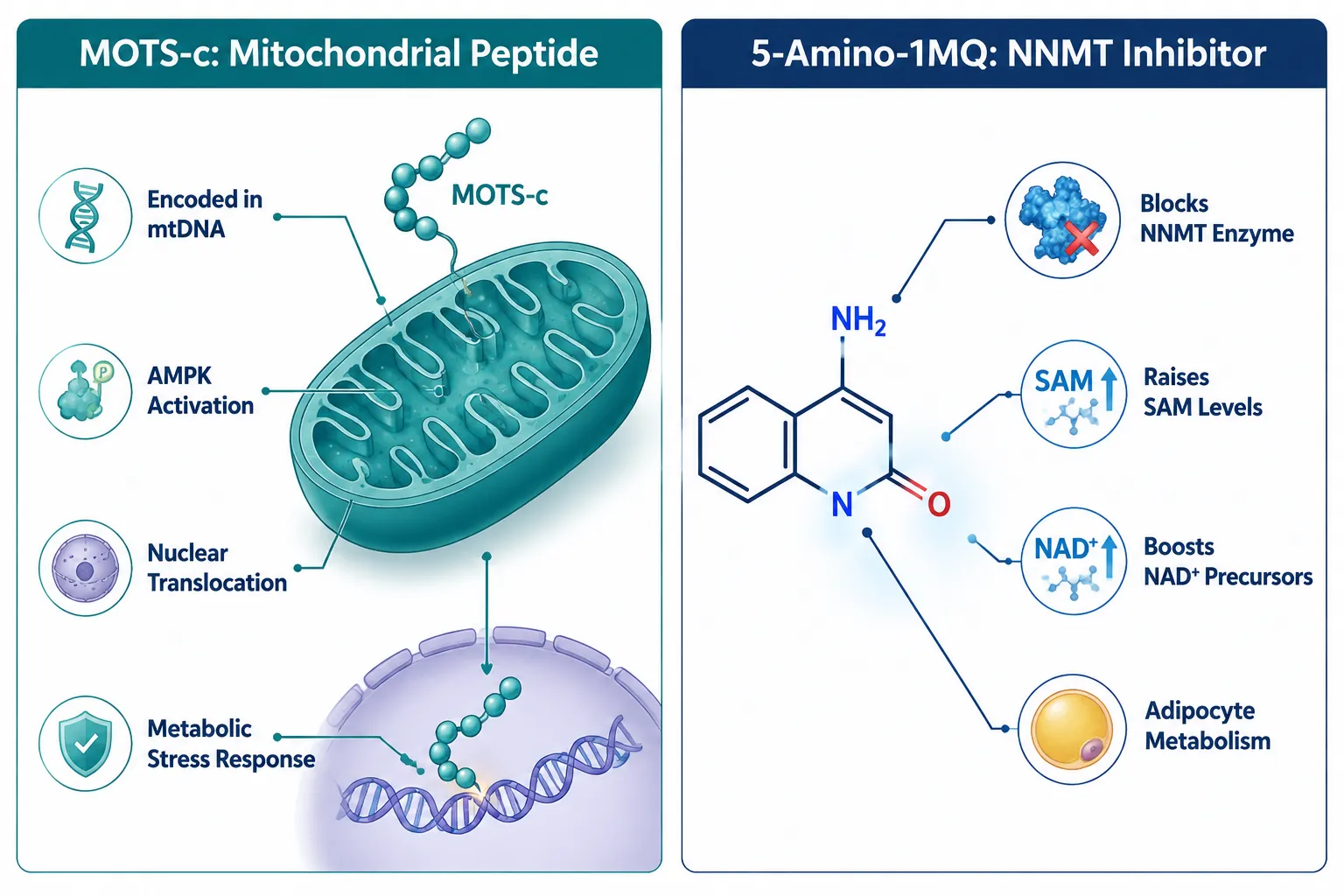
Before comparing efficacy, researchers must understand a foundational distinction. MOTS-c (Mitochondrial Open Reading Frame of the 12S rRNA type-c) is a 16-amino-acid peptide encoded within the 12S ribosomal RNA gene of mitochondrial DNA. It is a true signaling peptide, part of a growing family of mitochondria-derived peptides (MDPs) that includes humanin and SHLP2. Its classification places it squarely within systemic peptide research frameworks.

5-Amino-1MQ, by contrast, is a small-molecule inhibitor of nicotinamide N-methyltransferase (NNMT), a cytosolic enzyme. It is not a peptide. This distinction matters for study design: MOTS-c acts through receptor-mediated and nuclear translocation pathways, while 5-Amino-1MQ works by blocking an enzyme that consumes methyl groups and diverts them away from NAD+ biosynthesis.

Feature MOTS-c 5-Amino-1MQ
Molecular class Peptide (16 AA) Small-molecule inhibitor
Primary target AMPK, nuclear gene regulation NNMT enzyme
Origin Mitochondrial DNA Synthetic compound
Route studied Subcutaneous, IV (preclinical) Oral, subcutaneous (preclinical)
Evidence maturity Broad (2016 to present) Emerging (2020 to present)

How Each Compound Influences Mitochondrial Function
How Each Compound Influences Mitochondrial Function

Understanding the mechanistic pathways is central to any comparative review of the best research peptides for mitochondrial function.

MOTS-c: Direct Mitochondrial Signaling

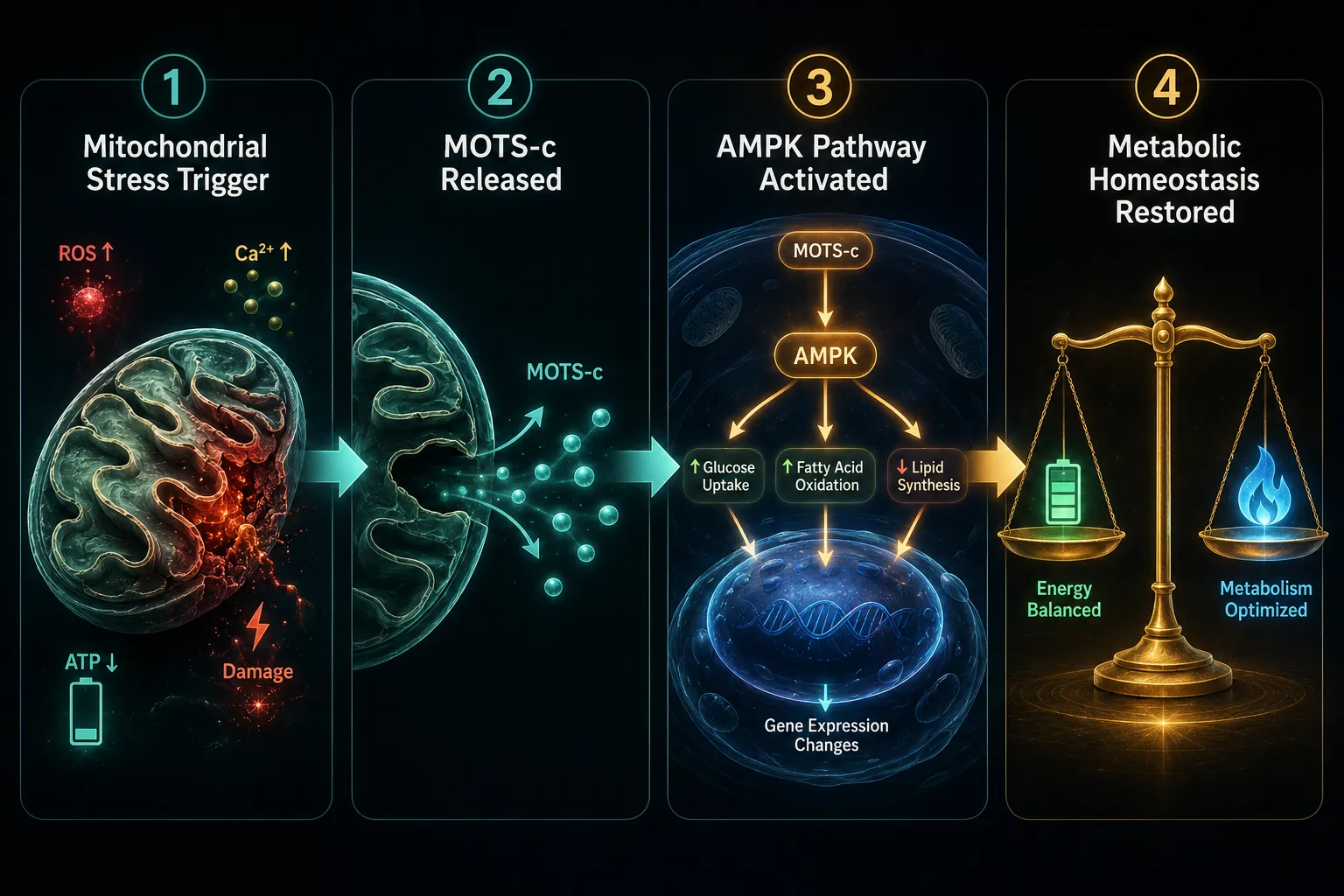
MOTS-c is released from mitochondria under conditions of metabolic stress. Once released, it translocates to the nucleus, where it regulates gene expression tied to glucose metabolism and oxidative stress response. Its most well-documented downstream effect is activation of AMPK (AMP-activated protein kinase), the master energy sensor of the cell.

Key mechanistic findings from preclinical models include:

  • Improved insulin sensitivity in high-fat diet mouse models
  • Reduced adipogenesis and fat accumulation in metabolic stress conditions
  • Enhanced exercise capacity in aged mouse models, with effects linked to skeletal muscle mitochondrial biogenesis
  • Anti-inflammatory signaling via nuclear factor regulation

Because MOTS-c originates from the mitochondrial genome itself, it is considered a retrograde signal, the mitochondrion communicating its functional state to the rest of the cell. Researchers exploring SS31 and MOTS-c combinations have noted complementary but non-redundant mechanisms, with SS31 acting on the inner mitochondrial membrane while MOTS-c operates at the nuclear level.

5-Amino-1MQ: NAD+ Pathway Modulation via NNMT Inhibition

5-Amino-1MQ targets NNMT, an enzyme that methylates nicotinamide (a NAD+ precursor) to form 1-methylnicotinamide. When NNMT is overactive, as seen in obesity, metabolic syndrome, and certain cancers, it depletes the methyl donor pool (S-adenosylmethionine, or SAM) and reduces NAD+ precursor availability.

By blocking NNMT, 5-Amino-1MQ:

  • Preserves SAM levels, supporting methylation reactions throughout the cell
  • Increases nicotinamide availability for NAD+ synthesis
  • Reduces lipid accumulation in adipocyte cell models
  • Raises resting metabolic rate in diet-induced obesity mouse models

The connection to mitochondrial function is indirect but meaningful: NAD+ is a critical cofactor in the electron transport chain, and raising its availability supports oxidative phosphorylation efficiency. Recent 2024-2026 research has also explored NNMT inhibition in the context of muscle stem cell metabolism and cellular senescence, broadening the compound's relevance beyond adipose tissue.

For researchers interested in signaling peptides and metabolic enzyme targets, 5-Amino-1MQ represents a distinct but complementary research avenue.

Comparing Evidence, Safety, and Research Applications
Comparing Evidence, Safety, and Research Applications

When selecting between these compounds for a specific study, researchers should weigh three factors: depth of evidence, safety profile, and research objective alignment.

Evidence Base

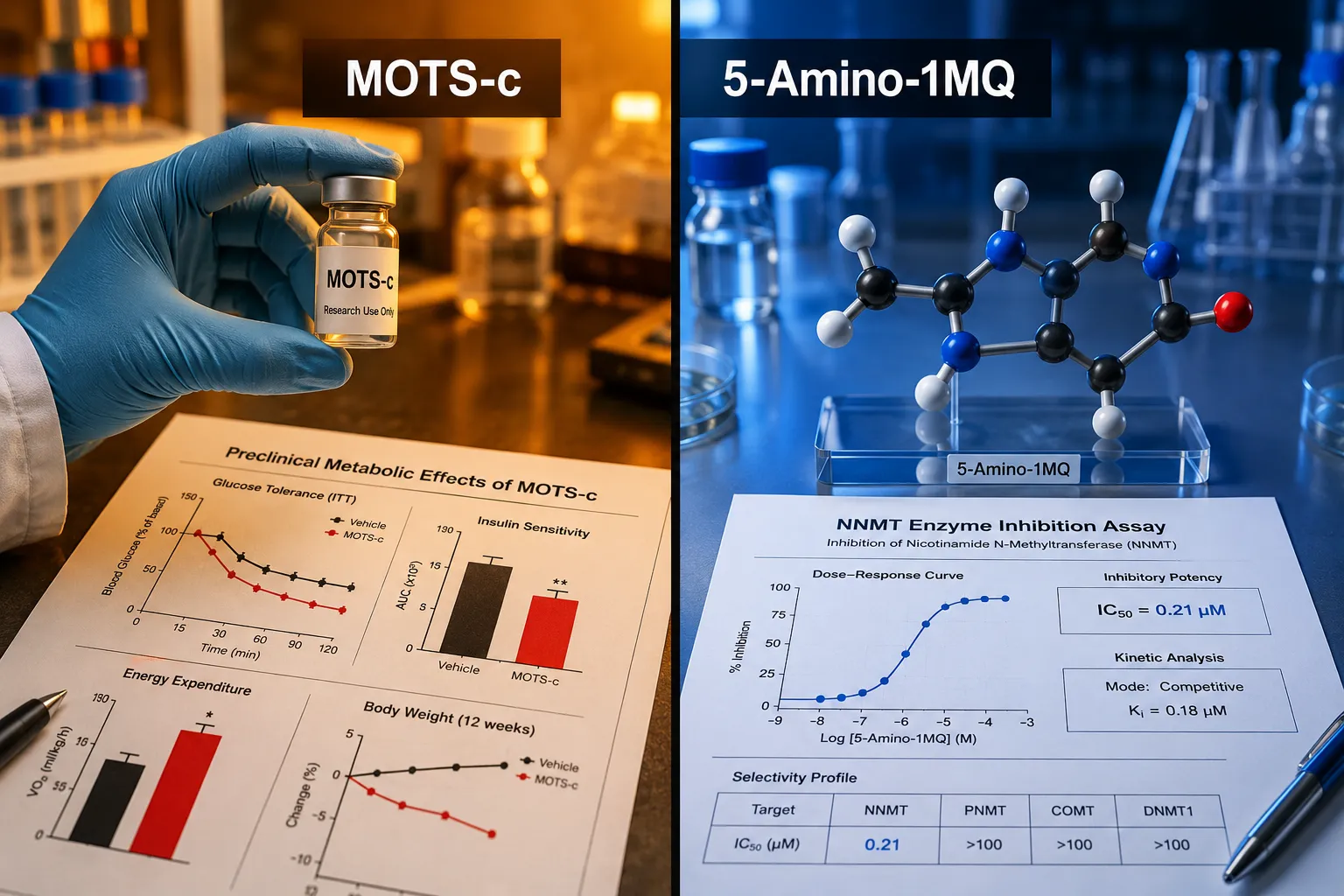
MOTS-c has a substantially larger body of preclinical literature. Studies published from 2016 onward have examined its role in aging, insulin resistance, exercise physiology, and inflammatory disease models. This breadth makes it a stronger candidate for translational research design where mechanistic precedent is required.

5-Amino-1MQ has a narrower but rapidly expanding evidence base. Most published data focuses on adipose tissue metabolism and obesity models. The compound's oral bioavailability in rodent studies gives it a practical advantage for certain experimental designs. Researchers focused on NAD+ biology or metabolic reprogramming may find it more directly relevant.

Research note: Neither compound should be conflated with approved therapeutics. Both remain preclinical research tools as of 2026, with no human clinical trial data establishing safety or efficacy in humans.

Safety and Risk Signals

Neither MOTS-c nor 5-Amino-1MQ has generated significant toxicity signals in published preclinical literature at research-relevant doses. MOTS-c, as an endogenous peptide, is generally considered to have a favorable tolerability profile in animal models. 5-Amino-1MQ's safety data is more limited given its shorter research history, and off-target effects of NNMT inhibition on methylation homeostasis remain an active area of investigation.

Researchers sourcing either compound should prioritize lab tested peptides with verified purity documentation to ensure experimental validity.

Choosing the Right Compound for Your Study

Research Objective Preferred Compound
Mitochondrial biogenesis and aging MOTS-c
Insulin resistance and glucose metabolism MOTS-c
NAD+ pathway and enzyme inhibition 5-Amino-1MQ
Adipose tissue metabolic reprogramming 5-Amino-1MQ
Exercise physiology models MOTS-c
Obesity and lipid metabolism Either (different mechanisms)

For researchers examining mitochondrial membrane integrity alongside these pathways, reviewing SS-31 peptide data provides useful mechanistic context, as SS-31 targets cardiolipin on the inner mitochondrial membrane, a third, distinct approach to mitochondrial support.

Those designing multi-compound protocols may also benefit from reviewing tissue recovery research literature, where mitochondrial function intersects with cellular repair endpoints.

Conclusion

This comparative review of the best research peptides for mitochondrial function confirms that MOTS-c and 5-Amino-1MQ are not competing compounds, they are mechanistically distinct tools suited to different research questions. MOTS-c offers a deeper evidence base and direct mitochondrial signaling relevance, making it the stronger choice for studies focused on biogenesis, aging, and insulin sensitivity. 5-Amino-1MQ addresses NAD+ pathway dynamics through NNMT inhibition, positioning it as the more targeted option for metabolic enzyme and adipose tissue research.

Actionable next steps for researchers:

  1. Define the primary endpoint, mitochondrial biogenesis, NAD+ availability, or metabolic rate, before selecting a compound.
  2. Review the latest 2024-2026 NNMT inhibition literature if designing 5-Amino-1MQ protocols, as the field is moving quickly.
  3. Source compounds with third-party purity verification to maintain experimental integrity.
  4. Consider combination designs only after establishing single-compound baselines using a single peptide model approach.
  5. Consult current regulatory guidance in your jurisdiction, neither compound is approved for human administration as of 2026.
Tags: 5-amino-1mq, ampk activation, mitochondria-derived peptides, mitochondrial function, mots-c peptide, nad+ metabolism, nnmt inhibitor, research peptides
https://www.puretestedpeptides.com/wp-content/uploads/2026/08/the-best-research-peptides-for-mitochondrial-function-a-comparative-review-of-mo.webp 1024 1536 https://www.puretestedpeptides.com/wp-content/uploads/2026/01/buy-peptides-online.jpg 2026-08-31 13:04:472026-08-31 13:04:47The Best Research Peptides for Mitochondrial Function: A Comparative Review of MOTS-c and 5-Amino-1MQ
You might also like
Mitochondria, Adenosine Triphosphate, and Peptide Signaling: Where MOTS-c and 5-Amino-1MQ Fit in Cellular Energy Research Mitochondria, Adenosine Triphosphate, and Peptide Signaling: Where MOTS-c and 5-Amino-1MQ Fit in Cellular Energy Research
The Broad Spectrum of Peptides: A Comprehensive Guide to Their Structure, Synthesis, and Diverse Research Applications The Broad Spectrum of Peptides: A Comprehensive Guide to Their Structure, Synthesis, and Diverse Research Applications
Where to Buy Research-Grade MOTS‑c and 5‑Amino‑1MQ: Quality Criteria for Mitochondrial Peptide Studies Where to Buy Research-Grade MOTS‑c and 5‑Amino‑1MQ: Quality Criteria for Mitochondrial Peptide Studies
Peptide Calculators in Research: How Labs Estimate Dosing, Concentration, and Reconstitution Peptide Calculators in Research: How Labs Estimate Dosing, Concentration, and Reconstitution
Enclomiphene vs Enclomiphene Citrate: What Researchers Need to Know Before Choosing a Formulation Enclomiphene vs Enclomiphene Citrate: What Researchers Need to Know Before Choosing a Formulation
Peptides 201: From Simple Peptides to Complex Polypeptides in Mitochondrial Research With MOTS-c and 5-Amino-1MQ Peptides 201: From Simple Peptides to Complex Polypeptides in Mitochondrial Research With MOTS-c and 5-Amino-1MQ
Peptides and Polypeptides in Mitochondrial Biology: How MOTS-c and 5-Amino-1MQ Compare With Classic Mitochondrial Pathways Peptides and Polypeptides in Mitochondrial Biology: How MOTS-c and 5-Amino-1MQ Compare With Classic Mitochondrial Pathways
Semax Peptide Nasal Spray: Administration, Dosing Concepts, and Research Applications Semax Peptide Nasal Spray: Administration, Dosing Concepts, and Research Applications
0 replies

Leave a Reply

Want to join the discussion?
Feel free to contribute!

Leave a Reply Cancel reply

Your email address will not be published. Required fields are marked *

×

Helpful Links

  • My account
  • Cart
  • Checkout
  • Refund and Returns Policy
  • Privacy Policy
  • SMS Privacy Policy
  • Login
  • My Account
  • Logout

USA Made Lab Tested Peptides

All products are sold for research, laboratory, or analytical purposes only, and are not for human consumption


Pure Tested Peptides is a chemical supplier. Pure Tested Peptides is not a compounding / chemical compounding facility as defined under 503A of the Federal Food, Drug, and Cosmetic act. Pure Tested Peptides is not an outsourcing facility as defined under 503B of the Federal Food, Drug, and Cosmetic act.

The statements made within this website have not been evaluated by the US Food and Drug Administration. The products we offer are not intended to diagnose, treat, cure or prevent any disease.

Human/Animal Consumption Prohibited. Laboratory/In-Vitro Experimental Use Only

Link to: MOTS-c and 5-Amino-1MQ Synergy: Optimizing Mitochondrial Function and Metabolic Research Link to: MOTS-c and 5-Amino-1MQ Synergy: Optimizing Mitochondrial Function and Metabolic Research MOTS-c and 5-Amino-1MQ Synergy: Optimizing Mitochondrial Function and Metabolic...MOTS-c and 5-Amino-1MQ Synergy: Optimizing Mitochondrial Function and Metabolic Research Link to: Where to Buy Research-Grade GLP-3 Retatrutide: Purity Standards, Vendor Selection, and Lab Considerations Link to: Where to Buy Research-Grade GLP-3 Retatrutide: Purity Standards, Vendor Selection, and Lab Considerations Where to Buy Research-Grade GLP-3 Retatrutide: Purity Standards, Vendor Selection, and Lab ConsiderationsWhere to Buy Research-Grade GLP-3 Retatrutide: Purity Standards, Vendor Selection,...
Scroll to top Scroll to top Scroll to top