Call or Text 727-513-9780
  • Shopping Cart Shopping Cart
    0Shopping Cart
Pure Tested Peptides | America's most trusted Peptides for sale online
  • Peptides for sale
    • Oral Peptides for sale
      • Peptide Capsules for sale
      • BPC 157 Capsules 1000mcg
      • SLU-PP-332 Capsules | 1000 mcg
      • 5-Amino-1MQ 50mg Capsules
      • Tesofensine 500mcg
    • All Peptides for sale
    • Peptide Sprays
      • BPC 157 Nasal Spray Kit
      • BPC-157 TB500 Nasal Spray Kit
      • Semax Nasal Spray 10mg
      • Selank – Nasal Spray Kit – 10mg
      • Epithalon 50MG Nasal Spray Kit
      • Ipamorelin 10mg Nasal Spray
      • Klow Nasal Spray (BPC-157 + TB-500 + GHK-Cu + KPV) | 80mg
      • Hulk Nasal Spray Tesa / Ipa Blend 6/3 MG
      • Klow Nasal Spray
      • NAD + 500 mg Nasal Spray
      • PT-141 Nasal Spray Kit
    • GHRH Peptides
      • Ipa Peptides
      • CJC-1295 Peptides
        • CJC-1295 with DAC 5 mg
        • CJC-1295 without DAC 5 mg
        • CJC-1295 Ipa 10mg
      • Tesa Peptides
        • Tesa Peptide
        • Tesa 20 mg
    • GHK-Cu Peptides
      • All GHK-Cu Peptides
      • GHK-Cu 100mg
      • KLOW Peptide Blend – Buy KLOW blend online
    • BPC Peptides
      • All BPC Peptides
      • BPC-157
      • BPC-157 TB-500
      • BPC 157 capsules 1000mcg
    • SLU-PP-332 Peptides
      • All SLU-PP-332 Peptides
      • SLU-PP-332 5mg
    • GLP3 Peptides
      • GLP3-R
      • GLP3-R CAG 10mg
      • GLP3-R 20mg
    • PT-141 Peptides
      • PT-141 Peptides for sale
      • PT-141 10mg
      • PT-141 Nasal Spray
    • CAG Peptides
      • Lipo-C Peptide Blend
      • CAG 5mg
      • CAG 10mg
    • MOTS-C Peptides
      • MOTS-C Peptides for sale
      • MOTS-c peptide
      • MOTS-c 10mg *6 pack*
    • 5 Amino 1MQ Peptides
      • 5 Amino 1MQ Peptides for sale
      • 5-Amino-1MQ 50mg Capsules
      • 5-Amino-1MQ 5mg
    • Epithalon Peptides
      • Epithalon Peptides for sale
      • Epithalon 10mg
      • Epithalon 50mg
  • Shop
    • GLPs
      • 5-Amino-1MQ 50mg Capsules
      • 5-Amino-1MQ 5mg
      • GLP3-Reta
      • L-Carnitine 500mg/ml
      • Tesofensine 500mcg
      • SLU-PP-332 5mg
      • MOTS-c 10mg *6 pack*
    • Epithalon & BPC Peptides
      • Epithalon 10mg
      • Epithalon 50mg
      • BPC-157
      • BPC 157 capsules 1000mcg
      • BPC-157 TB-500
      • BPC-157 TB500 Nasal Spray Kit
      • BPC 157 Nasal Spray Kit
    • BPC TB-500 & NAD+ Peptides
      • NAD+ 500 mg
      • KLOW Peptide Blend – Buy KLOW blend online
      • GLOW Peptide Blend
      • TB 500 5mg
      • BPC 157 capsules 1000mcg – Supplement
      • BPC 157 Nasal Spray Kit
      • BPC-157
      • BPC-157 TB500 Nasal Spray Kit
      • BPC-157 TB-500
      • BPC 157 capsules 1000mcg
    • LL-37 Peptide
      • LL-37 10 mg
    • MOTS-C & Selank
      • MOTS-c peptide
      • Selank 10mg
    • GHK Peptides
      • GHK-Cu 100mg
      • GLOW Peptide Blend
      • KLOW Peptide Blend – Buy KLOW blend online
  • COAs
  • Wholesale
    • Wholesale Peptides for sale
  • PTP FAQ
  • Affiliates
    • Selank Peptide: Advanced Pharmacological Mechanisms Underlying Its Anxiolytic and Nootropic Effects in Research
      • 5-Amino-1MQ Peptide: Detailed Mechanisms of NNMT Inhibition and Its Impact on Cellular Metabolism Research
        • MOTS-C Peptide: Unraveling Its Role in Mitochondrial Dynamics and Energy Metabolism Research
          • Epithalon Peptide and Telomerase Regulation: Investigating Its Impact on Cellular Senescence and Lifespan Research Models
            • GLP2-T vs GLP2 Tirz Peptide: Understanding the Naming, Mechanistic Nuances, and Research Implications for Gut Health
      • Peptides and Polypeptides in Modern Pharmacology: What Research on Metoprolol, Prednisone, and Amlodipine Reveals
        • Polypeptide Peptides vs NSAIDs: What Naproxen and Diclofenac Teach Tissue-Repair Researchers About BPC‑157 and TB‑500
          • Peptides and Polypeptides in Endocrine Pharmacology: How GLP-1, GLP-2, and GLP-3 Retatrutide Differ From Classic Drugs Like Prednisone and Amlodipine
          • 5‑Amino‑1MQ Peptide and NNMT Inhibition: How It Compares With Statins Like Atorvastatin in Adipose and Lipid Metabolism Research
      • Enclomiphene, Estrogen Receptor Signaling, and Luteinizing Phase Biology: What Hormone Researchers Should Measure
        • Mesenchymal Stem Cells, BPC‑157, and GHK‑Cu: How Tissue Repair Peptides Compare With Classic NSAIDs Like Naproxen in Injury Models
          • Peptide Calculator Use Cases Beyond Growth Hormone: Working Through GLP‑3 Retatrutide, MOTS‑c, and BPC‑157 Research Dosing
        • Polypeptide Peptides in Endocrine and Metabolic Pharmacology: Lessons From Amlodipine, Prednisone, and Metoprolol
        • Peptides Calculator for Advanced Blends: Worked Examples for Tesamorelin, CJC‑1295, and Ipamorelin Stacks
          • Peptides and Polypeptides in Human Physiology: How Molecular Size Shapes Research Applications
            • Selank Peptide: Advanced Pharmacological Mechanisms Underlying Its Anxiolytic and Nootropic Effects in Research
          • 5-Amino-1MQ Peptide: Detailed Mechanisms of NNMT Inhibition and Its Impact on Cellular Metabolism Research
            • MOTS-C Peptide: Unraveling Its Role in Mitochondrial Dynamics and Energy Metabolism Research
              • Epithalon Peptide and Telomerase Regulation: Investigating Its Impact on Cellular Senescence and Lifespan Research Models
                • GLP2-T vs GLP2 Tirz Peptide: Understanding the Naming, Mechanistic Nuances, and Research Implications for Gut Health
                  • Peptides and Polypeptides in Endocrine Pharmacology: How GLP-1, GLP-2, and GLP-3 Retatrutide Differ From Classic Drugs Like Prednisone and Amlodipine
                    • Polypeptide Peptides vs NSAIDs: What Naproxen and Diclofenac Teach Tissue-Repair Researchers About BPC‑157 and TB‑500
                      • Peptides and Polypeptides in Modern Pharmacology: What Research on Metoprolol, Prednisone, and Amlodipine Reveals
                        • 5‑Amino‑1MQ Peptide and NNMT Inhibition: How It Compares With Statins Like Atorvastatin in Adipose and Lipid Metabolism Research
                        • Enclomiphene, Estrogen Receptor Signaling, and Luteinizing Phase Biology: What Hormone Researchers Should Measure
                        • Mesenchymal Stem Cells, BPC‑157, and GHK‑Cu: How Tissue Repair Peptides Compare With Classic NSAIDs Like Naproxen in Injury Models
                        • Peptide Calculator Use Cases Beyond Growth Hormone: Working Through GLP‑3 Retatrutide, MOTS‑c, and BPC‑157 Research Dosing
                        • Polypeptide Peptides in Endocrine and Metabolic Pharmacology: Lessons From Amlodipine, Prednisone, and Metoprolol
                        • Peptides Calculator for Advanced Blends: Worked Examples for Tesamorelin, CJC‑1295, and Ipamorelin Stacks
                        • Peptides and Polypeptides in Human Physiology: How Molecular Size Shapes Research Applications
                        • Selank Peptide: Advanced Pharmacological Mechanisms Underlying Its Anxiolytic and Nootropic Effects in Research
                        • MOTS-C Peptide: Unraveling Its Role in Mitochondrial Dynamics and Energy Metabolism Research
                        • Peptides and Polypeptides in Modern Pharmacology: What Research on Metoprolol, Prednisone, and Amlodipine Reveals
                        • Peptides and Polypeptides in Endocrine Pharmacology: How GLP-1, GLP-2, and GLP-3 Retatrutide Differ From Classic Drugs Like Prednisone and Amlodipine
                        • 5-Amino-1MQ Peptide: Detailed Mechanisms of NNMT Inhibition and Its Impact on Cellular Metabolism Research
                        • Mesenchymal Stem Cells, BPC‑157, and GHK‑Cu: How Tissue Repair Peptides Compare With Classic NSAIDs Like Naproxen in Injury Models
                        • Peptide Calculator Use Cases Beyond Growth Hormone: Working Through GLP‑3 Retatrutide, MOTS‑c, and BPC‑157 Research Dosing
                        • GLP2-T vs GLP2 Tirz Peptide: Understanding the Naming, Mechanistic Nuances, and Research Implications for Gut Health
                        • Polypeptide Peptides in Endocrine and Metabolic Pharmacology: Lessons From Amlodipine, Prednisone, and Metoprolol
                        • Polypeptide Peptides vs NSAIDs: What Naproxen and Diclofenac Teach Tissue-Repair Researchers About BPC‑157 and TB‑500
                        • Peptides and Polypeptides in Human Physiology: How Molecular Size Shapes Research Applications
                        • Peptides Calculator for Advanced Blends: Worked Examples for Tesamorelin, CJC‑1295, and Ipamorelin Stacks
                        • 5‑Amino‑1MQ Peptide and NNMT Inhibition: How It Compares With Statins Like Atorvastatin in Adipose and Lipid Metabolism Research
                        • Enclomiphene, Estrogen Receptor Signaling, and Luteinizing Phase Biology: What Hormone Researchers Should Measure
                        • Epithalon Peptide and Telomerase Regulation: Investigating Its Impact on Cellular Senescence and Lifespan Research Models
                        • Best research protocol Klow blend
                        • best time to take BPC-157
                        • best time to take DSIP (Delta Sleep Inducing Peptide)
                        • best time to take CJC-1295
                        • best time to take AOD-9604
                        • best time to take Follistatin 344
                        • best time to take Ipamorelin
                        • best time to take MK-677 (Ibutamoren)
                        • best time to take Ligandrol (LGD-4033) — research compound
                        • best time to take Ostarine (MK-2866) — research compound
                        • best time to take GHK-CU
                        • best time to take TB-500
                        • best time to take MOTS-c
                        • best time to take Semax
                        • best time to take RAD-140 (Testolone) — research compound
                        • best time to take Thymosin Alpha-1
                        • best time to take PEG-MGF
                        • Biolife Plasma, Octapharma Plasma, and Research Peptides: How Plasma Donation Labs Differ From Peptide Suppliers
                        • best time to take YK-11 — research compound
                        • best time to take PT-141 (Bremelanotide)
                        • Best research protocol Klow blend
                        • 5-Amino-1MQ and MOTS-C Synergy: Metabolic Signaling, Mitochondria, and Research Design
                        • BPC-157 and TB-500: Investigating Their Combined Effects on Angiogenesis and Cellular Migration in Tissue Repair Models
                        • BPC-157 Peptide: Gut Barrier Function, Inflammation, and Tissue-Recovery Research
                        • 5‑Amino‑1MQ and MOTS‑c Synergy in Metabolic Research: Designing NNMT and Mitochondrial Biogenesis Stacks
                        • CJC-1295 with DAC vs. Without DAC: Half-Life, Release Kinetics, and Research Implications
                        • CJC‑1295 with DAC vs. Without DAC: Expanding on Half‑Life Differences Using Tesamorelin and Ipamorelin Blend Case Studies
                        • Collagen Biology and Copper‑Binding Peptides: How GHK‑Cu, Glow Blend, and Klow Blend Interact with Skin and Connective Tissue
                        • Collagen Biology and Regenerative Peptides: How GHK‑Cu, Glow Blend, and Klow Blend Affect Extracellular Matrix Research
                    • DNA, Telomeres, and Longevity Peptides: Positioning Epithalon and MOTS‑c in Genetic Aging Research
                      • Enclomiphene Citrate: serm Mechanism, Testosterone Research, and Stack Compatibility
                        • Enclomiphene vs Enclomiphene Citrate: Formulation, Bioavailability, and Research Distinctions
                        • Epithalon Peptide Research: Telomerase Activation, Aging, and Pineal Gland Function
                        • Estrogen Receptor Signaling and Enclomiphene: How Selective Modulators Compare with Classic Polypeptide Hormones
                        • GHK-Cu Peptide: Advanced Mechanisms in Extracellular Matrix Remodeling and Wound Healing Research
                        • GHK-Cu Peptide: Collagen Synthesis, Wound Repair, and Skin-Barrier Research Models
                        • GLP-1 vs GLP-3 vs GLP-2: Peptide Classification and Research Applications
                        • GLP-2 Peptide Research Guide: Gut Barrier Function, Nutrient Absorption, and Intestinal Recovery Models
                        • GLP-3 Retatrutide vs. GLP-1 Drugs: What Triple-Agonist Biology Changes in Research Models
                        • Ipamorelin and Tesamorelin Combination: Synergistic GH Secretagogue Research and Dosing Protocols
                        • GLP2 Tirz Peptide: What It Is, Why the Name Exists, and How Researchers Should Interpret It
                        • Klow Blend Peptide Nasal Spray: What the Formulation Is Trying to Do in Cognitive Research
                        • Mitochondria, NNMT Inhibition, and Peptide Modulators: Where MOTS‑c and 5‑Amino‑1MQ Fit in Cellular Energy Research
                        • MOTS-c Peptide: Mitochondrial Function, Energy Metabolism, and What Researchers Measure
                        • MOTS-c vs. 5-Amino-1MQ: Which Metabolic Research Questions Each Compound Actually Answers
                        • Nasal Spray Peptides: Bioavailability, Administration, and Semax/Selank Research Applications
                        • PT-141 Peptide Research: Mechanism of Action and Melanocortin Receptor Signaling
                        • Retatrutide for Research: Mechanism, Structure, and GLP-1/GLP-3 Dual Action
                        • Retatrutide for Obesity and Type 2 Diabetes: What the Latest Trial Data Suggest
                        • Tesofensine Peptide Research: Mechanism, Appetite Suppression, and Neuropeptide Y Pathways
  • Contact
    • Contact Customer Service
    • Text Customer Support
  • About US
  • Shop all peptides
  • Affiliate Program
    • Affiliate Signup
  • Login / Register Login / Register Page Link Login / Register Page Link
  • Click to open the search input field Click to open the search input field Search
  • Menu Menu
Where to Buy Research-Grade GLP-3 Retatrutide: Purity Standards, Vendor Selection, and Lab Considerations

Where to Buy Research-Grade GLP-3 Retatrutide: Purity Standards, Vendor Selection, and Lab Considerations

August 31, 2026/0 Comments/in Uncategorized/by

Fewer than 1% of investigational peptides reach Phase 3 clinical trials with simultaneous data across three distinct receptor pathways, retatrutide is one of them. That scientific rarity has driven intense interest from research institutions worldwide. Yet the question of where to buy research-grade GLP-3 retatrutide: purity standards, vendor selection, and lab considerations is far more complex than sourcing a conventional peptide. In 2026, retatrutide remains an investigational compound under strict manufacturer control, and understanding what that means for researchers is essential before any procurement decision is made.

Key Takeaways

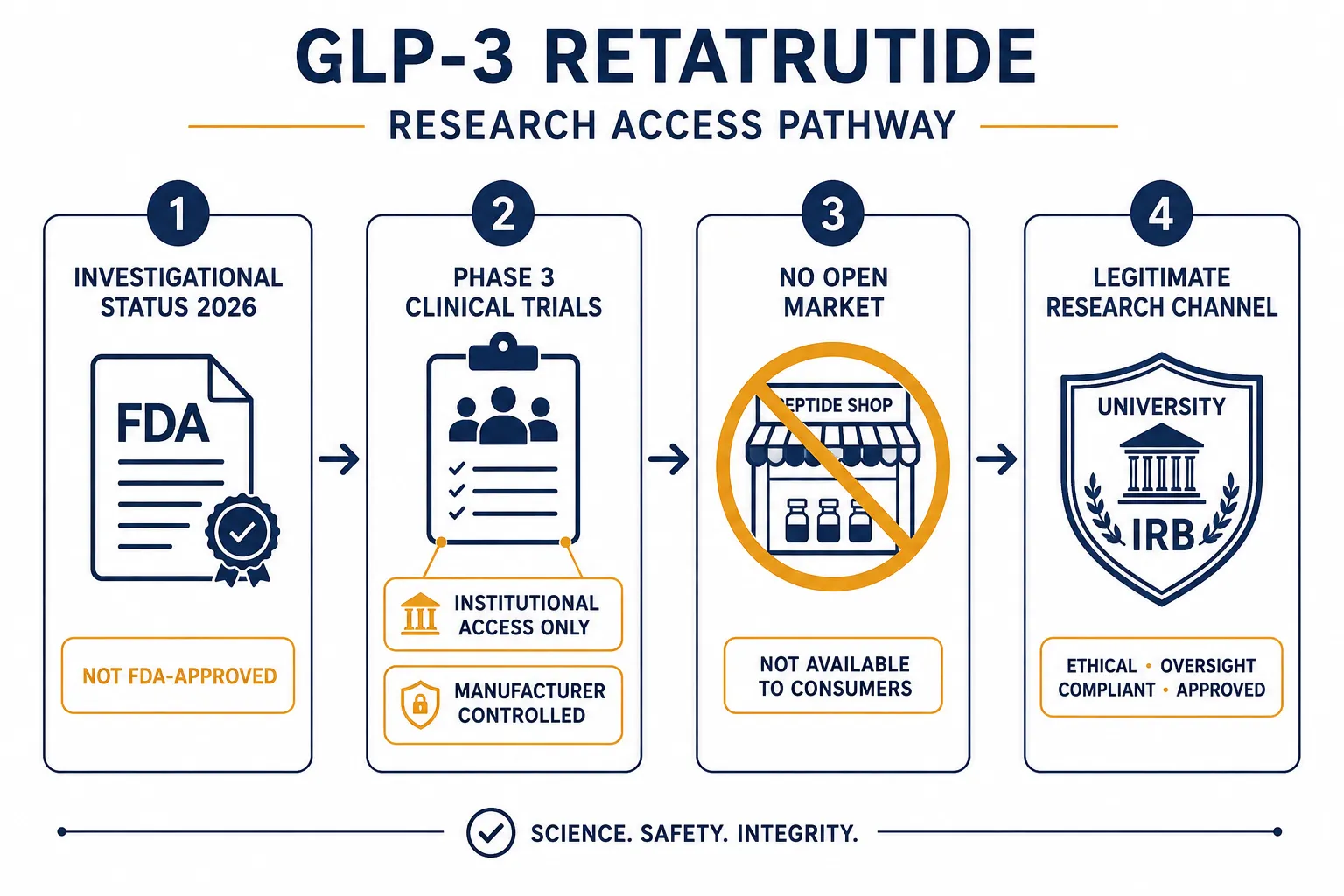
  • Retatrutide is not FDA-approved or commercially available as of 2026; access is limited to sanctioned clinical and institutional research channels.
  • No legitimate "open market" exists for research-grade retatrutide, consumer-facing peptide vendors cannot legally or reliably supply it.
  • Purity documentation, including third-party HPLC and mass spectrometry data, is non-negotiable for any research-grade compound.
  • Vendor selection must prioritize institutional affiliation, documented chain of custody, and verifiable certificates of analysis.
  • Proper lab handling of this potent multi-agonist peptide requires strict cold-chain storage, sterile reconstitution, and protocol documentation.

Understanding Retatrutide's Investigational Status in 2026
Understanding Retatrutide's Investigational Status in 2026

Retatrutide is a triple agonist targeting GLP-1, GIP, and glucagon receptors simultaneously. This mechanism sets it apart from dual agonists already in clinical use. As of 2026, it remains an investigational new drug (IND) advancing through Phase 3 trials for obesity, type 2 diabetes, and metabolic liver disease, none of which constitute an approved indication.

What this means in practice:

  • The compound is manufactured under exclusive pharmaceutical-grade controls by its developer.
  • It cannot be legally compounded by compounding pharmacies under current FDA guidance.
  • It is not available through standard laboratory supply chains or consumer-facing peptide retailers.

"Investigational status is not a technicality, it is a hard boundary that defines where legitimate access begins and ends."

Researchers interested in systemic peptide research involving novel multi-agonist compounds must recognize that retatrutide sits in a category governed by clinical trial infrastructure, not open procurement. Any vendor claiming to sell "research-grade retatrutide" outside of that framework warrants serious scrutiny.

Vendor Selection: Where to Buy Research-Grade GLP-3 Retatrutide Safely

The question of where to buy research-grade GLP-3 retatrutide: purity standards, vendor selection, and lab considerations begins with a clear understanding of what a legitimate source actually looks like in 2026.
Vendor Selection: Where to Buy Research-Grade GLP-3 Retatrutide Safely

Institutional and Clinical Trial Channels

The only verified access point for retatrutide in a research context is participation in a sanctioned Phase 3 clinical trial or an affiliated academic medical center with an active investigational protocol. These channels involve:

  • Institutional Review Board (IRB) approval
  • Formal investigator agreements with the sponsoring pharmaceutical company
  • Controlled distribution directly from the manufacturer or its authorized clinical research organization (CRO)

Red Flags in Vendor Claims

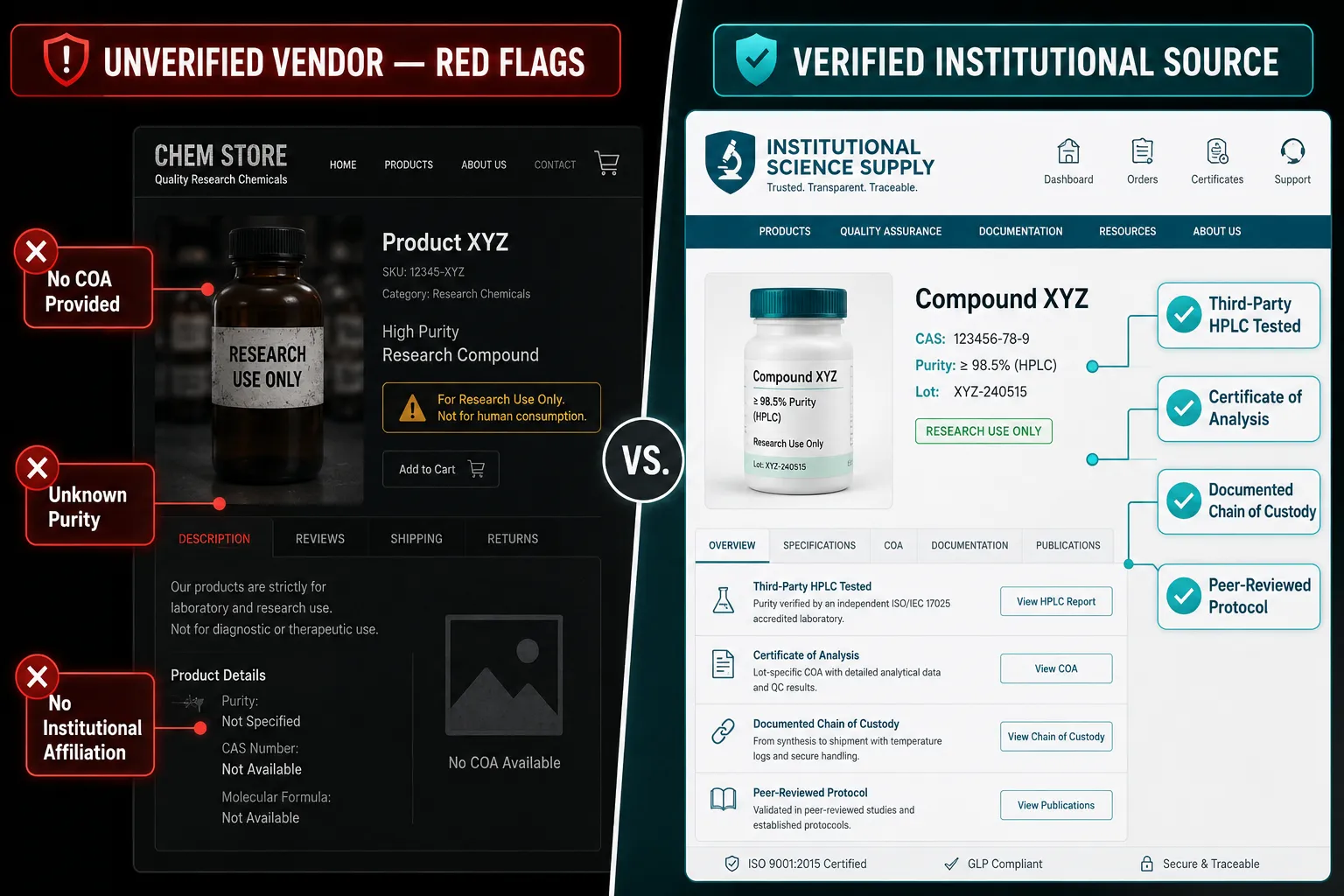
A growing number of consumer-facing peptide websites advertise compounds under names resembling retatrutide. Researchers should treat these with extreme caution. Common warning signs include:

Red Flag Why It Matters
No certificate of analysis (COA) Cannot verify purity or identity
No third-party HPLC data Internal testing is insufficient for research-grade claims
No institutional affiliation Legitimate supply chains require documented oversight
Vague sourcing language Indicates unknown synthesis origin
No mass spectrometry confirmation Sequence accuracy cannot be confirmed

For context on how rigorous documentation standards apply across peptide research categories, the SS-31 10mg research peptide considerations framework offers a useful benchmark for what responsible sourcing documentation looks like.

What Research-Grade Purity Actually Requires

For any peptide used in controlled research, "research-grade" is not a marketing label, it is a documentation standard. Minimum acceptable criteria include:

  • Purity of 98% or higher confirmed by reverse-phase HPLC
  • Mass spectrometry (MS) confirmation of correct molecular weight and sequence
  • Endotoxin testing results (LAL assay)
  • Sterility documentation for any injectable-format compound
  • Lot-specific COA traceable to a verified synthesis batch

These standards apply equally whether a lab is exploring translational research design or conducting preclinical metabolic studies.

Lab Considerations for Handling a Potent Multi-Agonist Peptide
Lab Considerations for Handling a Potent Multi-Agonist Peptide

Even in a legitimate research setting, where to buy research-grade GLP-3 retatrutide: purity standards, vendor selection, and lab considerations extends well beyond procurement. Retatrutide's triple-agonist profile means it is biologically potent at very low concentrations, which creates specific handling obligations.

Storage Requirements

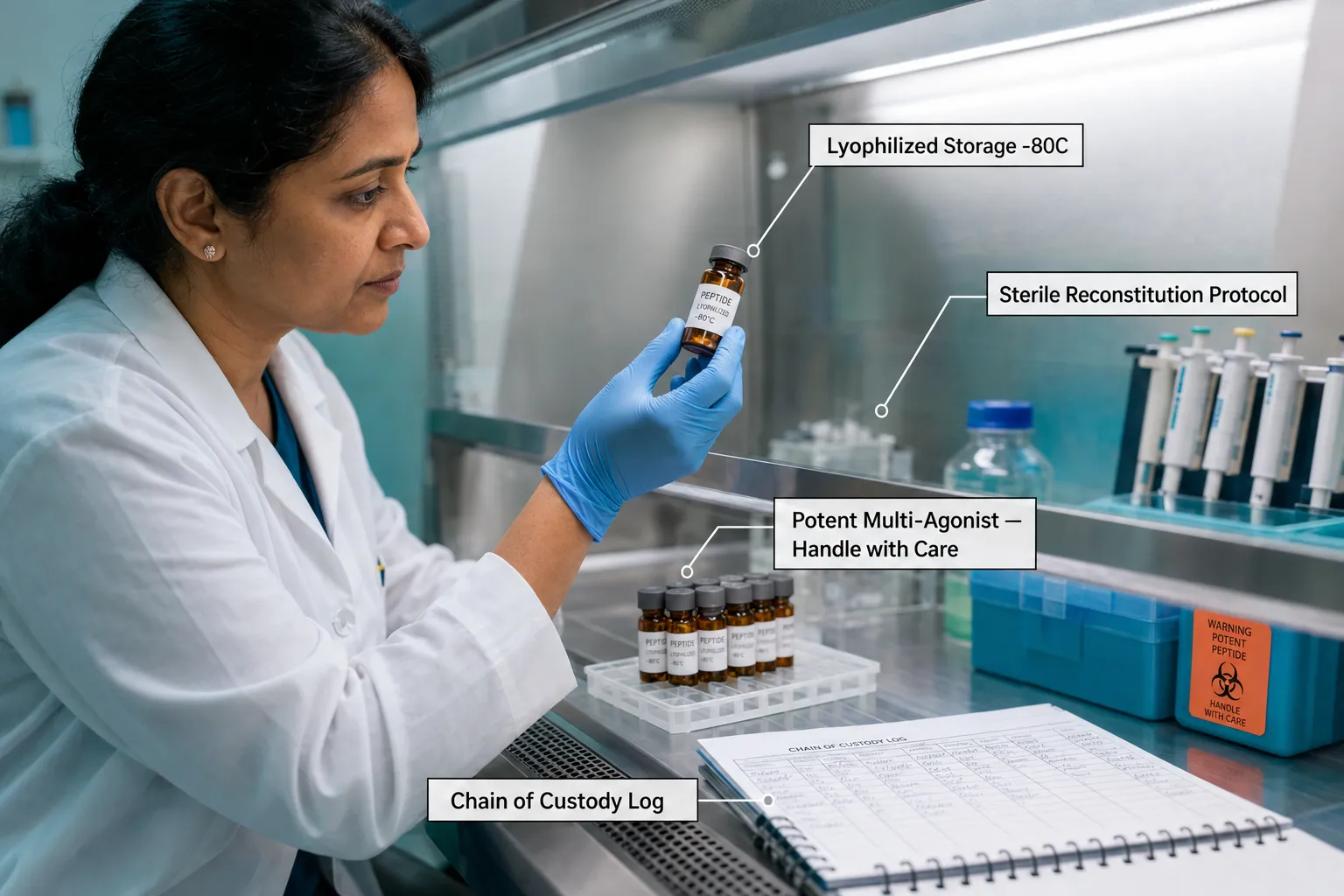
  • Lyophilized (freeze-dried) form should be stored at -80°C for long-term stability.
  • Reconstituted solutions degrade rapidly; prepare only what will be used within the experimental window.
  • Avoid repeated freeze-thaw cycles, which degrade peptide integrity and compromise data reliability.

Reconstitution Protocol

  • Use sterile bacteriostatic water or the solvent specified in the manufacturer's protocol.
  • Reconstitute slowly to avoid foaming, which can denature the peptide.
  • Document every reconstitution step as part of the experimental record.

Biosafety and Documentation

Given the compound's potency, personal protective equipment (PPE) including nitrile gloves, lab coat, and eye protection is standard. All handling should occur in a biosafety cabinet when working with injectable preparations.

Researchers engaged in stem cell research or telomere research involving metabolic pathways will recognize that documentation discipline is as important as the compound itself. Chain-of-custody logs, usage records, and storage temperature logs are not optional, they are part of what makes research reproducible and defensible.

Forward-Looking Outlook for Retatrutide Research Access

If Phase 3 data continues to support efficacy and safety, regulatory approval in one or more indications could follow within the next few years. At that point, the landscape for institutional access would shift considerably. Licensed clinical use would create clearer supply chains, though research applications outside approved indications would still require IND pathways.

Until then, researchers should direct all procurement inquiries through their institution's clinical trials office or directly to the sponsoring pharmaceutical company's medical affairs team. Off-label or DIY sourcing not only undermines data integrity, it carries significant regulatory and safety risk.

Conclusion

The answer to where to buy research-grade GLP-3 retatrutide: purity standards, vendor selection, and lab considerations is, in 2026, an institutional one. There is no legitimate open-market source. Actionable next steps for serious researchers include:

  1. Contact your institution's IRB or clinical trials office to explore active Phase 3 trial participation or affiliated access.
  2. Reach out to the sponsoring pharmaceutical company's medical affairs division for investigator-initiated research inquiries.
  3. Establish purity documentation standards, HPLC, MS, endotoxin, and sterility data, as non-negotiable requirements for any peptide compound used in your lab.
  4. Implement cold-chain storage and reconstitution protocols before any compound arrives.
  5. Avoid consumer-facing peptide vendors making retatrutide claims without verifiable institutional documentation.

Rigorous sourcing is not bureaucratic overhead, it is the foundation of reproducible, credible research.

Tags: glp-3 peptide, investigational compounds, lab peptide handling, peptide purity standards, research grade peptides, retatrutide research, systemic peptide research, vendor selection peptides
https://www.puretestedpeptides.com/wp-content/uploads/2026/08/where-to-buy-research-grade-glp-3-retatrutide-purity-standards-vendor-selection.webp 1024 1536 https://www.puretestedpeptides.com/wp-content/uploads/2026/01/buy-peptides-online.jpg 2026-08-31 13:05:382026-08-31 13:05:38Where to Buy Research-Grade GLP-3 Retatrutide: Purity Standards, Vendor Selection, and Lab Considerations
You might also like
Peptides 101 for Research-Use Only Buyers: Structure, Mechanisms, and Where GLP-3, MOTS-c, and 5-Amino-1MQ Fit In Peptides 101 for Research-Use Only Buyers: Structure, Mechanisms, and Where GLP-3, MOTS-c, and 5-Amino-1MQ Fit In
Collagen Research Peptides: Where GHK-Cu, Glow Blend, and Skin-Focused Formulas Fit in Laboratory Models Collagen Research Peptides: Where GHK-Cu, Glow Blend, and Skin-Focused Formulas Fit in Laboratory Models
Retatrutide and MASLD: How Triple-Agonist Research Is Reframing Liver-Fat Endpoints Retatrutide and MASLD: How Triple-Agonist Research Is Reframing Liver-Fat Endpoints
Tesofensine Mechanism Explained: Noradrenergic Appetite Modulation vs Incretin-Based GLP‑3 and GLP‑1 Pathways Tesofensine Mechanism Explained: Noradrenergic Appetite Modulation vs Incretin-Based GLP‑3 and GLP‑1 Pathways
Retatrutide and MASLD: Interpreting Liver-Fat Reductions and Microbiome Signals From Emerging GLP‑3 Data Retatrutide and MASLD: Interpreting Liver-Fat Reductions and Microbiome Signals From Emerging GLP‑3 Data
Tesofensine vs GLP‑3 Retatrutide vs Classic Appetite Drugs: Which Pathways Researchers Model for Weight‑Related Studies Tesofensine vs GLP‑3 Retatrutide vs Classic Appetite Drugs: Which Pathways Researchers Model for Weight‑Related Studies
Where to Buy Research-Grade Glow Blend Peptide: Evaluating Purity, Copper Complexes, and Skin-Model Compatibility Where to Buy Research-Grade Glow Blend Peptide: Evaluating Purity, Copper Complexes, and Skin-Model Compatibility
Klow Blend Peptide: Investigating Its Unique Formulation and Research Applications for Wellness Studies Klow Blend Peptide: Investigating Its Unique Formulation and Research Applications for Wellness Studies
0 replies

Leave a Reply

Want to join the discussion?
Feel free to contribute!

Leave a Reply Cancel reply

Your email address will not be published. Required fields are marked *

×

Helpful Links

  • My account
  • Cart
  • Checkout
  • Refund and Returns Policy
  • Privacy Policy
  • SMS Privacy Policy
  • Login
  • My Account
  • Logout

USA Made Lab Tested Peptides

All products are sold for research, laboratory, or analytical purposes only, and are not for human consumption


Pure Tested Peptides is a chemical supplier. Pure Tested Peptides is not a compounding / chemical compounding facility as defined under 503A of the Federal Food, Drug, and Cosmetic act. Pure Tested Peptides is not an outsourcing facility as defined under 503B of the Federal Food, Drug, and Cosmetic act.

The statements made within this website have not been evaluated by the US Food and Drug Administration. The products we offer are not intended to diagnose, treat, cure or prevent any disease.

Human/Animal Consumption Prohibited. Laboratory/In-Vitro Experimental Use Only

Link to: The Best Research Peptides for Mitochondrial Function: A Comparative Review of MOTS-c and 5-Amino-1MQ Link to: The Best Research Peptides for Mitochondrial Function: A Comparative Review of MOTS-c and 5-Amino-1MQ The Best Research Peptides for Mitochondrial Function: A Comparative Review...The Best Research Peptides for Mitochondrial Function: A Comparative Review of MOTS-c and 5-Amino-1MQ Link to: GLP-2 and GLP-2 Tirz Peptides: Intestinal Barrier Function and Research Applications Link to: GLP-2 and GLP-2 Tirz Peptides: Intestinal Barrier Function and Research Applications GLP-2 and GLP-2 Tirz Peptides: Intestinal Barrier Function and Research ApplicationsGLP-2 and GLP-2 Tirz Peptides: Intestinal Barrier Function and Research App...
Scroll to top Scroll to top Scroll to top