

Where to Buy Research‑Grade GLP-3 Retatrutide and GLP-2-T Peptides: Purity, Certificates of Analysis, and Vendor Red Flags
Fewer than 1 in 10 grey-market peptide vials tested by independent safety laboratories in 2026 matched the purity levels stated on their labels, a sobering statistic for any researcher sourcing GLP-class compounds. Understanding where to buy research-grade GLP-3 retatrutide and GLP-2-T peptides requires far more than a vendor comparison; it demands a working knowledge of purity standards, Certificate of Analysis (COA) interpretation, and the regulatory minefield that now surrounds these molecules.
Key Takeaways
- Retatrutide remains an investigational triple agonist with no FDA approval; any vendor selling it "for research use" while marketing human dosing protocols is operating in legally dangerous territory.
- A valid COA must include HPLC purity data, mass spectrometry confirmation, and endotoxin testing from an identifiable third-party laboratory.
- Black-market retatrutide consistently underperforms clinical-trial benchmarks, suggesting inferior formulations or outright counterfeiting.
- GLP-2-T (a truncated GLP-2 analog) requires the same rigorous purity verification as full-length GLP-class peptides, including sequence confirmation.
- Vendor red flags, dose regimens, patient testimonials, and no lot-traceable COAs, are disqualifying criteria for legitimate research procurement.
Understanding GLP-3 Retatrutide and GLP-2-T in a Research Context
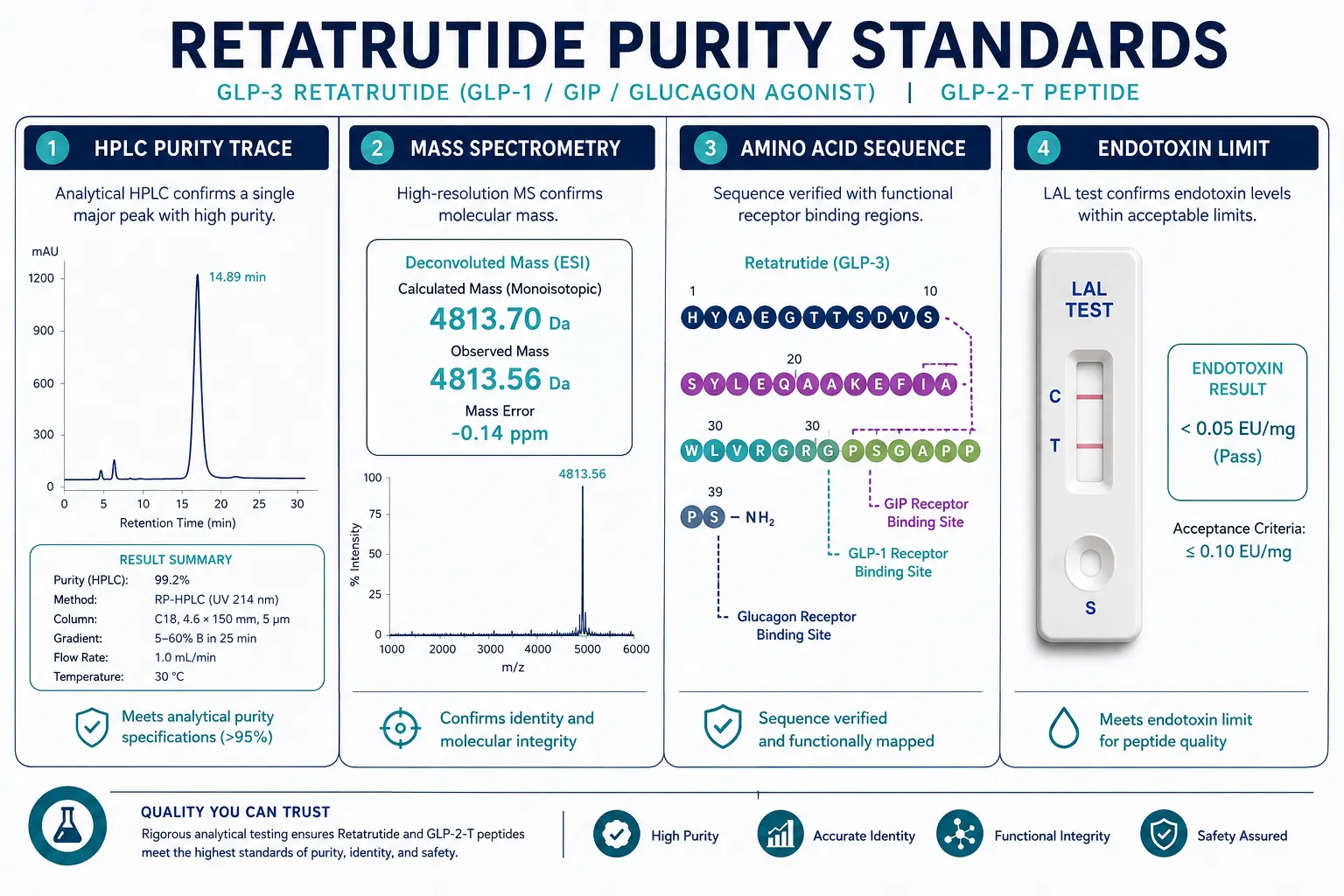
Retatrutide, developed by Eli Lilly, is a once-weekly triple agonist peptide targeting three receptors simultaneously: GIP, GLP-1, and glucagon. Phase III TRIUMPH trial data published in 2026 showed weight reductions of approximately 28 to 30 percent, placing it among the most potent metabolic peptides ever evaluated. Despite this, retatrutide holds no regulatory approval anywhere in the world as of August 2026. The only sanctioned access pathway is a tightly controlled expanded-access protocol (ClinicalTrials.gov NCT07629401) requiring documented failure of standard GLP-1/GIP therapies and significant obesity-related comorbidities, a far cry from open vendor sales.
GLP-2-T refers to truncated analogs of glucagon-like peptide-2, studied primarily for intestinal repair and mucosal recovery. Researchers exploring tissue recovery research often source GLP-2-T alongside longer-chain GLP-class peptides, making purity verification equally critical for both compound types.
"Any vendor advertising retatrutide with weight-loss protocols or patient testimonials is not operating as a legitimate research supplier, full stop."
The distinction between the Lilly investigational drug and the "GLP-3 retatrutide" sold by peptide vendors matters enormously. The term "GLP-3" is an informal label used in research communities; it is not an approved pharmacological designation. Researchers must treat any sourced material as a synthetic analog requiring independent verification, not as the clinical compound.
Purity Standards and COA Interpretation for GLP-Class Peptides
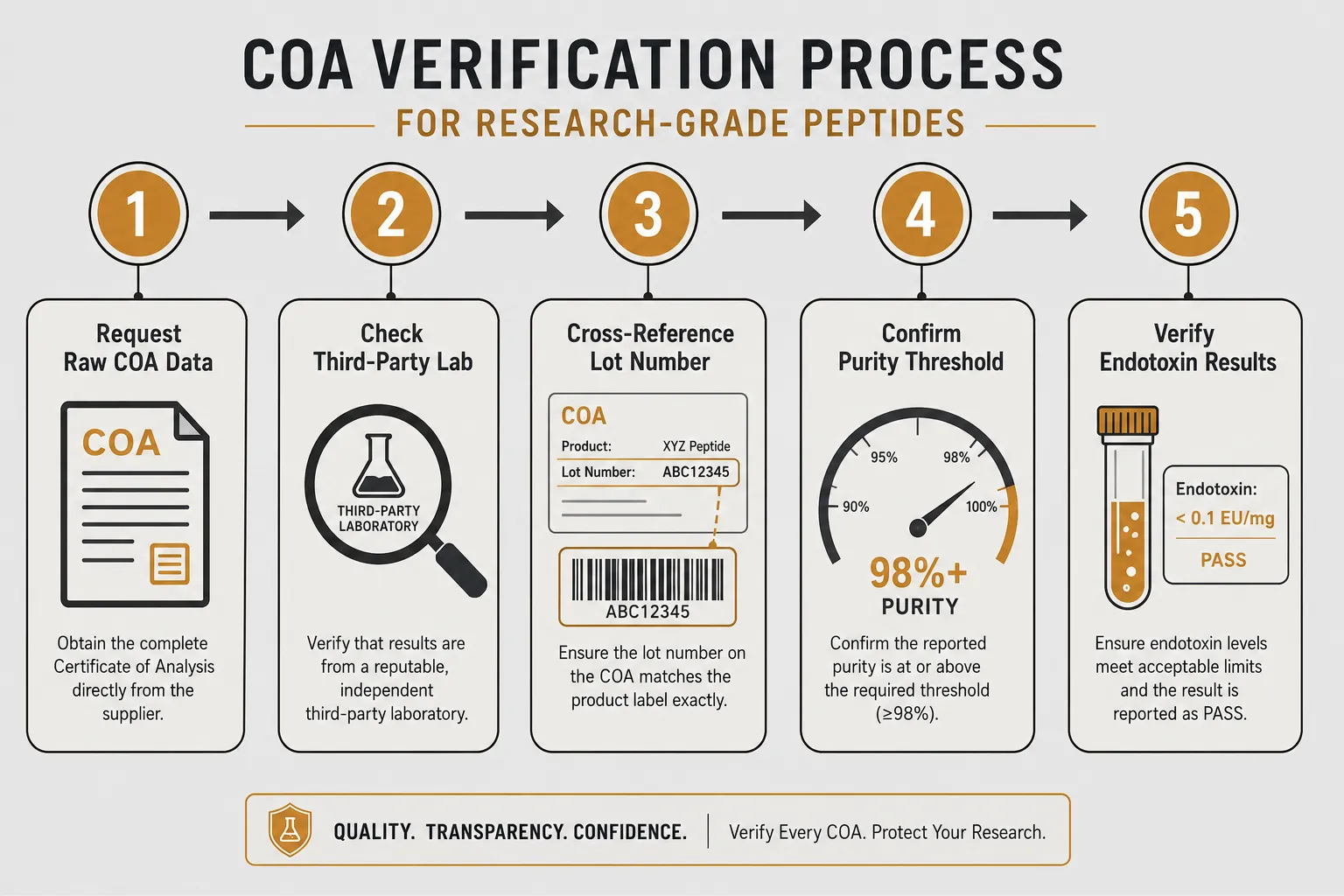
When evaluating where to buy research-grade GLP-3 retatrutide and GLP-2-T peptides, the Certificate of Analysis is the single most important document a vendor can provide. A legitimate COA is not a one-page marketing sheet, it is a traceable analytical report with the following components:
Minimum COA Requirements
| Analysis Type | Acceptable Standard | What to Check |
|---|---|---|
| HPLC Purity | Greater than or equal to 98% | Peak area percentage, not just a stated number |
| Mass Spectrometry | Molecular weight confirmation | Must match theoretical MW of the sequence |
| Amino Acid Analysis | Sequence verification | Confirms correct residue composition |
| Endotoxin Testing | Less than 1 EU/mg (research grade) | LAL or rFC method, not absent from report |
| Appearance | White to off-white lyophilized powder | Visual and physical description included |
Third-party versus in-house testing is a critical distinction. A COA generated by the same facility that synthesized the peptide carries significantly less weight than one issued by an independent analytical laboratory. The report should name the testing lab, include a lot number, and provide a date of analysis. Researchers should cross-reference the lot number against the vial label before use.
For signaling peptides and longer-chain analogs like retatrutide (39 amino acids), mass spectrometry confirmation is non-negotiable. Shorter peptides can occasionally pass HPLC with truncated sequences; MS data closes that gap.
Solvent and reconstitution data should also appear in supporting documentation. GLP-class peptides are typically reconstituted in sterile water or bacteriostatic water with acetic acid at low concentrations. Vendors that provide no guidance, or worse, recommend DMSO for injectable-grade research, signal a lack of formulation expertise.
Vendor Red Flags and the Regulatory Landscape in 2026
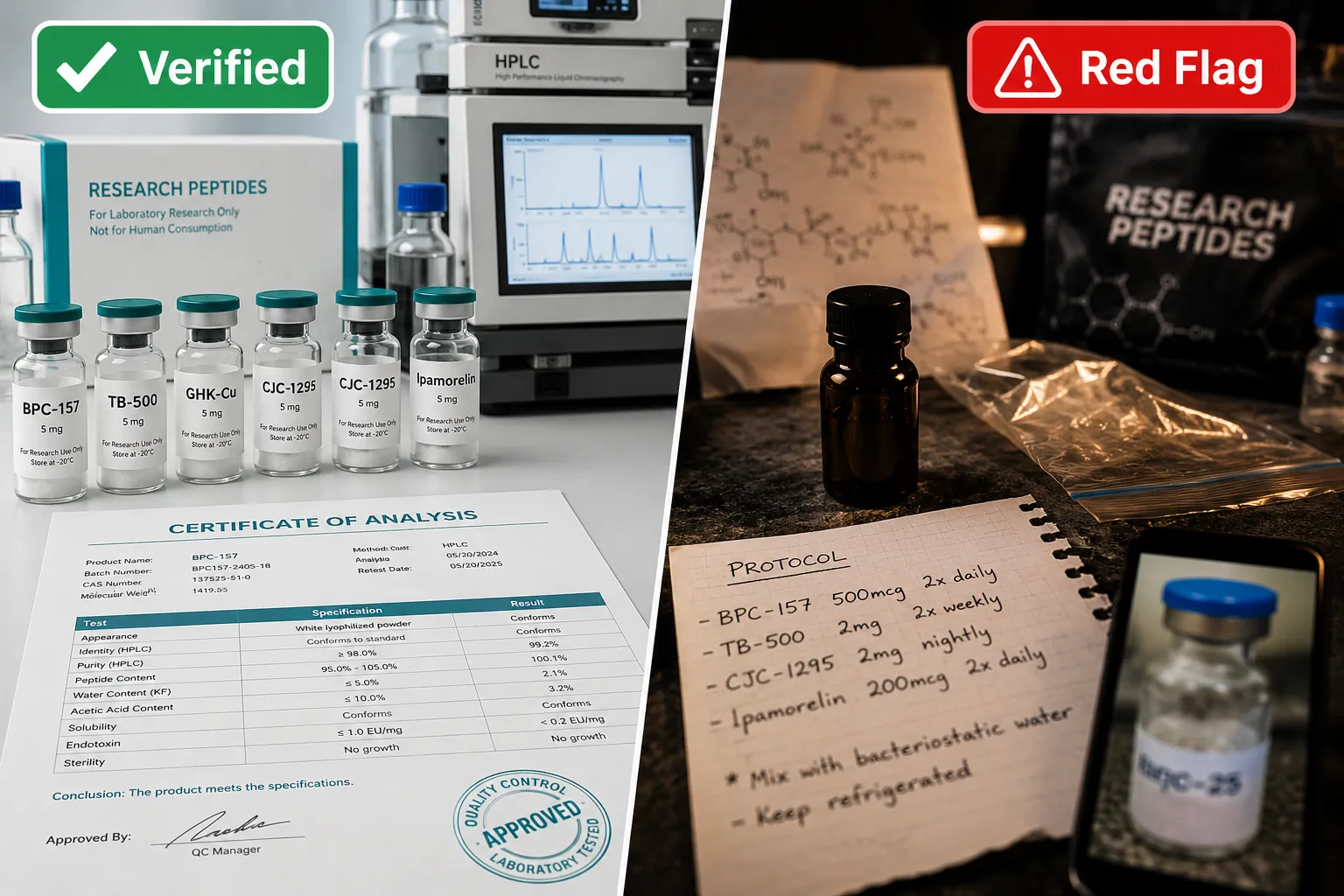
The regulatory environment around research peptide vendors shifted dramatically in mid-2026. Eli Lilly filed six federal lawsuits against named vendors, including Aesthetic Envy, Astra Peptides, Legendary Peptides, Striker Pharmacy, Texas Peptides, and Lone Star Peptide, alleging that each marketed retatrutide for human consumption while labeling it "for research use only." Four of these defendants were explicitly classified as research-use peptide sellers who allegedly crossed into unapproved clinical application. This legal action defines the clearest possible red-flag checklist for researchers evaluating where to buy research-grade GLP-3 retatrutide and GLP-2-T peptides.
Disqualifying vendor behaviors include:
- Publishing dose escalation protocols or injection schedules for human use
- Displaying before-and-after weight-loss testimonials
- Offering "medical consultations" or telehealth referrals alongside peptide sales
- Providing COAs without named third-party laboratories or lot numbers
- Selling retatrutide at prices inconsistent with legitimate synthesis costs for a 39-amino-acid peptide
Independent lab testing of black-market retatrutide in 2026 found that users outside clinical trials averaged weight loss of 3.6%, 7.1%, and 9.2% at measured intervals, compared to 5.7%, 11.9%, and 15.5% in formal trials. The gap strongly suggests inferior synthesis quality, incorrect sequences, or diluted formulations. Researchers relying on substandard material introduce uncontrolled variables that invalidate experimental results.
Legitimate research-grade vendors operate transparently. They restrict sales to verified research institutions, provide downloadable COAs with lot-traceable data, and do not market human applications. Researchers sourcing truncated peptide analogs or exploring somatotropin research alongside GLP-class compounds should apply identical scrutiny across all sourced materials. For additional context on evaluating peptide vendors, the guide on where to buy SS31 and Epithalon online offers a parallel framework applicable to GLP-class procurement.
Conclusion
Sourcing research-grade GLP-3 retatrutide and GLP-2-T peptides in 2026 demands a disciplined, evidence-based approach. The regulatory landscape has made clear that the line between "research use" and unapproved human administration is both legally enforced and scientifically consequential.
Actionable next steps for researchers:
- Require a third-party COA with HPLC purity at or above 98%, MS confirmation, and endotoxin data before placing any order.
- Verify the testing laboratory by name, search its accreditation independently.
- Cross-reference lot numbers between the COA and the physical vial upon receipt.
- Reject any vendor displaying human dosing protocols, testimonials, or telehealth referrals.
- Document the procurement chain for institutional compliance and reproducibility records.
Research integrity begins at the point of purchase. Applying a rigorous vendor-evaluation framework protects both experimental validity and institutional standing.


Leave a Reply
Want to join the discussion?Feel free to contribute!