Call or Text 727-513-9780
  • Shopping Cart Shopping Cart
    0Shopping Cart
Pure Tested Peptides | America's most trusted Peptides for sale online
  • Peptides for sale
    • Oral Peptides for sale
      • Peptide Capsules for sale
      • BPC 157 Capsules 1000mcg
      • SLU-PP-332 Capsules | 1000 mcg
      • 5-Amino-1MQ 50mg Capsules
      • Tesofensine 500mcg
    • All Peptides for sale
    • Peptide Sprays
      • BPC 157 Nasal Spray Kit
      • BPC-157 TB500 Nasal Spray Kit
      • Semax Nasal Spray 10mg
      • Selank – Nasal Spray Kit – 10mg
      • Epithalon 50MG Nasal Spray Kit
      • Ipamorelin 10mg Nasal Spray
      • Klow Nasal Spray (BPC-157 + TB-500 + GHK-Cu + KPV) | 80mg
      • Hulk Nasal Spray Tesa / Ipa Blend 6/3 MG
      • Klow Nasal Spray
      • NAD + 500 mg Nasal Spray
      • PT-141 Nasal Spray Kit
    • GHRH Peptides
      • Ipa Peptides
      • CJC-1295 Peptides
        • CJC-1295 with DAC 5 mg
        • CJC-1295 without DAC 5 mg
        • CJC-1295 Ipa 10mg
      • Tesa Peptides
        • Tesa Peptide
        • Tesa 20 mg
    • GHK-Cu Peptides
      • All GHK-Cu Peptides
      • GHK-Cu 100mg
      • KLOW Peptide Blend – Buy KLOW blend online
    • BPC Peptides
      • All BPC Peptides
      • BPC-157
      • BPC-157 TB-500
      • BPC 157 capsules 1000mcg
    • SLU-PP-332 Peptides
      • All SLU-PP-332 Peptides
      • SLU-PP-332 5mg
    • GLP3 Peptides
      • GLP3-R
      • GLP3-R CAG 10mg
      • GLP3-R 20mg
    • PT-141 Peptides
      • PT-141 Peptides for sale
      • PT-141 10mg
      • PT-141 Nasal Spray
    • CAG Peptides
      • Lipo-C Peptide Blend
      • CAG 5mg
      • CAG 10mg
    • MOTS-C Peptides
      • MOTS-C Peptides for sale
      • MOTS-c peptide
      • MOTS-c 10mg *6 pack*
    • 5 Amino 1MQ Peptides
      • 5 Amino 1MQ Peptides for sale
      • 5-Amino-1MQ 50mg Capsules
      • 5-Amino-1MQ 5mg
    • Epithalon Peptides
      • Epithalon Peptides for sale
      • Epithalon 10mg
      • Epithalon 50mg
  • Shop
    • GLPs
      • 5-Amino-1MQ 50mg Capsules
      • 5-Amino-1MQ 5mg
      • GLP3-Reta
      • L-Carnitine 500mg/ml
      • Tesofensine 500mcg
      • SLU-PP-332 5mg
      • MOTS-c 10mg *6 pack*
    • Epithalon & BPC Peptides
      • Epithalon 10mg
      • Epithalon 50mg
      • BPC-157
      • BPC 157 capsules 1000mcg
      • BPC-157 TB-500
      • BPC-157 TB500 Nasal Spray Kit
      • BPC 157 Nasal Spray Kit
    • BPC TB-500 & NAD+ Peptides
      • NAD+ 500 mg
      • KLOW Peptide Blend – Buy KLOW blend online
      • GLOW Peptide Blend
      • TB 500 5mg
      • BPC 157 capsules 1000mcg – Supplement
      • BPC 157 Nasal Spray Kit
      • BPC-157
      • BPC-157 TB500 Nasal Spray Kit
      • BPC-157 TB-500
      • BPC 157 capsules 1000mcg
    • LL-37 Peptide
      • LL-37 10 mg
    • MOTS-C & Selank
      • MOTS-c peptide
      • Selank 10mg
    • GHK Peptides
      • GHK-Cu 100mg
      • GLOW Peptide Blend
      • KLOW Peptide Blend – Buy KLOW blend online
  • COAs
  • Wholesale
    • Wholesale Peptides for sale
  • PTP FAQ
  • Affiliates
    • Selank Peptide: Advanced Pharmacological Mechanisms Underlying Its Anxiolytic and Nootropic Effects in Research
      • 5-Amino-1MQ Peptide: Detailed Mechanisms of NNMT Inhibition and Its Impact on Cellular Metabolism Research
        • MOTS-C Peptide: Unraveling Its Role in Mitochondrial Dynamics and Energy Metabolism Research
          • Epithalon Peptide and Telomerase Regulation: Investigating Its Impact on Cellular Senescence and Lifespan Research Models
            • GLP2-T vs GLP2 Tirz Peptide: Understanding the Naming, Mechanistic Nuances, and Research Implications for Gut Health
      • Peptides and Polypeptides in Modern Pharmacology: What Research on Metoprolol, Prednisone, and Amlodipine Reveals
        • Polypeptide Peptides vs NSAIDs: What Naproxen and Diclofenac Teach Tissue-Repair Researchers About BPC‑157 and TB‑500
          • Peptides and Polypeptides in Endocrine Pharmacology: How GLP-1, GLP-2, and GLP-3 Retatrutide Differ From Classic Drugs Like Prednisone and Amlodipine
          • 5‑Amino‑1MQ Peptide and NNMT Inhibition: How It Compares With Statins Like Atorvastatin in Adipose and Lipid Metabolism Research
      • Enclomiphene, Estrogen Receptor Signaling, and Luteinizing Phase Biology: What Hormone Researchers Should Measure
        • Mesenchymal Stem Cells, BPC‑157, and GHK‑Cu: How Tissue Repair Peptides Compare With Classic NSAIDs Like Naproxen in Injury Models
          • Peptide Calculator Use Cases Beyond Growth Hormone: Working Through GLP‑3 Retatrutide, MOTS‑c, and BPC‑157 Research Dosing
        • Polypeptide Peptides in Endocrine and Metabolic Pharmacology: Lessons From Amlodipine, Prednisone, and Metoprolol
        • Peptides Calculator for Advanced Blends: Worked Examples for Tesamorelin, CJC‑1295, and Ipamorelin Stacks
          • Peptides and Polypeptides in Human Physiology: How Molecular Size Shapes Research Applications
            • Selank Peptide: Advanced Pharmacological Mechanisms Underlying Its Anxiolytic and Nootropic Effects in Research
          • 5-Amino-1MQ Peptide: Detailed Mechanisms of NNMT Inhibition and Its Impact on Cellular Metabolism Research
            • MOTS-C Peptide: Unraveling Its Role in Mitochondrial Dynamics and Energy Metabolism Research
              • Epithalon Peptide and Telomerase Regulation: Investigating Its Impact on Cellular Senescence and Lifespan Research Models
                • GLP2-T vs GLP2 Tirz Peptide: Understanding the Naming, Mechanistic Nuances, and Research Implications for Gut Health
                  • Peptides and Polypeptides in Endocrine Pharmacology: How GLP-1, GLP-2, and GLP-3 Retatrutide Differ From Classic Drugs Like Prednisone and Amlodipine
                    • Polypeptide Peptides vs NSAIDs: What Naproxen and Diclofenac Teach Tissue-Repair Researchers About BPC‑157 and TB‑500
                      • Peptides and Polypeptides in Modern Pharmacology: What Research on Metoprolol, Prednisone, and Amlodipine Reveals
                        • 5‑Amino‑1MQ Peptide and NNMT Inhibition: How It Compares With Statins Like Atorvastatin in Adipose and Lipid Metabolism Research
                        • Enclomiphene, Estrogen Receptor Signaling, and Luteinizing Phase Biology: What Hormone Researchers Should Measure
                        • Mesenchymal Stem Cells, BPC‑157, and GHK‑Cu: How Tissue Repair Peptides Compare With Classic NSAIDs Like Naproxen in Injury Models
                        • Peptide Calculator Use Cases Beyond Growth Hormone: Working Through GLP‑3 Retatrutide, MOTS‑c, and BPC‑157 Research Dosing
                        • Polypeptide Peptides in Endocrine and Metabolic Pharmacology: Lessons From Amlodipine, Prednisone, and Metoprolol
                        • Peptides Calculator for Advanced Blends: Worked Examples for Tesamorelin, CJC‑1295, and Ipamorelin Stacks
                        • Peptides and Polypeptides in Human Physiology: How Molecular Size Shapes Research Applications
                        • Selank Peptide: Advanced Pharmacological Mechanisms Underlying Its Anxiolytic and Nootropic Effects in Research
                        • MOTS-C Peptide: Unraveling Its Role in Mitochondrial Dynamics and Energy Metabolism Research
                        • Peptides and Polypeptides in Modern Pharmacology: What Research on Metoprolol, Prednisone, and Amlodipine Reveals
                        • Peptides and Polypeptides in Endocrine Pharmacology: How GLP-1, GLP-2, and GLP-3 Retatrutide Differ From Classic Drugs Like Prednisone and Amlodipine
                        • 5-Amino-1MQ Peptide: Detailed Mechanisms of NNMT Inhibition and Its Impact on Cellular Metabolism Research
                        • Mesenchymal Stem Cells, BPC‑157, and GHK‑Cu: How Tissue Repair Peptides Compare With Classic NSAIDs Like Naproxen in Injury Models
                        • Peptide Calculator Use Cases Beyond Growth Hormone: Working Through GLP‑3 Retatrutide, MOTS‑c, and BPC‑157 Research Dosing
                        • GLP2-T vs GLP2 Tirz Peptide: Understanding the Naming, Mechanistic Nuances, and Research Implications for Gut Health
                        • Polypeptide Peptides in Endocrine and Metabolic Pharmacology: Lessons From Amlodipine, Prednisone, and Metoprolol
                        • Polypeptide Peptides vs NSAIDs: What Naproxen and Diclofenac Teach Tissue-Repair Researchers About BPC‑157 and TB‑500
                        • Peptides and Polypeptides in Human Physiology: How Molecular Size Shapes Research Applications
                        • Peptides Calculator for Advanced Blends: Worked Examples for Tesamorelin, CJC‑1295, and Ipamorelin Stacks
                        • 5‑Amino‑1MQ Peptide and NNMT Inhibition: How It Compares With Statins Like Atorvastatin in Adipose and Lipid Metabolism Research
                        • Enclomiphene, Estrogen Receptor Signaling, and Luteinizing Phase Biology: What Hormone Researchers Should Measure
                        • Epithalon Peptide and Telomerase Regulation: Investigating Its Impact on Cellular Senescence and Lifespan Research Models
                        • Best research protocol Klow blend
                        • best time to take BPC-157
                        • best time to take DSIP (Delta Sleep Inducing Peptide)
                        • best time to take CJC-1295
                        • best time to take AOD-9604
                        • best time to take Follistatin 344
                        • best time to take Ipamorelin
                        • best time to take MK-677 (Ibutamoren)
                        • best time to take Ligandrol (LGD-4033) — research compound
                        • best time to take Ostarine (MK-2866) — research compound
                        • best time to take GHK-CU
                        • best time to take TB-500
                        • best time to take MOTS-c
                        • best time to take Semax
                        • best time to take RAD-140 (Testolone) — research compound
                        • best time to take Thymosin Alpha-1
                        • best time to take PEG-MGF
                        • Biolife Plasma, Octapharma Plasma, and Research Peptides: How Plasma Donation Labs Differ From Peptide Suppliers
                        • best time to take YK-11 — research compound
                        • best time to take PT-141 (Bremelanotide)
                        • Best research protocol Klow blend
                        • 5-Amino-1MQ and MOTS-C Synergy: Metabolic Signaling, Mitochondria, and Research Design
                        • BPC-157 and TB-500: Investigating Their Combined Effects on Angiogenesis and Cellular Migration in Tissue Repair Models
                        • BPC-157 Peptide: Gut Barrier Function, Inflammation, and Tissue-Recovery Research
                        • 5‑Amino‑1MQ and MOTS‑c Synergy in Metabolic Research: Designing NNMT and Mitochondrial Biogenesis Stacks
                        • CJC-1295 with DAC vs. Without DAC: Half-Life, Release Kinetics, and Research Implications
                        • CJC‑1295 with DAC vs. Without DAC: Expanding on Half‑Life Differences Using Tesamorelin and Ipamorelin Blend Case Studies
                        • Collagen Biology and Copper‑Binding Peptides: How GHK‑Cu, Glow Blend, and Klow Blend Interact with Skin and Connective Tissue
                        • Collagen Biology and Regenerative Peptides: How GHK‑Cu, Glow Blend, and Klow Blend Affect Extracellular Matrix Research
                    • DNA, Telomeres, and Longevity Peptides: Positioning Epithalon and MOTS‑c in Genetic Aging Research
                      • Enclomiphene Citrate: serm Mechanism, Testosterone Research, and Stack Compatibility
                        • Enclomiphene vs Enclomiphene Citrate: Formulation, Bioavailability, and Research Distinctions
                        • Epithalon Peptide Research: Telomerase Activation, Aging, and Pineal Gland Function
                        • Estrogen Receptor Signaling and Enclomiphene: How Selective Modulators Compare with Classic Polypeptide Hormones
                        • GHK-Cu Peptide: Advanced Mechanisms in Extracellular Matrix Remodeling and Wound Healing Research
                        • GHK-Cu Peptide: Collagen Synthesis, Wound Repair, and Skin-Barrier Research Models
                        • GLP-1 vs GLP-3 vs GLP-2: Peptide Classification and Research Applications
                        • GLP-2 Peptide Research Guide: Gut Barrier Function, Nutrient Absorption, and Intestinal Recovery Models
                        • GLP-3 Retatrutide vs. GLP-1 Drugs: What Triple-Agonist Biology Changes in Research Models
                        • Ipamorelin and Tesamorelin Combination: Synergistic GH Secretagogue Research and Dosing Protocols
                        • GLP2 Tirz Peptide: What It Is, Why the Name Exists, and How Researchers Should Interpret It
                        • Klow Blend Peptide Nasal Spray: What the Formulation Is Trying to Do in Cognitive Research
                        • Mitochondria, NNMT Inhibition, and Peptide Modulators: Where MOTS‑c and 5‑Amino‑1MQ Fit in Cellular Energy Research
                        • MOTS-c Peptide: Mitochondrial Function, Energy Metabolism, and What Researchers Measure
                        • MOTS-c vs. 5-Amino-1MQ: Which Metabolic Research Questions Each Compound Actually Answers
                        • Nasal Spray Peptides: Bioavailability, Administration, and Semax/Selank Research Applications
                        • PT-141 Peptide Research: Mechanism of Action and Melanocortin Receptor Signaling
                        • Retatrutide for Research: Mechanism, Structure, and GLP-1/GLP-3 Dual Action
                        • Retatrutide for Obesity and Type 2 Diabetes: What the Latest Trial Data Suggest
                        • Tesofensine Peptide Research: Mechanism, Appetite Suppression, and Neuropeptide Y Pathways
  • Contact
    • Contact Customer Service
    • Text Customer Support
  • About US
  • Shop all peptides
  • Affiliate Program
    • Affiliate Signup
  • Login / Register Login / Register Page Link Login / Register Page Link
  • Click to open the search input field Click to open the search input field Search
  • Menu Menu

Tag Archive for: glp-3 peptide

Peptide Calculator Use Cases Beyond Growth Hormone: Working Through GLP‑3 Retatrutide, MOTS‑c, and BPC‑157 Research Dosing

Peptide Calculator Use Cases Beyond Growth Hormone: Working Through GLP‑3 Retatrutide, MOTS‑c, and BPC‑157 Research Dosing

July 18, 2026/0 Comments/by Pure Tested

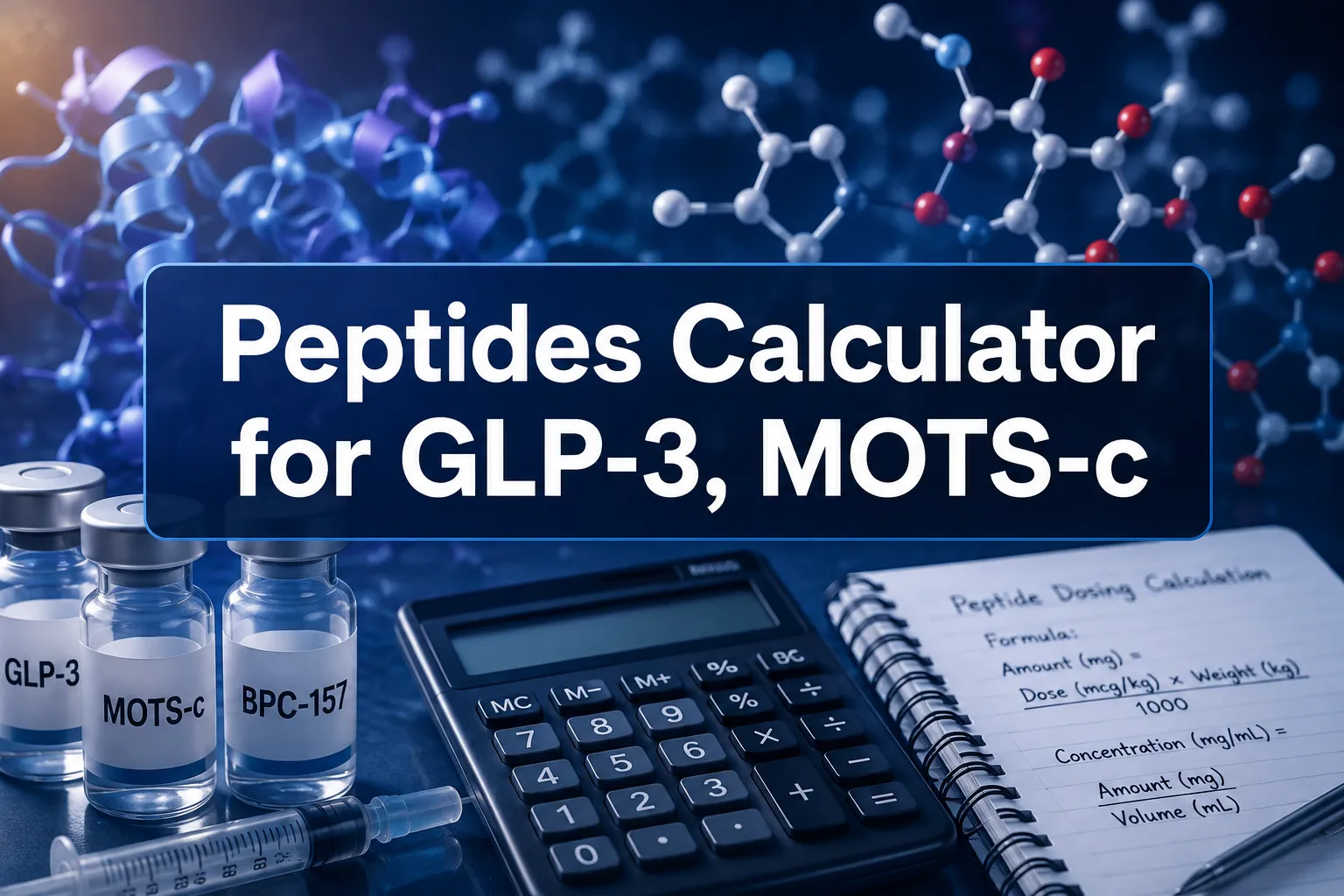
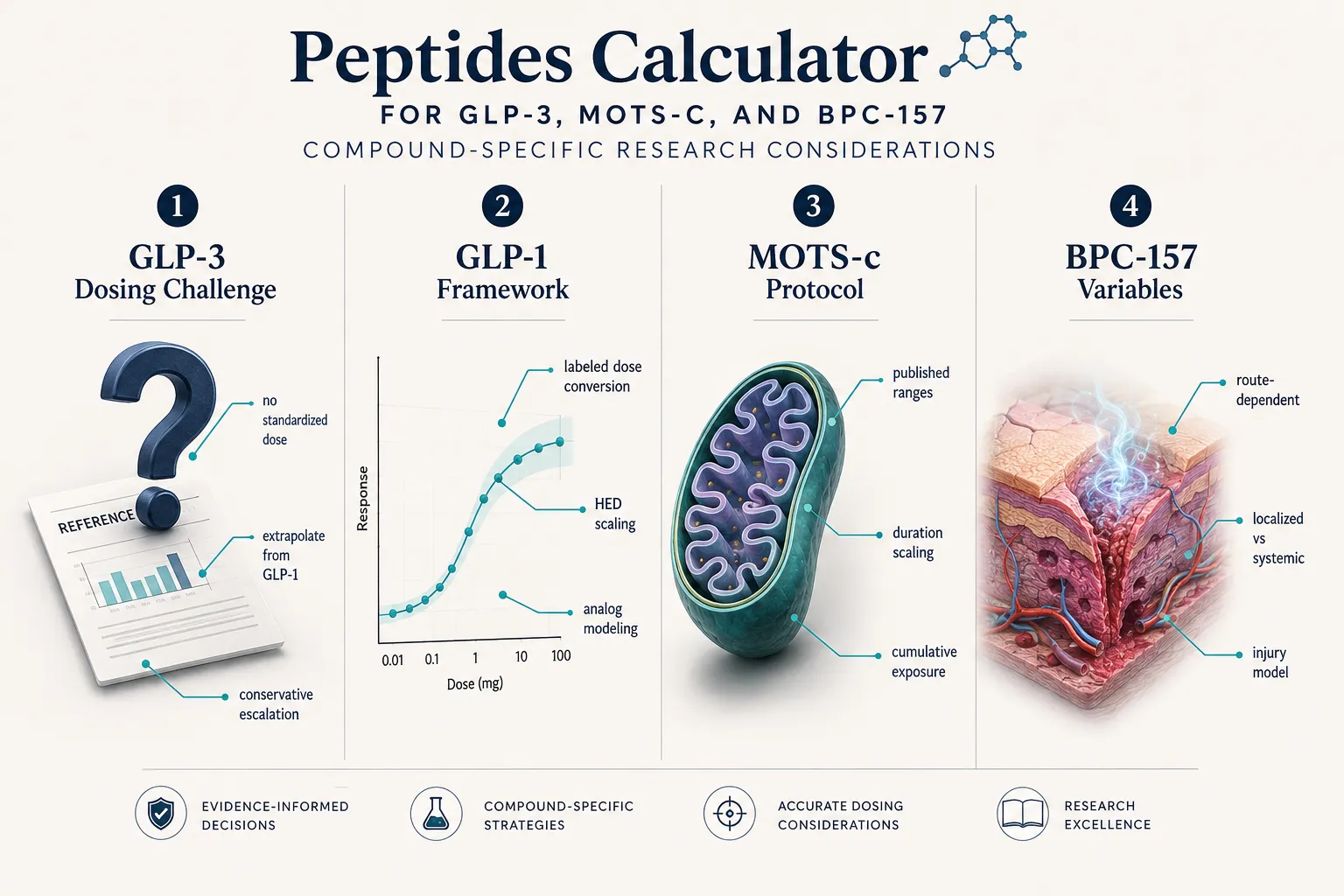
Most researchers reach for a peptide calculator when reconstituting a growth hormone secretagogue blend, then stop there. Yet the same arithmetic logic that converts a Tesamorelin vial into syringe units applies equally to metabolic triple agonists, mitochondrial peptides, and tissue-repair compounds. Peptide Calculator Use Cases Beyond Growth Hormone: Working Through GLP-3 Retatrutide, MOTS-c, and BPC-157 Research Dosing is a topic that deserves its own worked framework, because each compound carries unique concentration targets, titration schedules, and reconstitution constraints that a generic calculator must accommodate.

Bright infographic-style editorial landscape (): isometric illustration of three distinct peptide molecules — GLP-3

Key Takeaways

  • Peptide calculators are not limited to GH secretagogues, they handle any lyophilized compound requiring reconstitution math.
  • Retatrutide (GLP-3) uses slow titration schedules that demand week-by-week dose recalculation.
  • MOTS-c reconstitution targets are typically low-volume and require precise unit conversion.
  • BPC-157 research often involves both injectable and oral formats, each with different concentration logic.
  • GHK-Cu and other repair peptides follow the same calculator inputs: vial mass, diluent volume, and desired dose.

Why Peptide Calculator Use Cases Extend Well Beyond Growth Hormone

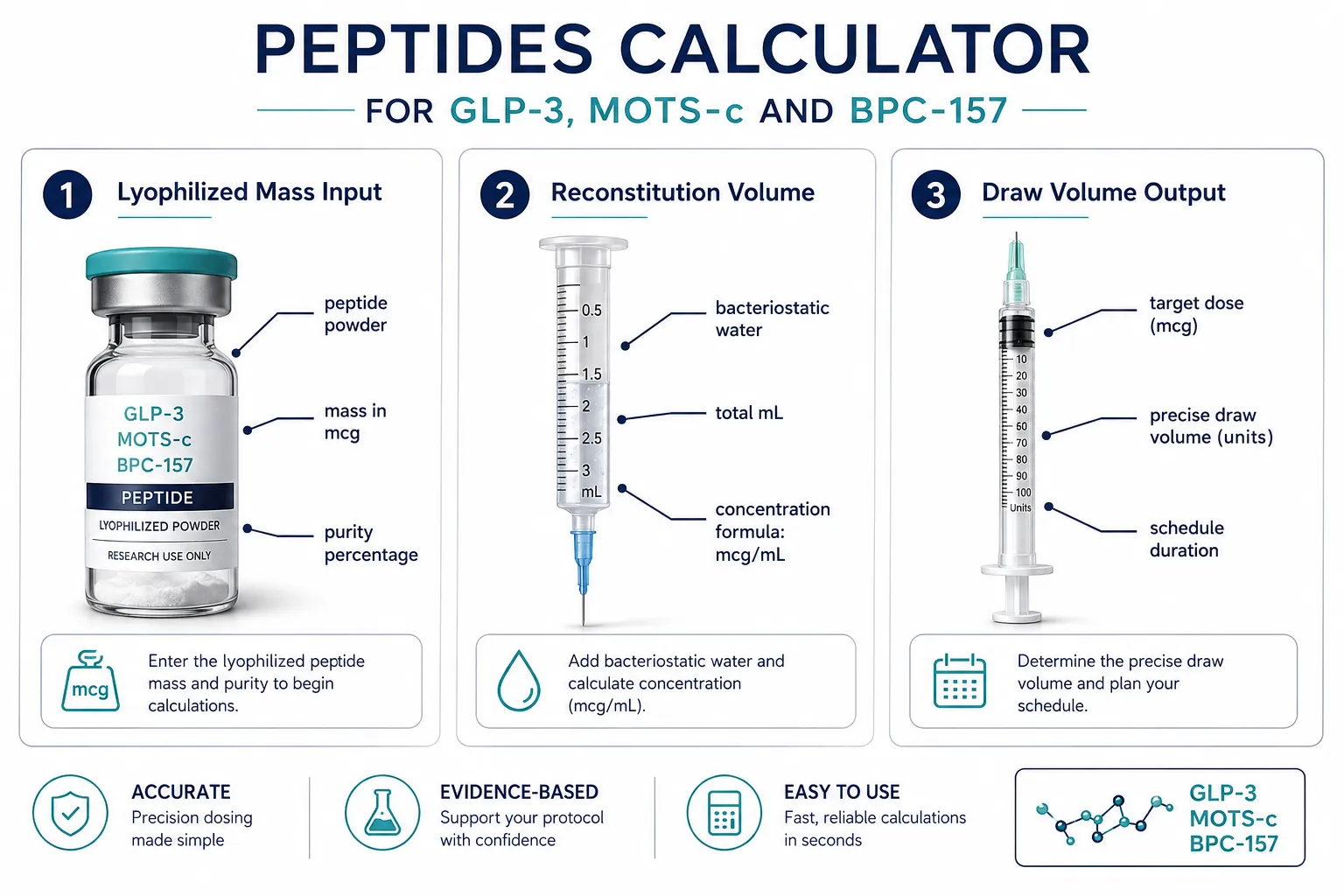
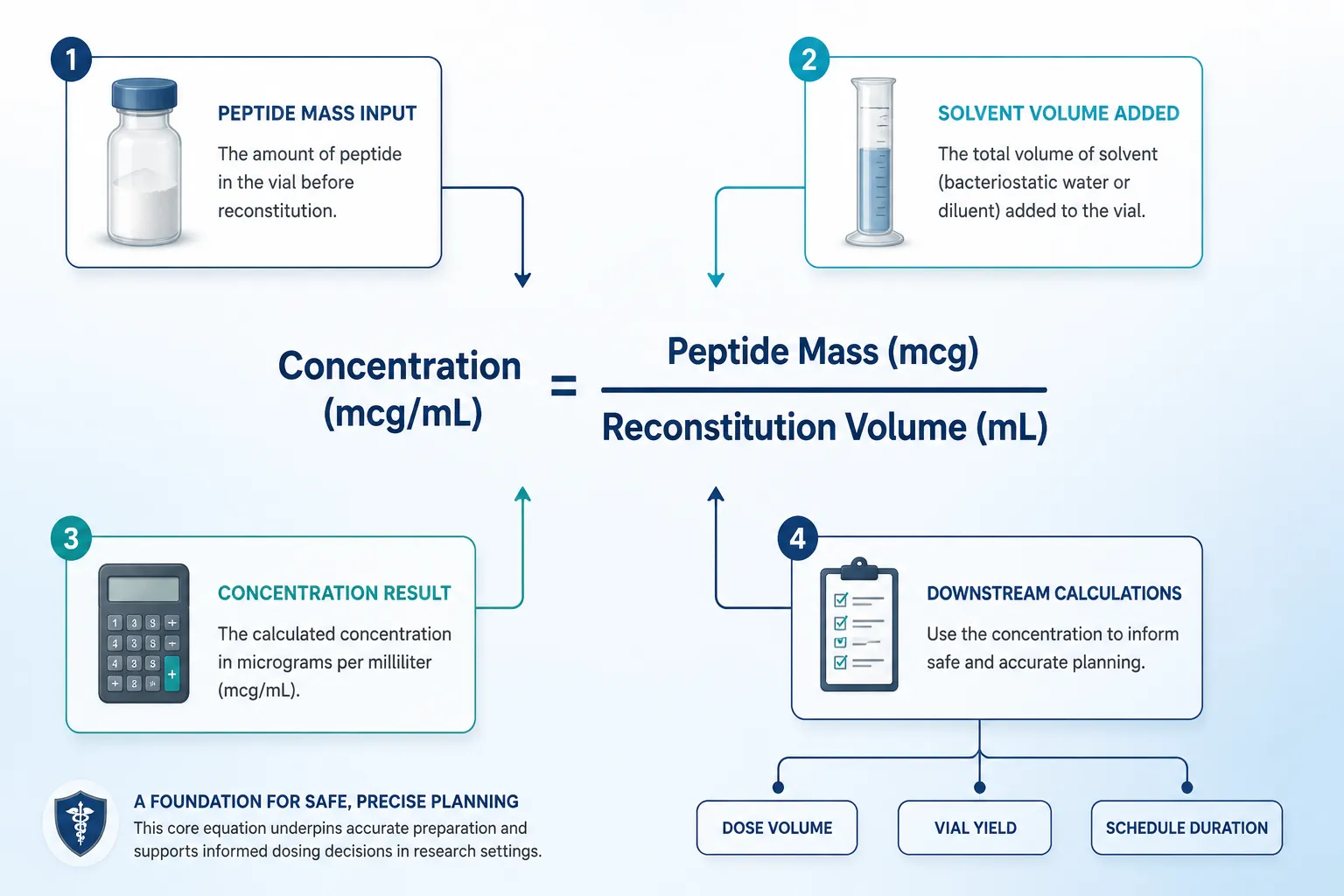
Growth hormone peptides like Ipamorelin and CJC-1295 popularized the reconstitution calculator because their dosing windows are narrow and their blends are common. A Tesamorelin dosage calculator works on the same three-input model every other peptide uses:

Input Example Value
Vial mass (mg) 5 mg
Diluent added (mL) 2 mL bacteriostatic water
Desired dose (mcg) 250 mcg

Result: concentration = 2,500 mcg/mL; draw = 0.10 mL (10 units on a U-100 syringe).

That formula is universal. The only variable is the peptide itself, and that is where researchers working with newer metabolic and tissue-repair compounds need a more expanded mental model.


Worked Examples: Peptide Calculator Use Cases Beyond Growth Hormone for Retatrutide, MOTS-c, and BPC-157

Retatrutide (GLP-3): Titration Math Week by Week

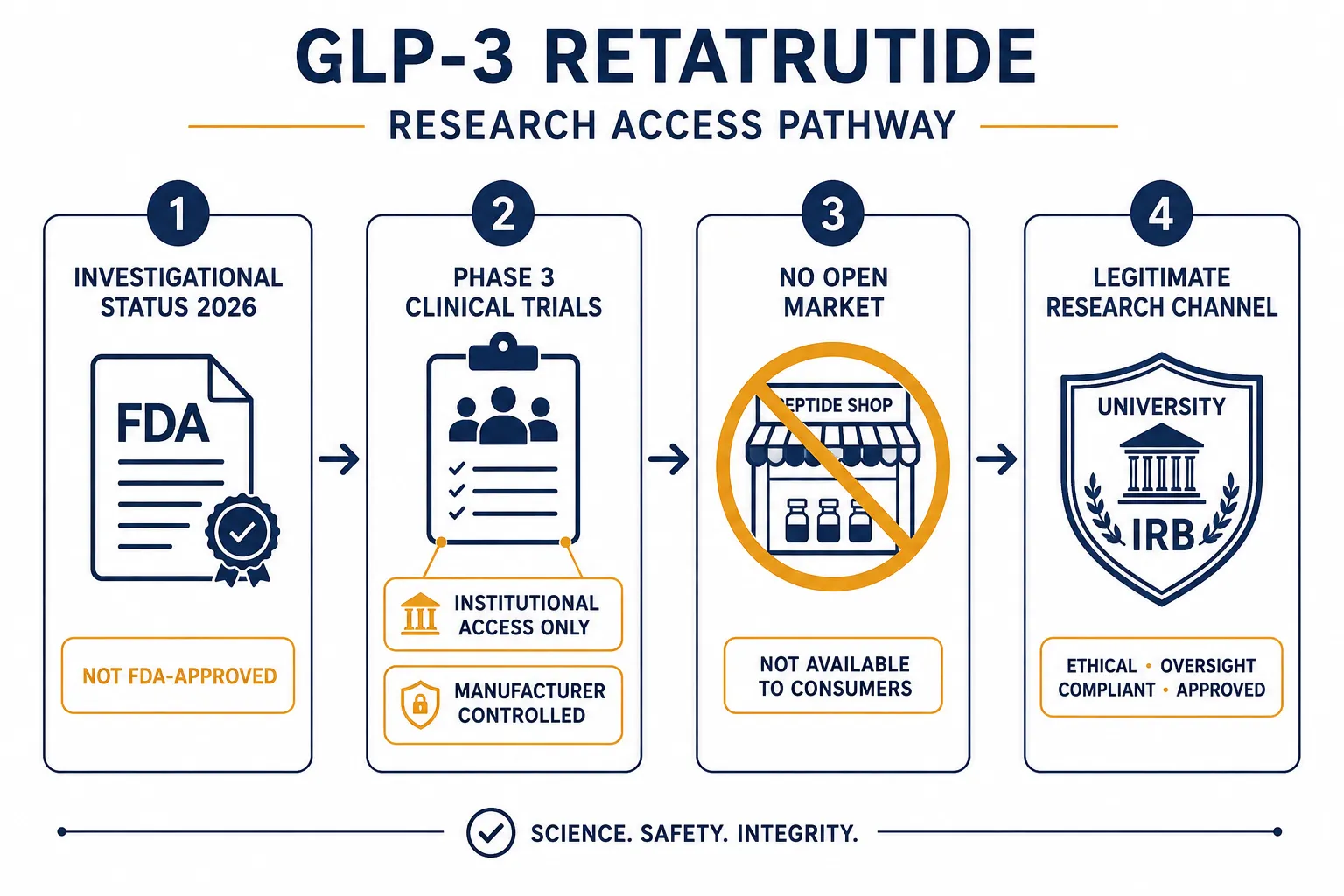
Retatrutide is a triple receptor agonist targeting GLP-1, GIP, and glucagon receptors simultaneously. It remains investigational, with Phase 3 trials ongoing as of 2026. Because it uses a slow titration schedule, commonly starting at 2 mg per week and stepping up over several weeks, the calculator must be re-run at each dose change.

Example scenario:

  • Vial: 10 mg retatrutide
  • BAC water added: 2 mL
  • Concentration: 5,000 mcg/mL (5 mg/mL)
  • Week 1 dose: 2 mg = draw 0.40 mL (40 units)
  • Week 4 dose: 4 mg = draw 0.80 mL (80 units)

Tools like PeptiTools and PeptideDeck provide live syringe diagrams that update as the dose field changes, which is especially useful for multi-week titration. For background on the incretin research context, see the GLP-3 retatrutide incretin research themes overview, and for a broader generational comparison, the generations of GLP-1 differences resource is instructive.

"The arithmetic never changes, only the target dose does. Running the calculator fresh at each titration step prevents cumulative dosing errors."

MOTS-c: Low-Volume Precision

MOTS-c, the mitochondrial peptide, is typically studied at doses in the 5-10 mg range. Because vials are often supplied at 5 mg, researchers frequently add only 1 mL of BAC water to achieve a 5 mg/mL concentration, meaning a 5 mg dose draws a full 1 mL, while a 2.5 mg dose draws 0.50 mL (50 units).

Key consideration: At low diluent volumes, measurement error is amplified. A 0.02 mL miscalculation at 5 mg/mL equals a 100 mcg dosing error. Dedicated MOTS-c calculators, such as those offered by MOTS-c Research, handle the unit conversion explicitly, displaying results in both mL and U-100 syringe units side by side. Researchers interested in MOTS-c metabolic stress applications can explore the MOTS-c metabolic stress research page for additional context.

BPC-157: Injectable vs. Oral Concentration Logic

BPC-157 is unique because it appears in both injectable and oral research formats. For injectable use, a common reconstitution is 5 mg into 2.5 mL BAC water, yielding 2 mg/mL. A 250 mcg research dose then draws 0.125 mL (12.5 units).

For oral BPC-157 formats, concentration logic shifts entirely, volume is less relevant than total mass per capsule or solution. Platforms like PeptideCalcs allow researchers to toggle between injectable and oral modes, keeping the math format-appropriate. The BPC-157 10mg vial research themes page provides additional reconstitution reference points.

BPC-157: Injectable vs. Oral Concentration Logic


Applying the Same Framework to GHK-Cu and Multi-Peptide Protocols

The calculator framework extends cleanly to copper peptides and combination protocols. GHK-Cu longevity research typically involves doses of 1-2 mg, often reconstituted in 1 mL of sterile water for a 1-2 mg/mL concentration. At 1 mg/mL, a 1 mg dose draws exactly 1 mL, straightforward, but only if the researcher has confirmed the vial mass and diluent volume before calculating.

Multi-peptide protocols, for example, combining BPC-157 with a mitochondrial support compound like SS-31 elamipretide, require running the calculator independently for each compound. Shared syringes or combined vials change the concentration of both peptides and invalidate pre-calculated draw volumes. Each compound must retain its own reconstitution record.

Best practices for multi-peptide calculator use:

  • Label each vial with concentration (mg/mL) and reconstitution date.
  • Store calculator outputs alongside vial records, not just in memory.
  • Re-run calculations if a vial is partially used and diluent volume has changed.
  • Use platforms that support custom vial inputs rather than locked preset values.

Platforms such as PeptiTools, PepExact, and Blackwell BioLabs offer free, no-signup calculators that accommodate custom inputs across a wide range of peptides, including Retatrutide, BPC-157, MOTS-c, and GHK-Cu, making them practical choices for researchers managing diverse compound libraries.

Applying the Same Framework to GHK-Cu and Multi-Peptide Protocols


Conclusion

Peptide Calculator Use Cases Beyond Growth Hormone: Working Through GLP-3 Retatrutide, MOTS-c, and BPC-157 Research Dosing confirms a straightforward principle: the reconstitution formula is universal, but each peptide demands context-specific inputs and awareness of format, titration schedule, and concentration sensitivity.

Actionable next steps for researchers in 2026:

  1. Identify the vial mass and intended diluent volume for each compound before touching a syringe.
  2. Use a calculator that displays results in both mL and U-100 syringe units simultaneously.
  3. For titrating compounds like Retatrutide, bookmark the calculator and re-run it at each dose step.
  4. Maintain a written reconstitution log per vial, do not rely on memory for concentration values.
  5. Consult a qualified clinician before applying any calculated dose in a research context.

The math is accessible. The discipline around it is what separates reliable research from avoidable error.

https://www.puretestedpeptides.com/wp-content/uploads/2026/07/peptide-calculator-use-cases-beyond-growth-hormone-working-through-glp-3-retatru.webp 1024 1536 Pure Tested https://www.puretestedpeptides.com/wp-content/uploads/2026/01/buy-peptides-online.jpg Pure Tested2026-07-18 13:04:442026-07-20 14:59:49Peptide Calculator Use Cases Beyond Growth Hormone: Working Through GLP‑3 Retatrutide, MOTS‑c, and BPC‑157 Research Dosing
Safety, stability, and storage of research‑grade retatrutide/“GLP‑3” solutions

Safety, stability, and storage of research‑grade retatrutide/“GLP‑3” solutions

July 4, 2026/0 Comments/by Pure Tested

Lyophilized retatrutide stored at −20 °C retains approximately 98% of its potency after 12 months, yet a significant share of research buyers still keep peptide vials at room temperature, a practice that can destroy bioactivity within days. As new stability data emerges and interest in this triple-receptor agonist grows, understanding the safety, stability, and storage of research-grade retatrutide/"GLP-3" solutions has become essential knowledge for any serious laboratory.

Key Takeaways

  • Retatrutide is an investigational research peptide only, not approved for human use.
  • Lyophilized (freeze-dried) powder is far more stable than reconstituted solution and can last up to 48 months at −20 °C.
  • Reconstituted solutions should be refrigerated at 2-8 °C and used within 4 weeks.
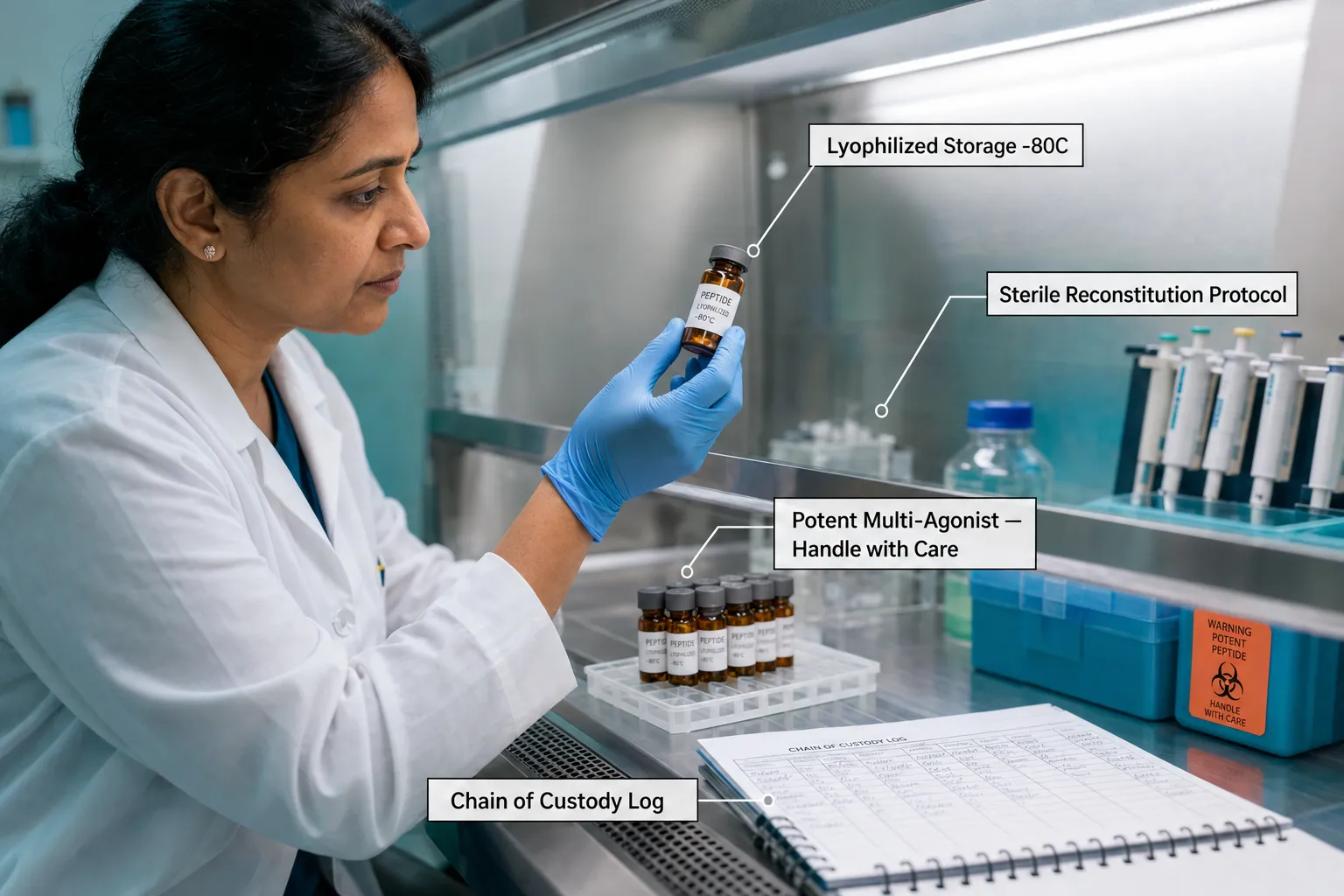
  • Proper PPE, biological safety cabinets, and biohazardous waste disposal are required for safe handling.
  • Light, heat, and repeated freeze-thaw cycles are the primary causes of peptide degradation.

Key Takeaways

Safe Handling of Research-Grade Retatrutide/"GLP-3" Solutions

Retatrutide, often labeled GLP-3 RT by vendors, is sold strictly as a research chemical. Safety Data Sheet (SDS) documentation classifies it as a laboratory chemical with health hazards typical of peptide and protein compounds, including potential for skin irritation and allergenic responses.

Required PPE for safe handling:

  • Nitrile gloves (minimum)
  • Lab coat or protective gown
  • Safety glasses or goggles
  • Work within a biological safety cabinet when handling powders

Researchers must avoid inhalation of lyophilized powder, ingestion, and direct skin or eye contact. Any spill should be absorbed with inert material and disposed of as biohazardous waste following local regulations.

"Research peptides like retatrutide must be treated with the same rigor as any uncharacterized bioactive compound, controlled environment, documented handling, and proper disposal."

For researchers exploring other peptides with similar handling requirements, guidance on safe peptide combinations and research protocols provides a useful reference point. Similarly, those working with mitochondria-targeted compounds can consult SS-31 research peptide handling considerations for parallel best practices.


Safe Handling of Research-Grade Retatrutide/"GLP-3" Solutions

Stability of Research-Grade Retatrutide/"GLP-3" Solutions: What the Data Shows

Peptide stability depends on three core variables: temperature, moisture, and light exposure. Retatrutide is no exception.

Lyophilized Powder Stability

Storage Condition Estimated Shelf Life Notes
−20 °C or below (frozen) 24-48 months Gold standard; ~98% potency at 12 months
2-8 °C (refrigerated) 12-24 months Acceptable for shorter-term storage
Room temperature Days to weeks Not recommended; rapid degradation risk

Reconstituted Solution Stability

Once reconstituted with bacteriostatic water, retatrutide solutions are considerably more vulnerable. Key guidelines include:

  • Store reconstituted vials at 2-8 °C (standard refrigerator)
  • Use within 4 weeks of reconstitution
  • Never freeze a reconstituted solution, ice crystal formation disrupts peptide structure
  • Protect from light by wrapping vials in foil or storing in opaque containers

The primary degradation pathways are oxidation, hydrolysis, and aggregation, all of which accelerate with heat and UV exposure. Researchers working with other sensitive peptides such as MOTS-c and Elamipretide will recognize these same degradation risks.


Reconstituted Solution Stability

Storage Best Practices for Research-Grade Retatrutide/"GLP-3" Solutions

Consistent, documented storage protocols protect both sample integrity and research validity.

Practical storage checklist:

  • Store lyophilized vials at −20 °C in a dedicated laboratory freezer
  • Include a desiccant packet in the storage container to control moisture
  • Label each vial with the date of receipt and reconstitution date
  • Minimize the number of times a vial is opened to reduce contamination risk
  • Avoid storing near freezer doors where temperature fluctuates

Researchers sourcing retatrutide should verify that suppliers provide Certificates of Analysis (CoA) confirming purity and identity. Reviewing a supplier's CoA documentation standards is a critical step before beginning any protocol. For those evaluating the retatrutide GLP-3 research peptide directly, verified purity data should accompany every order.

Researchers comparing peptide classes may also find value in reviewing how related compounds like ipamorelin and sermorelin stacks are handled, as overlapping storage principles apply across many research-grade peptides.


Conclusion

The safety, stability, and storage of research-grade retatrutide/"GLP-3" solutions demand the same disciplined approach applied to any high-value investigational compound. Three actionable priorities stand out:

  1. Handle with full PPE in a controlled environment and dispose of waste as biohazardous material.
  2. Store lyophilized powder at −20 °C to maximize shelf life up to 48 months; refrigerate reconstituted solutions and use within four weeks.
  3. Source from verified suppliers that provide independent CoA documentation confirming peptide identity and purity before beginning any research protocol.

Following these standards protects both the integrity of the research and the safety of everyone in the laboratory.

https://www.puretestedpeptides.com/wp-content/uploads/2026/07/Safety-stability-and-storage-of-research‑grade-retatrutideGLP‑3-solutions.png 1024 1536 Pure Tested https://www.puretestedpeptides.com/wp-content/uploads/2026/01/buy-peptides-online.jpg Pure Tested2026-07-04 13:02:462026-07-20 15:01:10Safety, stability, and storage of research‑grade retatrutide/“GLP‑3” solutions
Retatrutide vs GLP3 Peptide: How to Interpret the Naming Difference in Research Context

Retatrutide vs GLP3 Peptide: How to Interpret the Naming Difference in Research Context

July 1, 2026/0 Comments/by Pure Tested

Researchers and informed readers searching metabolic peptide literature in 2026 frequently encounter two terms side by side — "retatrutide" and "GLP-3 peptide" — and assume they are comparing two separate compounds. They are not. Understanding this naming gap is essential for reading clinical data accurately and avoiding confusion when evaluating research outcomes.

This article on Retatrutide vs GLP3 Peptide: How to Interpret the Naming Difference in Research Context explains where the informal label came from, what the science actually says, and how to navigate terminology when reviewing preclinical or clinical literature.

Key Takeaways

  • "GLP-3 peptide" is an informal shorthand, not an official scientific or regulatory term.
  • Retatrutide is the INN (International Nonproprietary Name) for a triple receptor agonist targeting GLP-1R, GIPR, and GcgR.
  • The "GLP-3" label emerged from a logical but unofficial progression: GLP-1 agonist, then dual GLP-1/GIP agonist, then "triple" or "GLP-3."
  • Phase 3 TRIUMPH-4 trial data showed up to 28.7% body weight reduction at 68 weeks with a 12 mg dose.
  • In formal research contexts, always use "retatrutide" or "triple receptor agonist" to ensure accurate source retrieval.

Where the "GLP-3" Label Comes From

Where the "GLP-3" Label Comes From

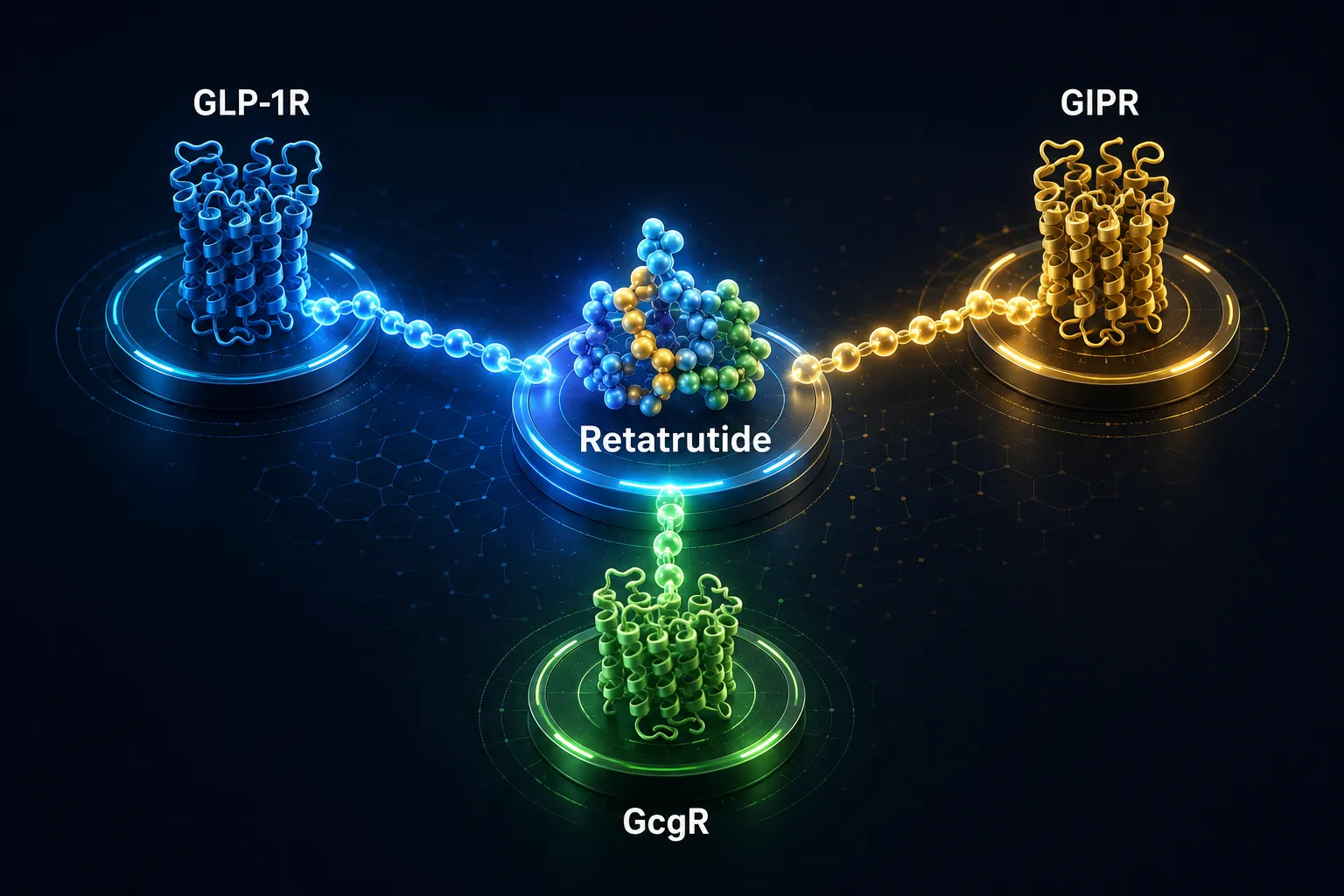
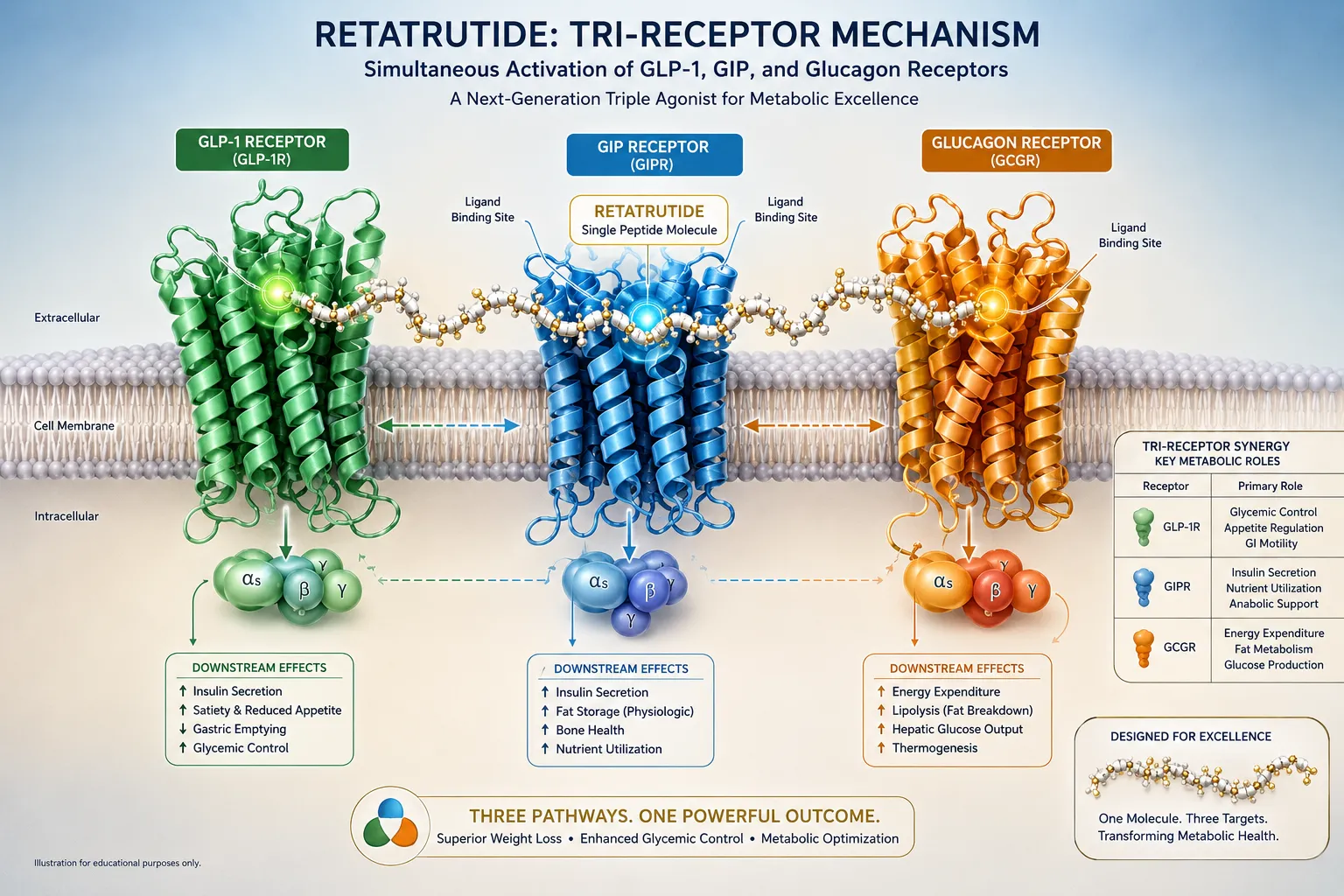
The naming logic follows a simple pattern that the research community informally adopted. GLP-1 receptor agonists — such as semaglutide — target a single receptor. Dual agonists like tirzepatide activate both the GLP-1 receptor and the GIP receptor. When retatrutide arrived as a compound activating three receptors simultaneously — GLP-1R, GIPR, and the glucagon receptor (GcgR) — some writers and online communities began calling it a "GLP-3" to signal that it goes one step further than a dual agonist.

This is a shorthand label, not a pharmacological classification. No regulatory body, no peer-reviewed journal, and no drug developer has officially designated retatrutide as a "GLP-3 receptor agonist." The glucagon receptor is not a third GLP receptor in any biological sense. GLP-1 and GLP-2 are the two glucagon-like peptides identified in the literature, and neither is the same as the glucagon receptor that retatrutide activates.

Term Type Official?
Retatrutide INN / clinical name Yes
Triple receptor agonist Mechanistic descriptor Yes
GLP-3 peptide Community shorthand No
GLP-1/GIP/GcgR agonist Pharmacological label Yes

For those already familiar with the broader landscape of incretin-based compounds, the GLP-1 incretin research themes article provides useful background on how these receptor classes differ.


What Retatrutide Actually Does in Research

What Retatrutide Actually Does in Research

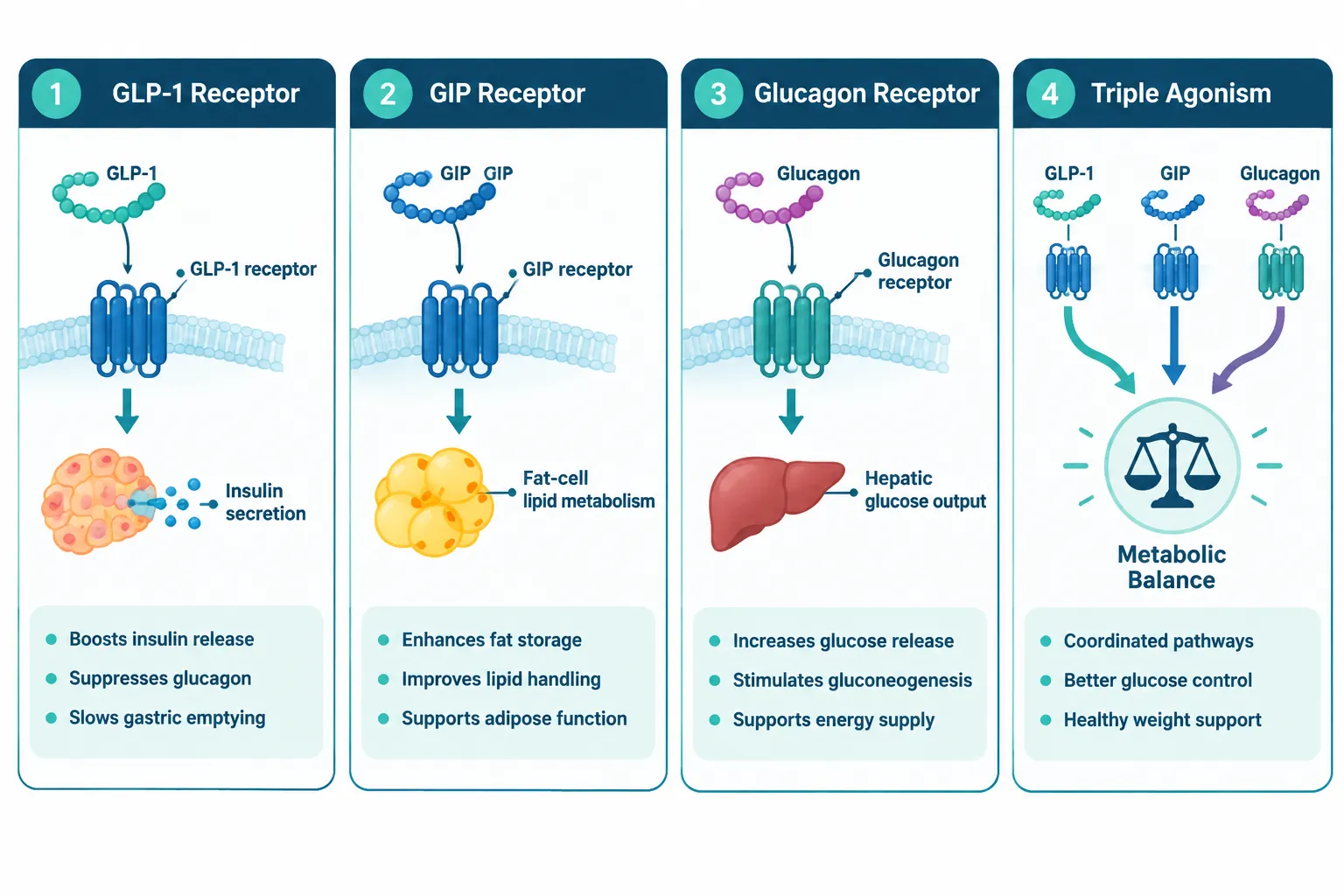
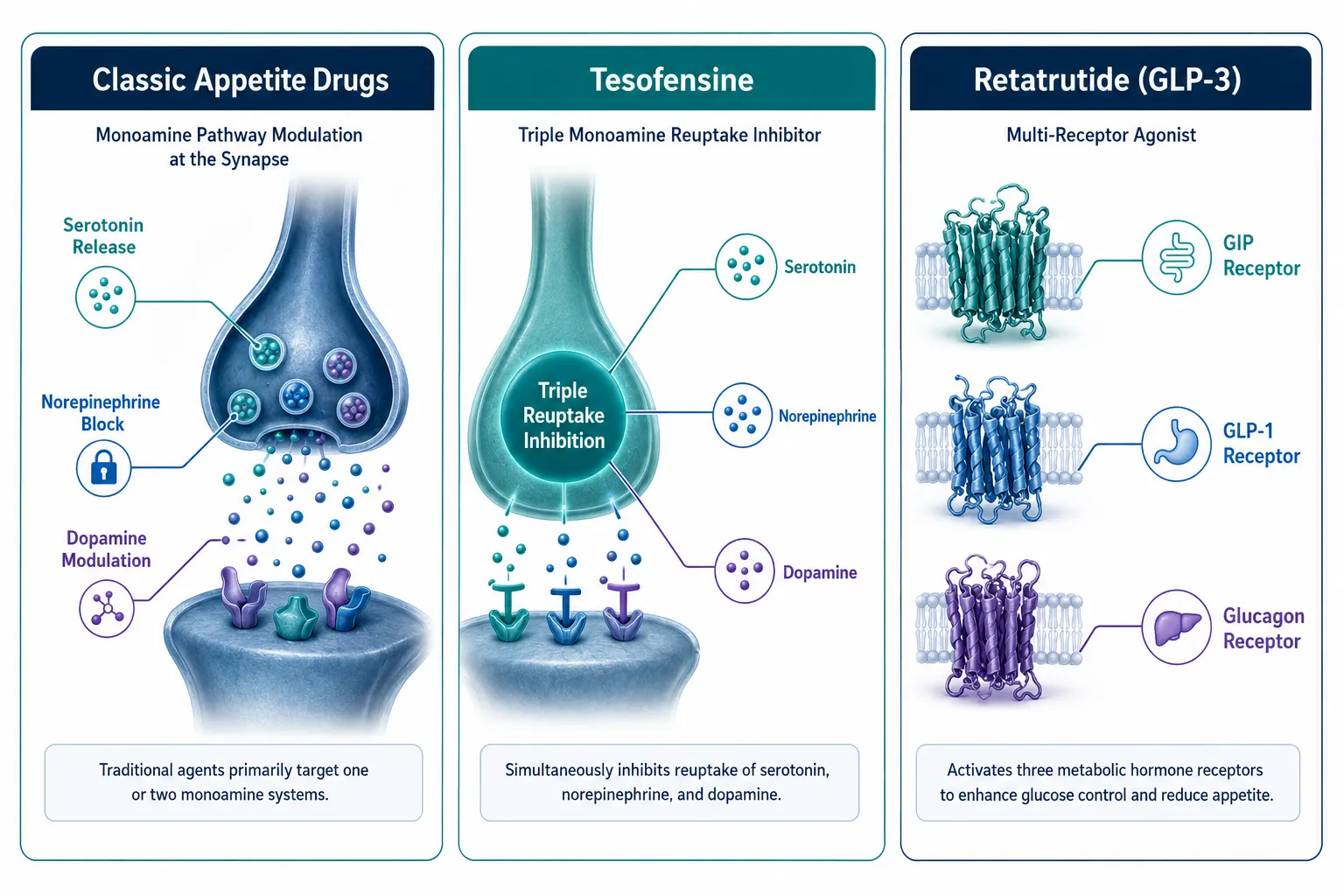
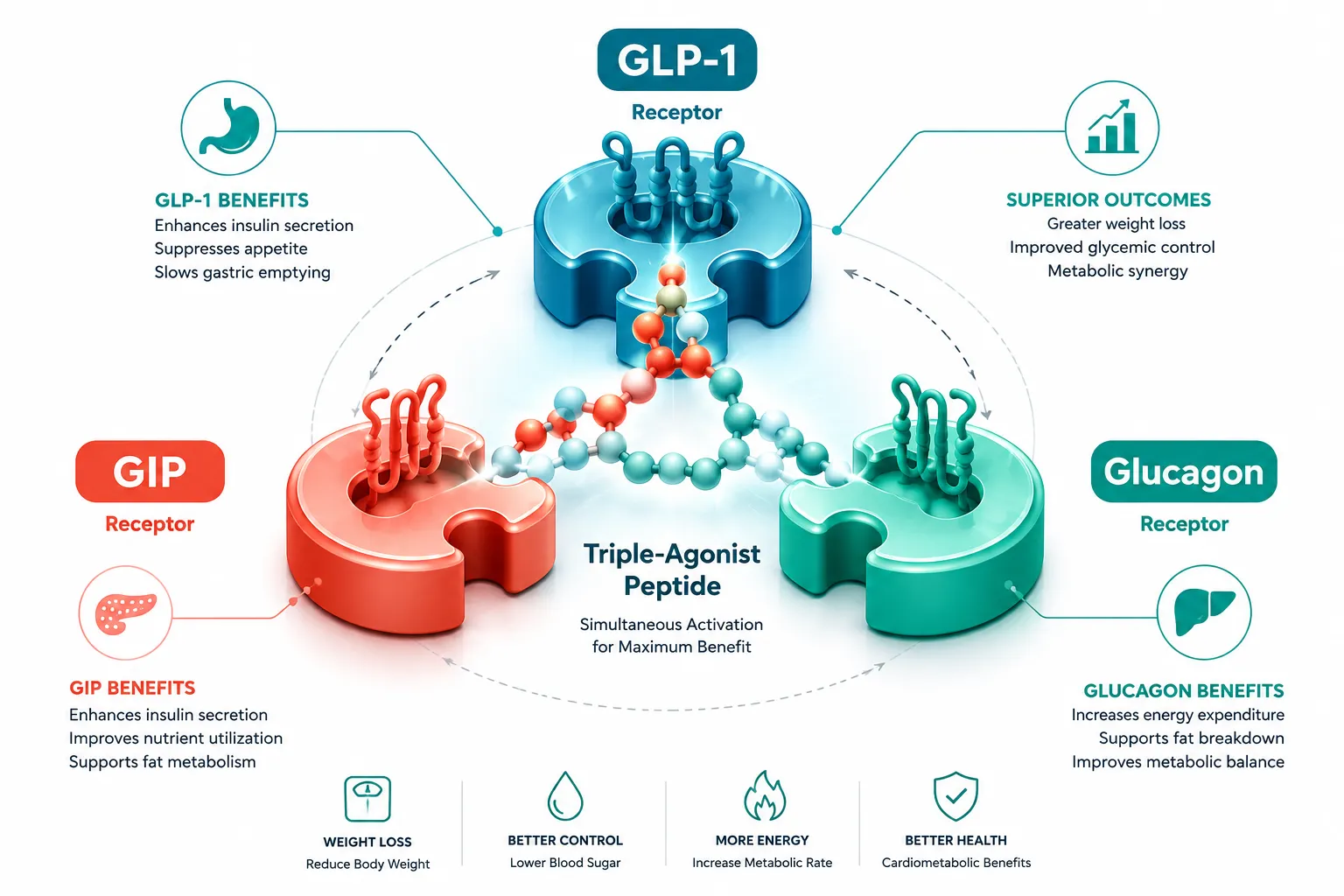
Retatrutide works by co-activating three distinct receptor pathways that each influence energy balance, appetite signaling, and glucose metabolism. The GLP-1 receptor component slows gastric emptying and reduces appetite. The GIP receptor component modulates insulin secretion and fat storage. The glucagon receptor component increases energy expenditure and promotes fat oxidation.

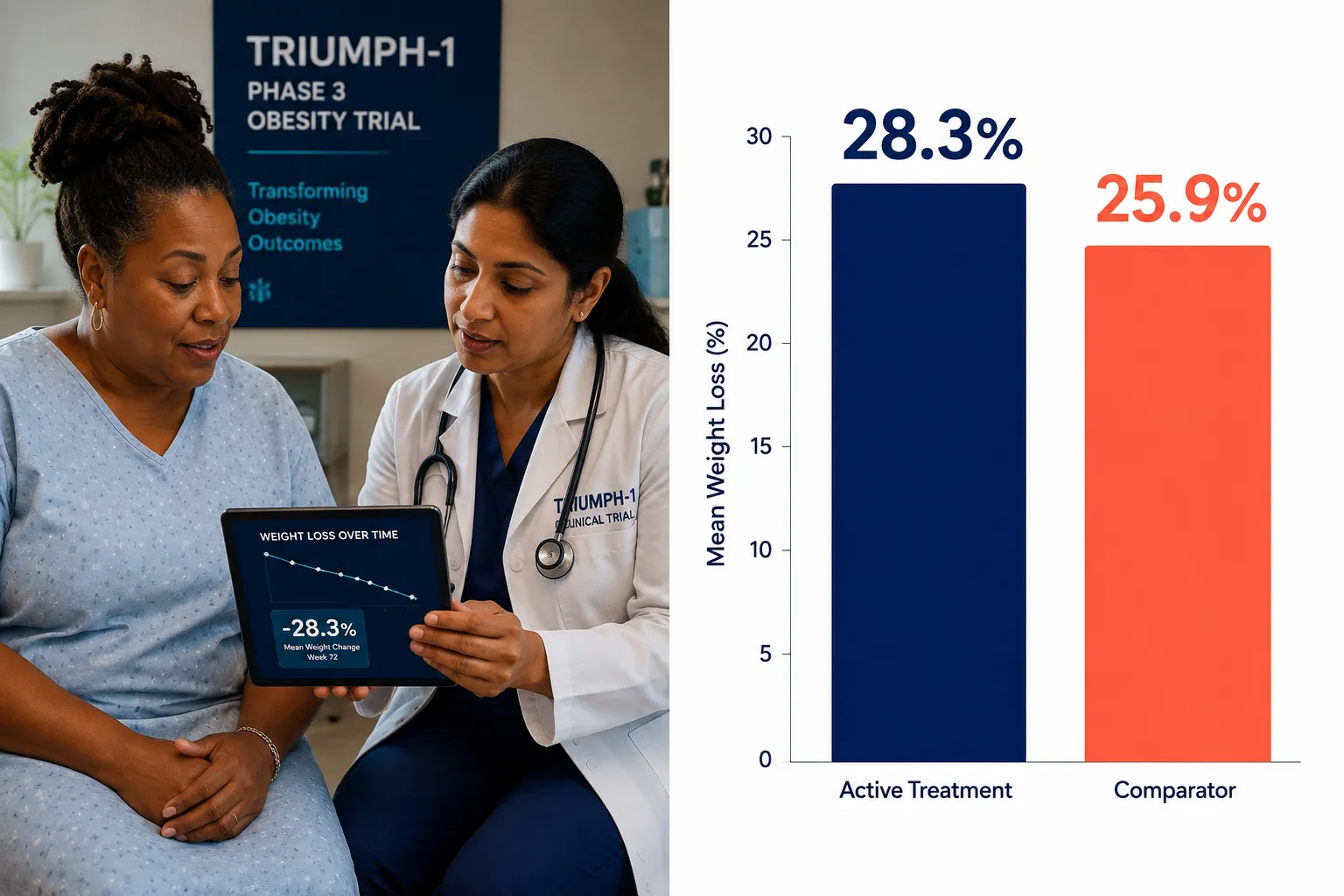
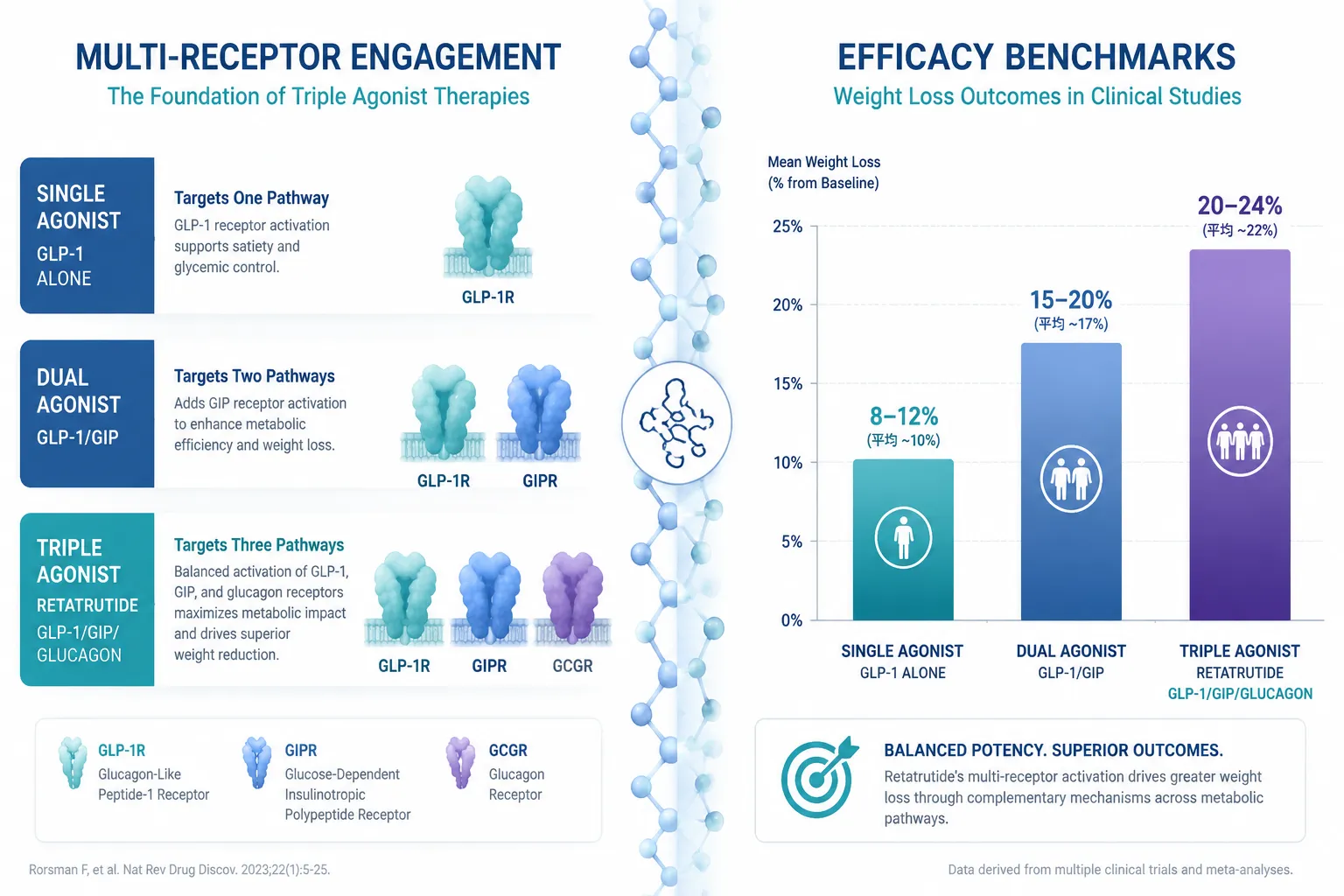
This triple mechanism is why Phase 2 trial data reported up to 24.2% body weight loss at 48 weeks with a 12 mg dose — a figure that exceeded what single or dual agonists had achieved at comparable timepoints. Phase 3 TRIUMPH-4 trial data extended that finding further, showing up to 28.7% body weight loss at 68 weeks with the same 12 mg dose.

"Triple agonism is not simply additive — the glucagon receptor component introduces an energy expenditure pathway that single and dual agonists do not access."

For researchers comparing incretin-based mechanisms, the dual receptor agonism research breakdown and the generations of GLP-1 differences articles offer relevant context. Researchers interested in complementary metabolic compounds may also find value in reviewing cagrilintide synergy with GLP-1 as a related area of investigation.


How to Interpret the Naming Difference in Research Context

How to Interpret the Naming Difference in Research Context

When evaluating Retatrutide vs GLP3 Peptide: How to Interpret the Naming Difference in Research Context, the practical rule is straightforward: use "retatrutide" for database searches on PubMed, ClinicalTrials.gov, or any regulatory archive. Searching "GLP-3 peptide" will return inconsistent results and may surface unrelated compounds or speculative content.

The informal "GLP-3" label is most common in:

  • Fitness and biohacking communities
  • Non-peer-reviewed blog content
  • Social media discussions comparing weight-loss peptides

It is rarely, if ever, used in:

  • Clinical trial registrations
  • Peer-reviewed pharmacology journals
  • FDA or EMA regulatory filings

Researchers studying adjacent compounds — such as tesofensine peptide overview or TESA body composition research themes — will notice the same pattern: informal community labels often diverge from official nomenclature. Maintaining terminological precision protects the integrity of literature reviews and prevents citation errors.


Conclusion

The core answer to Retatrutide vs GLP3 Peptide: How to Interpret the Naming Difference in Research Context is that no meaningful distinction exists between the two terms — they refer to the same compound, but one name is scientifically valid and one is not. Retatrutide is the correct, searchable, regulatory-recognized name for the triple GLP-1R/GIPR/GcgR agonist under active Phase 3 investigation.

Actionable next steps for researchers and informed readers:

  • Use "retatrutide" exclusively when searching clinical databases or citing literature.
  • Treat "GLP-3 peptide" as a community shorthand that signals triple agonism, not a distinct compound class.
  • Cross-reference mechanism descriptions against the three receptor targets (GLP-1R, GIPR, GcgR) to verify you are reading about the correct compound.
  • Follow TRIUMPH-4 and related Phase 3 trial updates for the most current efficacy and safety data.

Precision in terminology is not pedantic — it is the foundation of reliable research interpretation.

https://www.puretestedpeptides.com/wp-content/uploads/2026/07/Retatrutide-vs-GLP3-Peptide-How-to-Interpret-the-Naming-Difference-in-Research-Context.png 1024 1536 Pure Tested https://www.puretestedpeptides.com/wp-content/uploads/2026/01/buy-peptides-online.jpg Pure Tested2026-07-01 13:04:142026-07-20 15:01:17Retatrutide vs GLP3 Peptide: How to Interpret the Naming Difference in Research Context
Where to Buy GLP-3 Retatrutide for Research: A Guide to Sourcing High-Purity Peptides

Where to Buy GLP-3 Retatrutide for Research: A Guide to Sourcing High-Purity Peptides

June 22, 2026/0 Comments/by Pure Tested

Fewer than a handful of investigational compounds have generated as much preclinical interest in 2026 as retatrutide — yet the vast majority of online suppliers offering it operate in a legal and scientific gray zone that can compromise both research integrity and regulatory standing. Knowing where to buy GLP-3 retatrutide for research means understanding far more than price per milligram.

() detailed illustration of a molecular structure diagram of a 39-amino acid triple agonist peptide chain overlaid on a

Key Takeaways

  • Retatrutide (LY3437943) is a 39-amino acid triple agonist targeting GIP, GLP-1, and glucagon receptors, currently unapproved by any regulatory authority as of 2026.
  • The only legal route for non-clinical researchers is the Research Use Only (RUO) supply chain; marketing for human use is unlawful.
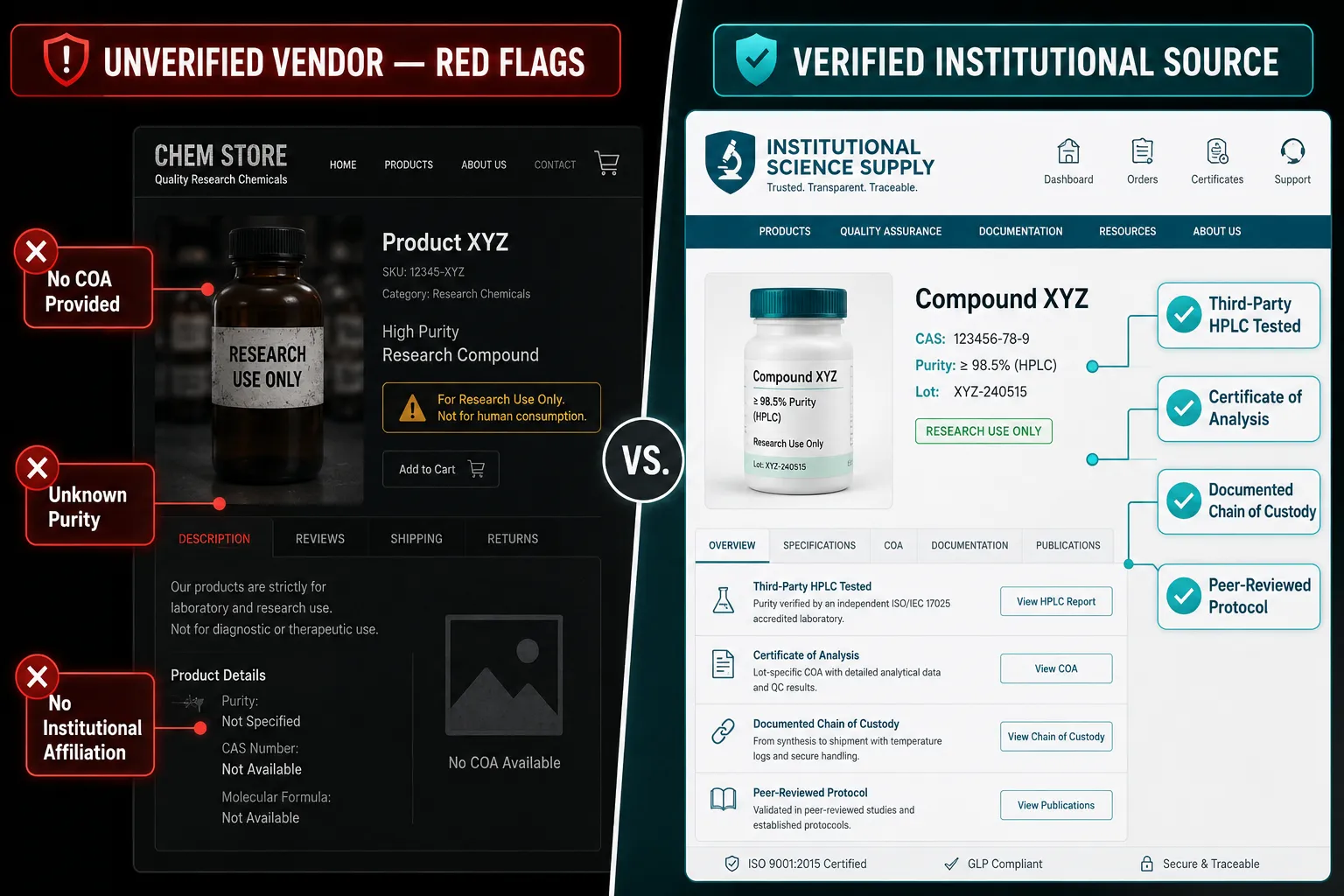
  • High-purity research peptides must be supported by third-party Certificates of Analysis (COA), HPLC data, and mass spectrometry confirmation.
  • Supplier vetting — not just price comparison — is the most critical step in the procurement process.
  • "Clinic-style" or wellness brands offering compounded retatrutide for patients fall entirely outside the approved legal framework.

Understanding Retatrutide's Research Status in 2026

Retatrutide, developed by Eli Lilly under the designation LY3437943, is a 39-amino acid peptide engineered as a triple receptor agonist. It simultaneously targets GIP, GLP-1, and glucagon receptors, making it a structurally distinct compound from earlier incretin-based molecules. For a deeper look at how dual and triple receptor agonism differs mechanistically, the GLP-1 dual receptor agonism research breakdown provides useful context.

As of March 2026, retatrutide holds no approval from the FDA, EMA, or any comparable regulatory body. It remains an investigational new drug, accessible only through Lilly-sponsored clinical trials or through the RUO supply chain for legitimate preclinical and in-vitro research. Any product marketed for human injection, weight loss, or telehealth prescribing is operating outside the law — full stop.

The FDA has issued warning letters to companies marketing GLP-3 and retatrutide products for human use. Researchers should also review the broader GLP-1 incretin research themes to understand where retatrutide sits within the evolving incretin landscape, and how the generations of GLP-1 differences inform its novel mechanism.


A Guide to Sourcing High-Purity Peptides: Supplier Vetting Criteria

A Guide to Sourcing High-Purity Peptides: Supplier Vetting Criteria

This is where most researchers make costly mistakes. The question of where to buy GLP-3 retatrutide for research is not answered by a Google search alone — it requires a structured vetting process.

Analytical Documentation Standards

A reputable RUO supplier will provide, at minimum:

Documentation Type What to Look For
HPLC Chromatogram Purity of 98% or higher
Mass Spectrometry (MS) Confirmed molecular weight match
Certificate of Analysis (COA) Batch-specific, third-party verified
Sterility / Endotoxin Data Available on request for sensitive assays

Never accept a supplier's self-reported purity without independent third-party confirmation. Batch-to-batch consistency matters enormously in preclinical models.

Labeling and Legal Compliance

All legitimate research peptides must be labeled "Not for Human Consumption" and "Research Use Only." Vials sold without this labeling — or marketed alongside dosing guides for weight loss — are red flags. Researchers sourcing peptide blends for research should apply the same scrutiny to multi-compound formulations.

Cold-Chain and Storage Integrity

Retatrutide, like most peptides, is sensitive to temperature degradation. Confirm that the supplier uses validated cold-chain shipping and that lyophilized vials arrive intact and properly sealed.


Practical Steps for Researchers: Where to Buy GLP-3 Retatrutide for Research Safely

Practical Steps for Researchers: Where to Buy GLP-3 Retatrutide for Research Safely

Once the regulatory framework is clear, the practical procurement process follows a logical sequence.

Step 1 — Confirm institutional authorization. Most academic and commercial labs require IRB or institutional review before ordering investigational compounds. Confirm your lab's procurement policy before placing any order.

Step 2 — Request documentation before purchase. Contact the supplier and ask for a sample COA and HPLC data for the specific retatrutide batch. A trustworthy supplier will provide these without hesitation. Review the quality testing protocols used by established research peptide vendors to benchmark what acceptable documentation looks like.

Step 3 — Evaluate the supplier's broader catalog and transparency. Suppliers who publish detailed research context pages — not just product listings — tend to operate with greater scientific rigor. The GLP-3 Retatrutide research page is an example of the kind of transparent, research-oriented presentation that signals a credible vendor.

Step 4 — Avoid "wellness" or compounding channels. There is no approved compounding monograph for retatrutide. Any clinic or telehealth platform offering it as a patient therapy is operating unlawfully. Researchers should also be cautious of suppliers who list the same compound under both research and clinical wellness categories.

Step 5 — Cross-reference with the broader peptide research community. Peer-reviewed forums, institutional procurement offices, and established research networks can help validate supplier reputation. The ultimate guide to peptide therapy and research offers foundational context on how research-grade peptides are evaluated across the field.


Conclusion

Sourcing high-purity retatrutide for legitimate preclinical research in 2026 demands a disciplined, documentation-first approach. The compound's investigational status means that the RUO supply chain is the only lawful option outside of Lilly's clinical program — and within that channel, quality varies enormously.

Actionable next steps:

  • Verify your institution's procurement authorization before ordering.
  • Request batch-specific HPLC and MS documentation from any prospective supplier.
  • Reject any vendor marketing retatrutide for human use, injection, or wellness purposes.
  • Use the GIP receptor research overview to strengthen the scientific rationale behind your study design.
  • Bookmark reputable supplier quality standards pages and revisit them with each new batch order.

Rigorous sourcing is not a bureaucratic formality — it is the foundation of reproducible, defensible research.

https://www.puretestedpeptides.com/wp-content/uploads/2026/06/Where-to-Buy-GLP-3-Retatrutide-for-Research-A-Guide-to-Sourcing-High-Purity-Peptides.png 1024 1536 Pure Tested https://www.puretestedpeptides.com/wp-content/uploads/2026/01/buy-peptides-online.jpg Pure Tested2026-06-22 13:03:412026-07-20 15:02:35Where to Buy GLP-3 Retatrutide for Research: A Guide to Sourcing High-Purity Peptides
GLP-3 Retatrutide vs. Polypeptide Peptides: A Comparative Research Guide to Metabolic Signaling Pathways

GLP-3 Retatrutide vs. Polypeptide Peptides: A Comparative Research Guide to Metabolic Signaling Pathways

June 19, 2026/0 Comments/by Pure Tested

Metabolic peptide research has shifted dramatically — where single-receptor agents once dominated laboratory inquiry, a new class of multi-target molecules is redefining what researchers expect from incretin-based signaling. This guide to GLP-3 Retatrutide vs. Polypeptide Peptides: A Comparative Research Guide to Metabolic Signaling Pathways examines how retatrutide's triple-receptor mechanism compares to conventional polypeptide agents, giving researchers a clear framework for understanding the underlying biology.

Key Takeaways

  • Retatrutide simultaneously activates three metabolic receptors: GLP-1R, GIPR, and the glucagon receptor (GcgR).
  • Conventional polypeptide peptides typically act on one or two receptor targets, producing narrower metabolic effects.
  • Triple agonism reshapes energy balance through complementary, overlapping signaling pathways.
  • Understanding receptor-level distinctions helps researchers design more targeted metabolic studies.
  • The term "GLP-3" is an informal research label — retatrutide's formal classification reflects its triple-agonist pharmacology.

Key Takeaways

Understanding the GLP-3 Label and Retatrutide's Classification

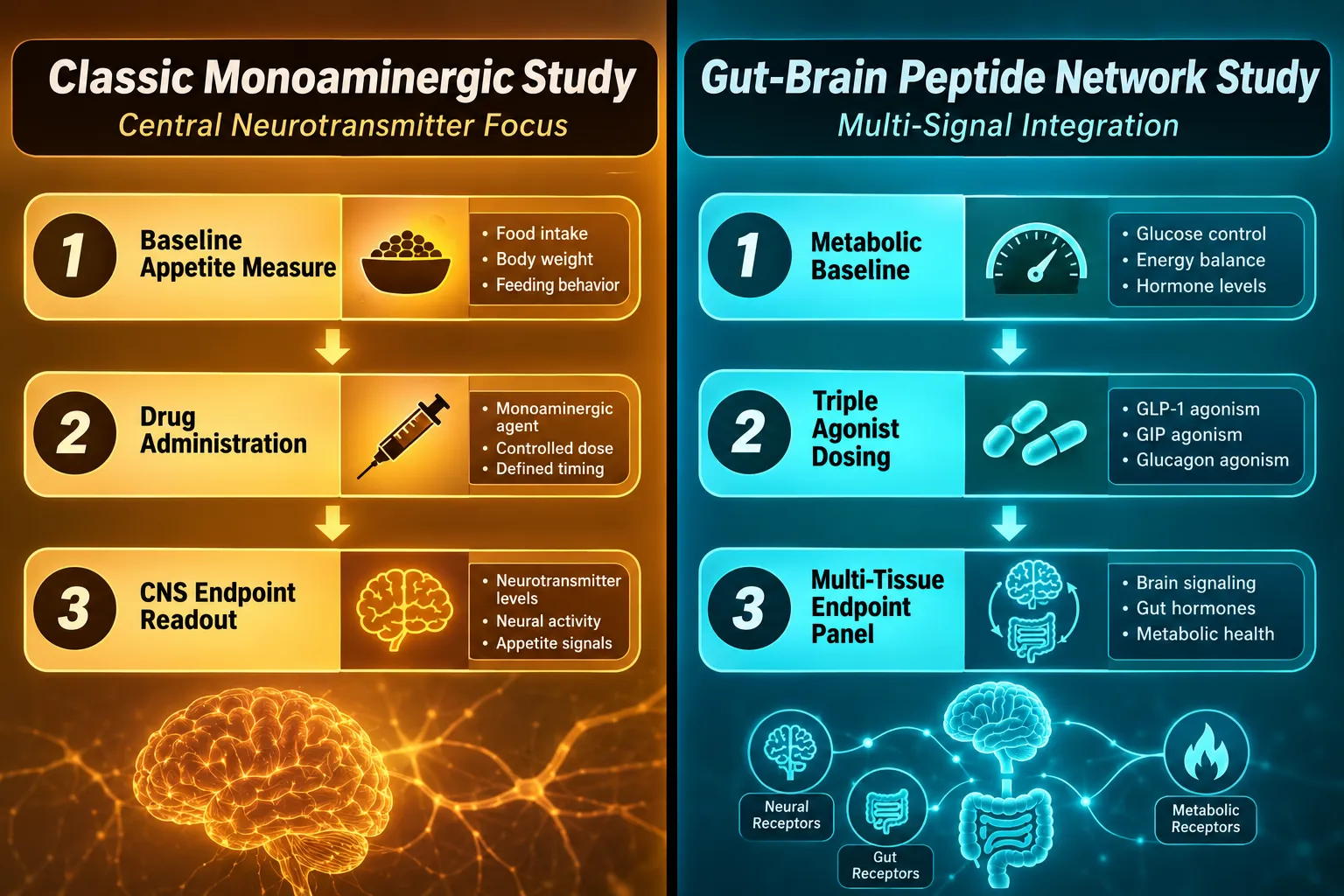
The label "GLP-3" circulates in research communities as shorthand for retatrutide, but it requires clarification. Retatrutide is not a third member of the glucagon-like peptide family in the classical sense. It is a synthetic triple agonist engineered to activate three distinct G-protein-coupled receptors simultaneously.

Conventional polypeptide peptides — including native GLP-1, GIP, and glucagon analogs — are typically single-receptor or, at most, dual-receptor agents. Their signaling is more contained. Retatrutide's design deliberately crosses those boundaries, which is why researchers studying GLP-3 Retatrutide incretin research themes often need a broader mechanistic framework than standard incretin models provide.

For context on how incretin generations have evolved, the overview of GLP-1 generations and their differences provides useful background on the progression from first-generation GLP-1 analogs to today's multi-agonist compounds.


Receptor-Level Mechanisms: How Retatrutide Differs from Conventional Polypeptide Peptides

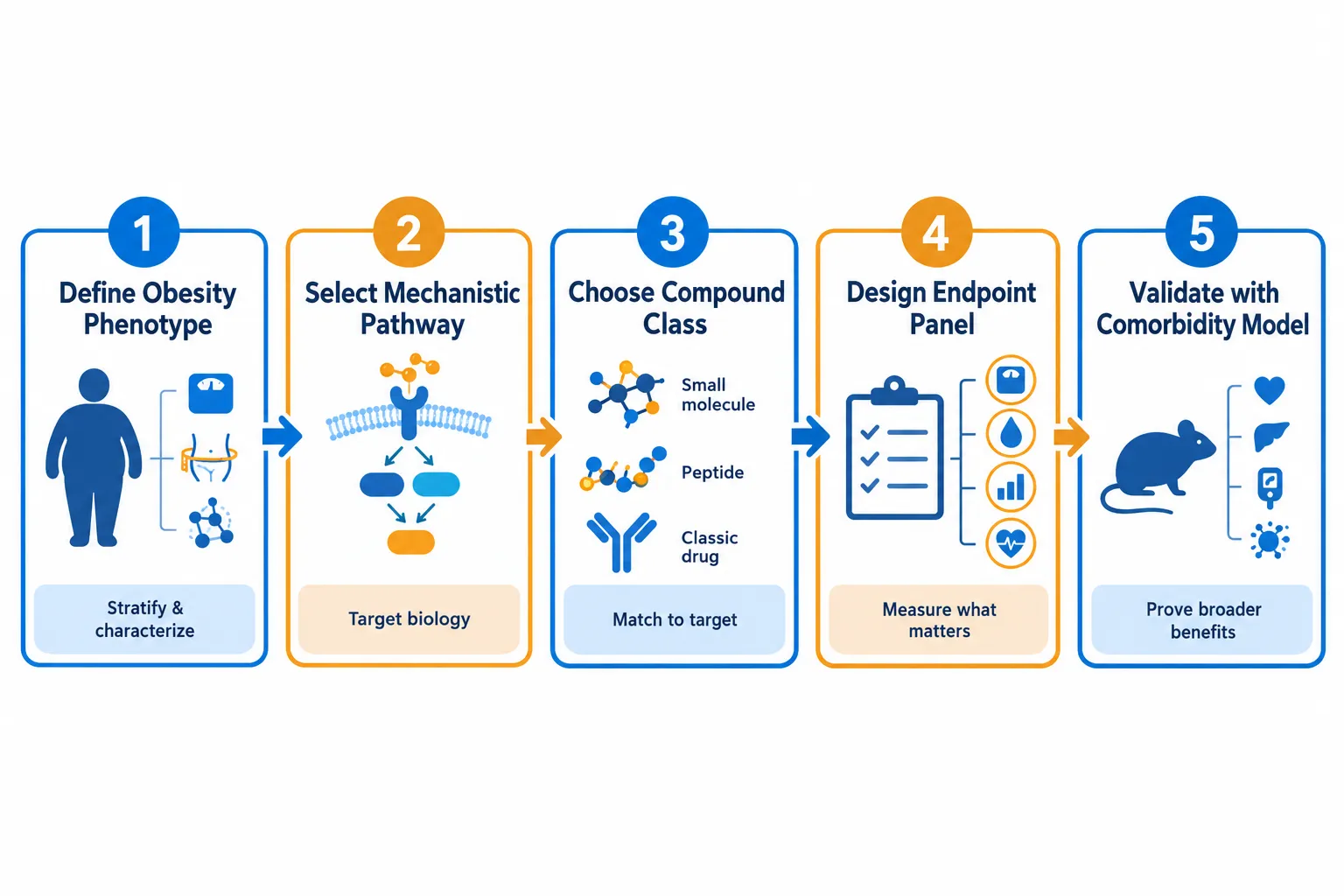
This section of the GLP-3 Retatrutide vs. Polypeptide Peptides: A Comparative Research Guide to Metabolic Signaling Pathways focuses on what happens at the receptor level — the core distinction between retatrutide and standard polypeptide agents.

Receptor-Level Mechanisms: How Retatrutide Differs from Conventional Polypeptide Peptides

GLP-1 Receptor Activation

GLP-1R activation is shared by both retatrutide and conventional GLP-1 analogs. This pathway drives glucose-dependent insulin secretion, slows gastric emptying, and reduces appetite through both central nervous system and vagal nerve signaling. Single-agonist GLP-1 peptides operate primarily through this mechanism alone.

GIP Receptor Activation

GIPR activation adds a second layer. GIP further potentiates insulin release and modulates adipose tissue metabolism. Emerging research also suggests GIPR signaling may influence reward-related feeding behavior. Most traditional polypeptide peptides do not engage this receptor.

Glucagon Receptor Activation

GcgR activation is where retatrutide most clearly separates itself. Glucagon receptor signaling increases hepatic glucose output and, critically for metabolic research, raises resting energy expenditure. This thermogenic component is largely absent from conventional incretin peptides.

Receptor Retatrutide GLP-1 Analogs GIP Analogs
GLP-1R Yes Yes No
GIPR Yes No Yes
GcgR Yes No No
Thermogenic effect Yes Minimal Minimal

Researchers exploring complementary metabolic peptides such as MOTS-C, the mitochondrial peptide, will recognize that energy expenditure modulation is a recurring theme across multiple research-stage compounds — though the mechanisms differ significantly.


Metabolic Signaling Pathways: Triple Agonism vs. Conventional Peptide Approaches

The practical research value of the GLP-3 Retatrutide vs. Polypeptide Peptides: A Comparative Research Guide to Metabolic Signaling Pathways comparison lies in understanding how these mechanisms interact at the systems level.

Metabolic Signaling Pathways: Triple Agonism vs. Conventional Peptide Approaches

Triple agonism creates overlapping, reinforcing signals across three metabolic axes:

  • Insulin axis — amplified through both GLP-1R and GIPR co-activation
  • Appetite axis — suppressed via central GLP-1R pathways and potentially GIPR reward modulation
  • Energy expenditure axis — elevated through GcgR-driven thermogenesis

Conventional polypeptide peptides typically address one or two of these axes. Researchers studying body composition agents like Tesamorelin and its metabolic effects or AOD-9604 research methodology will note that each compound targets a narrower physiological window.

"Multi-receptor engagement is not simply additive — the convergence of three distinct signaling pathways creates metabolic effects that single-agonist models cannot fully replicate."

For researchers building broader metabolic panels, understanding cagrilintide's synergy with GLP-1 pathways also illustrates how combination approaches are increasingly central to advanced metabolic research design.

Those sourcing research-grade material can review GLP-3 Retatrutide product details for specification and traceability information.


Conclusion

The distinction between retatrutide and conventional polypeptide peptides is not merely a matter of degree — it reflects a fundamentally different approach to metabolic receptor engagement. Where single or dual-agonist peptides offer focused, well-characterized signaling, retatrutide's triple-agonist profile introduces a more complex, multi-axis mechanism that researchers must account for in study design.

Actionable next steps for researchers:

  1. Map which receptor pathways are relevant to your specific metabolic research question before selecting a peptide agent.
  2. Review the GLP-1 generations overview to contextualize retatrutide within the broader incretin research landscape.
  3. Cross-reference thermogenic and energy expenditure data when comparing triple-agonist results against single-receptor peptide benchmarks.
  4. Consult available innovative peptide delivery systems research to ensure study protocols reflect current best practices.

Understanding these mechanistic foundations is the starting point for rigorous, reproducible metabolic peptide research in 2026.

https://www.puretestedpeptides.com/wp-content/uploads/2026/06/GLP-3-Retatrutide-vs.-Polypeptide-Peptides-A-Comparative-Research-Guide-to-Metabolic-Signaling-Pathways.png 1024 1024 Pure Tested https://www.puretestedpeptides.com/wp-content/uploads/2026/01/buy-peptides-online.jpg Pure Tested2026-06-19 13:42:052026-07-20 15:02:42GLP-3 Retatrutide vs. Polypeptide Peptides: A Comparative Research Guide to Metabolic Signaling Pathways
GLP3 Peptide vs Retatrutide: Why the Naming Confusion Matters in Obesity Research

GLP3 Peptide vs Retatrutide: Why the Naming Confusion Matters in Obesity Research

June 11, 2026/0 Comments/by Pure Tested

Over 1 billion adults worldwide live with obesity, and the race to find more effective treatments has never moved faster. Yet one of the biggest obstacles in 2026 is not a scientific one — it is a language problem. The debate around GLP3 Peptide vs Retatrutide: Why the Naming Confusion Matters in Obesity Research is more than a semantic argument. When researchers, clinicians, and consumers use the same term to mean different things, the consequences range from misread study data to misguided purchasing decisions.
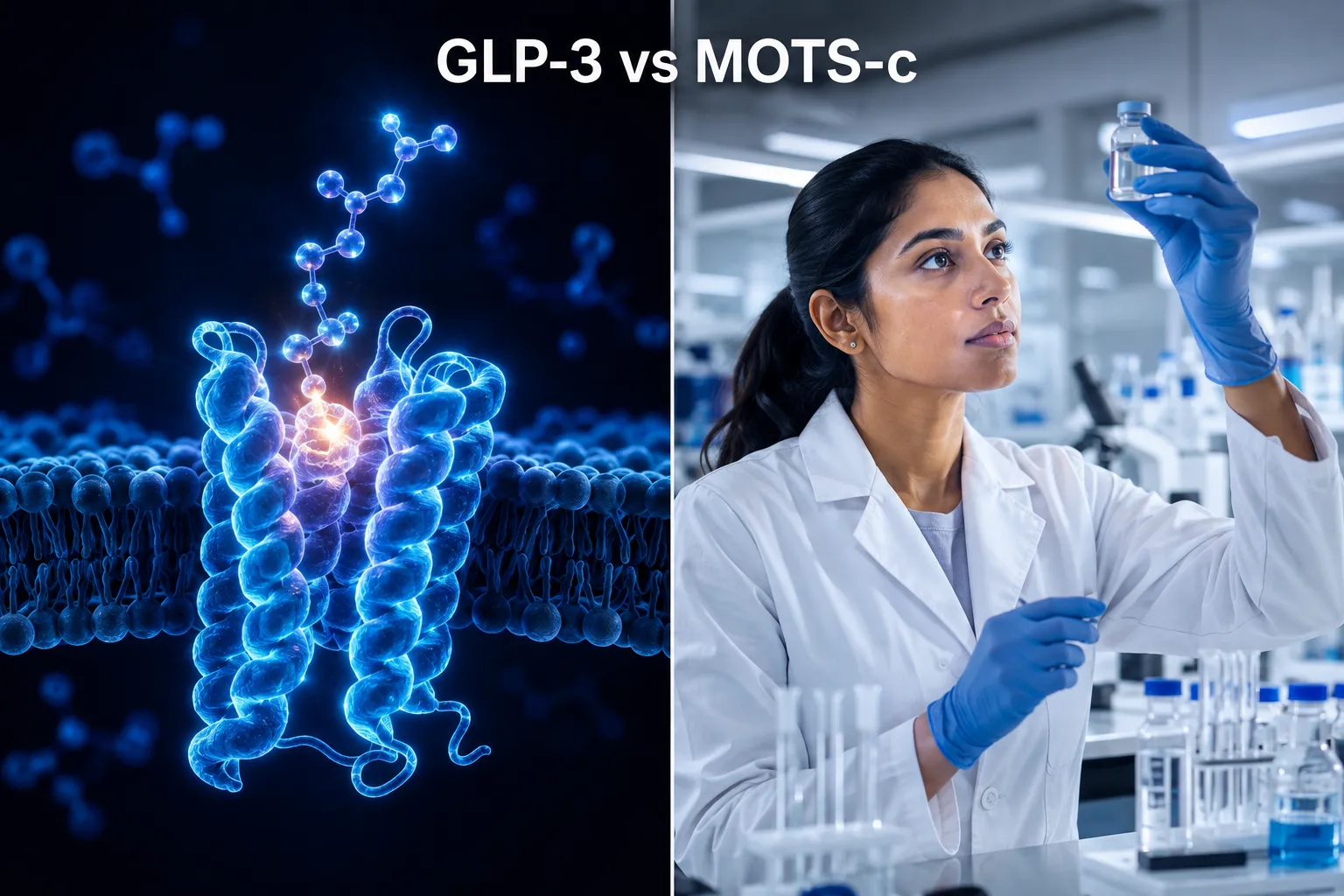
() scientific infographic-style illustration showing two labeled molecular structures side by side — one labeled 'GLP-3

Key Takeaways

  • "GLP-3" is an informal, consumer-driven nickname — not a recognized scientific classification for retatrutide.
  • Retatrutide (LY3437943) is a triple-receptor agonist targeting GLP-1, GIP, and glucagon receptors simultaneously.
  • Phase 3 trials have shown weight loss results as high as 28.7%, the highest ever recorded in an obesity drug trial.
  • Terminology confusion can distort research interpretation, marketplace trust, and regulatory understanding.
  • Researchers and buyers should verify compound identity by chemical name or CAS number, not informal labels.

What Is Retatrutide and Where Does "GLP-3" Come From

Retatrutide, developed by Eli Lilly under the code name LY3437943, is a first-in-class triple-receptor agonist. It activates three distinct hormone receptors at once:

Receptor Role in Metabolism
GLP-1 Appetite suppression, insulin secretion
GIP Fat metabolism, insulin sensitivity
Glucagon Energy expenditure, liver fat reduction

No approved drug before retatrutide has hit all three targets simultaneously. Semaglutide (Ozempic, Wegovy) targets only GLP-1. Tirzepatide (Mounjaro, Zepbound) targets GLP-1 and GIP. Retatrutide adds glucagon to the mix.

The nickname "GLP-3" emerged organically in consumer forums and social media. The logic was simple: GLP-1 targets one receptor, tirzepatide targets two, so this "third generation" drug must be GLP-3. The label stuck — but it is scientifically inaccurate.

"GLP-3" does not describe a receptor, a peptide family, or a drug class. It is marketing shorthand that has migrated into research discussions where precision is critical.

For a broader look at where peptide research is heading, the latest updates in peptide research provide useful context on how naming conventions evolve in this space.


Why the Naming Confusion Matters in Obesity Research and Clinical Trials

Why the Naming Confusion Matters in Obesity Research and Clinical Trials

The stakes of this terminology gap become clear when looking at the trial data. In the TRIUMPH-4 Phase 3 trial, retatrutide produced a mean weight loss of 28.7% at 68 weeks in adults with obesity and knee osteoarthritis — the highest figure ever recorded in any Phase 3 obesity drug trial. The TRIUMPH-3 trial, presented at the American College of Cardiology Annual Scientific Session in March 2026, reported 24.2% mean weight loss at 72 weeks in adults with elevated cardiovascular risk.

These are landmark numbers. But when a researcher searches for "GLP-3 trial results" and finds a mix of retatrutide data alongside unrelated GLP receptor biology, the confusion compounds.

Three specific risks created by the GLP-3 label:

  • Research misattribution: Studies on actual GLP receptor peptide biology get conflated with retatrutide clinical outcomes.
  • Regulatory misunderstanding: Eli Lilly plans to file a New Drug Application in late 2026 or early 2027. Informal naming can create confusion in public commentary on regulatory submissions.
  • Marketplace errors: Buyers searching for research-grade retatrutide may encounter mislabeled products. Reviewing a detailed GLP-3 and retatrutide compound overview helps clarify what is actually being sourced.

For those researching metabolic peptides more broadly, resources on AOD9604 metabolic research and tesa benefits show how naming precision matters across the entire category.


How Researchers and Buyers Can Navigate the GLP3 Peptide vs Retatrutide Naming Issue

How Researchers and Buyers Can Navigate the GLP3 Peptide vs Retatrutide Naming Issue

The clearest solution is to anchor every discussion to the compound's chemical identity, not its nickname.

Best practices for accurate identification:

  • Always reference retatrutide by its INN (International Nonproprietary Name) or Eli Lilly's code: LY3437943.
  • Cross-check any "GLP-3" product listing against verified chemical specifications.
  • Use peer-reviewed databases rather than consumer forums as primary sources.
  • When sourcing for research, prioritize suppliers with transparent quality testing protocols and third-party verification.

The GLP-3 retatrutide product page and the RETA GLP-3 research overview are examples of how suppliers can bridge the naming gap by providing both the informal label and the verified compound name together.

For researchers exploring related metabolic compounds, the 5-Amino-1MQ research overview offers a useful parallel on how novel compounds gain informal names before formal classification catches up.


Conclusion

The GLP3 Peptide vs Retatrutide naming confusion is not a trivial issue. It shapes how clinical trial data is interpreted, how regulatory conversations unfold, and how research-grade compounds are sourced. Retatrutide is a precisely defined triple-receptor agonist with Phase 3 data that sets a new benchmark for obesity pharmacology. "GLP-3" is a convenient shorthand that, when used carelessly, undermines that precision.

Actionable next steps:

  • Replace "GLP-3" with "retatrutide" or "LY3437943" in all research documentation.
  • Verify any compound labeled "GLP-3" against its full chemical specification before use.
  • Stay current with TRIUMPH trial publications and the anticipated NDA filing timeline.
  • Source research peptides only from suppliers who publish verified testing data alongside both the common and scientific names.

Precision in language is the foundation of precision in science. In obesity research, where the stakes are high and the compounds are complex, that foundation matters more than ever.

https://www.puretestedpeptides.com/wp-content/uploads/2026/06/GLP3-Peptide-vs-Retatrutide-Why-the-Naming-Confusion-Matters-in-Obesity-Research.png 1024 1536 Pure Tested https://www.puretestedpeptides.com/wp-content/uploads/2026/01/buy-peptides-online.jpg Pure Tested2026-06-11 13:06:552026-07-20 15:03:30GLP3 Peptide vs Retatrutide: Why the Naming Confusion Matters in Obesity Research
What Is the GLP3 Peptide? Research Distinctions, Naming Confusion, and How It Relates to Retatrutide

What Is the GLP3 Peptide? Research Distinctions, Naming Confusion, and How It Relates to Retatrutide

June 10, 2026/0 Comments/by Pure Tested

A single informal label is causing genuine confusion across research communities, patient forums, and peptide catalogs in 2026: "GLP-3." Researchers searching for this term are often looking for something very different from what the name implies. Understanding what the GLP-3 peptide actually refers to — and why that label is scientifically inaccurate — matters for anyone tracking the latest developments in metabolic research.

Key Takeaways

  • There is no hormone called "GLP-3." The term is an informal nickname, not a recognized scientific designation.
  • "GLP-3" almost always refers to retatrutide (LY3437943), a triple-agonist investigational compound developed by Eli Lilly.
  • Retatrutide simultaneously targets three receptors: GLP-1, GIP, and glucagon.
  • Phase 3 trial data shows approximately 28% average weight loss over 18 months — results comparable to bariatric surgery.
  • As of 2026, retatrutide is not FDA-approved and remains under active clinical investigation.

Key Takeaways

Understanding the Naming Confusion Around "GLP-3"

The phrase "GLP-3 peptide" does not correspond to any recognized hormone in human physiology. The glucagon-like peptide family includes GLP-1 and GLP-2, both derived from the proglucagon gene. GLP-1 is well-established for its role in insulin secretion and appetite regulation. GLP-2 supports intestinal growth. No GLP-3 exists in the official scientific literature.

So where does the term come from? It appears to have emerged organically from online communities and informal research discussions as shorthand for retatrutide — a compound that acts on three separate receptor pathways. The logic is loose: "triple action" became "GLP-3" in casual usage. The label stuck, even though it misrepresents the compound's actual mechanism.
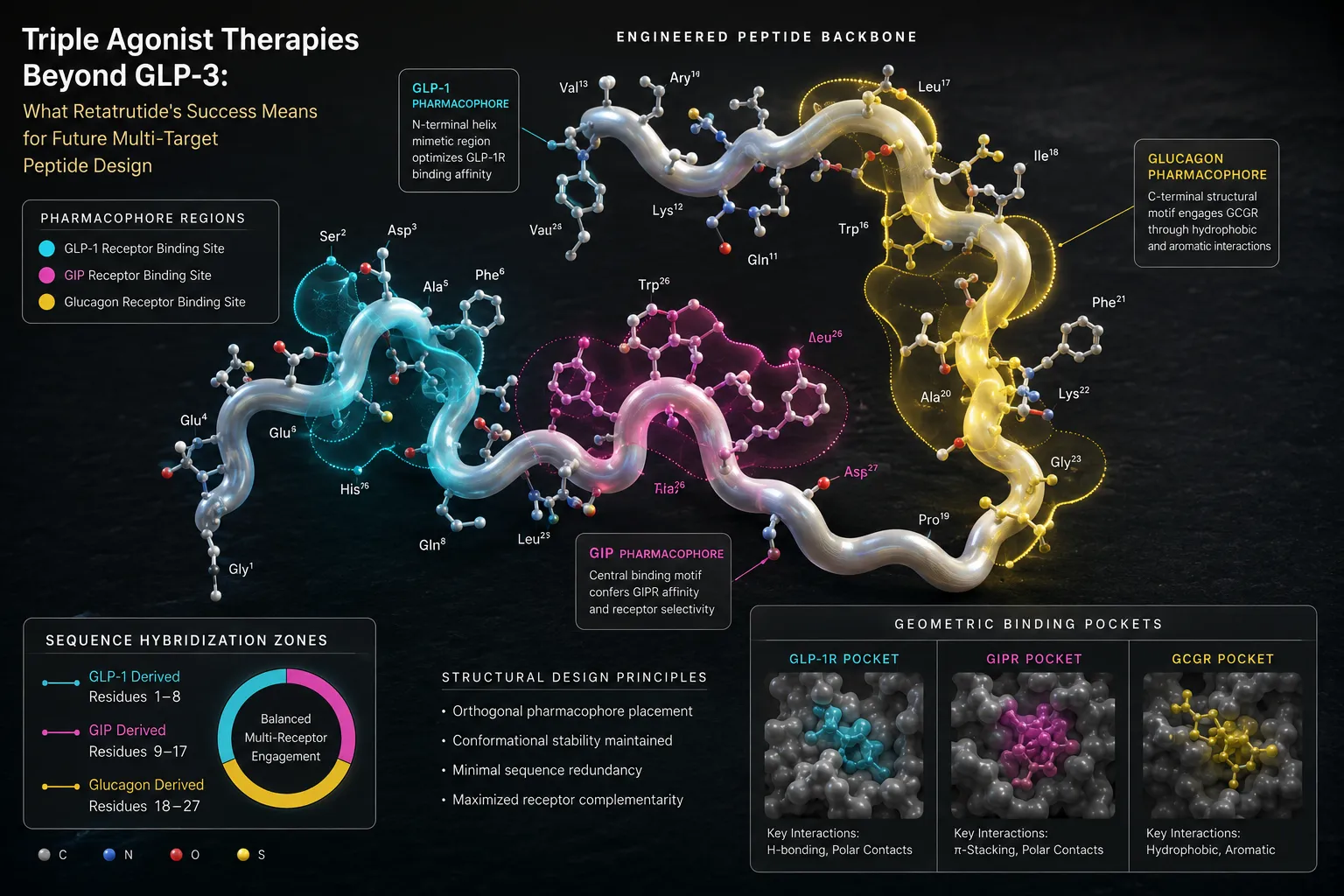
This kind of naming drift is not unusual in peptide research. For a broader look at how terminology evolves in this field, the ultimate guide to peptide therapy provides useful context on how compounds are classified and discussed.


What Is the GLP3 Peptide? Research Distinctions, Naming Confusion, and How It Relates to Retatrutide — The Core Answer

Retatrutide (development code LY3437943) is the compound most commonly referenced when someone asks about the "GLP-3 peptide." It is an investigational drug developed by Eli Lilly that activates three distinct hormone receptors simultaneously:

Receptor Primary Research Function
GLP-1 Reduces appetite, slows gastric emptying
GIP Improves insulin sensitivity, supports fat distribution
Glucagon Increases energy expenditure, promotes fat breakdown via thermogenesis

This triple-agonist profile is what separates retatrutide from earlier-generation compounds. Semaglutide targets GLP-1 alone. Tirzepatide targets GLP-1 and GIP. Retatrutide adds glucagon receptor activation on top of both, creating a broader metabolic effect.

For researchers already familiar with the GLP-1 peptide research landscape, retatrutide represents a meaningful step forward in receptor-targeting strategy. Those planning research with this compound should also review GLP-3 triple agonist research planning resources before sourcing.


What Is the GLP3 Peptide? Research Distinctions, Naming Confusion, and How It Relates to Retatrutide — The Core Answer

Phase 3 Data and Regulatory Status in 2026

The clinical results for retatrutide are among the most discussed in metabolic medicine this year. In Phase 3 trials, participants achieved an average weight loss of approximately 28% over 18 months — a figure that rivals outcomes typically seen with bariatric surgery. No other injectable medication has produced comparable numbers in trial data to date.

"Retatrutide's Phase 3 results represent the highest weight loss figures recorded for any injectable medication in clinical trials."

Despite these results, retatrutide is not FDA-approved as of 2026. Eli Lilly anticipates filing for FDA approval in 2026–2027, with potential commercial availability projected for late 2027 or 2028, contingent on successful trial completion and regulatory review.

Beyond weight loss, researchers are examining retatrutide's potential influence on type 2 diabetes, cardiovascular risk factors, and metabolic liver disease. The GIP receptor and its importance in metabolic signaling provides additional background on one of the three pathways retatrutide engages.


What Is the GLP3 Peptide? Research Distinctions, Naming Confusion, and How It Relates to Retatrutide — Practical Implications for Researchers

For researchers navigating this space, the terminology distinction has real consequences. Searching for "GLP-3 peptide" may return inconsistent results across databases, catalogs, and literature because the label is not standardized. Using the correct terminology — triple agonist, GLP-1/GIP/glucagon receptor agonist, or retatrutide/LY3437943 — will yield more reliable and reproducible search results.

Retatrutide is administered as a once-weekly subcutaneous injection, a delivery format consistent with other compounds in the GLP-1 class. Researchers interested in innovative peptide delivery systems will find the subcutaneous format familiar, though the triple-receptor profile introduces unique considerations for study design.

Those tracking the broader metabolic peptide landscape may also find value in reviewing AOD-9604 metabolic research and SLU-PP-332 metabolic research themes for comparative context on fat metabolism pathways.


What Is the GLP3 Peptide? Research Distinctions, Naming Confusion, and How It Relates to Retatrutide — Practical Implications

Conclusion

The "GLP-3 peptide" is not a real hormone — it is a widely circulated misnomer for retatrutide, a triple-agonist compound targeting GLP-1, GIP, and glucagon receptors. Clarifying this distinction is essential for accurate research planning, catalog navigation, and literature review.

Actionable next steps for researchers:

  • Use "retatrutide," "LY3437943," or "triple agonist" in database and catalog searches instead of "GLP-3."
  • Review the GIP receptor pathway alongside GLP-1 mechanisms before designing studies.
  • Monitor FDA filing updates from Eli Lilly, expected in the 2026–2027 window.
  • Consult what is new in peptide research for ongoing developments in this fast-moving field.

Precise terminology is not a minor detail in peptide research — it directly affects sourcing accuracy, study reproducibility, and regulatory compliance awareness.

https://www.puretestedpeptides.com/wp-content/uploads/2026/06/What-Is-the-GLP3-Peptide-Research-Distinctions-Naming-Confusion-and-How-It-Relates-to-Retatrutide.png 672 1024 Pure Tested https://www.puretestedpeptides.com/wp-content/uploads/2026/01/buy-peptides-online.jpg Pure Tested2026-06-10 13:06:532026-07-20 15:03:32What Is the GLP3 Peptide? Research Distinctions, Naming Confusion, and How It Relates to Retatrutide
GLP-3 Retatrutide vs Traditional GLP-1 Agonists: Mechanisms, Early Data, and Research-Only Use Cases

GLP-3 Retatrutide vs Traditional GLP-1 Agonists: Mechanisms, Early Data, and Research-Only Use Cases

June 3, 2026/0 Comments/by Pure Tested

A single peptide producing nearly 29% mean body weight loss in a clinical trial is not a headline most metabolic researchers expected to see this decade. Yet that is precisely what early data from retatrutide's Phase 3 program suggests. Understanding the comparison of GLP-3 Retatrutide vs Traditional GLP-1 Agonists: Mechanisms, Early Data, and Research-Only Use Cases requires looking closely at receptor biology, trial outcomes, and the strict research boundaries that currently govern this compound.

Key Takeaways

  • Retatrutide is a triple agonist activating GLP-1, GIP, and glucagon receptors simultaneously, while classic GLP-1 agents target only one receptor.
  • Phase 2 and early Phase 3 data show weight reductions of 24.2% to 28.7%, surpassing results seen with semaglutide or tirzepatide.
  • Retatrutide reduced liver fat by up to 82.4% in clinical studies, pointing to broad metabolic utility.
  • As of 2026, retatrutide is not FDA-approved and is designated for laboratory and research use only.
  • An FDA filing is anticipated between 2026 and 2027, making this a critical period for preclinical researchers to build foundational knowledge.

Receptor Mechanisms: How Retatrutide Differs from Classic GLP-1 Agonists

Receptor Mechanisms: How Retatrutide Differs from Classic GLP-1 Agonists

Traditional GLP-1 receptor agonists such as semaglutide work by mimicking the incretin hormone GLP-1. This single-receptor approach suppresses appetite, slows gastric emptying, and improves insulin secretion. The results are clinically meaningful, but the mechanism is inherently limited to one signaling pathway.

Retatrutide expands that model significantly. It activates three distinct receptors:

Receptor Primary Role
GLP-1 Appetite suppression, delayed gastric emptying
GIP Enhanced insulin secretion, lipid metabolism
Glucagon Increased energy expenditure, fat oxidation

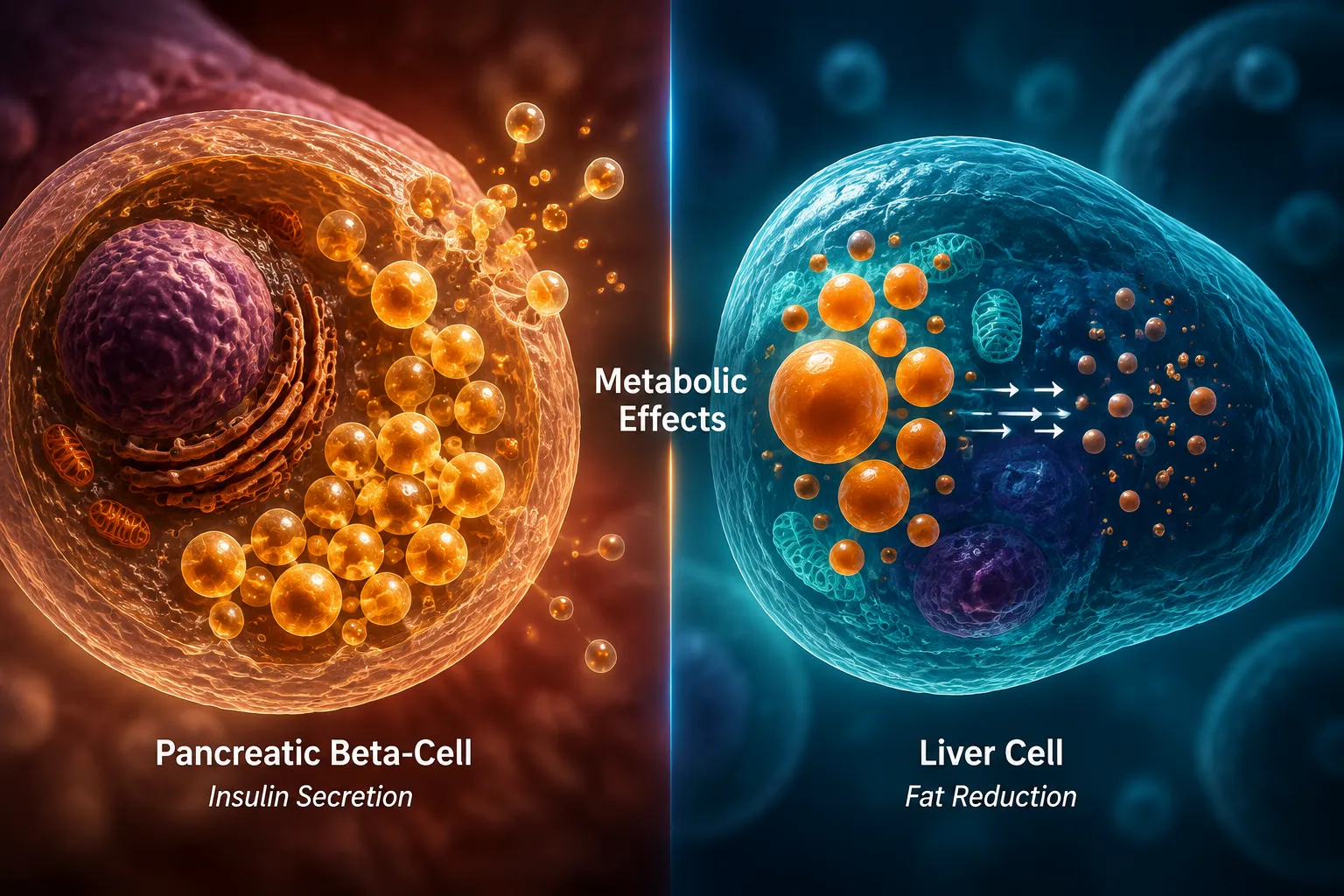
This triple-agonist design means the compound addresses energy balance from multiple angles at once. The glucagon receptor component is particularly notable. While glucagon is classically associated with raising blood glucose, its activation in a balanced incretin context appears to drive thermogenesis and fat oxidation without destabilizing glycemic control.

Cryo-electron microscopy studies have mapped exactly how retatrutide engages all three receptor types at the molecular level, providing a structural explanation for its activity profile. For researchers exploring the broader GLP-1 generations overview, this mechanistic leap from single to triple agonism represents a defining shift in incretin pharmacology.

Tirzepatide, a dual GLP-1/GIP agonist, sits between semaglutide and retatrutide on this spectrum. Retatrutide's additional glucagon receptor activation is the primary differentiator that researchers believe accounts for its superior efficacy signals in early trials.


Early Clinical Data: What the Trial Numbers Show

Early Clinical Data: What the Trial Numbers Show

The numbers from retatrutide's clinical program are difficult to ignore. In a Phase 2 trial published in the New England Journal of Medicine, participants receiving the 12 mg dose achieved a mean body weight reduction of 24.2% at 48 weeks. That figure exceeded the weight loss benchmarks set by both semaglutide and tirzepatide in comparable timeframes.

Preliminary data from the Phase 3 TRIUMPH-4 trial pushed that figure further. At 68 weeks, the mean body weight loss reached 28.7%, the highest reduction recorded in an obesity trial to date.

Beyond weight, the metabolic data is equally compelling:

  • Liver fat reduction of up to 82.4%, suggesting significant potential for non-alcoholic fatty liver disease research
  • Improvements in glycemic control and lipid profiles across trial cohorts
  • Once-weekly subcutaneous dosing with a half-life of approximately 6 days, supporting practical research protocols

The side effect profile is consistent with other incretin-based compounds. Gastrointestinal effects including nausea and vomiting were the most commonly reported adverse events, which aligns with what researchers observe across the GLP-1 class.

For those tracking how body composition peptides interact with metabolic pathways, the TESA body composition research themes page offers relevant context on related investigational compounds. Similarly, researchers studying fat metabolism may find value in reviewing AOD-9604 research method notes as a complementary reference point.


Research-Only Use Cases for GLP-3 Retatrutide vs Traditional GLP-1 Agonists

Research-Only Use Cases for GLP-3 Retatrutide vs Traditional GLP-1 Agonists

As of 2026, retatrutide holds no FDA approval and is not available for commercial or clinical use outside of authorized trials. It is strictly designated for laboratory and research purposes. This boundary is not a limitation to work around; it is the appropriate framework for a compound still moving through regulatory evaluation.

Within that framework, legitimate research use cases include:

  • Receptor binding studies examining triple-agonist pharmacodynamics
  • In vitro metabolic models exploring GIP and glucagon receptor co-activation
  • Preclinical obesity models comparing retatrutide's efficacy signals against established GLP-1 benchmarks
  • Liver health investigations given the striking hepatic fat reduction data

Researchers building metabolic study panels may also find it useful to explore cagrilintide synergy with GLP-1 as a complementary area of investigation, since amylin-GLP-1 combinations represent another emerging research direction. For broader metabolic and longevity research themes, the GLP-3 Reta incretin research themes resource provides a structured overview of where the science currently stands.

Researchers interested in how mitochondrial function intersects with metabolic peptide research can also reference MOTS-c mitochondrial peptide research for related mechanistic context.

An FDA filing is anticipated between 2026 and 2027. Until that process concludes, all use must remain within certified research environments with appropriate oversight.


Conclusion

The comparison of GLP-3 Retatrutide vs Traditional GLP-1 Agonists: Mechanisms, Early Data, and Research-Only Use Cases reveals a compound that is mechanistically distinct and clinically promising. Its triple-receptor design addresses metabolic dysfunction through pathways that single and dual agonists cannot reach simultaneously. The trial data, while still maturing, places retatrutide ahead of any previously studied obesity intervention by weight-loss magnitude.

Actionable next steps for researchers in 2026:

  1. Review the Phase 2 NEJM publication and TRIUMPH-4 preliminary data to establish baseline familiarity with the efficacy and safety signals.
  2. Map retatrutide's receptor pharmacology against your existing GLP-1 or dual-agonist research models to identify where triple agonism adds mechanistic value.
  3. Ensure all procurement and use of retatrutide complies strictly with research-only designations and institutional oversight requirements.
  4. Monitor FDA filing developments expected in the 2026-2027 window, as regulatory milestones will reshape the research landscape quickly.

The science is moving fast. Researchers who build foundational knowledge now will be best positioned to interpret and apply what comes next.


https://www.puretestedpeptides.com/wp-content/uploads/2026/06/GLP-3-Retatrutide-vs-Traditional-GLP-1-Agonists-Mechanisms-Early-Data-and-Research-Only-Use-Cases.png 1024 1536 Pure Tested https://www.puretestedpeptides.com/wp-content/uploads/2026/01/buy-peptides-online.jpg Pure Tested2026-06-03 13:04:222026-07-20 15:04:12GLP-3 Retatrutide vs Traditional GLP-1 Agonists: Mechanisms, Early Data, and Research-Only Use Cases
×

Helpful Links

  • My account
  • Cart
  • Checkout
  • Refund and Returns Policy
  • Privacy Policy
  • SMS Privacy Policy
  • Login
  • My Account
  • Logout

USA Made Lab Tested Peptides

All products are sold for research, laboratory, or analytical purposes only, and are not for human consumption


Pure Tested Peptides is a chemical supplier. Pure Tested Peptides is not a compounding / chemical compounding facility as defined under 503A of the Federal Food, Drug, and Cosmetic act. Pure Tested Peptides is not an outsourcing facility as defined under 503B of the Federal Food, Drug, and Cosmetic act.

The statements made within this website have not been evaluated by the US Food and Drug Administration. The products we offer are not intended to diagnose, treat, cure or prevent any disease.

Human/Animal Consumption Prohibited. Laboratory/In-Vitro Experimental Use Only

Scroll to top Scroll to top Scroll to top