Call or Text 727-513-9780
  • Shopping Cart Shopping Cart
    0Shopping Cart
Pure Tested Peptides | America's most trusted Peptides for sale online
  • Peptides for sale
    • Oral Peptides for sale
      • Peptide Capsules for sale
      • BPC 157 Capsules 1000mcg
      • SLU-PP-332 Capsules | 1000 mcg
      • 5-Amino-1MQ 50mg Capsules
      • Tesofensine 500mcg
    • All Peptides for sale
    • Peptide Sprays
      • BPC 157 Nasal Spray Kit
      • BPC-157 TB500 Nasal Spray Kit
      • Semax Nasal Spray 10mg
      • Selank – Nasal Spray Kit – 10mg
      • Epithalon 50MG Nasal Spray Kit
      • Ipamorelin 10mg Nasal Spray
      • Klow Nasal Spray (BPC-157 + TB-500 + GHK-Cu + KPV) | 80mg
      • Hulk Nasal Spray Tesa / Ipa Blend 6/3 MG
      • Klow Nasal Spray
      • NAD + 500 mg Nasal Spray
      • PT-141 Nasal Spray Kit
    • GHRH Peptides
      • Ipa Peptides
      • CJC-1295 Peptides
        • CJC-1295 with DAC 5 mg
        • CJC-1295 without DAC 5 mg
        • CJC-1295 Ipa 10mg
      • Tesa Peptides
        • Tesa Peptide
        • Tesa 20 mg
    • GHK-Cu Peptides
      • All GHK-Cu Peptides
      • GHK-Cu 100mg
      • KLOW Peptide Blend – Buy KLOW blend online
    • BPC Peptides
      • All BPC Peptides
      • BPC-157
      • BPC-157 TB-500
      • BPC 157 capsules 1000mcg
    • SLU-PP-332 Peptides
      • All SLU-PP-332 Peptides
      • SLU-PP-332 5mg
    • GLP3 Peptides
    • PT-141 Peptides
      • PT-141 Peptides for sale
      • PT-141 10mg
      • PT-141 Nasal Spray
    • CAG Peptides
      • Lipo-C Peptide Blend
      • CAG 5mg
      • CAG 10mg
    • MOTS-C Peptides
      • MOTS-C Peptides for sale
      • MOTS-c peptide
      • MOTS-c 10mg *6 pack*
    • 5 Amino 1MQ Peptides
      • 5 Amino 1MQ Peptides for sale
      • 5-Amino-1MQ 50mg Capsules
      • 5-Amino-1MQ 5mg
    • Epithalon Peptides
      • Epithalon Peptides for sale
      • Epithalon 10mg
      • Epithalon 50mg
  • Shop
    • GLPs
      • 5-Amino-1MQ 50mg Capsules
      • 5-Amino-1MQ 5mg
      • L-Carnitine 500mg/ml
      • Tesofensine 500mcg
      • SLU-PP-332 5mg
      • MOTS-c 10mg *6 pack*
    • Epithalon & BPC Peptides
      • Epithalon 10mg
      • Epithalon 50mg
      • BPC-157
      • BPC 157 capsules 1000mcg
      • BPC-157 TB-500
      • BPC-157 TB500 Nasal Spray Kit
      • BPC 157 Nasal Spray Kit
    • BPC TB-500 & NAD+ Peptides
      • NAD+ 500 mg
      • KLOW Peptide Blend – Buy KLOW blend online
      • GLOW Peptide Blend
      • TB 500 5mg
      • BPC 157 capsules 1000mcg – Supplement
      • BPC 157 Nasal Spray Kit
      • BPC-157
      • BPC-157 TB500 Nasal Spray Kit
      • BPC-157 TB-500
      • BPC 157 capsules 1000mcg
    • LL-37 Peptide
      • LL-37 10 mg
    • MOTS-C & Selank
      • MOTS-c peptide
      • Selank 10mg
    • GHK Peptides
      • GHK-Cu 100mg
      • GLOW Peptide Blend
      • KLOW Peptide Blend – Buy KLOW blend online
  • COAs
  • Wholesale
    • Wholesale Peptides for sale
  • PTP FAQ
  • Affiliates
    • Selank Peptide: Advanced Pharmacological Mechanisms Underlying Its Anxiolytic and Nootropic Effects in Research
      • 5-Amino-1MQ Peptide: Detailed Mechanisms of NNMT Inhibition and Its Impact on Cellular Metabolism Research
        • MOTS-C Peptide: Unraveling Its Role in Mitochondrial Dynamics and Energy Metabolism Research
          • Epithalon Peptide and Telomerase Regulation: Investigating Its Impact on Cellular Senescence and Lifespan Research Models
            • GLP2-T vs GLP2 Tirz Peptide: Understanding the Naming, Mechanistic Nuances, and Research Implications for Gut Health
      • Peptides and Polypeptides in Modern Pharmacology: What Research on Metoprolol, Prednisone, and Amlodipine Reveals
        • Polypeptide Peptides vs NSAIDs: What Naproxen and Diclofenac Teach Tissue-Repair Researchers About BPC‑157 and TB‑500
          • Peptides and Polypeptides in Endocrine Pharmacology: How GLP-1, GLP-2, and GLP-3 Retatrutide Differ From Classic Drugs Like Prednisone and Amlodipine
          • 5‑Amino‑1MQ Peptide and NNMT Inhibition: How It Compares With Statins Like Atorvastatin in Adipose and Lipid Metabolism Research
      • Enclomiphene, Estrogen Receptor Signaling, and Luteinizing Phase Biology: What Hormone Researchers Should Measure
        • Mesenchymal Stem Cells, BPC‑157, and GHK‑Cu: How Tissue Repair Peptides Compare With Classic NSAIDs Like Naproxen in Injury Models
          • Peptide Calculator Use Cases Beyond Growth Hormone: Working Through GLP‑3 Retatrutide, MOTS‑c, and BPC‑157 Research Dosing
        • Polypeptide Peptides in Endocrine and Metabolic Pharmacology: Lessons From Amlodipine, Prednisone, and Metoprolol
        • Peptides Calculator for Advanced Blends: Worked Examples for Tesamorelin, CJC‑1295, and Ipamorelin Stacks
          • Peptides and Polypeptides in Human Physiology: How Molecular Size Shapes Research Applications
            • Selank Peptide: Advanced Pharmacological Mechanisms Underlying Its Anxiolytic and Nootropic Effects in Research
          • 5-Amino-1MQ Peptide: Detailed Mechanisms of NNMT Inhibition and Its Impact on Cellular Metabolism Research
            • MOTS-C Peptide: Unraveling Its Role in Mitochondrial Dynamics and Energy Metabolism Research
              • Epithalon Peptide and Telomerase Regulation: Investigating Its Impact on Cellular Senescence and Lifespan Research Models
                • GLP2-T vs GLP2 Tirz Peptide: Understanding the Naming, Mechanistic Nuances, and Research Implications for Gut Health
                  • Peptides and Polypeptides in Endocrine Pharmacology: How GLP-1, GLP-2, and GLP-3 Retatrutide Differ From Classic Drugs Like Prednisone and Amlodipine
                    • Polypeptide Peptides vs NSAIDs: What Naproxen and Diclofenac Teach Tissue-Repair Researchers About BPC‑157 and TB‑500
                      • Peptides and Polypeptides in Modern Pharmacology: What Research on Metoprolol, Prednisone, and Amlodipine Reveals
                        • 5‑Amino‑1MQ Peptide and NNMT Inhibition: How It Compares With Statins Like Atorvastatin in Adipose and Lipid Metabolism Research
                        • Enclomiphene, Estrogen Receptor Signaling, and Luteinizing Phase Biology: What Hormone Researchers Should Measure
                        • Mesenchymal Stem Cells, BPC‑157, and GHK‑Cu: How Tissue Repair Peptides Compare With Classic NSAIDs Like Naproxen in Injury Models
                        • Peptide Calculator Use Cases Beyond Growth Hormone: Working Through GLP‑3 Retatrutide, MOTS‑c, and BPC‑157 Research Dosing
                        • Polypeptide Peptides in Endocrine and Metabolic Pharmacology: Lessons From Amlodipine, Prednisone, and Metoprolol
                        • Peptides Calculator for Advanced Blends: Worked Examples for Tesamorelin, CJC‑1295, and Ipamorelin Stacks
                        • Peptides and Polypeptides in Human Physiology: How Molecular Size Shapes Research Applications
                        • Selank Peptide: Advanced Pharmacological Mechanisms Underlying Its Anxiolytic and Nootropic Effects in Research
                        • MOTS-C Peptide: Unraveling Its Role in Mitochondrial Dynamics and Energy Metabolism Research
                        • Peptides and Polypeptides in Modern Pharmacology: What Research on Metoprolol, Prednisone, and Amlodipine Reveals
                        • Peptides and Polypeptides in Endocrine Pharmacology: How GLP-1, GLP-2, and GLP-3 Retatrutide Differ From Classic Drugs Like Prednisone and Amlodipine
                        • 5-Amino-1MQ Peptide: Detailed Mechanisms of NNMT Inhibition and Its Impact on Cellular Metabolism Research
                        • Mesenchymal Stem Cells, BPC‑157, and GHK‑Cu: How Tissue Repair Peptides Compare With Classic NSAIDs Like Naproxen in Injury Models
                        • Peptide Calculator Use Cases Beyond Growth Hormone: Working Through GLP‑3 Retatrutide, MOTS‑c, and BPC‑157 Research Dosing
                        • GLP2-T vs GLP2 Tirz Peptide: Understanding the Naming, Mechanistic Nuances, and Research Implications for Gut Health
                        • Polypeptide Peptides in Endocrine and Metabolic Pharmacology: Lessons From Amlodipine, Prednisone, and Metoprolol
                        • Polypeptide Peptides vs NSAIDs: What Naproxen and Diclofenac Teach Tissue-Repair Researchers About BPC‑157 and TB‑500
                        • Peptides and Polypeptides in Human Physiology: How Molecular Size Shapes Research Applications
                        • Peptides Calculator for Advanced Blends: Worked Examples for Tesamorelin, CJC‑1295, and Ipamorelin Stacks
                        • 5‑Amino‑1MQ Peptide and NNMT Inhibition: How It Compares With Statins Like Atorvastatin in Adipose and Lipid Metabolism Research
                        • Enclomiphene, Estrogen Receptor Signaling, and Luteinizing Phase Biology: What Hormone Researchers Should Measure
                        • Epithalon Peptide and Telomerase Regulation: Investigating Its Impact on Cellular Senescence and Lifespan Research Models
                        • Best research protocol Klow blend
                        • best time to take BPC-157
                        • best time to take DSIP (Delta Sleep Inducing Peptide)
                        • best time to take CJC-1295
                        • best time to take AOD-9604
                        • best time to take Follistatin 344
                        • best time to take Ipamorelin
                        • best time to take MK-677 (Ibutamoren)
                        • best time to take Ligandrol (LGD-4033) — research compound
                        • best time to take Ostarine (MK-2866) — research compound
                        • best time to take GHK-CU
                        • best time to take TB-500
                        • best time to take MOTS-c
                        • best time to take Semax
                        • best time to take RAD-140 (Testolone) — research compound
                        • best time to take Thymosin Alpha-1
                        • best time to take PEG-MGF
                        • Biolife Plasma, Octapharma Plasma, and Research Peptides: How Plasma Donation Labs Differ From Peptide Suppliers
                        • best time to take YK-11 — research compound
                        • best time to take PT-141 (Bremelanotide)
                        • Best research protocol Klow blend
                        • 5-Amino-1MQ and MOTS-C Synergy: Metabolic Signaling, Mitochondria, and Research Design
                        • BPC-157 and TB-500: Investigating Their Combined Effects on Angiogenesis and Cellular Migration in Tissue Repair Models
                        • BPC-157 Peptide: Gut Barrier Function, Inflammation, and Tissue-Recovery Research
                        • 5‑Amino‑1MQ and MOTS‑c Synergy in Metabolic Research: Designing NNMT and Mitochondrial Biogenesis Stacks
                        • CJC-1295 with DAC vs. Without DAC: Half-Life, Release Kinetics, and Research Implications
                        • CJC‑1295 with DAC vs. Without DAC: Expanding on Half‑Life Differences Using Tesamorelin and Ipamorelin Blend Case Studies
                        • Collagen Biology and Copper‑Binding Peptides: How GHK‑Cu, Glow Blend, and Klow Blend Interact with Skin and Connective Tissue
                        • Collagen Biology and Regenerative Peptides: How GHK‑Cu, Glow Blend, and Klow Blend Affect Extracellular Matrix Research
                    • DNA, Telomeres, and Longevity Peptides: Positioning Epithalon and MOTS‑c in Genetic Aging Research
                      • Enclomiphene Citrate: serm Mechanism, Testosterone Research, and Stack Compatibility
                        • Enclomiphene vs Enclomiphene Citrate: Formulation, Bioavailability, and Research Distinctions
                        • Epithalon Peptide Research: Telomerase Activation, Aging, and Pineal Gland Function
                        • Estrogen Receptor Signaling and Enclomiphene: How Selective Modulators Compare with Classic Polypeptide Hormones
                        • GHK-Cu Peptide: Advanced Mechanisms in Extracellular Matrix Remodeling and Wound Healing Research
                        • GHK-Cu Peptide: Collagen Synthesis, Wound Repair, and Skin-Barrier Research Models
                        • GLP-1 vs GLP-3 vs GLP-2: Peptide Classification and Research Applications
                        • GLP-2 Peptide Research Guide: Gut Barrier Function, Nutrient Absorption, and Intestinal Recovery Models
                        • GLP-3 Retatrutide vs. GLP-1 Drugs: What Triple-Agonist Biology Changes in Research Models
                        • Ipamorelin and Tesamorelin Combination: Synergistic GH Secretagogue Research and Dosing Protocols
                        • GLP2 Tirz Peptide: What It Is, Why the Name Exists, and How Researchers Should Interpret It
                        • Klow Blend Peptide Nasal Spray: What the Formulation Is Trying to Do in Cognitive Research
                        • Mitochondria, NNMT Inhibition, and Peptide Modulators: Where MOTS‑c and 5‑Amino‑1MQ Fit in Cellular Energy Research
                        • MOTS-c Peptide: Mitochondrial Function, Energy Metabolism, and What Researchers Measure
                        • MOTS-c vs. 5-Amino-1MQ: Which Metabolic Research Questions Each Compound Actually Answers
                        • Nasal Spray Peptides: Bioavailability, Administration, and Semax/Selank Research Applications
                        • PT-141 Peptide Research: Mechanism of Action and Melanocortin Receptor Signaling
                        • Retatrutide for Research: Mechanism, Structure, and GLP-1/GLP-3 Dual Action
                        • Retatrutide for Obesity and Type 2 Diabetes: What the Latest Trial Data Suggest
                        • Tesofensine Peptide Research: Mechanism, Appetite Suppression, and Neuropeptide Y Pathways
  • Contact
    • Contact Customer Service
    • Text Customer Support
  • About US
  • Shop all peptides
  • Affiliate Program
    • Affiliate Signup
  • Login / Register Login / Register Page Link Login / Register Page Link
  • Click to open the search input field Click to open the search input field Search
  • Menu Menu
Where to Buy Glow Blend and Klow Blend Peptides Online: Research-Grade vs Cosmetic-Grade Sourcing and Quality Control

Where to Buy Glow Blend and Klow Blend Peptides Online: Research-Grade vs Cosmetic-Grade Sourcing and Quality Control

September 13, 2026/0 Comments/in Uncategorized/by

Less than 30% of peptide products sold online include a verifiable third-party Certificate of Analysis, yet buyers routinely pay premium prices assuming research-grade purity. For anyone navigating where to buy Glow Blend and Klow Blend peptides online, understanding the difference between research-grade and cosmetic-grade sourcing is not just a matter of preference; it directly affects the integrity of any study or protocol that depends on these compounds.

Key Takeaways

  • Glow Blend and Klow Blend are distinct multi-peptide formulations with different compositional targets and mechanisms of action.
  • Research-grade products must carry third-party Certificates of Analysis (COAs) confirming purity, sequence accuracy, and absence of contaminants.
  • Cosmetic-grade or cosmetic-positioned products may use the same ingredient names but lack the documentation required for rigorous research use.
  • Red flags in vendor marketing include vague purity claims, no HPLC data, and language implying direct human therapeutic use.
  • Sourcing from vendors who publish transparent COAs and maintain research-only disclaimers is the safest approach for legitimate research purposes.

Understanding Glow Blend and Klow Blend: Composition and Purpose
Understanding Glow Blend and Klow Blend: Composition and Purpose

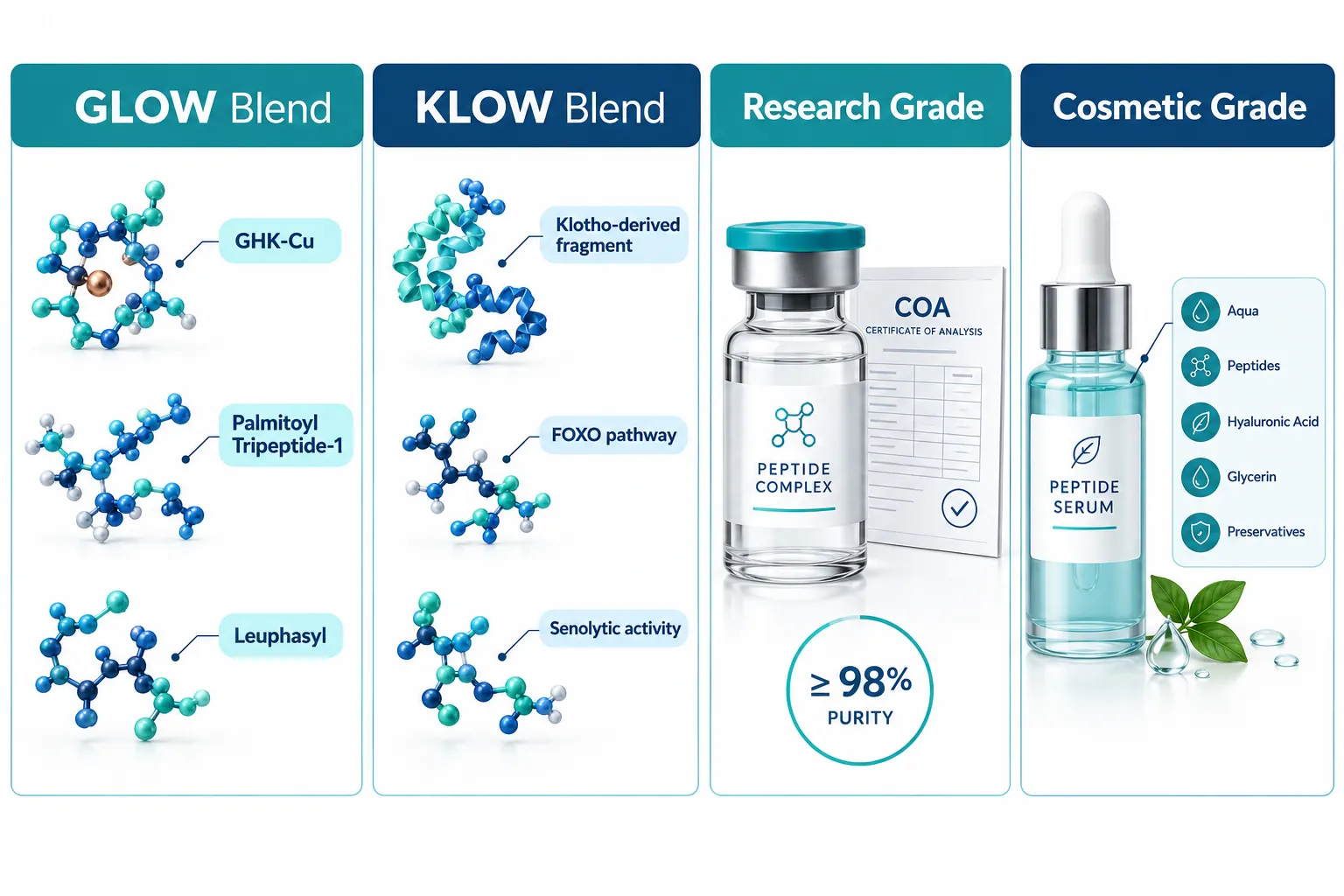
Glow Blend is a multi-peptide formulation typically built around skin-targeted bioactive peptides such as GHK-Cu (copper tripeptide-1), Palmitoyl Tripeptide-1, and signal peptides like Leuphasyl. These components are selected for their studied roles in collagen synthesis signaling, oxidative stress modulation, and dermal matrix support. In a research context, Glow Blend is examined for its potential effects on fibroblast activity and extracellular matrix remodeling.

Klow Blend takes a different mechanistic angle. It is formulated around Klotho-derived peptide fragments, which are of significant interest in longevity and cellular senescence research. Klotho-related peptides are studied for their interactions with FOXO signaling pathways, fibroblast growth factor receptors, and potential senolytic-adjacent activity. Klow Blend is therefore positioned more firmly in the anti-aging and cellular biology research space, rather than the topical cosmetic space.

The distinction matters enormously when sourcing. Because Glow Blend overlaps with cosmetic ingredient categories, it occupies a gray zone where cosmetic-grade and research-grade products can appear nearly identical on a product page. Klow Blend, being less mainstream, is more consistently sold through research-oriented channels, but that does not guarantee quality by default.

For broader context on how peptide blends are structured and categorized, the Peptides 101 for Research-Use Only Buyers guide provides a strong foundation.

Research-Grade vs Cosmetic-Grade: What the Distinction Actually Means
Research-Grade vs Cosmetic-Grade: What the Distinction Actually Means

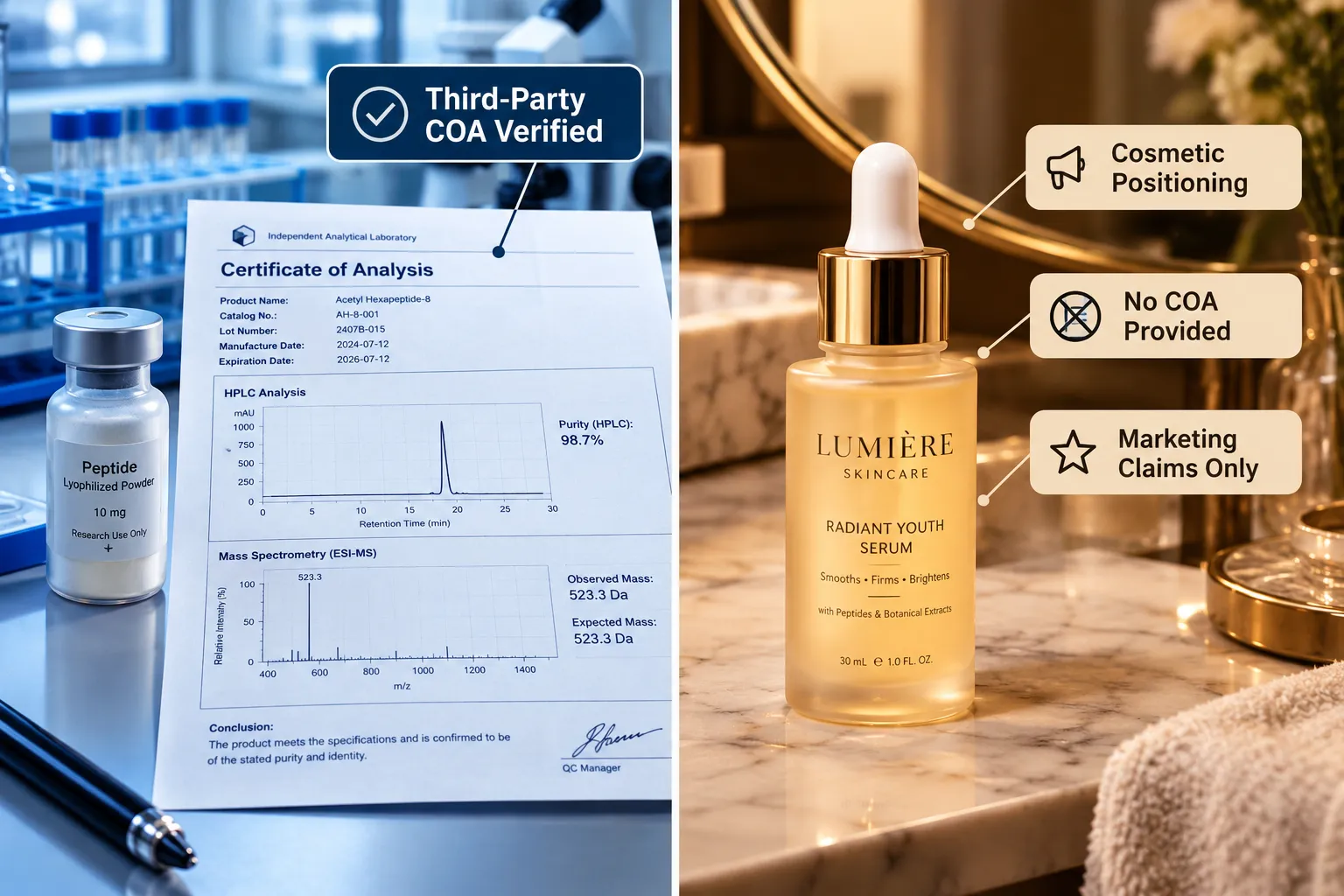
The terms "research-grade" and "cosmetic-grade" are not always defined consistently across the industry, which creates real confusion for buyers. Here is what each designation should mean in practice:

Research-Grade Standards

  • Purity of 98% or higher, confirmed by HPLC (High-Performance Liquid Chromatography)
  • Mass spectrometry verification of correct amino acid sequence
  • Endotoxin testing results included on the COA
  • Sterility or microbial testing documentation
  • Batch-specific COA linked to the product lot number
  • Clear "for research use only" labeling, not intended for human consumption

Cosmetic-Grade Standards

  • Purity thresholds are lower and often unspecified
  • COAs may be absent, generic, or not batch-specific
  • Formulated for topical application, not injection or reconstitution
  • May include preservatives, emulsifiers, or carrier ingredients not suitable for research
  • Often sold with marketing language implying direct skin or health benefits

"A COA without an HPLC chromatogram attached is not a COA, it is a label."

This distinction is especially critical for Glow Blend, where cosmetic serum brands and research peptide vendors may use nearly identical product names. A buyer who does not check for batch-specific HPLC data could easily purchase a cosmetic formulation while believing they have secured a research-grade compound.

Similar sourcing diligence applies to other research peptide blends. Buyers exploring BPC-157 and TB-500 blend products will recognize the same documentation requirements.

Where to Buy Glow Blend and Klow Blend Peptides Online: Vendor Evaluation Framework
Where to Buy Glow Blend and Klow Blend Peptides Online: Vendor Evaluation Framework

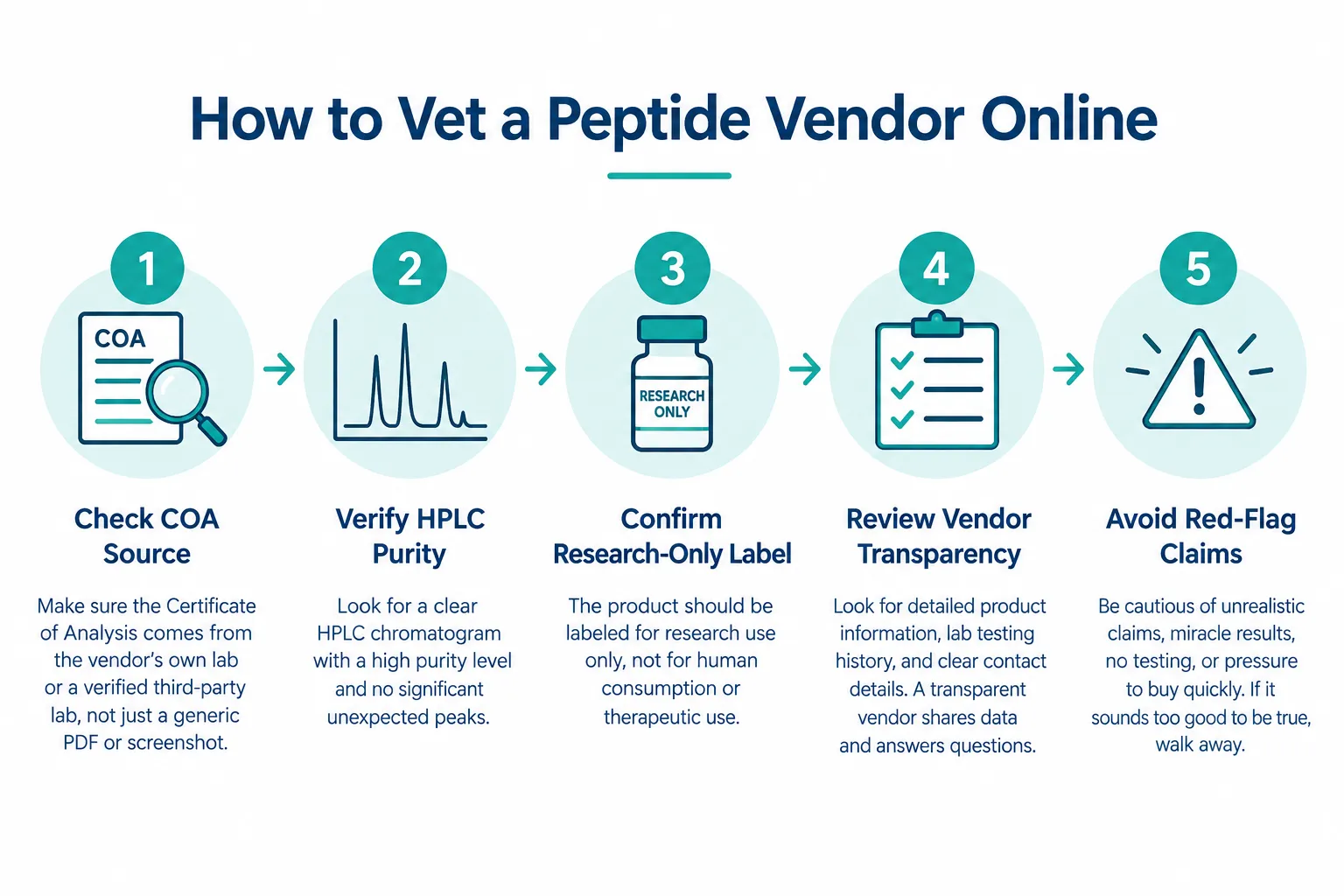
Knowing where to buy Glow Blend and Klow Blend peptides online requires a structured approach to vendor evaluation. The following framework helps separate credible research suppliers from cosmetic-adjacent or low-quality sources.

Step 1: Confirm Third-Party COA Availability

Every legitimate research-grade vendor publishes batch-specific COAs from independent laboratories. The COA should include:

  • HPLC purity percentage (target: 98%+)
  • Mass spectrometry confirmation
  • Endotoxin levels
  • The specific lot number matching the product being sold

If a vendor links to a generic or undated COA, treat it as a red flag.

Step 2: Evaluate Research-Only Disclaimers

Reputable vendors clearly state that their products are sold for laboratory and research purposes only, not for human use. Vendors who use language like "supports glowing skin" or "clinically shown to reduce wrinkles" without referencing controlled research are blurring the line between cosmetic marketing and research supply, and may not be held to research-grade standards.

Step 3: Assess Vendor Transparency

Look for vendors who publish:

  • Ingredient sourcing disclosures
  • Manufacturing location or GMP (Good Manufacturing Practice) compliance statements
  • Contact information for technical or scientific inquiries
  • Clear return and quality guarantee policies

Buyers sourcing other specialized peptides can apply the same framework. Resources like the guide on where to buy SS31 and Epithalon online demonstrate what transparent vendor communication looks like in practice.

Red Flags to Avoid

Common Red Flags in Peptide Vendor Marketing (2026)

  • Purity claims with no supporting HPLC data
  • COA dated more than 12 months ago with no batch reference
  • Product descriptions using therapeutic or cosmetic benefit language
  • No research-use-only disclaimer anywhere on the product page
  • Vague sourcing statements like “pharmaceutical grade” without documentation

Quality Control Practices: What Separates Top-Tier Suppliers

For both Glow Blend and Klow Blend, the highest-quality research suppliers in 2026 follow a consistent quality control model:

QC Element What to Look For
HPLC Testing Batch-specific chromatogram attached to COA
Mass Spec Sequence confirmation for each peptide component
Endotoxin Results below 1 EU/mg for injectable-grade research
Sterility Microbial testing documentation available
Packaging Lyophilized powder in sealed, labeled vials with lot number

Klow Blend, given its Klotho-derived peptide components, requires particular attention to sequence fidelity. Even minor synthesis errors in Klotho fragment peptides can alter receptor binding behavior, making mass spectrometry confirmation non-negotiable for serious research applications.

For researchers interested in how peptide endocrine interactions are documented and verified, the article on peptides and polypeptides in endocrine pharmacology offers useful mechanistic context.

Regulatory Context and the Telehealth Gray Zone

A growing number of telehealth and concierge wellness services in 2026 are incorporating peptide blends, including Glow Blend formulations, into supervised protocols. This creates a secondary market where research-grade compounds are sourced by practitioners for use in patient-adjacent contexts.

This practice exists in a regulatory gray zone. In the United States, peptides sold as research chemicals are not FDA-approved for human therapeutic use. Practitioners sourcing these compounds bear responsibility for verifying purity and safety documentation. Buyers in this space should be especially rigorous about COA verification and should not assume that a telehealth provider's use of a compound implies regulatory approval.

Understanding peptide dosing considerations is a related area where documentation quality directly affects research validity and safety.

Conclusion

Sourcing Glow Blend and Klow Blend peptides online in 2026 demands more than finding a vendor with a professional-looking website. The gap between cosmetic-grade and research-grade products is real, measurable, and consequential for anyone conducting legitimate research or operating within a supervised protocol.

Actionable next steps:

  1. Request batch-specific COAs with HPLC chromatograms before purchasing any Glow or Klow Blend product.
  2. Verify that the vendor uses clear research-only disclaimers and avoids therapeutic benefit language.
  3. Cross-reference endotoxin and mass spectrometry data for Klow Blend products specifically, given the sequence sensitivity of Klotho-derived fragments.
  4. Avoid vendors who cannot provide direct contact for scientific or technical questions.
  5. Use the vendor evaluation framework above as a repeatable checklist for every new supplier.

Quality documentation is not a bureaucratic formality, it is the foundation of reproducible, trustworthy research.

Tags: buy peptides online, certificate of analysis peptides, cosmetic-grade vs research-grade, glow blend peptides, klow blend peptides, peptide quality control, peptide sourcing online, research grade peptides
https://www.puretestedpeptides.com/wp-content/uploads/2026/09/where-to-buy-glow-blend-and-klow-blend-peptides-online-research-grade-vs-cosmeti.webp 1024 1536 https://www.puretestedpeptides.com/wp-content/uploads/2026/01/buy-peptides-online.jpg 2026-09-13 13:04:202026-09-13 13:04:20Where to Buy Glow Blend and Klow Blend Peptides Online: Research-Grade vs Cosmetic-Grade Sourcing and Quality Control
You might also like
Klow Blend vs Glow Blend: Choosing Skin and Wellness Peptide Formulations for Different Research Endpoints Klow Blend vs Glow Blend: Choosing Skin and Wellness Peptide Formulations for Different Research Endpoints
Complement-Dependent Cytotoxicity and Peptide-Based Assays: Safety Considerations for BPC-157, GHK-Cu, and Glow Blend Research Complement-Dependent Cytotoxicity and Peptide-Based Assays: Safety Considerations for BPC-157, GHK-Cu, and Glow Blend Research
Collagen Research Peptides: Where GHK-Cu, Glow Blend, and Skin-Focused Formulas Fit in Laboratory Models Collagen Research Peptides: Where GHK-Cu, Glow Blend, and Skin-Focused Formulas Fit in Laboratory Models
Where to Buy Research-Grade GLP-3 Retatrutide: Purity Standards, Vendor Selection, and Lab Considerations Where to Buy Research-Grade GLP-3 Retatrutide: Purity Standards, Vendor Selection, and Lab Considerations
Where to Buy Research-Grade Glow Blend Peptide: Evaluating Purity, Copper Complexes, and Skin-Model Compatibility Where to Buy Research-Grade Glow Blend Peptide: Evaluating Purity, Copper Complexes, and Skin-Model Compatibility
Epithalon Peptide Formulations: How Labs Compare Lyophilized vs Solution Stability in Telomere Research Epithalon Peptide Formulations: How Labs Compare Lyophilized vs Solution Stability in Telomere Research
Where to Buy Research-Grade MOTS‑c and 5‑Amino‑1MQ: Quality Criteria for Mitochondrial Peptide Studies Where to Buy Research-Grade MOTS‑c and 5‑Amino‑1MQ: Quality Criteria for Mitochondrial Peptide Studies
Best Research-Grade Hair Follicle and Tissue Compounds: Finasteride vs. GHK-Cu and Copper Peptide Formulations Best Research-Grade Hair Follicle and Tissue Compounds: Finasteride vs. GHK-Cu and Copper Peptide Formulations
0 replies

Leave a Reply

Want to join the discussion?
Feel free to contribute!

Leave a Reply Cancel reply

Your email address will not be published. Required fields are marked *

×

Helpful Links

  • My account
  • Cart
  • Checkout
  • Refund and Returns Policy
  • Privacy Policy
  • SMS Privacy Policy
  • Login
  • My Account
  • Logout

USA Made Lab Tested Peptides

All products are sold for research, laboratory, or analytical purposes only, and are not for human consumption


Pure Tested Peptides is a chemical supplier. Pure Tested Peptides is not a compounding / chemical compounding facility as defined under 503A of the Federal Food, Drug, and Cosmetic act. Pure Tested Peptides is not an outsourcing facility as defined under 503B of the Federal Food, Drug, and Cosmetic act.

The statements made within this website have not been evaluated by the US Food and Drug Administration. The products we offer are not intended to diagnose, treat, cure or prevent any disease.

Human/Animal Consumption Prohibited. Laboratory/In-Vitro Experimental Use Only

Link to: Spironolactone, Cardiorenal Pathways, and Tissue-Repair Peptides: How BPC-157 and TB-500 Complement Classic Heart and Kidney Drug Models Link to: Spironolactone, Cardiorenal Pathways, and Tissue-Repair Peptides: How BPC-157 and TB-500 Complement Classic Heart and Kidney Drug Models Spironolactone, Cardiorenal Pathways, and Tissue-Repair Peptides: How BPC-157...Spironolactone, Cardiorenal Pathways, and Tissue-Repair Peptides: How BPC-157 and TB-500 Complement Classic Heart and Kidney Drug Models Link to: Peptide Research and Omeprazole: What Acid-Suppressing Drugs Mean for GLP-2 and Gut-Focused Studies Link to: Peptide Research and Omeprazole: What Acid-Suppressing Drugs Mean for GLP-2 and Gut-Focused Studies Peptide Research and Omeprazole: What Acid-Suppressing Drugs Mean for GLP-2 and Gut-Focused StudiesPeptide Research and Omeprazole: What Acid-Suppressing Drugs Mean for GLP-2...
Scroll to top Scroll to top Scroll to top