Call or Text 727-513-9780
  • Shopping Cart Shopping Cart
    0Shopping Cart
Pure Tested Peptides | America's most trusted Peptides for sale online
  • Peptides for sale
    • Oral Peptides for sale
      • Peptide Capsules for sale
      • BPC 157 Capsules 1000mcg
      • SLU-PP-332 Capsules | 1000 mcg
      • 5-Amino-1MQ 50mg Capsules
      • Tesofensine 500mcg
    • All Peptides for sale
    • Peptide Sprays
      • BPC 157 Nasal Spray Kit
      • BPC-157 TB500 Nasal Spray Kit
      • Semax Nasal Spray 10mg
      • Selank – Nasal Spray Kit – 10mg
      • Epithalon 50MG Nasal Spray Kit
      • Ipamorelin 10mg Nasal Spray
      • Klow Nasal Spray (BPC-157 + TB-500 + GHK-Cu + KPV) | 80mg
      • Hulk Nasal Spray Tesa / Ipa Blend 6/3 MG
      • Klow Nasal Spray
      • NAD + 500 mg Nasal Spray
      • PT-141 Nasal Spray Kit
    • GHRH Peptides
      • Ipa Peptides
      • CJC-1295 Peptides
        • CJC-1295 with DAC 5 mg
        • CJC-1295 without DAC 5 mg
        • CJC-1295 Ipa 10mg
      • Tesa Peptides
        • Tesa Peptide
        • Tesa 20 mg
    • GHK-Cu Peptides
      • All GHK-Cu Peptides
      • GHK-Cu 100mg
      • KLOW Peptide Blend – Buy KLOW blend online
    • BPC Peptides
      • All BPC Peptides
      • BPC-157
      • BPC-157 TB-500
      • BPC 157 capsules 1000mcg
    • SLU-PP-332 Peptides
      • All SLU-PP-332 Peptides
      • SLU-PP-332 5mg
    • GLP3 Peptides
    • PT-141 Peptides
      • PT-141 Peptides for sale
      • PT-141 10mg
      • PT-141 Nasal Spray
    • CAG Peptides
      • Lipo-C Peptide Blend
      • CAG 5mg
      • CAG 10mg
    • MOTS-C Peptides
      • MOTS-C Peptides for sale
      • MOTS-c peptide
      • MOTS-c 10mg *6 pack*
    • 5 Amino 1MQ Peptides
      • 5 Amino 1MQ Peptides for sale
      • 5-Amino-1MQ 50mg Capsules
      • 5-Amino-1MQ 5mg
    • Epithalon Peptides
      • Epithalon Peptides for sale
      • Epithalon 10mg
      • Epithalon 50mg
  • Shop
    • GLPs
      • 5-Amino-1MQ 50mg Capsules
      • 5-Amino-1MQ 5mg
      • L-Carnitine 500mg/ml
      • Tesofensine 500mcg
      • SLU-PP-332 5mg
      • MOTS-c 10mg *6 pack*
    • Epithalon & BPC Peptides
      • Epithalon 10mg
      • Epithalon 50mg
      • BPC-157
      • BPC 157 capsules 1000mcg
      • BPC-157 TB-500
      • BPC-157 TB500 Nasal Spray Kit
      • BPC 157 Nasal Spray Kit
    • BPC TB-500 & NAD+ Peptides
      • NAD+ 500 mg
      • KLOW Peptide Blend – Buy KLOW blend online
      • GLOW Peptide Blend
      • TB 500 5mg
      • BPC 157 capsules 1000mcg – Supplement
      • BPC 157 Nasal Spray Kit
      • BPC-157
      • BPC-157 TB500 Nasal Spray Kit
      • BPC-157 TB-500
      • BPC 157 capsules 1000mcg
    • LL-37 Peptide
      • LL-37 10 mg
    • MOTS-C & Selank
      • MOTS-c peptide
      • Selank 10mg
    • GHK Peptides
      • GHK-Cu 100mg
      • GLOW Peptide Blend
      • KLOW Peptide Blend – Buy KLOW blend online
  • COAs
  • Wholesale
    • Wholesale Peptides for sale
  • PTP FAQ
  • Affiliates
    • Selank Peptide: Advanced Pharmacological Mechanisms Underlying Its Anxiolytic and Nootropic Effects in Research
      • 5-Amino-1MQ Peptide: Detailed Mechanisms of NNMT Inhibition and Its Impact on Cellular Metabolism Research
        • MOTS-C Peptide: Unraveling Its Role in Mitochondrial Dynamics and Energy Metabolism Research
          • Epithalon Peptide and Telomerase Regulation: Investigating Its Impact on Cellular Senescence and Lifespan Research Models
            • GLP2-T vs GLP2 Tirz Peptide: Understanding the Naming, Mechanistic Nuances, and Research Implications for Gut Health
      • Peptides and Polypeptides in Modern Pharmacology: What Research on Metoprolol, Prednisone, and Amlodipine Reveals
        • Polypeptide Peptides vs NSAIDs: What Naproxen and Diclofenac Teach Tissue-Repair Researchers About BPC‑157 and TB‑500
          • Peptides and Polypeptides in Endocrine Pharmacology: How GLP-1, GLP-2, and GLP-3 Retatrutide Differ From Classic Drugs Like Prednisone and Amlodipine
          • 5‑Amino‑1MQ Peptide and NNMT Inhibition: How It Compares With Statins Like Atorvastatin in Adipose and Lipid Metabolism Research
      • Enclomiphene, Estrogen Receptor Signaling, and Luteinizing Phase Biology: What Hormone Researchers Should Measure
        • Mesenchymal Stem Cells, BPC‑157, and GHK‑Cu: How Tissue Repair Peptides Compare With Classic NSAIDs Like Naproxen in Injury Models
          • Peptide Calculator Use Cases Beyond Growth Hormone: Working Through GLP‑3 Retatrutide, MOTS‑c, and BPC‑157 Research Dosing
        • Polypeptide Peptides in Endocrine and Metabolic Pharmacology: Lessons From Amlodipine, Prednisone, and Metoprolol
        • Peptides Calculator for Advanced Blends: Worked Examples for Tesamorelin, CJC‑1295, and Ipamorelin Stacks
          • Peptides and Polypeptides in Human Physiology: How Molecular Size Shapes Research Applications
            • Selank Peptide: Advanced Pharmacological Mechanisms Underlying Its Anxiolytic and Nootropic Effects in Research
          • 5-Amino-1MQ Peptide: Detailed Mechanisms of NNMT Inhibition and Its Impact on Cellular Metabolism Research
            • MOTS-C Peptide: Unraveling Its Role in Mitochondrial Dynamics and Energy Metabolism Research
              • Epithalon Peptide and Telomerase Regulation: Investigating Its Impact on Cellular Senescence and Lifespan Research Models
                • GLP2-T vs GLP2 Tirz Peptide: Understanding the Naming, Mechanistic Nuances, and Research Implications for Gut Health
                  • Peptides and Polypeptides in Endocrine Pharmacology: How GLP-1, GLP-2, and GLP-3 Retatrutide Differ From Classic Drugs Like Prednisone and Amlodipine
                    • Polypeptide Peptides vs NSAIDs: What Naproxen and Diclofenac Teach Tissue-Repair Researchers About BPC‑157 and TB‑500
                      • Peptides and Polypeptides in Modern Pharmacology: What Research on Metoprolol, Prednisone, and Amlodipine Reveals
                        • 5‑Amino‑1MQ Peptide and NNMT Inhibition: How It Compares With Statins Like Atorvastatin in Adipose and Lipid Metabolism Research
                        • Enclomiphene, Estrogen Receptor Signaling, and Luteinizing Phase Biology: What Hormone Researchers Should Measure
                        • Mesenchymal Stem Cells, BPC‑157, and GHK‑Cu: How Tissue Repair Peptides Compare With Classic NSAIDs Like Naproxen in Injury Models
                        • Peptide Calculator Use Cases Beyond Growth Hormone: Working Through GLP‑3 Retatrutide, MOTS‑c, and BPC‑157 Research Dosing
                        • Polypeptide Peptides in Endocrine and Metabolic Pharmacology: Lessons From Amlodipine, Prednisone, and Metoprolol
                        • Peptides Calculator for Advanced Blends: Worked Examples for Tesamorelin, CJC‑1295, and Ipamorelin Stacks
                        • Peptides and Polypeptides in Human Physiology: How Molecular Size Shapes Research Applications
                        • Selank Peptide: Advanced Pharmacological Mechanisms Underlying Its Anxiolytic and Nootropic Effects in Research
                        • MOTS-C Peptide: Unraveling Its Role in Mitochondrial Dynamics and Energy Metabolism Research
                        • Peptides and Polypeptides in Modern Pharmacology: What Research on Metoprolol, Prednisone, and Amlodipine Reveals
                        • Peptides and Polypeptides in Endocrine Pharmacology: How GLP-1, GLP-2, and GLP-3 Retatrutide Differ From Classic Drugs Like Prednisone and Amlodipine
                        • 5-Amino-1MQ Peptide: Detailed Mechanisms of NNMT Inhibition and Its Impact on Cellular Metabolism Research
                        • Mesenchymal Stem Cells, BPC‑157, and GHK‑Cu: How Tissue Repair Peptides Compare With Classic NSAIDs Like Naproxen in Injury Models
                        • Peptide Calculator Use Cases Beyond Growth Hormone: Working Through GLP‑3 Retatrutide, MOTS‑c, and BPC‑157 Research Dosing
                        • GLP2-T vs GLP2 Tirz Peptide: Understanding the Naming, Mechanistic Nuances, and Research Implications for Gut Health
                        • Polypeptide Peptides in Endocrine and Metabolic Pharmacology: Lessons From Amlodipine, Prednisone, and Metoprolol
                        • Polypeptide Peptides vs NSAIDs: What Naproxen and Diclofenac Teach Tissue-Repair Researchers About BPC‑157 and TB‑500
                        • Peptides and Polypeptides in Human Physiology: How Molecular Size Shapes Research Applications
                        • Peptides Calculator for Advanced Blends: Worked Examples for Tesamorelin, CJC‑1295, and Ipamorelin Stacks
                        • 5‑Amino‑1MQ Peptide and NNMT Inhibition: How It Compares With Statins Like Atorvastatin in Adipose and Lipid Metabolism Research
                        • Enclomiphene, Estrogen Receptor Signaling, and Luteinizing Phase Biology: What Hormone Researchers Should Measure
                        • Epithalon Peptide and Telomerase Regulation: Investigating Its Impact on Cellular Senescence and Lifespan Research Models
                        • Best research protocol Klow blend
                        • best time to take BPC-157
                        • best time to take DSIP (Delta Sleep Inducing Peptide)
                        • best time to take CJC-1295
                        • best time to take AOD-9604
                        • best time to take Follistatin 344
                        • best time to take Ipamorelin
                        • best time to take MK-677 (Ibutamoren)
                        • best time to take Ligandrol (LGD-4033) — research compound
                        • best time to take Ostarine (MK-2866) — research compound
                        • best time to take GHK-CU
                        • best time to take TB-500
                        • best time to take MOTS-c
                        • best time to take Semax
                        • best time to take RAD-140 (Testolone) — research compound
                        • best time to take Thymosin Alpha-1
                        • best time to take PEG-MGF
                        • Biolife Plasma, Octapharma Plasma, and Research Peptides: How Plasma Donation Labs Differ From Peptide Suppliers
                        • best time to take YK-11 — research compound
                        • best time to take PT-141 (Bremelanotide)
                        • Best research protocol Klow blend
                        • 5-Amino-1MQ and MOTS-C Synergy: Metabolic Signaling, Mitochondria, and Research Design
                        • BPC-157 and TB-500: Investigating Their Combined Effects on Angiogenesis and Cellular Migration in Tissue Repair Models
                        • BPC-157 Peptide: Gut Barrier Function, Inflammation, and Tissue-Recovery Research
                        • 5‑Amino‑1MQ and MOTS‑c Synergy in Metabolic Research: Designing NNMT and Mitochondrial Biogenesis Stacks
                        • CJC-1295 with DAC vs. Without DAC: Half-Life, Release Kinetics, and Research Implications
                        • CJC‑1295 with DAC vs. Without DAC: Expanding on Half‑Life Differences Using Tesamorelin and Ipamorelin Blend Case Studies
                        • Collagen Biology and Copper‑Binding Peptides: How GHK‑Cu, Glow Blend, and Klow Blend Interact with Skin and Connective Tissue
                        • Collagen Biology and Regenerative Peptides: How GHK‑Cu, Glow Blend, and Klow Blend Affect Extracellular Matrix Research
                    • DNA, Telomeres, and Longevity Peptides: Positioning Epithalon and MOTS‑c in Genetic Aging Research
                      • Enclomiphene Citrate: serm Mechanism, Testosterone Research, and Stack Compatibility
                        • Enclomiphene vs Enclomiphene Citrate: Formulation, Bioavailability, and Research Distinctions
                        • Epithalon Peptide Research: Telomerase Activation, Aging, and Pineal Gland Function
                        • Estrogen Receptor Signaling and Enclomiphene: How Selective Modulators Compare with Classic Polypeptide Hormones
                        • GHK-Cu Peptide: Advanced Mechanisms in Extracellular Matrix Remodeling and Wound Healing Research
                        • GHK-Cu Peptide: Collagen Synthesis, Wound Repair, and Skin-Barrier Research Models
                        • GLP-1 vs GLP-3 vs GLP-2: Peptide Classification and Research Applications
                        • GLP-2 Peptide Research Guide: Gut Barrier Function, Nutrient Absorption, and Intestinal Recovery Models
                        • GLP-3 Retatrutide vs. GLP-1 Drugs: What Triple-Agonist Biology Changes in Research Models
                        • Ipamorelin and Tesamorelin Combination: Synergistic GH Secretagogue Research and Dosing Protocols
                        • GLP2 Tirz Peptide: What It Is, Why the Name Exists, and How Researchers Should Interpret It
                        • Klow Blend Peptide Nasal Spray: What the Formulation Is Trying to Do in Cognitive Research
                        • Mitochondria, NNMT Inhibition, and Peptide Modulators: Where MOTS‑c and 5‑Amino‑1MQ Fit in Cellular Energy Research
                        • MOTS-c Peptide: Mitochondrial Function, Energy Metabolism, and What Researchers Measure
                        • MOTS-c vs. 5-Amino-1MQ: Which Metabolic Research Questions Each Compound Actually Answers
                        • Nasal Spray Peptides: Bioavailability, Administration, and Semax/Selank Research Applications
                        • PT-141 Peptide Research: Mechanism of Action and Melanocortin Receptor Signaling
                        • Retatrutide for Research: Mechanism, Structure, and GLP-1/GLP-3 Dual Action
                        • Retatrutide for Obesity and Type 2 Diabetes: What the Latest Trial Data Suggest
                        • Tesofensine Peptide Research: Mechanism, Appetite Suppression, and Neuropeptide Y Pathways
  • Contact
    • Contact Customer Service
    • Text Customer Support
  • About US
  • Shop all peptides
  • Affiliate Program
    • Affiliate Signup
  • Login / Register Login / Register Page Link Login / Register Page Link
  • Click to open the search input field Click to open the search input field Search
  • Menu Menu
Slupp332 and 5-Amino-1MQ: Designing Metabolic Flux Experiments Without Assuming Synergy

Slupp332 and 5-Amino-1MQ: Designing Metabolic Flux Experiments Without Assuming Synergy

October 14, 2026/0 Comments/in Uncategorized/by

Fewer than a dozen peer-reviewed studies have examined SLU-PP-332 in living systems, and preclinical data for 5-Amino-1MQ remain almost entirely confined to rodent adipose models, yet both compounds are already being marketed together as a "multifaceted metabolic approach." The topic of Slupp332 and 5-Amino-1MQ: Designing Metabolic Flux Experiments Without Assuming Synergy matters precisely because combining two mechanistically distinct research compounds without a proper factorial design produces uninterpretable data and, worse, misleading conclusions.

Key Takeaways

  • SLU-PP-332 and 5-Amino-1MQ act through completely separate molecular targets and should never be assumed to produce synergistic effects without statistical proof.
  • A factorial experimental design with at least four treatment arms is the minimum standard for testing whether an interaction between these compounds actually exists.
  • Metabolic flux endpoints, oxygen consumption rate, NAD+/NADH ratio, NNMT enzyme activity, must be measured independently before any combination data can be interpreted.
  • Neither compound has completed human obesity trials or received regulatory approval as of 2026; all data are preclinical or in vitro.
  • Marketing language about "synergy" is not a substitute for an interaction F-test in a properly powered study.

Distinct Mechanisms: Why Assuming Synergy Is a Scientific Error
Distinct Mechanisms: Why Assuming Synergy Is a Scientific Error

Understanding Slupp332 and 5-Amino-1MQ: Designing Metabolic Flux Experiments Without Assuming Synergy begins with a clear separation of mechanisms.

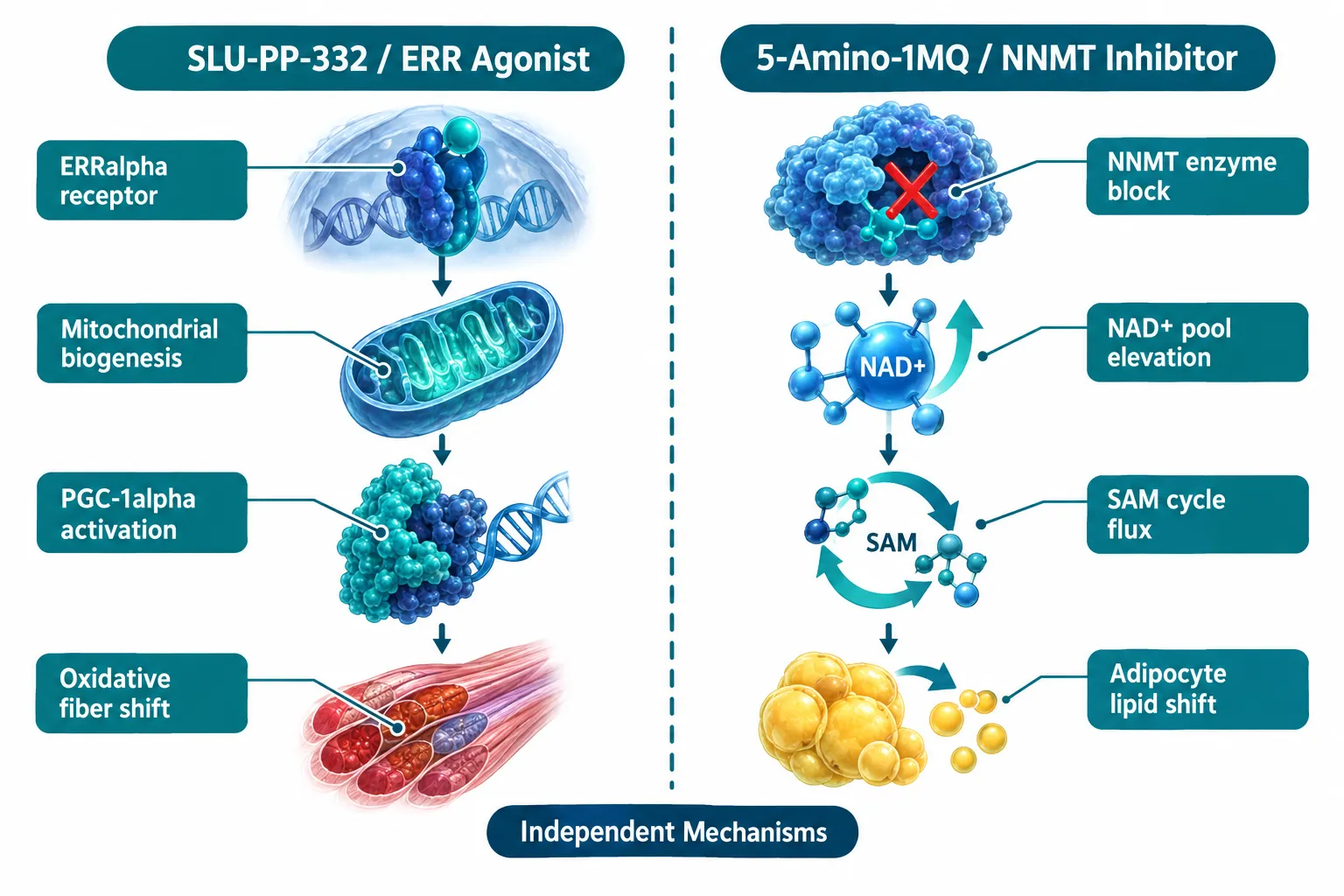
SLU-PP-332 (SLU-PP-332) is an agonist of estrogen-related receptors, particularly ERRalpha and ERRgamma. These nuclear receptors regulate mitochondrial biogenesis, oxidative phosphorylation gene expression, and the shift toward slow-twitch, fatigue-resistant muscle fiber types. Its endurance-related effects in rodent models have drawn comparisons to exercise adaptation, which is where the "exercise pill" label, and the skepticism that follows it, originates.

5-Amino-1MQ works through an entirely different mechanism. It inhibits nicotinamide N-methyltransferase (NNMT), an enzyme that consumes S-adenosylmethionine (SAM) while methylating nicotinamide. By blocking NNMT, the compound is thought to elevate intracellular NAD+ pools and shift the SAM cycle, which in turn influences adipocyte differentiation and lipid storage. Preclinical obesity data in rodents show modest reductions in fat mass, but these findings have not been replicated in human trials.

"Two compounds acting on different enzymes and receptors are not automatically additive, let alone synergistic. Interaction must be demonstrated, not assumed."

The practical implication is straightforward: because ERR agonism and NNMT inhibition operate on separate nodes of the metabolic network, their combined effect could be additive, sub-additive, or genuinely synergistic, and only a properly designed experiment can tell which.

For broader context on how small molecules like these fit into the research peptide landscape, the Peptides 101 for research-use only buyers guide provides useful background on structure, mechanisms, and compound classification.


Building a Factorial Design for Metabolic Flux Research
Building a Factorial Design for Metabolic Flux Research

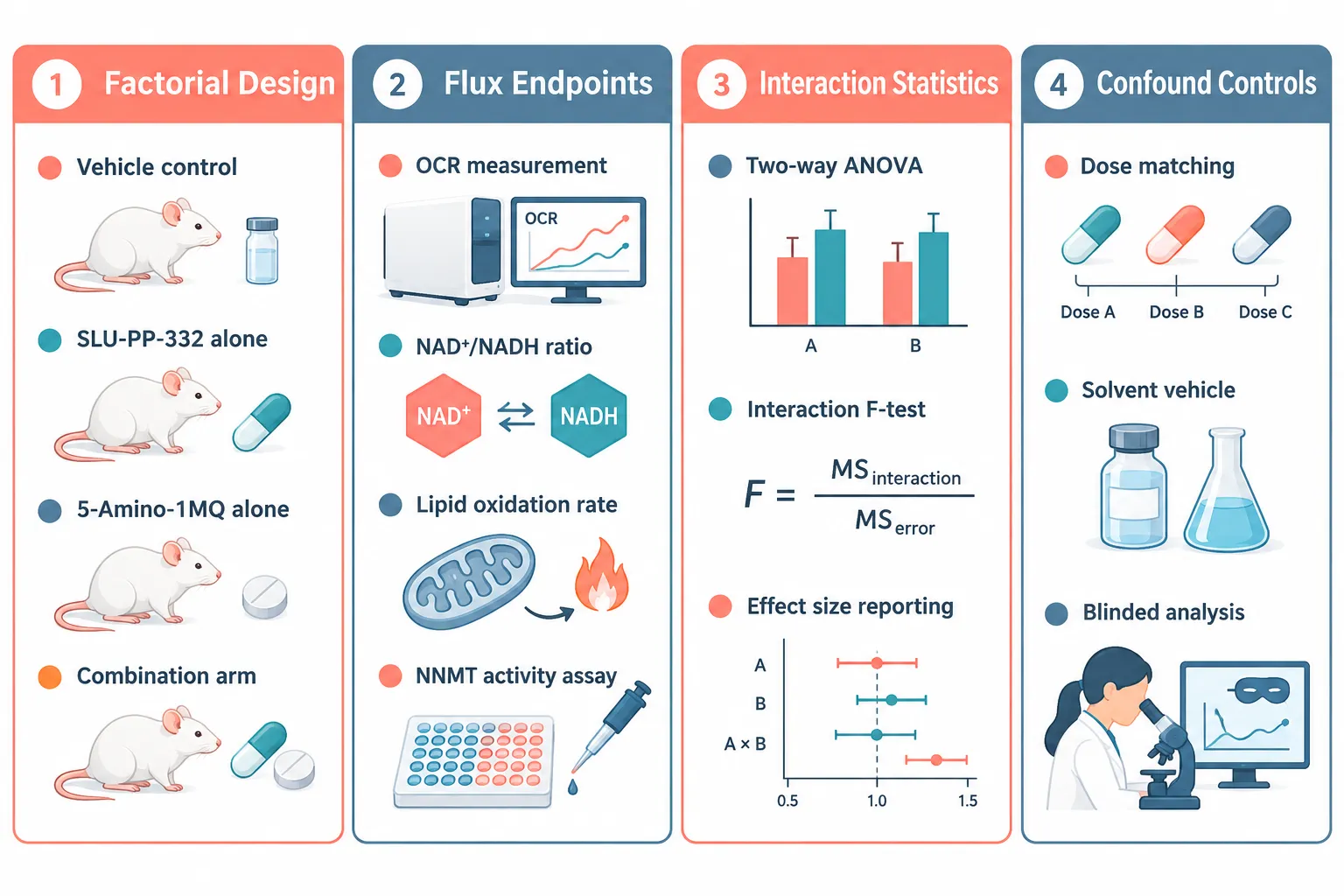
The core framework for Slupp332 and 5-Amino-1MQ: Designing Metabolic Flux Experiments Without Assuming Synergy is a 2×2 factorial design with four treatment arms:
Building a Factorial Design for Metabolic Flux Research

Arm SLU-PP-332 5-Amino-1MQ
1 (Vehicle control) No No
2 (ERR agonist only) Yes No
3 (NNMT inhibitor only) No Yes
4 (Combination) Yes Yes

This structure allows researchers to calculate a true interaction term using two-way ANOVA. If the combination arm produces an effect that is statistically greater than the sum of arms 2 and 3, synergy is supported. If not, the null hypothesis of additivity stands.

Concentration and Solvent Controls

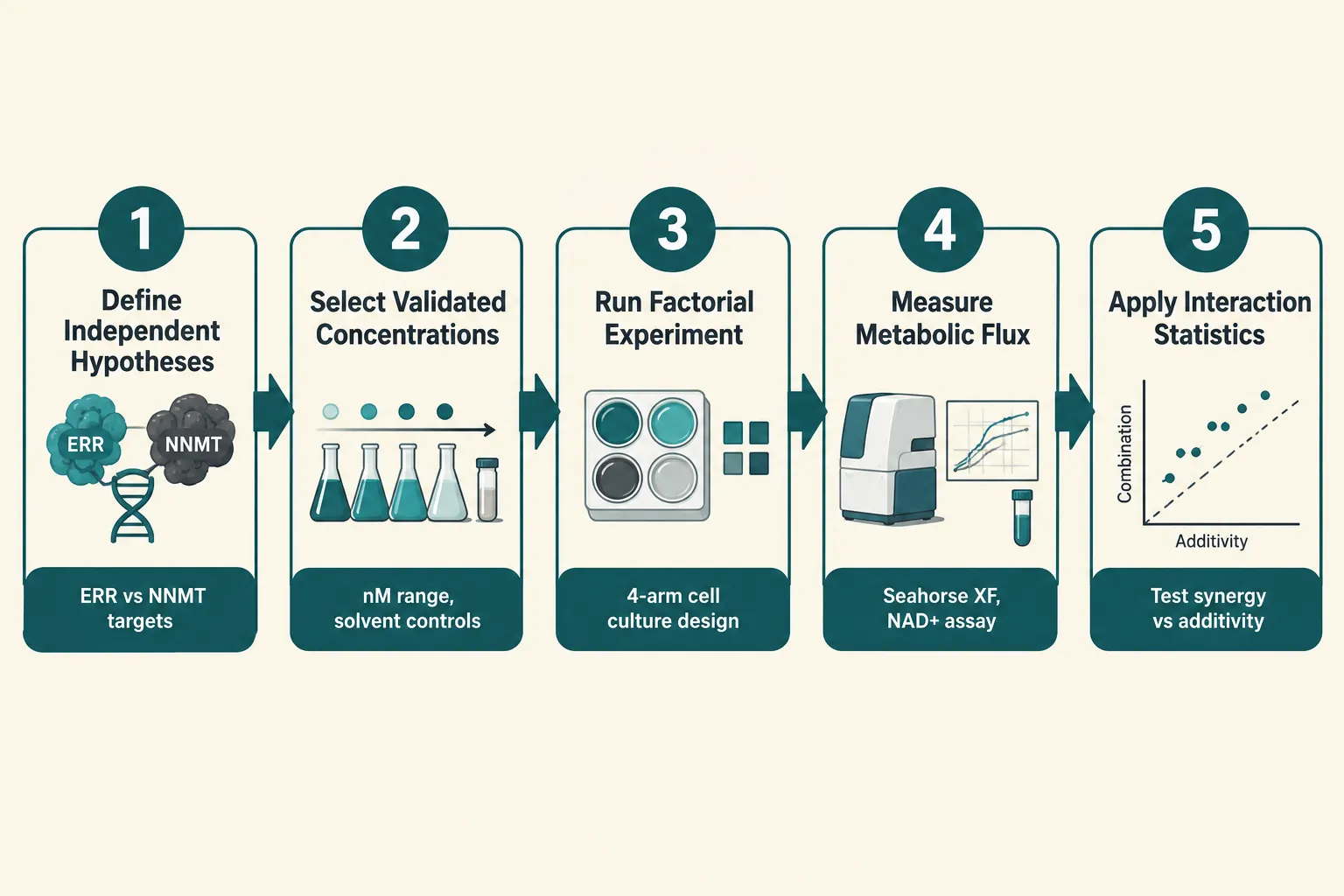
Both compounds present solubility challenges. SLU-PP-332 is typically dissolved in DMSO, and 5-Amino-1MQ requires aqueous buffering at physiological pH. Solvent vehicle controls must be matched across all arms, a step frequently omitted in informal or commercially motivated reports. Recommended starting concentrations for in vitro work are in the low nanomolar to low micromolar range, with dose-response curves run before any combination experiment begins.

Choosing Flux-Oriented Endpoints

The following endpoints are appropriate for this experimental framework:

  • Oxygen consumption rate (OCR): Measured via Seahorse XF analysis; reflects mitochondrial respiration and is the primary readout for SLU-PP-332 activity.
  • NAD+/NADH ratio: Enzymatic cycling assay; the primary quantitative readout for 5-Amino-1MQ's effect on the NAD+ pool.
  • NNMT enzyme activity: Direct fluorometric assay using nicotinamide substrate; confirms target engagement for 5-Amino-1MQ.
  • Lipid oxidation rate: Radiolabeled fatty acid oxidation or Seahorse fatty acid oxidation kit; relevant to both compounds' downstream effects on adipose metabolism.
  • PGC-1alpha and ERR target gene expression: RT-qPCR panel; confirms SLU-PP-332 target engagement at the transcriptional level.

Researchers interested in related metabolic compounds used in aging-support contexts can explore the aging support product category for additional reference compounds.


Interpreting Results and Avoiding Hype-Driven Conclusions

Once data are collected, the analysis must be hypothesis-driven. The interaction F-test in the two-way ANOVA is the statistical gatekeeper. A non-significant interaction term means the compounds behave independently at the doses tested, a finding that is scientifically valid and publishable, even if it contradicts marketing claims.

Expert commentary in the metabolic pharmacology field consistently flags two problems with current discourse around these compounds:

  1. The "exercise pill" narrative overstates SLU-PP-332's translatability from rodent treadmill models to human endurance physiology.
  2. The "fat-loss stack" narrative for 5-Amino-1MQ extrapolates rodent adipose data to human obesity without bridging pharmacokinetic or dose-equivalence data.

Neither compound has completed a human obesity trial or received regulatory approval as of late 2026. Researchers should clearly label any speculative expectations as such in publications and protocols.

For comparison, examining how well-characterized peptide combinations are studied, such as the safety considerations for combining Tesamorelin with CJC Ipamorelin, illustrates the importance of independent mechanism validation before combination claims are made. Similarly, the Tesamorelin vs Sermorelin comparison demonstrates how mechanistic differences between compounds inform experimental design choices.

Researchers working with growth hormone-related peptides in parallel studies may also find the Sermorelin vs CJC-1295 analysis useful for understanding how distinct receptor targets require separate experimental arms.

Reporting Standards

Published reports on this compound pair should include:

  • Full dose-response data for each compound alone
  • Solvent vehicle control data
  • The interaction F-statistic and p-value
  • Effect sizes (partial eta-squared or Cohen's d)
  • Clear labeling of in vitro vs. in vivo results

Conclusion

The scientific value of studying SLU-PP-332 and 5-Amino-1MQ together depends entirely on the rigor of the experimental design. Slupp332 and 5-Amino-1MQ: Designing Metabolic Flux Experiments Without Assuming Synergy is not just a methodological preference, it is the minimum standard for producing data that can actually advance understanding of metabolic flux modulation.

Actionable next steps for researchers:

  • Run single-compound dose-response curves before any combination experiment.
  • Build a 2×2 factorial design with matched solvent controls in all four arms.
  • Select flux endpoints that directly reflect each compound's known mechanism: OCR for SLU-PP-332, NAD+/NADH and NNMT activity for 5-Amino-1MQ.
  • Pre-register the interaction hypothesis and the statistical analysis plan before data collection begins.
  • Report interaction statistics explicitly, and distinguish between additive and synergistic outcomes in all communications.

The field does not need more marketing-style synergy claims. It needs properly powered factorial experiments with quantitative flux data and honest statistical reporting.

Tags: 5-amino-1mq, err agonist, factorial design, metabolic flux, mitochondrial biogenesis, nad+ research, nnmt inhibitor, slupp332
https://www.puretestedpeptides.com/wp-content/uploads/2026/10/slupp332-and-5-amino-1mq-designing-metabolic-flux-experiments-without-assuming-s.webp 1024 1536 https://www.puretestedpeptides.com/wp-content/uploads/2026/01/buy-peptides-online.jpg 2026-10-14 13:04:262026-10-14 13:04:26Slupp332 and 5-Amino-1MQ: Designing Metabolic Flux Experiments Without Assuming Synergy
You might also like
Atorvastatin in Metabolic Peptide Experiments: Controlling Lipid-Lowering Effects in Retatrutide and Mitochondrial Models Atorvastatin in Metabolic Peptide Experiments: Controlling Lipid-Lowering Effects in Retatrutide and Mitochondrial Models
Peptides and Polypeptides in Mitochondrial Research: How MOTS-c and 5-Amino-1MQ Interact With Mitochondria and ATP Peptides and Polypeptides in Mitochondrial Research: How MOTS-c and 5-Amino-1MQ Interact With Mitochondria and ATP
5-Amino-1MQ and MOTS-c Synergy in Adiposity Research: How Labs Stack Mitochondrial Peptides 5-Amino-1MQ and MOTS-c Synergy in Adiposity Research: How Labs Stack Mitochondrial Peptides
What Is Slupp332 With 5-Amino-1MQ? Research Context, Naming Confusion, and Potential Metabolic Relevance What Is Slupp332 With 5-Amino-1MQ? Research Context, Naming Confusion, and Potential Metabolic Relevance
Creatine Supplementation vs MOTS-c and 5-Amino-1MQ: Comparing Phosphagen and Mitochondrial Peptide Pathways in Muscle Cell Models Creatine Supplementation vs MOTS-c and 5-Amino-1MQ: Comparing Phosphagen and Mitochondrial Peptide Pathways in Muscle Cell Models
5-Amino-1MQ Research Assays: How NNMT-Related Readouts Can Be Separated From MOTS-c and SLU-PP-332 Effects 5-Amino-1MQ Research Assays: How NNMT-Related Readouts Can Be Separated From MOTS-c and SLU-PP-332 Effects
DNA, Mitochondria, and Research Peptides: How MOTS-c and 5-Amino-1MQ Interface With Cellular Energy and Genomic Pathways DNA, Mitochondria, and Research Peptides: How MOTS-c and 5-Amino-1MQ Interface With Cellular Energy and Genomic Pathways
Creatine Supplementation vs. 5-Amino-1MQ: Comparing NNMT Inhibition and Phosphagen Energy Systems in Muscle Cell Models Creatine Supplementation vs. 5-Amino-1MQ: Comparing NNMT Inhibition and Phosphagen Energy Systems in Muscle Cell Models
0 replies

Leave a Reply

Want to join the discussion?
Feel free to contribute!

Leave a Reply Cancel reply

Your email address will not be published. Required fields are marked *

×

Helpful Links

  • My account
  • Cart
  • Checkout
  • Refund and Returns Policy
  • Privacy Policy
  • SMS Privacy Policy
  • Login
  • My Account
  • Logout

USA Made Lab Tested Peptides

All products are sold for research, laboratory, or analytical purposes only, and are not for human consumption


Pure Tested Peptides is a chemical supplier. Pure Tested Peptides is not a compounding / chemical compounding facility as defined under 503A of the Federal Food, Drug, and Cosmetic act. Pure Tested Peptides is not an outsourcing facility as defined under 503B of the Federal Food, Drug, and Cosmetic act.

The statements made within this website have not been evaluated by the US Food and Drug Administration. The products we offer are not intended to diagnose, treat, cure or prevent any disease.

Human/Animal Consumption Prohibited. Laboratory/In-Vitro Experimental Use Only

Link to: Epithalon in Cellular-Aging Models: Separating Telomerase Activity, Telomere Length, DNA Damage, and Senescence Link to: Epithalon in Cellular-Aging Models: Separating Telomerase Activity, Telomere Length, DNA Damage, and Senescence Epithalon in Cellular-Aging Models: Separating Telomerase Activity, Telomere...Epithalon in Cellular-Aging Models: Separating Telomerase Activity, Telomere Length, DNA Damage, and Senescence Link to: Best Research-Grade Nasal Spray Peptides: Comparing Excipient Disclosure, Deposition, Stability, and Documentation Link to: Best Research-Grade Nasal Spray Peptides: Comparing Excipient Disclosure, Deposition, Stability, and Documentation Best Research-Grade Nasal Spray Peptides: Comparing Excipient Disclosure, Deposition, Stability, and DocumentationBest Research-Grade Nasal Spray Peptides: Comparing Excipient Disclosure, Deposition,...
Scroll to top Scroll to top Scroll to top