

Prednisone, Dexamethasone, and Methylprednisolone in Peptide Experiments: Building a Steroid-Exposure Timeline
Corticosteroids linger far longer than most researchers expect. A single dose of dexamethasone can suppress glucocorticoid receptor signaling for up to 54 hours after the drug has already cleared plasma, a gap wide enough to corrupt peptide experiment data without a carefully built steroid-exposure timeline. Understanding how prednisone, dexamethasone, and methylprednisolone in peptide experiments interact with glucose metabolism, appetite signaling, immune function, and tissue repair is not optional; it is the difference between clean results and confounded ones.
Key Takeaways
- Plasma half-life (2-4 hours) and biological half-life (18-54 hours) are completely different; biological half-life governs how long steroid effects overlap with peptide responses.
- Dexamethasone is long-acting (up to 54 h biological effect); prednisone and methylprednisolone are intermediate-acting (18-36 h).
- Non-genomic effects appear within seconds to minutes; genomic effects develop over hours and can persist days after plasma clearance.
- A minimum 3-day washout is a practical starting point for methylprednisolone; dexamethasone may require 5-7 days depending on dose.
- Delayed-release prednisone shifts the onset window by several hours, requiring adjusted peptide dosing schedules.
Why Plasma Half-Life Misleads Peptide Researchers
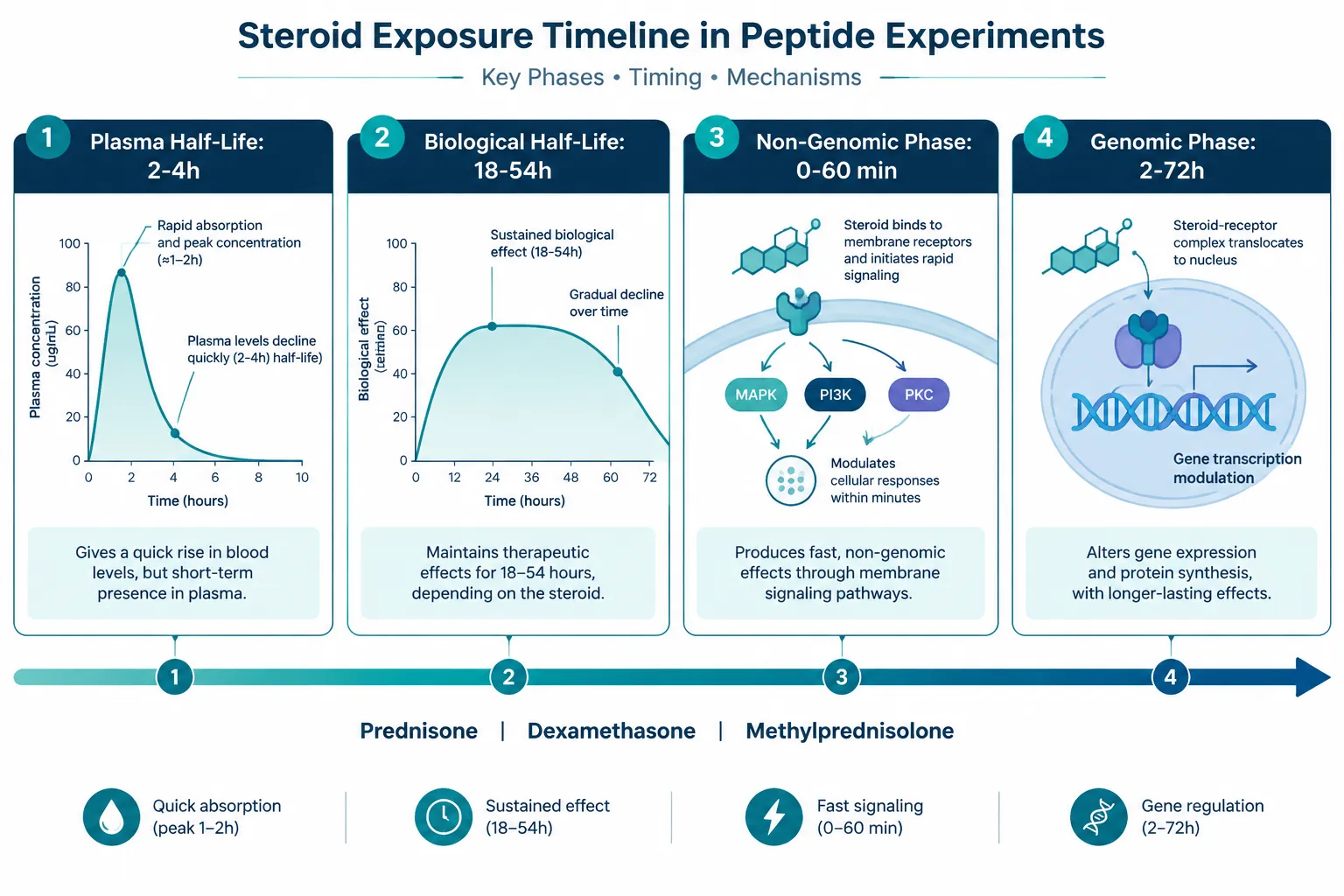
Most researchers check a pharmacokinetics table, read "2-3 hour half-life," and assume the corticosteroid is effectively gone by the next morning. That assumption is wrong for every drug in this class.
The key distinction is between elimination half-life and biological half-life:
| Corticosteroid | Plasma Half-Life | Biological Half-Life | Classification |
|---|---|---|---|
| Prednisone | ~2-3 h | 18-36 h | Intermediate-acting |
| Methylprednisolone | ~2-3 h | 18-36 h | Intermediate-acting |
| Dexamethasone | ~4 h | Up to 54 h | Long-acting |
Biological half-life reflects how long the drug continues to occupy glucocorticoid receptors, modulate gene transcription, and alter downstream signaling, the very pathways that many peptides also target. A peptide administered the morning after a dexamethasone dose is not entering a neutral cellular environment; it is entering one where transcriptional programs related to inflammation, glucose uptake, and protein synthesis are still actively suppressed or altered.
This is why building a proper steroid-exposure timeline is foundational before any co-administration or sequential experiment begins.
The Two-Phase Mechanism and Its Timeline Implications
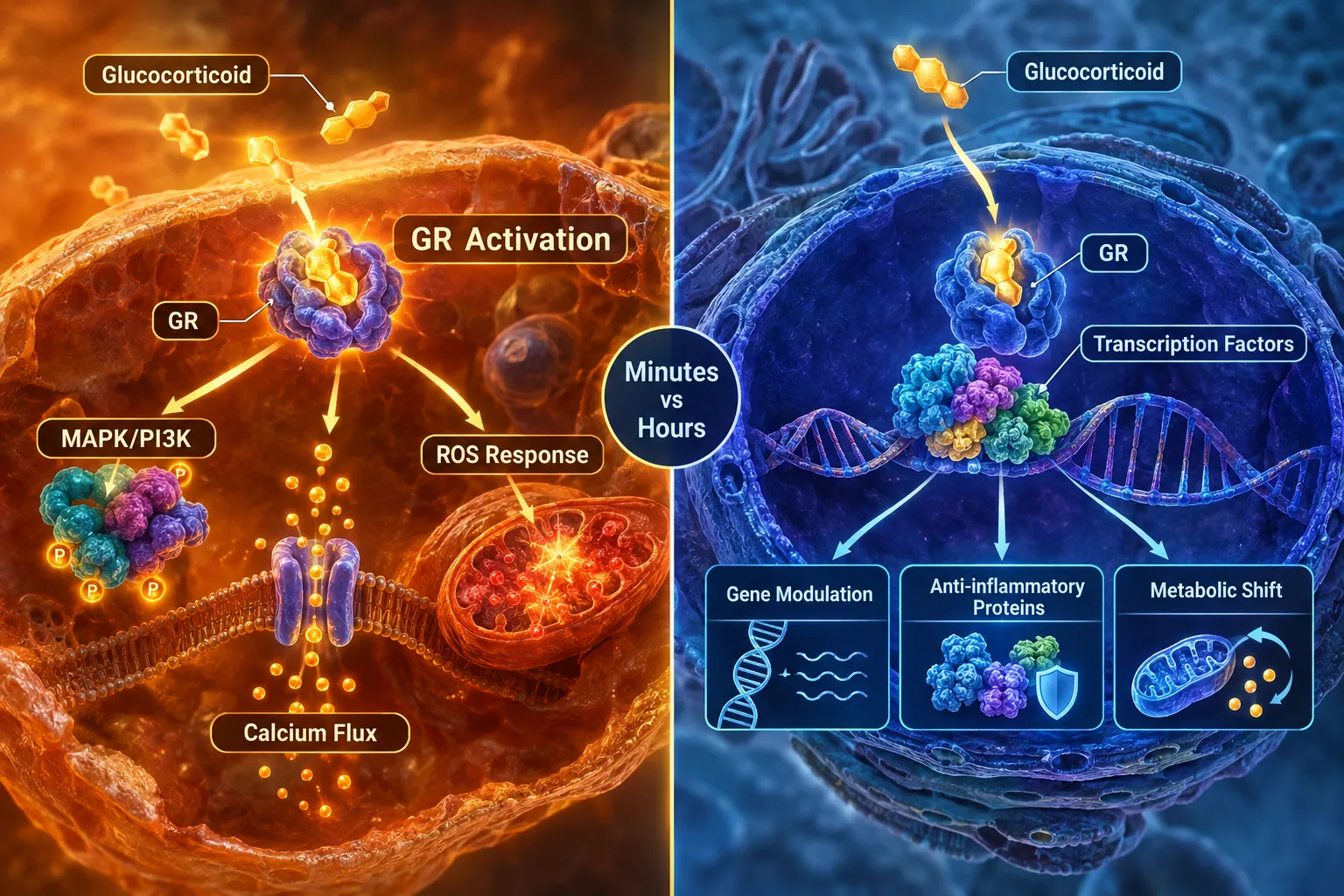
When designing prednisone, dexamethasone, and methylprednisolone in peptide experiments, researchers must account for two mechanistically distinct phases of corticosteroid action that unfold at very different speeds.
Non-Genomic Phase (Seconds to ~60 Minutes)
- Occurs at membrane-bound receptors and cytosolic receptors
- Activates MAPK, PI3K, and calcium-mobilization cascades
- Modulates reactive oxygen and nitrogen species (ROS/RNS) within minutes
- Detectable as early as 1-15 minutes after dexamethasone exposure in cell models
- Vanishes quickly after hormone removal
"Non-genomic actions vanish rapidly after hormone removal, but they can mask or amplify the initial signaling footprint of a simultaneously administered peptide."
This early phase is particularly relevant for peptides that also engage PI3K or MAPK pathways, for example, metabolic peptides studied alongside GLP-3 peptide signaling pathway research.
Genomic Phase (2 Hours to 3+ Days)
- Requires receptor translocation to the nucleus
- Drives changes in transcription factors, anti-inflammatory protein expression, and metabolic gene regulation
- Can begin surprisingly early, robust transcriptional shifts have been detected in some cell models within 10 minutes
- Persists well beyond plasma clearance, especially for dexamethasone
For peptides that influence tissue repair, adipocyte function, or immune modulation, this slow genomic phase is the primary source of confounding. Cells "remember" a steroid exposure through altered transcriptional states long after plasma levels fall to zero.
Building the Washout Timeline: Practical Guidance for Each Agent
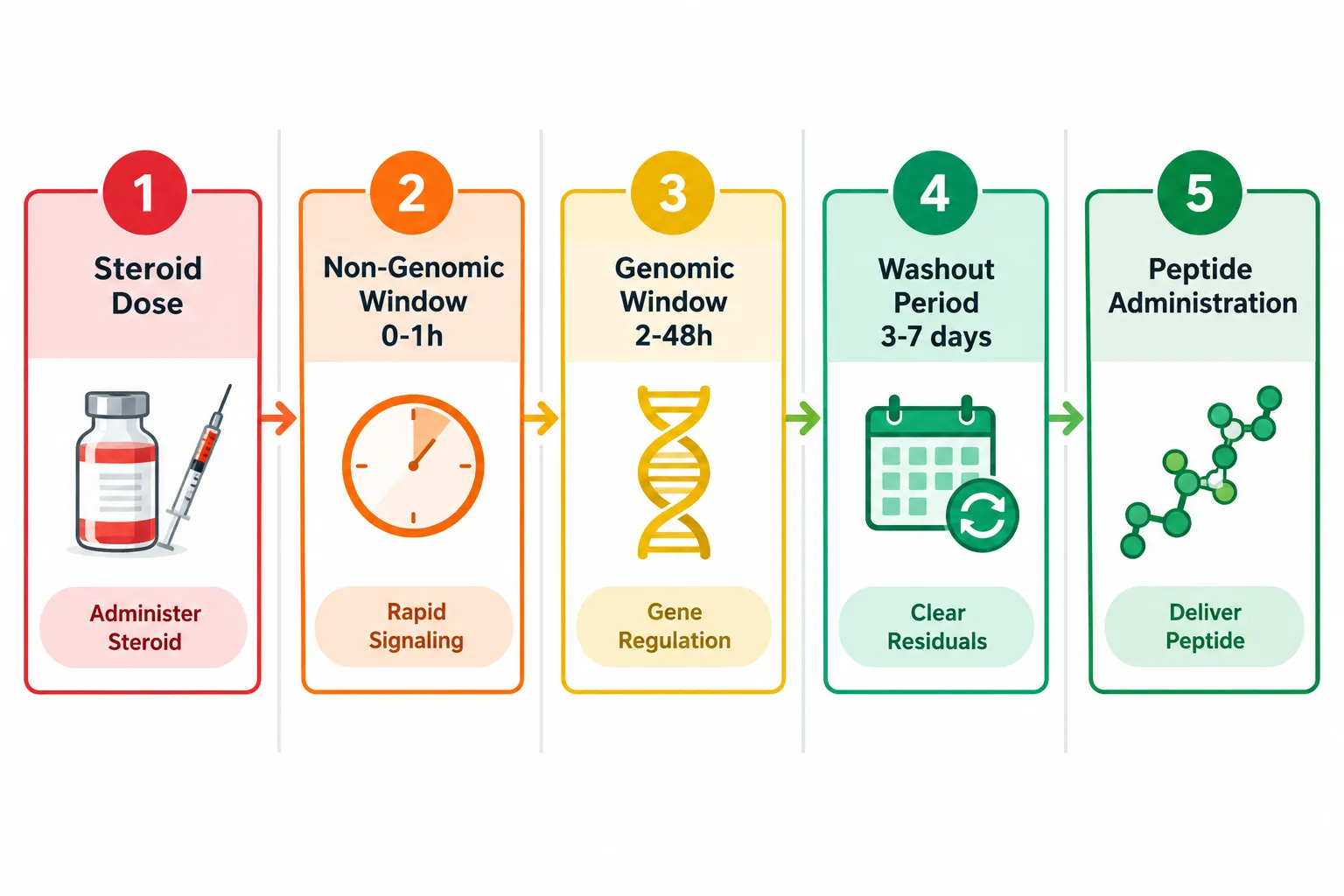
A structured washout strategy is the core of any credible steroid-exposure timeline. The following framework addresses the four biological domains most commonly shared between corticosteroids and research peptides.
Glucose and Appetite Confounding
Prednisone and methylprednisolone elevate fasting glucose and suppress appetite-regulatory hormones for the duration of their biological half-life. Any peptide with metabolic endpoints, such as those reviewed in resources covering what is the strongest peptide for weight loss, requires a washout of at least 36-48 hours for intermediate-acting agents and 72-96 hours for dexamethasone before metabolic outcomes can be attributed reliably to the peptide.
Immune Suppression Overlap
Both dexamethasone and methylprednisolone suppress cytokine production via NF-kB inhibition for the full span of their biological half-life. Researchers examining immunomodulatory peptides, including mitochondria-targeted candidates comparable to those covered in the LL-37 versus SS-31 benefits comparison, should plan washout windows conservatively:
- Methylprednisolone: minimum 3-day washout after therapeutic oral dosing
- Dexamethasone: minimum 5-day washout; extend to 7 days after high-dose IV exposure
- Prednisone: minimum 3-day washout for standard oral courses
Tissue-Repair Timing
Chronic steroid exposure recruits genomic pathways that suppress collagen synthesis, slow fibroblast proliferation, and reduce local growth factor expression. Peptides targeting wound healing or anabolic tissue responses will show attenuated effects if introduced within the genomic window. Sampling should be deferred until at least one full biological half-life after last steroid exposure.
Delayed-Release Prednisone: A Special Case
Standard immediate-release prednisone reaches peak plasma concentration at roughly 2 hours. Delayed-release formulations, however, show a median time to peak of 6.0-6.5 hours in healthy subjects. This shifts both the non-genomic onset and the early genomic window several hours later. Researchers using this formulation must adjust peptide dosing and sampling schedules accordingly, the full immune-suppressive and metabolic effects will not peak until late afternoon if the tablet is taken in the morning.
Dexamethasone as a Linear-PK Modeling Tool
Dexamethasone exhibits simple linear pharmacokinetics across a wide dose range, with a free plasma fraction of approximately 0.23. This predictability makes it a useful "prototype" steroid when modeling exposure timelines: once a timeline is built for dexamethasone, researchers can scale it using equivalence ratios to map expected effects for prednisone or methylprednisolone. For compound-specific sourcing considerations, reviewers evaluating study materials can also consult resources on peptide supplier comparisons to ensure purity standards meet experimental requirements.
Dense Early Sampling Is Non-Negotiable
Because robust transcriptional changes can occur within 10 minutes of glucocorticoid exposure in some cell models, experiment designs that sample only at 24-hour intervals will miss the non-genomic and early-genomic overlap entirely. A recommended minimum sampling schedule during co-administration:
- Baseline (pre-steroid)
- 15 minutes post-steroid
- 1 hour post-steroid
- 4 hours post-steroid
- 12 hours post-steroid
- 24 hours post-steroid
- 48-72 hours post-steroid (especially for dexamethasone)
Conclusion
Mapping prednisone, dexamethasone, and methylprednisolone in peptide experiments through a rigorous steroid-exposure timeline prevents one of the most common, and most underreported, sources of confounding in experimental biology. The actionable steps are clear:
- Never rely on plasma half-life alone. Use biological half-life to define washout periods: 36+ hours for prednisone and methylprednisolone, up to 54+ hours for dexamethasone.
- Account for both mechanistic phases. Schedule dense early sampling (minutes to hours) to capture non-genomic effects, and extend observation windows to 72+ hours for genomic phase readouts.
- Adjust for formulation. Delayed-release prednisone shifts peak effects by 4-5 hours versus immediate-release; sampling windows must move accordingly.
- Protect metabolic and immune endpoints. Apply the minimum 3-day methylprednisolone and 5-day dexamethasone washout rules before attributing glucose, appetite, or cytokine data to any co-administered peptide.
- Model first with dexamethasone. Its linear PK simplifies timeline construction, which can then be adapted for intermediate-acting agents.
Researchers who embed these principles into their experimental design from the outset will produce steroid-peptide data that is genuinely interpretable, and far more publishable.


Leave a Reply
Want to join the discussion?Feel free to contribute!