

Omeprazole, Famotidine, and GLP-Class Peptides: How Acid Suppression Changes Exposure and Feeding Readouts
More than half of patients who begin GLP-1 receptor agonist therapy are already taking a proton pump inhibitor or H2 blocker for reflux or ulcer prophylaxis. That overlap is rarely accidental, GLP-1 agents themselves slow gastric emptying, raise lower esophageal pressure, and generate the kind of upper GI discomfort that sends patients straight to the pharmacy for antacid relief. The result is a real-world pharmacological triangle involving omeprazole, famotidine, and GLP-class peptides: how acid suppression changes exposure and feeding readouts is a question that now sits at the center of peptide research and clinical practice alike.
Key Takeaways
- GLP-1 receptor agonists reduce gastric acid on their own and slow gastric emptying, creating a baseline environment that acid suppressors may amplify.
- Oral GLP-1 agents depend on stomach pH for absorption; co-administration with a PPI or H2 blocker can meaningfully shift bioavailability.
- Injectable GLP-1 formulations carry far lower pharmacokinetic risk from acid suppression, though gastric emptying effects on co-administered oral drugs persist.
- Acid suppression can indirectly improve GI tolerability, which affects meal size, satiety readouts, and adherence in feeding studies.
- No formal drug-drug interaction warning for semaglutide and PPIs or H2 blockers exists as of mid-2026, but timing guidance matters clinically.
The Gastric Environment Before Any Peptide Is Administered
Understanding why omeprazole, famotidine, and GLP-class peptides interact begins with gastric physiology. The fasting stomach maintains a pH between 1.5 and 2.5. This acidic bath is not merely incidental, it governs protein unfolding, activates pepsinogen, and determines the rate at which solid and liquid contents are transferred into the duodenum.
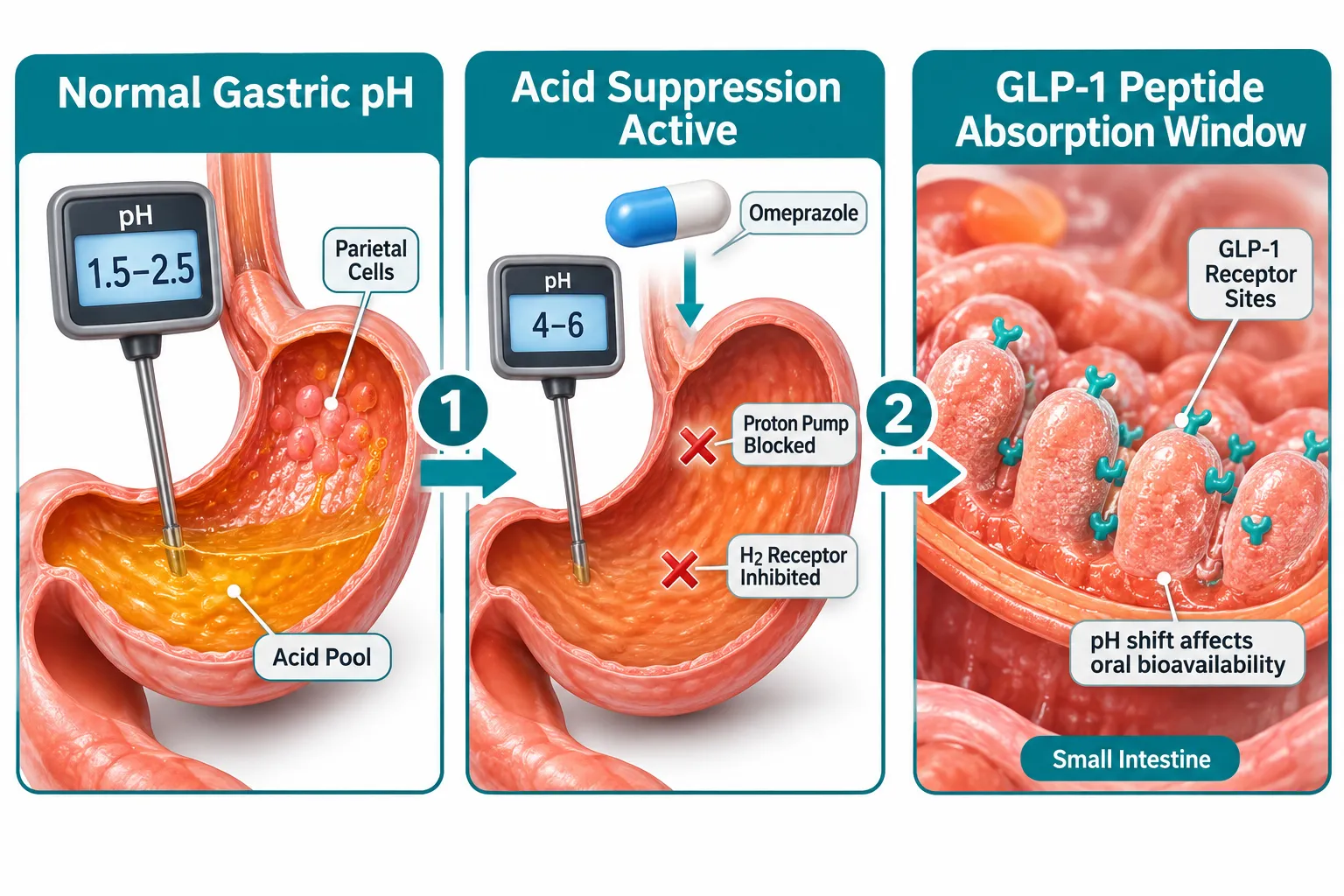
Omeprazole belongs to the proton pump inhibitor (PPI) class. It irreversibly blocks H+/K+-ATPase on parietal cells, raising intragastric pH to 4-6 within hours of the first dose and sustaining that elevation for 24 hours or more. Famotidine, an H2-receptor antagonist, blocks histamine-driven acid secretion with a faster onset but shorter duration; it typically raises pH to 3-5 and wears off in 8-12 hours.
GLP-1 receptor agonists add another layer. By stimulating GLP-1 receptors in the gut-brain axis, these peptides independently suppress acid secretion and dramatically delay gastric emptying, the latter being one of the primary mechanisms behind early satiety and post-meal glucose blunting. When an acid suppressor is added to this picture, the stomach becomes an altered chemical environment that influences everything downstream, including how co-administered drugs and nutrients are processed.
For researchers exploring GLP-3 peptide signaling pathways, this is especially relevant because GLP-2 and GLP-3 class agents also act on gut motility and barrier function, meaning any perturbation in gastric chemistry may cascade into changes in intestinal transit and nutrient absorption readouts.
Omeprazole, Famotidine, and GLP-Class Peptides: How Acid Suppression Changes Exposure and Feeding Readouts in Oral Formulations
The stakes rise sharply when the GLP-1 agent is taken orally. Oral semaglutide, the tablet form, depends on a salcaprozate sodium (SNAC) absorption enhancer that functions optimally only in a low-pH gastric environment. SNAC protects the peptide from proteolytic degradation and promotes local absorption through the gastric mucosa. When intragastric pH is raised substantially by a PPI, the protective mechanism is blunted and exposure can fall.
This is not a theoretical concern. Practice-based pharmacokinetic reviews note that chronic co-use of PPIs with oral semaglutide over weeks subtly but consistently shifts total drug exposure. H2 blockers like famotidine carry a similar profile but produce a less sustained pH elevation, which may make them somewhat less disruptive to oral peptide absorption, especially if famotidine is dosed in the evening and oral semaglutide is taken fasting in the morning.
Key practical points for oral GLP-1 co-therapy:
- Take oral GLP-1 agents first thing in the morning, fasting, with no more than 4 oz of plain water.
- Delay PPI dosing by at least 30 minutes after the GLP-1 tablet to allow gastric absorption to complete.
- If using famotidine as needed, evening dosing typically avoids the morning absorption window.
- Monitor for reduced efficacy signals (less appetite suppression, slower glucose response) as an indirect marker of exposure loss.
Researchers sourcing GLP-3 peptides for sale or studying peptide GLP analogs in pre-clinical feeding models should document co-administered pH-modifying agents because failure to do so is a common source of inter-subject variability in exposure data.
Injectable GLP-1 Agents and the Indirect Role of Acid Suppression
With subcutaneous formulations, the absorption route bypasses gastric pH entirely. Semaglutide injection, liraglutide, and tirzepatide are absorbed directly from subcutaneous tissue, so omeprazole or famotidine cannot alter their bioavailability directly.
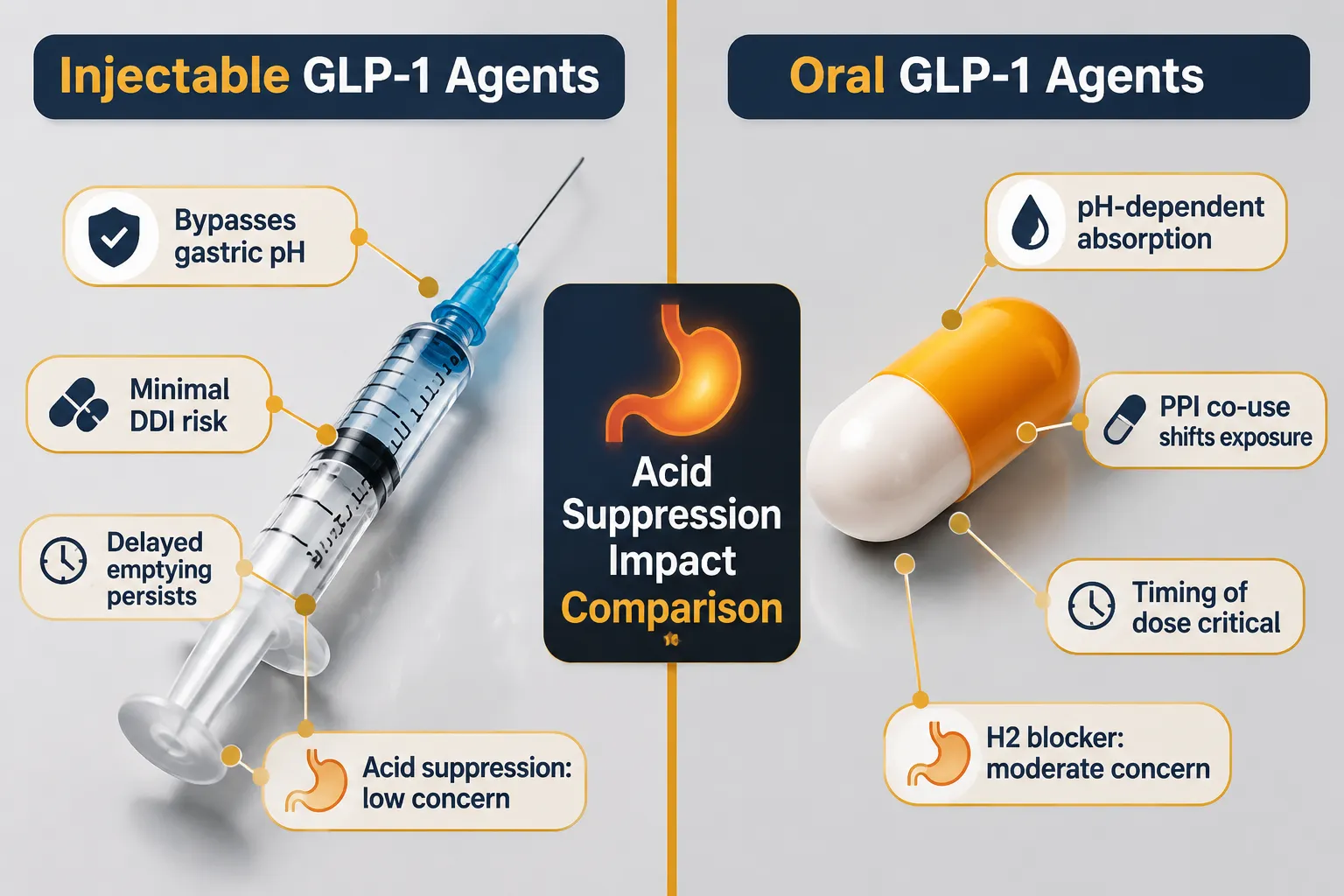
However, indirect effects remain clinically meaningful:
Gastric emptying and concomitant oral drugs. GLP-1 receptor agonists delay gastric emptying in all formulations. If a patient takes an oral medication alongside an injectable GLP-1 agent, that tablet or capsule lingers longer in the stomach. For omeprazole itself, this means its own onset of acid suppression may be delayed and its peak exposure modestly elevated, a feedback loop in which the GLP-1 peptide inadvertently changes how omeprazole behaves. Readers interested in peptide half-life dynamics will recognize this as a transit-time-dependent pharmacokinetic interaction.
Feeding readouts and GI tolerability. Acid suppression improves the upper GI symptoms that many patients experience on GLP-1 therapy, nausea, regurgitation, early satiety-related discomfort. When these symptoms are relieved, patients tolerate larger meals, eat more frequently, and report less pronounced satiety. In a feeding study context, this means that subjects on concurrent acid suppressors may show:
| Readout | Without Acid Suppression | With Acid Suppression |
|---|---|---|
| Reported satiety score | Higher | Modestly lower |
| Meal size | Smaller | Slightly larger |
| Adherence to protocol | Lower (GI intolerance) | Higher |
| Nausea-driven dropout | More likely | Less likely |
This creates a confound. A researcher studying what the strongest peptide for weight loss is in a rodent or human model may observe attenuated anorexigenic signaling not because the peptide is less potent, but because GI tolerability has shifted feeding behavior.
Timing Strategies and Research Protocol Considerations
For clinical research and supervised use involving acid suppressors alongside GLP-class peptides, a structured timing strategy minimizes confounds.
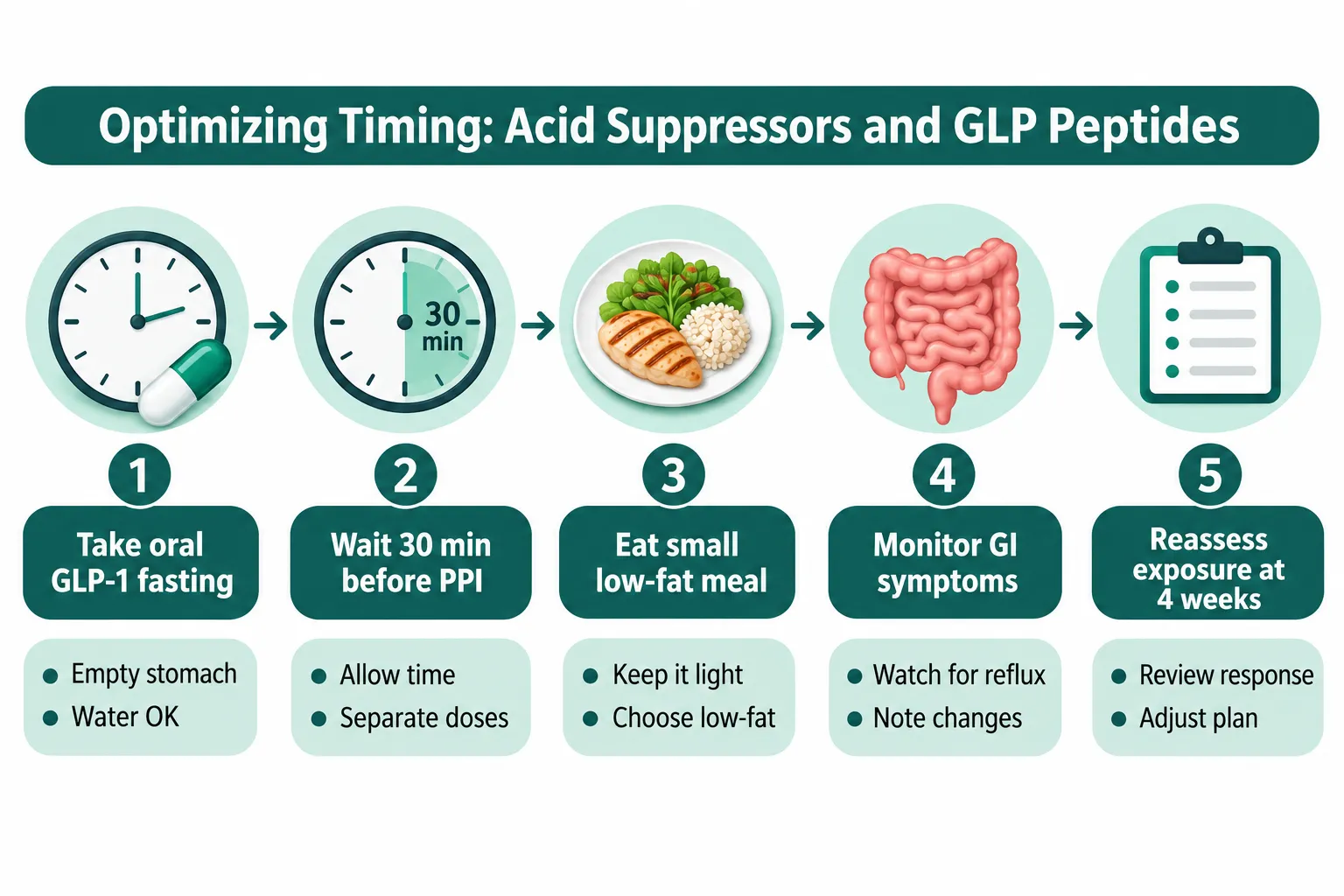
For injectable GLP-1/GLP-2/GLP-3 protocols:
- Document PPI or H2 blocker use as a covariate, not an exclusion criterion.
- Standardize meal composition and timing to control for gastric emptying variability.
- Note that GLP-2 analogs studied for intestinal repair, relevant to wholesale peptides research pipelines, also modulate gut motility and may interact with acid suppression in ways that affect mucosal absorption readouts.
For oral GLP-1 protocols:
- Treat acid suppression as a formal pharmacokinetic variable.
- Collect trough and peak peptide concentrations across multiple dosing cycles to detect exposure drift.
- Consider famotidine as a lower-risk alternative to PPIs when acid control is necessary and oral peptide exposure needs to be preserved.
Practitioners working with patients can find additional guidance through a peptides doctor near me directory to identify clinicians experienced in managing these polypharmacy scenarios.
As of 2026, no regulatory agency has issued a formal drug-drug interaction warning between semaglutide (or other approved GLP-1 agonists) and either omeprazole or famotidine. However, the growing rollout of oral GLP-1 agents makes it near-certain that targeted pharmacokinetic studies on chronic PPI co-therapy will emerge over the next few years. Researchers building wholesale peptides for sale supply chains for GLP-class compounds should anticipate that labeling updates may follow those studies.
Conclusion
The relationship between omeprazole, famotidine, and GLP-class peptides, and how acid suppression changes exposure and feeding readouts, is no longer a niche pharmacology footnote. It is a practical variable that shapes clinical outcomes, research data quality, and peptide bioavailability in ways that are often invisible unless deliberately controlled for.
Actionable next steps:
- For oral GLP-1 users, adhere strictly to fasting administration and delay any PPI dose by at least 30 minutes.
- For injectable GLP-1 protocols, log concurrent acid suppressor use and treat it as a covariate in any feeding or satiety analysis.
- For researchers, standardize meal composition, gastric emptying benchmarks, and acid-suppressor documentation across all GLP-class peptide studies.
- Monitor patients on combined therapy for subtle erosion of anorexigenic effect as a proxy for exposure change.
- Anticipate updated labeling guidance for oral GLP-1 agents as co-therapy PK data matures.
Getting the gastric environment right is not secondary to peptide research, it is foundational to it.