Call or Text 727-513-9780
  • Shopping Cart Shopping Cart
    0Shopping Cart
Pure Tested Peptides | America's most trusted Peptides for sale online
  • Peptides for sale
    • Oral Peptides for sale
      • Peptide Capsules for sale
      • BPC 157 Capsules 1000mcg
      • SLU-PP-332 Capsules | 1000 mcg
      • 5-Amino-1MQ 50mg Capsules
      • Tesofensine 500mcg
    • All Peptides for sale
    • Peptide Sprays
      • BPC 157 Nasal Spray Kit
      • BPC-157 TB500 Nasal Spray Kit
      • Semax Nasal Spray 10mg
      • Selank – Nasal Spray Kit – 10mg
      • Epithalon 50MG Nasal Spray Kit
      • Ipamorelin 10mg Nasal Spray
      • Klow Nasal Spray (BPC-157 + TB-500 + GHK-Cu + KPV) | 80mg
      • Hulk Nasal Spray Tesa / Ipa Blend 6/3 MG
      • Klow Nasal Spray
      • NAD + 500 mg Nasal Spray
      • PT-141 Nasal Spray Kit
    • GHRH Peptides
      • Ipa Peptides
      • CJC-1295 Peptides
        • CJC-1295 with DAC 5 mg
        • CJC-1295 without DAC 5 mg
        • CJC-1295 Ipa 10mg
      • Tesa Peptides
        • Tesa Peptide
        • Tesa 20 mg
    • GHK-Cu Peptides
      • All GHK-Cu Peptides
      • GHK-Cu 100mg
      • KLOW Peptide Blend – Buy KLOW blend online
    • BPC Peptides
      • All BPC Peptides
      • BPC-157
      • BPC-157 TB-500
      • BPC 157 capsules 1000mcg
    • SLU-PP-332 Peptides
      • All SLU-PP-332 Peptides
      • SLU-PP-332 5mg
    • GLP3 Peptides
    • PT-141 Peptides
      • PT-141 Peptides for sale
      • PT-141 10mg
      • PT-141 Nasal Spray
    • CAG Peptides
      • Lipo-C Peptide Blend
      • CAG 5mg
      • CAG 10mg
    • MOTS-C Peptides
      • MOTS-C Peptides for sale
      • MOTS-c peptide
      • MOTS-c 10mg *6 pack*
    • 5 Amino 1MQ Peptides
      • 5 Amino 1MQ Peptides for sale
      • 5-Amino-1MQ 50mg Capsules
      • 5-Amino-1MQ 5mg
    • Epithalon Peptides
      • Epithalon Peptides for sale
      • Epithalon 10mg
      • Epithalon 50mg
  • Shop
    • GLPs
      • 5-Amino-1MQ 50mg Capsules
      • 5-Amino-1MQ 5mg
      • L-Carnitine 500mg/ml
      • Tesofensine 500mcg
      • SLU-PP-332 5mg
      • MOTS-c 10mg *6 pack*
    • Epithalon & BPC Peptides
      • Epithalon 10mg
      • Epithalon 50mg
      • BPC-157
      • BPC 157 capsules 1000mcg
      • BPC-157 TB-500
      • BPC-157 TB500 Nasal Spray Kit
      • BPC 157 Nasal Spray Kit
    • BPC TB-500 & NAD+ Peptides
      • NAD+ 500 mg
      • KLOW Peptide Blend – Buy KLOW blend online
      • GLOW Peptide Blend
      • TB 500 5mg
      • BPC 157 capsules 1000mcg – Supplement
      • BPC 157 Nasal Spray Kit
      • BPC-157
      • BPC-157 TB500 Nasal Spray Kit
      • BPC-157 TB-500
      • BPC 157 capsules 1000mcg
    • LL-37 Peptide
      • LL-37 10 mg
    • MOTS-C & Selank
      • MOTS-c peptide
      • Selank 10mg
    • GHK Peptides
      • GHK-Cu 100mg
      • GLOW Peptide Blend
      • KLOW Peptide Blend – Buy KLOW blend online
  • COAs
  • Wholesale
    • Wholesale Peptides for sale
  • PTP FAQ
  • Affiliates
    • Selank Peptide: Advanced Pharmacological Mechanisms Underlying Its Anxiolytic and Nootropic Effects in Research
      • 5-Amino-1MQ Peptide: Detailed Mechanisms of NNMT Inhibition and Its Impact on Cellular Metabolism Research
        • MOTS-C Peptide: Unraveling Its Role in Mitochondrial Dynamics and Energy Metabolism Research
          • Epithalon Peptide and Telomerase Regulation: Investigating Its Impact on Cellular Senescence and Lifespan Research Models
            • GLP2-T vs GLP2 Tirz Peptide: Understanding the Naming, Mechanistic Nuances, and Research Implications for Gut Health
      • Peptides and Polypeptides in Modern Pharmacology: What Research on Metoprolol, Prednisone, and Amlodipine Reveals
        • Polypeptide Peptides vs NSAIDs: What Naproxen and Diclofenac Teach Tissue-Repair Researchers About BPC‑157 and TB‑500
          • Peptides and Polypeptides in Endocrine Pharmacology: How GLP-1, GLP-2, and GLP-3 Retatrutide Differ From Classic Drugs Like Prednisone and Amlodipine
          • 5‑Amino‑1MQ Peptide and NNMT Inhibition: How It Compares With Statins Like Atorvastatin in Adipose and Lipid Metabolism Research
      • Enclomiphene, Estrogen Receptor Signaling, and Luteinizing Phase Biology: What Hormone Researchers Should Measure
        • Mesenchymal Stem Cells, BPC‑157, and GHK‑Cu: How Tissue Repair Peptides Compare With Classic NSAIDs Like Naproxen in Injury Models
          • Peptide Calculator Use Cases Beyond Growth Hormone: Working Through GLP‑3 Retatrutide, MOTS‑c, and BPC‑157 Research Dosing
        • Polypeptide Peptides in Endocrine and Metabolic Pharmacology: Lessons From Amlodipine, Prednisone, and Metoprolol
        • Peptides Calculator for Advanced Blends: Worked Examples for Tesamorelin, CJC‑1295, and Ipamorelin Stacks
          • Peptides and Polypeptides in Human Physiology: How Molecular Size Shapes Research Applications
            • Selank Peptide: Advanced Pharmacological Mechanisms Underlying Its Anxiolytic and Nootropic Effects in Research
          • 5-Amino-1MQ Peptide: Detailed Mechanisms of NNMT Inhibition and Its Impact on Cellular Metabolism Research
            • MOTS-C Peptide: Unraveling Its Role in Mitochondrial Dynamics and Energy Metabolism Research
              • Epithalon Peptide and Telomerase Regulation: Investigating Its Impact on Cellular Senescence and Lifespan Research Models
                • GLP2-T vs GLP2 Tirz Peptide: Understanding the Naming, Mechanistic Nuances, and Research Implications for Gut Health
                  • Peptides and Polypeptides in Endocrine Pharmacology: How GLP-1, GLP-2, and GLP-3 Retatrutide Differ From Classic Drugs Like Prednisone and Amlodipine
                    • Polypeptide Peptides vs NSAIDs: What Naproxen and Diclofenac Teach Tissue-Repair Researchers About BPC‑157 and TB‑500
                      • Peptides and Polypeptides in Modern Pharmacology: What Research on Metoprolol, Prednisone, and Amlodipine Reveals
                        • 5‑Amino‑1MQ Peptide and NNMT Inhibition: How It Compares With Statins Like Atorvastatin in Adipose and Lipid Metabolism Research
                        • Enclomiphene, Estrogen Receptor Signaling, and Luteinizing Phase Biology: What Hormone Researchers Should Measure
                        • Mesenchymal Stem Cells, BPC‑157, and GHK‑Cu: How Tissue Repair Peptides Compare With Classic NSAIDs Like Naproxen in Injury Models
                        • Peptide Calculator Use Cases Beyond Growth Hormone: Working Through GLP‑3 Retatrutide, MOTS‑c, and BPC‑157 Research Dosing
                        • Polypeptide Peptides in Endocrine and Metabolic Pharmacology: Lessons From Amlodipine, Prednisone, and Metoprolol
                        • Peptides Calculator for Advanced Blends: Worked Examples for Tesamorelin, CJC‑1295, and Ipamorelin Stacks
                        • Peptides and Polypeptides in Human Physiology: How Molecular Size Shapes Research Applications
                        • Selank Peptide: Advanced Pharmacological Mechanisms Underlying Its Anxiolytic and Nootropic Effects in Research
                        • MOTS-C Peptide: Unraveling Its Role in Mitochondrial Dynamics and Energy Metabolism Research
                        • Peptides and Polypeptides in Modern Pharmacology: What Research on Metoprolol, Prednisone, and Amlodipine Reveals
                        • Peptides and Polypeptides in Endocrine Pharmacology: How GLP-1, GLP-2, and GLP-3 Retatrutide Differ From Classic Drugs Like Prednisone and Amlodipine
                        • 5-Amino-1MQ Peptide: Detailed Mechanisms of NNMT Inhibition and Its Impact on Cellular Metabolism Research
                        • Mesenchymal Stem Cells, BPC‑157, and GHK‑Cu: How Tissue Repair Peptides Compare With Classic NSAIDs Like Naproxen in Injury Models
                        • Peptide Calculator Use Cases Beyond Growth Hormone: Working Through GLP‑3 Retatrutide, MOTS‑c, and BPC‑157 Research Dosing
                        • GLP2-T vs GLP2 Tirz Peptide: Understanding the Naming, Mechanistic Nuances, and Research Implications for Gut Health
                        • Polypeptide Peptides in Endocrine and Metabolic Pharmacology: Lessons From Amlodipine, Prednisone, and Metoprolol
                        • Polypeptide Peptides vs NSAIDs: What Naproxen and Diclofenac Teach Tissue-Repair Researchers About BPC‑157 and TB‑500
                        • Peptides and Polypeptides in Human Physiology: How Molecular Size Shapes Research Applications
                        • Peptides Calculator for Advanced Blends: Worked Examples for Tesamorelin, CJC‑1295, and Ipamorelin Stacks
                        • 5‑Amino‑1MQ Peptide and NNMT Inhibition: How It Compares With Statins Like Atorvastatin in Adipose and Lipid Metabolism Research
                        • Enclomiphene, Estrogen Receptor Signaling, and Luteinizing Phase Biology: What Hormone Researchers Should Measure
                        • Epithalon Peptide and Telomerase Regulation: Investigating Its Impact on Cellular Senescence and Lifespan Research Models
                        • Best research protocol Klow blend
                        • best time to take BPC-157
                        • best time to take DSIP (Delta Sleep Inducing Peptide)
                        • best time to take CJC-1295
                        • best time to take AOD-9604
                        • best time to take Follistatin 344
                        • best time to take Ipamorelin
                        • best time to take MK-677 (Ibutamoren)
                        • best time to take Ligandrol (LGD-4033) — research compound
                        • best time to take Ostarine (MK-2866) — research compound
                        • best time to take GHK-CU
                        • best time to take TB-500
                        • best time to take MOTS-c
                        • best time to take Semax
                        • best time to take RAD-140 (Testolone) — research compound
                        • best time to take Thymosin Alpha-1
                        • best time to take PEG-MGF
                        • Biolife Plasma, Octapharma Plasma, and Research Peptides: How Plasma Donation Labs Differ From Peptide Suppliers
                        • best time to take YK-11 — research compound
                        • best time to take PT-141 (Bremelanotide)
                        • Best research protocol Klow blend
                        • 5-Amino-1MQ and MOTS-C Synergy: Metabolic Signaling, Mitochondria, and Research Design
                        • BPC-157 and TB-500: Investigating Their Combined Effects on Angiogenesis and Cellular Migration in Tissue Repair Models
                        • BPC-157 Peptide: Gut Barrier Function, Inflammation, and Tissue-Recovery Research
                        • 5‑Amino‑1MQ and MOTS‑c Synergy in Metabolic Research: Designing NNMT and Mitochondrial Biogenesis Stacks
                        • CJC-1295 with DAC vs. Without DAC: Half-Life, Release Kinetics, and Research Implications
                        • CJC‑1295 with DAC vs. Without DAC: Expanding on Half‑Life Differences Using Tesamorelin and Ipamorelin Blend Case Studies
                        • Collagen Biology and Copper‑Binding Peptides: How GHK‑Cu, Glow Blend, and Klow Blend Interact with Skin and Connective Tissue
                        • Collagen Biology and Regenerative Peptides: How GHK‑Cu, Glow Blend, and Klow Blend Affect Extracellular Matrix Research
                    • DNA, Telomeres, and Longevity Peptides: Positioning Epithalon and MOTS‑c in Genetic Aging Research
                      • Enclomiphene Citrate: serm Mechanism, Testosterone Research, and Stack Compatibility
                        • Enclomiphene vs Enclomiphene Citrate: Formulation, Bioavailability, and Research Distinctions
                        • Epithalon Peptide Research: Telomerase Activation, Aging, and Pineal Gland Function
                        • Estrogen Receptor Signaling and Enclomiphene: How Selective Modulators Compare with Classic Polypeptide Hormones
                        • GHK-Cu Peptide: Advanced Mechanisms in Extracellular Matrix Remodeling and Wound Healing Research
                        • GHK-Cu Peptide: Collagen Synthesis, Wound Repair, and Skin-Barrier Research Models
                        • GLP-1 vs GLP-3 vs GLP-2: Peptide Classification and Research Applications
                        • GLP-2 Peptide Research Guide: Gut Barrier Function, Nutrient Absorption, and Intestinal Recovery Models
                        • GLP-3 Retatrutide vs. GLP-1 Drugs: What Triple-Agonist Biology Changes in Research Models
                        • Ipamorelin and Tesamorelin Combination: Synergistic GH Secretagogue Research and Dosing Protocols
                        • GLP2 Tirz Peptide: What It Is, Why the Name Exists, and How Researchers Should Interpret It
                        • Klow Blend Peptide Nasal Spray: What the Formulation Is Trying to Do in Cognitive Research
                        • Mitochondria, NNMT Inhibition, and Peptide Modulators: Where MOTS‑c and 5‑Amino‑1MQ Fit in Cellular Energy Research
                        • MOTS-c Peptide: Mitochondrial Function, Energy Metabolism, and What Researchers Measure
                        • MOTS-c vs. 5-Amino-1MQ: Which Metabolic Research Questions Each Compound Actually Answers
                        • Nasal Spray Peptides: Bioavailability, Administration, and Semax/Selank Research Applications
                        • PT-141 Peptide Research: Mechanism of Action and Melanocortin Receptor Signaling
                        • Retatrutide for Research: Mechanism, Structure, and GLP-1/GLP-3 Dual Action
                        • Retatrutide for Obesity and Type 2 Diabetes: What the Latest Trial Data Suggest
                        • Tesofensine Peptide Research: Mechanism, Appetite Suppression, and Neuropeptide Y Pathways
  • Contact
    • Contact Customer Service
    • Text Customer Support
  • About US
  • Shop all peptides
  • Affiliate Program
    • Affiliate Signup
  • Login / Register Login / Register Page Link Login / Register Page Link
  • Click to open the search input field Click to open the search input field Search
  • Menu Menu

Tag Archive for: metabolic peptide experiments

Atorvastatin in Metabolic Peptide Experiments: Controlling Lipid-Lowering Effects in Retatrutide and Mitochondrial Models

Atorvastatin in Metabolic Peptide Experiments: Controlling Lipid-Lowering Effects in Retatrutide and Mitochondrial Models

October 4, 2026/0 Comments/in Uncategorized/by

Fewer than 10% of metabolic peptide experiments pre-specify how concurrent statin therapy will be handled, yet that omission can quietly invalidate a study's entire lipid endpoint. When the compound under investigation is a triple agonist as potent as retatrutide, and when mitochondrial probes such as MOTS-c or 5-Amino-1MQ are added to the design, the presence or absence of atorvastatin in the background becomes a variable that can dwarf the signal researchers are actually trying to measure. Understanding how to account for atorvastatin in metabolic peptide experiments, controlling lipid-lowering effects in retatrutide and mitochondrial models, is therefore not a minor procedural detail. It is a core element of experimental validity.

Key Takeaways

  • Atorvastatin's HMG-CoA reductase inhibition and pleiotropic effects can confound lipid endpoints in retatrutide and mitochondrial peptide studies if not systematically controlled.
  • Baseline lipid matching and pre-specified washout windows are the two most critical design decisions when atorvastatin is present in a study population.
  • Retatrutide's triple agonism (GLP-1, GIP, glucagon) independently lowers LDL, triglycerides, and hepatic lipids, making statin co-exposure a genuine confound rather than a neutral background variable.
  • Mitochondrial peptides such as MOTS-c and 5-Amino-1MQ interact with pathways that atorvastatin also touches, requiring careful arm construction to isolate each compound's contribution.
  • No completed published trial as of 2026 has formally used atorvastatin as a deliberate modulator of retatrutide's lipid effects; current guidance is therefore grounded in pharmacological principles and experimental design logic.

Why Atorvastatin Demands Attention in Metabolic Peptide Research
Why Atorvastatin Demands Attention in Metabolic Peptide Research

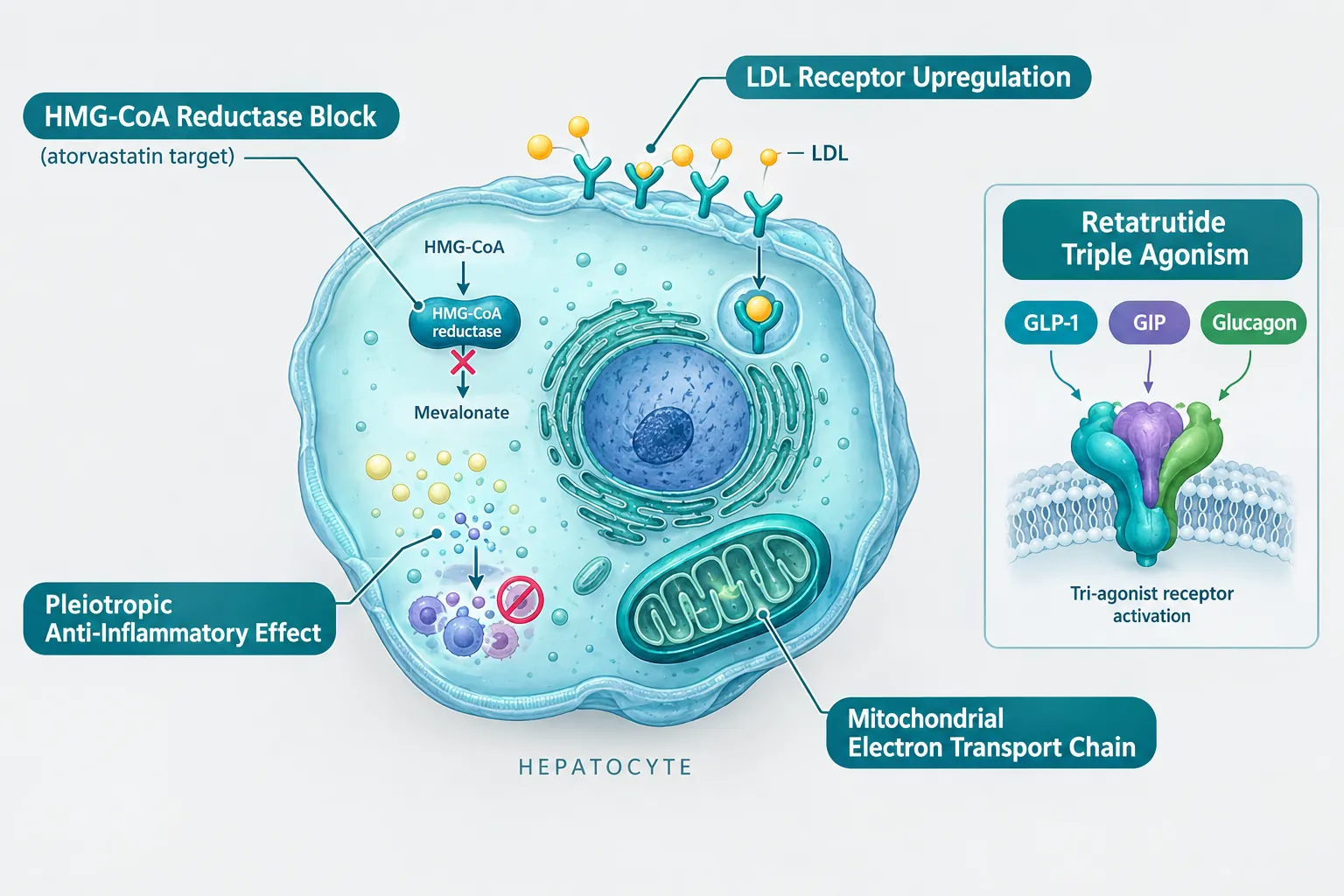
Atorvastatin is the world's most prescribed lipid-lowering drug. It blocks HMG-CoA reductase, the rate-limiting enzyme in hepatic cholesterol synthesis, and upregulates LDL receptors on liver cells. Beyond these primary actions, it exerts well-documented pleiotropic effects: reducing vascular inflammation, modulating endothelial nitric oxide, and influencing mitochondrial coenzyme Q10 levels. Each of these secondary actions intersects with pathways that metabolic peptides are designed to probe.

Retatrutide (LY3437943) activates GLP-1, GIP, and glucagon receptors simultaneously. Phase 2 trial data show mean weight reductions of approximately 22-24% over 48 weeks, accompanied by meaningful improvements in triglycerides, LDL cholesterol, and hepatic lipid content. Crucially, these lipid improvements arise from the peptide's own pharmacology, glucagon receptor agonism increases lipolysis and reduces lipogenesis, while GLP-1 and GIP components improve insulin sensitivity and reduce ectopic fat. When a participant is also taking atorvastatin, separating the statin's LDL effect from the peptide's LDL effect becomes statistically and mechanistically complex.

"The question is not whether atorvastatin matters, it clearly does. The question is whether the experimental design treats it as a known variable or an invisible confounder."

Researchers sourcing retatrutide peptide for preclinical work or reviewing GLP-3/retatrutide combination products should build statin status into their protocol from day one.


Experimental Design Principles for Atorvastatin in Metabolic Peptide Experiments
Experimental Design Principles for Atorvastatin in Metabolic Peptide Experiments

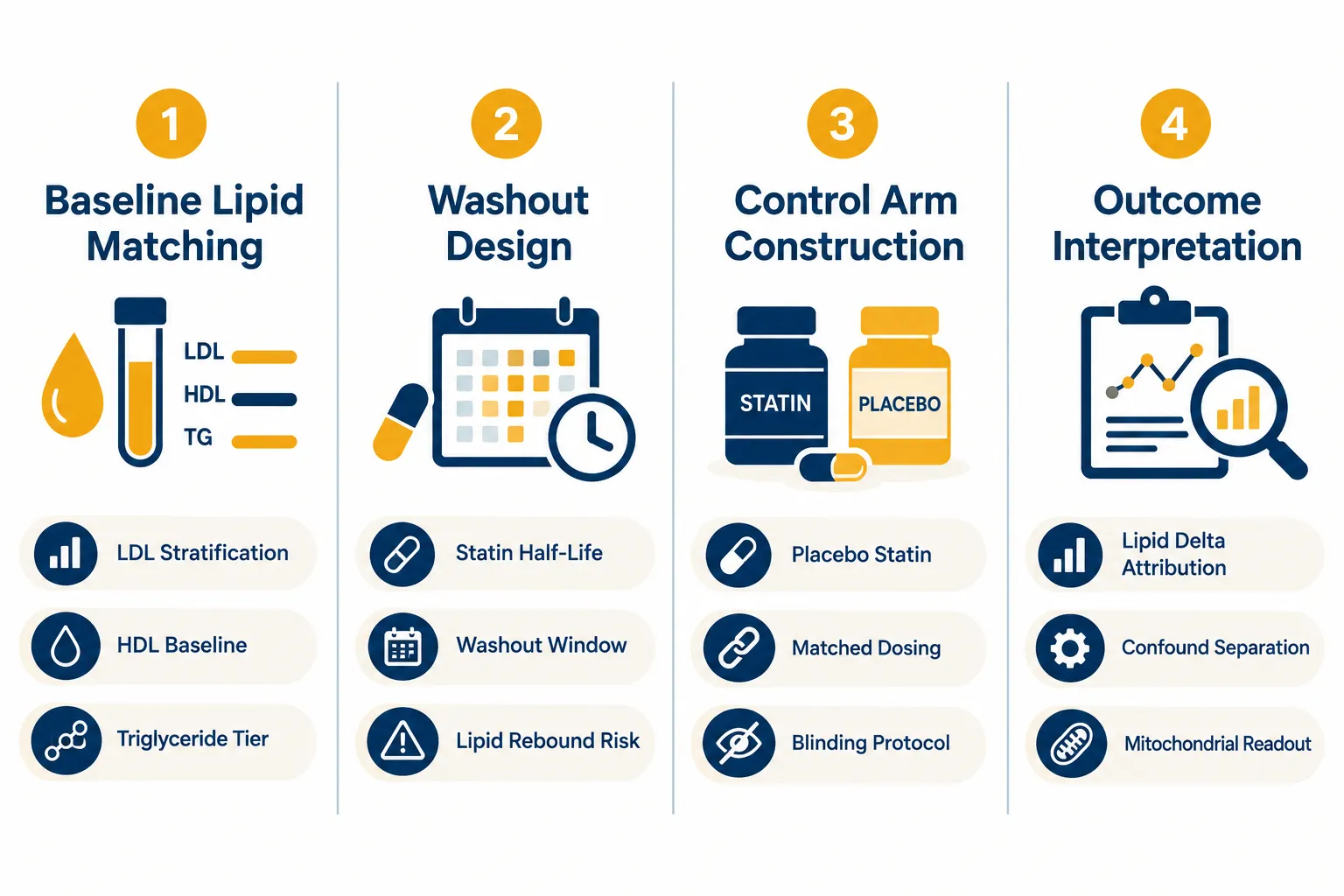
Rigorous control of atorvastatin's influence requires four interlocking design decisions.

Baseline Lipid Matching

Before randomization, participants or cell-line models should be stratified by:

  • LDL-C tier (optimal, borderline, elevated)
  • Triglyceride level (normal vs. elevated)
  • HDL-C baseline
  • Current statin dose (low, moderate, high intensity per ACC/AHA criteria)

Failure to match on these variables means that any observed lipid change could reflect pre-existing statin intensity differences rather than the peptide intervention. In retatrutide studies, where triglyceride reductions can exceed 30%, an unmatched high-intensity statin arm will produce misleading comparisons.

Washout Considerations

Atorvastatin has a plasma half-life of roughly 14 hours, but its pharmacodynamic effects on LDL receptor expression persist for several days after the last dose. A minimum two-week washout is generally recommended before lipid baseline measurements are taken in studies where statin use must be paused. However, washout carries its own risk: LDL rebound can occur within days, which may introduce a time-dependent confound if baseline measurements are taken at different points post-washout across participants.

Practical options:

Design Choice Advantage Risk
Full washout before baseline Clean lipid baseline LDL rebound, ethical concern in high-risk subjects
Stable dose maintained throughout Ethically safer Statin effect folded into all arms equally
Stratified by statin status (no washout) Preserves safety, enables subgroup analysis Requires larger sample size

Control Arm Construction

When atorvastatin cannot be washed out, as is often the case in cardiovascular-risk populations, the cleanest approach is to stratify randomization by statin use and ensure each treatment arm contains an equal proportion of statin users. This transforms atorvastatin from a confounder into a pre-specified effect modifier, allowing subgroup analyses to test whether the peptide's lipid effects differ by statin background.

Interpreting Outcomes Under Dual Therapy

In a dual-therapy scenario, the observed LDL reduction is a composite of atorvastatin's HMG-CoA blockade and retatrutide's glucagon-driven lipolysis and reduced hepatic lipogenesis. Statistical models should include statin dose as a covariate. Researchers interested in the GLP-3 peptide signaling pathway will recognize that receptor-level effects on lipid metabolism are distinct from enzyme-level inhibition, making additive versus synergistic modeling a meaningful analytical choice.


Mitochondrial Models: Where MOTS-c, 5-Amino-1MQ, and Atorvastatin Intersect
Mitochondrial Models: Where MOTS-c, 5-Amino-1MQ, and Atorvastatin Intersect

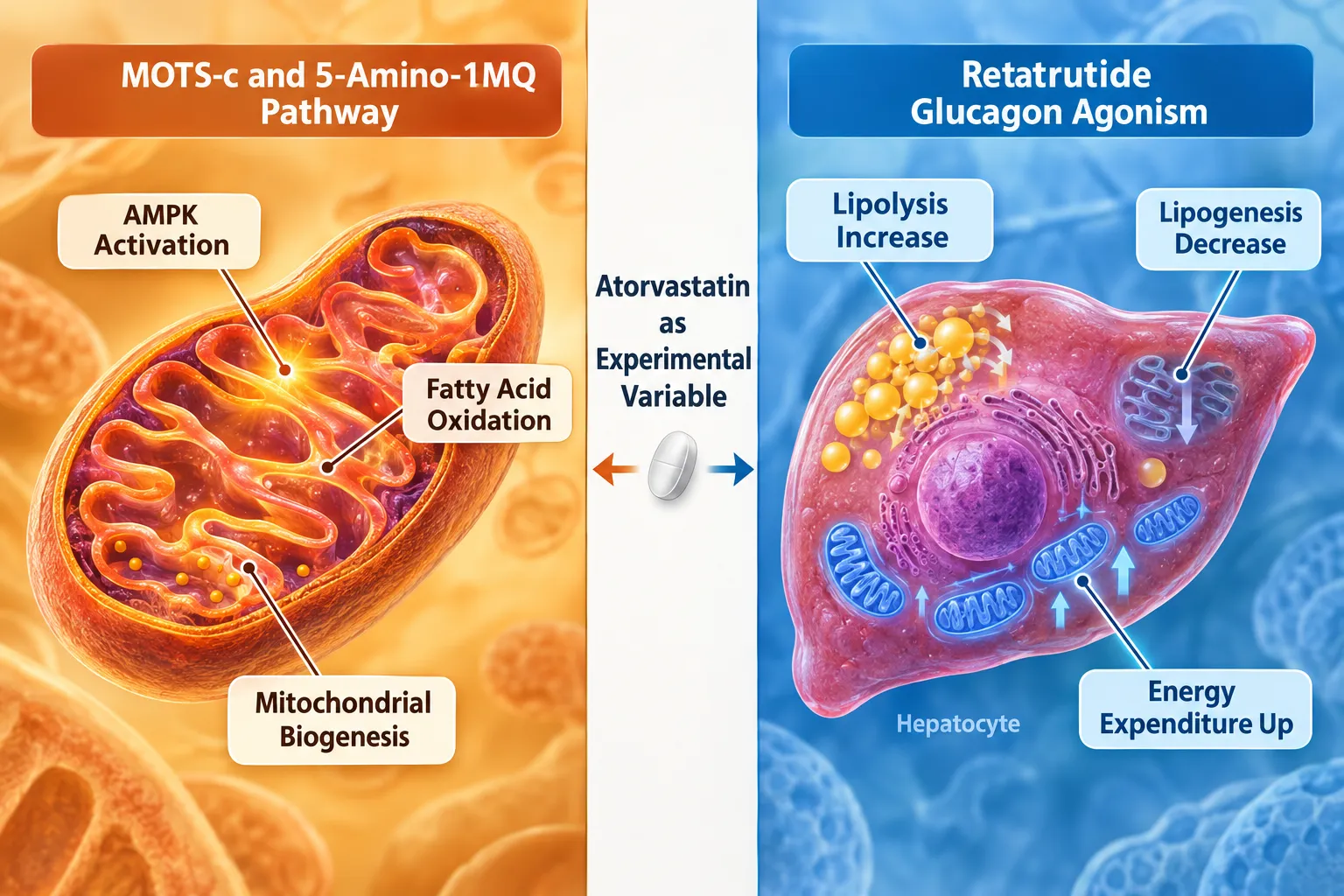
The complexity deepens considerably when mitochondrial peptides enter the experimental frame. MOTS-c is a mitochondria-derived peptide that activates AMPK, promotes fatty acid oxidation, and enhances mitochondrial biogenesis. 5-Amino-1MQ is a small-molecule inhibitor of NNMT (nicotinamide N-methyltransferase) that shifts cellular metabolism toward oxidative phosphorylation and reduces lipid accumulation. Both compounds operate on pathways that atorvastatin also touches, particularly through the coenzyme Q10 axis and mitochondrial electron transport chain dynamics.

Atorvastatin reduces endogenous coenzyme Q10 synthesis as a downstream consequence of HMG-CoA reductase inhibition. This can subtly impair mitochondrial respiratory chain efficiency, which is precisely the readout that MOTS-c and 5-Amino-1MQ experiments are designed to measure. An experiment that does not account for atorvastatin's CoQ10 effect may attribute impaired mitochondrial respiration to the peptide when the statin is the actual driver.

Key mitochondrial confounds introduced by atorvastatin:

  • Reduced CoQ10 availability in Complex I/III of the electron transport chain
  • Altered mitochondrial membrane potential in hepatocytes and myocytes
  • Possible upregulation of mitochondrial biogenesis as a compensatory response

For researchers working with SS-31 mitochondrial research models or reviewing SS-31 10mg research peptide considerations, the same logic applies: any statin in the background must be pre-specified, dose-recorded, and statistically controlled. Those exploring MOTS-c peptide for sale for metabolic research should document statin co-exposure in their experimental logs as a standard practice.

When retatrutide is layered on top of this mitochondrial model, the glucagon receptor agonism adds a third metabolic signal, increased hepatic fatty acid oxidation and energy expenditure, that further overlaps with both the peptide probes and the statin background. Isolating each compound's contribution requires:

  1. Pre-specified factorial or stratified designs
  2. Mitochondrial respiration assays (Seahorse XF or equivalent) run in statin-exposed versus statin-naive conditions
  3. CoQ10 plasma levels measured as a mechanistic covariate
  4. AMPK phosphorylation status as a shared downstream readout for MOTS-c, 5-Amino-1MQ, and glucagon agonism

Conclusion

Atorvastatin in metabolic peptide experiments, controlling lipid-lowering effects in retatrutide and mitochondrial models, is not a pharmacological afterthought. It is a design variable that, if ignored, can corrupt lipid endpoints, misattribute mitochondrial readouts, and produce irreproducible results. The actionable steps are clear:

  • Stratify by statin status at randomization, or pre-specify washout windows with lipid rebound monitoring.
  • Record atorvastatin dose intensity and include it as a covariate in all lipid and mitochondrial outcome models.
  • Measure CoQ10 levels when mitochondrial peptides such as MOTS-c, SS-31, or 5-Amino-1MQ are in the experimental design.
  • Use factorial subgroup analyses to test whether retatrutide's lipid effects differ by statin background, rather than assuming homogeneity.
  • Consult current phase 3 trial protocols as they become available; as of 2026, no completed study has formally used atorvastatin as a deliberate modulator of retatrutide's lipid effects, but the mechanistic rationale for doing so is strong.

Researchers who build these controls into their protocols from the outset will produce data that is interpretable, reproducible, and genuinely informative about the independent and combined contributions of each compound. Those who do not will spend far more time explaining away confounds than advancing the science.

https://www.puretestedpeptides.com/wp-content/uploads/2026/10/atorvastatin-in-metabolic-peptide-experiments-controlling-lipid-lowering-effects.webp 1024 1536 https://www.puretestedpeptides.com/wp-content/uploads/2026/01/buy-peptides-online.jpg 2026-10-04 13:04:572026-10-04 13:04:57Atorvastatin in Metabolic Peptide Experiments: Controlling Lipid-Lowering Effects in Retatrutide and Mitochondrial Models
×

Helpful Links

  • My account
  • Cart
  • Checkout
  • Refund and Returns Policy
  • Privacy Policy
  • SMS Privacy Policy
  • Login
  • My Account
  • Logout

USA Made Lab Tested Peptides

All products are sold for research, laboratory, or analytical purposes only, and are not for human consumption


Pure Tested Peptides is a chemical supplier. Pure Tested Peptides is not a compounding / chemical compounding facility as defined under 503A of the Federal Food, Drug, and Cosmetic act. Pure Tested Peptides is not an outsourcing facility as defined under 503B of the Federal Food, Drug, and Cosmetic act.

The statements made within this website have not been evaluated by the US Food and Drug Administration. The products we offer are not intended to diagnose, treat, cure or prevent any disease.

Human/Animal Consumption Prohibited. Laboratory/In-Vitro Experimental Use Only

Scroll to top Scroll to top Scroll to top