Call or Text 727-513-9780
  • Shopping Cart Shopping Cart
    0Shopping Cart
Pure Tested Peptides | America's most trusted Peptides for sale online
  • Peptides for sale
    • Oral Peptides for sale
      • Peptide Capsules for sale
      • BPC 157 Capsules 1000mcg
      • SLU-PP-332 Capsules | 1000 mcg
      • 5-Amino-1MQ 50mg Capsules
      • Tesofensine 500mcg
    • All Peptides for sale
    • Peptide Sprays
      • BPC 157 Nasal Spray Kit
      • BPC-157 TB500 Nasal Spray Kit
      • Semax Nasal Spray 10mg
      • Selank – Nasal Spray Kit – 10mg
      • Epithalon 50MG Nasal Spray Kit
      • Ipamorelin 10mg Nasal Spray
      • Klow Nasal Spray (BPC-157 + TB-500 + GHK-Cu + KPV) | 80mg
      • Hulk Nasal Spray Tesa / Ipa Blend 6/3 MG
      • Klow Nasal Spray
      • NAD + 500 mg Nasal Spray
      • PT-141 Nasal Spray Kit
    • GHRH Peptides
      • Ipa Peptides
      • CJC-1295 Peptides
        • CJC-1295 with DAC 5 mg
        • CJC-1295 without DAC 5 mg
        • CJC-1295 Ipa 10mg
      • Tesa Peptides
        • Tesa Peptide
        • Tesa 20 mg
    • GHK-Cu Peptides
      • All GHK-Cu Peptides
      • GHK-Cu 100mg
      • KLOW Peptide Blend – Buy KLOW blend online
    • BPC Peptides
      • All BPC Peptides
      • BPC-157
      • BPC-157 TB-500
      • BPC 157 capsules 1000mcg
    • SLU-PP-332 Peptides
      • All SLU-PP-332 Peptides
      • SLU-PP-332 5mg
    • GLP3 Peptides
      • GLP3-R
      • GLP3-R CAG 10mg
      • GLP3-R 20mg
    • PT-141 Peptides
      • PT-141 Peptides for sale
      • PT-141 10mg
      • PT-141 Nasal Spray
    • CAG Peptides
      • Lipo-C Peptide Blend
      • CAG 5mg
      • CAG 10mg
    • MOTS-C Peptides
      • MOTS-C Peptides for sale
      • MOTS-c peptide
      • MOTS-c 10mg *6 pack*
    • 5 Amino 1MQ Peptides
      • 5 Amino 1MQ Peptides for sale
      • 5-Amino-1MQ 50mg Capsules
      • 5-Amino-1MQ 5mg
    • Epithalon Peptides
      • Epithalon Peptides for sale
      • Epithalon 10mg
      • Epithalon 50mg
  • Shop
    • GLPs
      • 5-Amino-1MQ 50mg Capsules
      • 5-Amino-1MQ 5mg
      • GLP3-Reta
      • L-Carnitine 500mg/ml
      • Tesofensine 500mcg
      • SLU-PP-332 5mg
      • MOTS-c 10mg *6 pack*
    • Epithalon & BPC Peptides
      • Epithalon 10mg
      • Epithalon 50mg
      • BPC-157
      • BPC 157 capsules 1000mcg
      • BPC-157 TB-500
      • BPC-157 TB500 Nasal Spray Kit
      • BPC 157 Nasal Spray Kit
    • BPC TB-500 & NAD+ Peptides
      • NAD+ 500 mg
      • KLOW Peptide Blend – Buy KLOW blend online
      • GLOW Peptide Blend
      • TB 500 5mg
      • BPC 157 capsules 1000mcg – Supplement
      • BPC 157 Nasal Spray Kit
      • BPC-157
      • BPC-157 TB500 Nasal Spray Kit
      • BPC-157 TB-500
      • BPC 157 capsules 1000mcg
    • LL-37 Peptide
      • LL-37 10 mg
    • MOTS-C & Selank
      • MOTS-c peptide
      • Selank 10mg
    • GHK Peptides
      • GHK-Cu 100mg
      • GLOW Peptide Blend
      • KLOW Peptide Blend – Buy KLOW blend online
  • COAs
  • Wholesale
    • Wholesale Peptides for sale
  • PTP FAQ
  • Affiliates
    • Selank Peptide: Advanced Pharmacological Mechanisms Underlying Its Anxiolytic and Nootropic Effects in Research
      • 5-Amino-1MQ Peptide: Detailed Mechanisms of NNMT Inhibition and Its Impact on Cellular Metabolism Research
        • MOTS-C Peptide: Unraveling Its Role in Mitochondrial Dynamics and Energy Metabolism Research
          • Epithalon Peptide and Telomerase Regulation: Investigating Its Impact on Cellular Senescence and Lifespan Research Models
            • GLP2-T vs GLP2 Tirz Peptide: Understanding the Naming, Mechanistic Nuances, and Research Implications for Gut Health
      • Peptides and Polypeptides in Modern Pharmacology: What Research on Metoprolol, Prednisone, and Amlodipine Reveals
        • Polypeptide Peptides vs NSAIDs: What Naproxen and Diclofenac Teach Tissue-Repair Researchers About BPC‑157 and TB‑500
          • Peptides and Polypeptides in Endocrine Pharmacology: How GLP-1, GLP-2, and GLP-3 Retatrutide Differ From Classic Drugs Like Prednisone and Amlodipine
          • 5‑Amino‑1MQ Peptide and NNMT Inhibition: How It Compares With Statins Like Atorvastatin in Adipose and Lipid Metabolism Research
      • Enclomiphene, Estrogen Receptor Signaling, and Luteinizing Phase Biology: What Hormone Researchers Should Measure
        • Mesenchymal Stem Cells, BPC‑157, and GHK‑Cu: How Tissue Repair Peptides Compare With Classic NSAIDs Like Naproxen in Injury Models
          • Peptide Calculator Use Cases Beyond Growth Hormone: Working Through GLP‑3 Retatrutide, MOTS‑c, and BPC‑157 Research Dosing
        • Polypeptide Peptides in Endocrine and Metabolic Pharmacology: Lessons From Amlodipine, Prednisone, and Metoprolol
        • Peptides Calculator for Advanced Blends: Worked Examples for Tesamorelin, CJC‑1295, and Ipamorelin Stacks
          • Peptides and Polypeptides in Human Physiology: How Molecular Size Shapes Research Applications
            • Selank Peptide: Advanced Pharmacological Mechanisms Underlying Its Anxiolytic and Nootropic Effects in Research
          • 5-Amino-1MQ Peptide: Detailed Mechanisms of NNMT Inhibition and Its Impact on Cellular Metabolism Research
            • MOTS-C Peptide: Unraveling Its Role in Mitochondrial Dynamics and Energy Metabolism Research
              • Epithalon Peptide and Telomerase Regulation: Investigating Its Impact on Cellular Senescence and Lifespan Research Models
                • GLP2-T vs GLP2 Tirz Peptide: Understanding the Naming, Mechanistic Nuances, and Research Implications for Gut Health
                  • Peptides and Polypeptides in Endocrine Pharmacology: How GLP-1, GLP-2, and GLP-3 Retatrutide Differ From Classic Drugs Like Prednisone and Amlodipine
                    • Polypeptide Peptides vs NSAIDs: What Naproxen and Diclofenac Teach Tissue-Repair Researchers About BPC‑157 and TB‑500
                      • Peptides and Polypeptides in Modern Pharmacology: What Research on Metoprolol, Prednisone, and Amlodipine Reveals
                        • 5‑Amino‑1MQ Peptide and NNMT Inhibition: How It Compares With Statins Like Atorvastatin in Adipose and Lipid Metabolism Research
                        • Enclomiphene, Estrogen Receptor Signaling, and Luteinizing Phase Biology: What Hormone Researchers Should Measure
                        • Mesenchymal Stem Cells, BPC‑157, and GHK‑Cu: How Tissue Repair Peptides Compare With Classic NSAIDs Like Naproxen in Injury Models
                        • Peptide Calculator Use Cases Beyond Growth Hormone: Working Through GLP‑3 Retatrutide, MOTS‑c, and BPC‑157 Research Dosing
                        • Polypeptide Peptides in Endocrine and Metabolic Pharmacology: Lessons From Amlodipine, Prednisone, and Metoprolol
                        • Peptides Calculator for Advanced Blends: Worked Examples for Tesamorelin, CJC‑1295, and Ipamorelin Stacks
                        • Peptides and Polypeptides in Human Physiology: How Molecular Size Shapes Research Applications
                        • Selank Peptide: Advanced Pharmacological Mechanisms Underlying Its Anxiolytic and Nootropic Effects in Research
                        • MOTS-C Peptide: Unraveling Its Role in Mitochondrial Dynamics and Energy Metabolism Research
                        • Peptides and Polypeptides in Modern Pharmacology: What Research on Metoprolol, Prednisone, and Amlodipine Reveals
                        • Peptides and Polypeptides in Endocrine Pharmacology: How GLP-1, GLP-2, and GLP-3 Retatrutide Differ From Classic Drugs Like Prednisone and Amlodipine
                        • 5-Amino-1MQ Peptide: Detailed Mechanisms of NNMT Inhibition and Its Impact on Cellular Metabolism Research
                        • Mesenchymal Stem Cells, BPC‑157, and GHK‑Cu: How Tissue Repair Peptides Compare With Classic NSAIDs Like Naproxen in Injury Models
                        • Peptide Calculator Use Cases Beyond Growth Hormone: Working Through GLP‑3 Retatrutide, MOTS‑c, and BPC‑157 Research Dosing
                        • GLP2-T vs GLP2 Tirz Peptide: Understanding the Naming, Mechanistic Nuances, and Research Implications for Gut Health
                        • Polypeptide Peptides in Endocrine and Metabolic Pharmacology: Lessons From Amlodipine, Prednisone, and Metoprolol
                        • Polypeptide Peptides vs NSAIDs: What Naproxen and Diclofenac Teach Tissue-Repair Researchers About BPC‑157 and TB‑500
                        • Peptides and Polypeptides in Human Physiology: How Molecular Size Shapes Research Applications
                        • Peptides Calculator for Advanced Blends: Worked Examples for Tesamorelin, CJC‑1295, and Ipamorelin Stacks
                        • 5‑Amino‑1MQ Peptide and NNMT Inhibition: How It Compares With Statins Like Atorvastatin in Adipose and Lipid Metabolism Research
                        • Enclomiphene, Estrogen Receptor Signaling, and Luteinizing Phase Biology: What Hormone Researchers Should Measure
                        • Epithalon Peptide and Telomerase Regulation: Investigating Its Impact on Cellular Senescence and Lifespan Research Models
                        • Best research protocol Klow blend
                        • best time to take BPC-157
                        • best time to take DSIP (Delta Sleep Inducing Peptide)
                        • best time to take CJC-1295
                        • best time to take AOD-9604
                        • best time to take Follistatin 344
                        • best time to take Ipamorelin
                        • best time to take MK-677 (Ibutamoren)
                        • best time to take Ligandrol (LGD-4033) — research compound
                        • best time to take Ostarine (MK-2866) — research compound
                        • best time to take GHK-CU
                        • best time to take TB-500
                        • best time to take MOTS-c
                        • best time to take Semax
                        • best time to take RAD-140 (Testolone) — research compound
                        • best time to take Thymosin Alpha-1
                        • best time to take PEG-MGF
                        • Biolife Plasma, Octapharma Plasma, and Research Peptides: How Plasma Donation Labs Differ From Peptide Suppliers
                        • best time to take YK-11 — research compound
                        • best time to take PT-141 (Bremelanotide)
                        • Best research protocol Klow blend
                        • 5-Amino-1MQ and MOTS-C Synergy: Metabolic Signaling, Mitochondria, and Research Design
                        • BPC-157 and TB-500: Investigating Their Combined Effects on Angiogenesis and Cellular Migration in Tissue Repair Models
                        • BPC-157 Peptide: Gut Barrier Function, Inflammation, and Tissue-Recovery Research
                        • 5‑Amino‑1MQ and MOTS‑c Synergy in Metabolic Research: Designing NNMT and Mitochondrial Biogenesis Stacks
                        • CJC-1295 with DAC vs. Without DAC: Half-Life, Release Kinetics, and Research Implications
                        • CJC‑1295 with DAC vs. Without DAC: Expanding on Half‑Life Differences Using Tesamorelin and Ipamorelin Blend Case Studies
                        • Collagen Biology and Copper‑Binding Peptides: How GHK‑Cu, Glow Blend, and Klow Blend Interact with Skin and Connective Tissue
                        • Collagen Biology and Regenerative Peptides: How GHK‑Cu, Glow Blend, and Klow Blend Affect Extracellular Matrix Research
                    • DNA, Telomeres, and Longevity Peptides: Positioning Epithalon and MOTS‑c in Genetic Aging Research
                      • Enclomiphene Citrate: serm Mechanism, Testosterone Research, and Stack Compatibility
                        • Enclomiphene vs Enclomiphene Citrate: Formulation, Bioavailability, and Research Distinctions
                        • Epithalon Peptide Research: Telomerase Activation, Aging, and Pineal Gland Function
                        • Estrogen Receptor Signaling and Enclomiphene: How Selective Modulators Compare with Classic Polypeptide Hormones
                        • GHK-Cu Peptide: Advanced Mechanisms in Extracellular Matrix Remodeling and Wound Healing Research
                        • GHK-Cu Peptide: Collagen Synthesis, Wound Repair, and Skin-Barrier Research Models
                        • GLP-1 vs GLP-3 vs GLP-2: Peptide Classification and Research Applications
                        • GLP-2 Peptide Research Guide: Gut Barrier Function, Nutrient Absorption, and Intestinal Recovery Models
                        • GLP-3 Retatrutide vs. GLP-1 Drugs: What Triple-Agonist Biology Changes in Research Models
                        • Ipamorelin and Tesamorelin Combination: Synergistic GH Secretagogue Research and Dosing Protocols
                        • GLP2 Tirz Peptide: What It Is, Why the Name Exists, and How Researchers Should Interpret It
                        • Klow Blend Peptide Nasal Spray: What the Formulation Is Trying to Do in Cognitive Research
                        • Mitochondria, NNMT Inhibition, and Peptide Modulators: Where MOTS‑c and 5‑Amino‑1MQ Fit in Cellular Energy Research
                        • MOTS-c Peptide: Mitochondrial Function, Energy Metabolism, and What Researchers Measure
                        • MOTS-c vs. 5-Amino-1MQ: Which Metabolic Research Questions Each Compound Actually Answers
                        • Nasal Spray Peptides: Bioavailability, Administration, and Semax/Selank Research Applications
                        • PT-141 Peptide Research: Mechanism of Action and Melanocortin Receptor Signaling
                        • Retatrutide for Research: Mechanism, Structure, and GLP-1/GLP-3 Dual Action
                        • Retatrutide for Obesity and Type 2 Diabetes: What the Latest Trial Data Suggest
                        • Tesofensine Peptide Research: Mechanism, Appetite Suppression, and Neuropeptide Y Pathways
  • Contact
    • Contact Customer Service
    • Text Customer Support
  • About US
  • Shop all peptides
  • Affiliate Program
    • Affiliate Signup
  • Login / Register Login / Register Page Link Login / Register Page Link
  • Click to open the search input field Click to open the search input field Search
  • Menu Menu

Tag Archive for: skin matrix remodeling

Collagen, GHK-Cu, and Glow Blend: How Research-Use Peptides Advance Skin Matrix and Wound-Healing Models Beyond Classic Collagen Supplements

Collagen, GHK-Cu, and Glow Blend: How Research-Use Peptides Advance Skin Matrix and Wound-Healing Models Beyond Classic Collagen Supplements

September 5, 2026/0 Comments/in Uncategorized/by

Collagen supplements generated over 1.5 billion dollars in global retail sales in 2025, yet the molecules driving the most compelling skin-matrix and wound-healing research in 2026 are not the powders in those shakers. The field of Collagen, GHK-Cu, and Glow Blend: How Research-Use Peptides Advance Skin Matrix and Wound-Healing Models Beyond Classic Collagen Supplements represents a meaningful shift in how scientists study dermal repair, moving from passive structural proteins toward active signaling peptides that instruct cells to rebuild tissue.

Key Takeaways

  • Classic collagen supplements provide bulk structural protein; research-use peptides such as GHK-Cu act as active signaling molecules that modulate the extracellular matrix (ECM).
  • GHK-Cu stimulates synthesis of type I collagen, elastin, and glycosaminoglycans while also regulating metalloproteinase activity and promoting angiogenesis.
  • GHK-Cu is naturally present in skin wound fluid at peak concentrations during acute repair, giving it biological relevance in wound-healing models.
  • Glow Blend formulations combine copper peptides with complementary compounds to study multi-pathway skin regeneration in controlled research settings.
  • Purity and third-party testing are critical when sourcing peptides for any skin tissue research application.

What Classic Collagen Supplements Actually Do, and Where They Fall Short
What Classic Collagen Supplements Actually Do, and Where They Fall Short

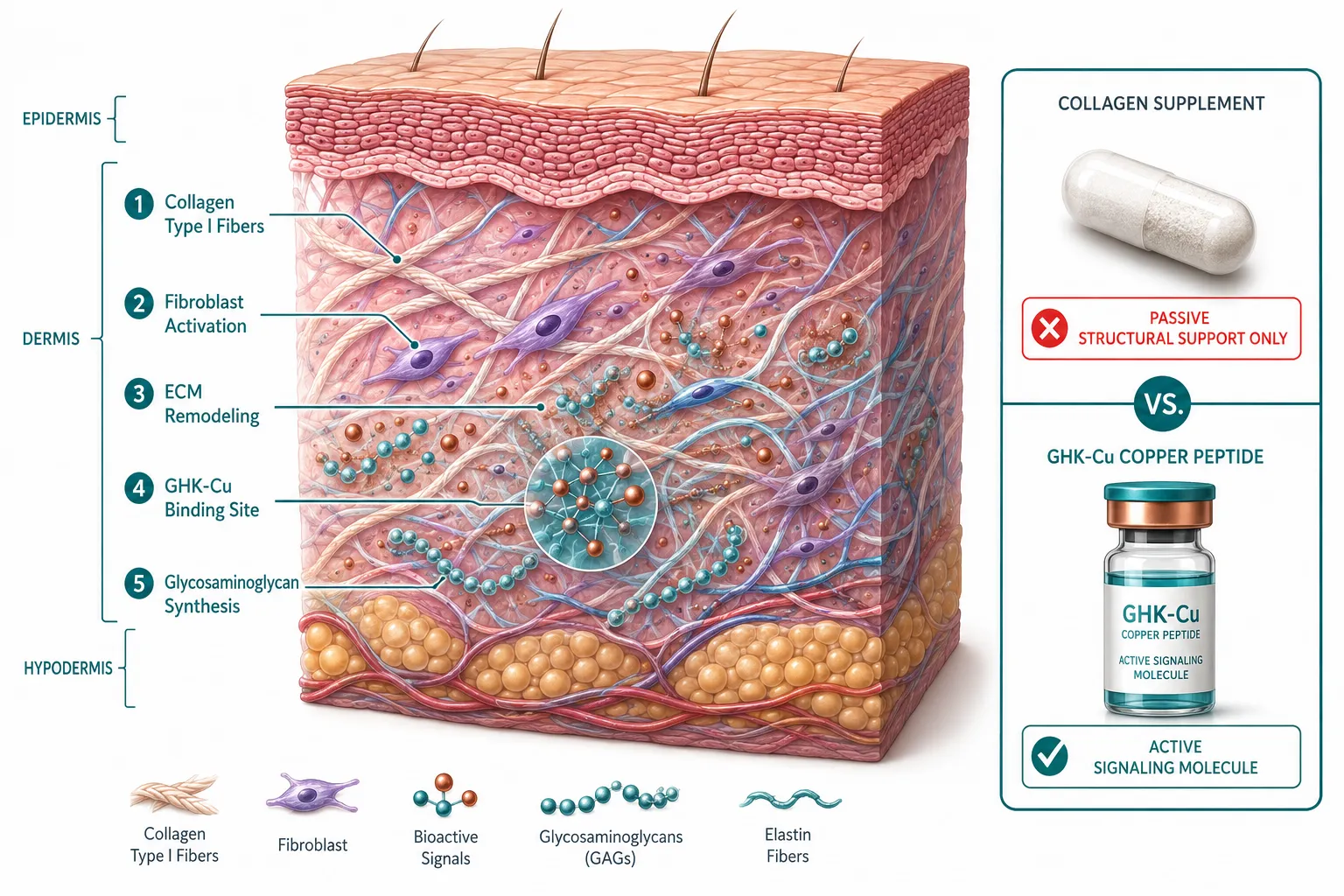
Hydrolyzed collagen supplements work by delivering amino acid precursors, primarily glycine, proline, and hydroxyproline, that cells can use to assemble new collagen fibers. This is passive support. The body receives raw materials, but no direct instruction to activate fibroblasts, regulate matrix metalloproteinases (MMPs), or promote new blood vessel growth.

For general nutritional support, that approach has merit. For skin collagen synthesis research, however, it lacks mechanistic specificity. Scientists studying dermal repair need compounds that interact with defined molecular targets, produce measurable cellular responses, and can be tested in controlled wound models. Classic collagen powders do not meet that standard.

This gap is precisely why skin collagen synthesis research has increasingly turned to bioactive peptides, short amino acid sequences that bind receptors, regulate gene expression, and trigger repair cascades at the cellular level.

Key limitations of classic collagen supplementation in research contexts:

Feature Classic Collagen Supplement GHK-Cu Research Peptide
Mechanism Passive amino acid delivery Active ECM signaling
Fibroblast activation Indirect, minimal Direct stimulation
MMP modulation None Documented regulation
Angiogenesis Not observed Promoted
Wound-healing model utility Low specificity High specificity

GHK-Cu: The Copper Peptide Redefining Skin Matrix Research

Understanding Collagen, GHK-Cu, and Glow Blend: How Research-Use Peptides Advance Skin Matrix and Wound-Healing Models Beyond Classic Collagen Supplements requires a close look at what makes GHK-Cu biologically distinct.

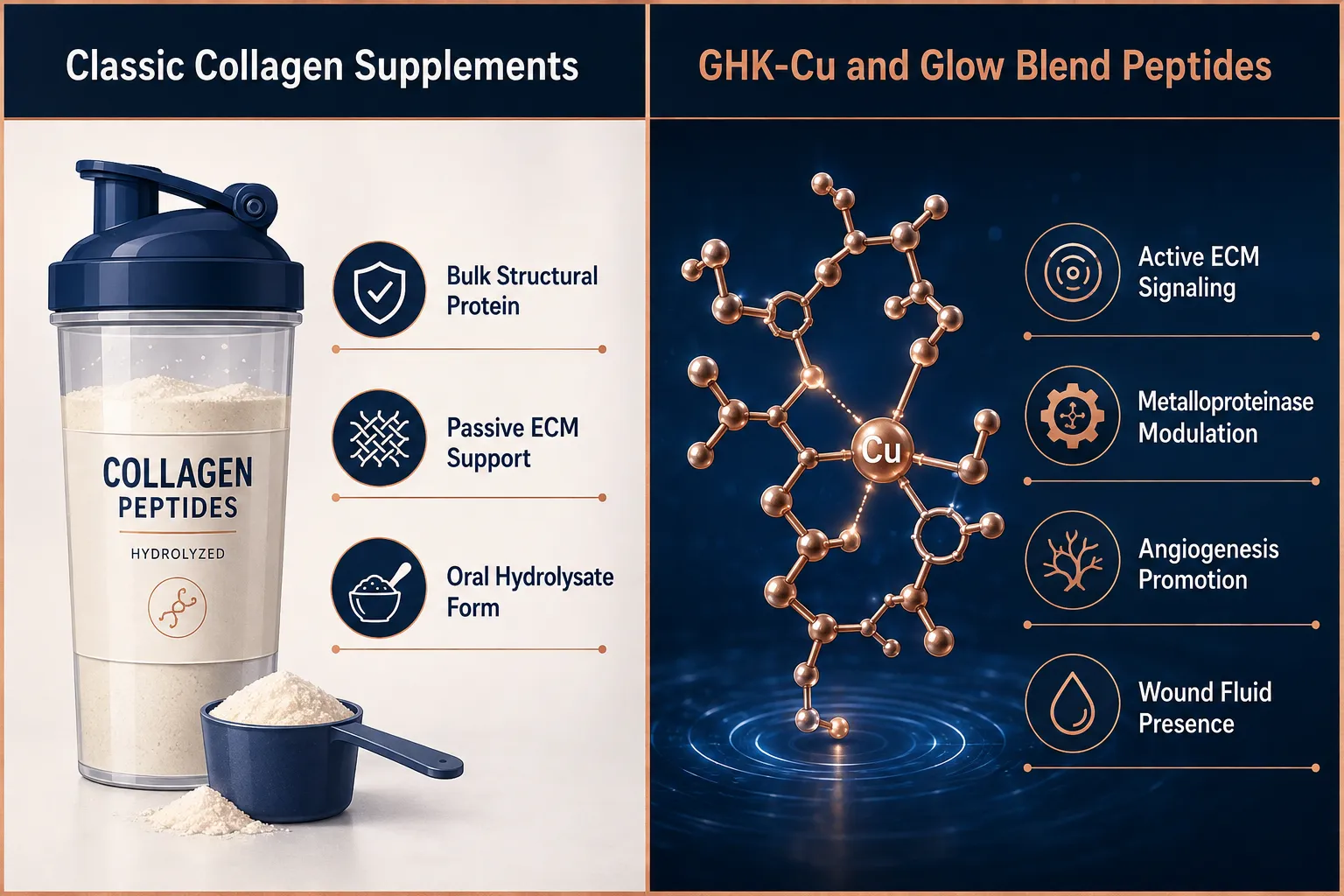
GHK-Cu (glycyl-L-histidyl-L-lysine copper complex) is a naturally occurring tripeptide found in human plasma, saliva, and urine. Crucially, the highest concentrations appear in skin wound fluid during the acute repair phase, a detail that gives this peptide strong biological relevance for wound-healing models rather than making it simply a cosmetic additive.
GHK-Cu: The Copper Peptide Redefining Skin Matrix Research

How GHK-Cu Modulates the Extracellular Matrix

Research consistently documents that GHK-Cu:

  • Stimulates synthesis of type I collagen, elastin, and glycosaminoglycans, the three structural components that give skin its tensile strength and hydration
  • Regulates metalloproteinase activity, preventing excessive ECM breakdown while allowing productive remodeling
  • Promotes angiogenesis (new blood vessel formation) and nerve outgrowth, both essential for tissue repair
  • Suppresses pro-inflammatory cytokines including TGF-beta and IL-6, reducing chronic inflammation that impairs healing

A 2026 review published in the Aesthetic Surgery Journal concluded that GHK-Cu consistently enhanced ECM synthesis and showed anti-inflammatory effects, supporting its classification as a regenerative adjunct rather than a cosmetic ingredient. The same review reported improved patient satisfaction after laser resurfacing and significant reductions in wrinkle volume and depth compared with controls.

Importantly, GHK-Cu can penetrate the stratum corneum in sufficient concentrations to activate regenerative events in the dermis, a pharmacokinetic property that classic collagen molecules, due to their large molecular weight, cannot replicate.

For researchers exploring tissue repair peptides, GHK-Cu represents a well-characterized tool with a defined mechanism of action and a growing clinical evidence base.

Glow Blend and Multi-Peptide Research Models for Skin Regeneration

"The most informative skin-matrix research in 2026 does not rely on a single compound, it maps how peptide combinations interact across repair pathways."

Glow Blend formulations typically combine GHK-Cu with complementary peptides and cofactors designed to address multiple aspects of skin biology simultaneously. In research settings, these blends allow scientists to study synergistic effects across collagen synthesis, antioxidant defense, and cellular proliferation pathways in a single model.

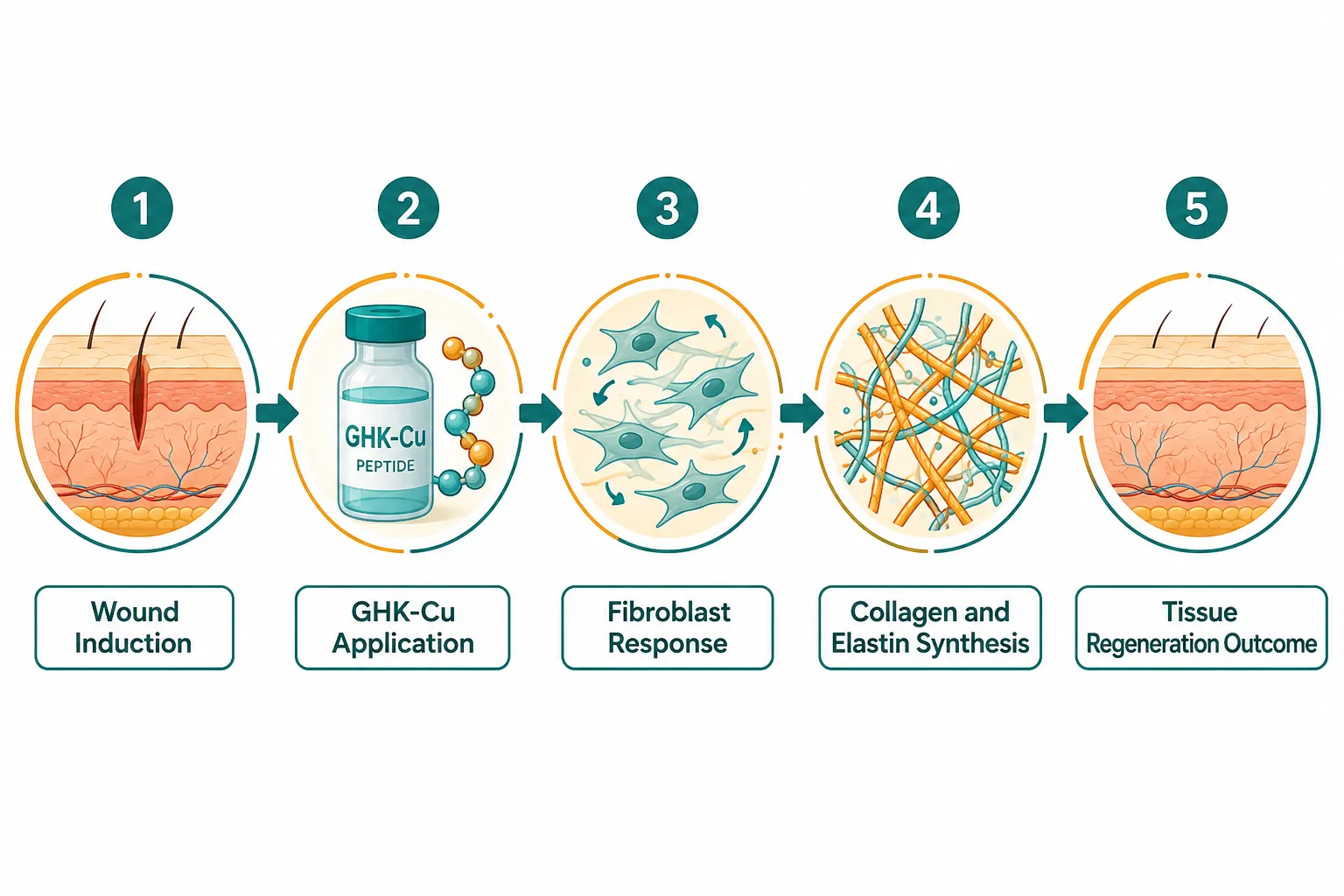
This multi-pathway approach mirrors how the body actually heals. Wound repair is not a single-step process; it involves overlapping phases of inflammation, proliferation, and remodeling, each requiring different molecular signals. A blend that addresses several of these phases simultaneously produces more clinically relevant data than any single compound tested in isolation.
Glow Blend and Multi-Peptide Research Models for Skin Regeneration

What Research Models Using Glow Blend Typically Examine

  • Fibroblast proliferation rates under combined peptide stimulation
  • Collagen fiber density and organization measured via histological staining
  • MMP-to-TIMP ratios as markers of balanced ECM remodeling
  • Angiogenic marker expression (VEGF, CD31) in treated versus control tissue

A prospective clinical trial registered in early 2026 (NCT07437586) is actively evaluating whether a topical GHK-Cu gel can safely accelerate healing of standardized small skin wounds in healthy adults compared with a vehicle gel, a direct test of the mechanistic claims built up through years of in vitro and animal model work.

Researchers sourcing compounds for these models should prioritize verified purity. Reviewing skin peptide sourcing standards and third-party peptide testing protocols is an essential step before any experimental design is finalized.

For broader context on how peptide combinations perform across biological systems, the literature on systemic peptide research provides useful comparative frameworks.

Conclusion

The contrast between classic collagen supplementation and research-use peptides such as GHK-Cu and Glow Blend is not a matter of degree, it is a difference in mechanism. Collagen powders supply raw materials. GHK-Cu and related copper peptides issue cellular instructions: activate fibroblasts, remodel the ECM, suppress inflammation, build new vessels.

For researchers building skin matrix and wound-healing models in 2026, the actionable steps are clear:

  1. Define the target pathway, collagen synthesis, MMP regulation, angiogenesis, or inflammation, before selecting a peptide or blend.
  2. Prioritize purity, use only third-party tested compounds to ensure experimental validity.
  3. Design for mechanism, measure specific biomarkers (collagen type I, elastin, VEGF, MMP ratios) rather than relying on broad outcome proxies.
  4. Consider multi-peptide models where the research question involves overlapping repair phases.

The science of Collagen, GHK-Cu, and Glow Blend: How Research-Use Peptides Advance Skin Matrix and Wound-Healing Models Beyond Classic Collagen Supplements continues to mature rapidly. Researchers who align their sourcing, model design, and outcome measures with the current mechanistic evidence will be best positioned to generate reproducible, high-impact findings.

https://www.puretestedpeptides.com/wp-content/uploads/2026/09/collagen-ghk-cu-and-glow-blend-how-research-use-peptides-advance-skin-matrix-and.webp 1024 1536 https://www.puretestedpeptides.com/wp-content/uploads/2026/01/buy-peptides-online.jpg 2026-09-05 13:06:462026-09-05 13:06:46Collagen, GHK-Cu, and Glow Blend: How Research-Use Peptides Advance Skin Matrix and Wound-Healing Models Beyond Classic Collagen Supplements
×

Helpful Links

  • My account
  • Cart
  • Checkout
  • Refund and Returns Policy
  • Privacy Policy
  • SMS Privacy Policy
  • Login
  • My Account
  • Logout

USA Made Lab Tested Peptides

All products are sold for research, laboratory, or analytical purposes only, and are not for human consumption


Pure Tested Peptides is a chemical supplier. Pure Tested Peptides is not a compounding / chemical compounding facility as defined under 503A of the Federal Food, Drug, and Cosmetic act. Pure Tested Peptides is not an outsourcing facility as defined under 503B of the Federal Food, Drug, and Cosmetic act.

The statements made within this website have not been evaluated by the US Food and Drug Administration. The products we offer are not intended to diagnose, treat, cure or prevent any disease.

Human/Animal Consumption Prohibited. Laboratory/In-Vitro Experimental Use Only

Scroll to top Scroll to top Scroll to top