

Where to Buy Research-Grade MOTS-c and 5-Amino-1MQ: Vendor Selection, Purity Standards, and Certificate of Analysis Essentials
Less than 30% of peptide vendors operating online in 2026 publish batch-specific, third-party-verified Certificates of Analysis, yet researchers routinely base purchasing decisions on price alone. For anyone sourcing compounds like MOTS-c and 5-Amino-1MQ, that gap between available documentation and actual buyer behavior represents a serious risk to experimental integrity.
This guide addresses where to buy research-grade MOTS-c and 5-Amino-1MQ, covering vendor selection criteria, purity thresholds, COA interpretation, and the red flags that separate compliant research suppliers from cosmetic-grade or non-compliant ones.
Key Takeaways
- Purity for research-grade MOTS-c should reach at least 98%, with leading vendors now reporting 99.5-99.8% by HPLC.
- A valid COA must include batch number, purity method, identity confirmation, net peptide content, endotoxin status, and storage conditions.
- Independent third-party lab verification is the strongest differentiator among MOTS-c vendors in 2026.
- Documentation standards for 5-Amino-1MQ lag behind MOTS-c; apply stricter manual vetting when sourcing this compound.
- "Research use only" labeling is a legal and ethical requirement, not optional language.
Vendor Selection for Research-Grade MOTS-c and 5-Amino-1MQ
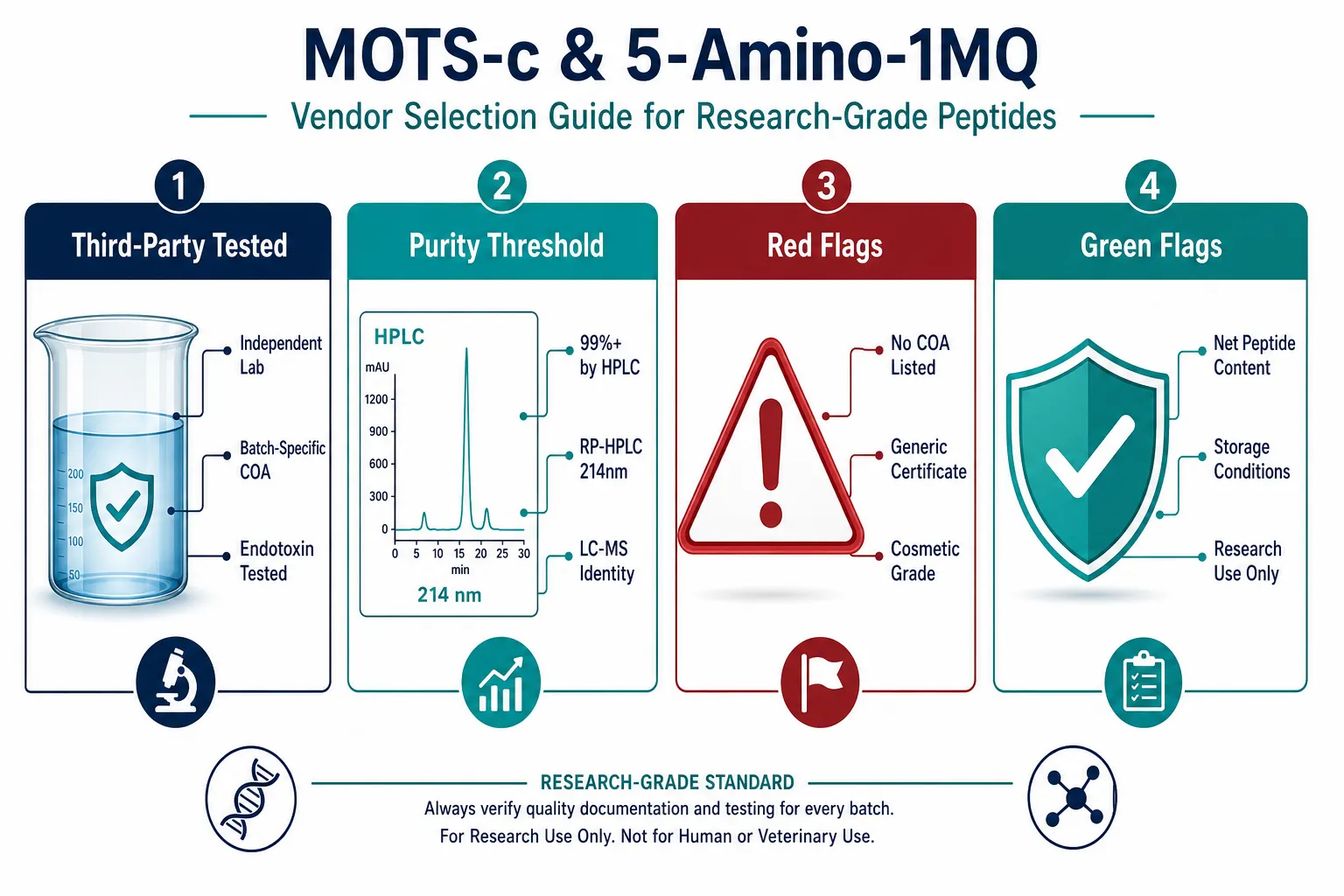
The single most important criterion when evaluating a vendor is not price, it is whether the supplier publishes a batch-specific Certificate of Analysis from an independent laboratory. Vendors that rely on in-house testing only, or that provide a single generic COA covering multiple batches, offer far weaker quality assurance.
For MOTS-c specifically, a growing number of suppliers now meet this standard. Vendors such as Oath Research, Veritas Peptides, Summit Peptides, NextEdge Peptides, Glacier Aminos, and Peptiq have published 2026 COAs that include third-party lab names, including testing facilities such as Apex Laboratory, TraceHelix, and Peptigrity. This transparency is meaningful because it allows independent verification of results.
For those engaged in systemic peptide research, the vendor's documentation practices directly affect the reliability of any downstream data. A supplier who cannot name the testing laboratory or provide a lot-matched document should not be considered research-grade.
Vendor evaluation checklist:
- Is the COA batch-specific, not generic?
- Is the testing laboratory named and independently verifiable?
- Does the product carry explicit "for research use only" labeling?
- Is the compound described as a peptide or small molecule (not a cosmetic ingredient)?
- Does the vendor provide solvent compatibility guidance?
Researchers comparing vendor scoring rubric frameworks will find that these five criteria consistently separate high-quality suppliers from the rest of the market.
Purity Standards and Testing Methods
Purity thresholds matter because even small percentages of impurities, including truncated sequences, oxidized residues, or residual solvents, can alter biological activity in cell culture or in-vivo models.
Accepted minimums for research-grade compounds:
| Compound | Minimum Acceptable Purity | Preferred Standard |
|---|---|---|
| MOTS-c | 95% by HPLC | 98-99.8% by RP-HPLC |
| 5-Amino-1MQ | 95% by HPLC | 98%+ by HPLC |
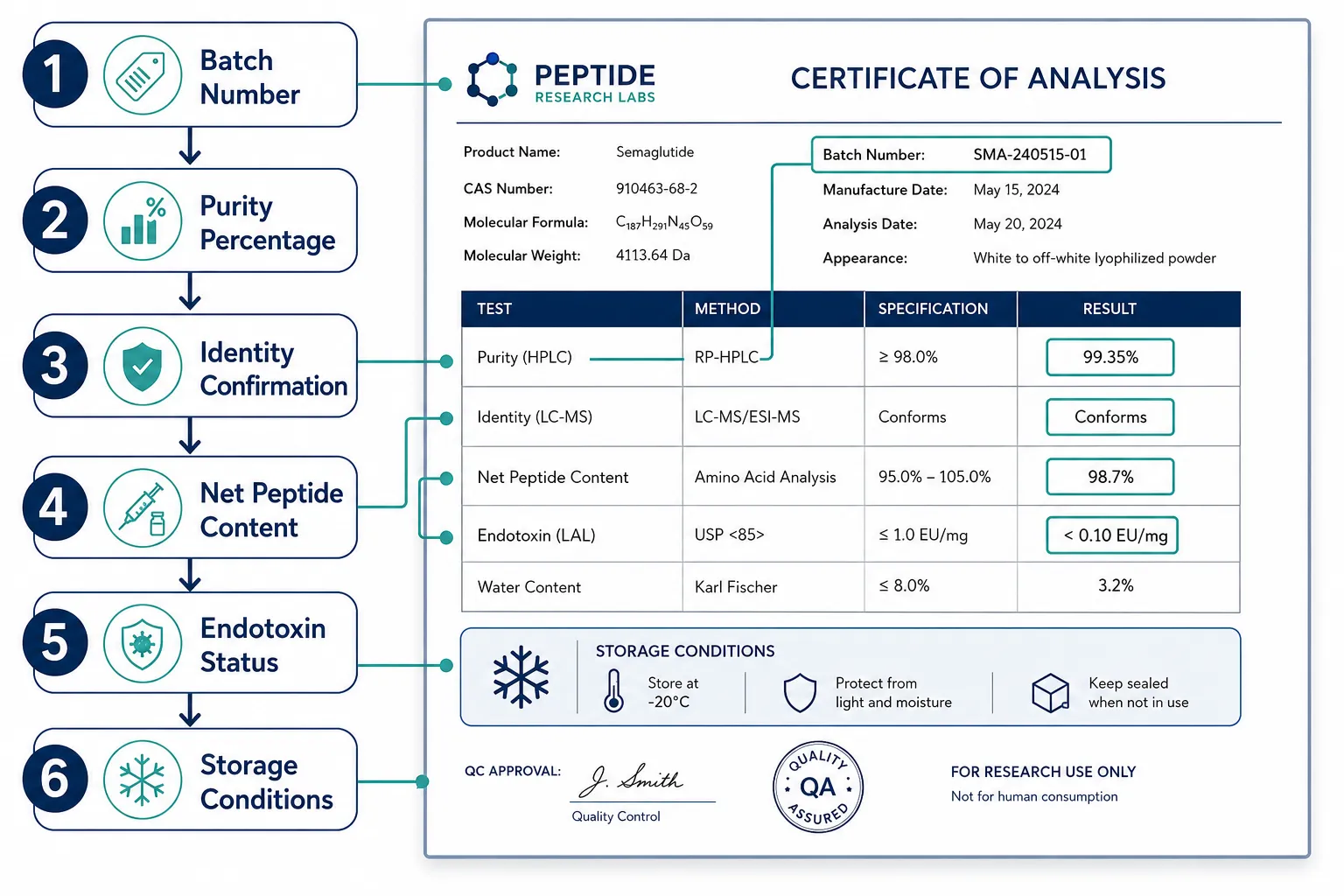
For MOTS-c, leading vendors in 2026 report purity figures of 99.5-99.8% using reversed-phase HPLC (RP-HPLC) at 214 nm. Identity is confirmed separately via LC-MS or ESI-MS, which verifies molecular weight against the theoretical value for the compound. Both tests should appear on the same COA.
"A purity figure without an identity confirmation method is incomplete documentation, it tells you how much of something is present, but not whether that something is the correct compound."
Net peptide content is a separate and equally important figure. A vial labeled as containing 5 mg of MOTS-c may contain only 3.8 mg of actual peptide if the remainder is counter-ion, water, or excipient. Reputable vendors now report net peptide content alongside gross weight, and this distinction is critical for accurate dosing in research protocols.
Endotoxin testing is increasingly standard among top-tier MOTS-c vendors. For any work involving live cell cultures or animal models, endotoxin levels above 1 EU/mg can compromise results. Researchers conducting SS-31 mitochondrial research will recognize this concern as consistent across mitochondria-targeted peptide compounds.
Certificate of Analysis Essentials: What Every COA Must Include
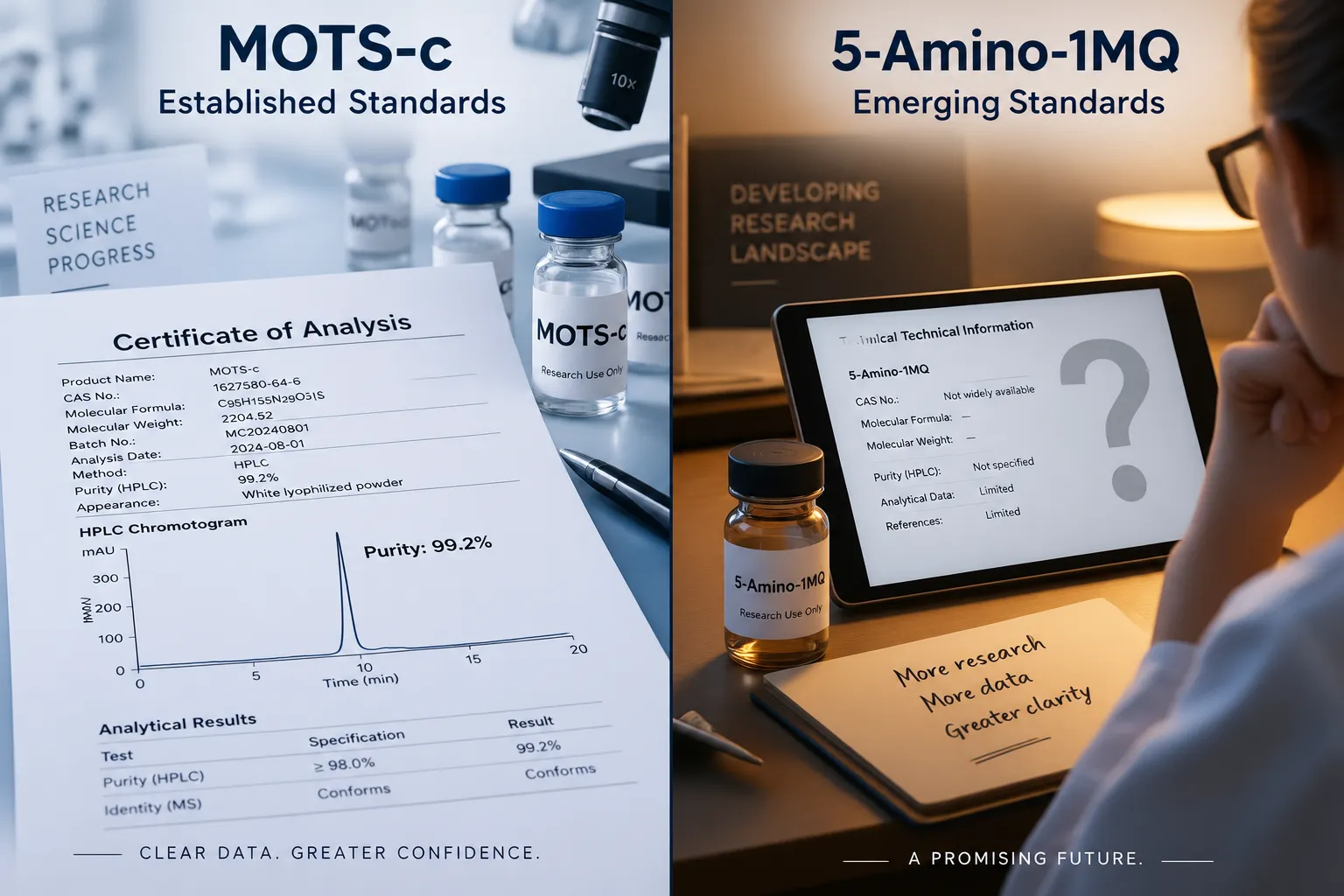
Understanding where to buy research-grade MOTS-c and 5-Amino-1MQ requires the ability to critically evaluate a COA before purchase. Not all documents labeled "Certificate of Analysis" meet research standards.
A compliant research-grade COA must contain:
- Batch or lot number, unique identifier linking the document to a specific production run
- Purity percentage and method, e.g., "99.6% by RP-HPLC at 214 nm"
- Identity confirmation, e.g., "confirmed by LC-MS; observed MW matches theoretical MW"
- Net peptide content, actual peptide mass as a percentage of labeled weight
- Fill accuracy, confirmation that vial contents match labeled quantity
- Endotoxin status, result in EU/mg or EU/mL with the method used
- Counter-ion disclosure, e.g., acetate or TFA salt form, relevant to solvent compatibility
- Storage conditions, temperature, light, and humidity requirements
- "Research use only" statement, a legal and ethical requirement in most jurisdictions
Solvent compatibility is a practical concern tied directly to COA data. TFA (trifluoroacetate) salt forms can be cytotoxic in cell-based assays; researchers should confirm whether the vendor offers acetate-exchanged product or discloses the counter-ion explicitly. This is especially relevant for those working in skin tissue research or skin rejuvenation research where cell viability is a primary endpoint.
The 5-Amino-1MQ documentation gap: Unlike MOTS-c, 5-Amino-1MQ currently lacks an equivalent body of publicly available, third-party-verified COAs from named vendors. This does not mean compliant suppliers do not exist, it means buyers must apply more rigorous manual vetting. Request the COA directly before purchase, confirm the testing lab independently, and do not accept a generic or undated document.
Researchers working on metabolic or somatotropin research pathways who incorporate 5-Amino-1MQ should factor this documentation gap into their experimental design and sourcing timelines.
Conclusion
Sourcing research-grade MOTS-c and 5-Amino-1MQ responsibly in 2026 means treating vendor documentation as a primary selection criterion, not an afterthought. The steps are clear: require a batch-specific COA from a named independent laboratory, verify purity by RP-HPLC and identity by LC-MS, confirm net peptide content and endotoxin status, and check that "research use only" language is present.
Actionable next steps:
- Before ordering, email the vendor and request the COA for the current batch. If they cannot provide one promptly, move on.
- Cross-reference the named testing laboratory against publicly available lab directories to confirm it exists independently.
- For 5-Amino-1MQ, apply the same COA checklist used for MOTS-c and reject any document that omits identity confirmation or net peptide content.
- Store compounds according to COA specifications and document the lot number in all experimental records.
The research peptide market is moving toward greater transparency. Buyers who demand rigorous documentation now will benefit from better data quality and contribute to raising the standard across the industry.