Call or Text 727-513-9780
  • Shopping Cart Shopping Cart
    0Shopping Cart
Pure Tested Peptides | America's most trusted Peptides for sale online
  • Peptides for sale
    • Oral Peptides for sale
      • Peptide Capsules for sale
      • BPC 157 Capsules 1000mcg
      • SLU-PP-332 Capsules | 1000 mcg
      • 5-Amino-1MQ 50mg Capsules
      • Tesofensine 500mcg
    • All Peptides for sale
    • Peptide Sprays
      • BPC 157 Nasal Spray Kit
      • BPC-157 TB500 Nasal Spray Kit
      • Semax Nasal Spray 10mg
      • Selank – Nasal Spray Kit – 10mg
      • Epithalon 50MG Nasal Spray Kit
      • Ipamorelin 10mg Nasal Spray
      • Klow Nasal Spray (BPC-157 + TB-500 + GHK-Cu + KPV) | 80mg
      • Hulk Nasal Spray Tesa / Ipa Blend 6/3 MG
      • Klow Nasal Spray
      • NAD + 500 mg Nasal Spray
      • PT-141 Nasal Spray Kit
    • GHRH Peptides
      • Ipa Peptides
      • CJC-1295 Peptides
        • CJC-1295 with DAC 5 mg
        • CJC-1295 without DAC 5 mg
        • CJC-1295 Ipa 10mg
      • Tesa Peptides
        • Tesa Peptide
        • Tesa 20 mg
    • GHK-Cu Peptides
      • All GHK-Cu Peptides
      • GHK-Cu 100mg
      • KLOW Peptide Blend – Buy KLOW blend online
    • BPC Peptides
      • All BPC Peptides
      • BPC-157
      • BPC-157 TB-500
      • BPC 157 capsules 1000mcg
    • SLU-PP-332 Peptides
      • All SLU-PP-332 Peptides
      • SLU-PP-332 5mg
    • GLP3 Peptides
    • PT-141 Peptides
      • PT-141 Peptides for sale
      • PT-141 10mg
      • PT-141 Nasal Spray
    • CAG Peptides
      • Lipo-C Peptide Blend
      • CAG 5mg
      • CAG 10mg
    • MOTS-C Peptides
      • MOTS-C Peptides for sale
      • MOTS-c peptide
      • MOTS-c 10mg *6 pack*
    • 5 Amino 1MQ Peptides
      • 5 Amino 1MQ Peptides for sale
      • 5-Amino-1MQ 50mg Capsules
      • 5-Amino-1MQ 5mg
    • Epithalon Peptides
      • Epithalon Peptides for sale
      • Epithalon 10mg
      • Epithalon 50mg
  • Shop
    • GLPs
      • 5-Amino-1MQ 50mg Capsules
      • 5-Amino-1MQ 5mg
      • L-Carnitine 500mg/ml
      • Tesofensine 500mcg
      • SLU-PP-332 5mg
      • MOTS-c 10mg *6 pack*
    • Epithalon & BPC Peptides
      • Epithalon 10mg
      • Epithalon 50mg
      • BPC-157
      • BPC 157 capsules 1000mcg
      • BPC-157 TB-500
      • BPC-157 TB500 Nasal Spray Kit
      • BPC 157 Nasal Spray Kit
    • BPC TB-500 & NAD+ Peptides
      • NAD+ 500 mg
      • KLOW Peptide Blend – Buy KLOW blend online
      • GLOW Peptide Blend
      • TB 500 5mg
      • BPC 157 capsules 1000mcg – Supplement
      • BPC 157 Nasal Spray Kit
      • BPC-157
      • BPC-157 TB500 Nasal Spray Kit
      • BPC-157 TB-500
      • BPC 157 capsules 1000mcg
    • LL-37 Peptide
      • LL-37 10 mg
    • MOTS-C & Selank
      • MOTS-c peptide
      • Selank 10mg
    • GHK Peptides
      • GHK-Cu 100mg
      • GLOW Peptide Blend
      • KLOW Peptide Blend – Buy KLOW blend online
  • COAs
  • Wholesale
    • Wholesale Peptides for sale
  • PTP FAQ
  • Affiliates
    • Selank Peptide: Advanced Pharmacological Mechanisms Underlying Its Anxiolytic and Nootropic Effects in Research
      • 5-Amino-1MQ Peptide: Detailed Mechanisms of NNMT Inhibition and Its Impact on Cellular Metabolism Research
        • MOTS-C Peptide: Unraveling Its Role in Mitochondrial Dynamics and Energy Metabolism Research
          • Epithalon Peptide and Telomerase Regulation: Investigating Its Impact on Cellular Senescence and Lifespan Research Models
            • GLP2-T vs GLP2 Tirz Peptide: Understanding the Naming, Mechanistic Nuances, and Research Implications for Gut Health
      • Peptides and Polypeptides in Modern Pharmacology: What Research on Metoprolol, Prednisone, and Amlodipine Reveals
        • Polypeptide Peptides vs NSAIDs: What Naproxen and Diclofenac Teach Tissue-Repair Researchers About BPC‑157 and TB‑500
          • Peptides and Polypeptides in Endocrine Pharmacology: How GLP-1, GLP-2, and GLP-3 Retatrutide Differ From Classic Drugs Like Prednisone and Amlodipine
          • 5‑Amino‑1MQ Peptide and NNMT Inhibition: How It Compares With Statins Like Atorvastatin in Adipose and Lipid Metabolism Research
      • Enclomiphene, Estrogen Receptor Signaling, and Luteinizing Phase Biology: What Hormone Researchers Should Measure
        • Mesenchymal Stem Cells, BPC‑157, and GHK‑Cu: How Tissue Repair Peptides Compare With Classic NSAIDs Like Naproxen in Injury Models
          • Peptide Calculator Use Cases Beyond Growth Hormone: Working Through GLP‑3 Retatrutide, MOTS‑c, and BPC‑157 Research Dosing
        • Polypeptide Peptides in Endocrine and Metabolic Pharmacology: Lessons From Amlodipine, Prednisone, and Metoprolol
        • Peptides Calculator for Advanced Blends: Worked Examples for Tesamorelin, CJC‑1295, and Ipamorelin Stacks
          • Peptides and Polypeptides in Human Physiology: How Molecular Size Shapes Research Applications
            • Selank Peptide: Advanced Pharmacological Mechanisms Underlying Its Anxiolytic and Nootropic Effects in Research
          • 5-Amino-1MQ Peptide: Detailed Mechanisms of NNMT Inhibition and Its Impact on Cellular Metabolism Research
            • MOTS-C Peptide: Unraveling Its Role in Mitochondrial Dynamics and Energy Metabolism Research
              • Epithalon Peptide and Telomerase Regulation: Investigating Its Impact on Cellular Senescence and Lifespan Research Models
                • GLP2-T vs GLP2 Tirz Peptide: Understanding the Naming, Mechanistic Nuances, and Research Implications for Gut Health
                  • Peptides and Polypeptides in Endocrine Pharmacology: How GLP-1, GLP-2, and GLP-3 Retatrutide Differ From Classic Drugs Like Prednisone and Amlodipine
                    • Polypeptide Peptides vs NSAIDs: What Naproxen and Diclofenac Teach Tissue-Repair Researchers About BPC‑157 and TB‑500
                      • Peptides and Polypeptides in Modern Pharmacology: What Research on Metoprolol, Prednisone, and Amlodipine Reveals
                        • 5‑Amino‑1MQ Peptide and NNMT Inhibition: How It Compares With Statins Like Atorvastatin in Adipose and Lipid Metabolism Research
                        • Enclomiphene, Estrogen Receptor Signaling, and Luteinizing Phase Biology: What Hormone Researchers Should Measure
                        • Mesenchymal Stem Cells, BPC‑157, and GHK‑Cu: How Tissue Repair Peptides Compare With Classic NSAIDs Like Naproxen in Injury Models
                        • Peptide Calculator Use Cases Beyond Growth Hormone: Working Through GLP‑3 Retatrutide, MOTS‑c, and BPC‑157 Research Dosing
                        • Polypeptide Peptides in Endocrine and Metabolic Pharmacology: Lessons From Amlodipine, Prednisone, and Metoprolol
                        • Peptides Calculator for Advanced Blends: Worked Examples for Tesamorelin, CJC‑1295, and Ipamorelin Stacks
                        • Peptides and Polypeptides in Human Physiology: How Molecular Size Shapes Research Applications
                        • Selank Peptide: Advanced Pharmacological Mechanisms Underlying Its Anxiolytic and Nootropic Effects in Research
                        • MOTS-C Peptide: Unraveling Its Role in Mitochondrial Dynamics and Energy Metabolism Research
                        • Peptides and Polypeptides in Modern Pharmacology: What Research on Metoprolol, Prednisone, and Amlodipine Reveals
                        • Peptides and Polypeptides in Endocrine Pharmacology: How GLP-1, GLP-2, and GLP-3 Retatrutide Differ From Classic Drugs Like Prednisone and Amlodipine
                        • 5-Amino-1MQ Peptide: Detailed Mechanisms of NNMT Inhibition and Its Impact on Cellular Metabolism Research
                        • Mesenchymal Stem Cells, BPC‑157, and GHK‑Cu: How Tissue Repair Peptides Compare With Classic NSAIDs Like Naproxen in Injury Models
                        • Peptide Calculator Use Cases Beyond Growth Hormone: Working Through GLP‑3 Retatrutide, MOTS‑c, and BPC‑157 Research Dosing
                        • GLP2-T vs GLP2 Tirz Peptide: Understanding the Naming, Mechanistic Nuances, and Research Implications for Gut Health
                        • Polypeptide Peptides in Endocrine and Metabolic Pharmacology: Lessons From Amlodipine, Prednisone, and Metoprolol
                        • Polypeptide Peptides vs NSAIDs: What Naproxen and Diclofenac Teach Tissue-Repair Researchers About BPC‑157 and TB‑500
                        • Peptides and Polypeptides in Human Physiology: How Molecular Size Shapes Research Applications
                        • Peptides Calculator for Advanced Blends: Worked Examples for Tesamorelin, CJC‑1295, and Ipamorelin Stacks
                        • 5‑Amino‑1MQ Peptide and NNMT Inhibition: How It Compares With Statins Like Atorvastatin in Adipose and Lipid Metabolism Research
                        • Enclomiphene, Estrogen Receptor Signaling, and Luteinizing Phase Biology: What Hormone Researchers Should Measure
                        • Epithalon Peptide and Telomerase Regulation: Investigating Its Impact on Cellular Senescence and Lifespan Research Models
                        • Best research protocol Klow blend
                        • best time to take BPC-157
                        • best time to take DSIP (Delta Sleep Inducing Peptide)
                        • best time to take CJC-1295
                        • best time to take AOD-9604
                        • best time to take Follistatin 344
                        • best time to take Ipamorelin
                        • best time to take MK-677 (Ibutamoren)
                        • best time to take Ligandrol (LGD-4033) — research compound
                        • best time to take Ostarine (MK-2866) — research compound
                        • best time to take GHK-CU
                        • best time to take TB-500
                        • best time to take MOTS-c
                        • best time to take Semax
                        • best time to take RAD-140 (Testolone) — research compound
                        • best time to take Thymosin Alpha-1
                        • best time to take PEG-MGF
                        • Biolife Plasma, Octapharma Plasma, and Research Peptides: How Plasma Donation Labs Differ From Peptide Suppliers
                        • best time to take YK-11 — research compound
                        • best time to take PT-141 (Bremelanotide)
                        • Best research protocol Klow blend
                        • 5-Amino-1MQ and MOTS-C Synergy: Metabolic Signaling, Mitochondria, and Research Design
                        • BPC-157 and TB-500: Investigating Their Combined Effects on Angiogenesis and Cellular Migration in Tissue Repair Models
                        • BPC-157 Peptide: Gut Barrier Function, Inflammation, and Tissue-Recovery Research
                        • 5‑Amino‑1MQ and MOTS‑c Synergy in Metabolic Research: Designing NNMT and Mitochondrial Biogenesis Stacks
                        • CJC-1295 with DAC vs. Without DAC: Half-Life, Release Kinetics, and Research Implications
                        • CJC‑1295 with DAC vs. Without DAC: Expanding on Half‑Life Differences Using Tesamorelin and Ipamorelin Blend Case Studies
                        • Collagen Biology and Copper‑Binding Peptides: How GHK‑Cu, Glow Blend, and Klow Blend Interact with Skin and Connective Tissue
                        • Collagen Biology and Regenerative Peptides: How GHK‑Cu, Glow Blend, and Klow Blend Affect Extracellular Matrix Research
                    • DNA, Telomeres, and Longevity Peptides: Positioning Epithalon and MOTS‑c in Genetic Aging Research
                      • Enclomiphene Citrate: serm Mechanism, Testosterone Research, and Stack Compatibility
                        • Enclomiphene vs Enclomiphene Citrate: Formulation, Bioavailability, and Research Distinctions
                        • Epithalon Peptide Research: Telomerase Activation, Aging, and Pineal Gland Function
                        • Estrogen Receptor Signaling and Enclomiphene: How Selective Modulators Compare with Classic Polypeptide Hormones
                        • GHK-Cu Peptide: Advanced Mechanisms in Extracellular Matrix Remodeling and Wound Healing Research
                        • GHK-Cu Peptide: Collagen Synthesis, Wound Repair, and Skin-Barrier Research Models
                        • GLP-1 vs GLP-3 vs GLP-2: Peptide Classification and Research Applications
                        • GLP-2 Peptide Research Guide: Gut Barrier Function, Nutrient Absorption, and Intestinal Recovery Models
                        • GLP-3 Retatrutide vs. GLP-1 Drugs: What Triple-Agonist Biology Changes in Research Models
                        • Ipamorelin and Tesamorelin Combination: Synergistic GH Secretagogue Research and Dosing Protocols
                        • GLP2 Tirz Peptide: What It Is, Why the Name Exists, and How Researchers Should Interpret It
                        • Klow Blend Peptide Nasal Spray: What the Formulation Is Trying to Do in Cognitive Research
                        • Mitochondria, NNMT Inhibition, and Peptide Modulators: Where MOTS‑c and 5‑Amino‑1MQ Fit in Cellular Energy Research
                        • MOTS-c Peptide: Mitochondrial Function, Energy Metabolism, and What Researchers Measure
                        • MOTS-c vs. 5-Amino-1MQ: Which Metabolic Research Questions Each Compound Actually Answers
                        • Nasal Spray Peptides: Bioavailability, Administration, and Semax/Selank Research Applications
                        • PT-141 Peptide Research: Mechanism of Action and Melanocortin Receptor Signaling
                        • Retatrutide for Research: Mechanism, Structure, and GLP-1/GLP-3 Dual Action
                        • Retatrutide for Obesity and Type 2 Diabetes: What the Latest Trial Data Suggest
                        • Tesofensine Peptide Research: Mechanism, Appetite Suppression, and Neuropeptide Y Pathways
  • Contact
    • Contact Customer Service
    • Text Customer Support
  • About US
  • Shop all peptides
  • Affiliate Program
    • Affiliate Signup
  • Login / Register Login / Register Page Link Login / Register Page Link
  • Click to open the search input field Click to open the search input field Search
  • Menu Menu
Where to Buy Research-Use Peptides: A Vendor-Comparison Framework for COAs, Identity Testing, and Batch Traceability

Where to Buy Research-Use Peptides: A Vendor-Comparison Framework for COAs, Identity Testing, and Batch Traceability

October 16, 2026/0 Comments/in Uncategorized/by

A 2026 cross-vendor review found that fewer than half of ten surveyed research peptide suppliers published lot-specific Certificates of Analysis before purchase, meaning most researchers were ordering compounds without confirmed identity data in hand. For scientists who depend on reproducible results, that gap is not a minor inconvenience; it is a direct threat to experimental validity. Knowing where to buy research-use peptides requires more than finding a supplier with a product listing. It demands a structured framework for evaluating COAs, identity testing methods, and batch traceability before a single order is placed.

Key Takeaways

  • Batch-specific COAs, not generic or on-request documents, are the baseline standard for credible research-use peptide suppliers in 2026.
  • Identity testing should use at least two orthogonal analytical methods; LC-MS combined with HPLC retention time is the current minimum.
  • Independent, third-party laboratory testing (not in-house) is essential to eliminate financial conflicts of interest in purity reporting.
  • Lot numbers on vials, searchable COA libraries, and QR-code or digital traceability systems are now moving from premium features to baseline expectations.
  • A multi-parameter testing panel covering purity, identity, heavy metals, endotoxin, and sterility represents the highest tier of vendor documentation.

Why Documentation Standards Define Vendor Quality

The research peptide market has matured rapidly. What differentiated a top-tier supplier in 2022, publishing any HPLC result at all, is now considered a floor, not a ceiling. By 2026, the benchmark has shifted toward comprehensive, independently verified, batch-specific documentation that a researcher can interrogate before committing to a purchase.
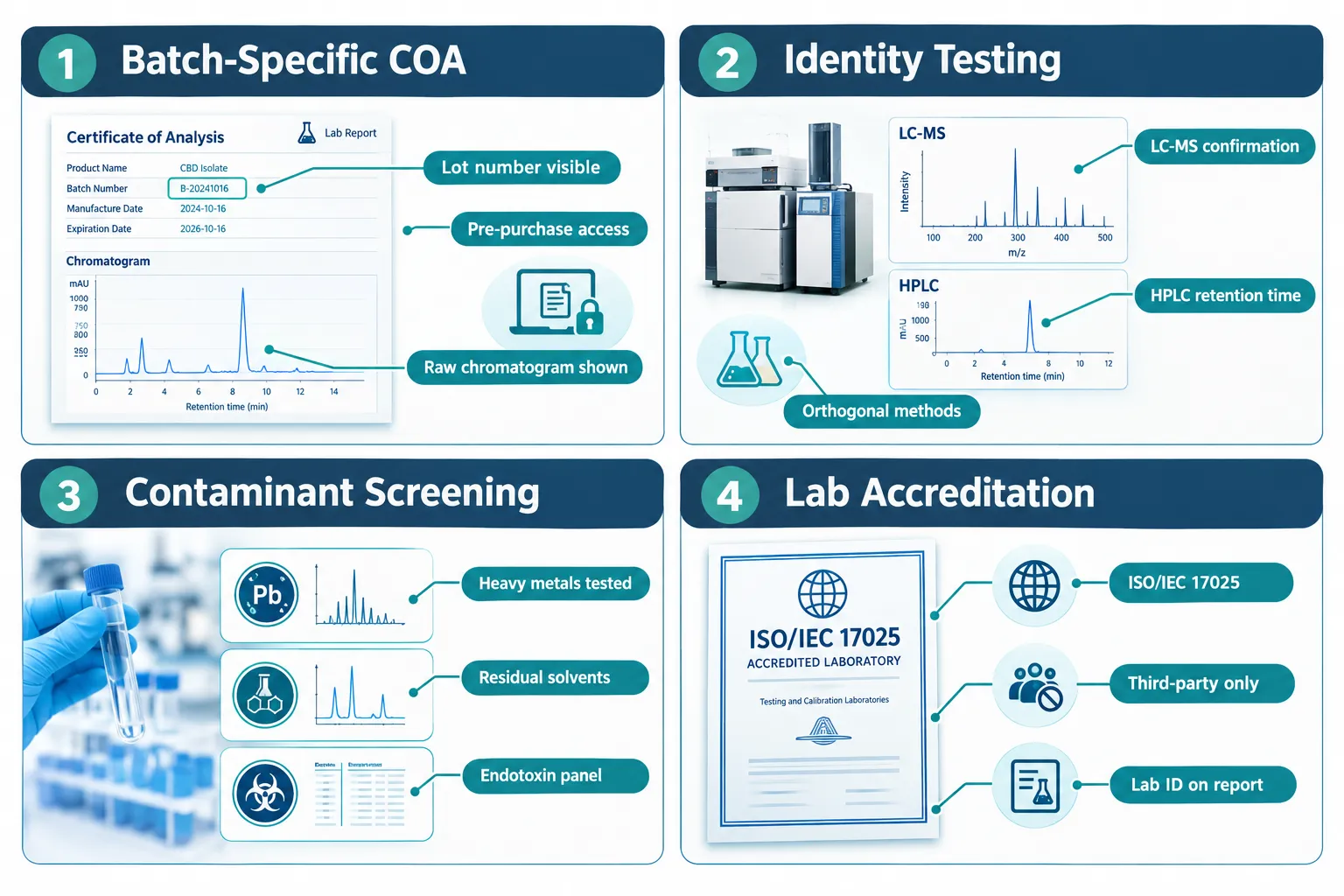
Why Documentation Standards Define Vendor Quality

Three documentation pillars define vendor quality in the current landscape:

1. Certificate of Analysis (COA) accessibility
A COA should be batch-specific, meaning it reflects the exact lot being sold, not a representative sample from a prior production run. Reputable suppliers publish COAs directly on product pages, accessible before purchase, with the lot number visible and matching the vial label. Generic or on-request-only COAs are a red flag.

2. Analytical method breadth
A purity percentage alone is insufficient. The COA should include the raw HPLC chromatogram, the mass spectrum or LC-MS data confirming molecular identity, and, for smaller peptides where higher-confidence structural confirmation is needed, potentially NMR data. Technical guidance published in 2026 is explicit: identity confirmation requires at least two orthogonal analytical methods.

3. Third-party laboratory independence
In-house testing creates a direct financial conflict of interest. The laboratory name, accreditation status (ideally ISO/IEC 17025), and a unique lab identifier should appear on every COA. This allows researchers to cross-reference results independently.

"Batch-specific COAs made available directly on product pages, rather than only on request, are the clearest signal of a supplier's commitment to transparency."


Building a Vendor-Comparison Framework for COAs, Identity Testing, and Batch Traceability

Applying a consistent framework when deciding where to buy research-use peptides removes guesswork and protects experimental integrity. The following criteria can be used to score and compare any supplier.
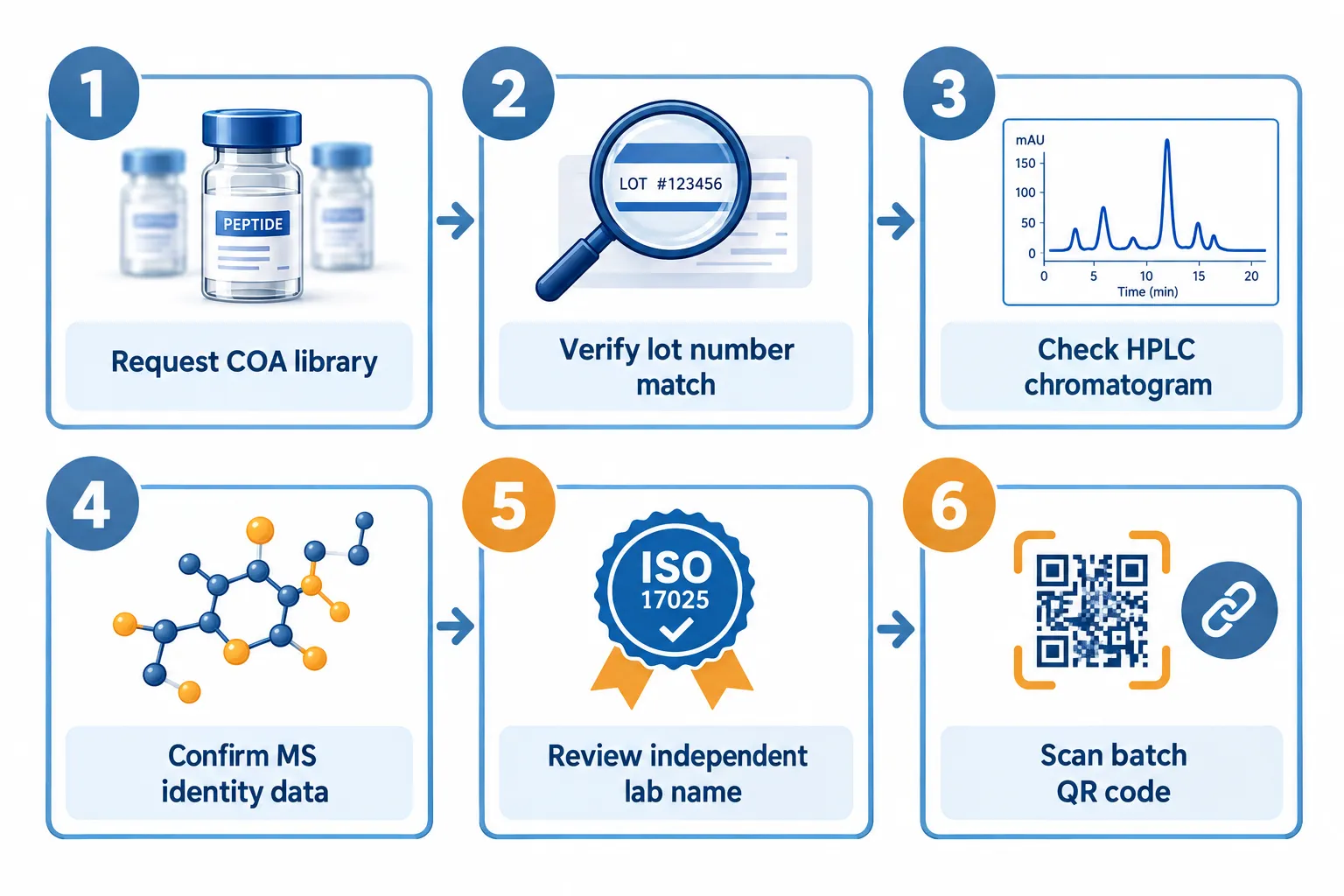
Building a Vendor-Comparison Framework for COAs, Identity Testing, and Batch Traceability

Tier 1: COA Completeness

COA Element Minimum Standard High-Coverage Standard
Lot number Present, matches vial Linked via QR or digital library
Purity method HPLC-UV, ≥98% target HPLC + net peptide content
Identity method MS or LC-MS LC-MS/MS + NMR for small peptides
Contaminant screening Residual solvents Heavy metals, endotoxin, sterility, fentanyl screen
Lab accreditation Third-party named ISO/IEC 17025, unique lab ID

Tier 2: Identity Testing Depth

Identity testing is the area where vendor claims diverge most sharply from actual practice. HPLC alone confirms purity but not molecular identity, a compound can be highly pure and still be the wrong molecule. LC-MS confirms molecular weight and, combined with HPLC retention time, provides strong identity evidence. Suppliers offering LC-MS/MS or multi-lab cross-verification represent the current gold standard.

When researching specific compounds, for example, exploring SS31 peptide or reviewing tesa sourcing and science, the same documentation criteria apply regardless of peptide class.

Tier 3: Batch Traceability Systems

Traceability means a researcher can link a specific vial to a specific production run and its associated analytical data. Best-practice suppliers assign unique lot numbers to every vial, maintain searchable COA libraries, and increasingly use QR codes or digital batch IDs that connect directly to the testing lab's portal. This supports reproducibility: if an experiment needs to be replicated, the exact batch parameters are recoverable.

For researchers sourcing compounds such as GLP-3R peptides or cagrilinitide, batch traceability is particularly important given the complexity of these molecules and the sensitivity of downstream assays.


Practical Vendor Evaluation: What to Check Before Ordering

The framework above translates into a short pre-purchase checklist that researchers can apply to any supplier, including those listed in general where to buy peptides directories.
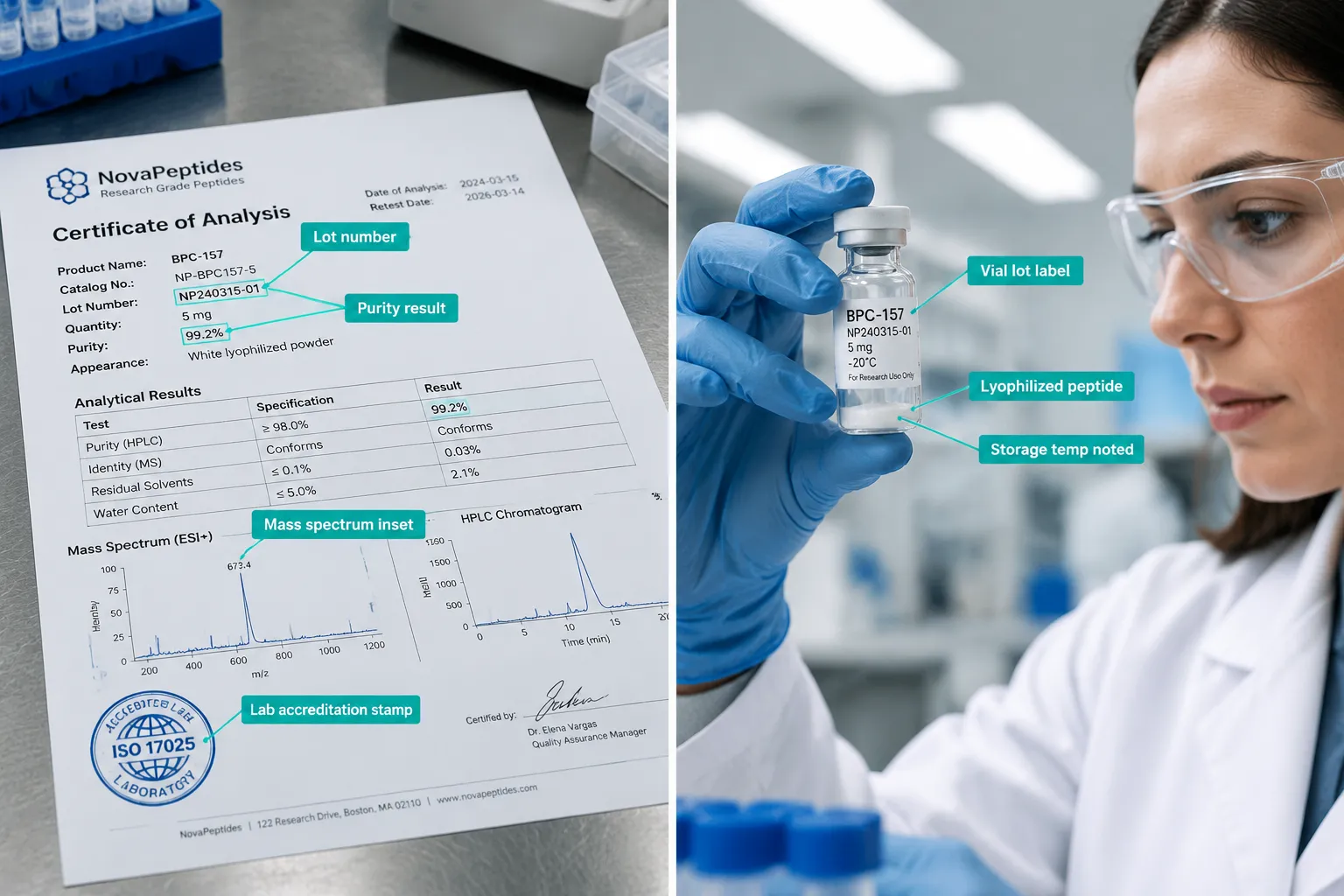
Practical Vendor Evaluation: What to Check Before Ordering

Before placing an order, confirm the following:

  • The COA on the product page carries the same lot number as the vial being shipped.
  • The HPLC chromatogram and mass spectrum are visible on the COA, not just a summary percentage.
  • The testing laboratory is named and independently accredited, not the vendor's own facility.
  • The supplier's "Research Use Only" policy is clearly stated on the site and product pages.
  • Contaminant screening results are included, or the supplier can specify which analytes are tested.

For compounds where purity and identity are especially critical, such as SS31 and epithalon or sermorelin, a seven-parameter independent panel (covering purity, net peptide content, identity, heavy metals, sterility, endotoxin, and adulterant screening) now exists as a documented benchmark in the industry.

Signals that indicate lower documentation standards:

  • COAs available "on request" only, after purchase
  • No laboratory name or accreditation number on the document
  • Purity stated as a single number with no supporting chromatogram
  • No lot number on the vial or product page
  • Identity confirmed by HPLC alone, without mass spectrometry

Conclusion

The question of where to buy research-use peptides is ultimately a question about documentation quality. A vendor-comparison framework built around COAs, identity testing, and batch traceability gives researchers an objective, repeatable method for evaluating any supplier, independent of marketing claims or price.

Actionable next steps:

  1. Download or screenshot the COA from any supplier under consideration before ordering, and verify the lot number matches the product listing.
  2. Confirm the testing laboratory is third-party and independently accredited; search the lab name to verify its existence and scope.
  3. Check that identity is confirmed by mass spectrometry, not HPLC alone.
  4. For high-stakes research, prioritize suppliers with multi-parameter panels and digital batch traceability systems.
  5. Revisit vendor documentation standards with each new order, lot-level quality can vary even within a single supplier.

Applying this framework consistently transforms a purchasing decision into a quality-control step, protecting both research integrity and the reproducibility of results.

Tags: batch traceability, hplc purity testing, identity testing, lc-ms peptide analysis, peptide coa, research peptides, third-party lab testing, where to buy peptides
https://www.puretestedpeptides.com/wp-content/uploads/2026/10/where-to-buy-research-use-peptides-a-vendor-comparison-framework-for-coas-identi.webp 1024 1536 https://www.puretestedpeptides.com/wp-content/uploads/2026/01/buy-peptides-online.jpg 2026-10-16 13:04:152026-10-16 13:04:15Where to Buy Research-Use Peptides: A Vendor-Comparison Framework for COAs, Identity Testing, and Batch Traceability
You might also like
Nasal Spray Peptides: Delivery Methods, Bioavailability, and Research Advantages Nasal Spray Peptides: Delivery Methods, Bioavailability, and Research Advantages
The Fundamental Difference: Peptides vs. Polypeptides in Research and Their Distinct Applications The Fundamental Difference: Peptides vs. Polypeptides in Research and Their Distinct Applications
Epithalon Peptide in Longevity Research: Telomeres, Cellular Aging, and What Labs Measure Epithalon Peptide in Longevity Research: Telomeres, Cellular Aging, and What Labs Measure
Peptides in Modern Research: From Simple Chains to Complex Polypeptide Hormones Peptides in Modern Research: From Simple Chains to Complex Polypeptide Hormones
Peptides 101 for Research-Use Only Buyers: Structure, Mechanisms, and Where GLP-3, MOTS-c, and 5-Amino-1MQ Fit In Peptides 101 for Research-Use Only Buyers: Structure, Mechanisms, and Where GLP-3, MOTS-c, and 5-Amino-1MQ Fit In
Glow Blend Peptide: Examining Its Ingredients and Research Potential for Skin Health and Collagen Synthesis Glow Blend Peptide: Examining Its Ingredients and Research Potential for Skin Health and Collagen Synthesis
What Are Polypeptide Peptides? From Collagen and Hormones to Advanced Research Compounds Like GLP-3 Retatrutide What Are Polypeptide Peptides? From Collagen and Hormones to Advanced Research Compounds Like GLP-3 Retatrutide
Enclomiphene vs Enclomiphene Citrate: How Labs Choose Between Research Formulations and Vendors Enclomiphene vs Enclomiphene Citrate: How Labs Choose Between Research Formulations and Vendors
0 replies

Leave a Reply

Want to join the discussion?
Feel free to contribute!

Leave a Reply Cancel reply

Your email address will not be published. Required fields are marked *

×

Helpful Links

  • My account
  • Cart
  • Checkout
  • Refund and Returns Policy
  • Privacy Policy
  • SMS Privacy Policy
  • Login
  • My Account
  • Logout

USA Made Lab Tested Peptides

All products are sold for research, laboratory, or analytical purposes only, and are not for human consumption


Pure Tested Peptides is a chemical supplier. Pure Tested Peptides is not a compounding / chemical compounding facility as defined under 503A of the Federal Food, Drug, and Cosmetic act. Pure Tested Peptides is not an outsourcing facility as defined under 503B of the Federal Food, Drug, and Cosmetic act.

The statements made within this website have not been evaluated by the US Food and Drug Administration. The products we offer are not intended to diagnose, treat, cure or prevent any disease.

Human/Animal Consumption Prohibited. Laboratory/In-Vitro Experimental Use Only

Link to: Prednisone Versus Retatrutide in Metabolic Models: Designing Controls for Glucose, Appetite, and Inflammation Link to: Prednisone Versus Retatrutide in Metabolic Models: Designing Controls for Glucose, Appetite, and Inflammation Prednisone Versus Retatrutide in Metabolic Models: Designing Controls for Glucose,...Prednisone Versus Retatrutide in Metabolic Models: Designing Controls for Glucose, Appetite, and Inflammation Link to: Trazodone in Appetite and Sleep Experiments: Controlling Sedation When Testing Tesofensine or Retatrutide Link to: Trazodone in Appetite and Sleep Experiments: Controlling Sedation When Testing Tesofensine or Retatrutide Trazodone in Appetite and Sleep Experiments: Controlling Sedation When Testing Tesofensine or RetatrutideTrazodone in Appetite and Sleep Experiments: Controlling Sedation When Testing...
Scroll to top Scroll to top Scroll to top