

Trazodone in Appetite and Sleep Experiments: Controlling Sedation When Testing Tesofensine or Retatrutide
Sedation is one of the most underestimated confounders in metabolic research. When a compound reduces food intake and body weight, investigators need to know whether that effect stems from genuine appetite suppression or from a drug-induced reduction in activity, alertness, and feeding motivation. That distinction becomes especially difficult when trazodone is used as a sleep adjunct alongside potent appetite-modifying agents. This article serves as a confounder guide for studies where sleep, feeding, and body weight are primary endpoints, with a direct focus on trazodone in appetite and sleep experiments: controlling sedation when testing tesofensine or retatrutide.
Key Takeaways
- Trazodone improves objective sleep continuity but carries a meaningful sedation and dizziness burden that can confound activity and feeding endpoints.
- Tesofensine acts through monoamine reuptake inhibition; its CNS stimulant profile may mask or interact with trazodone-induced sedation in unpredictable ways.
- Retatrutide, a triple GLP-1/GIP/glucagon receptor agonist, shows no major sedation signal in phase 2 data, making trazodone co-administration particularly risky as a confounder.
- Experimental designs must separate pharmacologic appetite effects from circadian disruption and sedation-driven reductions in feeding behavior.
- Standardized polysomnography, actigraphy, and validated daytime alertness scales are essential tools for isolating trazodone's contribution to any observed outcome.
Pharmacological Profiles: Why the Combination Creates Complexity
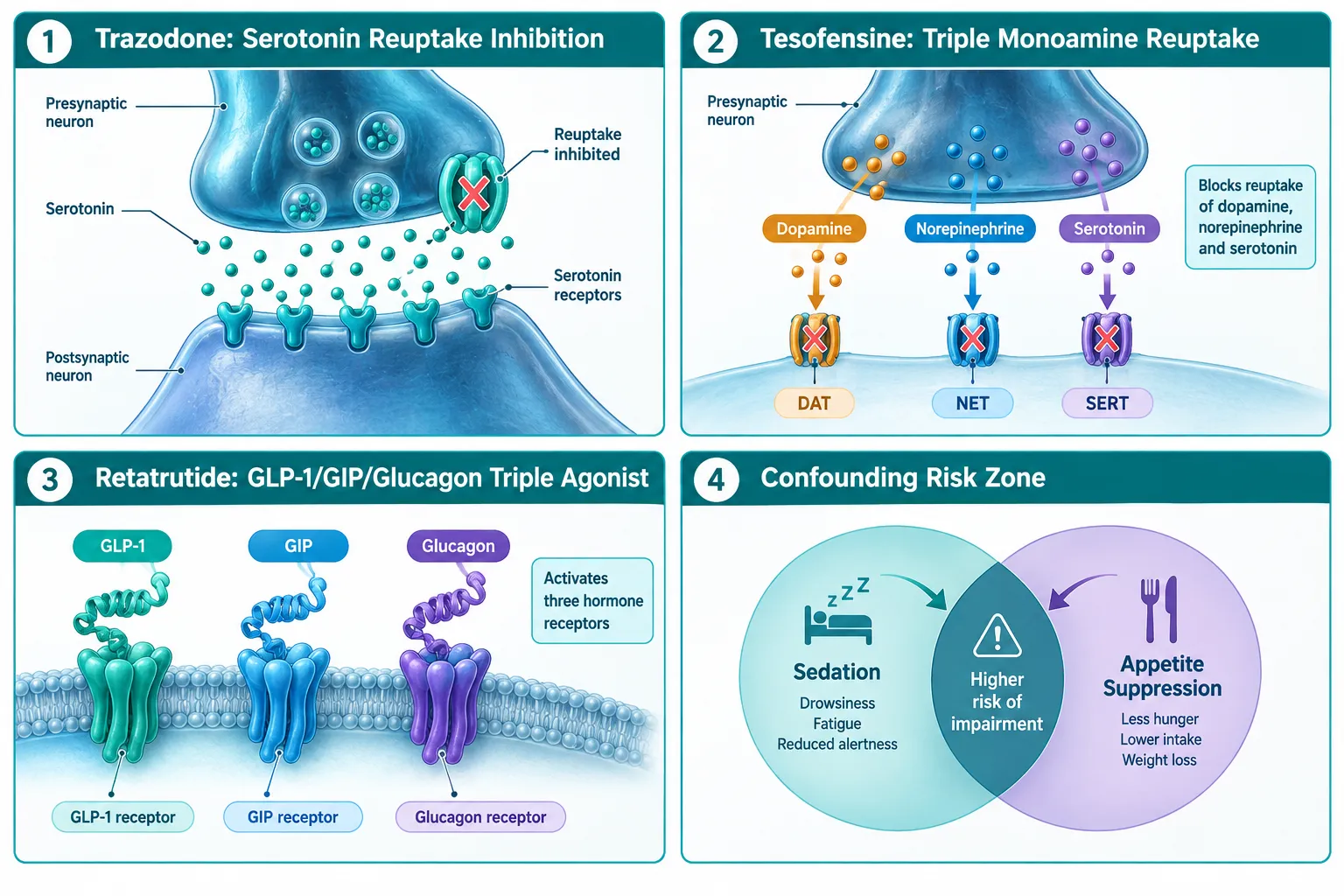
Understanding why trazodone in appetite and sleep experiments creates methodological tension requires a clear picture of each agent's mechanism.
Trazodone is a serotonin antagonist and reuptake inhibitor (SARI). At low doses (50-150 mg), its histamine H1 and alpha-1 adrenergic antagonism produces sedation. At doses approaching 180 mg/day, where aggregated RCT data show the strongest improvements in subjective sleep quality, somnolence, dizziness, and next-day cognitive blunting become clinically significant. Importantly, trazodone alters sleep architecture even when it improves sleep continuity, reducing slow-wave and REM proportions in some polysomnographic analyses.
Tesofensine inhibits the reuptake of serotonin, dopamine, and norepinephrine. This triple monoamine mechanism produces appetite suppression but also increases arousal, heart rate, and locomotor activity. Pairing a stimulant-profile compound with a sedating one creates a pharmacodynamic tug-of-war that is nearly impossible to model cleanly.
Retatrutide is a triple agonist at GLP-1, GIP, and glucagon receptors. Phase 2 obesity trial data show substantial weight loss and GI side effects but no major sedation signal. Ongoing phase 3 TRIUMPH trials do not include standardized sedative adjuncts, which means adding trazodone to a retatrutide study introduces a variable absent from the pivotal evidence base. Researchers interested in the compound's dosing range can review options such as Reta 10mg and Reta 30mg for context on experimental formulations.
Separating Appetite Effects from Sedation: The Core Confounder Problem
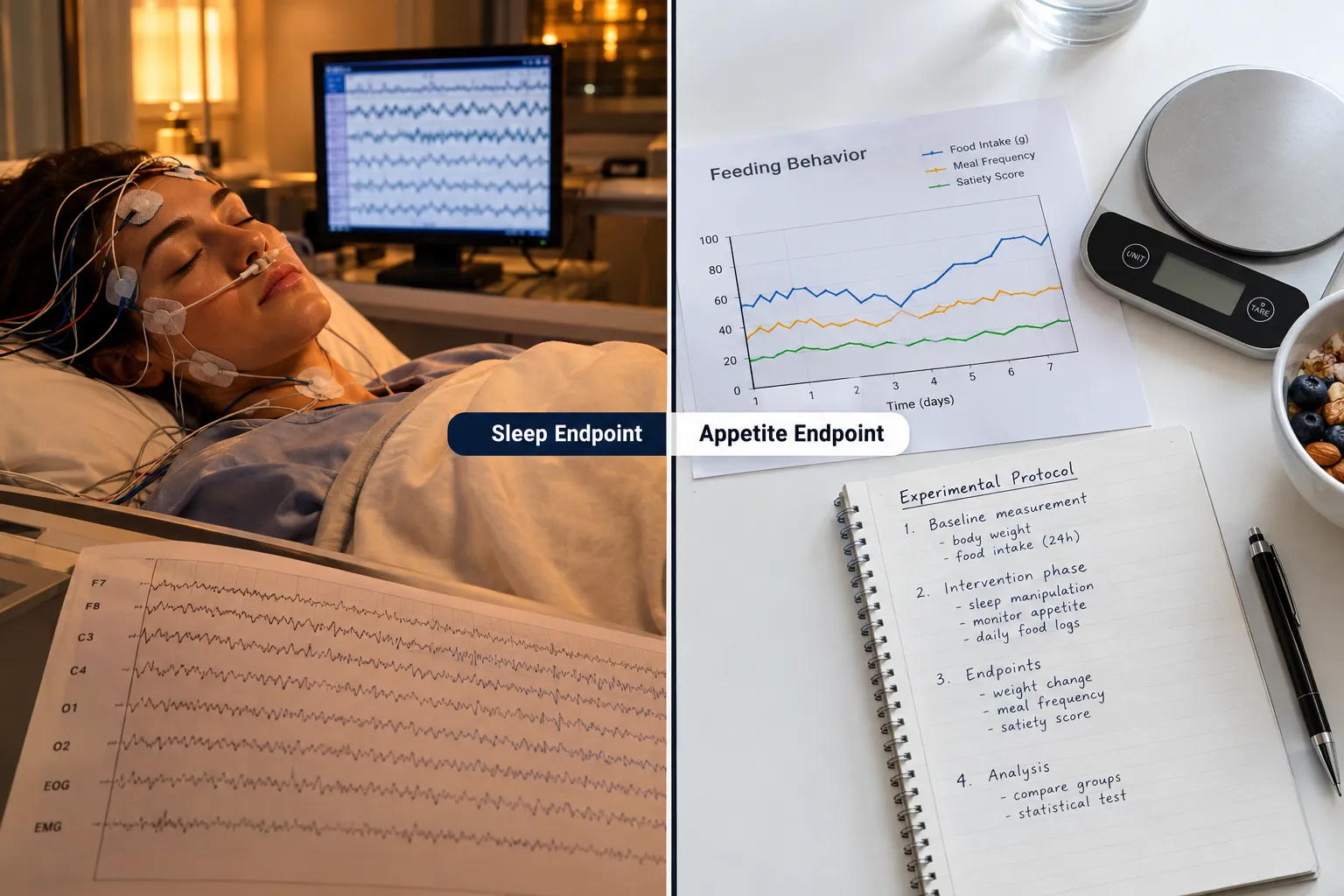
The central challenge in controlling sedation when testing tesofensine or retatrutide is that sedation reduces feeding through at least three independent pathways that have nothing to do with appetite:
| Sedation-Driven Feeding Reduction | Pharmacologic Appetite Suppression |
|---|---|
| Reduced locomotor activity lowers caloric demand | Direct action on hypothalamic hunger circuits |
| Shortened waking window decreases meal opportunities | Delayed gastric emptying reduces hunger signals |
| Cognitive blunting impairs food-seeking motivation | GLP-1 receptor activation modulates reward pathways |
| Circadian phase shift alters meal timing | Monoamine reuptake inhibition reduces hedonic eating |
When trazodone is present, any reduction in food intake could reflect sedation-driven behavioral suppression rather than the test compound's pharmacologic action. This is not a theoretical concern. A head-to-head comparison of trazodone against zolpidem found trazodone to be less potent as a hypnotic yet more broadly sedating at standard doses, suggesting its sedation profile extends well beyond the sleep window.
Circadian disruption adds another layer. Trazodone shifts sleep architecture and may alter the timing of cortisol, ghrelin, and leptin secretion, all of which directly regulate appetite. An experiment that records feeding behavior without accounting for these hormonal shifts will misattribute circadian-driven appetite changes to the test compound.
For studies using retatrutide, which researchers can explore in formulations such as GLP3 Reta 20mg GSF or the Buy GLP-3 Peptide GLP3 Reta 10mg 99% Pure Third Party Tested option, the absence of a sedation signal in existing data makes any trazodone-induced sedation especially visible as a confound.
Designing Around the Confounder: A Practical Protocol Framework
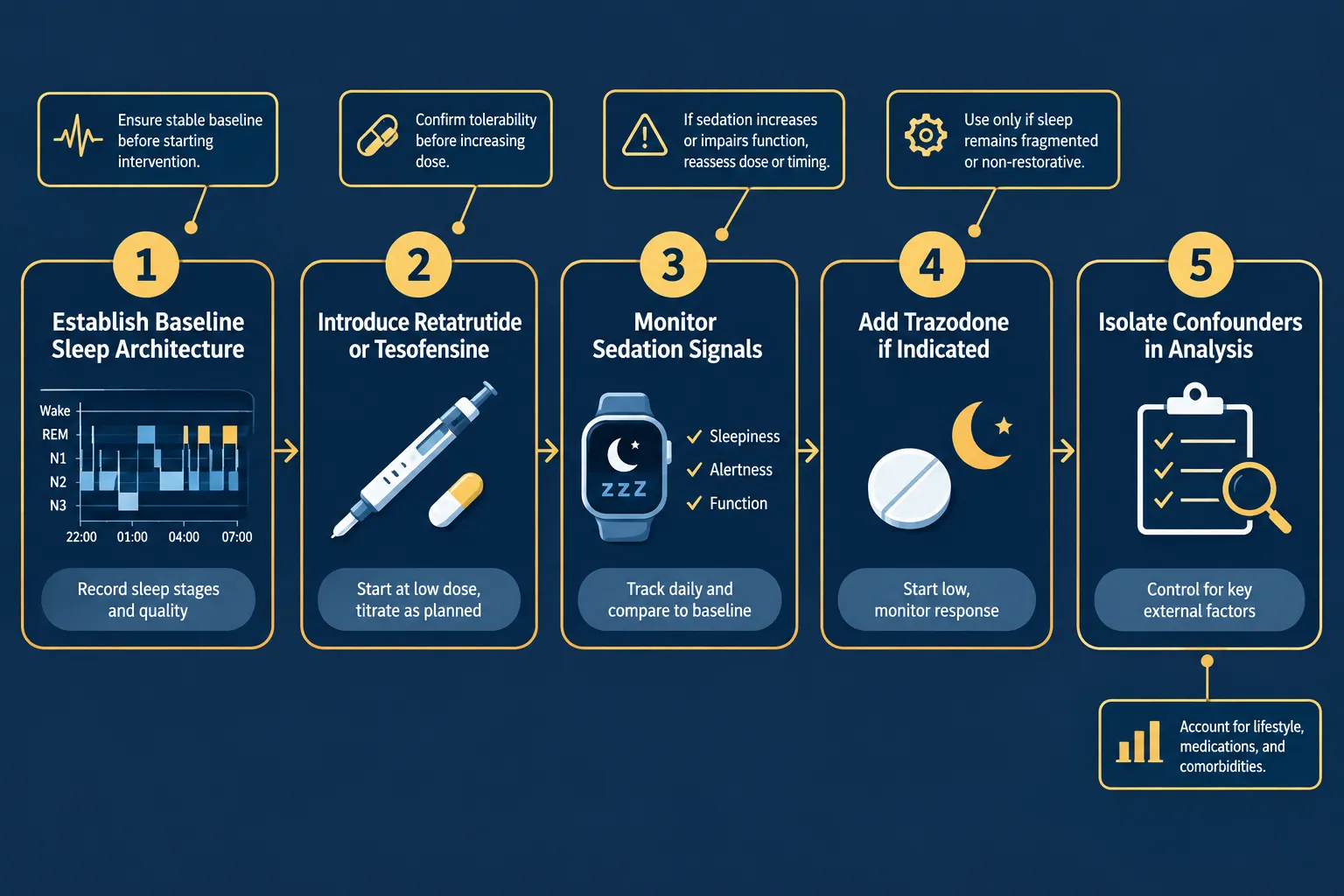
Applying trazodone in appetite and sleep experiments: controlling sedation when testing tesofensine or retatrutide responsibly requires a structured approach to experimental design. The following framework addresses the most common methodological gaps.
Establish a Trazodone-Only Baseline Period
Before introducing the test compound, run a washout and then a trazodone-alone phase of at least two weeks. Collect polysomnography, actigraphy, daytime alertness scores (Epworth Sleepiness Scale), and 24-hour food intake diaries. This baseline isolates trazodone's independent contribution to sedation and feeding behavior.
Use Objective Sleep Architecture Monitoring
Subjective sleep quality ratings are insufficient. Full polysomnography or validated wrist actigraphy must be used to document changes in sleep efficiency, wake-after-sleep-onset, and REM latency. A 2026 polysomnographic meta-analysis confirmed that trazodone improves objective sleep continuity but alters architecture, a finding that demands continuous monitoring rather than endpoint-only assessment.
Separate Daytime Alertness from Nighttime Sleep Metrics
Collect alertness data at fixed intervals during the active phase using validated tools such as the Psychomotor Vigilance Task (PVT) and the Karolinska Sleepiness Scale. This separates residual sedation from genuine improvements in sleep quality and prevents daytime hypoactivity from being recorded as reduced appetite.
Pre-register Sedation as a Competing Endpoint
Any protocol testing retatrutide or tesofensine alongside trazodone should pre-register sedation-related outcomes, somnolence, dizziness, activity counts, as competing endpoints. This forces statistical models to account for sedation's independent contribution to weight and feeding outcomes. Researchers sourcing retatrutide for such studies may find the Buy Reta and Buy GLP-3 Reta resources useful for procurement context.
Consider Non-Sedating Sleep Alternatives
Where sleep stabilization is needed but sedation confounding is unacceptable, low-dose melatonin or cognitive behavioral therapy for insomnia (CBT-I) protocols offer sleep support with minimal pharmacodynamic interference. These alternatives do not carry trazodone's alpha-1 and H1 antagonism burden.
Conclusion
The intersection of trazodone and novel metabolic agents like tesofensine or retatrutide is a genuine methodological minefield. Trazodone's sedation profile, well-documented across meta-analyses and head-to-head trials, can suppress activity, shift circadian hormone timing, and reduce meal frequency through mechanisms entirely independent of the test compound's appetite pharmacology. For studies where sleep, feeding, and body weight are primary endpoints, this is not a minor nuisance; it is a threat to internal validity.
Actionable next steps for researchers:
- Implement a trazodone-only baseline phase before introducing the test compound.
- Use polysomnography and actigraphy rather than self-report alone.
- Pre-register sedation as a competing endpoint in every protocol.
- Evaluate whether a non-sedating sleep intervention can replace trazodone without compromising sleep quality goals.
- Review the existing phase 3 TRIUMPH trial design for retatrutide to align sedation monitoring approaches with the emerging gold standard.
Separating pharmacologic appetite suppression from sedation-driven behavioral changes is not optional in high-quality metabolic research. It is the difference between a publishable finding and a confounded dataset.


Leave a Reply
Want to join the discussion?Feel free to contribute!